(ENG) Beyond the Neon: 5 Hidden Histories That Reveal the Soul of Osaka
Fukushima is, in truth, a keeper of the city’s deeper soul—an "Island of Fortune" whose true wealth is measured not in yen, but in the resonant histories waiting just beneath its surface.
福島天滿宮 Fukushima-temmangu > 花くじら 歩店 Hanakujira - Oden restaurant
Listen attentively to the historical stories told in detail
The Search for Osaka's Quiet Heart
To the world, Osaka announces itself in a torrent of light and flavor. We think of the kinetic energy of Dotonbori, the towering commercial fortresses of Umeda, and a culinary scene so boisterous it has defined the city’s identity. But behind this dazzling facade, a quieter, more profound Osaka exists. What stories lie dormant in the streets just beyond the glow of the neon, far from the clamor of the central tourist hubs? The answer, for the thoughtful traveler, can be found in Fukushima Ward. Often dismissed as a convenient commuter link or simply another district for food lovers, Fukushima is, in truth, a keeper of the city’s deeper soul—an "Island of Fortune" whose true wealth is measured not in yen, but in the resonant histories waiting just beneath its surface.
The Saint's Blessing: Where Fortune Survived the Flames
The name of a place is its founding myth, a narrative lens that can focus its entire history. The name "Fukushima" is no mere label; it is a declaration of resilience, a blessing spoken into existence over a thousand years ago. To understand this district is to first grasp the power of this fortune, a legacy tested by fire and time, yet proven miraculously unbroken.
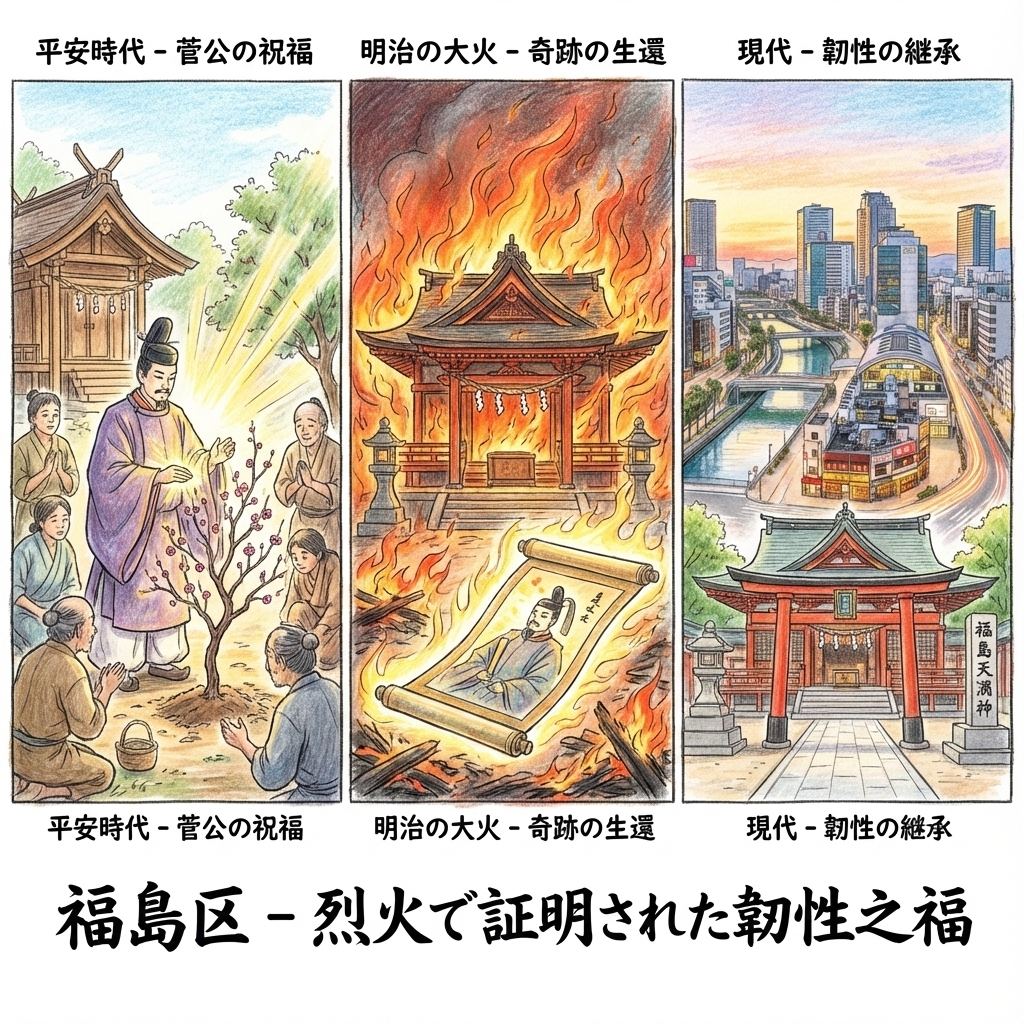
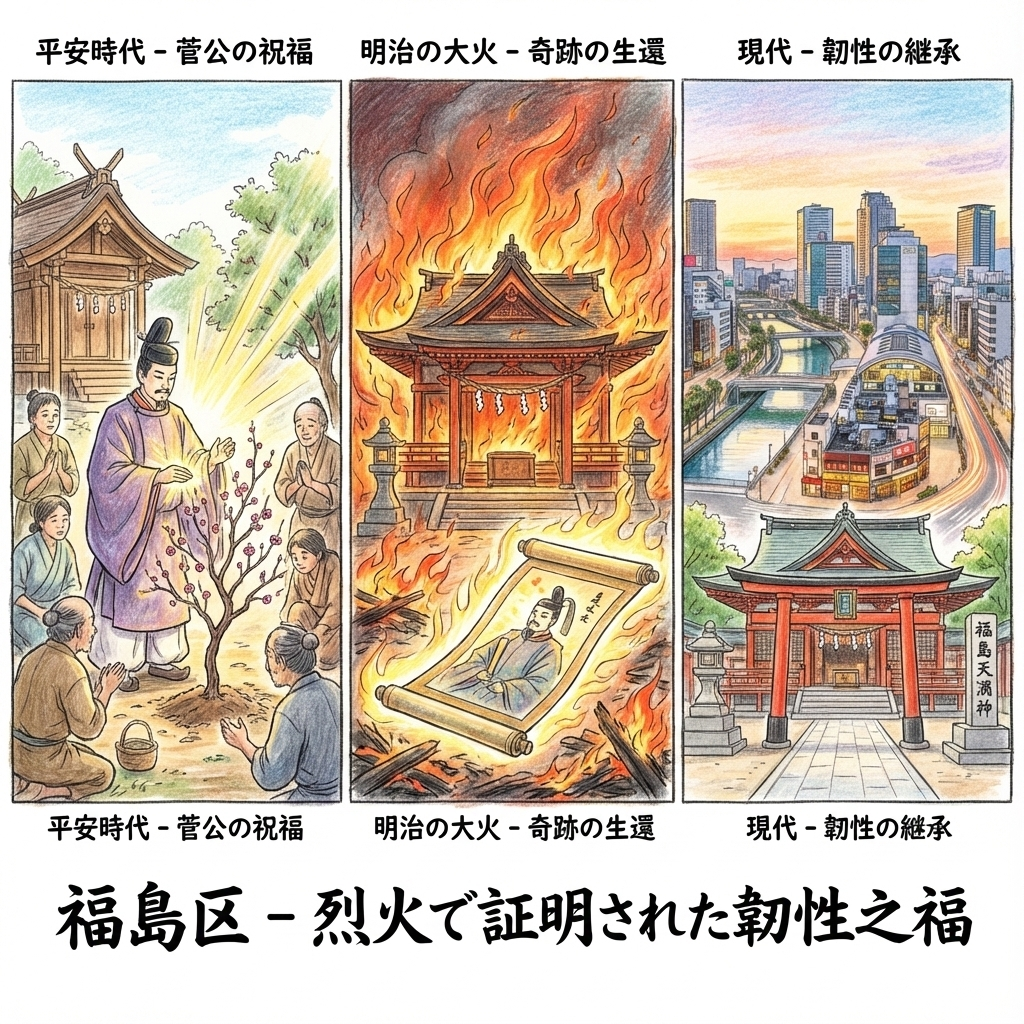
In the early 10th century, the great scholar-saint Sugawara no Michizane paused on this land during his sorrowful journey into exile. As he awaited favorable winds to carry his ship into Osaka Bay, local villagers offered him sincere hospitality. Moved by their kindness, he bestowed upon them a gift more lasting than any coin: a name for their home. He called it Fukushima (福島), the "Island of Fortune." To commemorate his stay, he left behind poems, a self-portrait, and planted sacred plum and pine trees, around which the grateful villagers would later build a shrine in his honor.
The power of this blessing was dramatically validated centuries later. During the devastating "Great Kita Fire" of the Meiji era, the shrine was engulfed in flames. While the main hall was severely damaged, its most sacred artifact—the very self-portrait Michizane had gifted—was discovered miraculously unharmed. This was seen not as coincidence, but as proof of the protective fortune woven into the district’s identity. That spirit of endurance continued into the modern age, when the shrine absorbed and gave sanctuary to other local faiths, like the Naka no Tenjin Ato, whose own altars had been damaged during the war.
- Hidden Gem: The Fukushima Tenmangu Shrine stands today as the quiet heart of this narrative. As the 12th stop on the official Sugawara no Michizane pilgrimage, it is an opportunity to connect with a powerful story of resilience, to seek a blessing for one’s own endeavors, and to feel how a community’s faith, when tested, can consolidate and endure.
This divine blessing sanctified the ground, but it was the tangible force of flowing water that would carve the district's commercial destiny.
The River's Veins: How Water Forged a Modern Hub
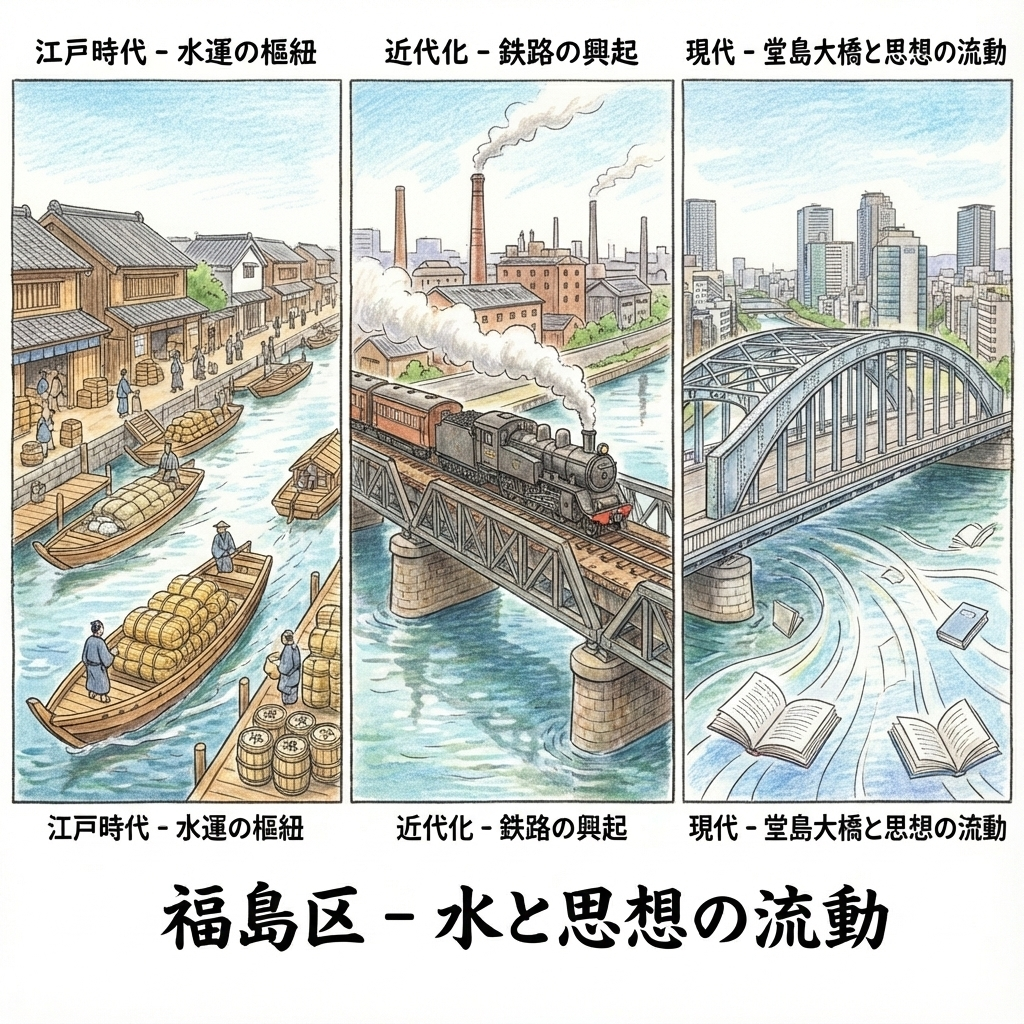
Fukushima's modern convenience is no accident of city planning; it is a direct inheritance of a geographic logic established by water. To understand why a train arrives here so efficiently today, one must first understand how rice barges navigated these same currents centuries ago. Osaka’s destiny has always been written in water, and Fukushima was born of its lifeblood.
Formed from the rich silt deposited by the old Yodo River, the land of Fukushima was naturally positioned as a vital node in the vast water transport network of the Edo period. As canals connected Osaka to Kyoto and the port of Fushimi, Fukushima became a crucial hub where rice, sake, and countless other goods flowed, fueling the nation’s economy. The district's modern role as a nexus of movement is not a new invention but a direct legacy of this history.
This foundational logic transitioned seamlessly into the modern era. When railways supplanted waterways, Fukushima’s role as a hub was simply recast in steel. The geographical convergence that once drew barges is the same force that now pulls train lines toward JR Fukushima Station, making it a paragon of connectivity. The ancient current powers the modern pulse.
- Hidden Gem: The Dojima Bridge is a monument to this legacy. Opened in 1927, it is an elegant steel arch bridge where the roadbed hangs suspended beneath the graceful curve of its structure, a masterpiece by the celebrated designer Hori Takeo. To walk along the riverbank at dusk, watching the bridge’s lights reflect on the water, is to witness the city's modern form paying homage to its foundational waterways and to understand that Fukushima’s convenience is an echo of a history carved by the river.
Just as the rivers carried goods and people, the district also became a channel for the unstoppable flow of new ideas that would shape modern Japan.
The Scholar's Shadow: Where New Ideas Found a Home
A neighborhood's character is often defined by the intellectual currents that flow through it. While Fukushima was not the epicenter of Japan’s frantic push toward modernization, it acted as a vital receptive ground—a place where the radical new ideas of the Meiji era met the practical worlds of commerce and daily life.
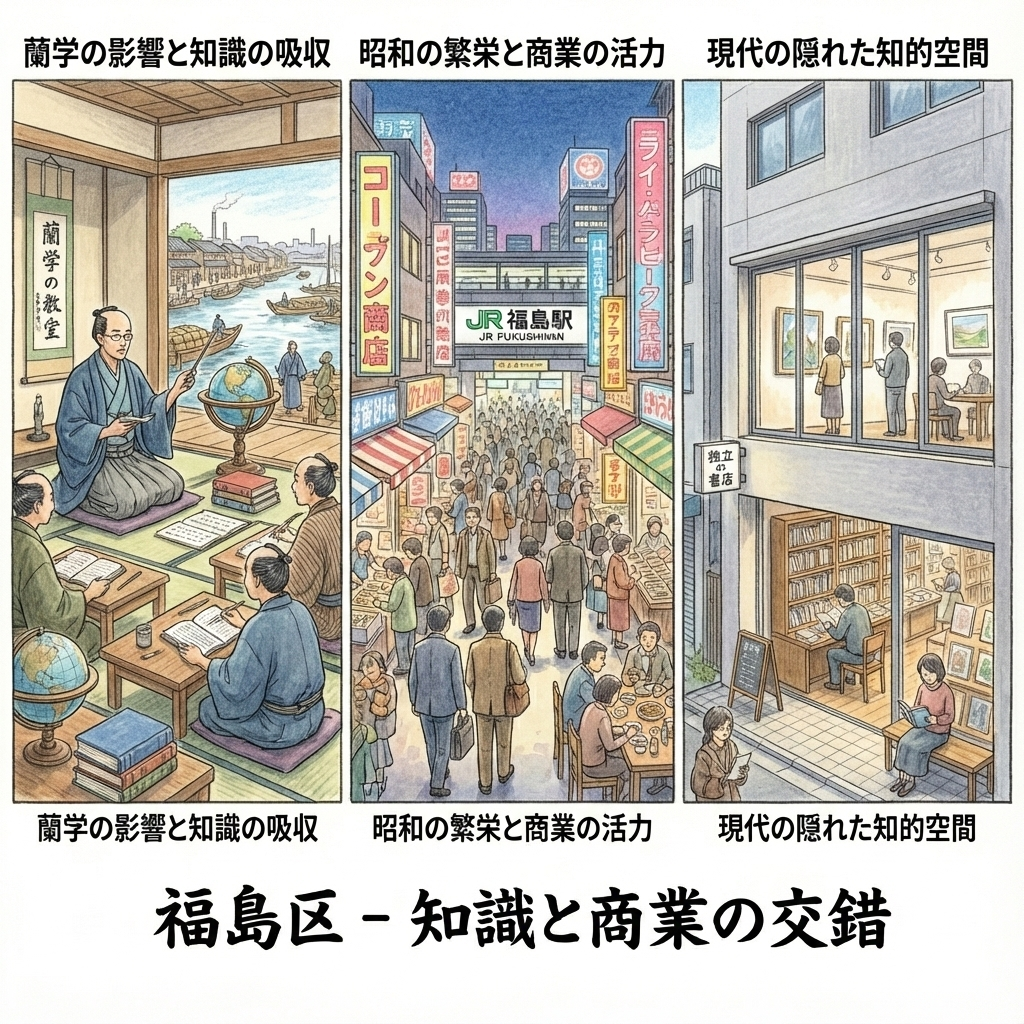
The nearby Tekijuku academy, founded by the visionary physician Ogata Koan, was a crucible for "Dutch Learning" (蘭学), producing some of the nation’s greatest modernizers, including the celebrated educator Fukuzawa Yukichi. As these new ways of thinking spread, Fukushima, with its growing transportation links, became an attractive district for the forward-thinking merchants, intellectuals, and entrepreneurs who were building a new Japan. Here, a unique fusion of commercial ambition and cultural curiosity took root.
This legacy of intellectual openness fueled a prosperous commercial boom that peaked from the Showa 40s to 60s (1965-1985), cementing the district’s reputation as a place where knowledge and business intersect. That spirit lives on today, attracting a thoughtful commerce that values substance and innovation over fleeting trends.
- Hidden Gem: The JR Fukushima Station shopping street and its surrounding cultural spaces are the modern embodiment of this heritage. The historical influx of discerning merchants and intellectuals created a demand for quality that persists. To feel the scholar's shadow, look beyond the chain restaurants. Explore an independent bookstore or a small creative shop on a side street. In these quiet spaces, you can find the lingering spirit of an era when new ideas were the most valuable currency, fueling the progress that continues to define this dynamic urban landscape.
The enduring impact of these ideas stands in stark contrast to the fleeting footprint left by those who sought to command the district through force.
The Warlord's Footprint: Echoes of Power in the Commoner's Realm
The memory of a place is defined as much by what it forgets as by what it enshrines. While other parts of Japan are dominated by the castles of samurai lords, Fukushima’s history tells a different story: one where the grand dramas of warlords were a passing show, and the quiet life of the common person proved the more enduring force.
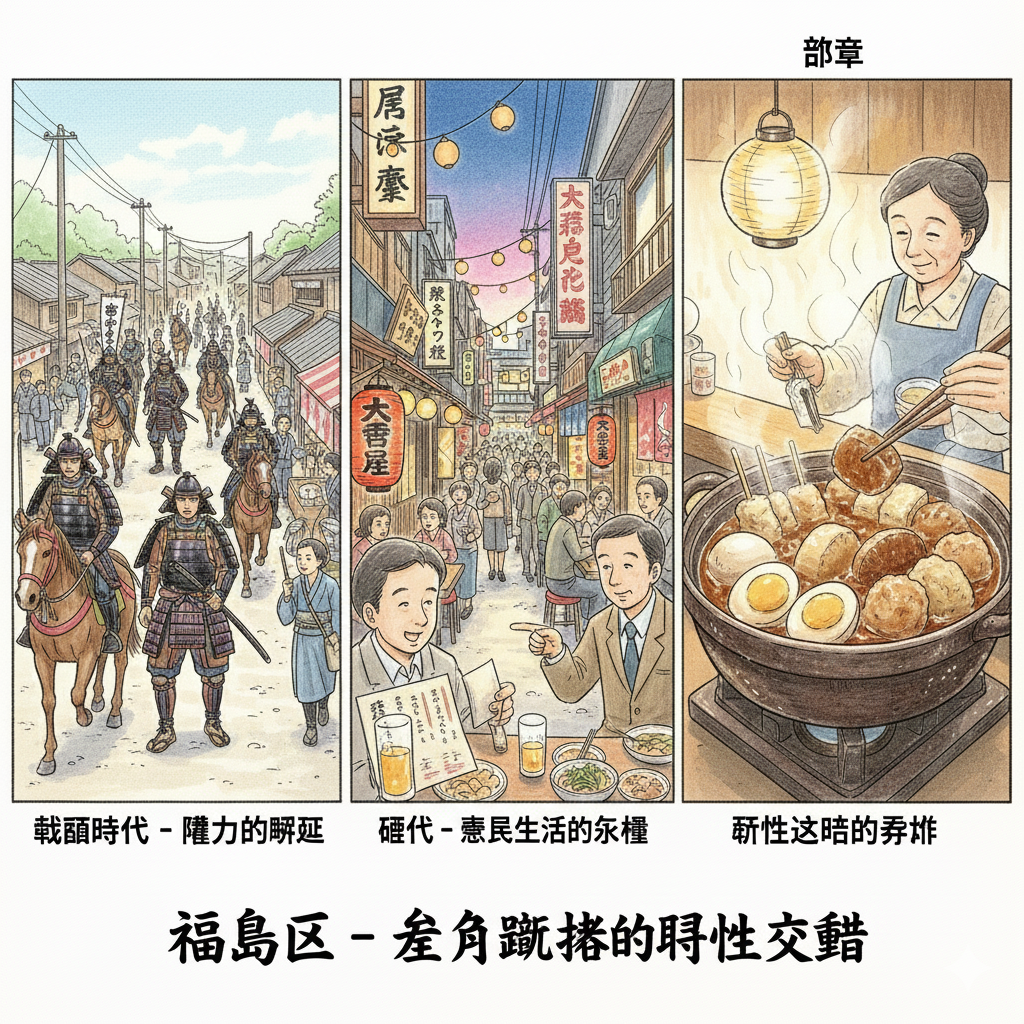
Over the centuries, great figures marched through. The legendary warrior Minamoto no Yoshitsune passed by in the 12th century. During the turbulent Sengoku (Warring States) period, powerful figures like Ashikaga Yoshiakira and clans such as the Miyoshi briefly used the area for its strategic position. Yet, no great fortress was ever built here, no permanent seat of power established. The ambitions of warlords were transient, their footprints washed away by time.
Herein lies the district's most powerful narrative: while the samurai and their conflicts have vanished, the humble, essential work of providing food, drink, and lodging has remained its unshakable foundation. This is the culture of the shomin (庶民)—the common people, the everyday merchants and artisans whose lives formed the true, unbreakable heart of the city.
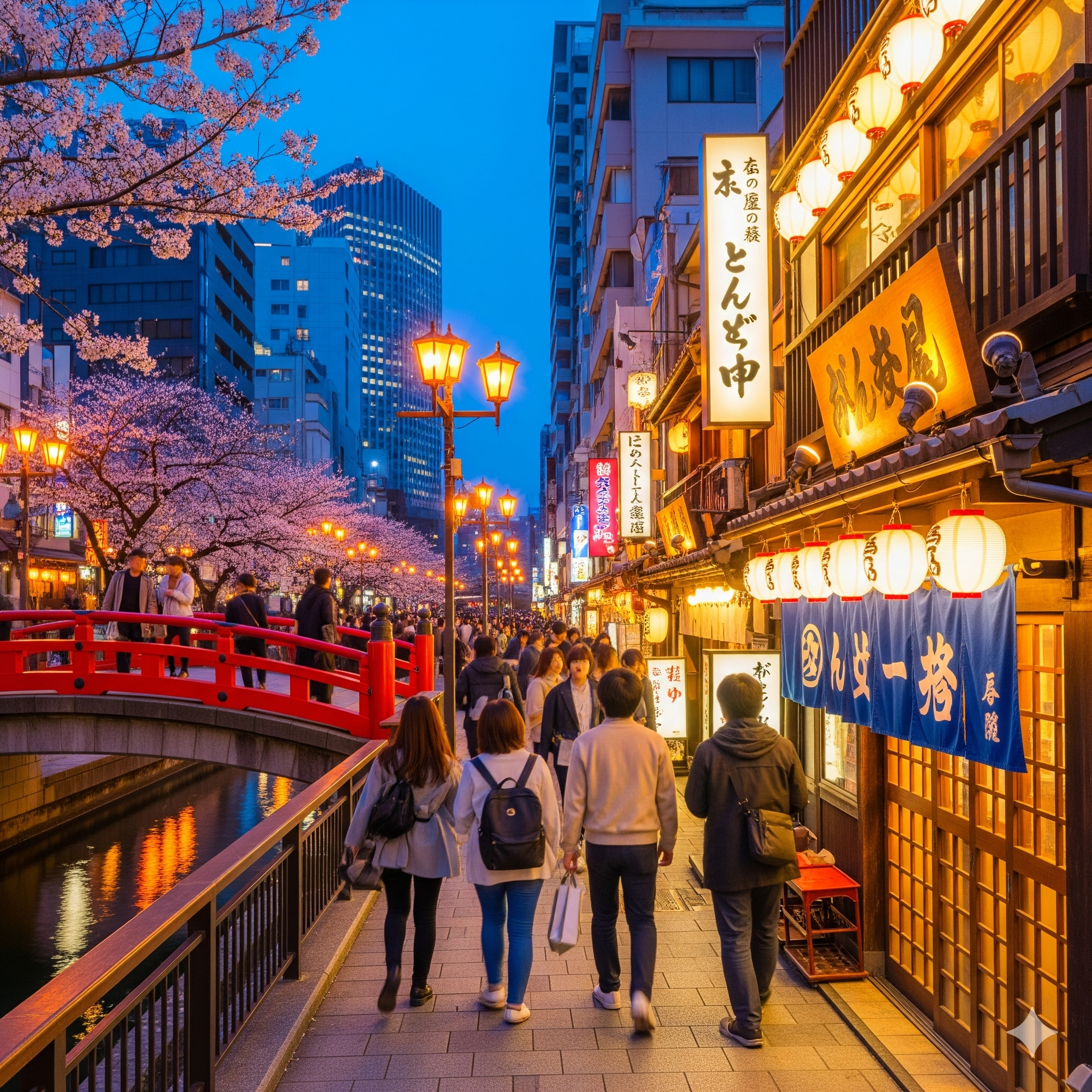
- Hidden Gem: Fukushima’s vibrant izakaya alleys and shomin dining districts are living museums of this profound resilience. Step inside one and listen for the rhythmic clatter of plates and the easy laughter between strangers—this is the sound of a community whose strength has outlasted every shogun's decree. These establishments are not just places to eat; they are a testament to the quiet, enduring power of ordinary life.
This deep-rooted spirit of the common person finds its most celebrated expression in the district’s unwavering commitment to authentic culinary craft.
The Chef's Vow: Finding Authenticity in a Bowl of Oden
In an age of globalized travel, the search for "authenticity" has become the modern pilgrim’s quest. Fukushima offers a sanctuary for this pursuit. It stands as a quiet rebuke to the highly commercialized food scenes that dominate other parts of Osaka. This is not where you find novelty for novelty’s sake; this is where you find the city’s true, unpretentious culinary soul.
Fukushima’s food culture is rooted in the gritty resilience of the post-war revival, refined through decades of serving the daily needs of local people. Its renown comes not from flash and marketing, but from an unwavering dedication to craft. It is a place that proves true value lies in consistency, quality, and an honest connection between the maker and the community they serve.
In a world that shouts, Fukushima's flavor is a confident whisper. It proves that the most memorable experiences are not manufactured for visitors, but are simply discovered in the steady, quiet rhythm of daily life.
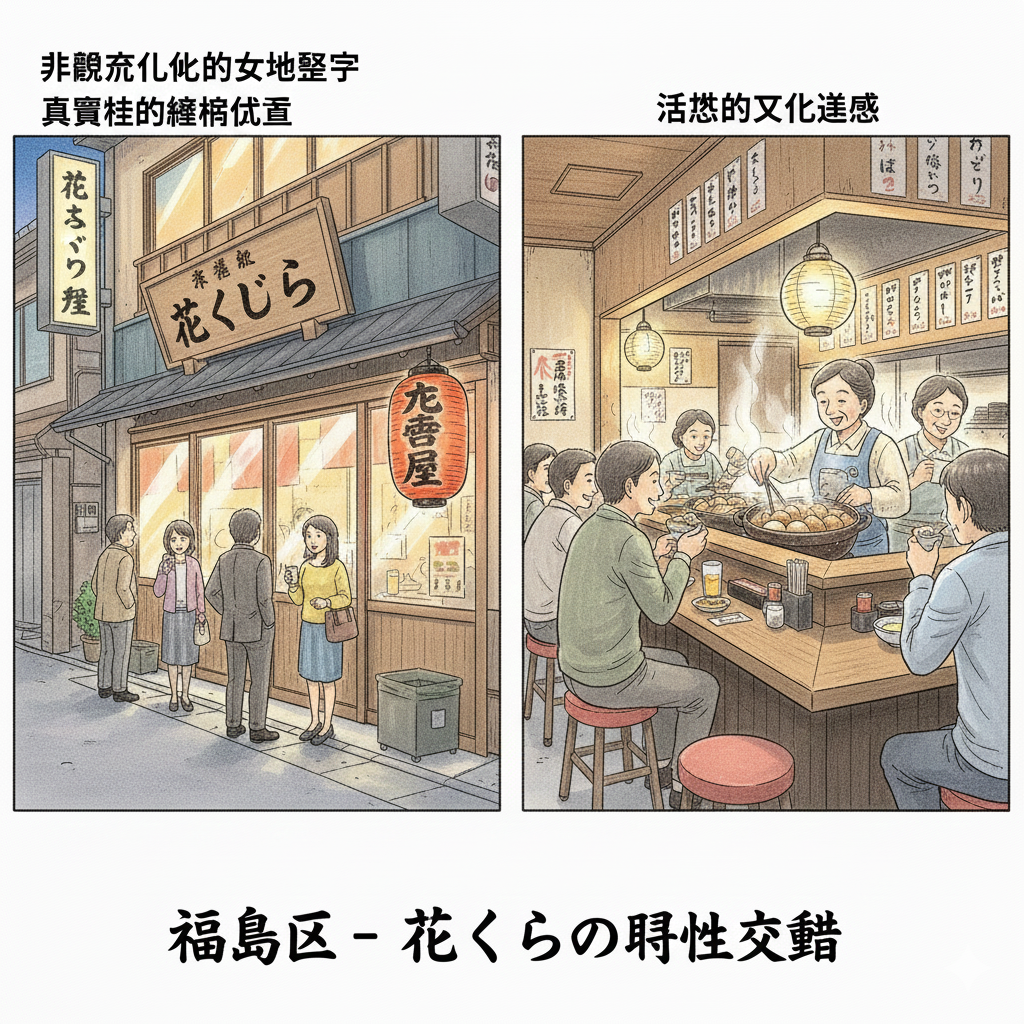
- Hidden Gem: The ultimate expression of this ethos is Hanakujira Ayumiten, a Michelin-recommended oden restaurant. Tucked away near the station, this humble establishment has earned international acclaim for perfecting one of Japan’s most beloved home-style dishes. To sit at its counter before the large, gently simmering copper pot, shoulder-to-shoulder with local regulars, is to do more than eat a meal. It is an act of participation in the living heritage of Osaka’s shomin spirit, a taste of an authenticity so pure it needs no advertisement.
The Fortune You Find for Yourself
The story of Fukushima is the story of Osaka in miniature, distilled to its most essential elements. Its true "fortune" is not a single, buried treasure but a rich tapestry woven from centuries of resilience against fire, a quiet reverence for intellect, and, above all, the life-affirming spirit of its common people. It reveals that the soul of a great city is rarely found in its famous monuments, but in the steady, unassuming heartbeat of the neighborhoods that sustain it. As you continue your own journeys, it leaves you with a vital question: What stories are waiting in the quiet streets just beyond the spotlight, and what might they teach us about the true soul of a city?