(ENG) The Islands of Resilience: Walking Through the Layered History of Osaka’s Nishiyodogawa
Trace Nishiyodogawa's evolution from the ancient "80 Islands" and wartime industrial centers to a modern green sanctuary through a deep urbanist walking guide.

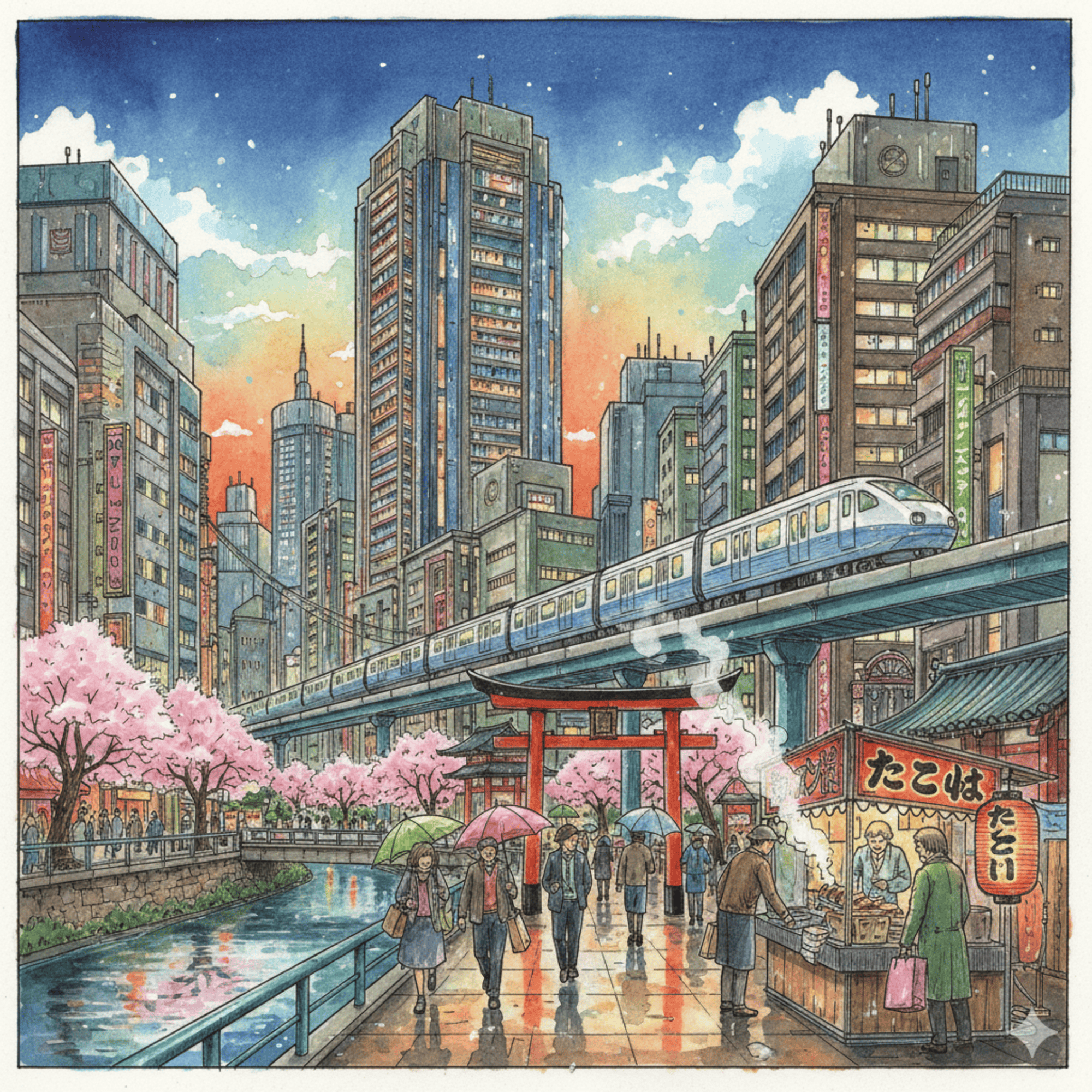
How can a heavily polluted hell where "birds also fall" be transformed into a green community?
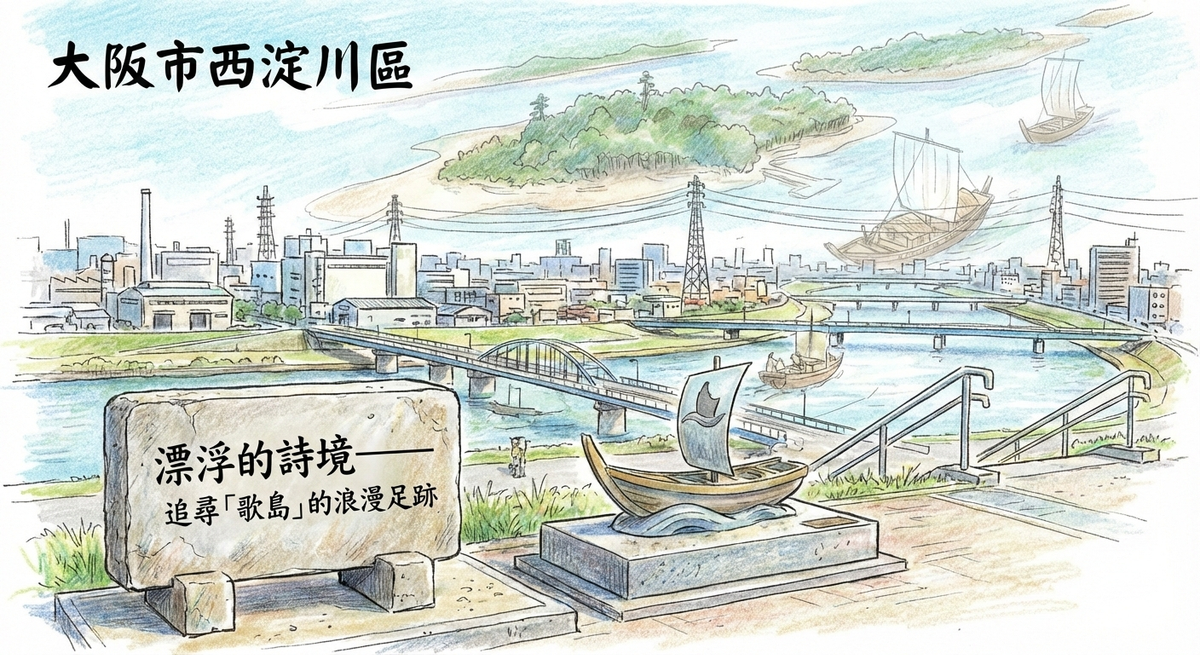
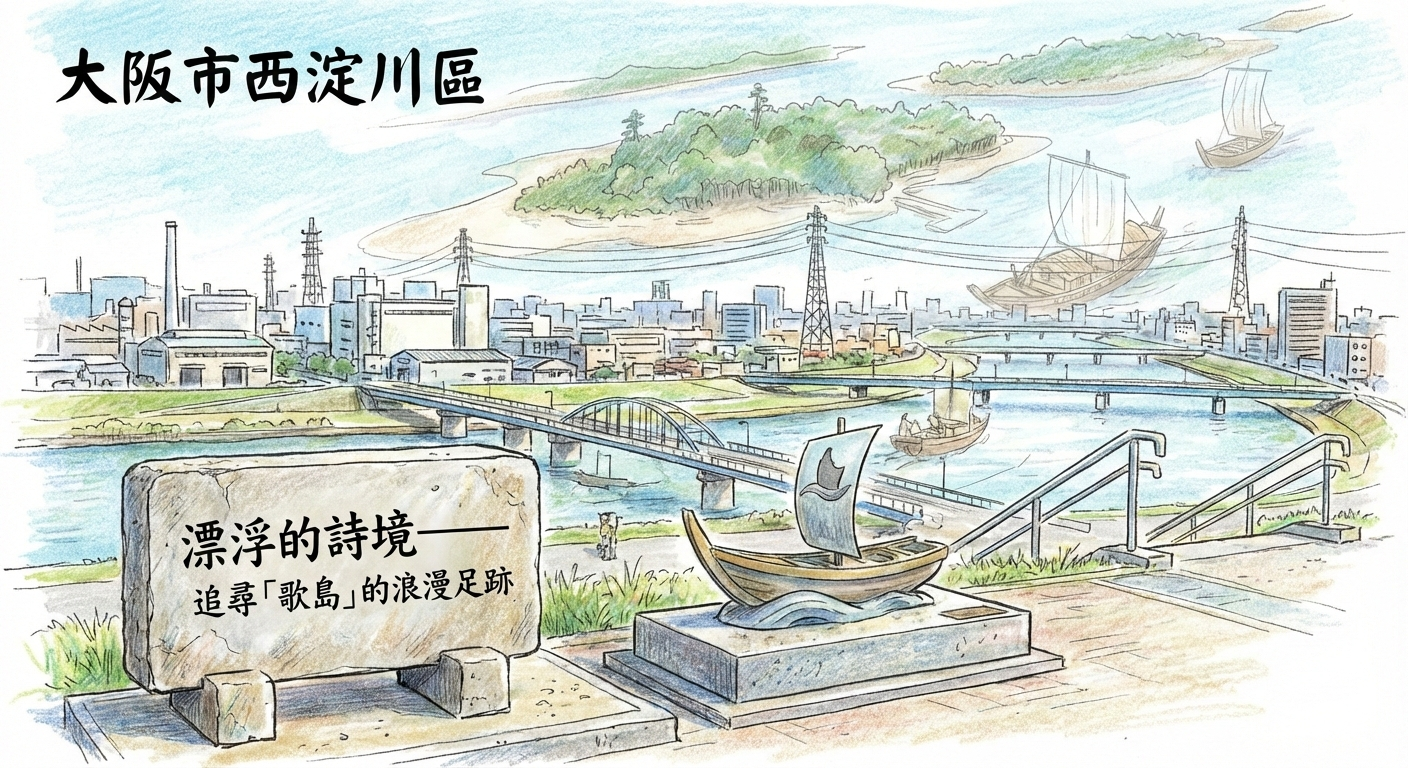
What are the interesting contrasts between the ancient poetry and the modern industrial landscape of "Namba Yaju Islands"?
What does the stone lantern of Himejima Shrine protect?
The Paradox of the Water’s Edge
To the casual observer, Nishiyodogawa Ward appears as a quintessential landscape of modern Osaka—a dense grid of industrial facilities, transit corridors, and post-war residential blocks. Yet, this territory is a geographical paradox. Long before it was an industrial epicenter, it was a poetic archipelago known as the Naniwa Yasojima (the Eighty Islands), where silt from the Yodogawa and Yamato rivers formed a shifting, water-bound world. Over the last century, it transitioned from these romantic marshlands to a "mist hell" of heavy industry, only to emerge today as a global model of environmental recovery and civic tenacity.
For the intellectually curious traveler, Nishiyodogawa offers a narrative far more profound than the neon-lit spectacle of Dotonbori. It is a place where the "true" Osaka is revealed not in grand monuments, but in the urban texture of survival and the slow reclamation of the green. To understand this ward is to look beneath the modern pavement and decipher the echoes of the "lost islands" that still define its soul.
Listen to the historical stories told in detail (For subscribers only)
The Ghostly Archipelago: Deciphering the "Eighty Islands"
The history of Nishiyodogawa is written in its nomenclature. In antiquity, the region was a collection of sandbars and deltas at the mouth of the major rivers of the Kinki region. This "Naniwa Yasojima" was of immense strategic and cultural importance, serving as a leisure retreat for the aristocrats of Kyoto and Naniwa, who left behind poetic monuments celebrating the water's edge.
Linguistic Fossils
The geography of this vanished landscape is preserved through linguistic fossils. The modern neighborhood names—Utajima, Mitejima, Himejima, Nakajima, and Nishijima—all carry the suffix -shima or -jima, meaning "island." These names act as anchors for an ancient history, marking the high points of a topography that has since been filled and leveled. Mitejima (御幣島), in particular, refers to the "sacred strips of paper" used in Shinto purification, signaling the spiritual weight these sandbars once held.
The Archaeological Walk
A journey through this history begins at Mitejima Station. Travelers should not look for ancient ruins, but for the "archaeological" markers of the modern era—public art and commemorative plaques installed by the community to honor these lost sandbars. Your task is to look for the naming plaques that designate where one vanished island ended and another began. Walking between these sites allows one to imaginatively reconstruct the ancient shoreline, transforming a standard city street into a historical palimpsest. This transition from the abstract beauty of ancient names leads naturally to the physical necessity of spiritual protection in a land defined by water.
Faith Against the Flood: The Resilience of Himejima Shrine
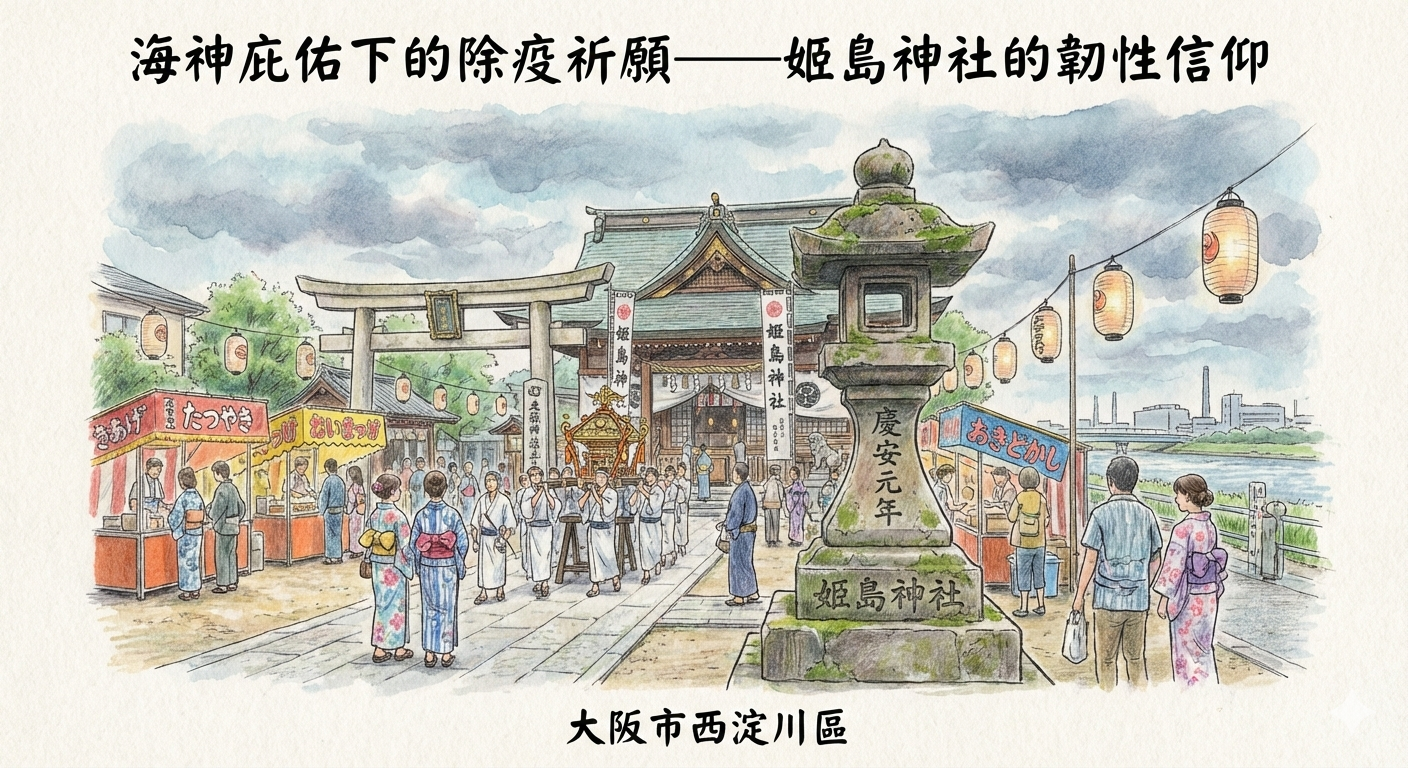
Because of its low-lying position, Nishiyodogawa has historically been vulnerable to the twin threats of river flooding and seawater incursion. Before the advent of modern tidal embankments and the Yodogawa flood bypass, the residents relied on a spiritual defense system rooted in "Sumiyoshi" ocean-deity worship.
Rituals as Community Defense
The development of local shrines was not merely a matter of piety but an essential community mechanism for resilience. Himejima Shrine, dedicated to the deity Akahime-no-mikoto, serves as the epicenter of this faith. Rituals like the Summer Festival (Natsu-matsuri) were established to protect the populace during the months when floods and plagues were most frequent. These ceremonies were the collective heartbeat of a people living at the mercy of the tides.
"The presence of stone lanterns dated to 1648 within the shrine grounds serves as enduring evidence of a community that has sought protection and demonstrated resilience against the elements for nearly four centuries."
This spiritual defense provided the psychological foundation for the community, allowing them to endure until the physical landscape was irrevocably altered by the industrialization of the 19th and 20th centuries.
From Black Smoke to Green Shade: The Oonogawa Epic
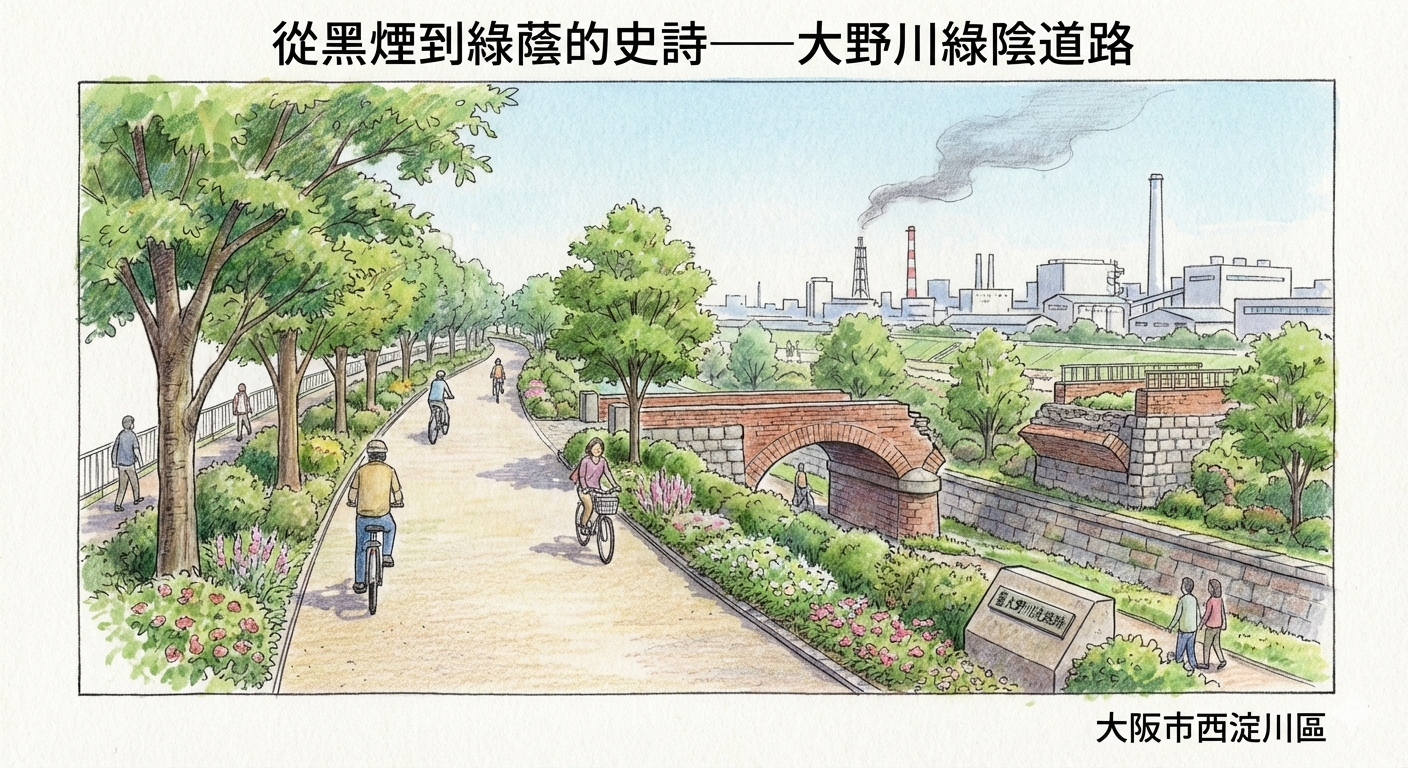
The 20th century brought a different kind of trial to Nishiyodogawa. As the ward became a hub for steel and chemicals, its "Eighty Islands" were replaced by an industrial forest. By the 1960s, the region was trapped in an ecological "mist hell" so severe that residents recall birds falling from the sky and drivers being forced to use headlights at midday to pierce the smog.
A Victory Monument for Activism
The current Oonogawa Ryokuin Road represents a profound environmental epic. This 3.8-kilometer green corridor was won through the persistent activism of pollution victims who demanded the right to breathe and established democratic medical care. What was once the heavily polluted Oonogawa and Nakajima canals has been transformed into a lush, signal-free path—a rare urban luxury where pedestrians move uninterrupted by the city's mechanical pulse.
Spatial Observation
Walking this road today, one experiences a unique spatial continuity. The path retains the original bridge structures; as you walk over what are now sunken streets, you are traversing the exact elevation where toxic water once flowed. The absence of traffic signals creates a meditative flow, a "green victory" that acts as a living monument to the ward’s ability to reconcile its industrial trauma with a sustainable future. This environmental recovery, however, was preceded by an even more violent disruption.
The Duality of Trauma: War and Rapid Reconstruction
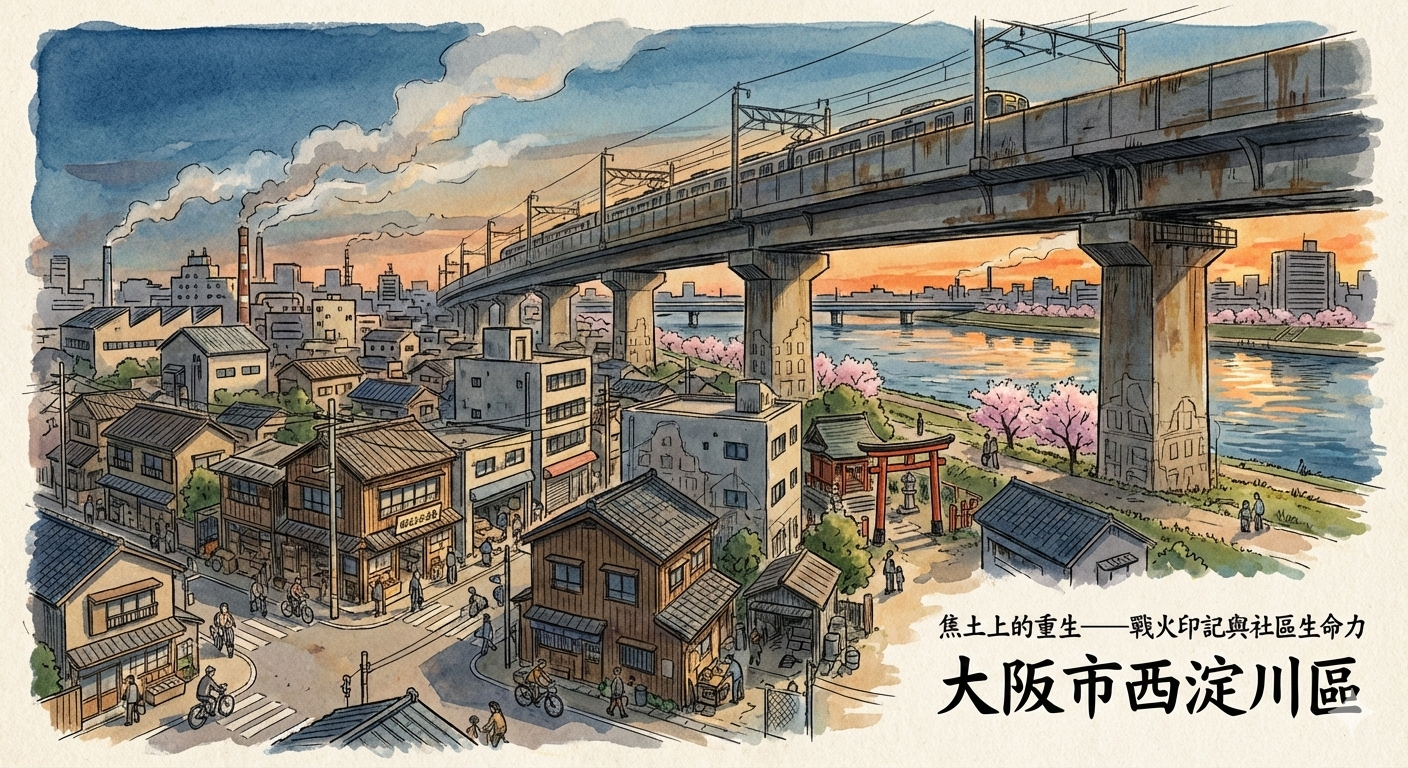
Nishiyodogawa’s identity is further layered by the scars of 20th-century warfare. Due to its status as a vital industrial engine, the ward was a primary target for Allied air raids. The devastation was concentrated in June 1945, when five major attacks leveled neighborhoods including Tsukamoto, Hanakawa, Tsukada, Owada, and Nozato.
The Survival Philosophy
The beauty of Nishiyodogawa does not reside in "grand monuments," but in the "urban texture" of its rapid post-war reconstruction. Following the fires of 1945, the ward was rebuilt with a pragmatic energy, often re-establishing the very industries that would later cause the pollution crisis. This created a tragic, layered cycle: a community that survived fire only to face the "mist hell" of their own recovery. To walk through the residential zones near the JR Kobe Line is to witness a "survival philosophy"—a landscape that prioritized recovery and functionality over aesthetic pretense. These streets are the physical manifestation of a community that refuses to be defined by its destruction, shifting from the scars of the past to the quiet, local rewards of the present.
The Insider’s Vantage: Sanpoji Temple and Local Wisdom
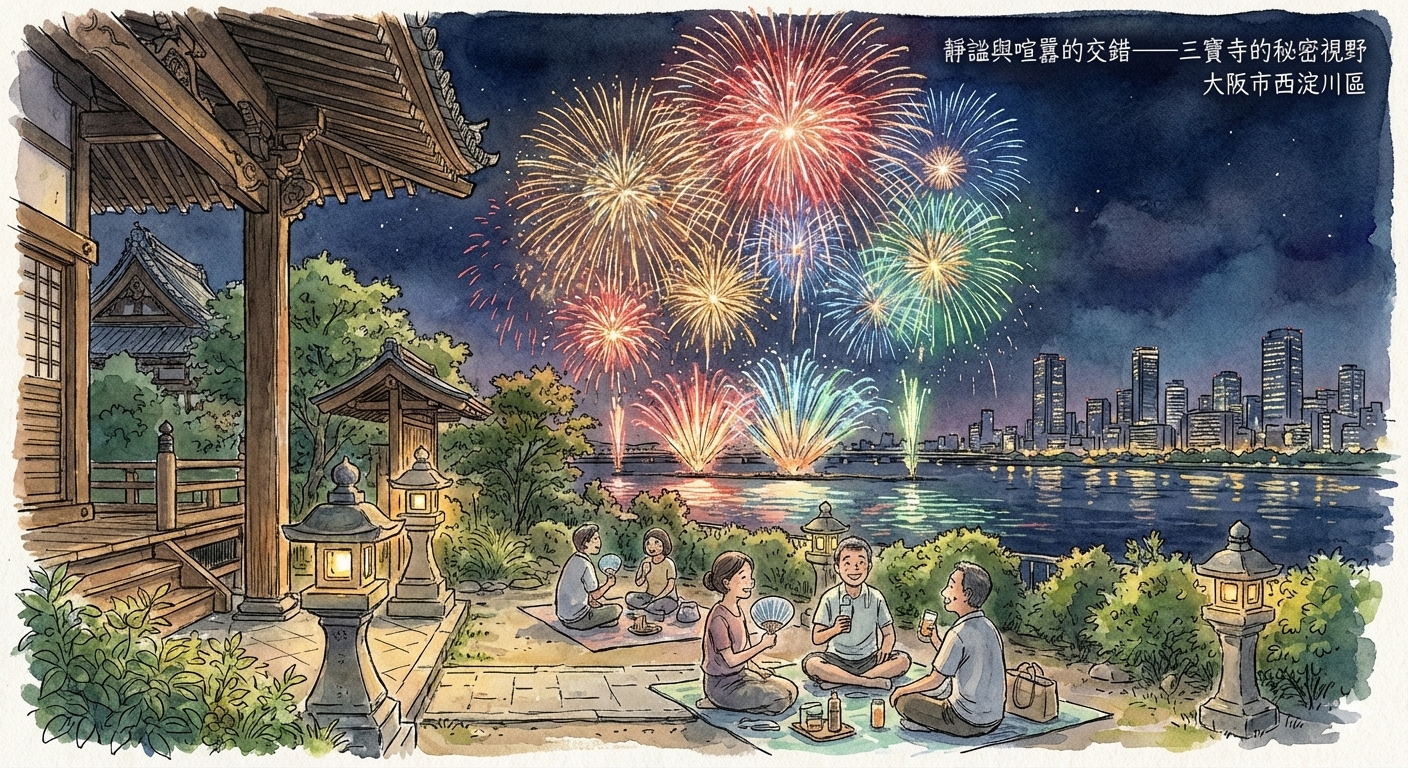
The final layer of Nishiyodogawa is its "cultural ownership" of the space. While Osaka's major events, such as the Yodogawa Fireworks Festival, are often defined by commercialized chaos, the residents of Nishiyodogawa maintain an intimate relationship with their river through "secret" vantage points that bypass the tourist masses.
The Local Key
Sanpoji Temple (Himejima 1-2-8) represents a "local key" to the city. Situated roughly two kilometers from the fireworks launch site, it offers a niche vantage point. Viewing the spectacle from a sacred, quiet temple ground versus a crowded riverbank transforms the experience from a tourist activity into a moment of communal reflection. This temple reflects a local wisdom—a way for the residents to reclaim the river’s beauty on their own terms. It is the final piece of the Nishiyodogawa puzzle: the quiet reward for a century of resilience.
Hidden Gems & Tactical Exploration
For the traveler seeking specific historical anchors, Himejima Shrine (Himejima 4-14-2) remains the ward's most significant "hidden gem." Beyond its 17th-century lanterns, its role as a site for plague-expelling rituals provides a direct link to the survival strategies of old Osaka.
The best way to experience these layers is through spatial continuity. By walking the paths between the shrine, the Oonogawa Ryokuin Road, and the reconstruction zones of Tsukamoto, the traveler can feel the transition from the ancient archipelago to the resilient modern ward.
Conclusion: A Philosophical Reflection on the Layered City
Nishiyodogawa is a testament to the "Resilience of the Island." Its history proves that understanding a city requires more than observing its highlights; it requires an examination of its layers of trauma and recovery. From the poetic sandbars of the Eight Islands to the industrial smog of the 20th century and the green sanctuaries of today, this ward has constantly reinvented itself without ever losing its genius loci.
How do modern cities reconcile their industrial "dark legacies" with a green future? Nishiyodogawa suggests the answer lies in honesty—acknowledging the scars of pollution and war while celebrating the civic strength required to heal them.
To explore more of Osaka's forgotten corridors, subscribe to our historical dispatches.
Planning Your Journey into History
- Getting There:
- JR West: Use the JR Tozai Line (Mitejima Station) for the archaeological walks or the JR Kobe Line (Tsukamoto Station) for the eastern reconstruction zones.
- Hanshin Line: Access via Himejima Station for the shrine and Sanpoji Temple.
- Recommended Tour Type: "Industrial Heritage & Environmental Recovery Walking Tours," focusing on the Oonogawa Ryokuin Road.
- Accommodation Tip: Stay near the JR Kobe Line (Tsukamoto area). This provides a central base for exploring the wartime reconstruction zones while remaining minutes away from the transport hubs of Osaka Station.
References
- Nishiyodogawa-ku (Ward), Osaka City, 檢索日期:10月 11, 2025
- 姬岛神社| 旅游景点和体验, 檢索日期:10月 11, 2025
- The Experience of Organizing Pollution Victims in Nishiyodogawa - あおぞら財団, 檢索日期:10月 11, 2025
- 大野川緑陰道路(おおのがわりょくいんどうろ) 檢索日期:10月 11, 2025
- War Damage to Nishiyodogawa - あおぞら財団, 檢索日期:10月 11, 2025
- Where is the super secret spot of the Yodogawa Fireworks Festival ..., 檢索日期:10月 11, 2025
 Lawrence
 Lawrence
 Lawrence