(ENG) The Palimpsest of Osaka: Walking Through 1,600 Years of History in Ikuno-ku
Explore the deep history of Osaka’s Ikuno-ku. Beyond Korea Town, discover 1,600 years of imperial engineering, industrial giants, and cultural resilience.

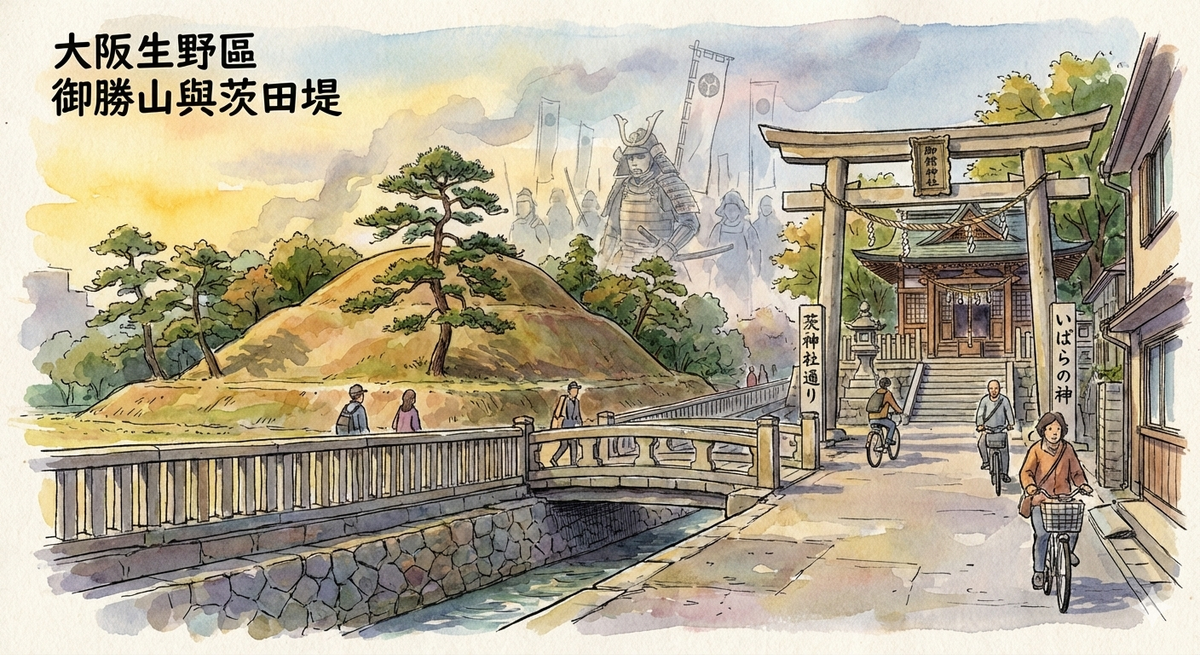
How did ancient water projects shape Ikuno's geography?
How did Korean immigration transform the district's food culture?
What links Panasonic's origins to the district's industrial spirit?
Listen to the historical stories told in detail (For subscribers only)
The Sound of the Ancient Tide
To the casual visitor, the Ikuno-ku district of southeastern Osaka is often simplified as the city’s vibrant "Korea Town." However, beneath the neon signs of K-pop cafes and the aroma of street food lies a dense ledger of Japanese civilization—a geographical palimpsest where one era is written directly over the last. This district is not merely a modern ethnic enclave; it is the site of 5th-century imperial engineering, the birthplace of global industrial titans, and a testament to centuries of international exchange. To truly understand Ikuno-ku, one must move beyond the surface-level shopping lists and embrace a perspective of spatial awareness. By walking its narrow alleyways and visiting its hidden shrines, a traveler can trace the evolution of Japan from a swampy wetland into a modern economic powerhouse.
The journey through Ikuno-ku is best understood as an excavation of five distinct historical layers, beginning with the very foundations of the Osaka plains.
The Emperor’s Blueprint and Ancient Power
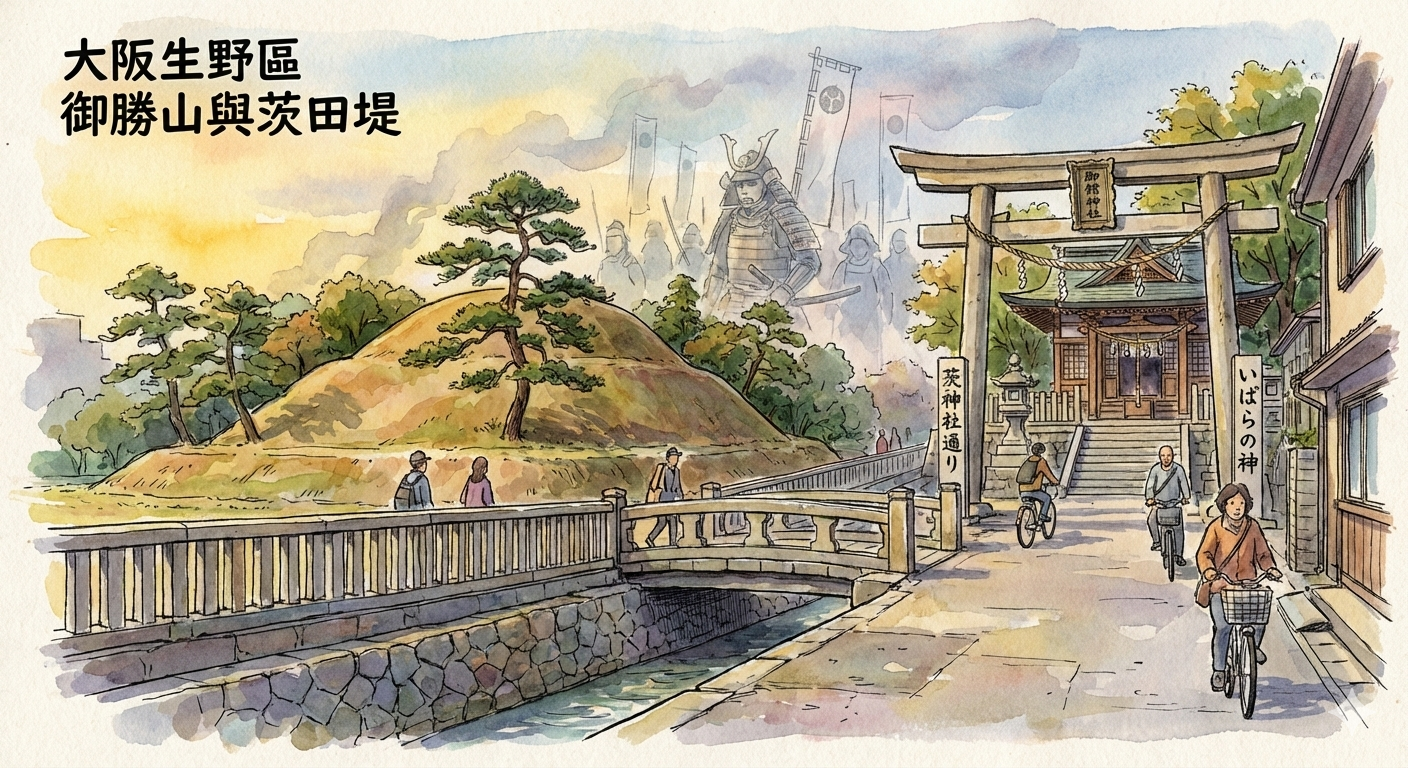
In the 5th century, the Naniwa (Osaka) plains were a disparate collection of wetlands and lagoons. The development of Ikuno-ku was dictated by a monumental shift in engineering that transformed this landscape into a habitable center of power. Under the reign of Emperor Nintoku, the region saw the birth of the Ibaraki Embankment (Ibaraki-zutsumi), a massive water-control project designed to prevent the flooding of the Kawachi Lake. This was not merely a construction project; it was the technological foundation of a civilization. This 1,500-year-old blueprint of drainage and land reclamation literally enabled the industrial footprints of the 20th century; the factories of the modern era stand only because of the ancient embankments that first tamed the tide.
The physical remnants of this ancient power are still visible at the Okachiyama Kofun, a large, keyhole-shaped burial mound dating back to the early 5th century. While its original 120-meter structure was partially compromised centuries later, its strategic value remained. During the Siege of Osaka in 1614–1615, Tokugawa Ieyasu chose this ancient tomb as his tactical headquarters, effectively layering the power of the Shogunate atop the prestige of ancient kings. Nearby, the Miyae Shrine Memorial Monument (弥栄神社御旅所) stands as a "hidden gem" anchor, providing physical evidence of this ancient power shift and the district's imperial connections.
"The legacy of the 'Matodono' (the target palace) and the 'Ibaraki no Kami' remains etched in the local memory, marking the site as the ancient residence of Emperor Nintoku and the starting point of the great embankment."
Today, walking along Ibaraki Shrine Street allows travelers to observe how the modern city grid still respects these ancient contours, moving from the physical landscape of tombs to the intellectual landscape brought by the district’s first international residents.
The Baekje Scholars and the Hangeul Echo
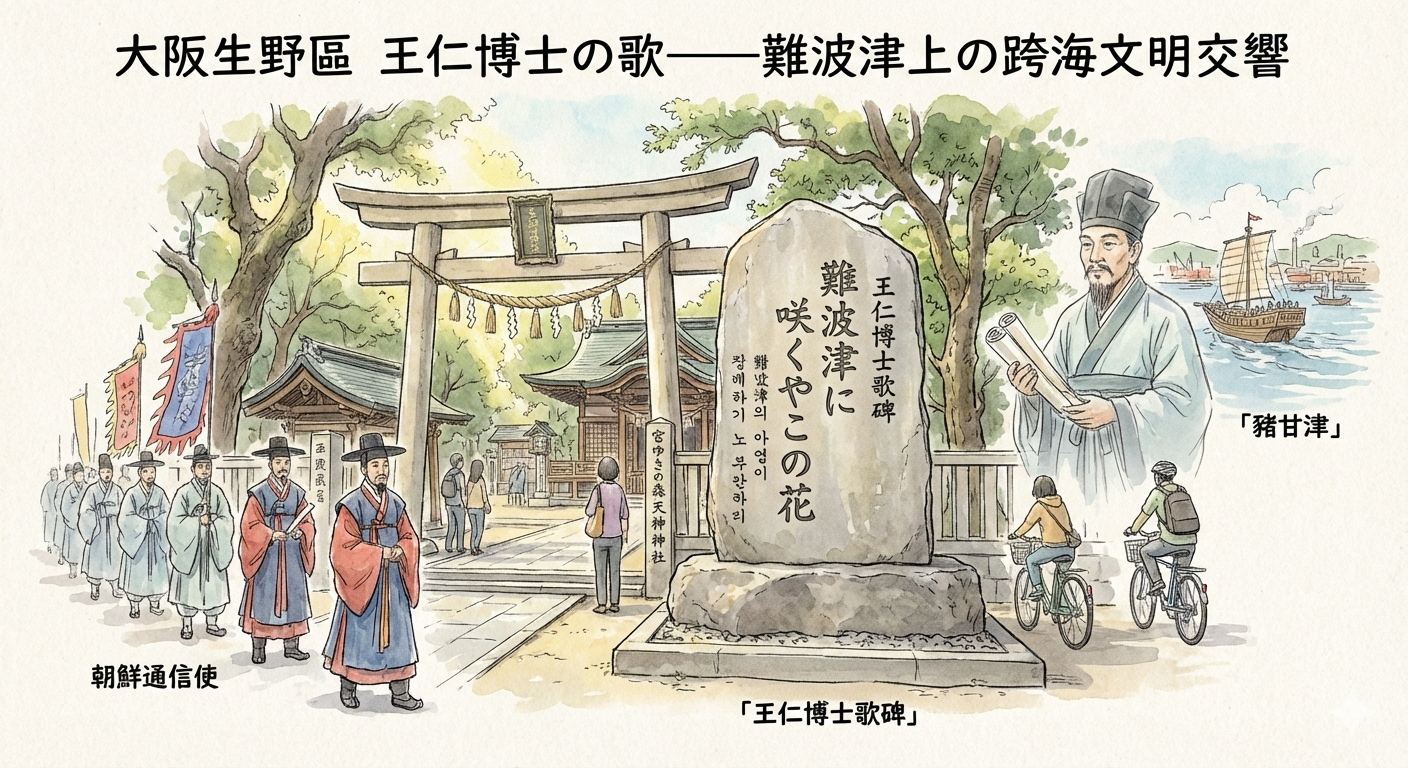
Ikuno-ku’s identity as an international crossroads began at the ancient port of Ikai-no-tsu (the Port of the Pig-Herders). Situated at the mouth of Naniwa Bay, this port served as the primary gateway for "Toraijin"—migrants from the Korean Peninsula, particularly the Kingdom of Baekje. These scholars and craftsmen brought with them the essential tools of civilization: advanced agriculture, civil engineering, and the written word.
At the Miyukimori Tenjingu, established in 406 AD, this history of egalitarian exchange is preserved in stone. The shrine features a monument dedicated to Dr. Wang-in, the scholar credited with introducing Chinese characters to Japan. Remarkably, the monument features the famous waka poem, "Naniwa-zu ni Sakuya Kono Hana," translated into Hangeul. This translation is believed to be a legacy of the Chosun Tongsinsa (Korean Envoys) of the Edo period, who provided the Hangeul transcription to commemorate the ancient cultural bond. This connection serves as a powerful counter-narrative to modern geopolitical tensions, proving that the foundation of Japanese high culture was a collaborative, cross-cultural endeavor.
As the centuries passed, the ancient port of Ikai-no-tsu gradually silted up, and the professional "pig-herder" guilds faded into the mists of history. However, the land they helped settle remained, transitioning from an international gateway to a site of gritty industrialism.
The Birthplace of Global Giants
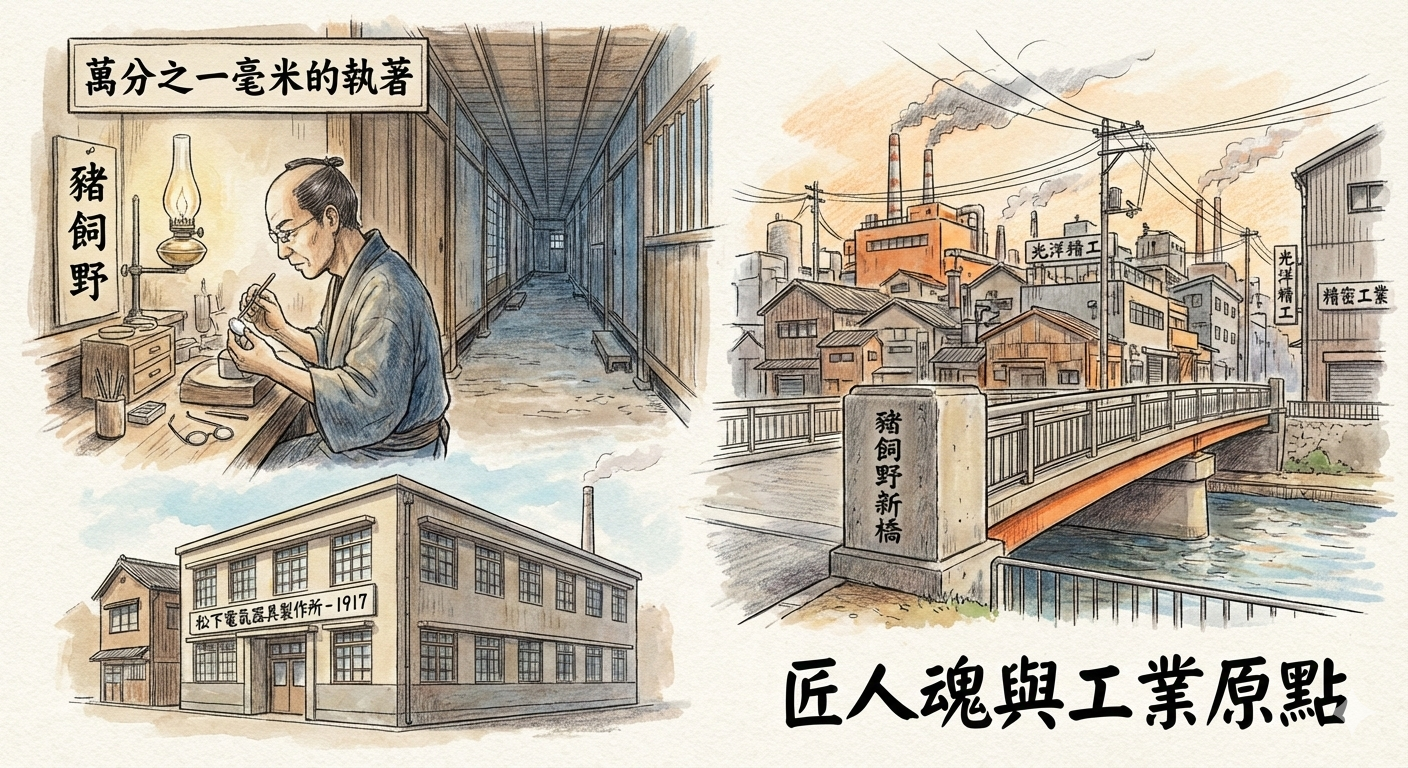
The transition from the Edo period to the early 20th century saw Ikuno-ku emerge as the cradle of the Japanese economic miracle. The district became famous for its "Machigoba"—small, family-run town factories. This tradition began with specialized crafts in specific sub-districts: the meticulous carving of tombstones in Katae and the grinding of eyeglass lenses in Tajima. This culture of Monozukuri (craftsmanship) prioritized a level of "1/10,000 mm" precision that would eventually define Japanese exports.
The historical significance of this layer is monumental. In 1917, a young Konosuke Matsushita began his journey in a tiny nagaya (row house) in Ikai-no, founding what would become Panasonic. A few years later, in 1921, Koyo Seiko (now JTEKT) established its bearing factory in the very marshes that Emperor Nintoku once drained. These global giants were not born in polished corporate parks, but in the determination of Ikuno’s narrow streets. As one navigates these labyrinthine blocks, it is clear that Ikuno-ku serves as a vital chapter in any [Guide to Osaka's Industrial Heritage], demonstrating how micro-innovation fuels macro-economic shifts.
The precision of these machines was matched only by the resilience of the human community that operated them.
From Survival to Celebration: The Post-War Resilience
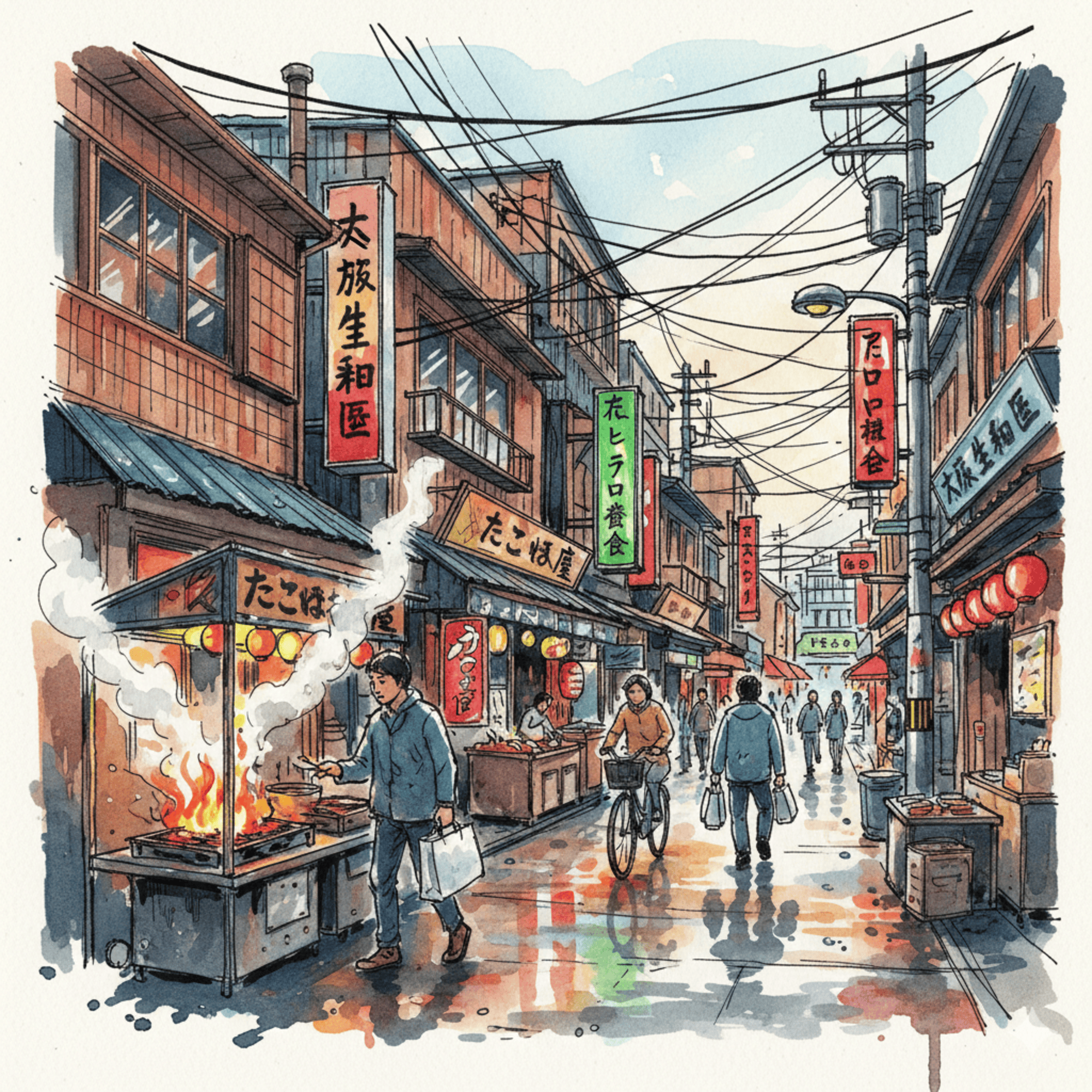
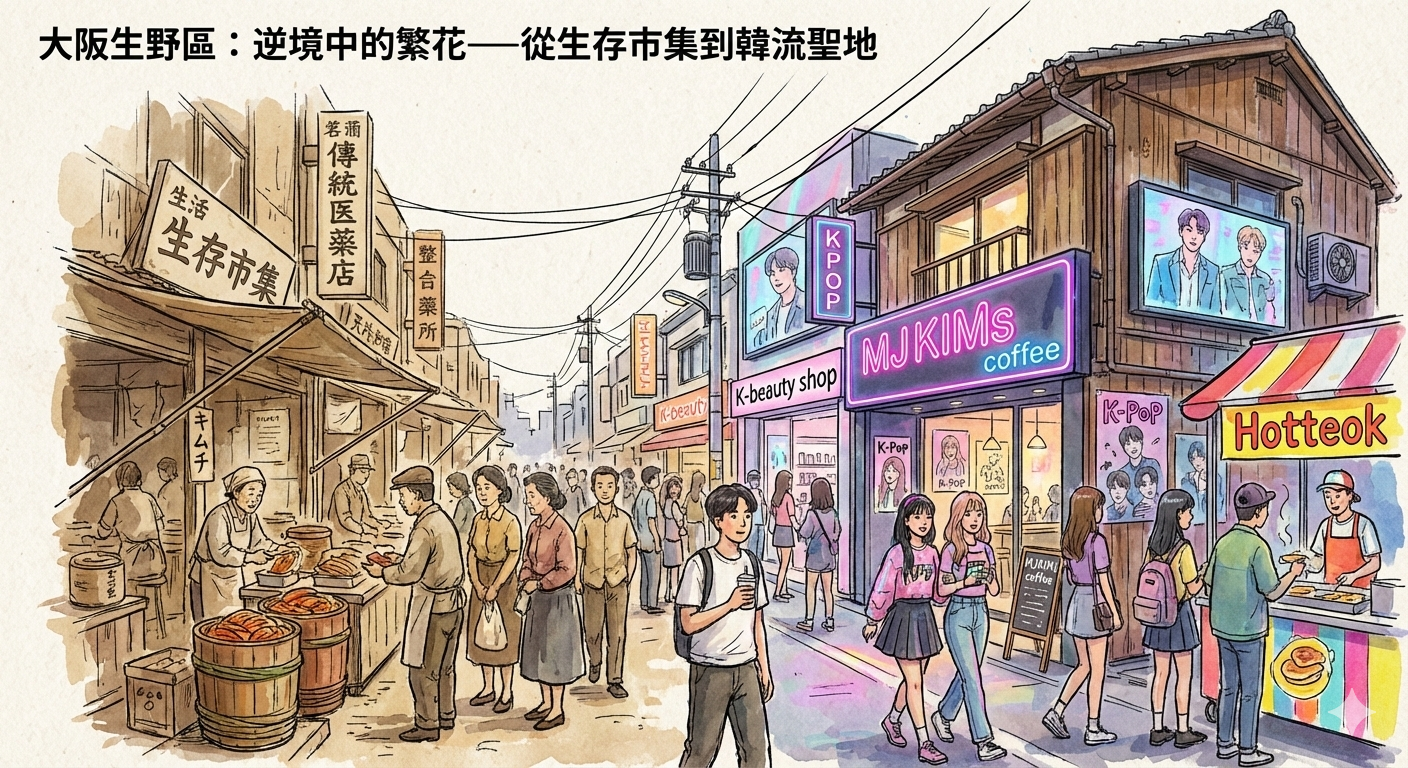
The modern demographic of Ikuno-ku was shaped by the socio-economic upheavals of the Japanese colonial period and the post-war era. As the Zainichi Korean community settled in the Tsuruhashi and Ikuno areas, they faced immense challenges in a landscape of scarcity. Their response was the creation of a self-sustaining economy, manifesting in the dense, vibrant alleyways of the Tsuruhashi Market and Ikuno Korea Town.
While modern Japan is increasingly defined by standardized, sterile shopping malls, Ikuno-ku retains its high-density "alleyway culture"—a physical manifestation of historical grit. In recent decades, this survival-based market has transformed into a global "Mecca" for Hallyu (Korean Wave) pop culture. Modern evolutions like MJKIMs coffee function as sanctuaries for "Oshi" (idol) culture, where fans gather to celebrate their favorite stars. Nearby, S cafe+bar offers a sensory experience where the traditional streetscape meets modern indulgence, serving sophisticated "Oreo cheesecakes" and "bitter tiramisus." These spaces represent the newest layer of the palimpsest, where K-pop aesthetics integrate into a district that has seen sixteen centuries of change.
This resilience is perhaps most famously expressed through the district’s unique culinary philosophy, born from the necessity of the post-war years.
The Alchemy of "Horumon": A Culinary Philosophy
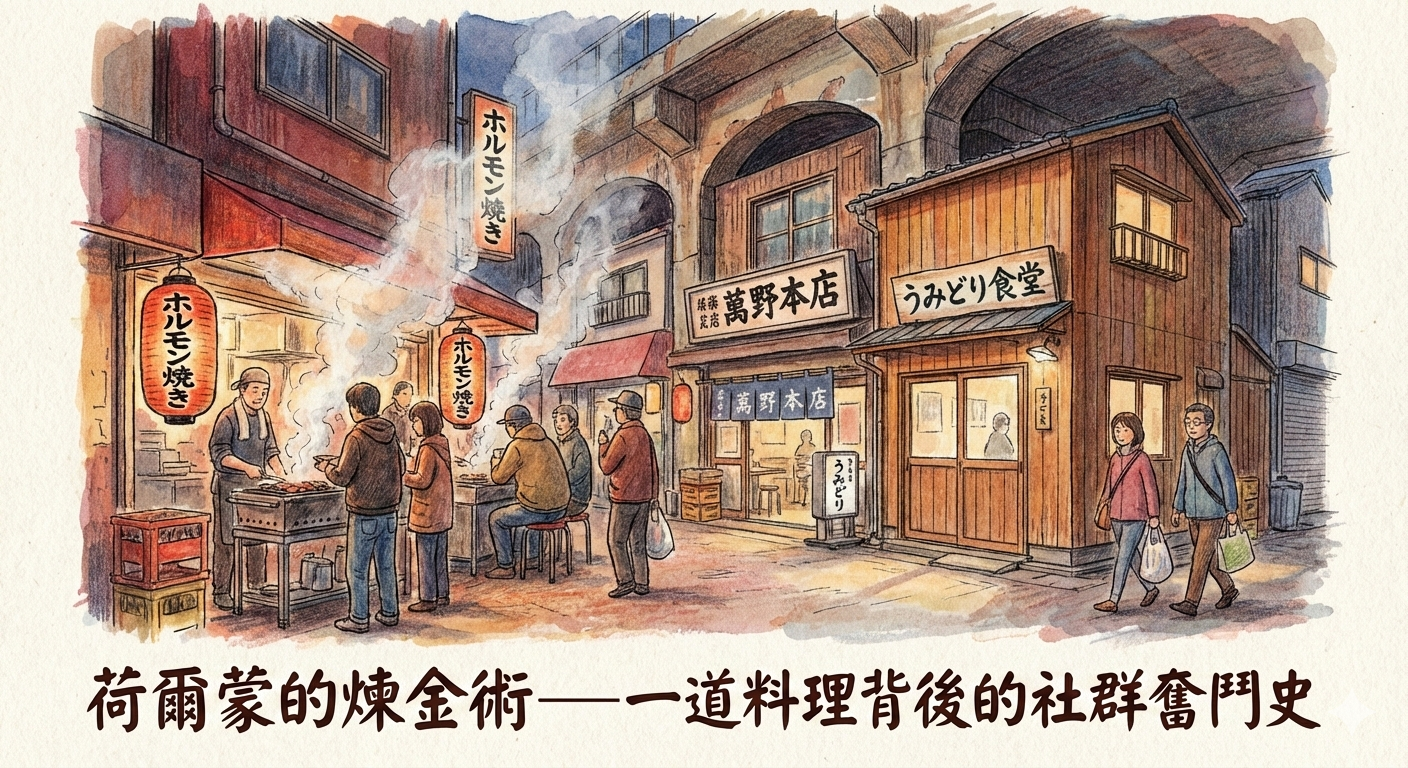
In the lean years following World War II, food was a tool for cultural survival. The community in Ikuno-ku pioneered the consumption of what was then known as "Tonchan" (pork offal), a practice that transformed what was once discarded into a high-nutrition culinary export. By the 1950s, this practice evolved into the popularized "Horumon" culture we recognize today.
The etymology of "Horumon" captures the district’s complexity. While it draws from the German/English word for "hormone" to signify nutritional vitality, it is also a play on the Osaka dialect term suterumon—"things to be thrown away." This culinary "alchemy" turned waste into the foundation of the world-renowned Yakiniku culture. Dining at traditional eateries along the Ikuno Hontori Shopping Street, such as the esteemed Yakiniku Manno, is an act of historical appreciation for a community that refused to let anything go to waste. It is the ultimate proof of innovation born from scarcity.
The Living Palimpsest
To walk through Ikuno-ku is to navigate a living archive. From the 5th-century embankments of Emperor Nintoku that made the land habitable, to the 20th-century workshops of Konosuke Matsushita and the 21st-century Hallyu cafes, the district refuses to erase its past. Understanding Osaka requires more than visiting its neon-lit highlights; it requires observing these layers of struggle, innovation, and cultural synthesis.
In a world of increasingly sanitized urban spaces, what can we learn from a place like Ikuno-ku that refuses to erase its complicated, multicultural past? Perhaps it is that the strongest civilizations are not those that are built from scratch, but those that are layered, reused, and constantly reimagined.
To receive more deep dives into the "travelable history" of Japan’s hidden districts, subscribe to the Lawrence Travel Stories newsletter.
Travel Logistics & Practical Advice
- Access: Ikuno-ku is easily accessible via JR Tsuruhashi Station or Momodani Station. Both offer immediate entry into the historic market districts.
- Accommodation: For those wishing to experience the "spatial continuity" of the district, look for boutique stays or traditional nagaya (row house) renovations near the historic shopping streets to truly feel the density of the history.
- Recommended Tours: We highly recommend a "Historical Walking Tour of Ancient Ikuno," which connects the Okachiyama Kofun, the Miyae Shrine Memorial Monument, and the industrial landmarks of the Tajima and Katae areas.
References
- 光洋精工発祥の地猪飼野, accessed October 12, 2025
- 【四天王寺から御勝山古墳の謎を追って】仁徳天皇 茨田堤の業績に ..., accessed October 12, 2025
- 御幸森天神宮(みゆきもりてんじんぐう) 前編 | 酒と出会いとお寺とお宮, accessed October 12, 2025
- 鶴橋の地名の由来とは?〜大阪編~ | 人生を全力で楽しむブログ, accessed October 12, 2025
- 朝鲜族 - 历史沿革, accessed October 12, 2025
- 生野區自由行旅遊攻略(2025):附近熱門好去處、人氣景點、行程規劃、住宿、美食、交通、天氣等等——重要資訊一文睇清(於2025年10月更新)|Trip.com, accessed October 12, 2025
- https://hk.trip.com/travel-guide/destination/ikuno-ward-2016470/
- 生野コリアタウンの隠れ家カフェで楽しむ絶品オレオチーズケーキ - Lemon8-app, accessed October 12, 2025
- 生野本通商店街付近でみんながオススメする人気グルメ20選 - Retty, accessed October 12, 2025
- 隠れ家イタリアンのお店 in 生野区 | 大阪 今里のレンタルスタジオ*赤ちゃんからご年配の方までみんなが笑顔になれる場所, accessed October 12, 2025
- 大阪市生野区ってどんなまち?|生野ものづくりタウン事業(IMT) - note, accessed October 12, 2025
- 会社案内 | 山本精工株式会社, accessed October 12, 2025
- 精密加工の吉見製作所, accessed October 12, 2025
- 株式会社 平川製作所[精密部品・切削加工のエキスパート], accessed October 12, 2025
 Lawrence
 Lawrence