(ENG) The Soul of a Skyscraper City: Uncovering the Secret History of Umeda
Umeda is not just a place to pass through; it is a destination rich with overlapping layers of history. It is a city built on sacred myths, defined by tragic love stories, forged in post-war grit, and crowned with futuristic ambition.

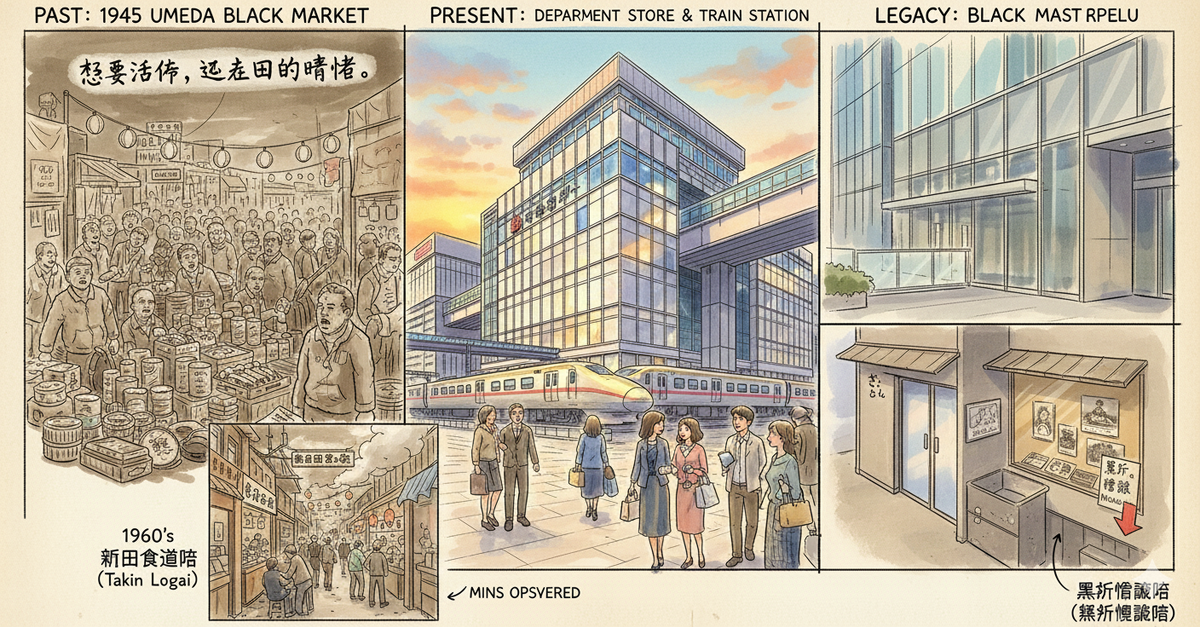
グランフロント大阪 GRAND FRONT OSAKA > 露天神社(お初天神)Tsuyuno Tenjinsya (Ohatsu Tenjin)
Listen attentively to the historical stories told in detail
To the first-time visitor, Osaka’s Umeda district is a dazzling and overwhelming storm of light, sound, and motion. As the busiest transportation hub in western Japan, it’s a city within a city, defined by soaring skyscrapers, labyrinthine department stores, and a ceaseless river of humanity. But beneath this futuristic surface lies a palimpsest—a canvas where stories have been written, erased, and written over again, yet never fully disappear. These hidden histories of love, survival, and ambition are what truly define Umeda's character. This journey will uncover five of the most surprising stories etched into the very foundations of the city.
The Name on the Map: From a Buried Field to a Sacred Plum Garden
A city's name is its oldest story, and Umeda's holds a secret of deliberate cultural rebranding. It is a tale of how a simple geographic descriptor was transformed into a poetic legend, forever altering the identity of the land itself.
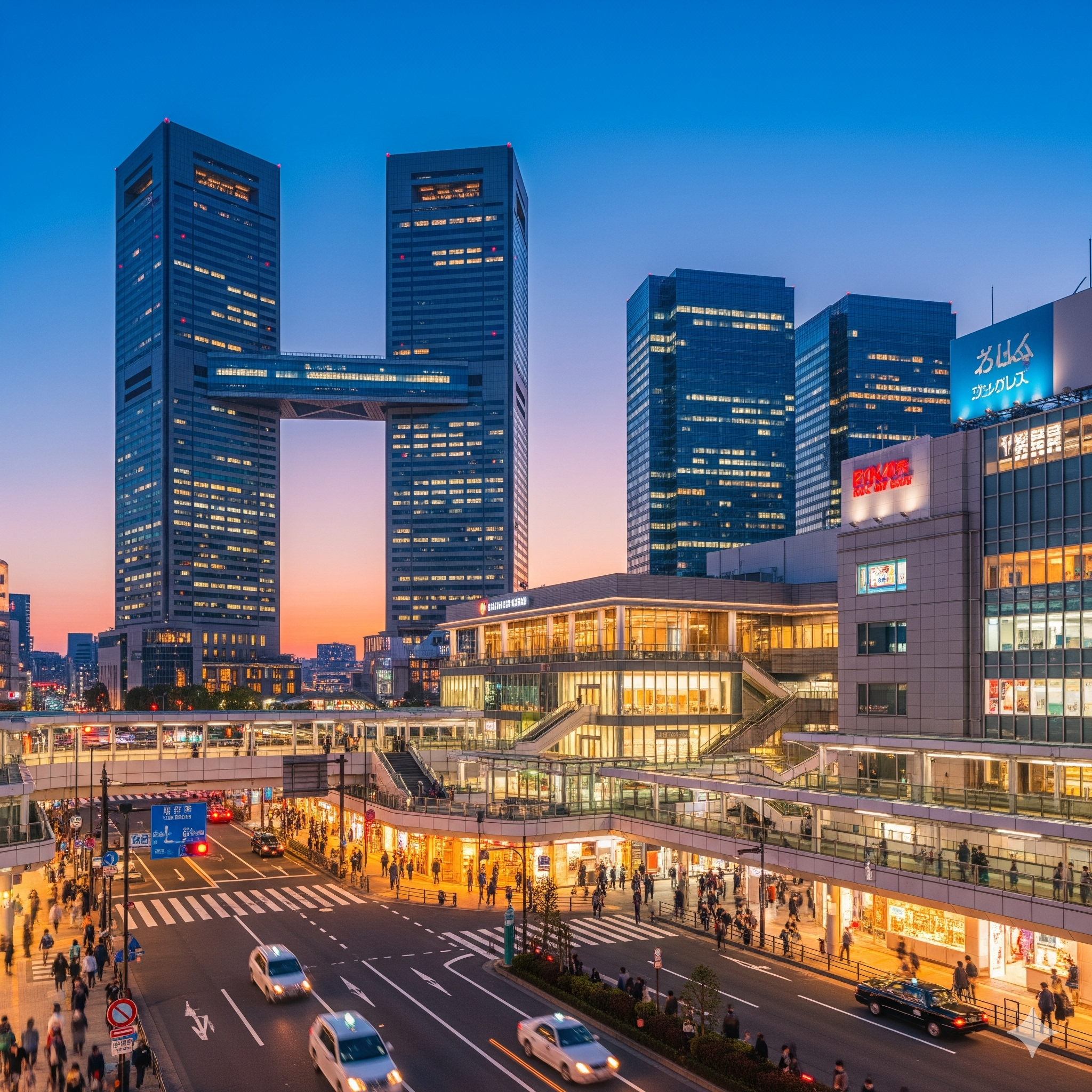
The name "Umeda" has two competing origins, each telling a very different story. The first is practical, if unflattering: the area was originally a low-lying wetland, and its name was likely written as "埋田" (Umeda), meaning "buried" or "reclaimed land." A second, more feudal theory suggests the name derived from a local lord, the "Umeda clan." Yet a far more poetic origin story came to define the district: "梅田" (Umeda), meaning "Plum Field." According to legend, the great scholar-deity Sugawara no Michizane was exiled during the Heian period and, while passing through, stopped to admire a beautiful red plum tree that grew here.
This shift was more than a simple change in characters; it was a masterful act of cultural elevation. By linking the area to a revered deity and the poetic imagery of plum blossoms, local leaders gave Umeda a sacred and prestigious foundation. This legend gained remarkable historical weight in 2005, when an archaeological dig uncovered ancient plum tree roots and sake cups, confirming that a culture of aristocratic "flower viewing banquets" did indeed exist here centuries ago. From a legend of divine grace that elevated the land, Umeda's next great story would be written in human tears, transforming another local shrine into a national sanctuary.
"To connect with this origin story, seek out the serene Tsunashiki Tenjinsha Shrine, the district's 'northern guardian.' Find the 'Name Origin Monument' to see the legend set in stone, then taste it for yourself with a plum-flavored ice cream from the basement food hall of the nearby Hankyu department store."
The Ghost in the Alley: A Tragic Love That Became a Lover's Sanctuary
A powerful work of art can transform a physical location, embedding a single human story into the very spirit of a place for centuries. In Umeda, a tragic romance from the early 18th century became so iconic that it forever fused a local shrine with the idea of eternal love.
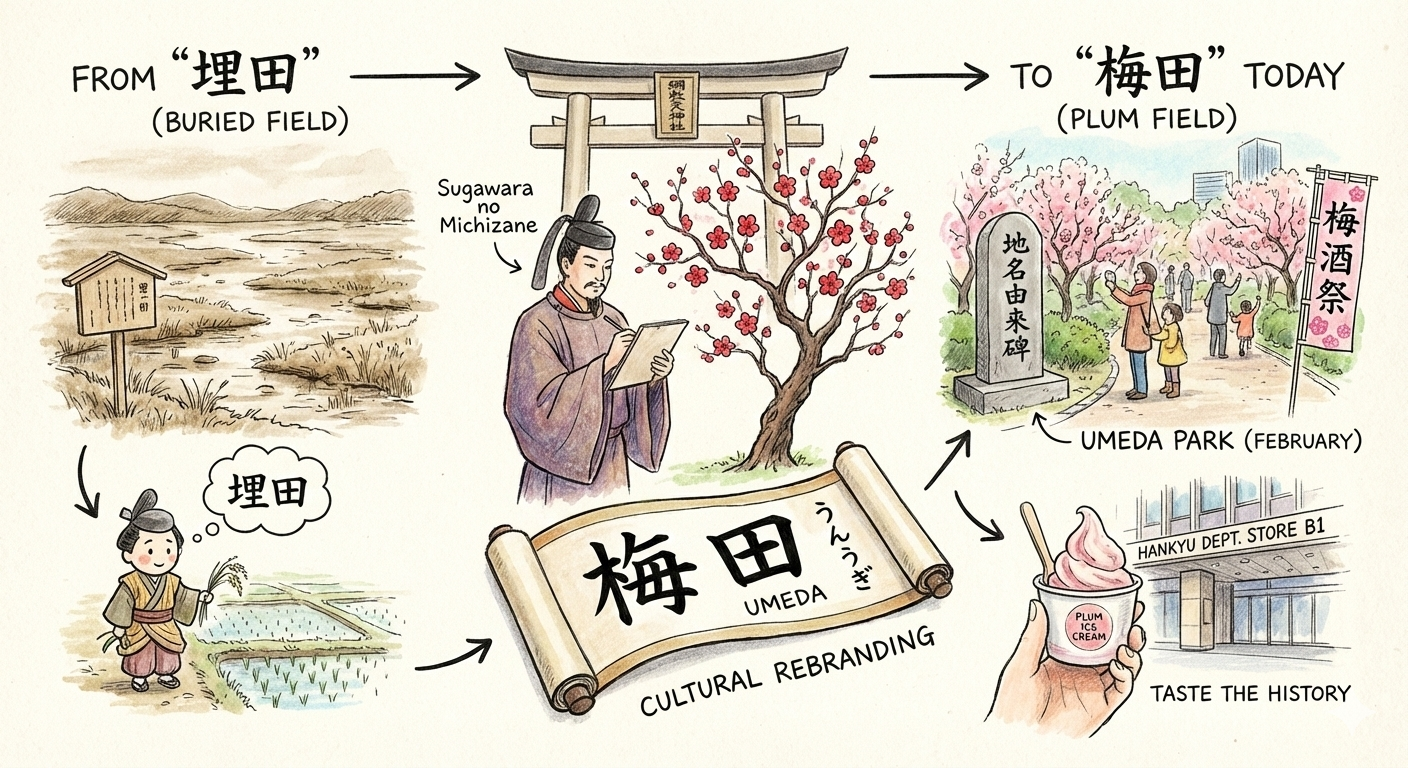
In 1703, a young shop apprentice named Tokubei and a beautiful courtesan, Ohatsu, found themselves in an impossible situation. Trapped by circumstance, they chose to end their lives together in the sacred grove of the Tsuyu no Tenjinja Shrine. Their story might have been forgotten, but it was immortalized by the great playwright Chikamatsu Monzaemon in his puppet theater masterpiece, Sonezaki Shinju (The Love Suicides at Sonezaki). The play was a sensation. It transformed the shrine, where a memorial tower for the lovers now stands, from a local place of worship into a national pilgrimage site for lovers, a symbol of eternal, if tragic, devotion. So powerful was the connection that the shrine earned a new name in the popular imagination: "Ohatsu Tenjin," in honor of its immortal heroine.
"Venture into the lively Sonezaki district to find the Tsuyu no Tenjinja Shrine (Ohatsu Tenjin). Visit in the evening when the paper lanterns are lit, creating a uniquely romantic and solemn atmosphere. Here you can see the living legacy of the story, as modern couples leave heart-shaped wooden wishes (ema) for their own happiness."
From this timeless tale of love surviving in memory, we turn to a story of collective survival in the city's more recent, and much harsher, past.
The City from the Ashes: From Post-War Black Market to Retail Kingdom
The true character of a city is often forged in its toughest times. Umeda’s current commercial brilliance did not emerge from a planner’s blueprint but grew directly from the chaotic, desperate soil of post-war Japan.
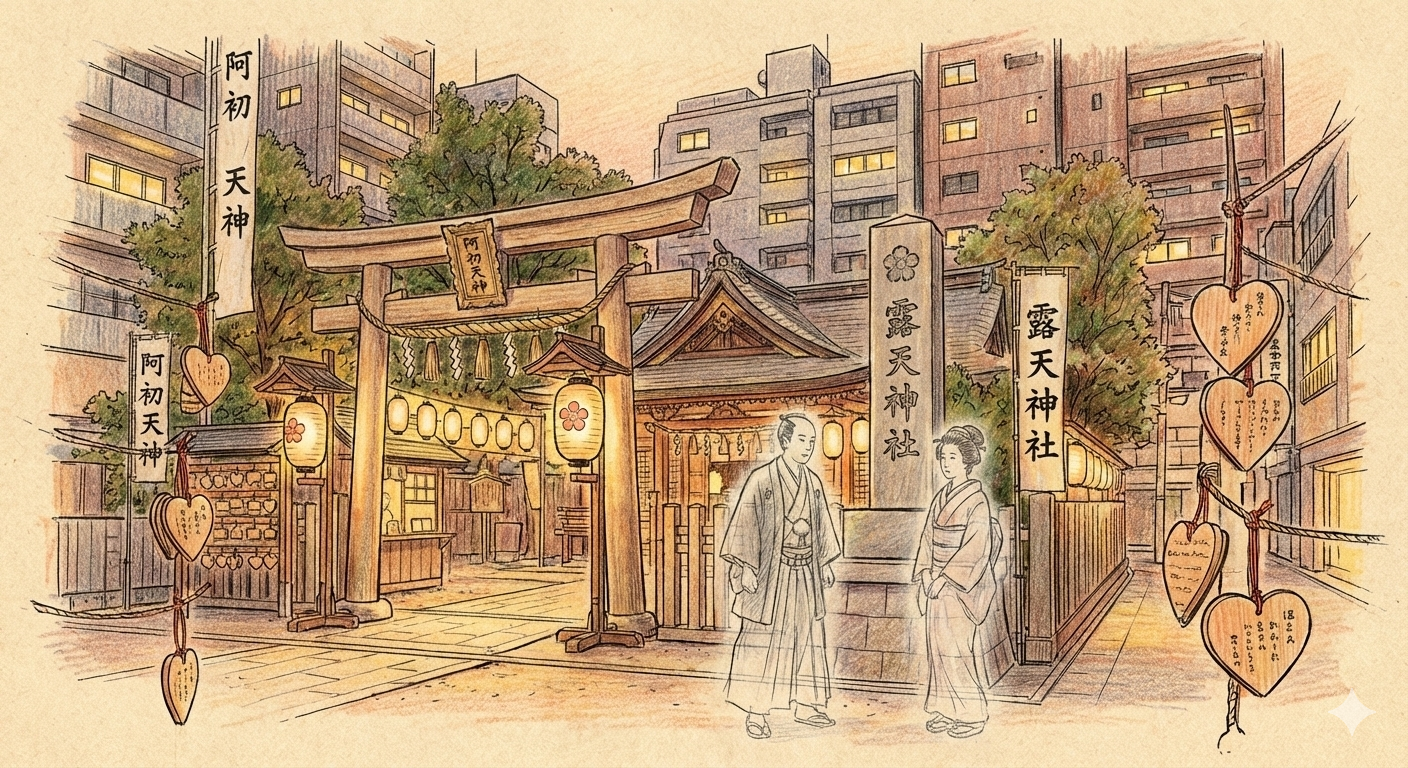
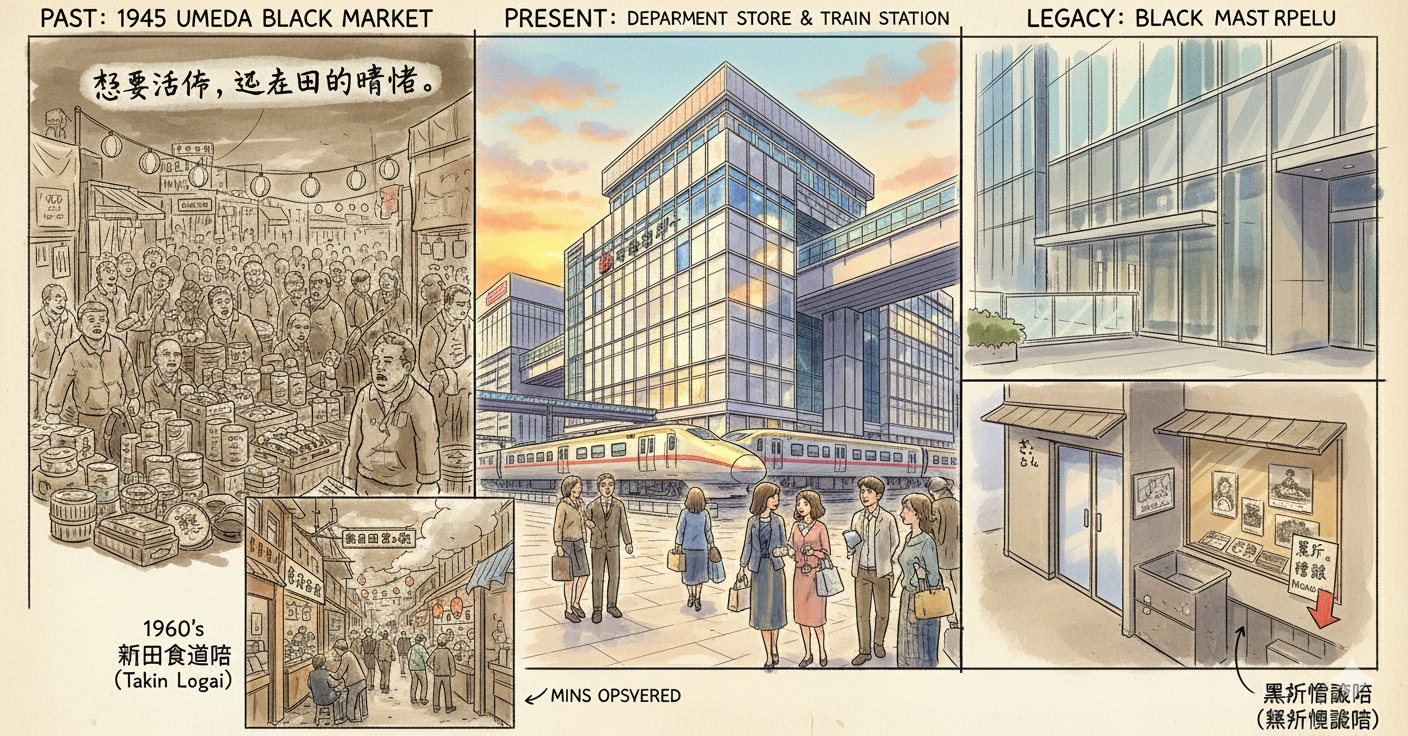
After World War II, the area west of Umeda station became the site of the "Aozora Ichiba" or "Blue Sky Market," a massive black market where survival was the only currency. Here, everything from military rations and old clothes to smuggled goods was traded. The desperation of the era was captured in a common saying:
"If you want to live, go to the dark alleys of Umeda."
Yet, from this crucible of chaos, modern Umeda was born. Visionary companies like Hankyu Railway pioneered the "station-direct shopping mall" model, transforming the very ground where the black market once thrived into a legitimate hub of commerce. Today, gleaming landmarks like GRAND FRONT OSAKA stand on its former core. This dramatic transformation from street-level grit to polished retail was not just a surface-level phenomenon; Umeda's next ambition lay in conquering the world right underfoot.
"For a taste of this bygone era, dive into the Shin-Umeda Shokudogai, a network of narrow alleys with a Showa-era feel. But for the ultimate hidden gem, visit a local Kushikatsu (fried skewer) shop and ask to see the 'Black Market Memory Museum' in its basement—a tiny, powerful exhibit of photos and artifacts preserving this gritty chapter of Umeda's history."
The Labyrinth Below: The Engineering Marvel of Japan's First Underground City
As Osaka boomed in the mid-20th century, the pressure on its surface became immense. The solution was as bold as it was ambitious: to go down. The development of Umeda's underground was a visionary response to the needs of a modern metropolis, representing a new frontier in urban design.
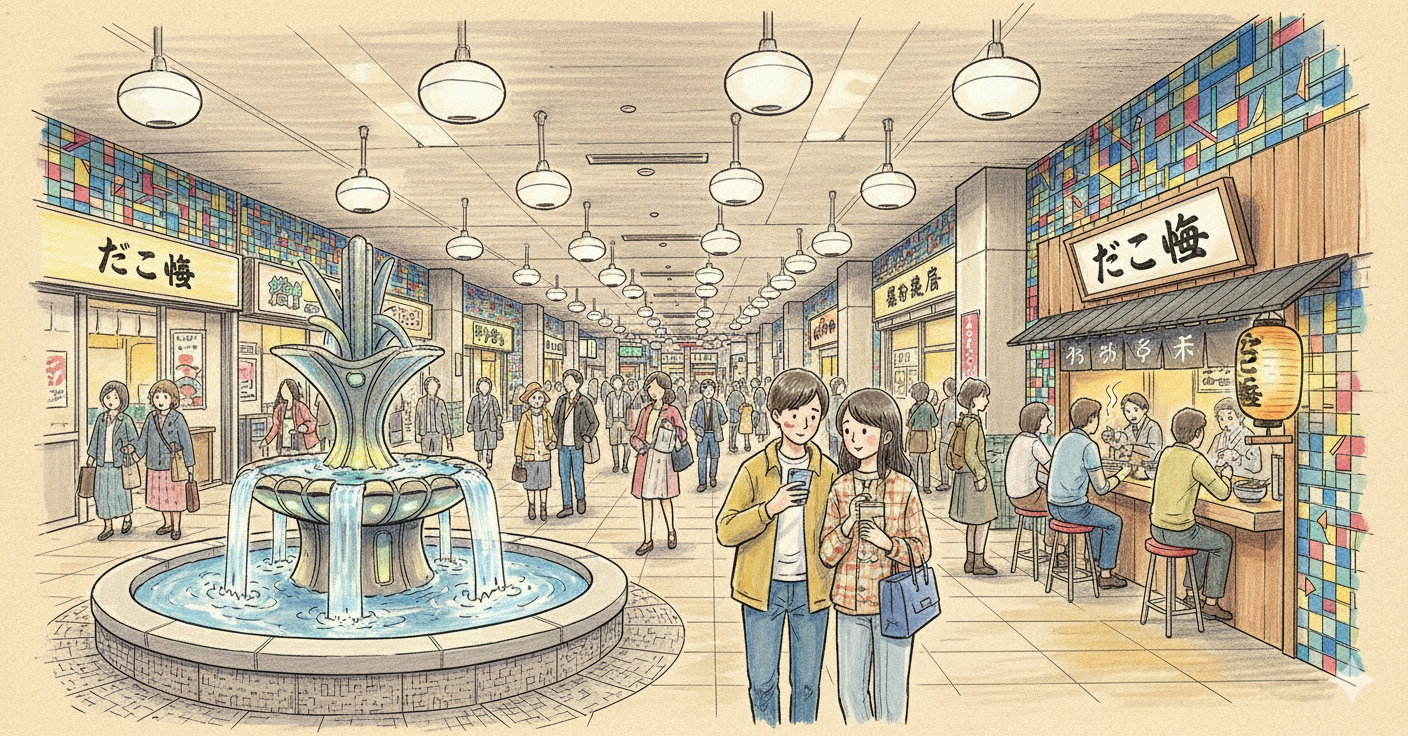
In 1963, inspired by the "underground cities" of Paris, Osaka built "Whity Umeda," Japan's first large-scale underground shopping street. This was not merely a subterranean mall; it was a landmark of post-war engineering ambition. It was designed to solve chronic surface-level traffic congestion by completely replacing and absorbing the older, ground-level "Umeda Arcade," which was demolished in 1962. With its state-of-the-art air conditioning and lighting, it redefined urban life. Its complexity became legendary, spawning a local joke that "first-timers always get lost," and its "Izumi no Hiroba" (Fountain Plaza) became a beloved social hub for generations. Having conquered the world beneath the streets, Umeda's final ambition was to reach for the heavens themselves, creating a modern icon with an ancient soul.
"Embrace the joy of getting lost in Whity Umeda, but arm yourself with the official 'Whity Umeda Map' app. Keep an eye out for the historic oden (stew) shop, 'Takoume,' which has been operating here since it first opened—a living piece of the mall's history."
The Tower to the Sky: A Modern Marvel with an Ancient Soul
Sometimes, the most futuristic architecture is deeply connected to the most ancient of myths. The Umeda Sky Building, one of Osaka's most iconic modern landmarks, is the perfect symbol of a city that looks to the future without ever forgetting the distant past.
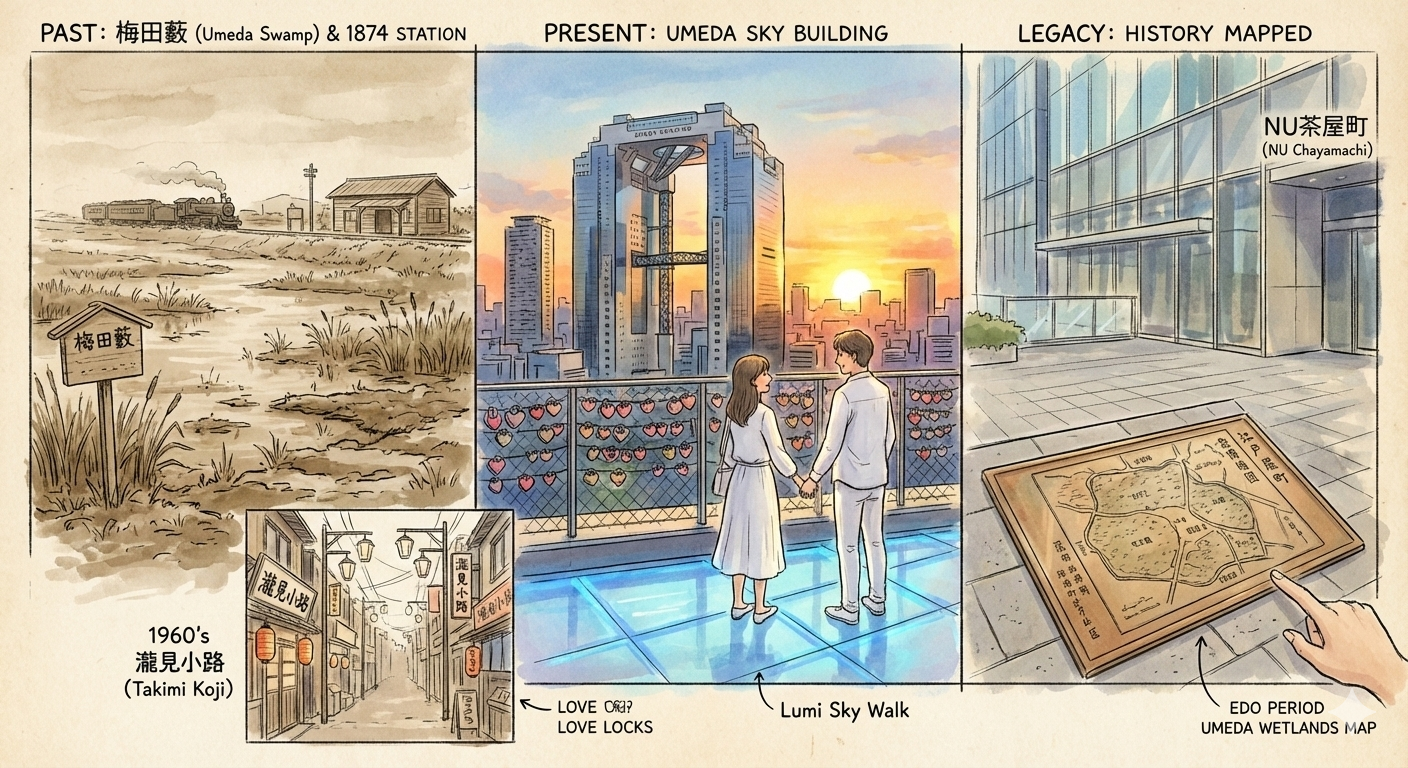
Completed in 1993, the Umeda Sky Building quickly gained international acclaim and was once named one of the "world's top 20 most peculiar buildings." Its design, however, draws from a surprisingly ancient source: the "Tower of Babel" from Mesopotamia, reflecting a timeless ambition to connect earth and heavens. Its features embody this goal, from the breathtaking "Floating Garden Observatory" linking its two towers to the "love lock wall" where couples pledge their devotion. Below, the "Takimi Koji" food alley whisks visitors back to 1960s Osaka. From this incredible high-altitude perspective, all of Umeda's historical layers—from the sacred ground to the underground labyrinth—can be seen at once.
"Plan your visit to the Umeda Sky Building for the 'Magic Hour' around sunset. For a truly magical photo, wear white shoes or trousers. As you walk across the 'Lumi Sky Walk' on the 39th floor, the floor illuminates your every step with glowing celestial patterns, making you feel as if you're walking among the stars."
The City as a Palimpsest
Umeda is not just a place to pass through; it is a destination rich with overlapping layers of history. It is a city built on sacred myths, defined by tragic love stories, forged in post-war grit, and crowned with futuristic ambition. Like a palimpsest, its modern surface has been written over its past, but the faint outlines of older stories remain, waiting to be discovered by those who know where to look.
The next time you stand in a bustling city center, what hidden stories might be waiting right under your feet?
Works Cited
- 梅田の観光スポット21選!名所、定番グルメ、買い物スポットも紹介 - MATCHA, accessed December 25, 2025
- 【梅田景點推薦】2025大阪梅田一日遊行程!藍天大廈、摩天輪、阪急百貨攻略 - 波比看世界, accessed December 25, 2025
- 綱敷天神社御旅社, accessed December, 2025
- 綱敷天神社 由緒, accessed December 25, 2025
- 2025露天神社景點推薦(於10月更新)| Trip Moments, accessed December 25, 2025
- 地下街的歷史| 企業信息| 大阪地下街株式會社| 御坂的地下街, accessed December 25, 2025
- 地下街の歴史 | 企業情報 - 大阪地下街株式会社, accessed December 25, 2025
- 梅田おすすめ観光スポット8選!定番人気スポットや穴場の見どころを紹介 | なっぷ, accessed December 25, 2025