(ENG) Nakanoshima: The Sandbar That Engineered Modern Japan
Trace Nakanoshima’s evolution from the world’s first futures market to a center of Meiji-era enlightenment—a deep dive into the architecture of Osaka’s Water Capital.

How did Nakanoshima transform from a feudal storehouse district into a public park?
What role did the Dojima Rice Exchange play in global financial history?
How did early innovations in Nakanoshima influence Japan's modern education and global finance systems?
 Lawrence
The Cartography of Power and Water
In the heart of Osaka, bifurcated by the relentless currents of the Dojima and Tosabori rivers, lies a slender, three-kilometer sandbar that functions as the institutional spine of the city. To understand Nakanoshima is to understand the "soul of the Water Capital," but more importantly, to recognize it as the laboratory where Japan’s transition from feudalism to modernity was meticulously engineered. This landscape is a palimpsest; beneath the neoclassical facades and manicured lawns lie the strata of a 400-year-old economic and intellectual experiment. To walk here is to traverse the physical remains of a strategic struggle for the nation’s future. This evolution began not with political decrees, but with the high-stakes world of global finance that first gathered along these riverbanks.

Listen to the historical stories told in detail (For subscribers only)
The Dojima Rice Exchange: Where the Future Was Invented
By the 18th century, Nakanoshima had emerged as the neural center of Japan’s food supply and fiscal stability. The island was a dense thicket of Kurayashiki—fortified warehouse-residences where feudal lords (daimyo) stored tax rice to be converted into the cash required for their lavish expenditures in Edo. Amidst this logistical maze, the Yodoya family—a merchant dynasty of staggering influence—facilitated a market so sophisticated that physical trade eventually yielded to abstraction. This resulted in the "Rice Ticket" system, culminating in the 1730 official sanction of the Dojima Rice Exchange: the world’s first organized futures market.
The "Yodoya Seizure" of 1705 remains a seminal moment in this history, illustrating the inherent friction between the warrior and merchant classes. When the Shogunate confiscated the family’s immense wealth under the pretext of "extravagance unsuitable to their rank," it was a desperate assertion of political power over burgeoning economic dominance. The Yodoya downfall served as a stark warning: in the Edo period, economic control did not equal political immunity. This conflict was essentially a clash over Shokubun-kan—the "sense of duty" and rank that defined one's place in the feudal hierarchy. Today, this legacy is anchored by the "Single Grain of Rice" monument at the Nakanoshima Garden Bridge. Designed with contributions from Tadao Ando, this shimmering stainless steel sculpture marks the site where the logic of modern capitalism was codified. Historically, rice prices determined here were broadcast across the archipelago via “Flag Signals,” a visual telegraph system that ensured the fluctuations of a single grain in Osaka resonated through the entire national economy. As this flow of capital matured, it created the necessary infrastructure for a different kind of currency: the flow of transformative Western ideas.

Tekijuku: The Anatomy of a New National Mind
As the 19th century progressed, Osaka became the primary corridor for Rangaku (Dutch Learning), the only window into Western science and medicine. In 1838, the physician Ogata Koan established Tekijuku, an academy that operated as a meritocratic sanctuary within a rigid caste society. While the physical school stood just across the river, its intellectual life was inextricably bound to the Nakanoshima warehouse network, forming a "knowledge corridor" where the feudal mind was systematically dismantled.
Tekijuku was radically non-feudal; students were ranked solely by academic prowess, an environment that birthed the "brains of the Meiji Restoration." Figures like Fukuzawa Yukichi—the founder of Keio University who was born within the Nakatsu-han warehouse on Nakanoshima—transitioned here from "samurai" to "citizen." The intensity of their discipline is etched into the building itself; the upstairs pillars are scarred with sword gashes, left by students venting the immense pressure of their studies. Their most prized relic was the Doeff-Halma Dutch-Japanese dictionary. As the only copy available, it was a "relic of craving" so worn by the constant, desperate hands of students that it came to symbolize the hunger for a modern world. This academic rigor soon found a permanent sanctuary through the philanthropic vision of Osaka’s merchant princes.

The Sumitomo Legacy: Architecture as Character
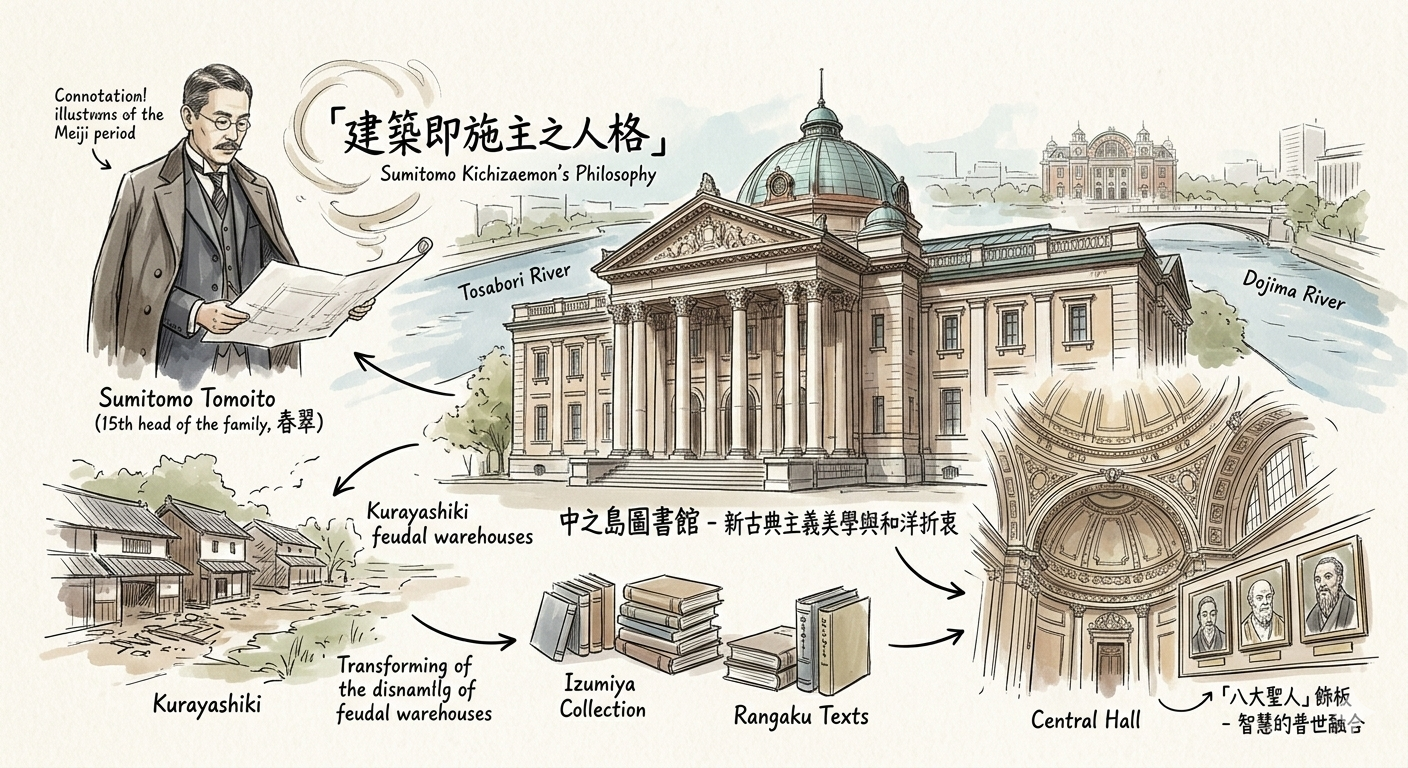
Following the 1872 abolition of feudal domains, the defunct Kurayashiki lands were repurposed into the bedrock of a new civic identity. In 1900, the 15th head of the Sumitomo family, Sumitomo Kichizaemon, initiated the construction of the Nakanoshima Library. This act of Mecenat (philanthropy) was a strategic move to ensure social stability through cultural enrichment. For the Sumitomo family, architecture was not merely functional; it was "the owner’s character" made manifest in stone.
The library is a masterpiece of Wayo-fusion—a synthesis of East and West. Its Neo-Classical Greek-Roman exterior, featuring a grand Corinthian portico and bronze dome, signals a commitment to global Enlightenment, while the Baroque interior utilizes high-quality domestic woods. Crucially, the library was seeded with a 20,000-volume donation, including rare Rangaku texts from the "Izumiya" collection, bridging the gap between the radicalism of Tekijuku and the institutionalization of knowledge. Within the central hall, the "Eight Sages" plaques—featuring thinkers from Confucius to Socrates—symbolize a universal synthesis of wisdom. This permanent temple of stone was intended as a more durable defense of the family legacy than any financial ledger. Yet, this calculated philanthropy stood in sharp contrast to the tragic, impulsive heroism of the man who would build the hall next door.
Central Public Hall: The Martyrdom of a Civic Spirit
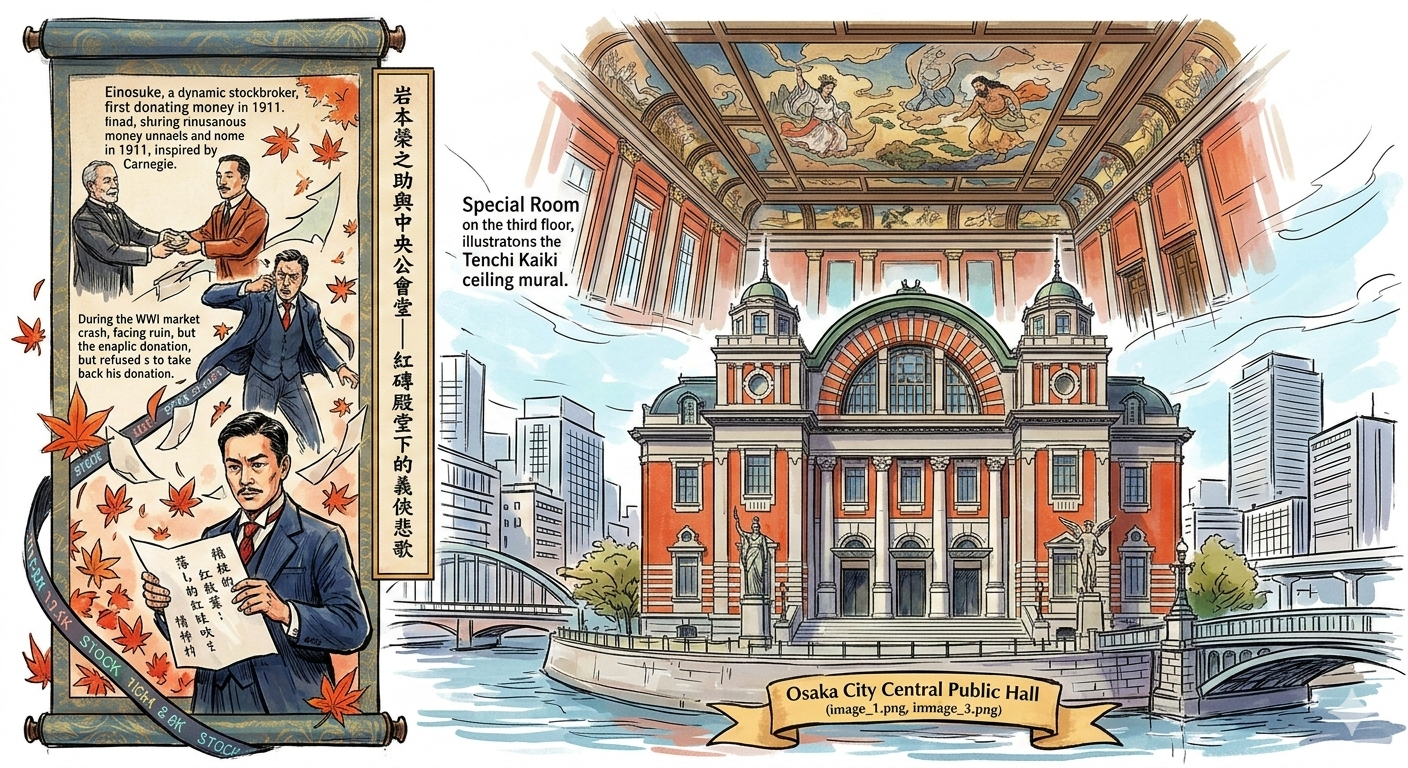
By the early 20th century, Osaka had become the "Manchester of the Orient," an industrial titan fueled by a new class of stockbrokers. Among them was Iwamoto Einosuke, a legendary figure who, inspired by Andrew Carnegie’s philanthropy during a 1909 visit to America, donated 1 million yen to provide Osaka’s citizens with a world-class public hall. It was a strategic attempt to import Western civic pride into the heart of the Japanese commercial spirit.
The Central Public Hall, a magnificent red-brick edifice, remains the island’s aesthetic anchor. However, its history is tinged with the tragedy of its benefactor. Following a market crash during World War I, Iwamoto faced financial ruin but refused to reclaim his donation, viewing such an act as a betrayal of the merchant's honor. He committed suicide in 1916, two years before the hall's completion. His death poem, reflecting on “the falling red leaves that scatter before the autumn arrives,” remains a poignant footnote to the hall’s grandeur. The building’s "Special Room" features the "Tenchi Kaiki" mural on its ceiling—a depiction of the Japanese creation myth. Coupled with the statues of Minerva (Wisdom) and Mercury (Commerce) on the facade, these symbols represent Osaka’s self-conceived rebirth as a modern metropolis where ancient mythology and modern trade find a tenuous balance.
Nakanoshima Park: The Democratization of the Samurai Sandbar
The final layer of Nakanoshima’s evolution is the physical erasure of the samurai’s logistics network. The 1872 "abolition of domains" instantly rendered the 130-plus Kurayashiki obsolete. What were once walled, private feudal enclosures were systematically transformed into public green space, representing a profound spatial victory for the common citizen over the warrior class.
Established in 1891, Nakanoshima Park replaced the high walls of isolation with open paths and public institutions. Today, the park is dotted with "warehouse markers"—discreet monuments indicating where clans like the Kurume, Tsuyama, and Hiroshima once held their exclusive territories. At the eastern tip lies the Nakanoshima Rose Garden, a sensory layer that softens the island's industrial past. In Japanese garden theory, a Tsukiyama is a curated imitation of a mountain; Nakanoshima itself is a form of "engineered Tsukiyama"—a man-made island serving as a curated imitation of a modern, democratic civic center.

The River and the Stone—A Reflection on Permanence
The history of Nakanoshima is a symphony played between the fluidity of the rivers and the solidity of its stones. The Dojima and Tosabori rivers brought the rice, the capital, and the information that catalyzed a nation's metamorphosis. The stone buildings—the library, the public hall, and the monuments—were the merchant class's attempt to freeze that fluidity into a permanent legacy, to create a sense of belonging in a world of rapid change.
Nakanoshima teaches us that cities are not merely collections of infrastructure, but layers of intent and memory. To walk its length is to see how economic power can be transmuted into cultural heritage. In our current age of digital finance and ephemeral data—the modern equivalents of the "Flag Signals" and "Rice Tickets"—we must ask: what permanent stones are we laying down today to anchor the future of our own urban fabric?
For those who seek the layers beneath the highlights, subscribe to the Historical Travel Stories newsletter for deep dives into the world’s most significant urban landscapes.
Appendix for the Discerning Traveler
To fully appreciate the spatial evolution and neoclassical silhouettes of Nakanoshima, the following guidance is recommended:
- Arrival: Access the island via the Keihan Nakanoshima Line or the Midosuji Line (Yodoyabashi Station). The latter places you at the historic bridge that once served as the gateway to the rice markets.
- The Intellectual Route: Begin at the "Single Grain of Rice" monument at the Garden Bridge to ground yourself in the island's financial origins. Proceed eastward past the Nakanoshima Library and the Central Public Hall, observing the transition from "finance" to "knowledge" to "civic pride." Conclude at the Rose Garden to see the island's final aesthetic layer.
- Accommodations: Select a hotel with an unobstructed view of the Central Public Hall. The evening illumination is designed to highlight the red-brick textures and neoclassical details, offering a stark, beautiful contrast against the glass-and-steel skyline of modern Osaka.
Further reading
- 近世日本の市場経済: 大坂米市場分析, accessed March 4, 2026,
- 水都大阪水邊漫步指南』各區域的水邊漫步指南3「中之島區域, accessed March 4, 2026,
- 18.堂島米市場(どうじまこめいちば)跡碑 - 大阪市, accessed March 4, 2026,
- 堂島米市場跡|大阪-大阪市北エリア(梅田/福島/天満) OSAKA-INFO EXPERIENCE, accessed March 4, 2026,
- 堂島米市場 - JPX, accessed March 4, 2026,
- 堂島米市場跡碑「一粒の米」 | 名所案内, accessed March 4, 2026,
- 瀧宿|景點和體驗| 大阪資訊 - OSAKA Info, accessed March 4, 2026,
- 適塾-, accessed March 4, 2026,
- 大阪適塾是江戶時代的醫者-蘭學者-教育工作者緒方洪庵的舊宅|明治維新相關景點【日本漫遊】, accessed March 4, 2026,
- 历史沿革 - 大阪大学適塾記念センター, accessed March 4, 2026,
- 緒方洪庵と適塾の門弟たち : 人を育て国を創る - CiNii Research, accessed March 4, 2026,
- コラム6 大阪府立中之島図書館 - 大阪市, accessed March 4, 2026,
- 大阪府立中之島図書館 | 人物編 | 住友の歴史 | 住友グループ広報委員会, accessed March 4, 2026,
- 大阪府立中之島図書館 | 住友の歴史, accessed March 4, 2026,
- 大阪府立中之島図書館 | 特別対談 | 住友の歴史 | 住友グループ広報 ..., accessed March 4, 2026,
- 兵庫ひとり旅① 阪神間モダニズムとファミリーヒストリー|SACHIKO_S - note, accessed March 4, 2026,
- 公会堂の歴史について - 大阪市中央公会堂 OSAKA CITY CENTRAL ..., accessed March 4, 2026,
- 大阪市中央公会堂 | 都市の記憶~歴史を継承する建物~ | 特集記事 - 三幸エステート, accessed March 4, 2026,
- 大阪市中央公会堂 | 観光スポット・体験 | OSAKA-INFO, accessed March 4, 2026,
- 大阪市中央公会堂の建築, accessed March 4, 2026,
- 江戸時代の米蔵屋敷跡・中之島周辺めぐり - 星のまち交野, accessed March 4, 2026,
- 中之島公園– 計畫成果– 大阪水遊城, accessed March 4, 2026,
- 博士論文(要約) 論文題目 明治初期大阪の都市行財政 氏 名 崎島 達矢 - 東京大学, accessed March 4, 2026,
- 大阪市西区土佐堀「薩摩藩蔵屋敷跡」の碑 - 大阪どっかいこ!, accessed March 4, 2026
 Lawrence
 Lawrence
 Lawrence