(ENG) Tokyo’s Hidden Heart: A Historical Journey Through Takinogawa
Explore the forgotten history of Tokyo’s Takinogawa. From samurai legends to industrial pioneers, the district shaped Japan’s cultural landscape.



Listen to the historical stories told in detail (For subscribers only)
The Whispering Layers of Takinogawa
To the casual observer, Takinogawa (now part of Kita-ku) may appear as a quiet residential enclave, yet to the cultural cartographer, it is a vital, overlooked historical nexus. While the administrative name of "Takinogawa-ku" vanished decades ago, its "historical aura" remains vibrantly embedded in the landscape. This district is defined by a dramatic topographical shift: it sits atop the Musashino Terrace, a high bluff that falls away sharply toward the low-lying Oji area.
This physical "step" in the earth created the conditions for its history—providing strategic military vistas and the hydraulic power of the Shakujii River. Within these streets, water, innovation, and power converged across the Medieval, Edo, and Meiji eras. As your guide, I invite you to look past the modern concrete to the five hidden narratives that define this palimpsest of human resilience.
The Samurai Echo at Matsuhashi (Medieval Power)
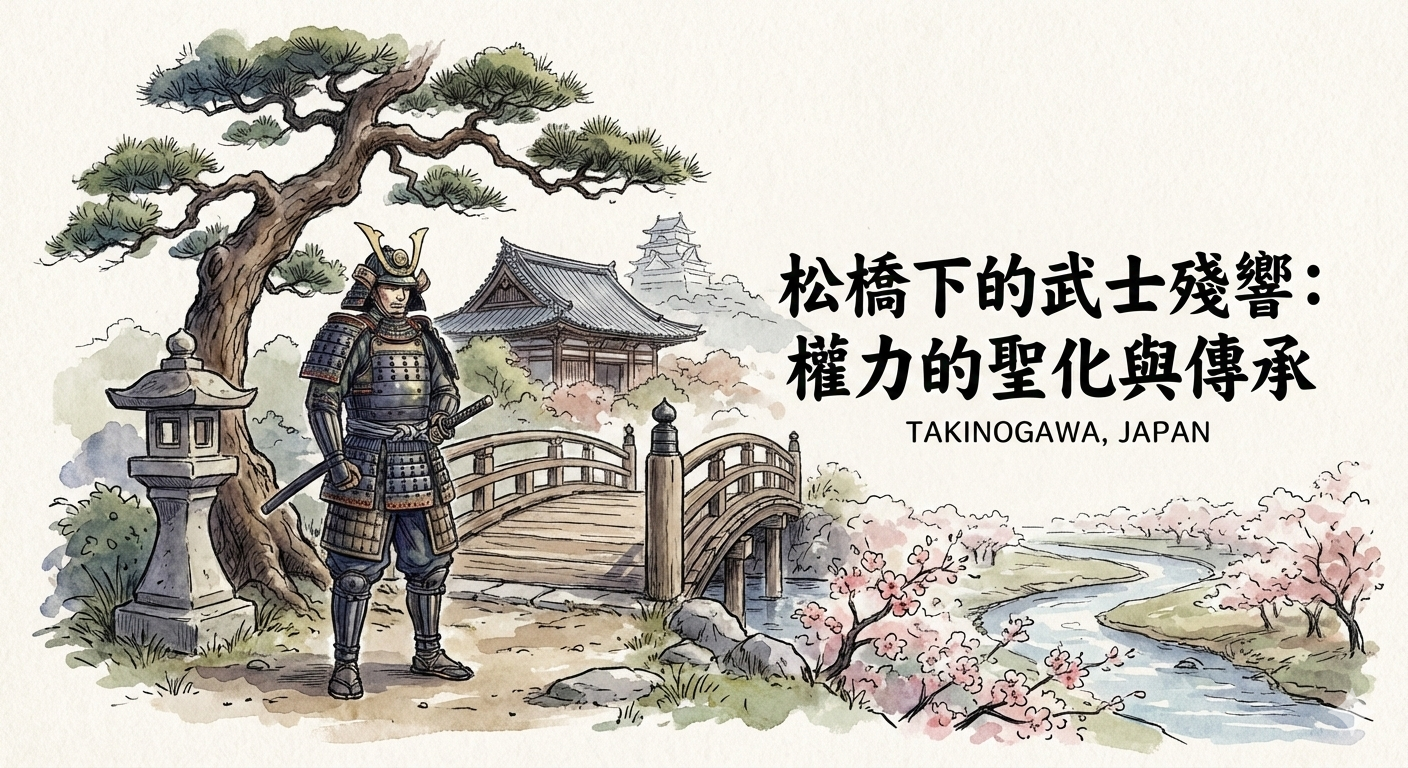
In the Medieval Musashi Province, the strategic command of high ground was the ultimate arbiter of power. Occupation of the Musashino Terrace was more than a military necessity; it was a means of sanctifying a landscape through physical presence. Takinogawa, perched on this bluff, was a natural theater for the rise and fall of warrior clans seeking to dominate the Kanto Plain.
Historical Analysis The history of this high ground is anchored by the Takinogawa clan, a branch of the influential Toshima family. Here stood Takinogawa Castle, a fortification that once commanded the river valley below. Its dominance was brief; in 1477, the castle fell to the legendary strategist Ota Dokan, signaling the collapse of the Toshima family’s influence. Yet, the spiritual legacy of the site predates the castle. In 1180, Minamoto no Yoritomo, founder of the Kamakura Shogunate, famously prayed at the Matsuhashi Benzaiten, linking this soil to the very dawn of the warrior age.
The "So What?" Layer For the historically minded, the choice of the Takinogawa clan to build their castle here was a deliberate attempt to inherit the "historical legitimacy" of Yoritomo. By occupying the ground where the great Shogun once prayed, they sought to bridge the gap between divine favor and military might.
Kongo-ji Temple: Though the physical walls of the 15th-century castle have vanished, this temple serves as the modern anchor point for the medieval narrative.
A fifteen-minute visit to the temple grounds offers a profound spatial experience. To stand here is to recognize the continuity of a site that has been a center of power for nearly a millennium.
Innovation in the Soil (The Edo Burdock Legacy)
The identity of a region is often defined not by the steel of its lords, but by the quiet, persistent labor of those who till its soil. During the Edo period, Takinogawa’s most enduring contribution to Japan was grown in the earth, defining the nation’s culinary heritage for centuries.
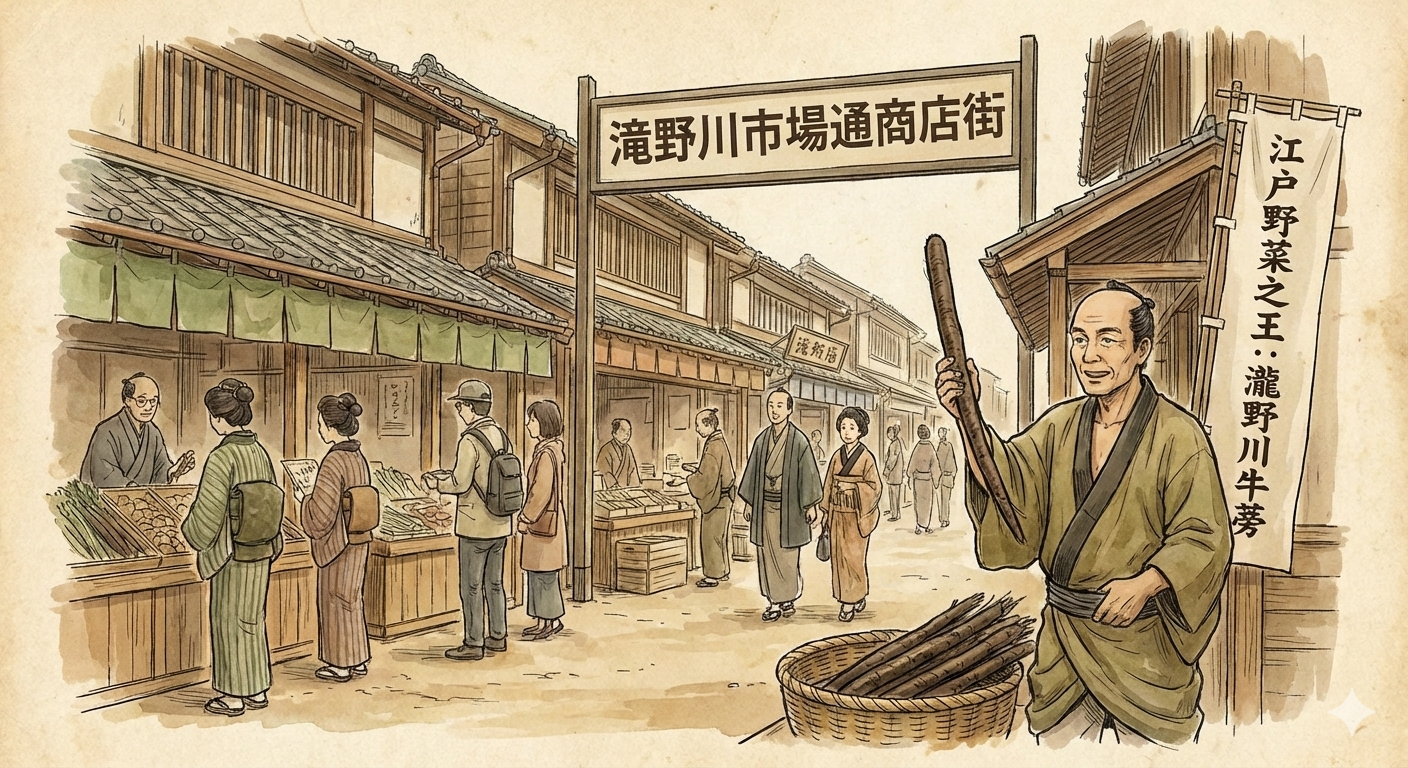
Historical Analysis During the Genroku era (1688–1704), a local farmer named Suzuki Gengo achieved a feat of agricultural engineering. Through careful selection and breeding, he developed the Takinogawa Burdock (Gobo). This variety was so superior in its length, flavor, and adaptability that it became the gold standard for the entire nation.
The "So What?" Layer The impact of this grassroots innovation is staggering: approximately 90% of the burdock varieties cultivated in modern Japan share the genetic lineage of the Takinogawa burdock. This positions the district not merely as an old farming village, but as a global center of food heritage. It proves that innovation is not always mechanical; sometimes, it is the patient refinement of the organic world.
Travel Framing For those seeking the living descendants of this history, walk the Takinogawa Market Street (Shotengai). Here, the agricultural legacy translates into modern commerce, proving that the district’s "innovation in the soil" remains a tangible part of daily Tokyo life.
The Paper Empire (Shibusawa Eiichi’s Vision)
Modernization requires more than just political will; it requires the strategic marriage of geography and industry. The Oji and Takinogawa areas, blessed with the flow of the Shakujii River, became the "cradle of Japanese capitalism" during the Meiji Restoration.
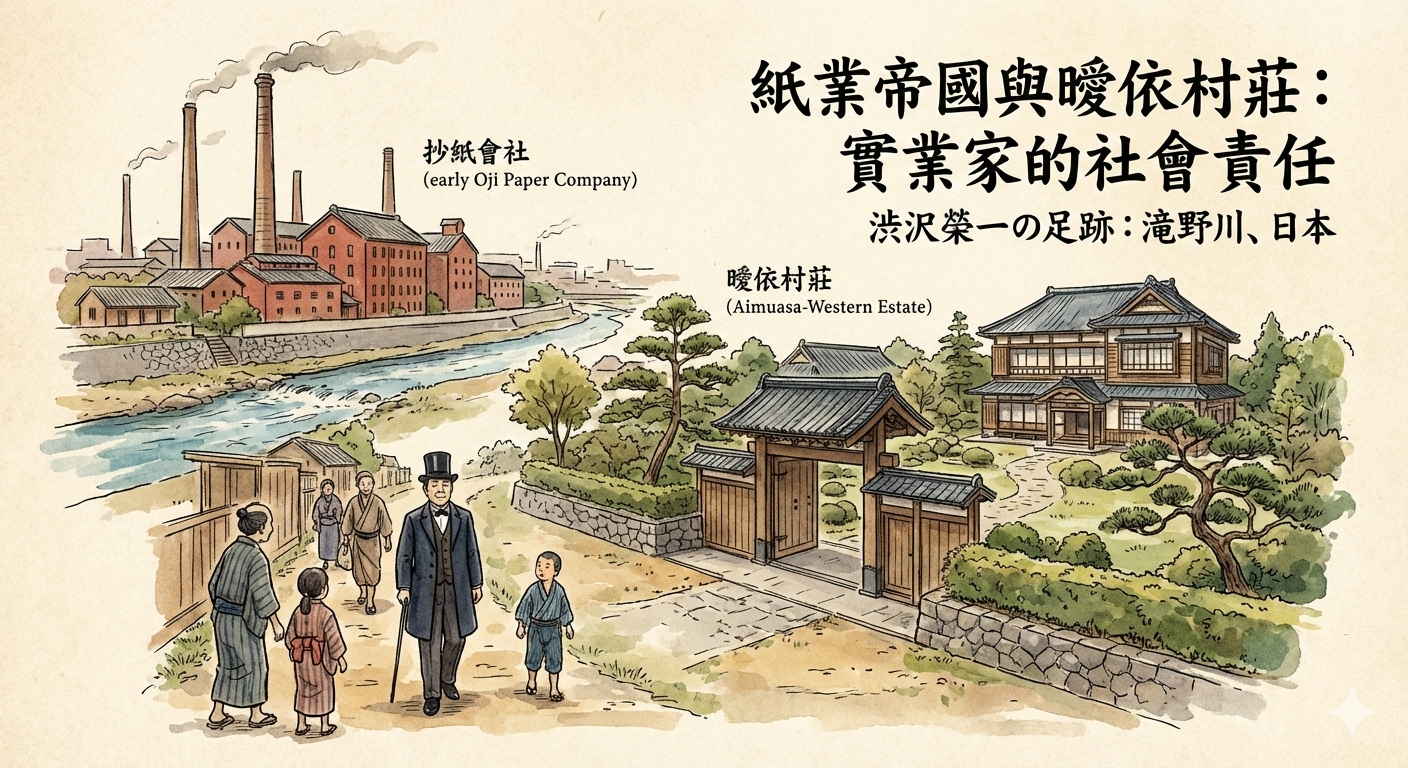
Historical Analysis In 1872, Shibusawa Eiichi—the "Father of Japanese Capitalism"—established the Sho-shi Kaisha (later Oji Paper). He selected this site specifically because the Shakujii River provided the consistent water supply essential for paper milling. In 1879, Shibusawa built his residence, Aii Sonso ("Ambiguous Village"), in Takinogawa, where he lived for over fifty years.
The "So What?" Layer Shibusawa’s legacy is a study in "integrated success." He resided here not as an isolated tycoon, but as a "citizen of Takinogawa," active in local education and police administration. However, his story is also one of resilience. While Shibusawa’s presence shaped the district, the Aii Sonso residence was largely destroyed in a 1945 air raid. This loss highlights the fragility of architecture against the permanence of vision.
Walking Guide Today, the spatial relationship between the Paper Museum, the Shibusawa Memorial Museum, and the surviving garden structures within Asukayama Park allows visitors to trace the path from industrial raw material to the social responsibility of a local leader.
Defending the Milestones (The Ichirizuka Crisis)
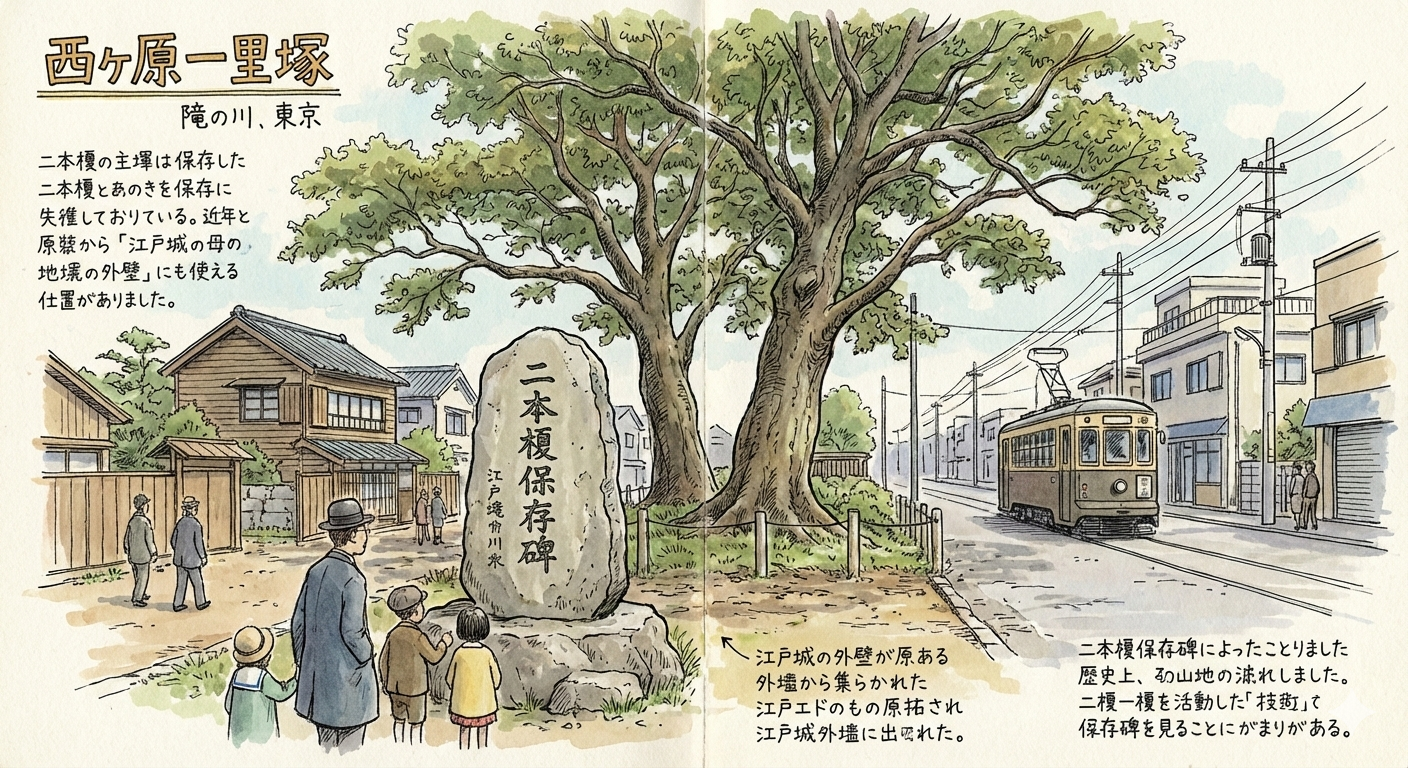
As Tokyo rushed toward modernization in 1916, a crisis arose that forced a choice between infrastructure and heritage. The preservation of the Nishigahara Ichirizuka—the second milestone from Nihonbashi on the old Iwatsuki Highway—became a landmark case for urban conservation.
Historical Analysis Plans for streetcar expansion threatened to demolish the Ichirizuka and its iconic "Nihon-enoki" (twin trees). Shibusawa Eiichi, alongside local town head Nagano Takayoshi, spearheaded a campaign to save the markers. They argued that a "civilized society" must take responsibility for its history even amidst rapid change.
The "So What?" Layer This was a philosophical stand against the erasure of history. To build the preservation monument, they utilized stones repurposed from the outer moat of Edo Castle (Toranomon gate). This was a profound symbolic act: using the physical remains of the Shogunate’s center to protect a marker of the Shogunate’s roads. It was a "civilized choice" to honor the roots of the city.
Spatial Note The twin trees stand today as a physical anchor for the modern walker, a place where the speed of the city was forced to yield to the memory of the Edo traveler.
The Master’s Grace (Nanushi no Taki Park)
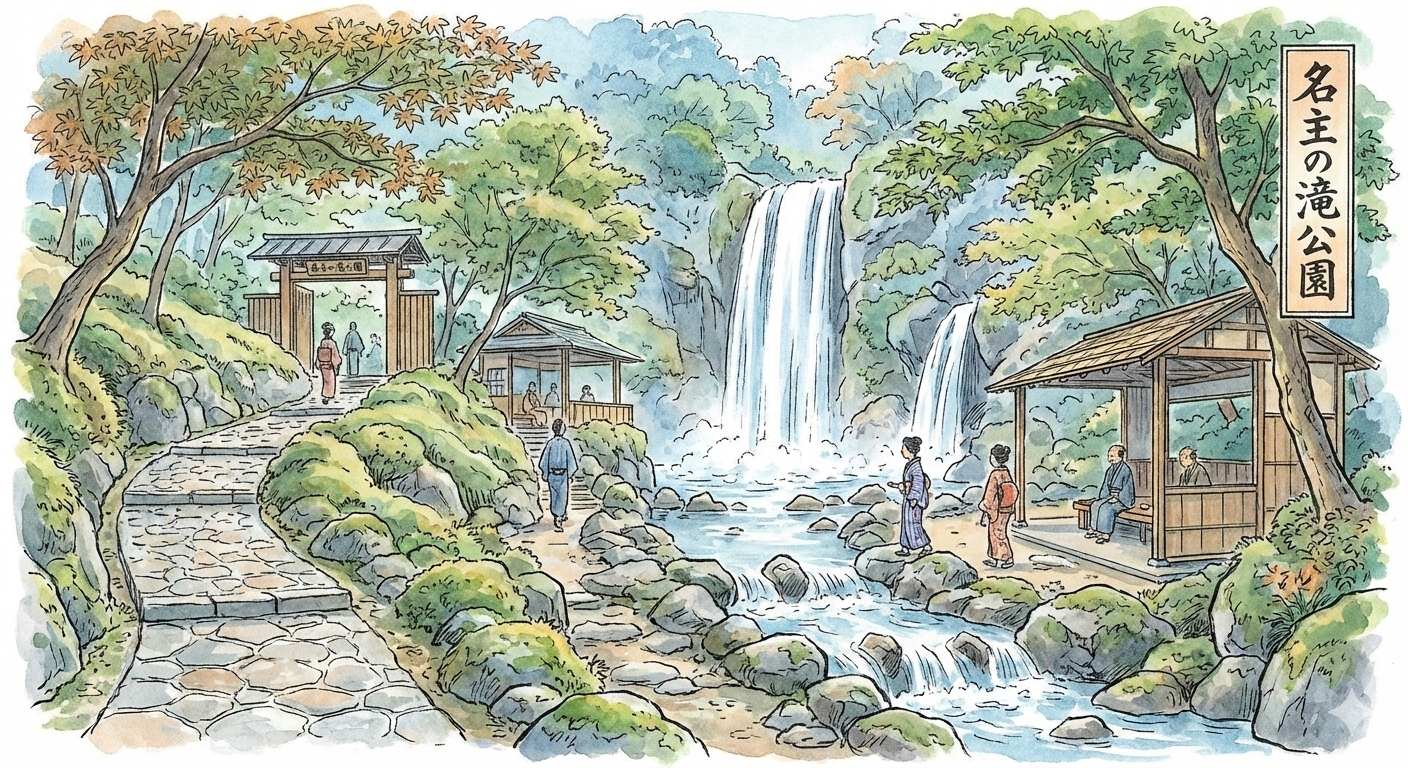
In the urban heat of Tokyo, the concept of "public welfare" often finds its most beautiful expression in water and shade. Nanushi no Taki Park is the result of a "gift of the master," a private sanctuary opened to the public in the Edo period.
Historical Analysis Hatano Magohachi, the local leader (Nanushi) of Oji Village, originally developed this garden at his residence. In a remarkable act of community service, he opened his private retreat to the common people, providing a space for respite from the summer heat.
The "So What?" Layer The park utilizes a Kaiyu-shiki (stroll-style) layout. This aesthetic prioritizes the sensory experience of "coolness" and natural hydraulics over grandiosity. It represents a refined Edo-period sensibility that sought harmony between human design and the landscape’s natural features.
Waterfall Name | Historical/Current Status |
Male Waterfall (O-daki) | The primary, most powerful flow; currently operational. |
Female Waterfall (Me-daki) | A gentler companion to the Male waterfall; currently non-operational. |
Dokko Waterfall (Dokko no Taki) | Named after a ritual implement; currently non-operational. |
Yugyoku Waterfall (Yugyoku no Taki) | "Abundant Jade" waterfall; restored and currently operational. |
From District to Spirit
The history of Takinogawa is a narrative written in water, soil, and stone. Across a millennium, we see a recurring theme of Water, Resilience, and Innovation. From the strategic heights of the samurai to the industrial mills of Shibusawa and the enduring genetic legacy of its burdock, this district has consistently influenced the national stage from its quiet corner of northern Tokyo.
In a city that moves as fast as Tokyo, what does it mean to walk upon a landscape where every step is supported by a thousand years of quiet innovation? To walk through Takinogawa is to realize that the spirit of a place survives long after its administrative borders have been erased.
Join our exploration of the world’s palimpsests. Subscribe to Lawrence Travel Stories for more layered narratives of history and place.
Planning Your Historical Walk
- How to Get There: Access via the Toden Arakawa Line (Tokyo's last surviving streetcar) or by taking the JR line to Oji Station.
- Recommended Walking Route:
- Asukayama Park: Visit the Shibusawa Memorial Museum and the Kyu-Shibusawa Garden.
- Nishigahara Ichirizuka: Walk along the old Iwatsuki Highway to see the preserved twin trees.
- Kongo-ji Temple: Explore the site of the former Takinogawa Castle.
- Nanushi no Taki Park: Conclude in the cool serenity of the waterfalls.
- Nearby Accommodation: Stay near the Oji area for early access to the parks and a base for exploring northern Tokyo.
- Historical Tip: Visit during the Kitsune no Gyoretsu (Fox Parade) season. Local folklore, famously depicted in Hiroshige’s woodblock prints, suggests foxes gathered at an Enoki tree on New Year’s Eve. By linking this folklore to the preserved "Nihon-enoki" milestones, the "layered" narrative of Takinogawa feels truly complete.
Reference materials
- 行ってみたい知っておきたい滝野川の周辺施設をご紹介 - 東京事務所探しプラス, accessed October 13, 2025
- 金剛寺~源頼朝布陣伝承地~ - 中世歴史めぐり, accessed October 13, 2025
- 滝野川城の見所と写真・200人城主の評価(東京都北区) - 攻城団, accessed October 13, 2025
- 滝野川 金剛寺 - 王子生活, accessed October 13, 2025
- 滝野川ゴボウ | 江戸東京野菜について | 東京の農業 - JA東京中央会, accessed October 13, 2025
- 王子・滝野川地域と渋沢栄一 - 東京, accessed October 13, 2025
- 旧渋沢庭園 | 散策ガイド | 飛鳥山3つの博物館, accessed October 13, 2025
- 東京「王子」には何がある?魅力的な観光スポット10選! - スカイチケット, accessed October 13, 2025
- 旧渋沢庭園 クチコミ・アクセス・営業時間|王子・十条 - フォートラベル, accessed October 13, 2025
- 第49巻(DK490115k)本文|デジタル版『渋沢栄一伝記資料 ..., accessed October 13, 2025
- 名主の滝公園 - ヨッコの「ちょい旅と花」たより, accessed October 13, 2025
- 王子の狐火, accessed October 13, 2025
- 王子 狐の行列 公式サイト | 浮世絵「王子装束ゑの木 大晦日の狐火 ..., accessed October 13, 2025