(ENG) 5 Hidden Stories That Will Change How You See Hong Kong: Eastern Kowloon
The stories of Kowloon Bay and Ngau Tau Kok are chapters in a grand urban epic about the constant remaking of a city. From a Song Dynasty well buried beneath a runway to a chic cafe hidden inside a factory, this landscape reveals that the past is never truly erased.

九龍灣Kowloon Bay & 牛頭角 Ngau Tau Kok

Listen attentively to the historical stories told in detail
The City's Buried Soul
When I was young, I lived in Kowloon Bay for more than four years, and my first purchased apartment was there as well. My impression of Kowloon Bay and Ngau Tau Kok has always been summed up in one word—“poverty.” The streets are crowded with people constantly on the move, their pace matching that of Central and Tsim Sha Tsui. The difference is that here, the crowds consist of workers rushing through life simply to earn their daily bread.
At first glance, Kowloon Bay and Ngau Tau Kok present a familiar story of modern Hong Kong: a landscape of gleaming office towers, bustling commercial hubs, and dense residential estates. It is a world of concrete, steel, and ceaseless motion. But beneath this contemporary facade lie the hidden historical codes of a far richer story. This is a place defined by a powerful life force of destruction and reconstruction, where ancient dynasties, industrial grit, and profound transformation converge. The ground beneath your feet, whether original earth or reclaimed land, is a tapestry woven from quarried mountains, forgotten settlements, and the dreams of generations.
This journey will uncover five surprising stories hidden in plain sight. We will peel back the layers of this seemingly ordinary urban landscape, transforming it from a simple map of streets and buildings into a treasure map of hidden history, revealing the true, resilient soul of Hong Kong.
Under the Runway: An Ancient Kingdom Revealed by a Modern Airport
Hong Kong's old Kai Tak Airport is remembered globally as an icon of 20th-century aviation, a thrilling gateway to the city defined by its dramatic landings. There is a profound irony, then, that this symbol of modernity was built directly on top of a thousand-year-old settlement, its history buried and forgotten until progress itself unearthed it.
The discovery was an astonishing accident of development. As construction began for the modern subway system, archaeological teams working beneath the former airport grounds uncovered the extensive remains of a Song Dynasty settlement. The scale of the find was staggering: a total of 5,266 artifacts were unearthed. The discoveries included major remains like ancient wells, kilns, and tombs, and of the artifacts found, over 3,700 were deemed important.
This discovery was a game-changer for Hong Kong's identity. It provided concrete, undeniable proof of a stable and important settlement in the region hundreds of years before the colonial era. It fundamentally deepened the city's historical narrative, pulling its timeline back from a recent colonial outpost to a place with deep, ancient roots connected to the broader sweep of Chinese history.
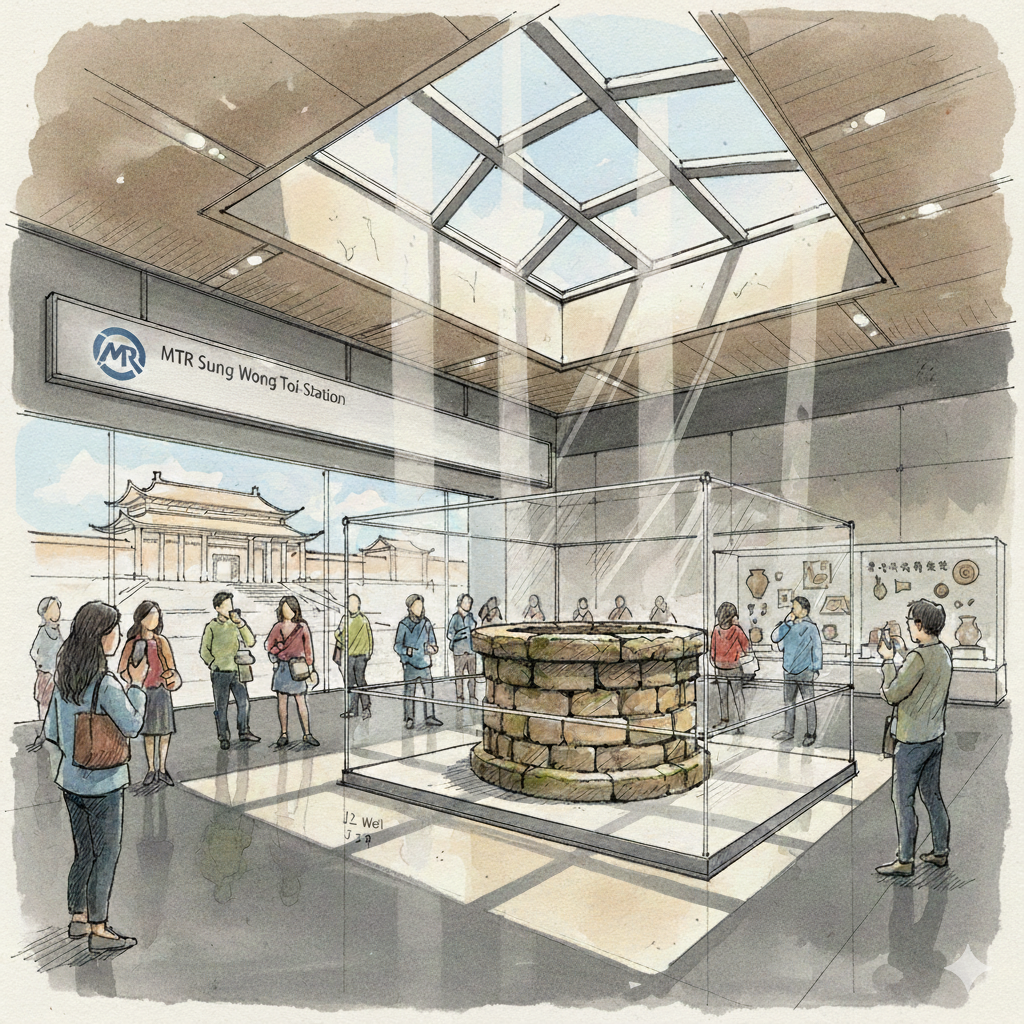
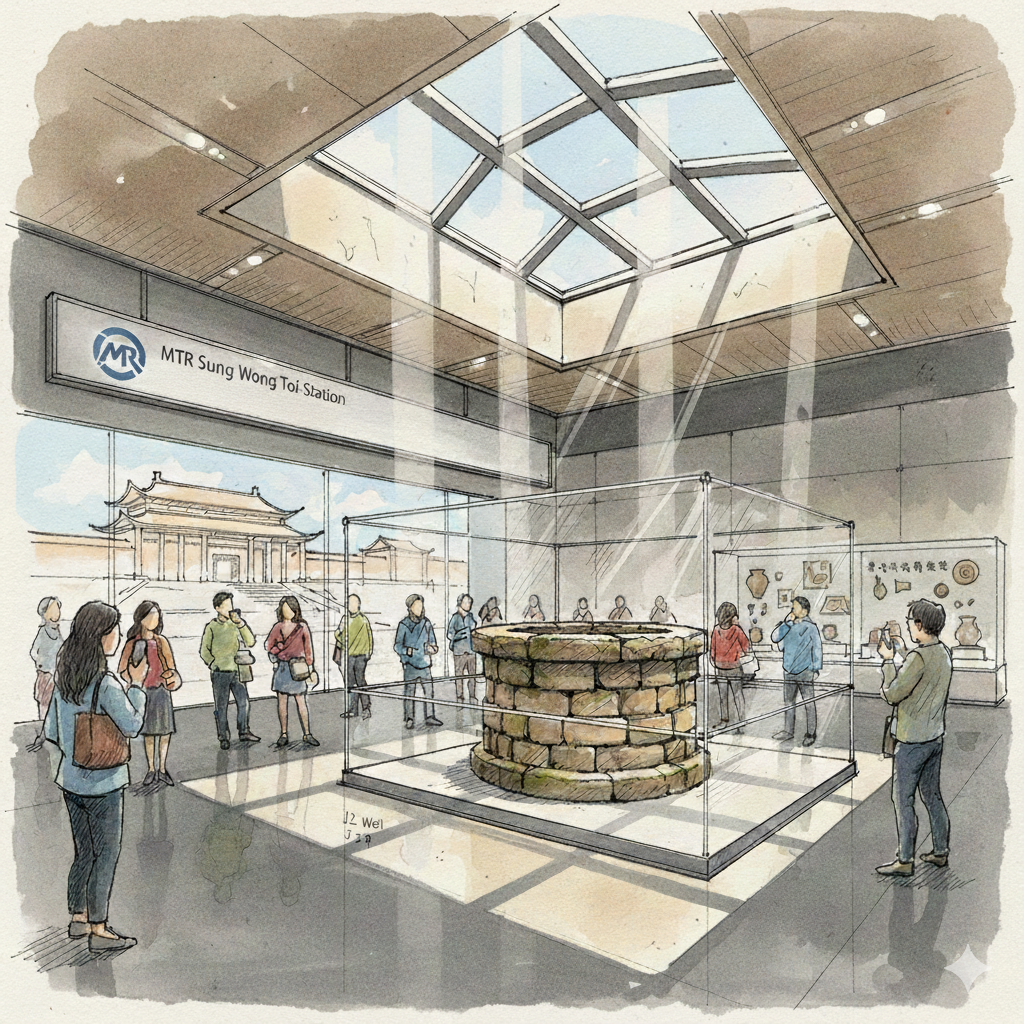
Faced with the challenge of preserving this past amidst ongoing development, the city chose an innovative solution. Instead of removing all the artifacts to a distant museum, many were preserved on-site. In a remarkable fusion of past and present, key relics—most notably the ancient J2 well and its channel—were meticulously placed within the new Sung Wong Toi MTR station. They now rest directly under a massive skylight in the station ceiling, creating an "underground museum" where commuters can literally look down through a window into a thousand years of history.
Hidden Gem: The "Time Window" at Sung Wong Toi MTR Station This is more than a display case; it's a portal in the floor of a busy transit hub where daily commuters can have an unexpected dialogue with a thousand-year-old past. It makes history a living part of the city, and it's just the beginning. The government has proposed building a dedicated Song Dynasty archaeological museum nearby, promising an even deeper dive into the roots buried beneath the runway.
While some parts of this history were accidentally buried, other parts of the landscape were actively sacrificed to build the future.
The Vanishing Cape: How One Place Gave Itself to Create Another
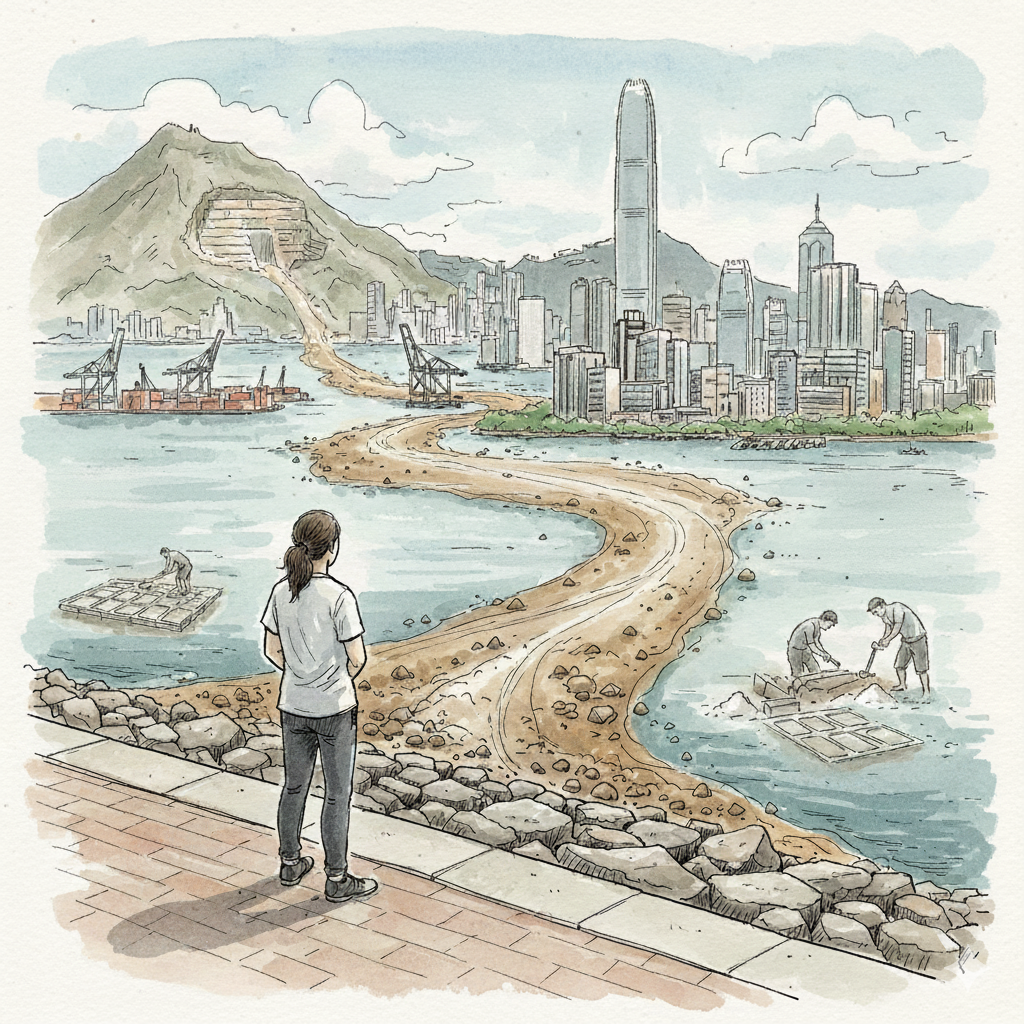
The name Ngau Tau Kok literally translates to "Ox Horn," a title derived from its original geography as a rugged cape jutting out into the sea. Today, that cape is gone, its dramatic shape erased from the map. This is the story of how an entire landform was systematically dismantled, its very substance given up to create the foundation for its neighbor.
Historically, Ngau Tau Kok's identity was forged in stone. It was a key quarrying center, part of the "Four Hills" of granite that provided the essential building blocks for early colonial Hong Kong. Its hills were chipped away piece by piece to construct the city's first piers, buildings, and streets.
This identity of sacrifice reached its zenith in the post-war era. To create the vast, flat land needed for Kowloon Bay's new industrial zones and the expansion of Kai Tak Airport, developers needed an immense amount of fill. They found it in the Jordan Valley area of Ngau Tau Kok. The hills and cape that gave the area its name were quarried away, and the rock and earth were used to fill in the bay. In essence, Ngau Tau Kok was physically moved and dissolved into the sea to become the ground upon which Kowloon Bay now stands. It is a powerful metaphor for Hong Kong's relentless cycle of "creative destruction"—erasing one landscape to engineer another in the name of progress.
Hidden Gem: The View from the Kwun Tong Promenade Stand on the waterfront promenade today, on land that was once open water, and look out at the harbor. You are not just seeing a view; you are standing on the ghost of Ngau Tau Kok's mountains. To truly grasp the scale of this transformation, consult an old map and visualize the original coastline. This spot offers a poignant opportunity to comprehend the immense sacrifice one place made to build another.
This newly formed land became the stage for one of the world's most legendary aviation feats.
The Checkerboard and the Cockpit: A Legend in the Skies
By the 1970s, the jet age was in full swing, and Hong Kong needed to accommodate larger, more powerful aircraft to maintain its status as a vital international hub. The extension of the Kai Tak Airport runway was more than just an engineering project; it was the setting for an aviation legend that pilots and passengers would speak of for decades.
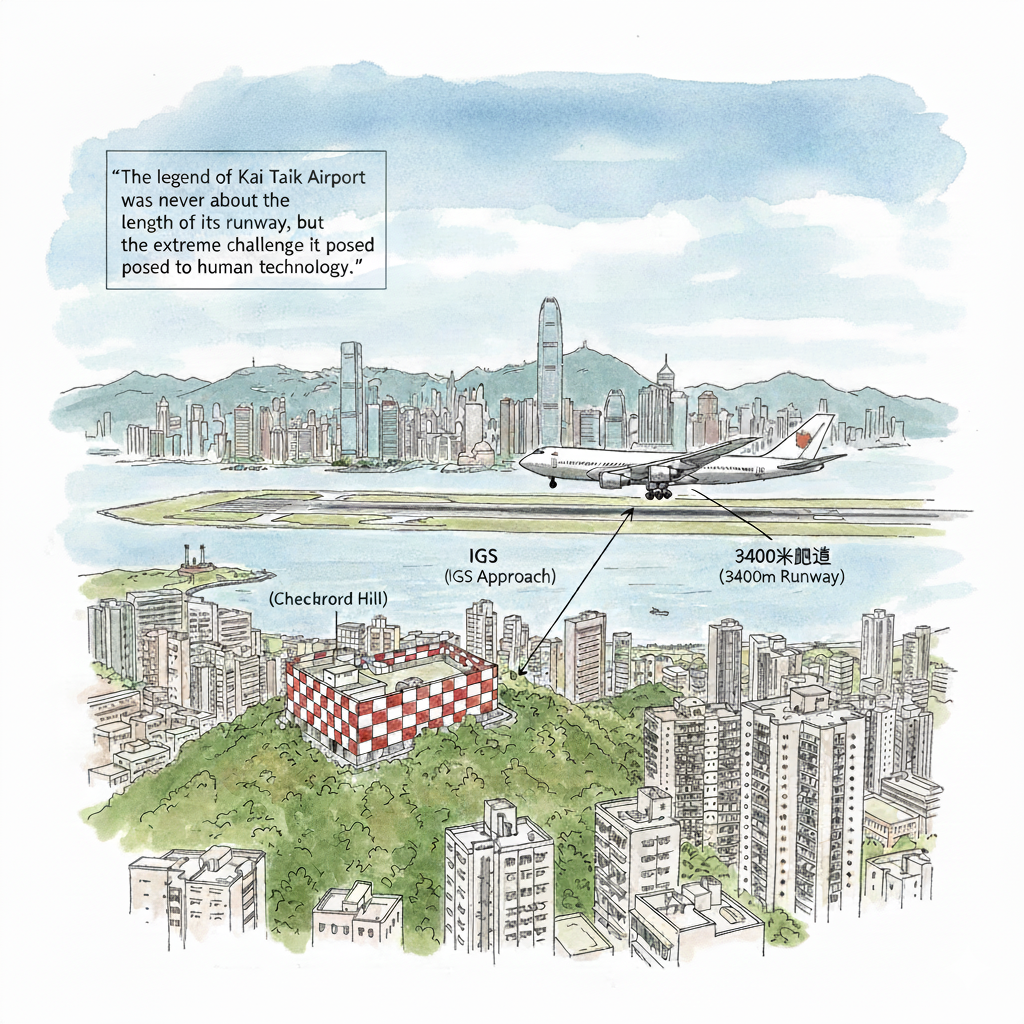
The project was an epic of engineering. The massive land reclamation effort of the 1970s not only created the ground for today's industrial districts but also, crucially, for the new 3,400-meter Kai Tak runway, a concrete spear extending directly into the harbor.
Yet, what made Kai Tak legendary was not its length but its notoriously difficult landing. Because of the surrounding hills, a direct approach was impossible. Pilots had to aim for a giant orange-and-white marker painted on a Kowloon hillside known as Checkerboard Hill (格仔山). Upon reaching this landmark, they had to execute a sharp, low-altitude right-hand turn to align with the runway, a heart-stopping maneuver that became a global symbol of pilot skill and precision. The Checkerboard was the final, critical waypoint in one of the most demanding landings in commercial aviation.
Hidden Gem: The Tip of the Old Runway at Kai Tak Cruise Terminal For the ultimate exercise in historical imagination, walk to the very end of the Kai Tak Cruise Terminal, which sits on the footprint of the old runway. Standing at what was once the threshold, you can look back towards the city and the hills where the checkerboard once stood. From this vantage point, you can almost hear the roar of the engines and picture the breathtaking sight of a jumbo jet banking sharply overhead, its wings seemingly grazing the rooftops as it made its final, famous turn.
The workers who powered this industrial and infrastructural boom—quarrying the hills and building the runways—needed a place to live. This led to a unique social experiment in the shadow of the cranes.
The Concrete Garden: A Self-Sufficient World for the "Pioneering Oxen"
During Hong Kong's post-war industrial boom, the demand for labor was immense, creating an urgent need for worker housing. The Garden Estate (花園大廈) in Ngau Tau Kok was built to meet this need. But it was far more than just a housing project; it was a pioneering experiment in community building, designed to be a self-reliant world for its residents.
The earliest residents called themselves "pioneering oxen" (開荒牛), a name that perfectly captured their experience. Conditions were initially harsh and isolated. Ngau Tau Kok Road was a rough track lacking basic amenities, and for years, residents relied on ferries to get to other parts of the city.
This isolation, however, forced the Garden Estate to become a remarkably self-sufficient ecosystem. The Housing Society designed the ground floors with numerous shop spaces—restaurants, butchers, barbers, and clinics. Because the estate was built before other major developments, its shops had a crucial "first-mover advantage," serving not just its own residents but the entire developing area. The estate even provided worker dormitories for single laborers. This foresight turned it into a vital commercial and social anchor for the nascent community.
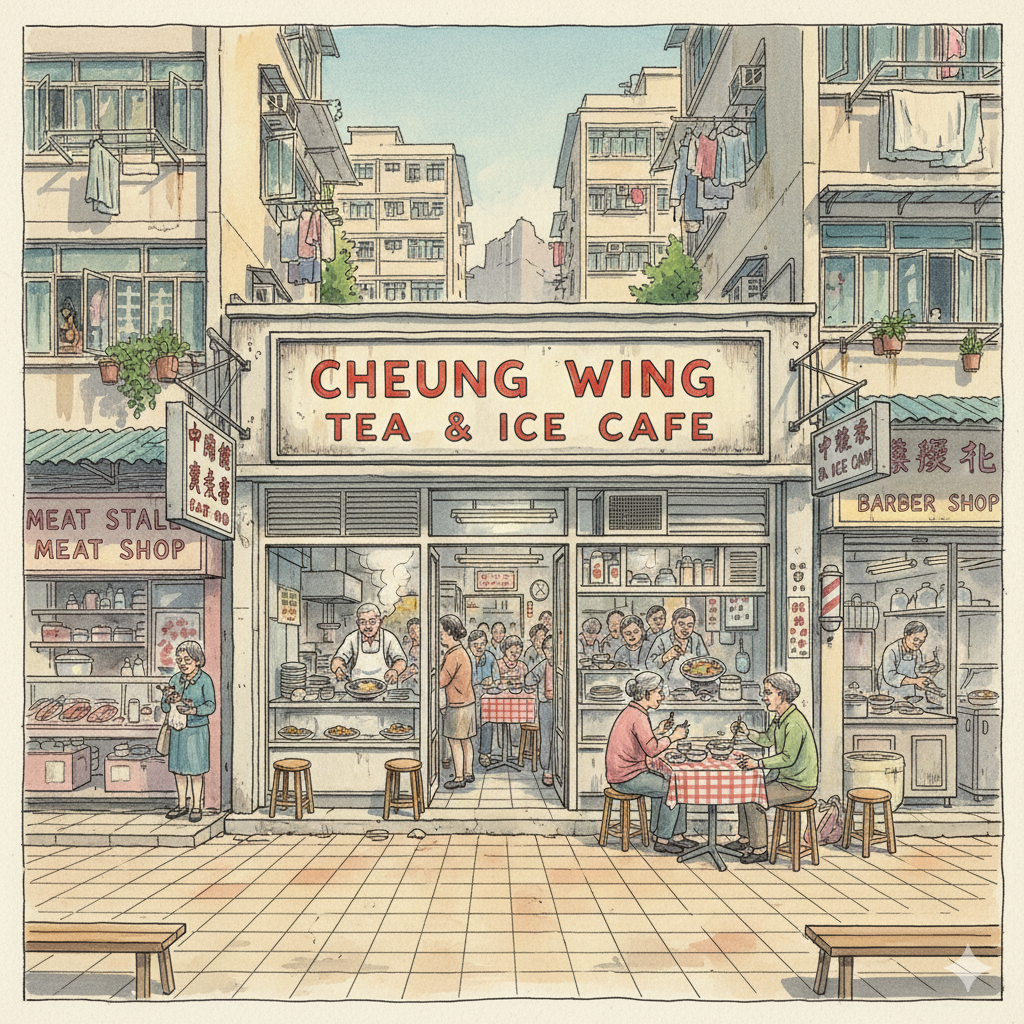
Hidden Gem: The Old-School Shops of Garden Estate, like Cheung Wing Cafe (祥榮茶冰廳) Some of these original businesses still operate, serving as living museums. Visiting Cheung Wing Cafe is not just about tasting nostalgic, "wok-hei" infused pork chop rice. It's about experiencing the enduring spirit of "street-neighbor pricing" (街坊價)—a culture of affordability and mutual support within a tight-knit community—forged during those tough, early years. It’s a taste of the heart that powered Hong Kong’s industrial might.
The very buildings that once housed the industrial machine are now being reborn with a new, unexpected purpose.
The Industrial Chameleon: Where Factories Hide Coffee Shops and Bookstores
The final chapter in this story is one of transformation. As Hong Kong's economy has shifted, the government has designated Kowloon East as its second Central Business District (CBD2). But instead of a wholesale demolition of the old, a surprising and creative evolution is taking place within the area's aging factory buildings.
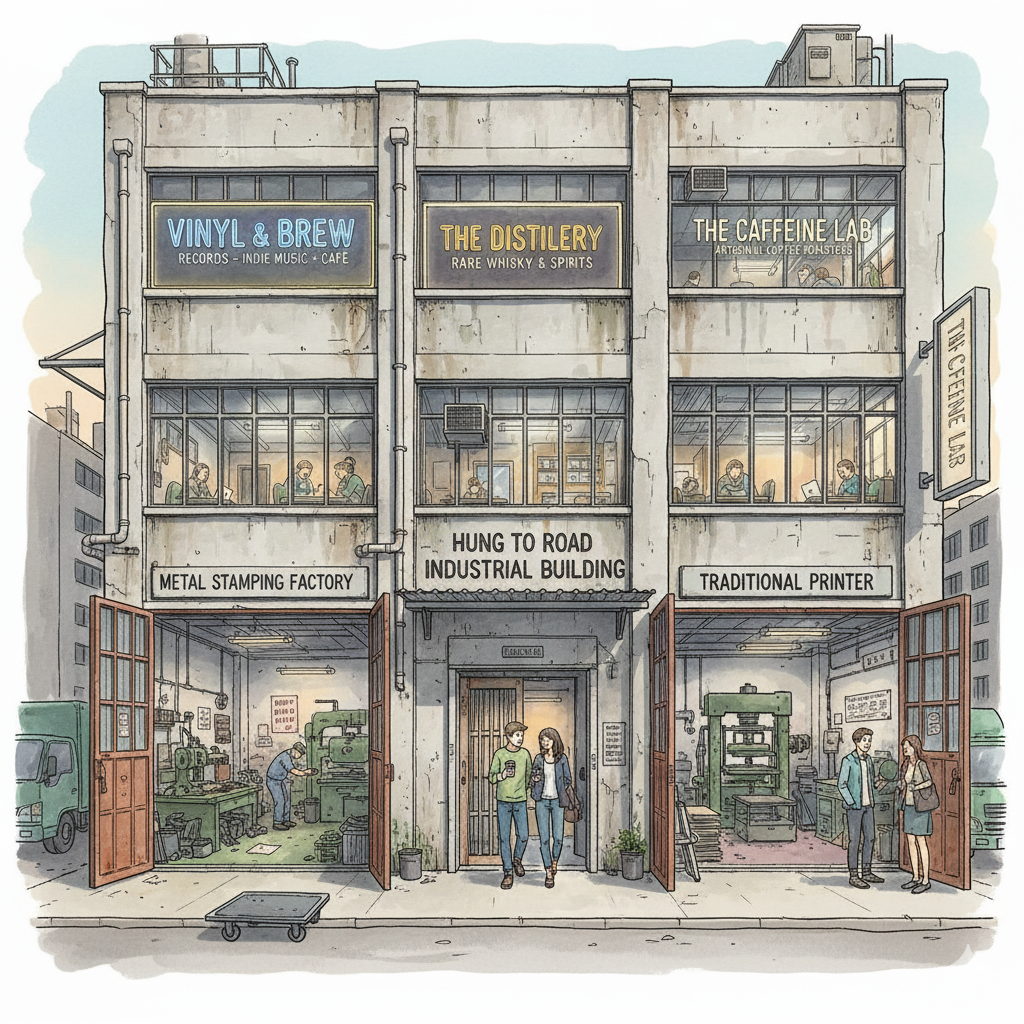
These industrial buildings now house a unique dual ecosystem. On one floor, a traditional metalwork shop or printing press might still be in operation. But on the floor above, you might find a new wave of creative enterprises. Tucked away in these concrete shells are music bookstores, second-hand goods shops (夜冷), specialist whiskey bars, and artisanal coffee roasters.
The primary driver of this creative boom is low space cost. The affordable rent in these functional, no-frills buildings provides a vital "breathing space" for startups, artists, and cultural entrepreneurs who could never afford a storefront in a prime retail district. As a result, Kowloon Bay's industrial zone has become an unintentional incubator for Hong Kong's creative economy, a place where new ideas can take root in old soil.
Hidden Gem: The "Industrial-Chic" Cafes and Studios on Hung To Road The experience of discovering these places is part of their magic. You enter a gritty, functional factory building, ride a clanking freight elevator, and emerge into a beautifully designed coffee shop or a quiet independent bookstore. The contrast is stark and compelling: the peaceful aroma of brewing coffee mixing with the rumble of delivery trucks outside. This is the most tangible sign of Hong Kong’s economic adaptability.
This final transformation perfectly encapsulates the area's continuous, centuries-long cycle of reinvention.
Reading the Layers of the City
The stories of Kowloon Bay and Ngau Tau Kok are chapters in a grand urban epic about the constant remaking of a city. From a Song Dynasty well buried beneath a runway to a chic cafe hidden inside a factory, this landscape reveals that the past is never truly erased. Instead, it is "folded" into the layers of the present, waiting to be rediscovered.
Together, these five stories—of buried foundations, sacrificed mountains, legendary landings, resilient communities, and creative rebirth—form a microcosm of the Hong Kong spirit. They are a powerful testament to the city's incredible capacity for survival and resilience, its ability to adapt, reinvent, and build a future without completely forgetting its past. They remind us that every city is a living document, rich with stories.
What hidden stories are waiting to be discovered in the streets you walk every day?
Works Cited
- Kwun Tong District Legends | HK Culture 18 Districts. Retrieved October 21, 2025.
- Sorry—170 Years of Land Reclamation—Map—Kowloon Bay’s “Sea Changes and Mulberry Fields” (Accessible version). Retrieved October 21, 2025.
- How archaeological relics found in Kowloon Bay and nearby areas can be developed jointly with other local monuments. Retrieved October 21, 2025.
- Kai Tak Airport’s Checkerboard Hill has been restored to
 Lawrence
 Lawrence
commemorate its legend! | r/aviation - Reddit. Retrieved October 21, 2025.
- Architectural Article—Historical and Cultural Heritage Program. Retrieved October 21, 2025.
- Review of Cheung Wing Café—Hong Kong Ngau Tau Kok’s Hong Kong-style café/ice room | OpenRice. Retrieved October 21, 2025.
- Kowloon Bay Factory Buildings — Wikipedia. Retrieved October 21, 2025.
- [Area’s Small Shops 2025] 9 Surviving Local Restaurants in Ngau Tau Kok! Factory canteens/old Shanghai cuisine/tatami cafés/curry beef brisket rice | eatwo. Retrieved October 21, 2025.