(ENG) 5 Stories That Will Change How You See Taipei: A Journey Through Zhongshan District's Hidden History
Protect a city's cultural memory is not an act of nostalgia; it is a investment in its future identity. Stories of Zhongshan reveal this beauty.
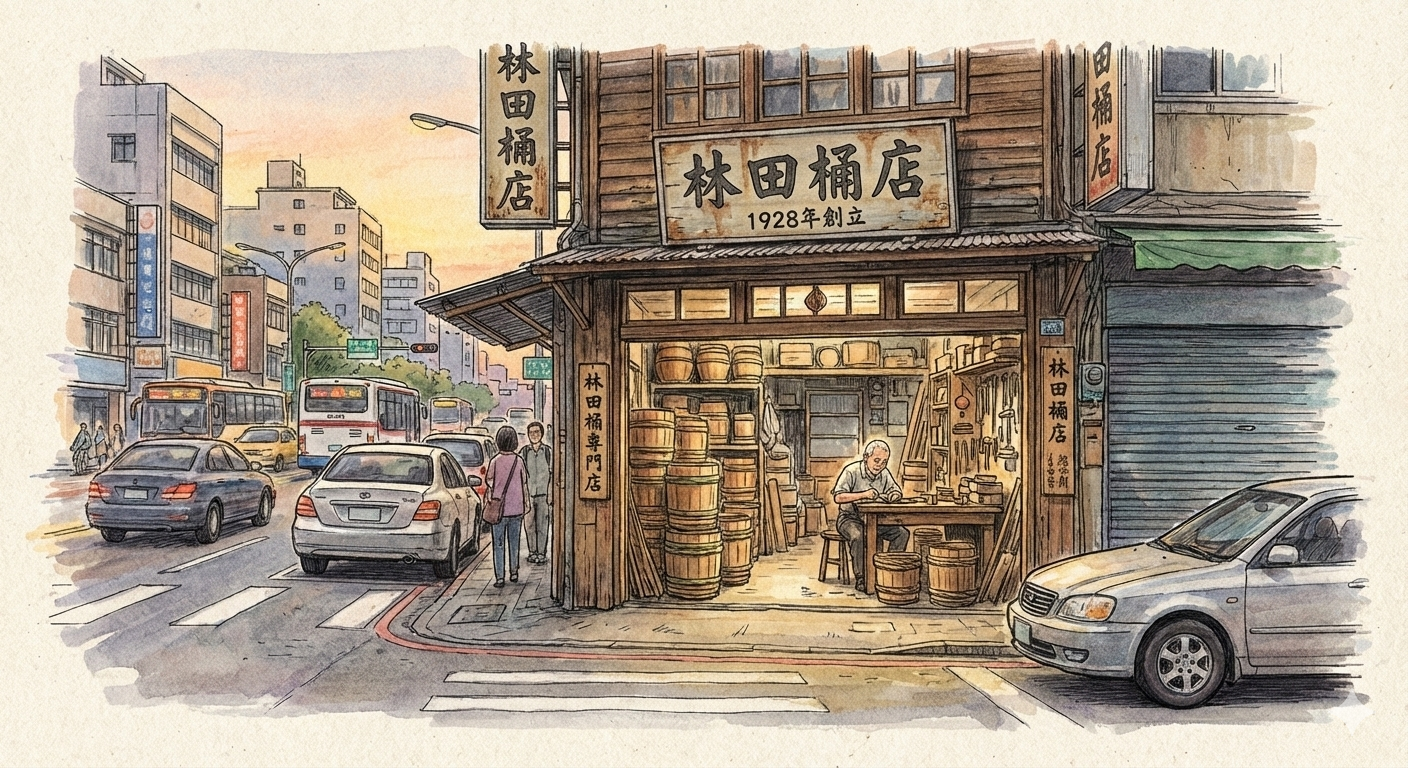
林田桶店 Linsen Wooden Bucket Shop > 大直的劍潭古寺 Dazhi Jiantan Temple
Listen attentively to the historical stories told in detail
Beyond the Neon Façade
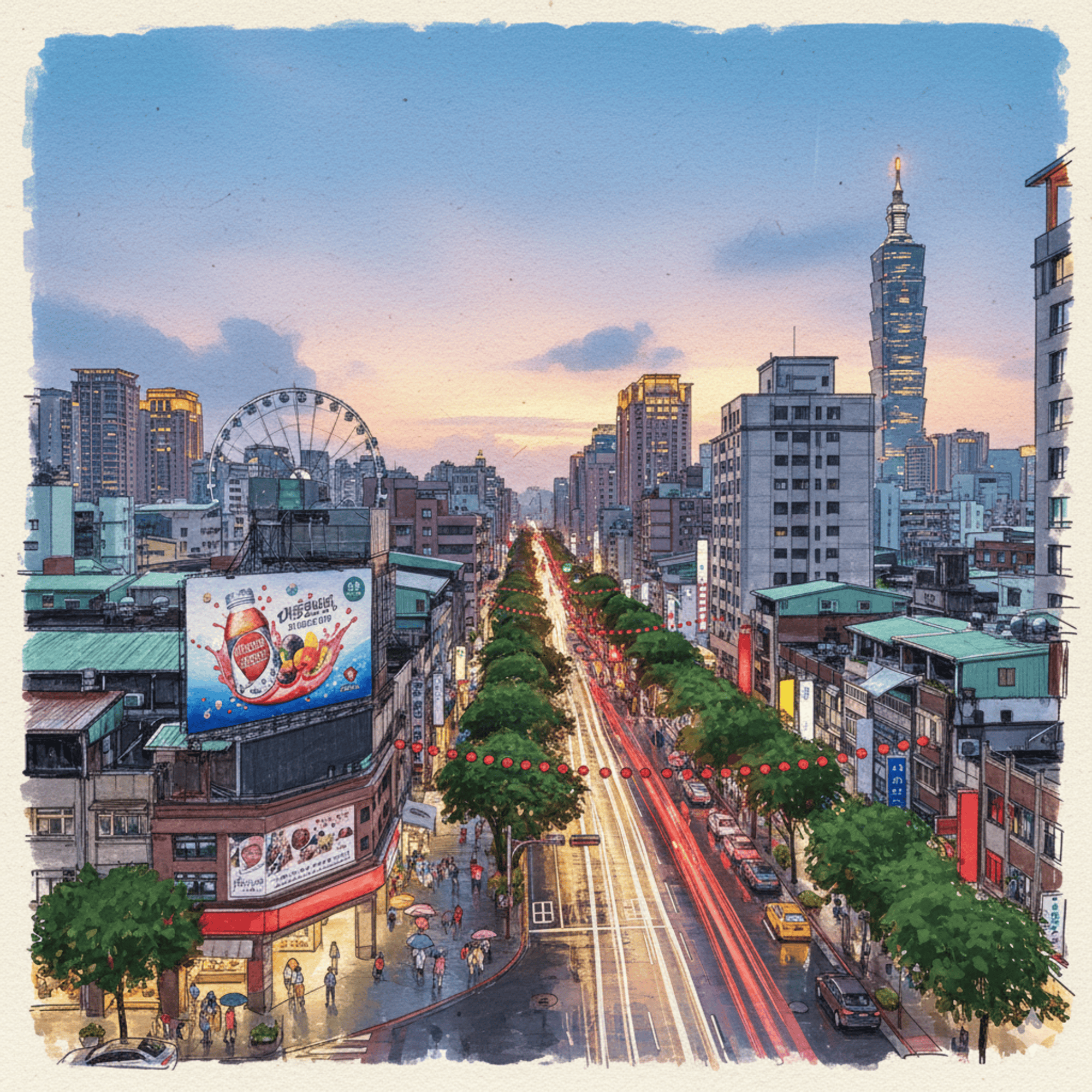
We often experience a modern city as a dazzling but anonymous collection of glass skyscrapers, rushing traffic, and bustling commercial streets. It’s easy to walk through a metropolis like Taipei and see only its vibrant, contemporary surface. But beneath this neon façade, etched into the very layout of its avenues and alleys, are profound stories of power, resilience, ambition, and memory. In a district like Zhongshan, the past isn't just a distant memory; it's a living presence, silently shaping the world we see today.
This journey will uncover five such stories, each revealing a surprising truth about how a city is made, unmade, and remembered. From a century-old workshop that has outlasted highways to a sacred temple torn from its legendary home, these narratives offer more than just historical facts—they provide a glimpse into the very soul of Taipei.
The Living Fossil: How a 100-Year-Old Bucket Shop Measures a City’s Frantic Pulse
To truly understand a city, we must learn to read its quietest elements. Sometimes, the most powerful stories aren't found in grand monuments but in the small, seemingly anachronistic places that have stubbornly refused to change. These cultural anchors provide a fixed point against which we can measure the dizzying velocity of urban transformation.
In the heart of Zhongshan District's relentless modernity stands the Linsen Wooden Bucket Shop (林田桶店). Founded in 1928, the shop is a veritable "living fossil" on what was once the ceremonial "Chokushi Kaido," a grand avenue built during the Japanese colonial era to connect Taipei's central station to the powerful Taiwan Grand Shrine. For nearly a century, this humble workshop has been a silent witness to history, watching as Japanese aristocrats, international heads of state, and celebrities passed its doors.
The shop’s significance lies in its stillness. Its unchanging nature acts as a ruler against which the district's dramatic evolution can be measured. From its storefront, the owners witnessed the construction of Taipei's first elevated highway, the Fuxing Viaduct, in 1955, and then watched its demolition just forty years later in 1995—a powerful symbol of the city's shifting philosophies on urban planning. While the cars outside grew sleeker and the buildings taller, the timeless craft inside remained constant; remarkably, the interior still retains the appearance it had when American President Eisenhower's motorcade passed by in 1960. This endurance is not passive; its survival is a product of both geographical "inertia" and the owner's active "perseverance," a testament to the traditional lifeblood that continues to flow beneath the commercial surface.
In a city obsessed with the future, the most profound story is often told by what refuses to change. The Linsen Wooden Bucket Shop doesn't just sell buckets; it holds a century of Taipei's memory.
- Hidden Gem: Visit Linsen Wooden Bucket Shop (林田桶店). Stand before this century-old establishment and observe the stark contrast between the traditional, handcrafted wooden wares inside and the ceaseless flow of modern traffic just feet away. It's a rare opportunity to feel the relentless pulse of urban change from a point of perfect stillness.
This story of quiet endurance stands in sharp contrast to the district's next chapter, which was a loud, bold declaration of post-war ambition cast in concrete and steel.
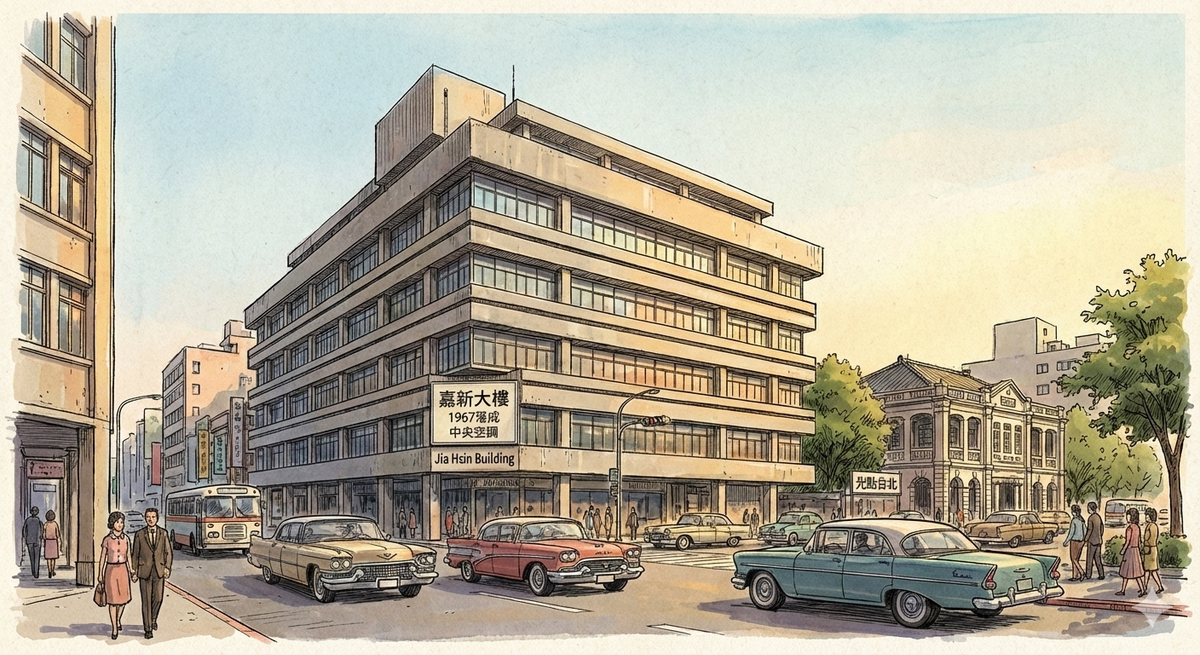
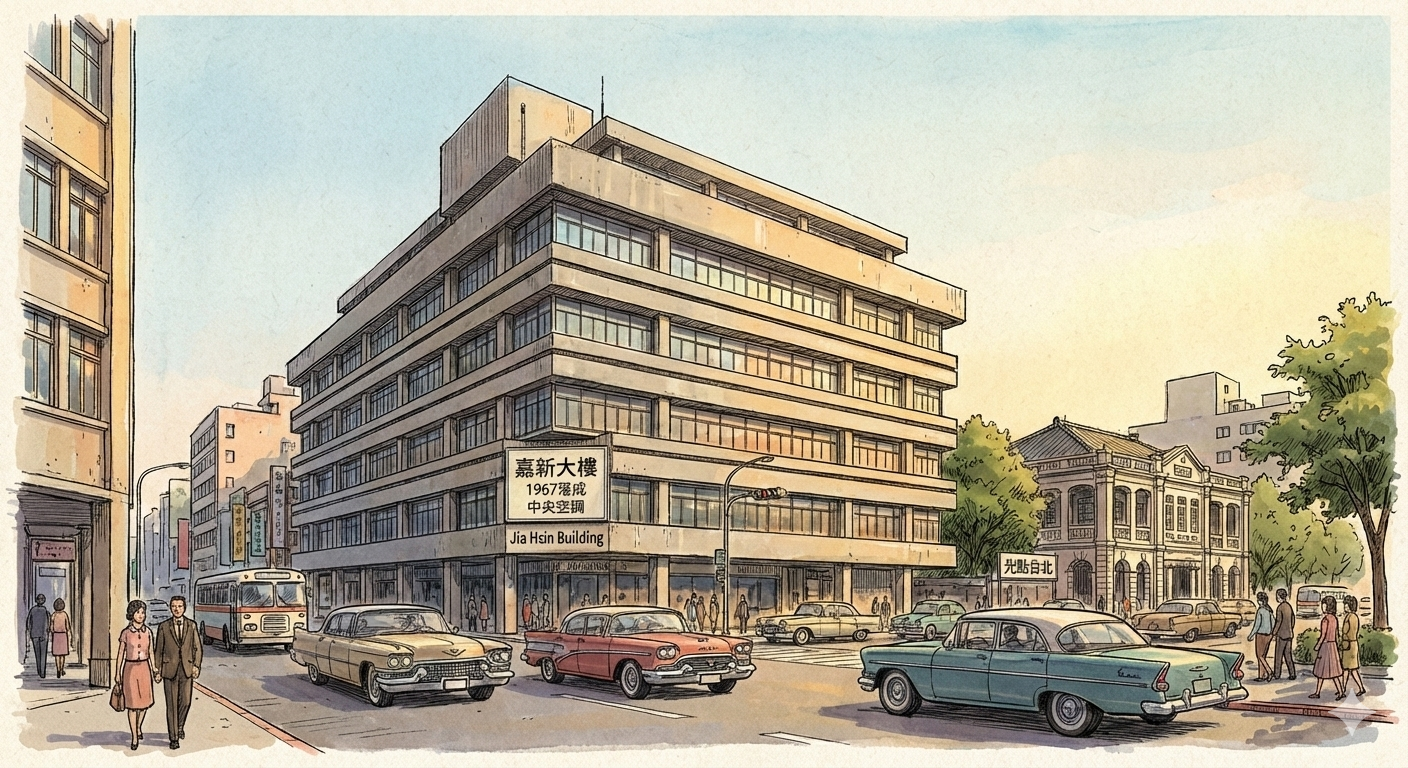
The Modernist Statement: When Air Conditioning Was a Declaration of Independence
In the landscape of a developing nation, architecture is never just about shelter; it is a statement of intent. For post-war Taiwan, rebuilding its identity and economic ambition required more than policy—it required physical symbols that could project a new, modern face onto the world stage.
The Chia Hsin Building (嘉新大樓), completed in 1967, was precisely such a symbol. Designed by Chang Chao-kang, one of the first Chinese architects trained in the Bauhaus tradition, it was a landmark of international modernism rising on Zhongshan North Road. Its clean lines and functional form were a deliberate break from the past, signaling Taiwan's embrace of a global future.
But its most revolutionary feature wasn't aesthetic; it was atmospheric. The Chia Hsin Building was Taiwan's first commercial high-rise equipped with central air conditioning. In the 1960s, this was more than a luxury—it was a monumental declaration. It signaled that Taiwan could provide a world-class business environment, capable of attracting international corporations and competing on the global economic stage. Paired with the nearby Ambassador Hotel, which opened in 1964, the building helped transform Zhongshan North Road from a colonial ceremonial route into a dynamic hub for international commerce, where American sedans lined the streets and a new era of prosperity felt palpable.
- Hidden Gem: Admire the clean, modernist lines of the Chia Hsin Building (嘉新大樓) and then visit the nearby SPOT Taipei (光點台北). This allows you to witness the area's transformation firsthand. You can see the center of post-war economic ambition (Chia Hsin) and then, just steps away, the elegant conversion of a former diplomatic powerhouse—the U.S. ambassador's residence—into a beloved public cinema and cultural space.
This successful projection of modernity, however, came at a cost. The next story reveals how the same top-down forces of redevelopment can sever a community's deepest cultural roots.
The Uprooted Temple: A Dragon-Slaying Legend Severed from Its Home
A city’s soul is woven from its stories, and those stories are inextricably tied to the land. Sacred legends and cultural memory draw their power from physical geography. When political power reshapes that landscape, it can do more than move buildings; it can silence a narrative and erase a memory from the map.
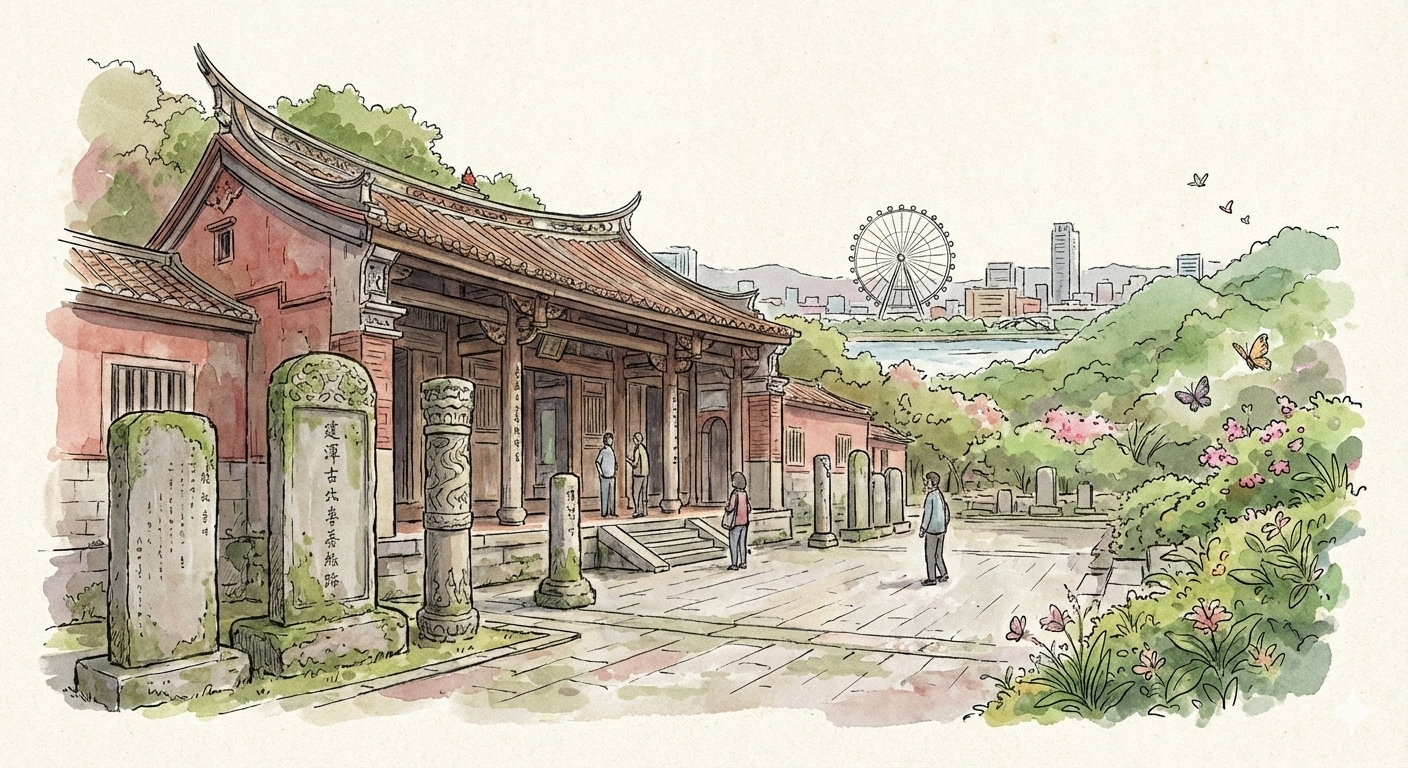
The very name "Jiantan" (劍潭), or Sword Lake, originates from a foundational myth: the hero Koxinga (鄭成功) is said to have slain a vicious water dragon in the Keelung River here, calming its waters with his sword. This legend imbued the area with a sacred, heroic identity. At its heart was the Jiantan Temple (劍潭古寺), originally named Guanyin Temple. As one of Taipei's most ancient temples, with origins in the Ming-Zheng period, it sat for centuries in a location of perfect feng shui, nestled against the mountains and facing the water.
This ancient connection was severed between 1937 and 1940. The Japanese colonial government, seeking to expand the grounds of the Taiwan Grand Shrine—the highest symbol of colonial authority—forcibly relocated the temple. This was not a simple move but a calculated act of cultural erasure. By uprooting the temple, the authorities severed it from the very landscape that gave its founding legend meaning. They cleared the way for an unimpeded, dominant colonial symbol, systematically weakening one of the area's most potent local narratives. Though the temple was rebuilt in Dazhi, the move stripped it of its geographic and spiritual context. It lost its profound connection to the land and its former prominence, leaving it with a desolate, quiet air that speaks more of loss than of simple relocation.
A temple can be rebuilt, but its soul is tied to the land. The story of Jiantan Temple is a somber reminder that the most lasting wounds of power are not inflicted on buildings, but on the memories they hold.
- Hidden Gem: Visit the relocated Dazhi Jiantan Temple (大直劍潭古寺) to see the original stone pillars and other historical artifacts that survived the traumatic move. Afterward, for a moment of powerful reflection, visit the nearby Jiantan Butterfly Garden (劍南蝶園). From this natural sanctuary, you can overlook the modern city and contemplate the complex, often fraught, relationship between human history and the natural landscape it occupies.
While Jiantan Temple's story is one of cultural loss, our next story reveals the powerful resilience of culture in the face of overwhelming commercial pressure.
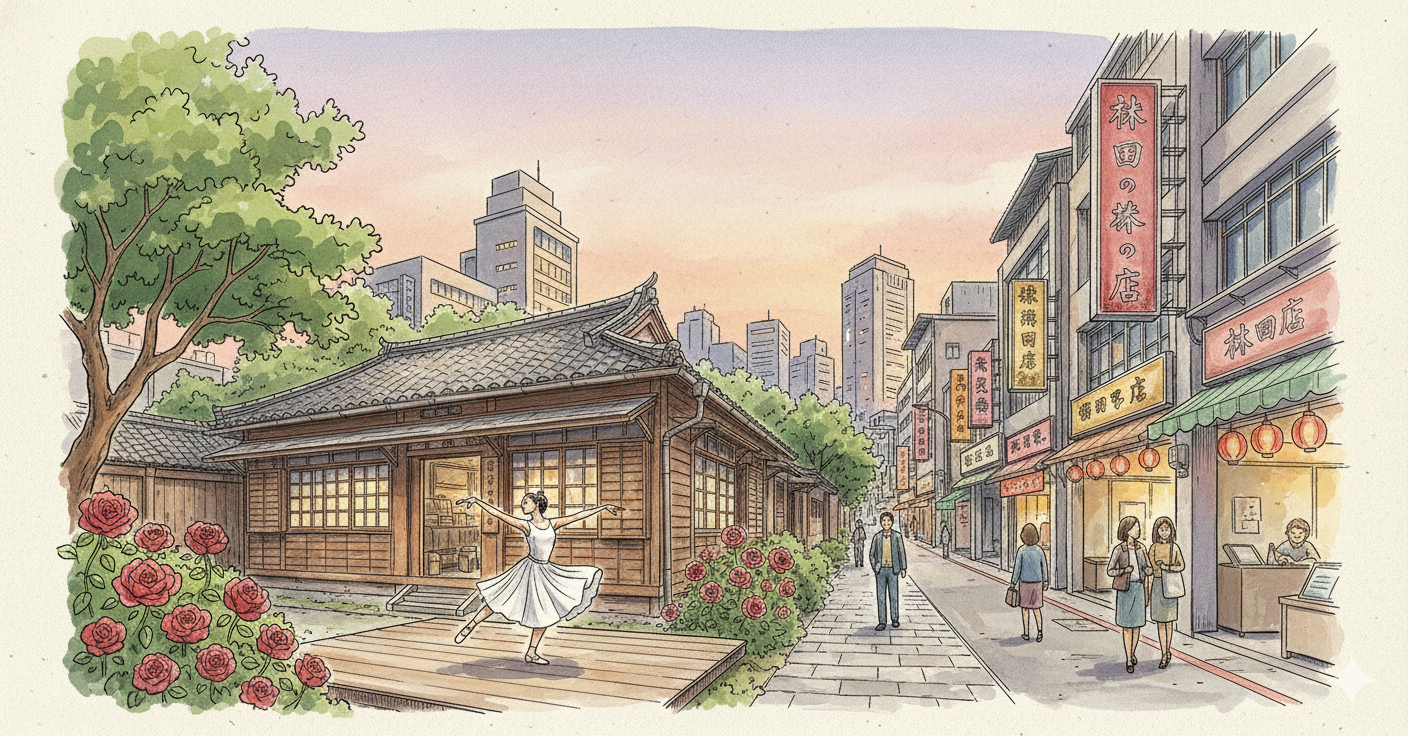
The Rose in the Nightlife District: Art's Fierce Resilience
In a city’s most commercially driven spaces, culture often struggles to find a foothold. The "Tiaotong" (條通) alleys of Zhongshan District, long famous for a vibrant nightlife shaped by the presence of the U.S. military and Japanese tourist groups since the 1960s, are a prime example. Yet, it is precisely in such unexpected places that cultural anchors can emerge, offering a powerful counter-narrative to their surroundings.
Tucked away amidst the neon signs and bustling restaurants is the Tsai Jui-Yueh Dance Research Institute (蔡瑞月舞蹈社), a site affectionately known as the "Rose Heritage Site" (玫瑰古蹟). This simple Japanese-style house was the cradle of modern dance in Taiwan, founded by the pioneering dancer Tsai Jui-Yueh. Its very existence creates a fascinating tension: a place of serious,本土 (local) artistic creation thriving in the heart of a district defined by international consumerism and entertainment.
The institute’s journey is a testament to cultural tenacity. It has survived decades of urban development pressure, fought for its official recognition as a historic site, and was even rebuilt after a devastating fire. Its nickname, the "Rose," perfectly captures its identity: beautiful, fragile, and yet armed with thorns of resilience. The institute stands as a powerful example of "resilient resistance," proving that local culture can not only survive but also flourish in the most challenging urban environments, providing a space for identity and art against all odds.
- Hidden Gem: Visit the Rose Heritage Site—Tsai Jui-Yueh Dance Research Institute (玫瑰古蹟—蔡瑞月舞蹈社). Explore the beautifully preserved space to learn about the history of modern dance in Taiwan. Then, take a walk through the surrounding Tiaotong alleys to fully appreciate the profound contrast between this quiet cultural sanctuary and the energetic commercial world that envelops it.
From the visible struggles for cultural preservation in the city's core, we turn to the quiet acts of conservation happening in its more forgotten corners.
The City's Quiet Corners: Finding History in University Campuses and Butterfly Gardens
Not all of a city's history is written along its main thoroughfares. Sometimes, the most precious fragments of the past are preserved in its "buffer zones"—spaces like university campuses or ecological reserves that are shielded from the relentless pace of commercial development. These quiet corners often function as unintentional archives, holding onto pieces of history and nature that would otherwise be lost.
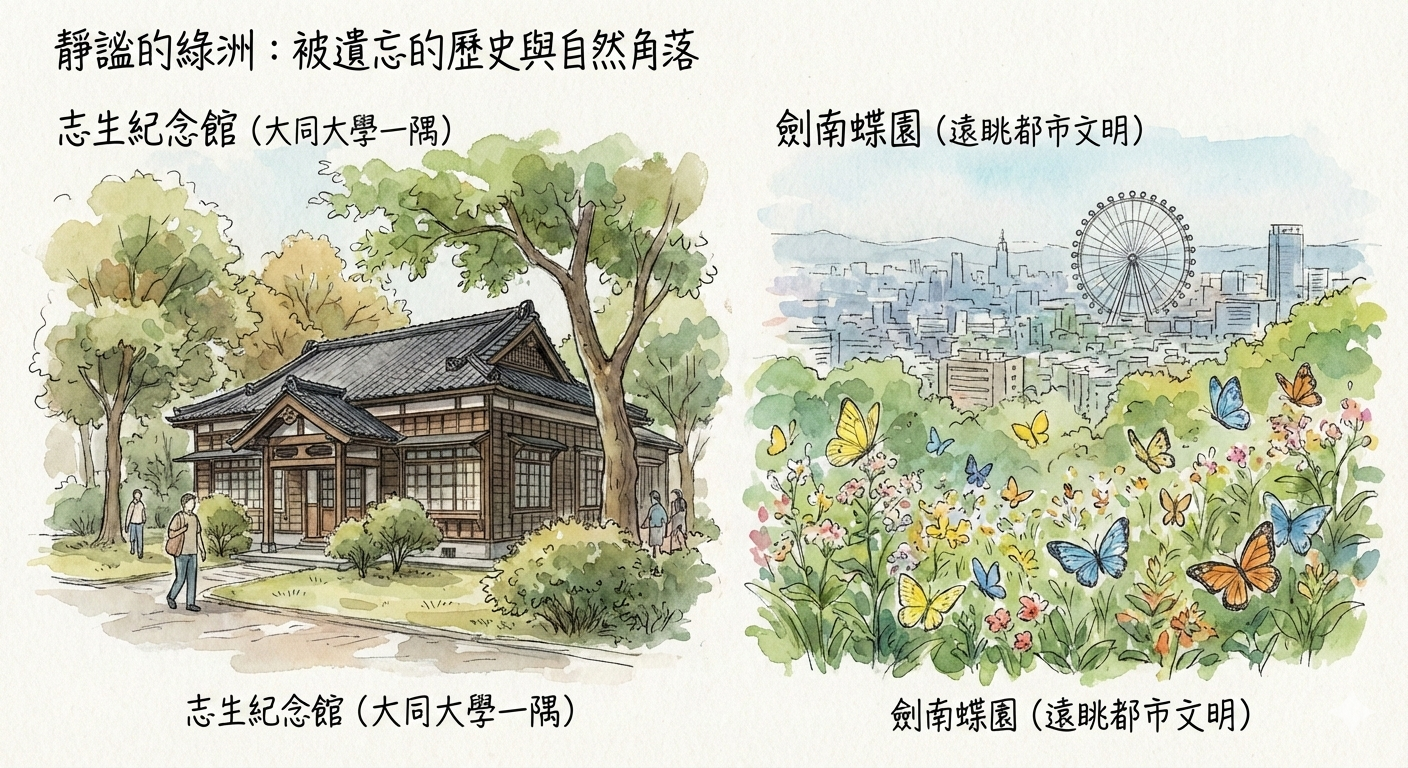
Zhongshan District is home to two remarkable examples. The first is the Shisheng Memorial Hall (志生紀念館), a historic Japanese-style house tucked away, almost hidden, within the campus of Tatung University. Protected by the academic institution, this piece of private history has remained a "static" fragment, untouched by the commercial transformation happening just outside the university's walls. The second is the Jiantan Butterfly Garden (劍南蝶園), an ecological conservation area on the district's fringe, representing Taiwan's only outdoor ecological butterfly conservation park.
Though one is cultural and the other natural, these two sites share a common function. They are the city's quiet spaces, preserving memory and nature precisely because they lie outside the primary commercial axis. Their value is magnified by their contrast with the modern world. Standing in the tranquil butterfly garden and seeing the massive Miramar Ferris Wheel turning in the distance is a powerful reminder of what is saved when we choose to set certain spaces apart.
- Hidden Gem: Pair a visit to the little-known Shisheng Memorial Hall (志生紀念館) with a trip to the Jiantan Butterfly Garden (劍南蝶園). This unique "tour of tranquility" allows you to experience the parts of the city that have been saved by being set apart. It offers a rare and vital space for reflection on what a city gains by preserving its quiet corners.
These five stories, woven together, create a more complex and meaningful map of Taipei.
The Unwritten Map of a City's Soul
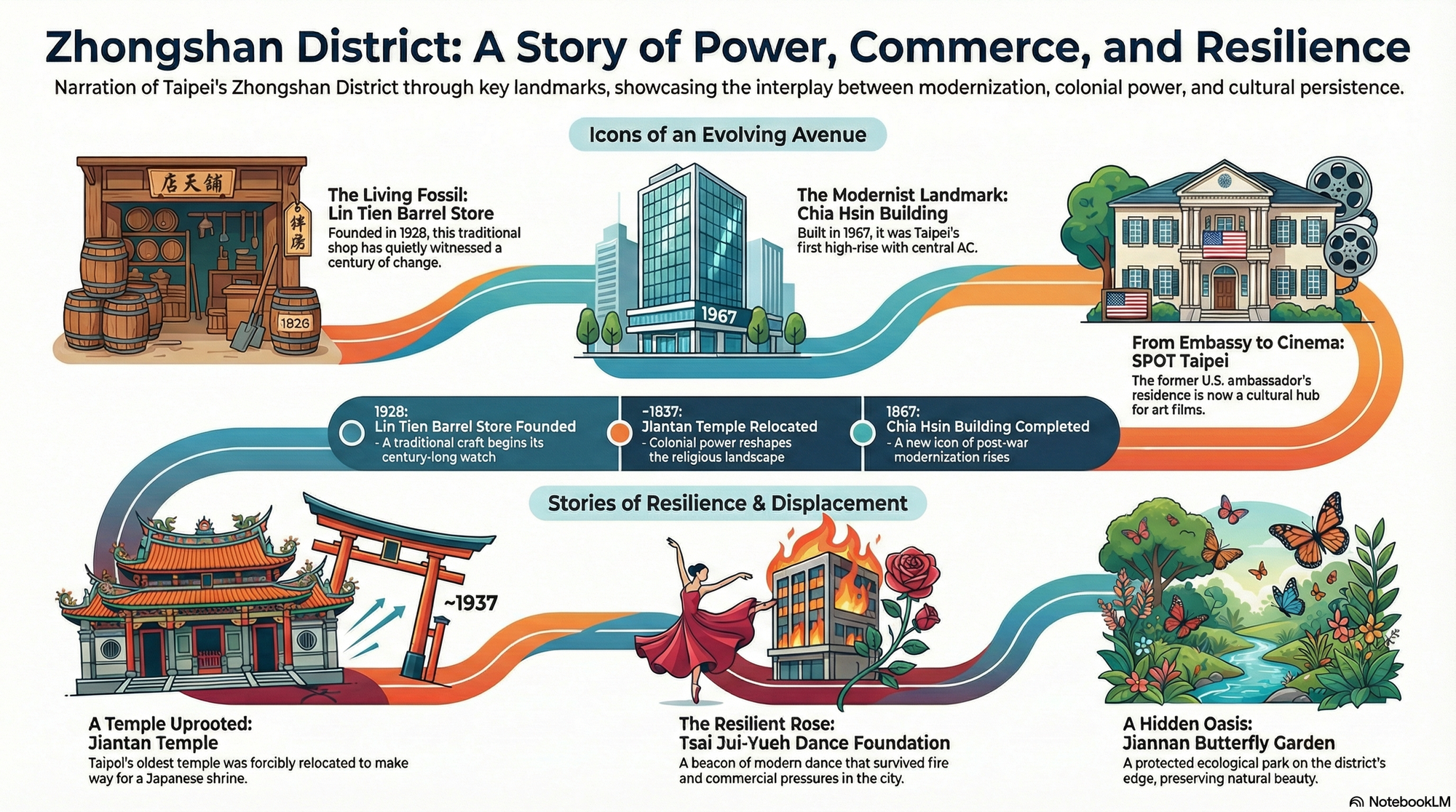
A city’s true character is not found in a single narrative of progress but in the dynamic, often conflicting, tensions between change and permanence, displacement and resilience. The stories of Zhongshan District reveal this beautifully. The fleeting nature of grand infrastructure, like the Fuxing Viaduct, and the imposition of colonial power, seen in the relocation of Jiantan Temple, stand in stark contrast to the enduring strength of grassroots memory and culture found in the century-long vigil of the Linsen Wooden Bucket Shop and the tenacious rebirth of the Tsai Jui-Yueh Dance Institute.
These stories teach us a vital lesson about urban development. Protecting a city's cultural memory is not an act of nostalgia; it is a crucial investment in its future identity. By understanding the forces that have shaped, erased, and preserved the landscape, we become more conscious guardians of the places we inhabit. The most meaningful parts of a city are often those that whisper rather than shout.
The next time you walk down a familiar street, what forgotten stories might be waiting for you, hidden in plain sight?
 Lawrence
 Lawrence