(ENG) Beyond Taipei 101: Xinyi Will Change How You See the City's Busiest District
Xinyi is a city of layers, where an agricultural past flows beneath a financial present, and a military memory stands in a commercial future.

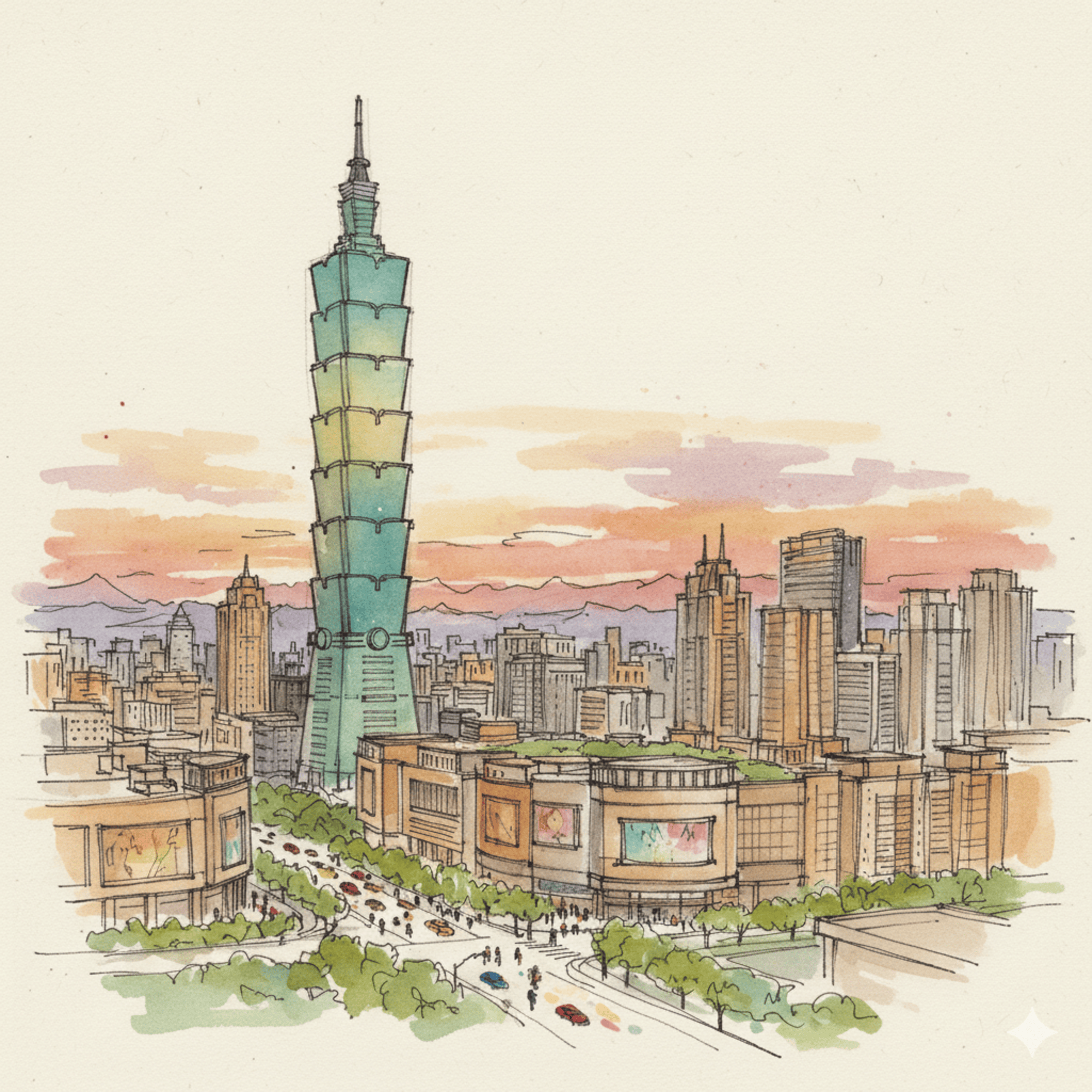
台北101 Taipei 101
Listen to the historical stories told in detail (For subscribers only)
Picture Taipei's Xinyi District. Your mind likely summons the image of Taipei 101, a spear of glass and steel piercing the clouds. You see the gleaming facades of luxury department stores, the rivers of people flowing along meticulously planned avenues, and the vibrant pulse of a global financial hub. This is the Xinyi we know—a city of the future, built on ambition and concrete. But this hyper-modern landscape is not what it seems. It is a "time fault," a place where centuries of forgotten history are compressed and layered just beneath the surface, waiting to be discovered. Peel back the chrome and glass, and you'll find a world of ancient waterways, military villages, and industrial empires waiting to tell their stories.
The Lost River: How an Ancient Waterway Nourishes the City's Roots
To truly understand a city, you must first understand its geography. Before the skyscrapers and stock tickers, there was only land and water. Xinyi's story begins not with finance, but with farming—a way of life made possible by a critical, and now invisible, source of nourishment.
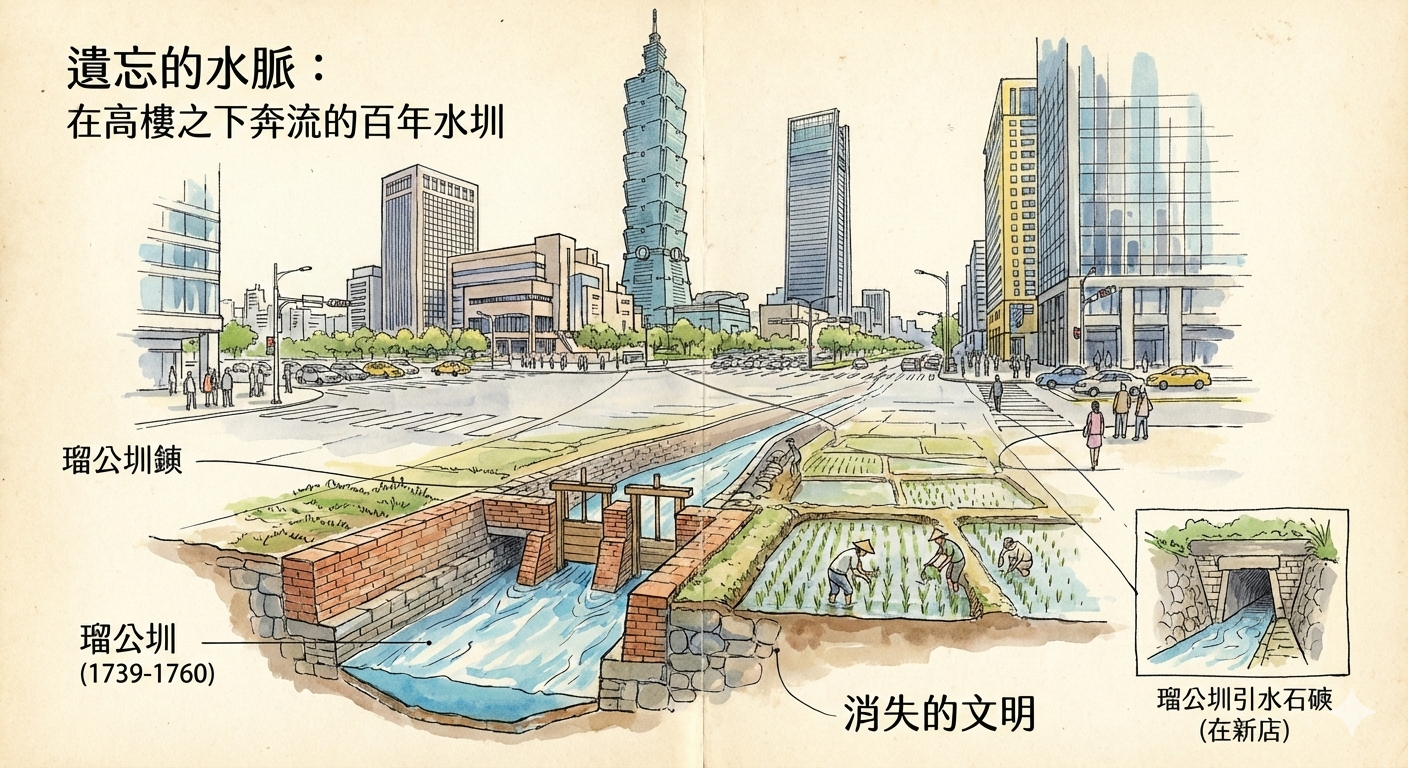
Long before it was a commercial center, this land was a patchwork of fertile fields sustained by the Liugong Canal. Driven by the ambition of pioneer Guo Xiliu and his family, this massive irrigation project began in 1739 and took over two decades to complete, finally bringing water to the Taipei basin in 1760. It was an engineering marvel that, by the Japanese era, had grown into a complex network absorbing eight major irrigation ponds. This "disappeared civilization" of canals was the true foundation of the district. But as the city modernized, this lifeline was sacrificed for progress; the life-giving canals were covered over, paved, and transformed into major arteries like the bustling Xinyi Road.
The irony of this transformation is profound. The city’s modern pulse—the ceaseless flow of traffic and commerce—now runs directly over its forgotten lifeline. The very water that once nourished rice paddies now flows unseen beneath the feet of bankers and shoppers, a silent testament to the district's agricultural past.
For a tangible connection to this lost world, urban explorers can seek out this hidden gem: The Liugong Canal Intake Stone Tunnel (瑠公圳引水石硿). Although located in New Taipei City's Xindian District, it's the very origin point of the water that once fed all of Xinyi, offering a powerful sense of the project's immense scale.
This agricultural era would eventually give way to an age of conflict and migration, forever changing the landscape once again.
The Time Capsule Village: A Glimpse of Post-War Life in the Shadow of Skyscrapers
In the aftermath of the Chinese Civil War, Taiwan's strategic importance surged, and Xinyi's open fields were repurposed into a key military zone. This pivotal shift brought a new wave of people to the area, who built communities that would become living monuments to an era of profound change.
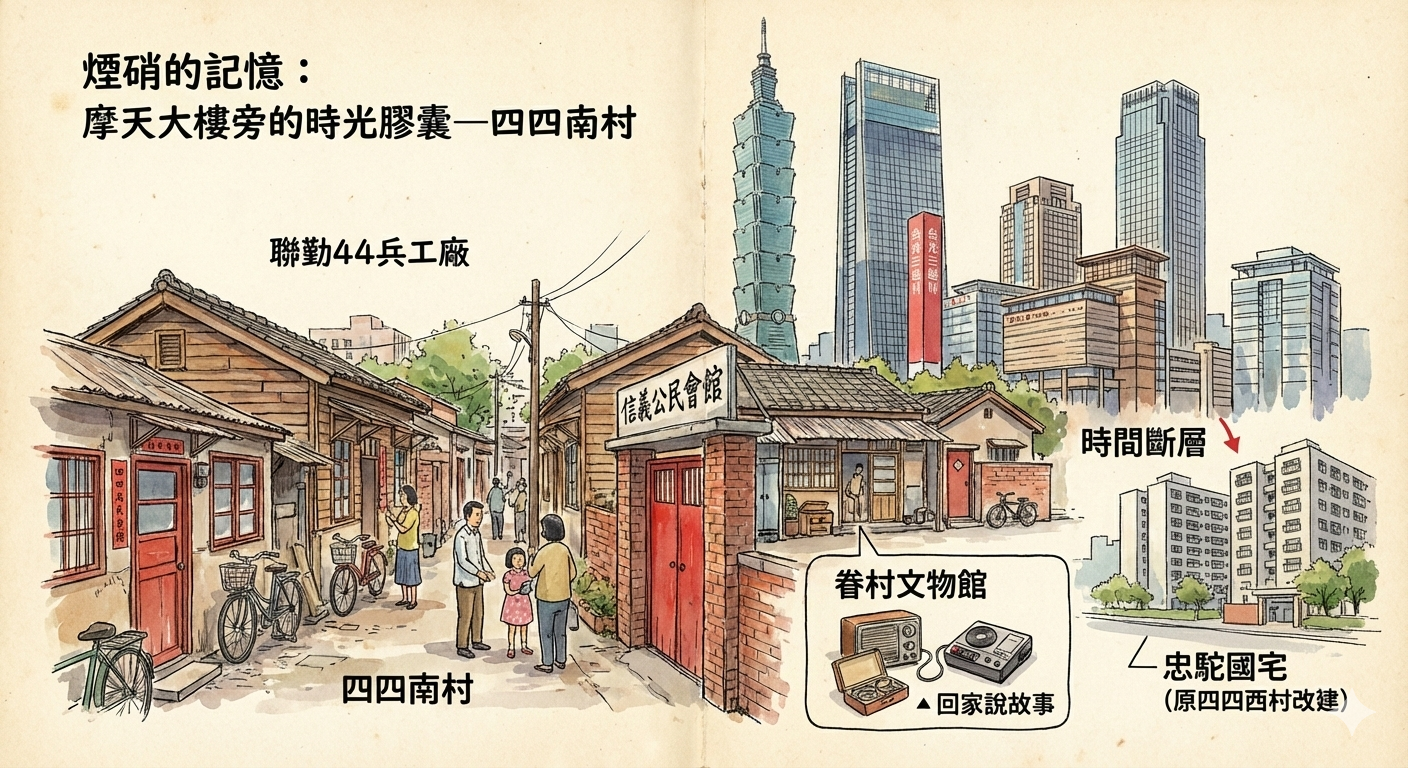
At the heart of this transformation was the No. 44 Arsenal, a major military-industrial facility. To house its workers and their families who had migrated from mainland China, a sprawling dependents' village was built. This community became known as Forty-Four South Village (四四南村), a place defined by a poignant contradiction: its structures were built with makeshift materials, reflecting their "temporary nature," yet in the hearts of the residents, they became "permanent homes." What was meant to be a temporary solution forged a unique and lasting culture born of shared experience.
Today, thanks to preservation efforts that repurposed it into the "Xinyi Assembly Hall," what remains of this village offers one of the most surreal cityscapes in Taipei. The low-slung, humble architecture stands in stark, dramatic defiance of the towering luxury of surrounding malls like BELLAVITA and Taipei 101. This is the "time fault" made visible—a quiet, communal past staring directly into the face of a glittering, globalized present. It serves as a living textbook on social change, a powerful visual reminder of the lives that existed here before the boom.
To truly grasp this historical contrast, visit the primary hidden gem: Forty-Four South Village (四四南村). Explore the preserved homes in the Xinyi Assembly Hall to feel the quiet, communal life of the past. Then, for a deeper understanding, compare it with its modernized counterpart, the Zhongtuo Public Housing (忠駝國宅), the former site of Forty-Four West Village, to see the two different fates of 眷村 (military village) culture.
From this era of military industry, the district would evolve once more, entering a new phase of production under a different regime.
The Tobacco Empire's Second Act: From Industrial Factory to Creative Powerhouse
A city’s industrial heritage tells the story of its economic soul. The Songshan Tobacco Plant was more than just a factory; it was a symbol of an era of modernization and state-controlled production during the Japanese colonial period, operating as a key production base for the government's state monopoly system.
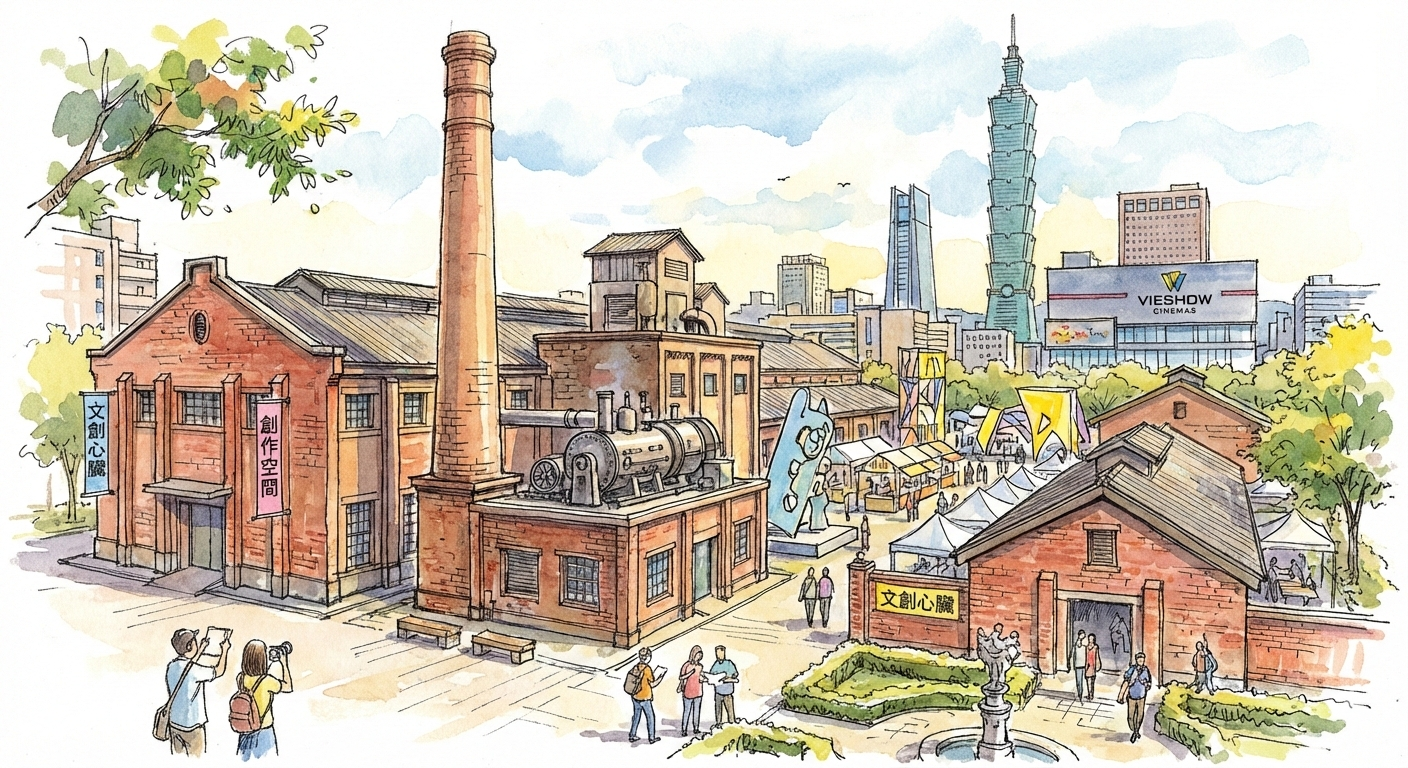
Built on a sprawling 6.6-hectare site, the Songshan Tobacco Plant is a masterpiece of modernist industrial architecture. Its grounds are defined by a grand central courtyard, a powerful boiler room, and an iconic smokestack—all of which are now designated historic sites. The design speaks to an age of efficiency, order, and large-scale manufacturing.
The site's profound transformation from a place of "manufacturing" to a hub of "creation" mirrors Taiwan's broader economic evolution. The rigid, historical factory structure now houses free-flowing creativity, hosting design exhibitions, artisan markets, and cultural events. This unique dialogue between past and present—between the industrial machine and the artistic spirit—has turned the old factory into a modern creative powerhouse.
To appreciate the soul of this industrial marvel, look for these hidden gems: The Boiler Room and Smokestack (鍋爐房與煙囪). These structures were the factory's power core and stand as monuments to industrial efficiency. Also, seek out the non-production spaces, like the Baroque-style employee gardens, which offer a more humanized glimpse into the lives of the workers.
This planned industrial past set the stage for an even more ambitious vision of urban planning that would define the district's future.
The Blueprint City: How a Wasteland Was Willed into a Global Hub
Large-scale urban planning is a statement of ambition, a city’s declaration of its future self. The Xinyi Planning District was not an organic development; it was a deliberate and massive project conceived in the 1980s on over 150 hectares of land to pivot Taipei's entire urban axis and project a new, powerful image to the world.
Before the plan, this area was a low-density mix of military facilities, villages, and open land. The vision was to transform it into a high-density international core. The construction of the World Trade Center and Exhibition Center was a critical first step, built to pave the way for Taiwan's participation in the global economy and trade. This was followed by the rise of Taipei 101, which became a global icon and a definitive symbol of Taipei's arrival on the world stage.
This ambitious plan gave birth to what is now known as the "Xinyi Style"—a unique fusion of high-end retail, international brands, world-class cultural venues, and meticulously designed public spaces. This new identity didn't just create a commercial district; it fundamentally reshaped Taipei's urban character, completing a historic "urban axis reversal" that shifted the city's economic and cultural center of gravity eastward.
To truly appreciate the scale and vision of the plan, find a new perspective with these hidden gems: A viewpoint from the Four Beasts Mountains (四獸山), such as Elephant or Tiger Mountain, where you can see the district's rigid geometry from above and contrast it with old aerial photos. Down on the ground, experience the pedestrian-focused design of the Xiangti Avenue Plaza and its connecting sky-bridges (香堤大道廣場與空中廊道), which showcases the modern 'people-first' philosophy of the plan.
But even a grand, top-down plan cannot erase everything that came before, as resilient cultural anchors continue to thrive in the shadows of progress.
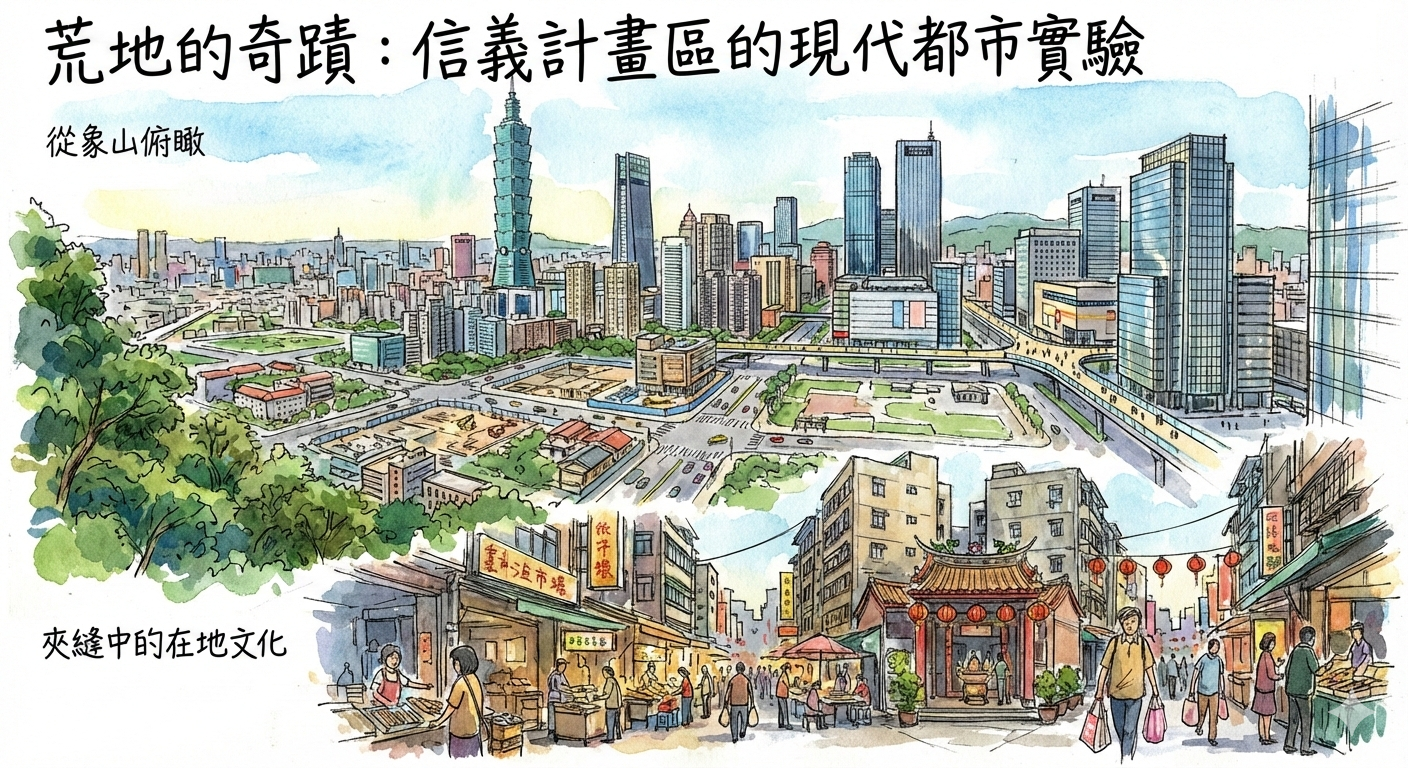
The Resilient Faith: Ancient Roots in a Modern World
When a place undergoes such radical and rapid modernization, what survives? In the gleaming canyons of Xinyi, amidst the relentless currents of global capital, lie deep-rooted cultural anchors that connect this modern world to its most ancient origins.
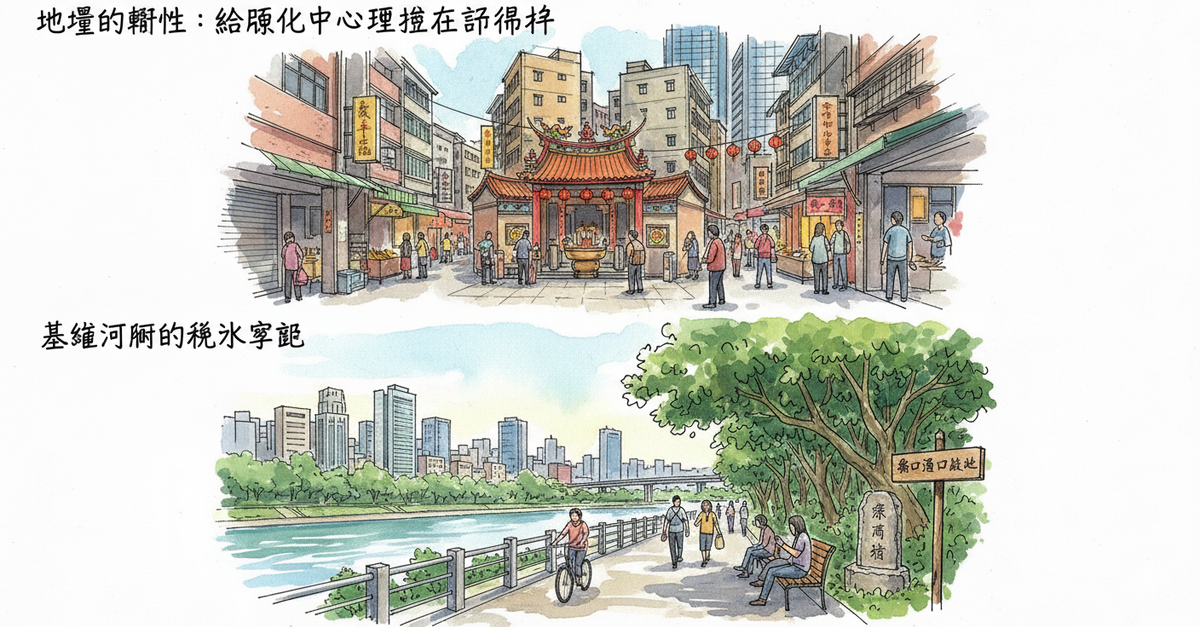
Before it was Xinyi, this area was known as "Xikou," a hub for the indigenous Ketagalan people and early Han settlers who lived and traded along the Keelung River. Even today, tucked between skyscrapers and department stores, traditional temples like the Songshan Jin'an Gong persist. These sacred spaces are living links to the agricultural communities that first settled this land, long before any master plan was conceived.
These temples are far more than relics; they are powerful symbols of cultural toughness. They are spiritual anchors for a local community that has withstood successive waves of military, industrial, and financial transformation. Their continued presence proves that local identity can not only survive but thrive alongside global capitalism, serving as a quiet but firm reminder of the district’s true roots.
To find the district's spiritual soul, seek out these hidden gems: Small local temples like Songshan Jin'an Gong or Tianbao Shengdao Gong (松山進安宮/天寶聖道宮). Their presence amidst the high-rises is a powerful statement. Then, walk along the Keelung Riverside Park (基隆河畔的親水空間) and imagine the original 'Xikou' port, reconnecting the concrete city to its life-giving river.
These layers of history—from ancient rivers to modern temples—combine to create a city far more complex than it first appears.

A City of Layers
Xinyi District is not one city, but many. It is a "city of layers," where an agricultural past flows beneath a financial present, and a military memory stands in the shadow of a commercial future. Its true richness is found not in its glittering surface, but in understanding the tensions between these layers—the dialogues and contradictions that define its character. To walk through Xinyi is to walk through time, encountering the ghosts of farmers, soldiers, and factory workers on the way to a luxury boutique.
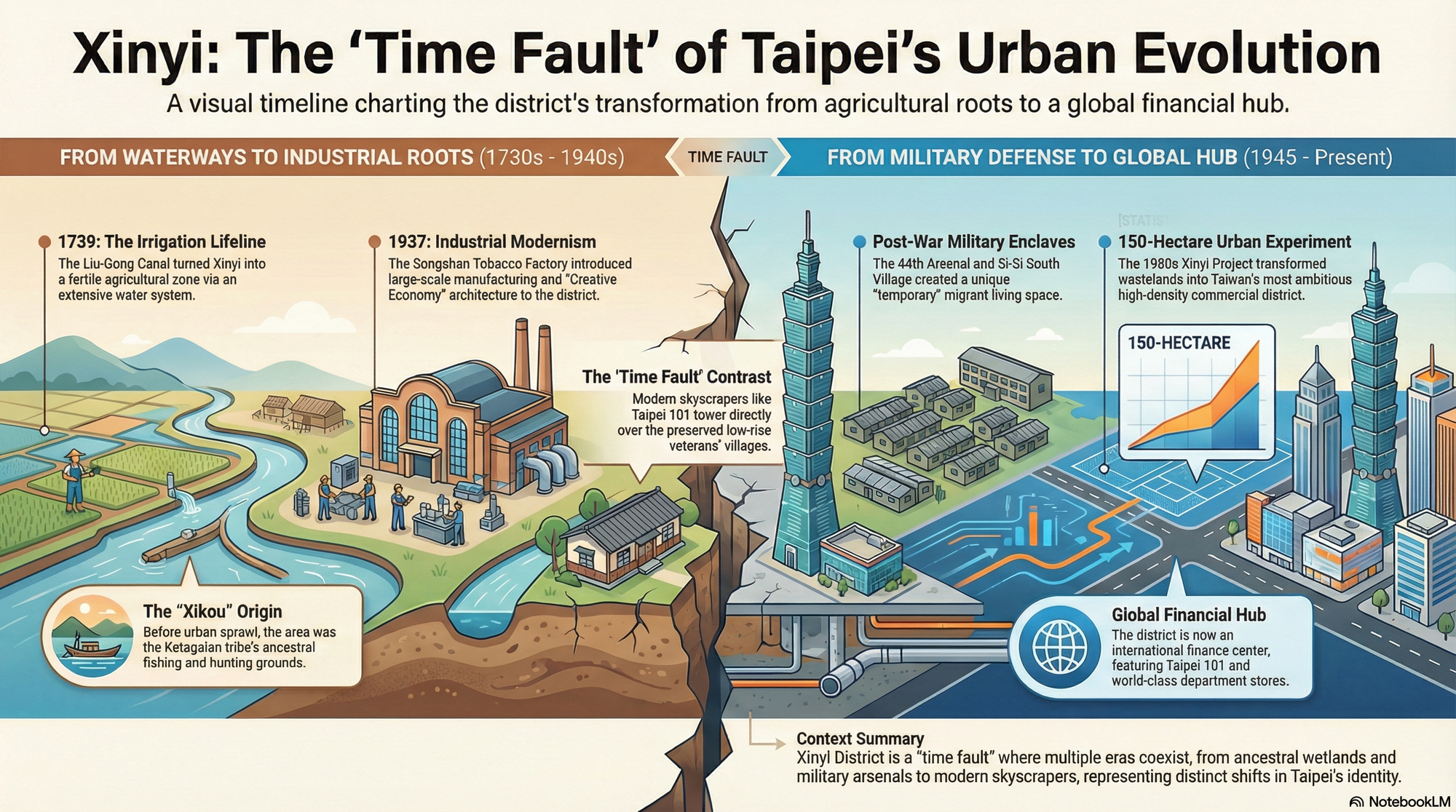
The next time you stand beneath a skyscraper, what forgotten histories will you wonder about, buried just beneath your feet?
 Lawrence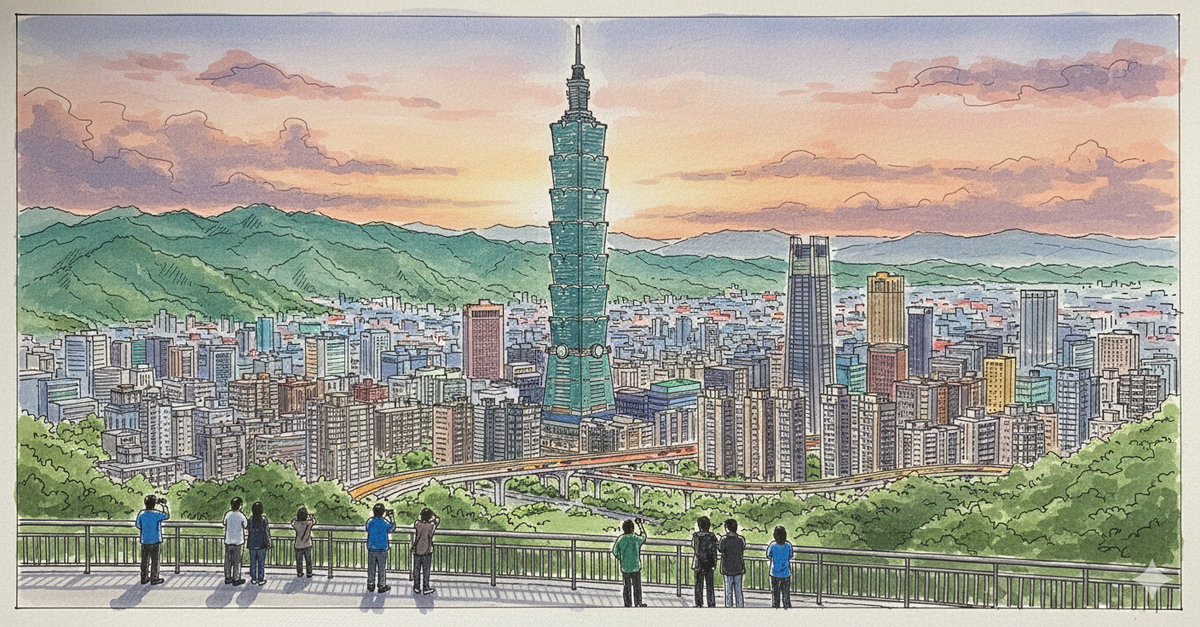
 Lawrence