(ENG) Beyond the Neon: 5 Forgotten Layers of Osaka’s Industrial Waterfront

How did ancient rituals at Sumiyoshi Shrine protect early mariners?
What is the meaning of 'Ever-bright City' and Osaka's industrial rise come?
How did Okinawan and Korean migrants shape Taisho's social landscape?
 Lawrence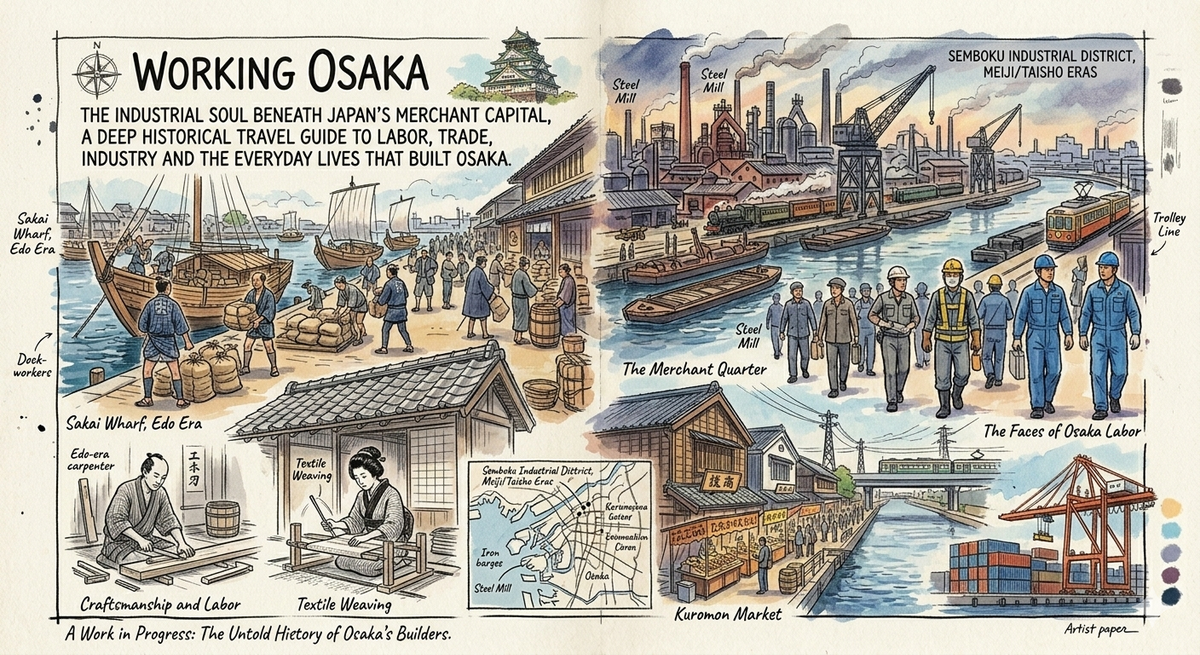
To understand a city, in addition to visiting local markets, public toilets, and cemeteries, one should also visit local industrial facilities and historical sites. How did the Osaka Industrial Zone transform from an ancient center of maritime faith into a modern heavy industrial hub?
The Gateway of Gods and Grime: An Introduction
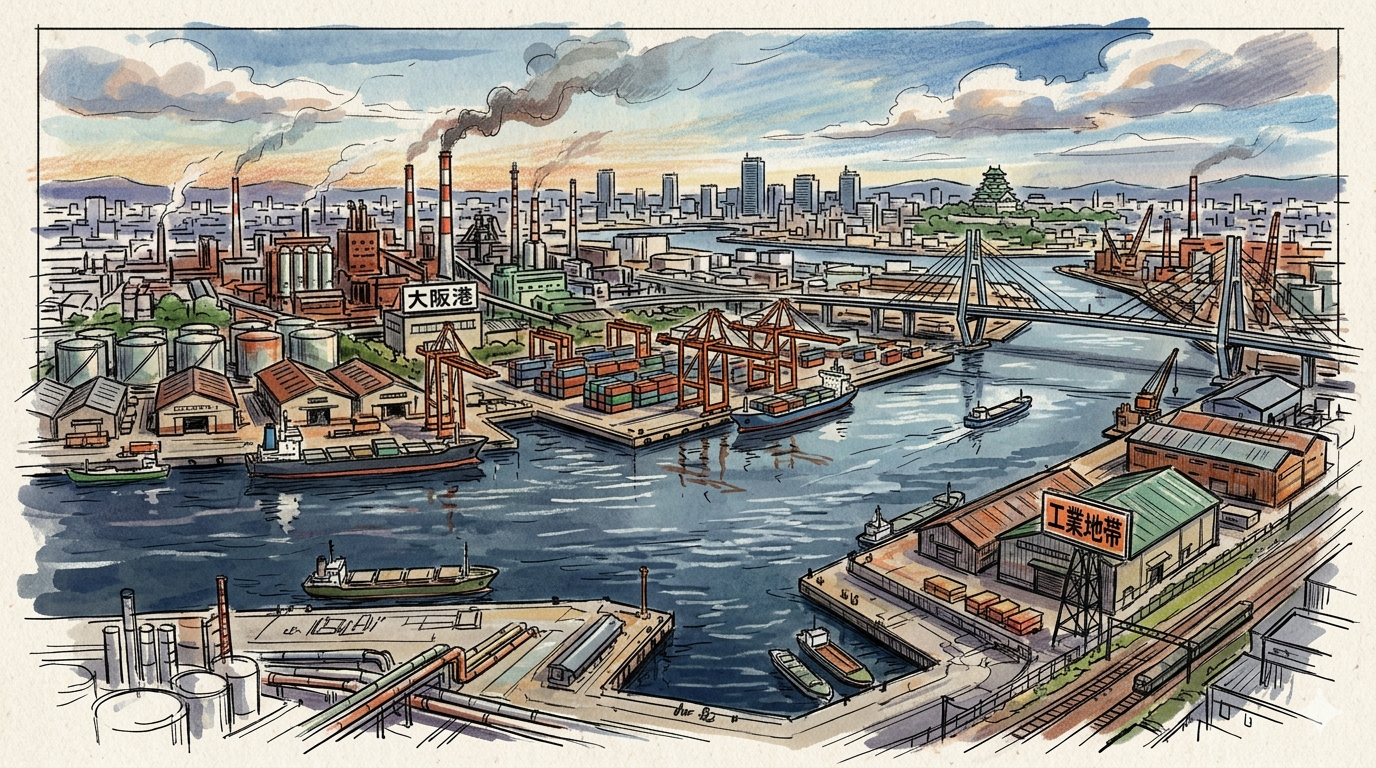
To the uninitiated, the waterfront of southern Osaka is a vista of rusted cranes and concrete canals, a stark juxtaposition to the manicured temples of the interior. Yet, for the seeker of "spatial memory," the districts of Sumiyoshi and Taisho reveal a profound narrative of transformation. This landscape is a palimpsest where sacred waters transitioned into raw industrial power. Much of Taisho sits upon Shinden—reclaimed "new fields" from the Edo period—creating a geographic tension where ancient diplomatic ports evolved into the "East’s Manchester." This guide is designed for the walker who seeks to understand the city through its deep-rooted layers of labor and faith, moving beyond neon distractions to find the grit of the forge and the silence of the shrine. Here, the spiritual protection of sea gods eventually yielded to the relentless discipline of the factory whistle, marking a shift from agrarian time to the measured hours of the global machine.
Listen to the historical stories told in detail (For subscribers only)
The "Nightless City": Shibusawa’s Electric Revolution in Sangenya
By the late 19th century, Japan faced a fiscal crisis fueled by an imbalance of textile trade. The response necessitated a radical shift from agrarian time—governed by the sun—to a modern industrial discipline. The junction of the Kizugawa and Shirunashigawa rivers in Sangenya provided the inevitable stage for this revolution. The area offered vast, affordable land reclaimed during the Edo period and deep-water access for the raw cotton arriving from India and the West.
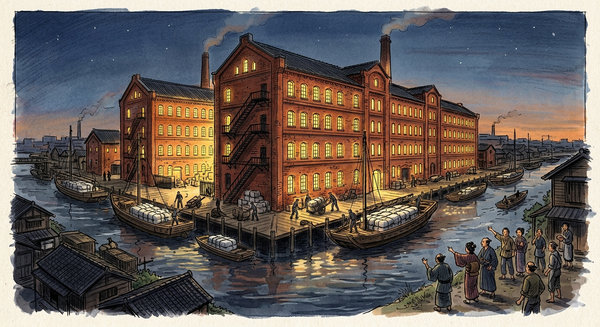
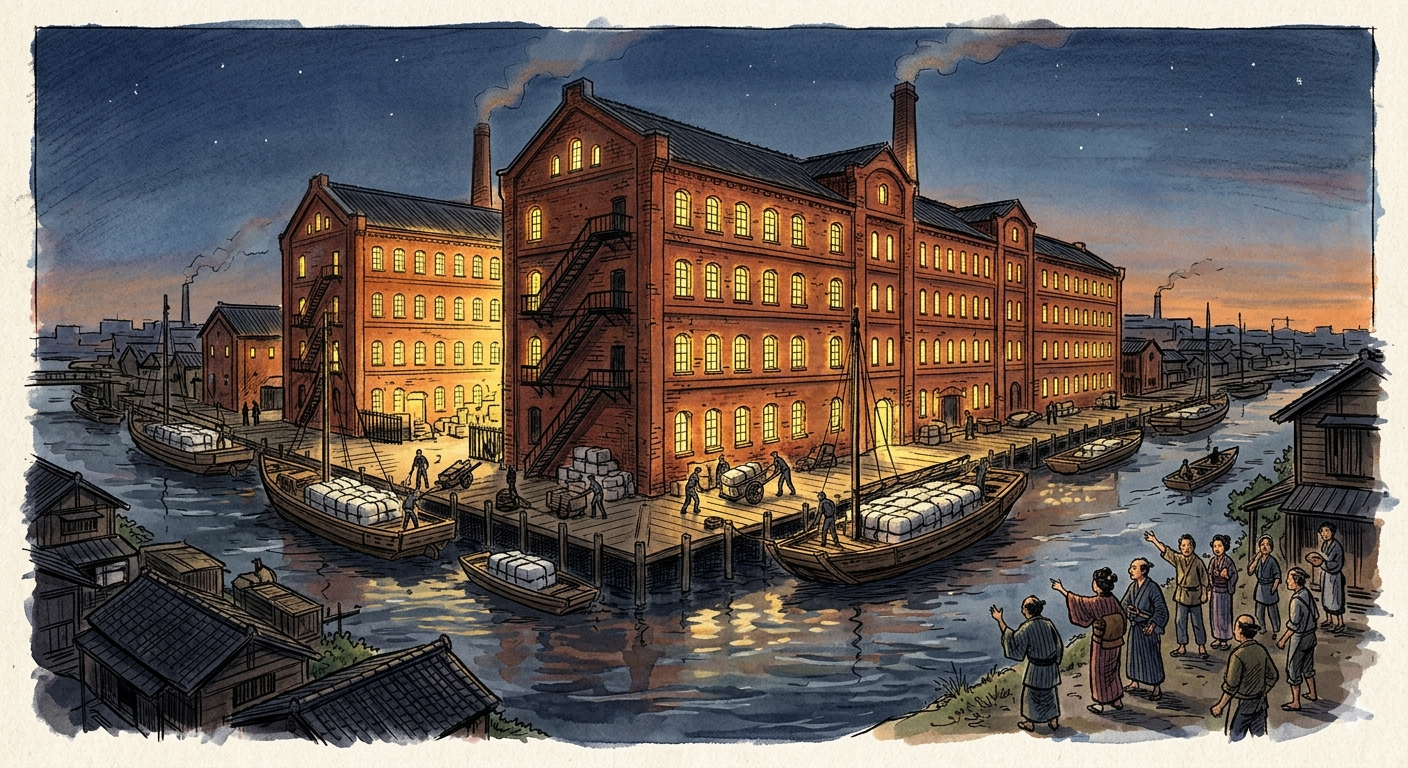
In 1883, Shibusawa Eiichi, the architect of Japanese capitalism, founded the Osaka Spinning Company here. It was a titan of its era, housing 10,500 spindles and advanced British machinery. Yet, its most transformative feature was the introduction of carbon-filament electricity. This technology allowed the factory to break the limits of natural light, introducing 24-hour rotating shifts. The ghostly light emanating from the red-brick factory windows did more than illuminate threads; it signaled a "landscape of discipline" that devoured the natural rhythms of the village. This was the start of an "internal colonization" where the bodies of female laborers were synchronized with the relentless pace of the machine.
"The local farmers and residents gathered around the factory at night, marvelling at the mysterious, constant light peeking through the windows of the red-brick buildings, calling it a 'Nightless City'."
This industrial wonder eventually earned Osaka the moniker "East’s Manchester," but it began here, in the flicker of a carbon filament. To find the physical echo of this revolution, walk to Sangenya Park. In its southwest corner stands the Osaka Spinning Co. Monument, a solitary stone marker where massive brick ruins once dominated the horizon before the fire raids of 1945.
The transition from this 19th-century industrial grind reveals that the waterfront’s role as a global gateway was established over a millennium earlier by a specialized class of maritime experts who mediated between the celestial and the salt-sprayed.
The Astronomer-Priests: Navigating the "Small Inlet of Sumiyoshi"
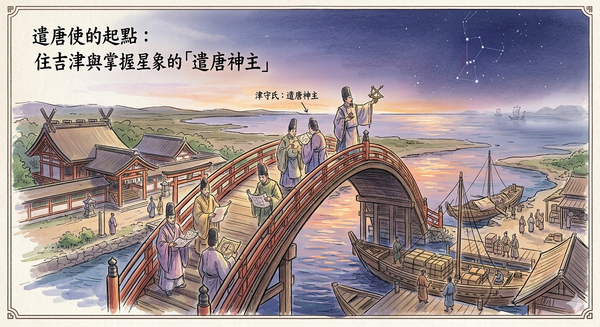
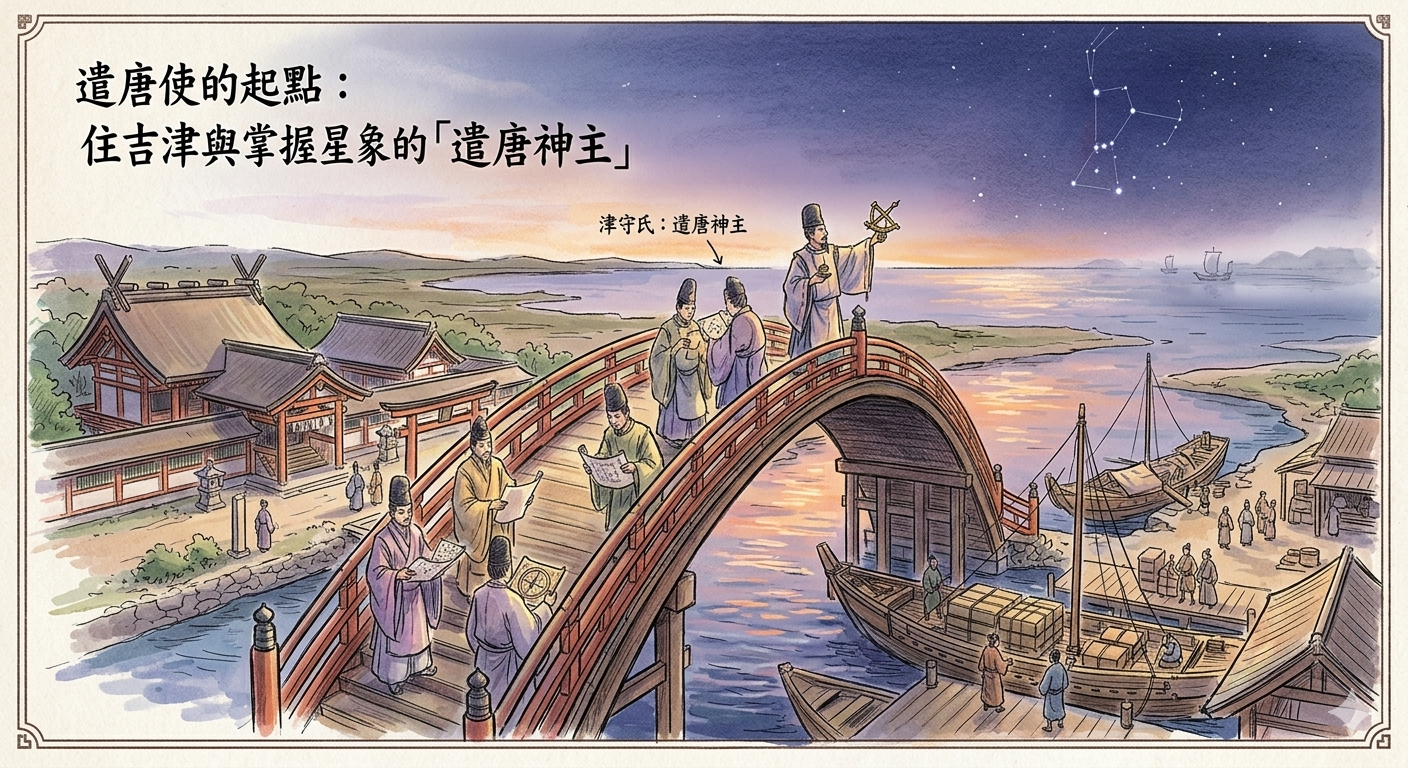
Long before Osaka was a center of heavy industry, the "Small Inlet of Sumiyoshi" (Sumiyoshi-no-Hosoe) served as the primary international threshold for the ancient Japanese state. The gatekeepers of this portal were the Tsumori clan—priests of the Sumiyoshi Taisha Shrine whose name translates to "protectors of the port." They held a technical monopoly over the Yotsunofune (the "Four Ships") that carried diplomats and monks to Tang China.
The Tsumori were not mere mystics; they were masters of meteorology and astronomy. The three primary deities of the shrine—the Soko-tsu-no-o—represent the Bottom, Middle, and Surface of the sea. These gods are intrinsically linked to the three stars of Orion's Belt, used for celestial navigation. The clan’s "rituals" were, in fact, the application of sophisticated data regarding seasonal monsoons and ocean currents. In an era when a third of all voyages ended in disaster, the shrine functioned as a "national maritime insurance station," providing the spiritual and technical confidence necessary to cross the unknowable waters.
Standing today at the Hosoigawa River, a mere remnant of that ancient inlet, one can view the Sorihashi Bridge. Its steep, dramatic arc, historically maintained by shipwrights, serves as a physical boundary between the realm of the sea and the sanctuary of the gods. The bridge’s curve reminds us that navigation was once a sacred science.
The mantle of maritime power later passed from these astronomer-priests to the Edo-period merchants, who utilized the same sea gods to anchor a global network of commercial credit.
A 17th-Century Billboard: The 600 Stone Lanterns of Global Trade
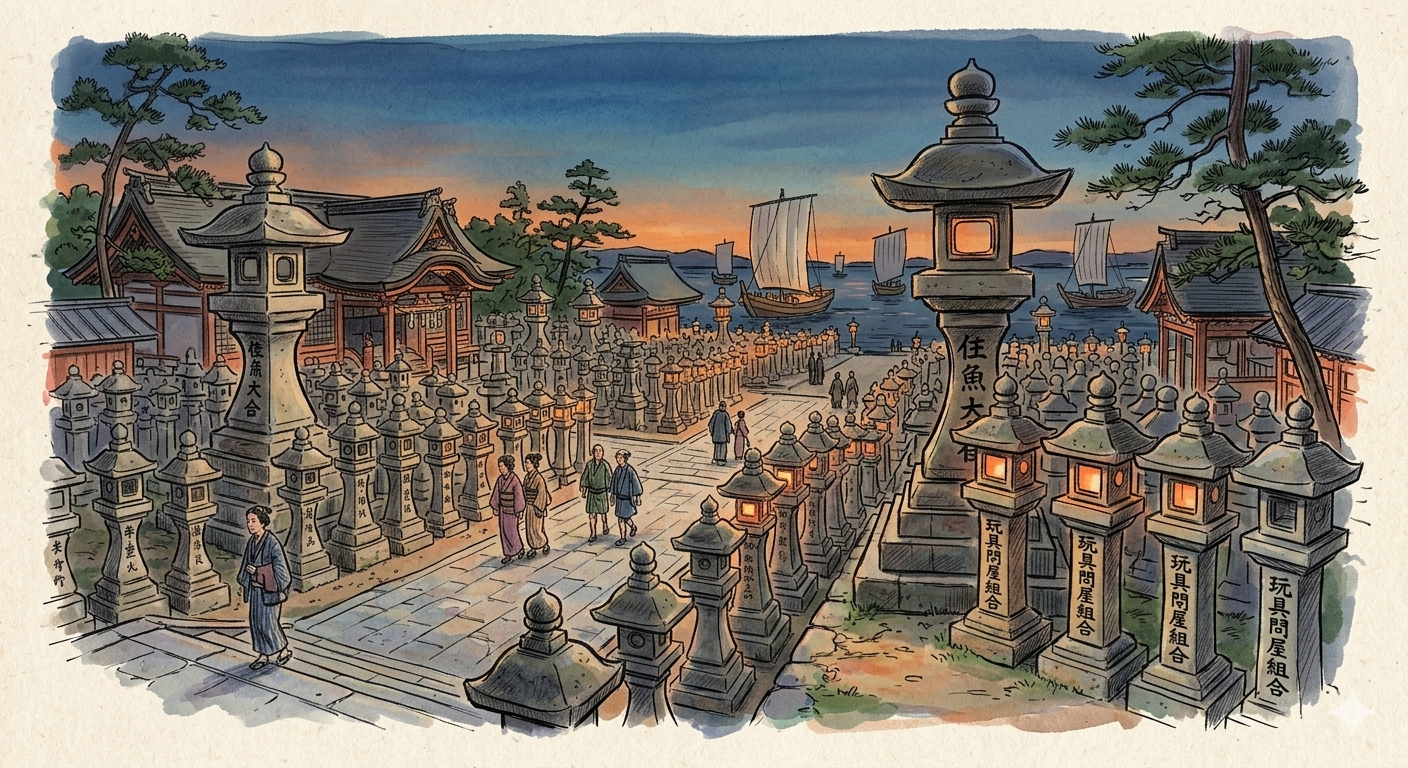
As Osaka evolved into the "Kitchen of the World," its prosperity was carried on the hulls of the Kitamaebune (northern-bound ships). This network brought essential "Fish Fertilizer" (dried sardines) to the city, fueling the agricultural boom on the surrounding plains. Sumiyoshi Taisha became the epicenter of a "commercial directory" for this vast trade network.
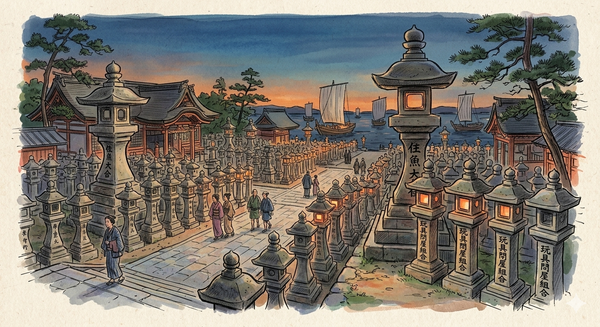
Within the shrine grounds stand over 600 massive stone lanterns. During the Edo period, these served as a physical LinkedIn or a commercial billboard. Donated by merchant guilds, the size and placement of a lantern acted as a public verification of a merchant's credit and reliability. The most imposing, standing nine meters tall, were donated by the fish fertilizer wholesalers, the economic heavyweights of the era. Among these, the Toy Wholesaler lanterns are particularly notable; they have been meticulously repaired five times since 1762, a testament to a centuries-long lineage of commercial pride and "long-termism."
These lanterns were functional as well as symbolic, acting as a land-based lighthouse system. On dark nights, their combined glow guided ships toward the mouth of the Kizugawa, blending merchant theology with maritime logistics. This forest of stone in Sumiyoshi Park remains a directory of those who built Osaka’s wealth, yet it omits the stories of the marginalized laborers who physically shaped the industrial waterfront.
Resilience in the "Hollows": The Living Legacy of Little Okinawa
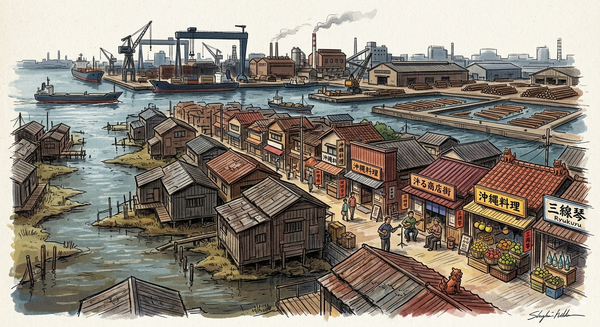
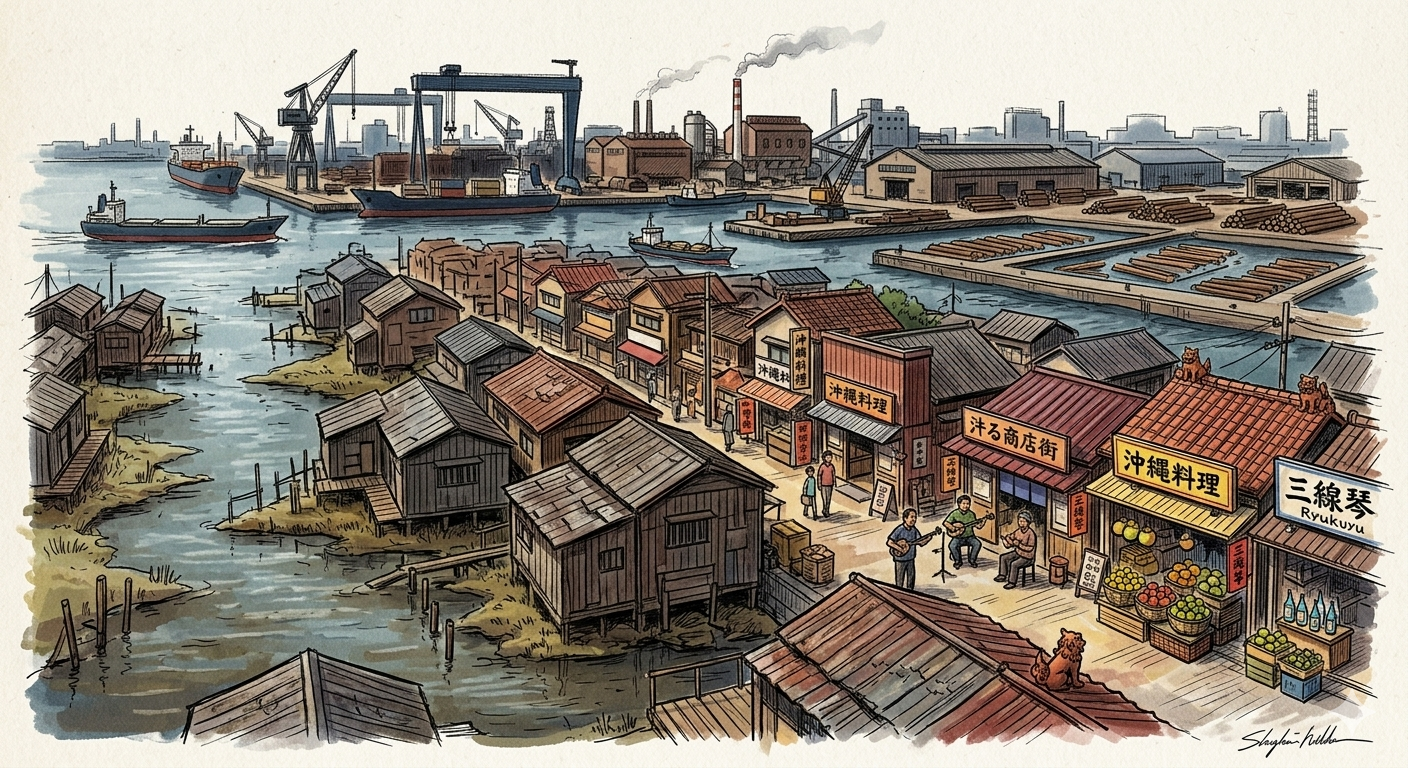
In the 1920s, a collapse in sugar prices known as "Cycad Hell" spurred a massive migration from Okinawa to Osaka. These migrants sought survival in the heavy industries of Taisho Ward, an "island within an island." Settling in the Kubun-gwa—the "hollows"—they inhabited low-lying marshlands that were literally below sea level.
The geography was as precarious as their social standing. Facing systemic exclusion and signs that read "No Ryukyuans allowed," they built barracks in flood-prone zones. When the tides rose, the Okinawan migrants lived in a state of constant watery negotiation, famously standing on floating timber inside their homes to keep their feet dry. This landscape of stigma, however, was transformed through cultural resilience. Within these hollows, the resonance of the sanshin (lute) and the strength of communal aid groups turned a geography of exclusion into a distinct ethnic identity.
To experience this legacy, walk through the Hirao Shoten-gai. The air is thick with the scent of awamori and Okinawan citrus, a sensory departure from the rest of Osaka. This street marks the boundary of "Little Okinawa," a space where the "hollows" were eventually filled with pride rather than floodwaters.
This experience of migration mirrored that of another group whose labor in the mud of the canals powered the timber and shipbuilding industries that would define the modern port.
Balance on the Log Ponds: The Hidden Korean Industrial History
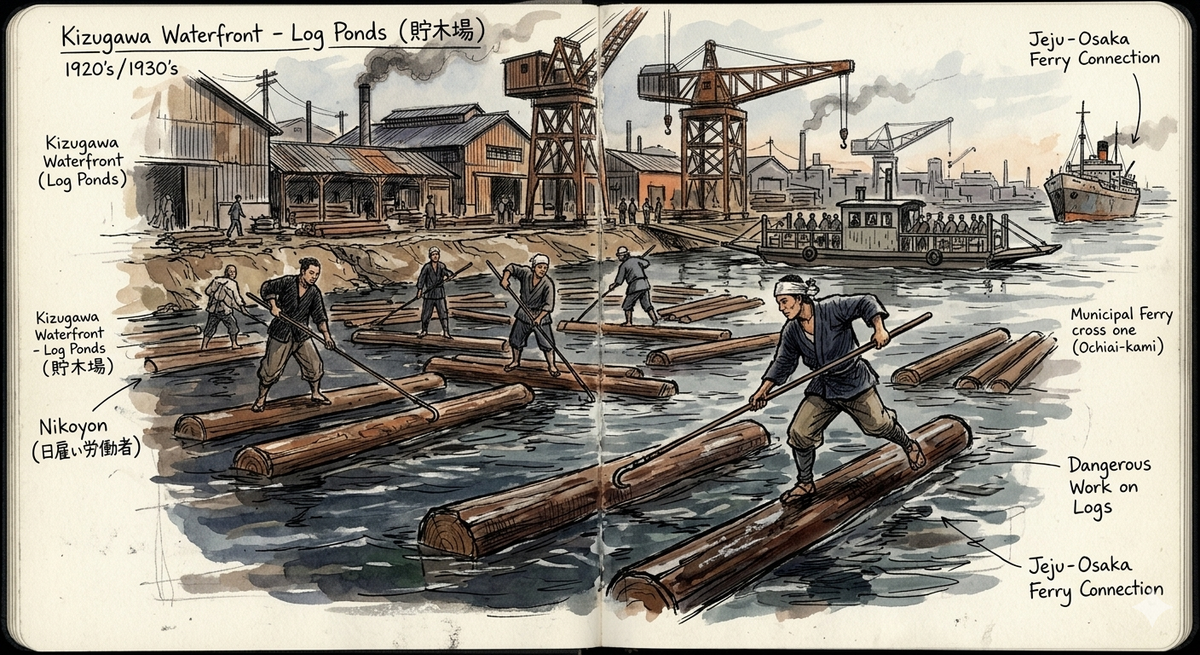
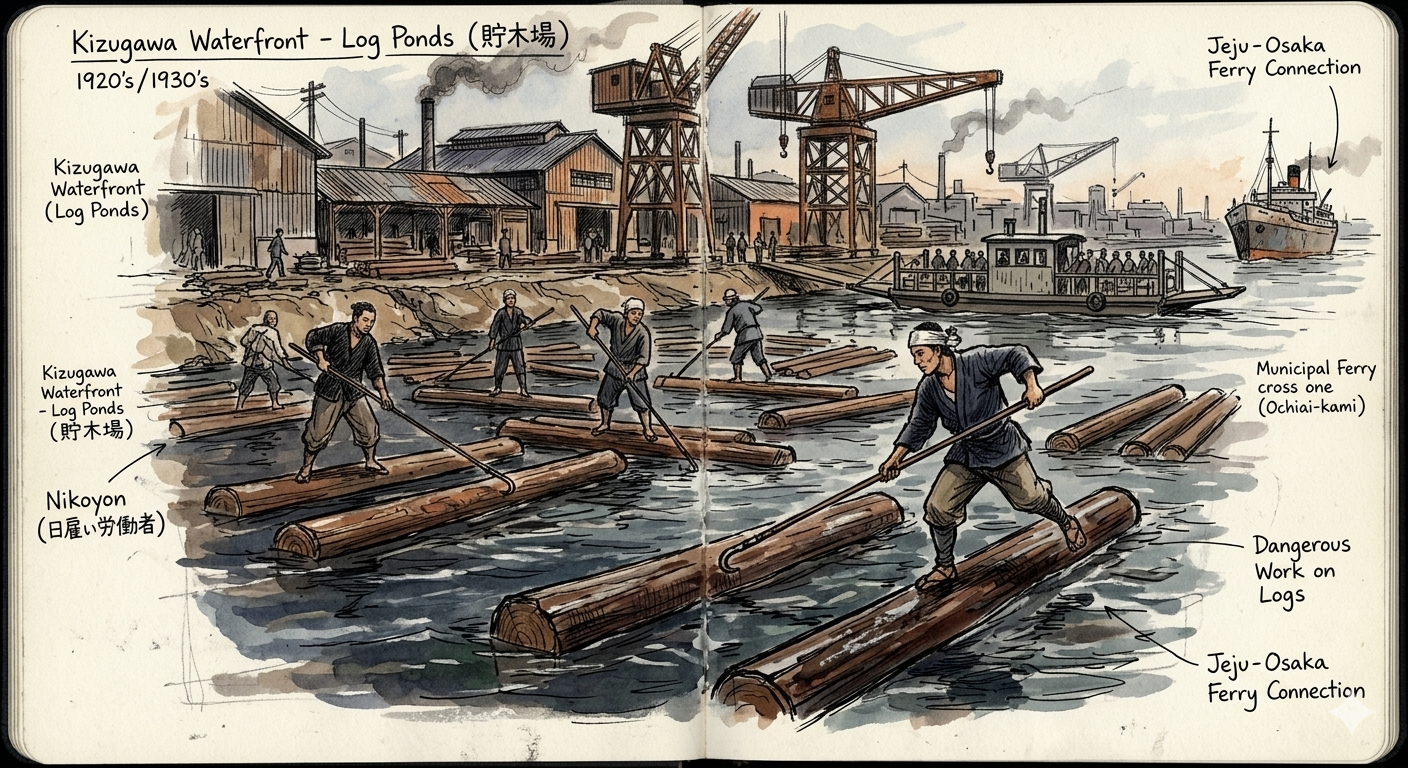
In 1922, the Kimi-ga-yo Maru ferry line established an umbilical cord between Jeju Island and Osaka. For thousands of Koreans fleeing colonial land seizures, this vessel was the gateway to the "3D" (Dirty, Dangerous, and Demeaning) labor that underpinned the "Japanese Economic Miracle." They became the Nikoyon—day laborers named for their meager 240-yen daily wage.
In the timber ponds along the Kizugawa, these laborers performed a dangerous, floating ballet. Armed only with a tobiguchi (a long hooked pole), they balanced on shifting logs, sorting and guiding massive trunks into the sawmills. This work required immense skill and carried the constant threat of being crushed or drowned, yet it remains largely buried in the mud of the canals. The city’s free municipal ferries, such as the Ochiai-kami ferry, are the living relics of this era. They were never intended for tourists; they were the essential "transportation for the transport-poor," moving a workforce without cars between cramped barracks and the ironworks.
Today, a ride on these ferries offers a view of the rusted cranes and the dark water of the log ponds—the silent tombstones of a colonial workforce whose exploitation built the modern skyline.
Hidden Gems for the Thoughtful Traveler
For the traveler seeking the most poignant remnants of these hidden layers, two sites are essential: the Taisho Okinawa Child Club (TOCC), which continues to preserve the narrative of migrant resilience, and the remnant log ponds of Hirabayashi, where the stillness of the water still holds the echoes of the timber industry.
Philosophical Reflection: The Layered Waterfront
The story of Osaka’s waterfront serves as a reminder that a city’s "highlights" are often its least revealing features. Sumiyoshi and Taisho are not merely geographic points; they are "layers of observation." They reveal a transition from the sacred navigation of astronomer-priests to the disciplined light of the "Nightless City," and finally to the resilient survival of those who lived in the hollows.
As we traverse these industrial edges, we must ask: how does a modern city decide which histories to memorialize with stone and which to wash away with the tide? The rusted ferries and ancient lanterns suggest that the most enduring histories are those written in the mud and the labor of the people, waiting for the walker to look beneath the surface.
If you found value in this deep-history exploration, please subscribe for more narratives that prioritize the "spatial memory" of the world’s evolving urban landscapes.
Practicalities: Navigating the Industrial Past
- Access: Take the Nankai Line to Sumiyoshi Taisha Station for the shrine and lanterns. For the Taisho district, use the JR Loop Line or the Taisho loop bus.
- Recommended Tour: To truly understand the "Water Capital," utilize the public ferry system. Most are free of charge and provide the best vantage point for viewing the industrial architecture of the Kizugawa and Shirunashigawa.
- Walking Note: Wear sturdy footwear. This is a journey through an active industrial landscape where history is found in the grit of the pavement.
Reference and Further reading
- Osaka - accessed March 11, 2026,
- Taisho Ward History: A modern frontier? - Osaka.com, accessed March 11, 2026,
- 歴史 - asahi-net.or.jp, accessed March 11, 2026,
- http://www.asahi-net.or.jp/~IM7J-KKI/rekishi/rekishi.html
- フィールドワーク『大阪・大正区 リトル沖縄を歩く』―「違和共生」「正しさの暴力」を考える, accessed March 11, 2026,
- The Role of Cotton Spinning Books in the Developments of the Cotton spinning industry in Japan Kanji TAMAGAWA - International Conference, accessed March 11, 2026,
- The History of U.S. Cotton in Japan, accessed March 11, 2026,
- まちの特徴・名所 - 大阪市, accessed March 11, 2026,
- The Formation of Japanese Labor Movement;1868-1914 NIMURA, Kazuo, accessed March 11, 2026,
- Mengyo Kaikan | Tourist Attractions and Experiences | OSAKA-INFO, accessed March 11, 2026,
- “Being Okinawan” Within and Beyond the Ethnic Boundary - SciSpace, accessed March 11, 2026,
- Tomiyama Ichirō: Nationalism, Modernism, Colonialism — A Perspective from Okinawa | by NGO /ŋoʊ/ | Medium, accessed March 11, 2026,
- 川と海に囲まれた特徴的 な風景や「大大阪」 時代を彷彿とさせる近 代史の面影などの多彩な魅力があります。 - 大阪市大正区の情報サイト 地元ナビ.com(じもなび), accessed March 11, 2026,
- 住之江区 - 大阪市立図書館, accessed March 11, 2026,
- 大正区の工場群とその足跡を伝える石碑|観光スポット検索 - 大阪ミュージアム, accessed March 11, 2026,
- Sumiyoshi-ku, Osaka - accessed March 11, 2026,
- History Sumiyoshi Taisha spiritually protects the port of Osaka and the old imperial capitals of Nara and Kyoto further inland., accessed March 11, 2026,
- Sumiyoshi Taisha | HOME, accessed March 11, 2026,
- Suminoe no Tsu - accessed March 11, 2026,
- 遣隋使・遣唐使の歴史とロマン | すみよし探歩, accessed March 11, 2026,
- 026 第十六次遣唐使船「よつのふね」に乗る|入唐留学 - エンサイクロメディア空海, accessed March 11, 2026,
- Sumiyoshi taisha - Osaka, Japan - Weebly, accessed March 11, 2026,
- Sumiyoshi Taisha Shrine - Cultural Properties Digital Content Download Site, accessed March 11, 2026,
- Sumiyoshi Taisha Osaka: Bridges, Lanterns, Grilled Eel and Vintage ..., accessed March 11, 2026,
- The Process of Identity Formation in an Okinawan Cultural Activist Group in Osaka, accessed March 11, 2026,
- Hidden Gems in Osaka (2026 Guide) - City Unscripted, accessed March 11, 2026,
- 熊野参詣道王子社及び関連文化財 学術調査報告書 - 和歌山県, accessed March 11, 2026,
- (第4章)大阪生野コリアタウンとソウルガリボン洞 : 二つのエスニックコミュニティの過去とい, accessed March 11, 2026,
- 大阪市生野区 在日コリアンが外国にルーツをもつ子どもたちを支援するまち, accessed March 11, 2026,
- Koreans in Japan - accessed March 11, 2026,
- Zainichi Koreans in Japan: Exploring the Ethnic Minority's Challenges - CEIAS, accessed March 11, 2026,
- Zainichi: The Korean Diaspora in Japan - Association for Asian Studies, accessed March 11, 2026,
- Connecting the History of “Zaihan Koreans” with “Residents' Histories”: Studies on the Local History of the Osaka Region and Zainichi Koreans - ResearchGate, accessed March 11, 2026,
- Exhibition Room 3 - The History Museum of J-Koreans, accessed March 11, 2026,
- 関西の沖縄出身者社会と芸能 : 両大戦間期を中心に, accessed March 11, 2026,
- Chapter 1 Its Background - The Labor Movement in Japan by Sen Katayama, accessed March 11, 2026,
- (PDF) History of Japanese Labor Movements - Academia.edu, accessed March 11, 2026,
- 水の都・大阪市で今も残る渡し船に乗ってきた!, accessed March 11, 2026,
- 大正区の渡船 - 大阪市 City of Osaka, accessed March 11, 2026
 Lawrence
 Lawrence
 Lawrence