(ENG) Beyond the Neon: Five Hidden Stories at Higashisumiyoshi-ku that will change how you see Osaka
Higashisumiyoshi-ku, a district that appears on the surface to be a quiet residential suburb, reveals itself to be a microcosm of Osaka’s entire history. It is the story of a gateway for international ideas, a melting pot for immigrant artisans, a landscape alive with folklore...


Listen attentively to the historical stories told in detail
The City You Think You Know
Osaka. The name itself conjures a kinetic swirl of images: steam rising from takoyaki stalls, the electric glow of the Glico Running Man, and the boisterous energy of a city that proudly calls itself Japan’s Kitchen. It is a metropolis of voracious appetites and modern momentum, a place where the present is lived loudly and deliciously. But what if the city’s true soul isn’t found in the vibrant chaos of its famous districts, but in the quiet streets of a residential neighborhood you’ve likely never heard of?
Beyond the clamor and the crowds, in the seemingly ordinary landscape of Higashisumiyoshi-ku, lies a hidden gateway to Japan’s most ancient past. This is not the Osaka of guidebooks. It is a place of phantom roads, artisan clans, sacred trees, and poetic sanctuaries. Here, beneath the surface of the everyday, are stories that connect a tranquil community to the grand saga of a nation’s birth. We will unearth five of these narratives, each one a key that unlocks a deeper, more profound understanding of a city you only thought you knew.
The Phantom Road: Tracing the Footsteps of Ancient Diplomats
In the genesis of any great nation, roads are more than mere infrastructure; they are the arteries through which culture, power, and identity flow. Some are paved and celebrated, while others fade into memory, becoming what the Japanese call maboroshi no kodō—a phantom ancient road. The story of Osaka’s international origins begins on such a path.
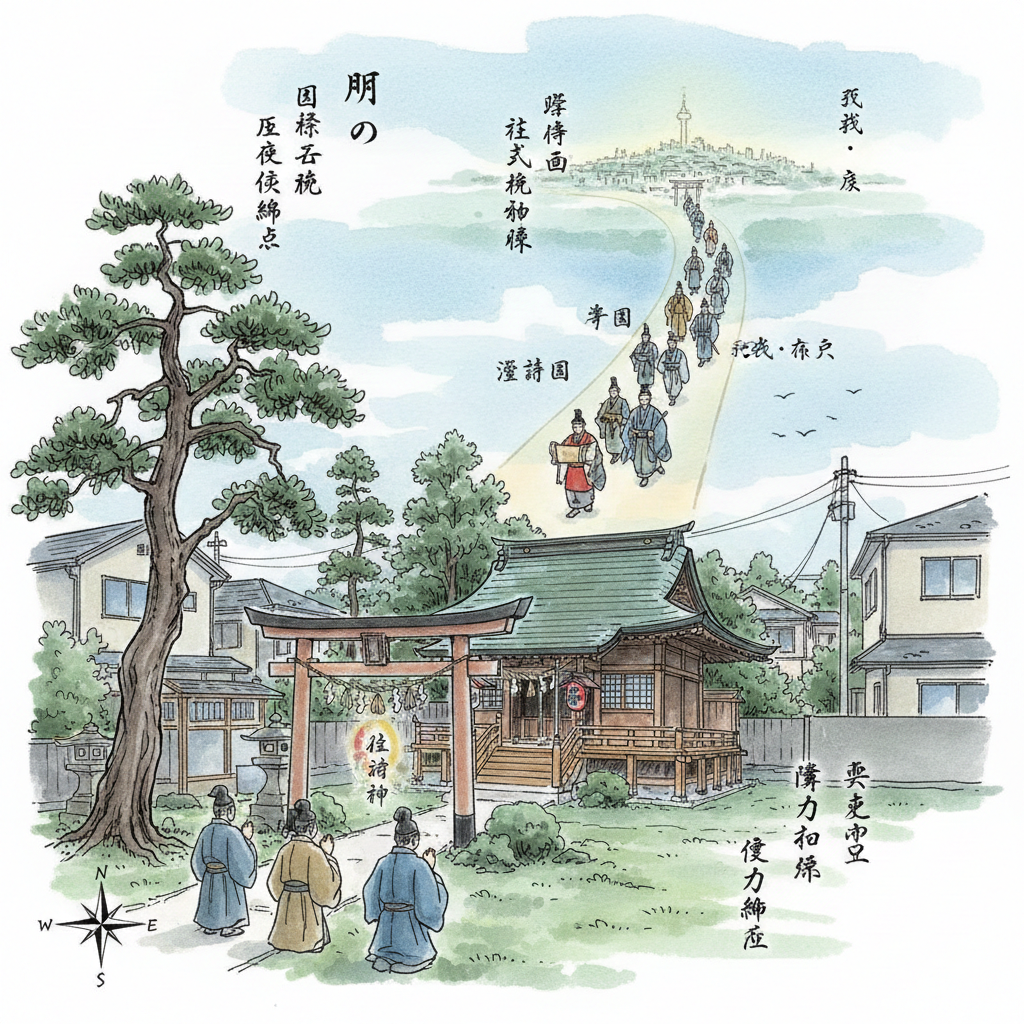
This phantom road was the Shihatsumichi, the vital artery connecting the ancient international port of Sumiyoshi-tsu to the fledgling capitals of Asuka and Nara. From the Asian mainland came diplomats, artisans, and Buddhist monks, and it was along this corridor that their ideas, technologies, and faiths traveled, fueling the very engine of Japan’s early centralization. Though its exact route is now a puzzle for historians, its spiritual anchor remains, hidden in plain sight.
The key to this forgotten world is the Nakaomi Sumuchi Jinja (中臣須牟地神社), a shrine of immense prestige tucked away in a quiet neighborhood. As an Engishiki-nai shrine, its pedigree is impeccable, established by the powerful Nakaomi clan—the hereditary masters of state ritual. This is the profound discovery: a tranquil, unvisited local shrine is, in fact, a monument to a state-level project. Its establishment here was a strategic act of spiritual consolidation, a way for the central government to sanctify and control the nation’s gateway to the world. It completely subverts the area’s modern identity, revealing a peaceful residential area as the ancient threshold of an empire. This phantom road was not just for diplomats, however; it was also the path taken by the pioneering clans who would build this community from the ground up.
The Founders' Mark: How Immigrant Artisans Shaped a Neighborhood
The story of early Japan is inextricably linked to the toraijin—immigrant clans who brought with them the advanced skills that would shape a nation. These founders often left their mark in the most enduring way possible: in the very names of the places they settled.
The neighborhood name "Tanabe" is a direct echo of the Tanabe clan, a group of settlers who migrated from the West Country and made this land their home. Believed to be related to the legendary Haji clan of master potters, the Tanabe were artisans, engineers, and culture-bearers. They founded Yamasaka Shrine (山坂神社) to worship their ancestral gods, embedding their identity into the spiritual landscape. The shrine’s dedication to deities associated with the Haji clan solidifies this connection, suggesting the Tanabe brought with them a legacy of craftsmanship that would become the bedrock of the community.
Today, two gems allow us to touch this history:
- Yamasaka Shrine: The physical and spiritual heart of the Tanabe legacy.
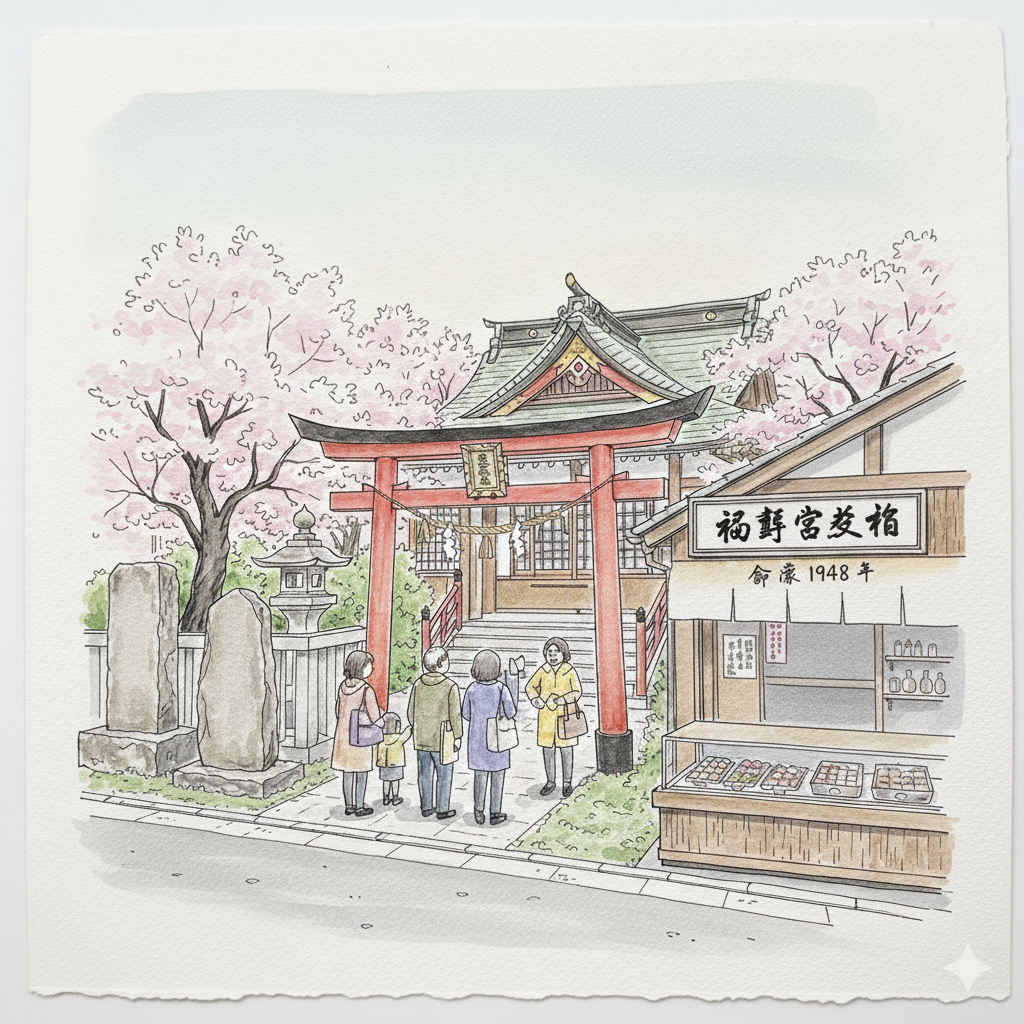
- The Kitatanabe Neighborhood: A community where the echo of this artisan heritage can still be felt. While the ancient pottery kilns are gone, the spirit of meticulous craft lives on in places like Fukujudo Hidenobu (福壽堂秀信), a traditional confectionery shop founded in 1948.
Here lies a living testament to cultural continuity. The same meticulous patience required to shape clay in a kiln centuries ago is now found in the delicate folding of sweet bean paste—a shared DNA of precision that defines the neighborhood's soul. A simple neighborhood walk becomes a journey through centuries of heritage, a taste of a sweet bun a connection to the founders themselves. Yet, beyond the stories of these pioneering clans, the land itself holds legends tied to the deeper magic of nature and local folklore.
The Falcon's Pact: A Sacred Tree and a Mirrored Pond
Local folklore is the poetry of a landscape, revealing a community’s intimate relationship with the natural world. In these tales, ordinary ponds and trees are transformed into sites of myth and memory, forging a sacred contract between humans and the environment that can endure for a thousand years.
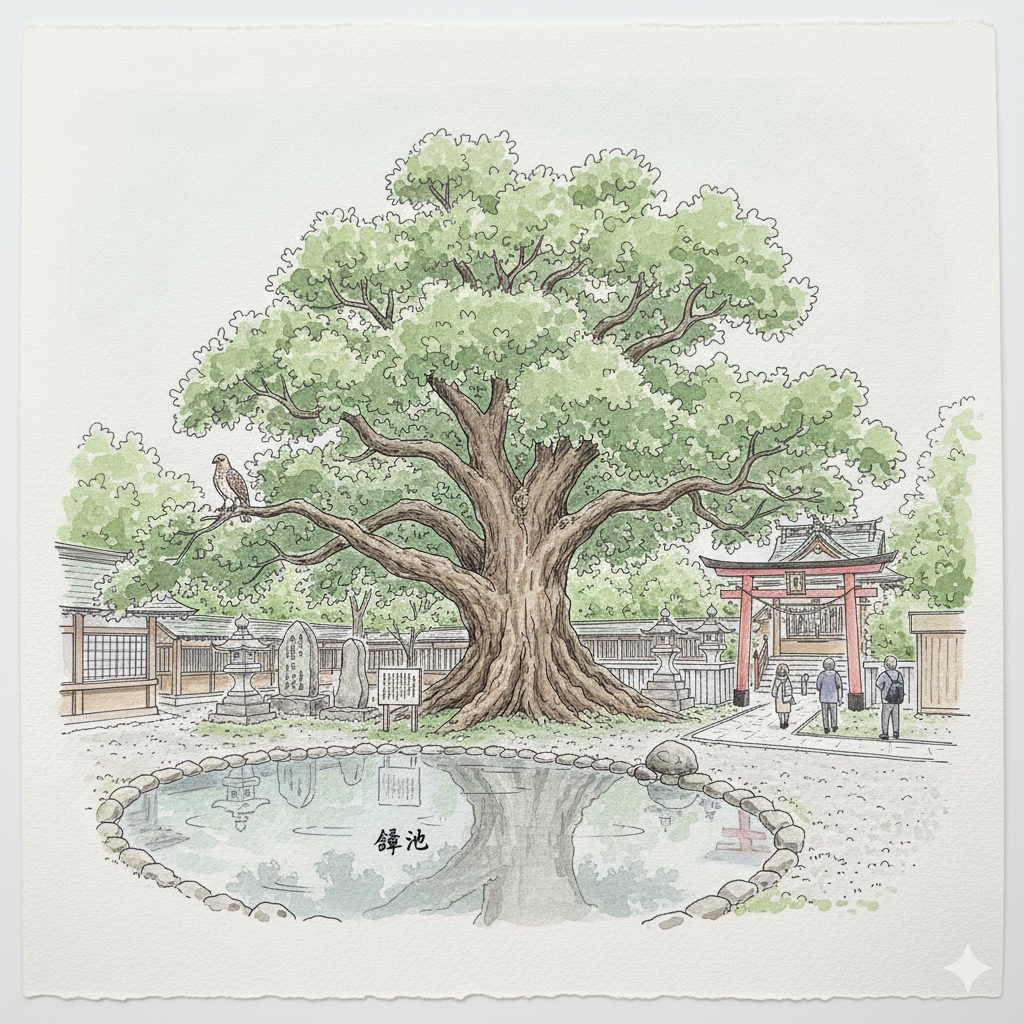
The founding legend of Takaai Shrine (鷹合神社) is one such story. The name Takaai itself means "falcon meeting," and it originates from a tale of loss and revelation. A nobleman named Sake-gimi had lost his prized hunting falcon and, in despair, stopped to rest by a tranquil pond known as the "Kagami-ike" (鏡池), or Mirror Pond, located in the southeast corner of the head priest's residence. As he gazed into the water, he saw not his own reflection, but that of his lost falcon, perched silently in the branches of a great tree above him.
This is more than just a quaint tale; it is the story of a sacred, three-way pact between the human (the nobleman), the animal (the falcon), and nature (the tree and pond). The pond's reflective surface acted as a sacred interface, a mirror that mediated between the worlds and revealed a hidden truth. The land was named for this covenant, but the true treasure of the shrine today is the living witness to that legend: a magnificent "Kusunoki no kooki" (楠之古木), an ancient camphor tree so revered it has been officially designated a preservation tree by the city of Osaka. The ancient camphor is not merely old; it is a breathing monument to this thousand-year-old relationship, a silent guardian of the pact between humanity and the wild. And while some shrines are born from folklore, others became unlikely centers of high culture and sophisticated art.
The Poet's Sanctuary: Where Courtly Art Met Sacred Farmland
In pre-modern Japan, culture was not a static commodity confined to the imperial capital. It was a fluid force, flowing along trade routes and pilgrimage paths to flourish in the most unexpected of regional centers. In these places, the refined arts of the aristocracy would meet the earthy, foundational beliefs of the local people, creating a cultural tapestry of extraordinary richness.
Kumata Shrine (熊野田神社) stands as a testament to this phenomenon—a surprising medieval "cultural enclave." During the Heian period, this local shrine became a renowned center for Renga (連歌), a highly sophisticated form of collaborative poetry. Local masters and visiting nobles from the Kyoto court would gather here, their linked verses creating a bridge between the agrarian countryside and the pinnacle of imperial culture. The shrine was not on the periphery; it was a vibrant hub of artistic expression.
Its most compelling feature is this remarkable dual identity, which is still celebrated today in two distinct treasures:
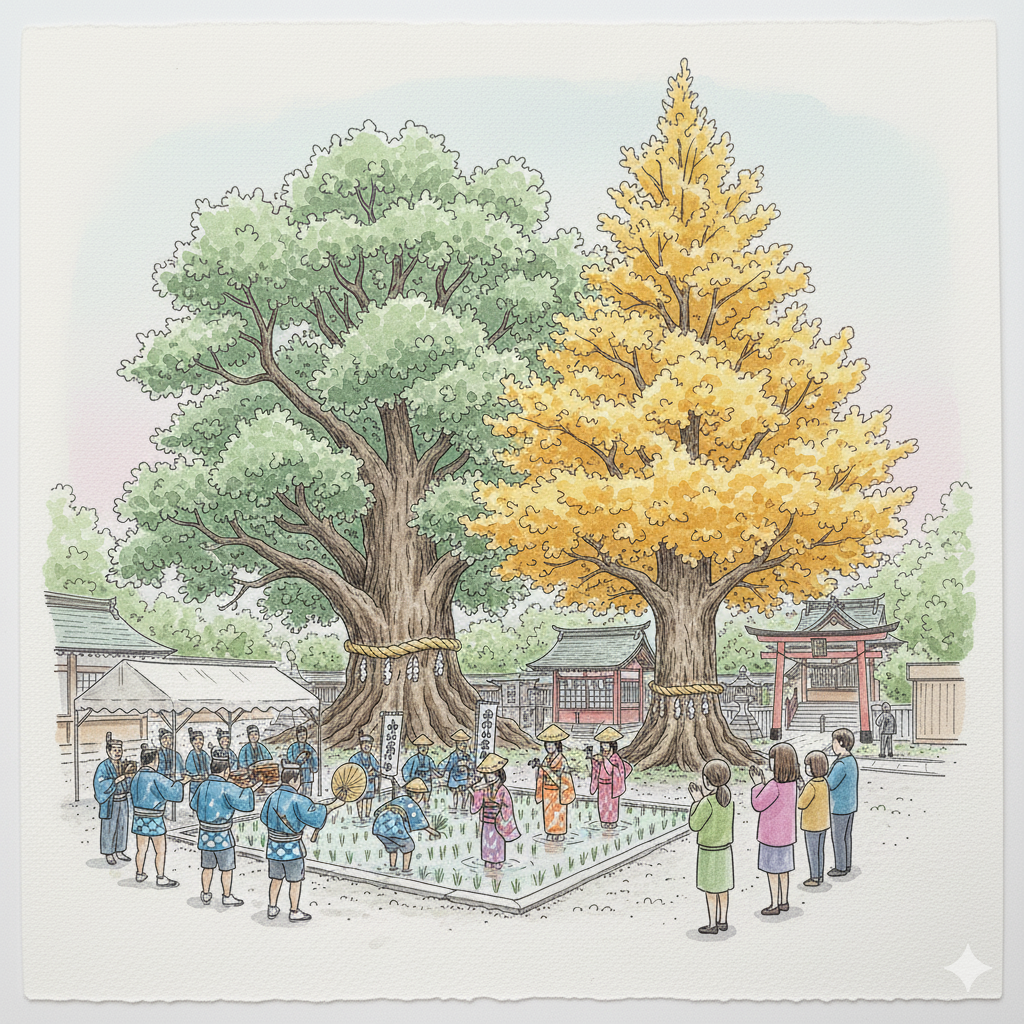
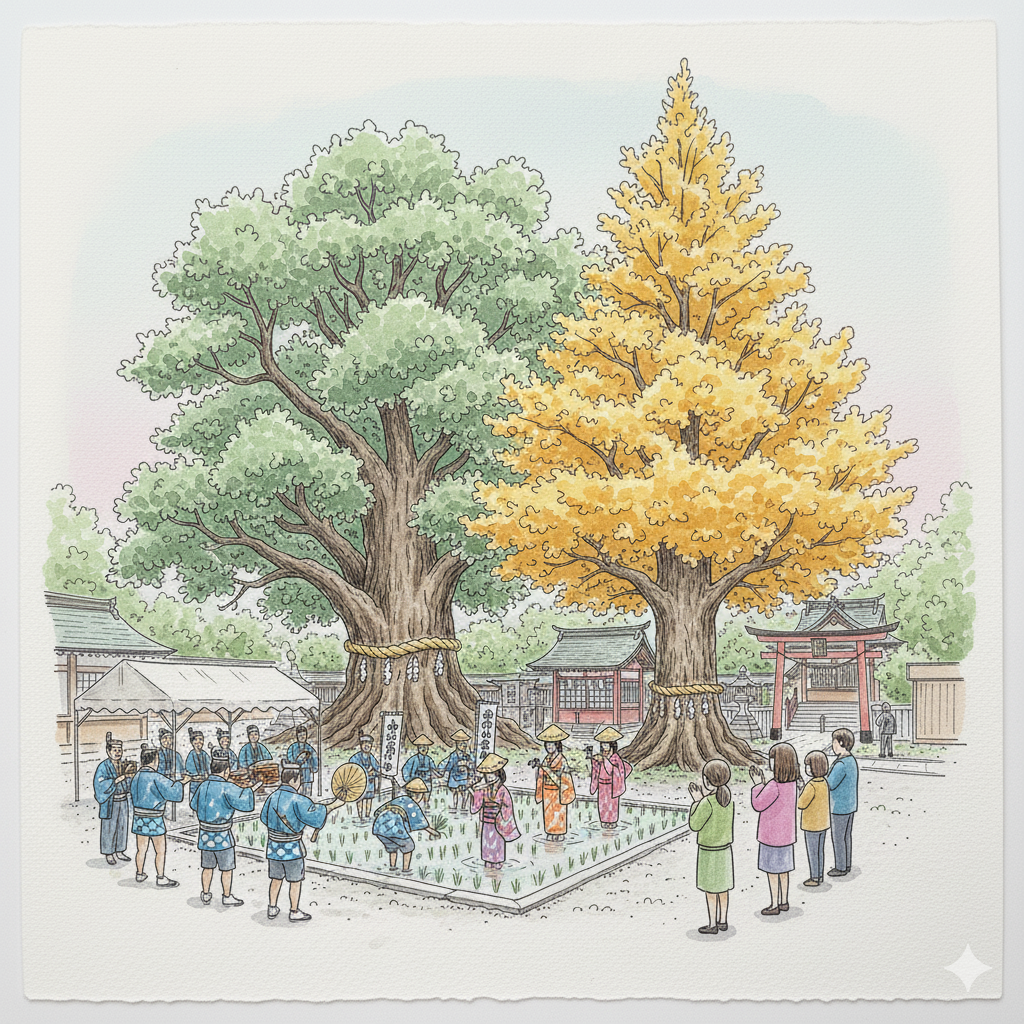
- The Otaue Shinto Ritual (御田植神事): Held every April, this rice-planting festival is a prayer for a bountiful harvest. Its profound cultural importance is recognized by its designation as a National Intangible Folk Cultural Property.
- The Sacred Trees: The shrine is guarded by two colossal trees—an 800-1000-year-old camphor and a 500-year-old ginkgo. Local folklore endows them with healing powers, believed to improve lactation and cure breast diseases.
Here, the Renga poetry represents a human attempt to create harmony and order through art, while the Otaue ritual is a human plea for harmony and order from nature. Kumata Shrine is thus a sanctuary for both created and requested harmony, a rare place where artistic and agricultural ambitions converge. It offers a perfect fusion: the elite, cerebral world of collaborative poetry and the most fundamental, earth-bound faith of agriculture, giving visitors a rare glimpse into the complex spiritual life of medieval Japan. It is a place where prayers for poetry and prayers for rice were offered with equal reverence, a theme of provisioning that finds its modern echo in the district’s role today.
The Market's Heartbeat: Osaka's Kitchen, Hidden in Plain Sight
The story of Higashisumiyoshi-ku comes full circle, returning to its origins as a vital node of circulation. The ancient, phantom Shihatsumichi once channeled diplomacy and culture into the heart of Japan; today, the tangible, roaring reality of the Osaka City Central Wholesale Market, Eastern Market channels the food that sustains the 2.7 million people of the modern metropolis.
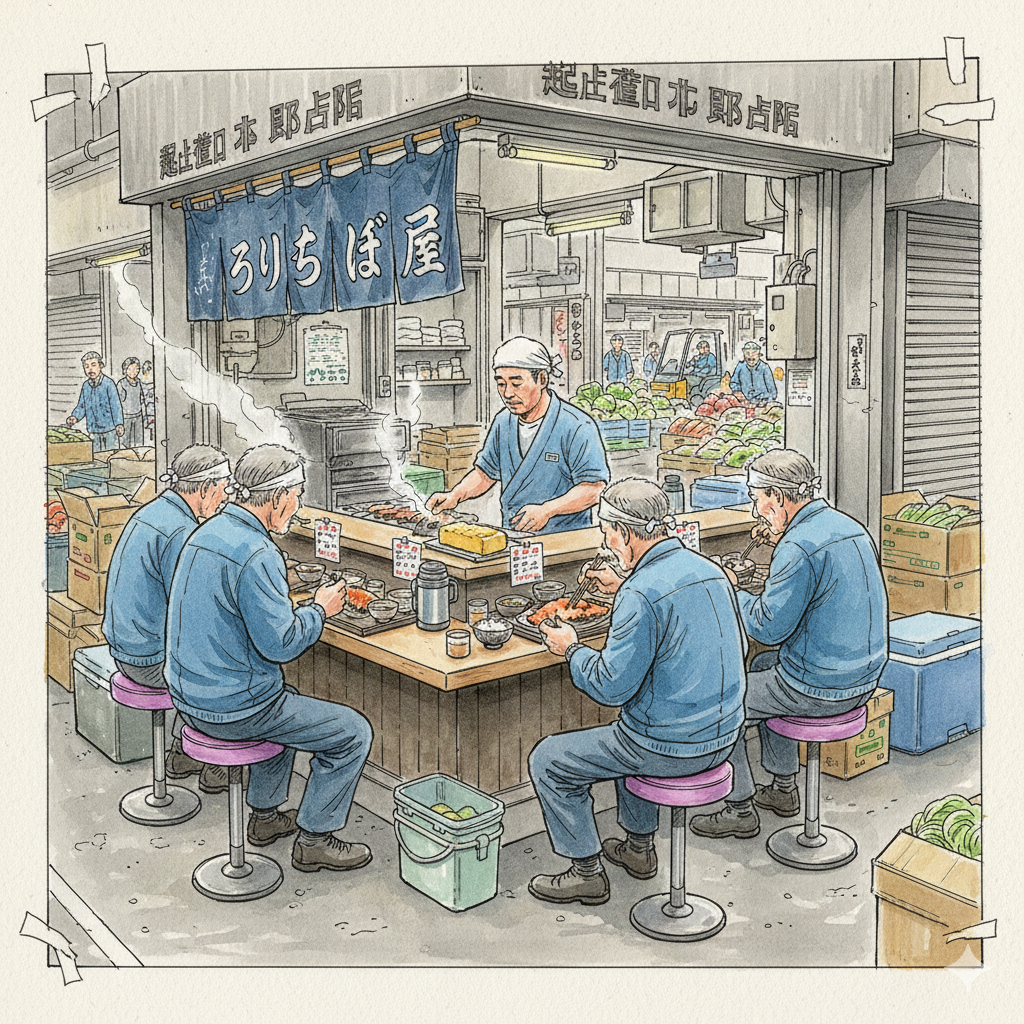
This is not a polished tourist destination like Kuromon Market. This is the real, beating heart of Osaka's "Nation's Kitchen" (Tenka no Daidokoro). It is a sprawling, functional, and unapologetically authentic world of logistics, auctions, and the hardworking people who feed a city. The true hidden gem here is not a historical artifact but a living experience: the unpretentious canteens tucked away in the "Kanren-kita-to" building.
A perfect example is "Sushi Hide" (寿し秀), a tiny restaurant that, in a twist of pure Osaka pragmatism, serves no sushi at all. Instead, it is famous among market workers for its simple, perfect grilled salmon and dashi-rolled omelet set meals. Accessing these canteens can feel intimidating for an outsider, a world not explicitly designed for visitors. But that is precisely the point. To share a meal here is to stand at the modern endpoint of the same logistical "lifeblood" that flowed down the Shihatsumichi 1,500 years ago. It is a form of cultural immersion that offers a taste of the true "artisan spirit" of modern Osaka, far from any curated trail. These five stories, from phantom roads to wholesale markets, collectively paint a new, profound portrait of the city.
Finding the Eternal in the Everyday
Higashisumiyoshi-ku, a district that appears on the surface to be a quiet residential suburb, reveals itself to be a microcosm of Osaka’s entire history. It is the story of a gateway for international ideas, a melting pot for immigrant artisans, a landscape alive with folklore, a sanctuary for high art, and the engine room of a modern culinary capital. Each layer adds to a narrative far richer and more complex than the neon glow of the city center suggests.
There is a philosophical constant that runs through these five stories: the eternal lifeblood of circulation. The flow of people, goods, and ideas has been the district’s defining characteristic for over a millennium, from the ancient diplomats walking the Shihatsumichi to the trucks of fresh produce leaving the Eastern Market before dawn. The artisan spirit of the Tanabe clan finds its modern heir in the unwavering dedication of a neighborhood confectioner. The sacred pact with nature, symbolized by a falcon’s reflection, endures in the shade of a thousand-year-old tree.
In unearthing these narratives, we are reminded that history is not something cordoned off in museums. It lives in place names, in local legends, in the rituals of a shrine, and in the simple satisfaction of a worker’s morning meal. The ultimate lesson of Higashisumiyoshi-ku is an invitation to look closer, to seek out the eternal in the everyday. What timeless stories are waiting to be discovered in the quiet neighborhoods we pass through every day?
Works Cited
- 大阪府大阪市東住吉区の特徴, accessed October 12, 2025
- Sumiyoshi-ku, Osaka - Wikipedia, accessed October 12, 2025
- 東住吉区の訪れてみたい神社3選 | 大阪市東住吉区で不動産の売却、買取、査定のことならi-Homes'(アイホームズ) | ブログ, accessed October 12, 2025
- 磯歯津路(しはつみち)について知りたい。 - レファレンス協同データベース - 国立国会図書館, accessed October 12, 2025
- 041 磯歯津路(しはつみち) - 東住吉100物語 - 大阪市, accessed October 12, 2025
- Koko Hana - Kita Tanabe/Kara-age (Deep-fried chicken) | Tabelog, accessed October 12, 2025
- 菓匠館 福壽堂秀信|1948年創業 大阪の和菓子屋, accessed October 12, 2025
- 素盞嗚尊神社(大阪府矢田駅)の投稿(1回目)。明治5年(1872年) - ホトカミ, accessed October 12, 2025
- A Local's Secret Guide to 43 of Osaka's Hidden Gems - City Unscripted, accessed October 12, 2025
- Kumata jinja (Shrine), accessed October 12, 2025
- Kumata Shrine, Tourist Attractions and Experiences, accessed October 12, 2025
- Kumata Shrine| Tourist attractions and experiences | OSAKA-INFO, accessed October 12, 2025
- 大阪市東部中央卸売市場「寿し秀」で、さけと出し巻き定食, accessed October 12, 2025
 Lawrence
 Lawrence