(ENG) Hung Shui Kiu Historical Walk – Discovering the Vanishing Townscape on Hong Kong's Urban Fringe
Often seen as a mere transit point, Hung Shui Kiu hides a rich historical depth. This story takes you on a journey through its vanishing townscape, from the quiet alleys of Tang Kwai Tsuen to the remnants of old markets, capturing the essence of a community transitioning between past and future.

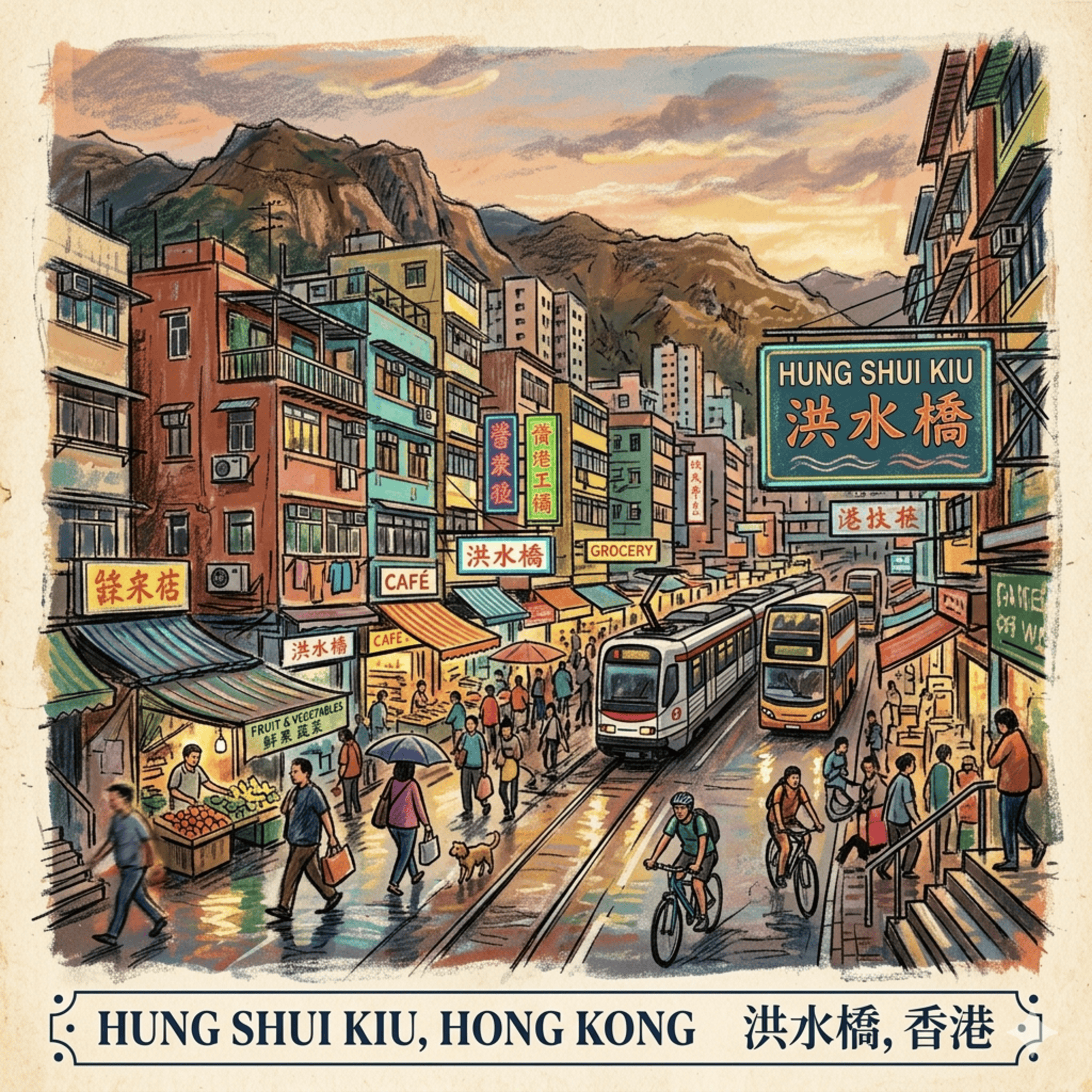
This is a historical travel story and walking guide to Hung Shui Kiu, a unique town situated on the edge of Yuen Long and Tuen Mun. By exploring Tang Kwai Tsuen and old market remnants, it traces the area's transformation from a rural farming community into a modern transit hub. Readers will gain a deep understanding of local heritage and the nostalgic street life that persists amidst rapid urban development.
 Lawrence
Historically, Hung Shui Kiu occupies a liminal space, a physical and political "borderland" situated at the intersection of the Yuen Long plain and the Tuen Mun valley. Long before modern administrative boundaries split the area between two districts, it functioned as a "triple-no-man’s-land"—a strategic convergence point where the dominant Tang clans of Ping Shan and Ha Tsuen saw their influence overlap and, occasionally, collide. For the warlords of the early 20th century, the refugees of the post-war era, and the missionaries who followed, this was a frontier of opportunity and sanctuary.
To walk through Hung Shui Kiu today is to traverse a landscape where history is not merely recorded but etched into the very soil. This guide is designed for the intellectually curious traveler—the flâneur who understands that a street is more than a thoroughfare; it is a text where narratives of violence, survival, and transition are layered one atop the other. This journey begins at the water's edge, where the area’s name hints at a visceral, crimson past that the modern city has attempted to refine.
Listen to the historical stories told in detail (For subscribers only)
The Crimson Origin: Legend, Geology, and the "Red Water" Bridge
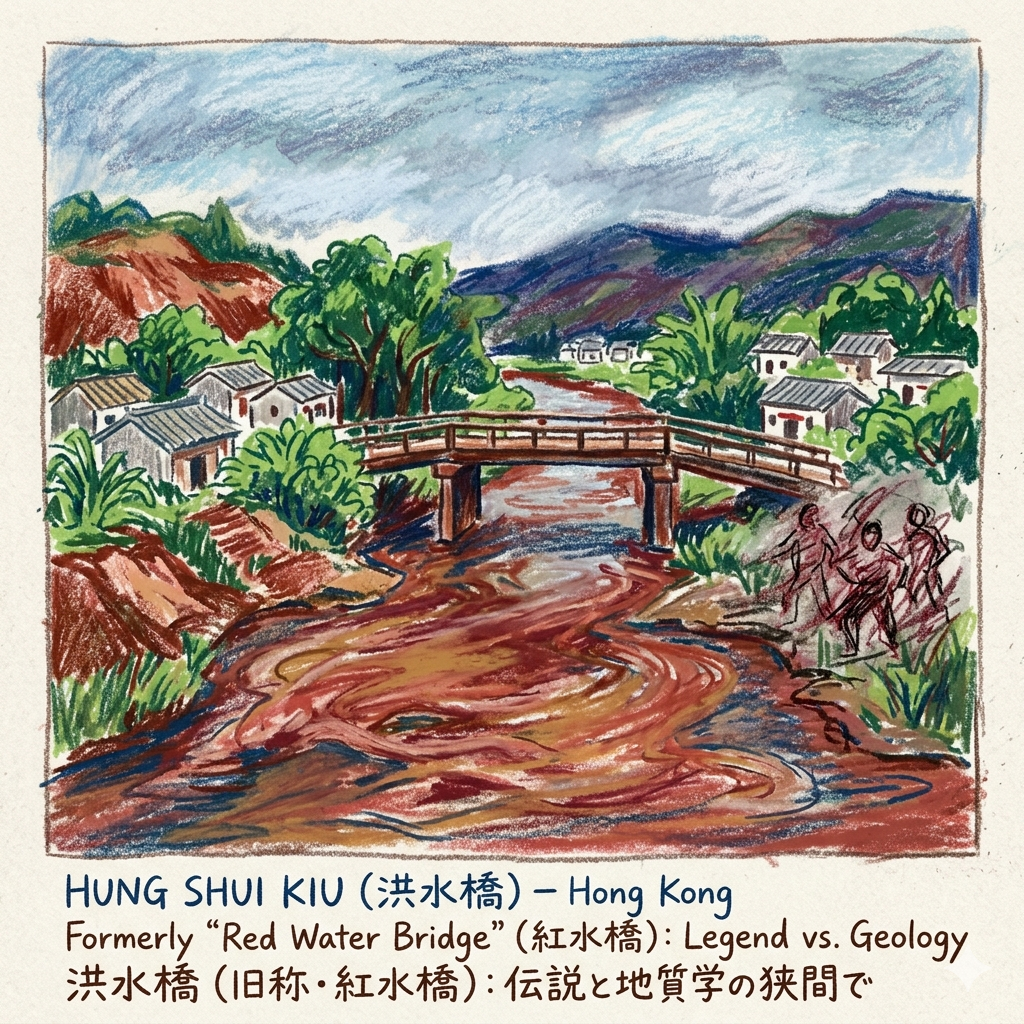
In the New Territories, naming is rarely a neutral act; it is an assertion of dominance or a chilling warning. The etymology of "Hung Shui Kiu" serves as a primary example of "linguistic refinement" (雅化). The contemporary characters for "Flood Water Bridge" act as a euphemism, a deliberate act of smoothing over a more violent past: the original "Red Water Bridge."
Two competing narratives attempt to explain this crimson origin. The first is a grim account of "legal violence" involving the Mao Family Three Tigers. According to oral history, the Ping Shan Tang clan—seeking to consolidate their hold on the fertile plain—leveraged their elite connections with the imperial court (朝廷) to secure an order for the extermination of the Mao clan, who were branded as neighborhood tyrants. In the ensuing massacre near modern-day Tan Kwai Tsuen, the blood of the fleeing family reportedly stained the stream red.
Contrastingly, geologists point to the high concentration of iron oxide in the soil of the nearby Red Water Hill (Hung Shui Shan). During heavy rains, this red silt washes into the river, creating a natural, rust-colored torrent.
Folk Narrative (Massacre) | Geological Reality (Red Soil) |
Origin: The "Mao Family Three Tigers" slaughter. | Origin: High iron oxide content in the hills. |
Logic: A warning of clan dominance and "legal" retribution. | Logic: Descriptive markers of resource characteristics. |
Social Impact: Created a "taboo space" associated with blood and ghosts. | Social Impact: Provided a natural visual basis for later legends. |
Historical Status: Reflects the consolidation of power by the Tang clan. | Historical Status: Grounded in the physical landscape of the New Territories. |
The "bloody" legend persists because it functions as a historical marker of clan hegemony. It serves as a reminder that this land was won through the strategic elimination of competitors, a narrative of power that a simple geological explanation cannot satisfy. This tension between the soil and the bloodline defines the area’s defensive architecture.
The Tenant’s Fortress: Defensive Living in Tin Sam Tsuen
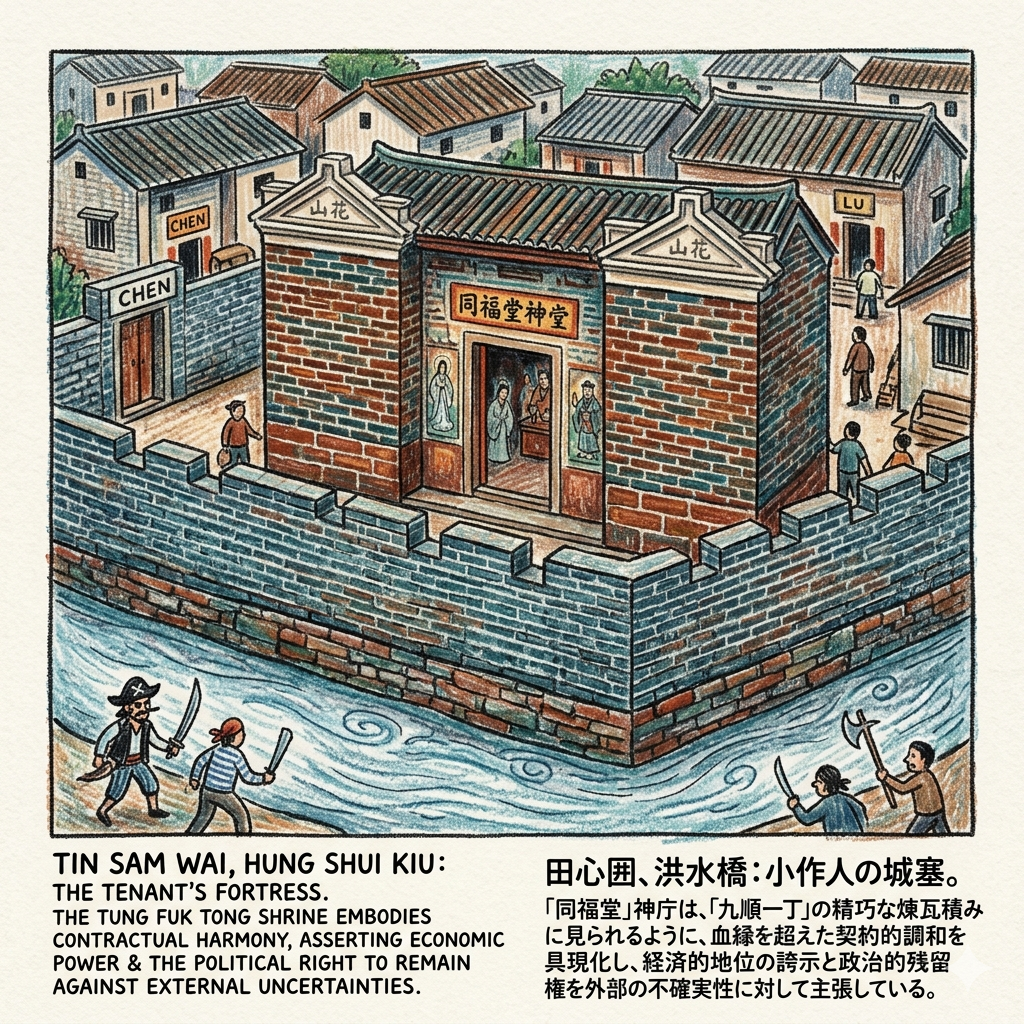
For the migrant groups of the 17th century, life in the shadow of the great clans required a distinct "survival philosophy." Tin Sam Tsuen (historically Tin Sam Wai) exemplifies this struggle. Unlike the single-surname villages of the Tangs, Tin Sam was a multi-surname community of Chen and Lu families who settled as "guests" or tenants of the Ha Tsuen Tangs.
To exist as tenants in a land of powerful hosts, the villagers built a fortress. The original settlement was a walled village (Wai), complete with a moat to deter pirates and land-hungry neighbors. At the heart of this defensive layout stands the Tung Fuk Tong shrine, a structure that prioritized "contractual harmony" over bloodline purity.
- Contractual Harmony: Instead of a single ancestral hall, the shrine houses a pantheon including Guanyin and Tin Hau.
- The Zhou and Wang Deities: Crucially, the villagers worship "Zhou and Wang," two Qing officials who fought against the Great Clearance (遷界令). By enshrining them, the multi-surname village asserted their political right to return and remain on the land.
- Material Status: The shrine features sophisticated "nine-straight-one-butt" brickwork and 1930s Western-style pediments (山花). These architectural flourishes—alongside a 1955 mural renovation—suggest that even as tenants, the villagers had acquired the economic power to challenge the social hierarchy of the great clans through high-quality masonry.
"The Tung Fuk Tong serves as the spiritual soul of the village... its multi-deity worship intended to condense the common sense of different surnames against external uncertainties."
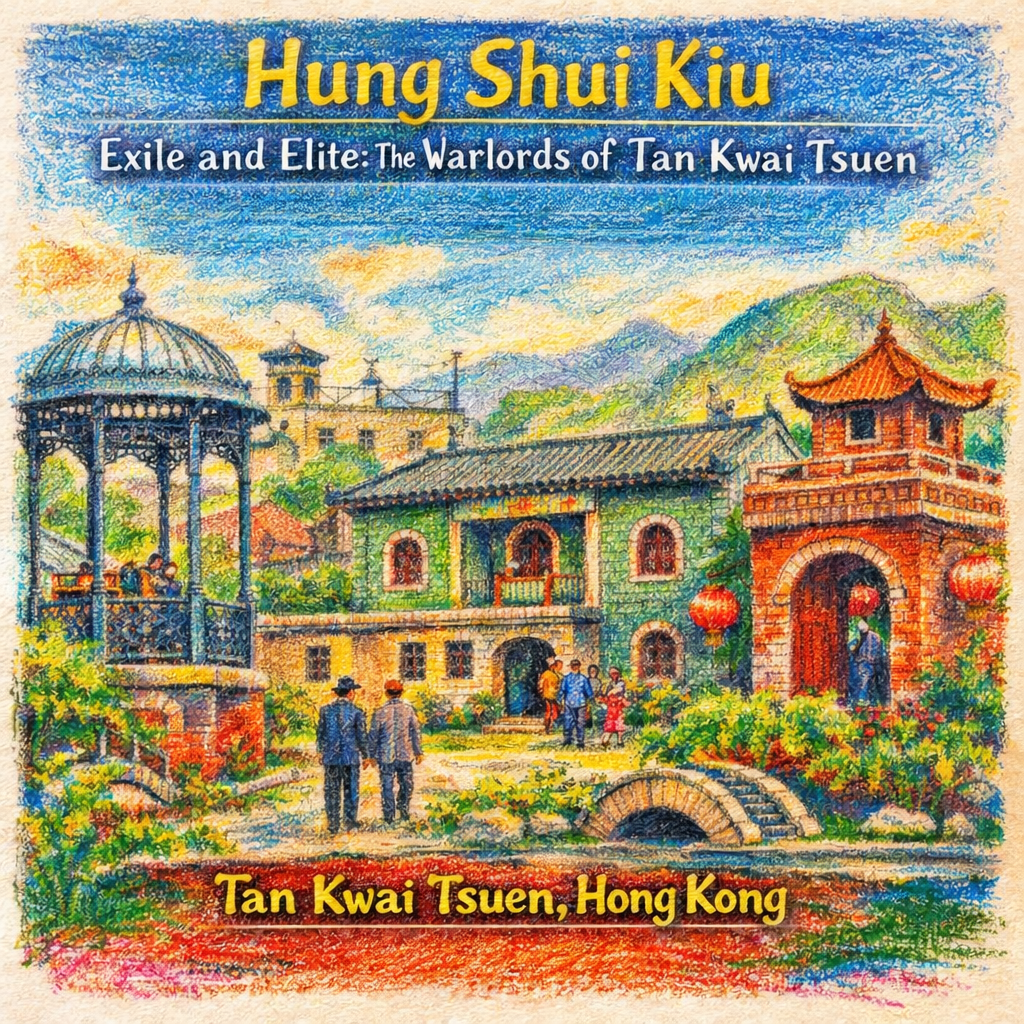
Exile and Elite: The Warlords of Tan Kwai Tsuen
By the early 20th century, Hung Shui Kiu’s isolation and its proximity to the new Castle Peak Road transformed it into a sanctuary for political exiles. The development of Tan Kwai Tsuen was spearheaded by Shen Hongying, a Guangxi warlord who sought refuge in Hong Kong after his defeat in mainland power struggles. The name "Tan Kwai" is a piece of political nostalgia, translating to "A heart toward Guangxi," yet Shen maintained his influence through a strategic alliance with the local Tang clan.
A standout architectural relic of this era is Zhuo Garden (Zhuo Yuan), built in 1939 by Wang Zhuo. Wang, a local resident who served in the colonial police, eventually became a wealthy businessman operating a petroleum business in Yuen Long. His residence reflects the rise of the "comprador" elite—men who bridged the gap between colonial systems and traditional rural life.
Zhuo Garden is a hybrid space: its traditional Chinese green-brick structure is accented by Western-style iron pavilions and red-brick gatehouses. This melding of styles mirrors the transition of New Territories power from traditional clan elders to a new class of gentry. Later, during the Cold War, the area’s strategic value was further solidified with the establishment of the British 42nd Barracks, turning a site of elegant exile into a military outpost.
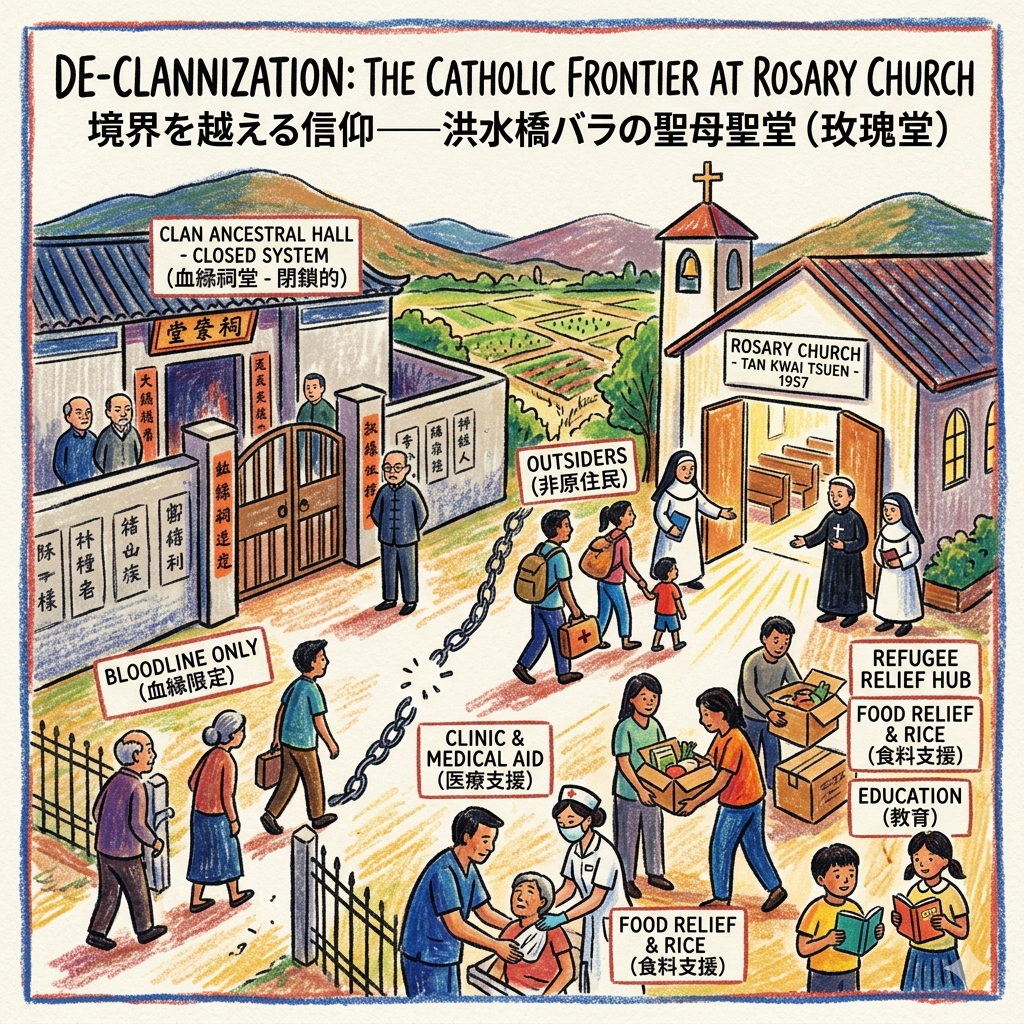
De-clannization: The Catholic Frontier at Rosary Church
The post-war era brought an influx of refugees that further eroded the traditional clan order. In 1957, the establishment of the Rosary Church in Tan Kwai Tsuen marked a significant shift in the social landscape.
While the ancestral halls of the clans were "closed" systems—serving only those of a specific bloodline—the Catholic mission operated an "open" model. Between the 1950s and 70s, the church functioned as a vital welfare hub, providing clinics and food relief to refugees who were excluded from the clan-based safety nets.
Summary of Transition:
- 1957: Established as a small mission chapel in rural farmland to serve the influx of "outsiders."
- 1960s-70s: Became a center for Refugee Relief, providing medical aid and education to those beyond the clan's reach.
- Present: A Regional Landmark that symbolizes the diversification of Hung Shui Kiu beyond its ancestral origins.
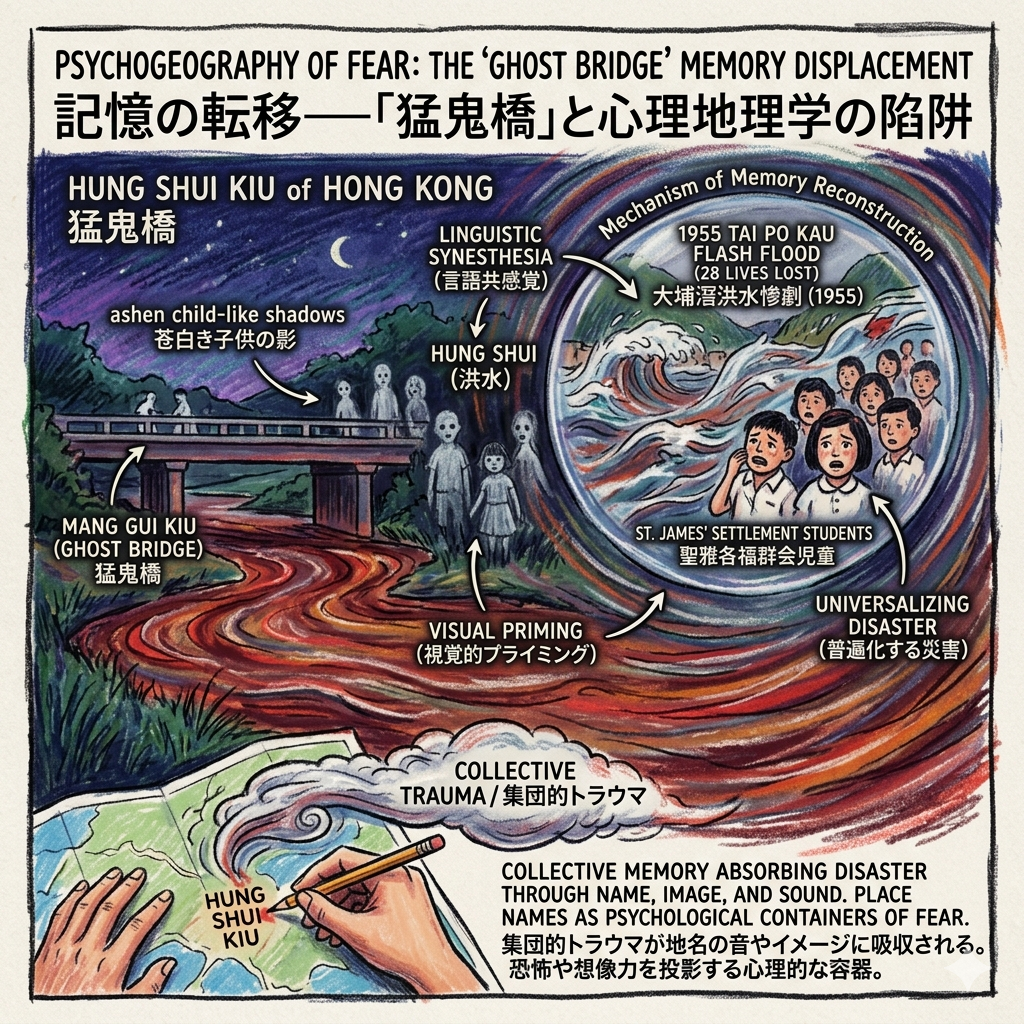
Psychogeography of Fear: The "Ghost Bridge" Memory Displacement
The name "Hung Shui Kiu" carries a heavy psychological burden, often acting as a "container" for collective trauma, even when that trauma occurred elsewhere. This is best seen in the myth of the "Ghost Bridge" (Mang Gui Kiu).
Public imagination has frequently displaced the 1955 Tai Po Kau tragedy—where 28 people, including a group of St. James’ Settlement students, were swept away by a flash flood—to Hung Shui Kiu. Though the events happened miles away, the linguistic link between "Flood" (Hung Shui) and the area’s "Red Water" legends made it the perfect site for this memory to take root.
The Mechanism of Memory Reconstruction:
- Linguistic Synesthesia: The word "Flood" in the name triggered immediate associations with the 1955 disaster.
- Visual Priming: The natural red silt of the river reinforced the "bloody" narrative of the Mao massacre.
- Universalizing Disaster: Local rumors of "ashen child-like shadows" seen near the bridge at night specifically mirror the tragic loss of the St. James’ Settlement children.
Hidden Gems for the Mindful Traveler
For those seeking to witness the physical remnants of these power struggles, one site stands as a silent sentinel:
The Gatehouse of Zhuo Garden Located along Tan Kwai Tsuen Road, the original gatehouse remains as the final physical witness to the "Warlord Era." Observe the materiality of the structure: the contrast of traditional Chinese green-brick masonry with the colonial-influenced red-brick gatehouse. It reveals the rise of the comprador class that redefined the New Territories' power dynamic long before the first modern apartments arrived.
Conclusion: The Layered Observation of a Gateway Town
Hung Shui Kiu is a palimpsest. Beneath the modern blueprints of the Northern Metropolis—with its high-tech hubs and transit-oriented developments—lie the "red water" and the intricate bloodlines of the past. To understand this area is to understand that its transition from a "triple-no-man's-land" to a strategic core is not a loss of identity, but another layer being added to the stack.
As the frontier status of this gateway town is replaced by modern centralities, we must ask: How does a community maintain its soul when the very landscape that birthed its legends is re-engineered? Perhaps the answer lies in the persistent memory of the "Red Water" that still flows, however invisibly, beneath the concrete.
To delve deeper into the hidden narratives of Hong Kong’s spatial history, subscribe to our weekly explorations.
Navigating the History
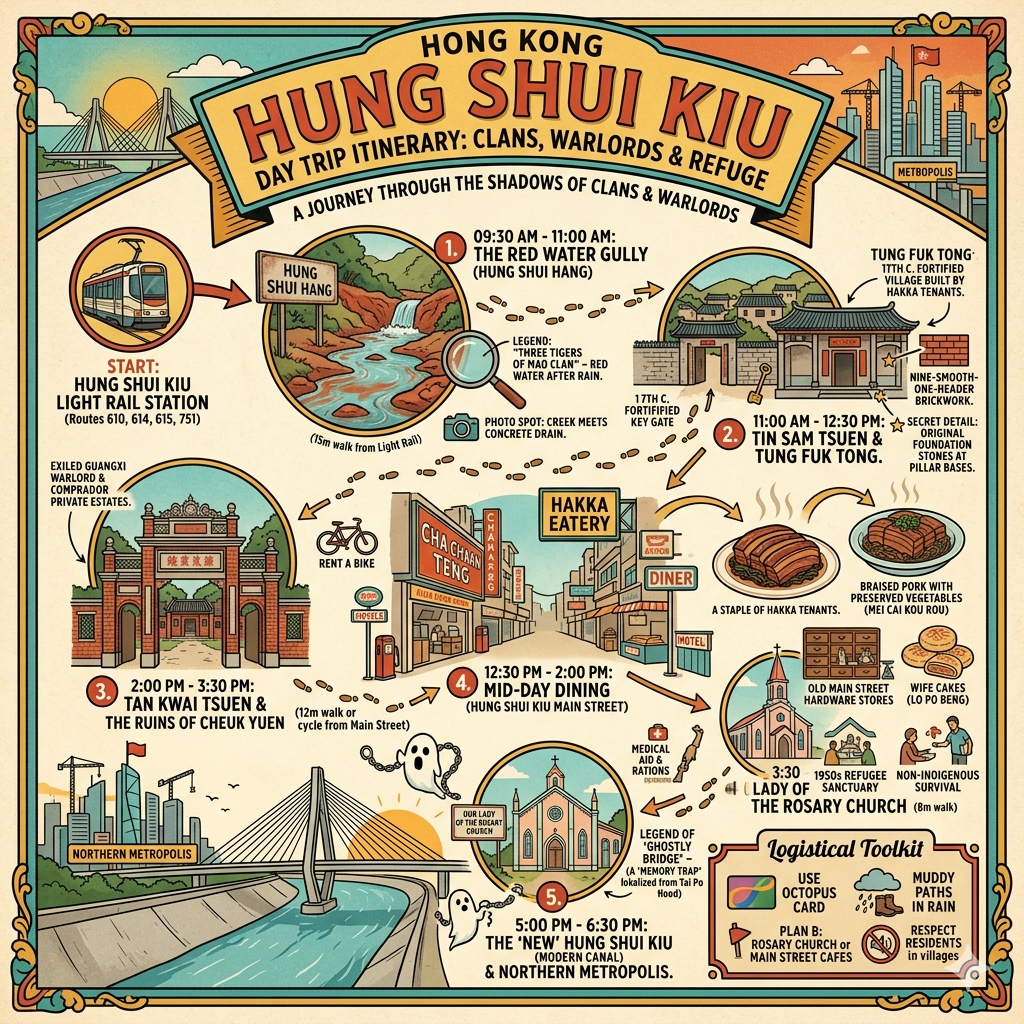
How to get there: Take the MTR to Siu Hong or Tin Shui Wai Station, then transfer to the Light Rail (Routes 610, 614, 615, or 751) and alight at the Hung Shui Kiu stop. The Light Rail tracks largely follow the historic path of the old Castle Peak Road.
Recommended walking route:
- Hung Shui Kiu River: Start near the Light Rail station. Look for the distinctive red silt patterns in the riverbed after a heavy rain—the geological heart of the "Red Water" legend.
- Tin Sam Tsuen: A short walk leads to the Tung Fuk Tong shrine. Contrast its traditional green-brick facade and 1930s Western pediments with the modern Light Rail infrastructure nearby.
- Tan Kwai Tsuen Road: Walk south to find the Zhuo Garden gatehouse and the Rosary Church, tracing the path from warlord exile to Catholic sanctuary.
Nearby historical tours: The Ping Shan Heritage Trail is located just one stop away on the Light Rail, providing a necessary counterpoint to Hung Shui Kiu by showcasing the absolute regional dominance of the Tang clan ancestral halls.
Reference and Further reading
- 青山公路(洪水橋段) - 香港巴士大典- Fandom, accessed April 20, 2026,
- 洪水橋- accessed April 20, 2026,
- 跑遊元朗屏山鄉(7) - 洪水橋灼園| tEre-tErRiTOrY, accessed April 20, 2026,
- Hung Shui Kiu - accessed April 20, 2026,
- Historic Building Appraisal, accessed April 20, 2026,
- 洪水橋、廈村- 天行足跡Skywalker's footprints, accessed April 20, 2026,
- Search for Information on Individual Buildings (1444 and New Items) (3) - Antiquities Advisory Board, accessed April 20, 2026,
- Mang Gui Kiu - accessed April 20, 2026,
- 先賢之路:西貢天主教傳教史.indd 1 14/3/2022 下午5:04, accessed April 20, 2026,
- 玫瑰堂, accessed April 20, 2026,
- 九龍首間天主教堂歌德式的玫瑰堂 - Kowloon Post 龍週, accessed April 20, 2026,
- 堂區歷史簡介 - 玫瑰堂, accessed April 20, 2026,
- 玫瑰堂(二)—— 粉紅色和白色為主調的教堂 - 尋蹤覓蹟, accessed April 20, 2026,
- 大埔滘山洪暴发事件 - accessed April 20, 2026,
- 大埔滘山洪暴發事件- accessed April 20, 2026,
- 【都市傳說】猛鬼橋在何處?大埔滘猛鬼橋講故 - 橙新聞, accessed April 20, 2026,
- 青山公路- accessed April 20, 2026,
- 田心村(洪水橋) - accessed April 20, 2026,
- 洪水橋及厦村發展大綱圖編號D/HSK/2 說明書, accessed April 20, 2026
Lawrence Lawrence
 Lawrence