(ENG) Kameari Walking Guide – Finding Real-Life Nostalgia in the Town of Kochikame
Explore the nostalgic streets of Kameari, the real-life setting of the legendary manga Kochikame. This walking guide takes you through bronze statues and local landmarks, capturing the unique blend of pop culture and traditional Tokyo charm in one slow, atmospheric walk.

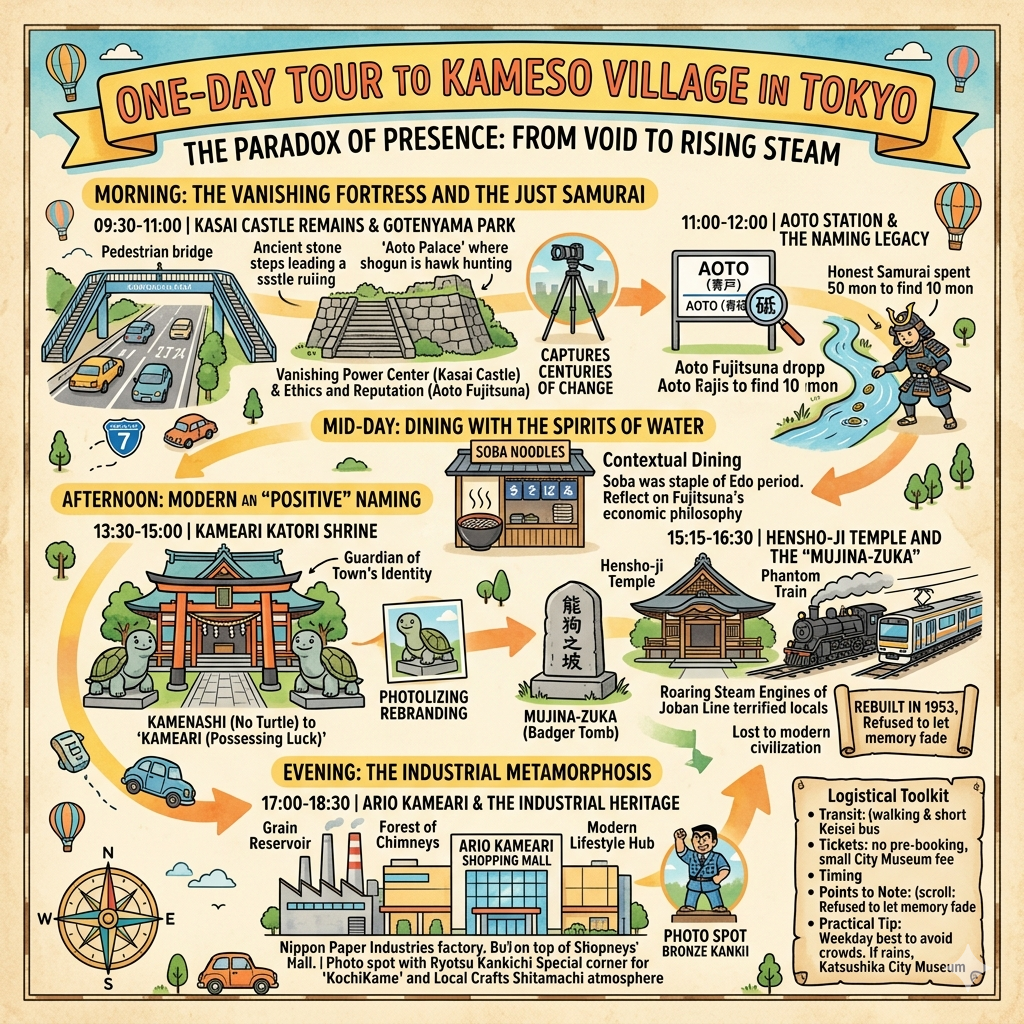
This is a cultural travel story and walking guide to Kameari, a charming neighborhood in Tokyo famous as the setting of the manga series Kochikame. By exploring its bronze statues, traditional shopping streets, and local shrines, this journey reveals how a fictional police officer’s legacy intertwines with the authentic, slow-paced daily life of a classic Shitamachi district.
 Lawrence
The Ghost Village Beneath the Asphalt
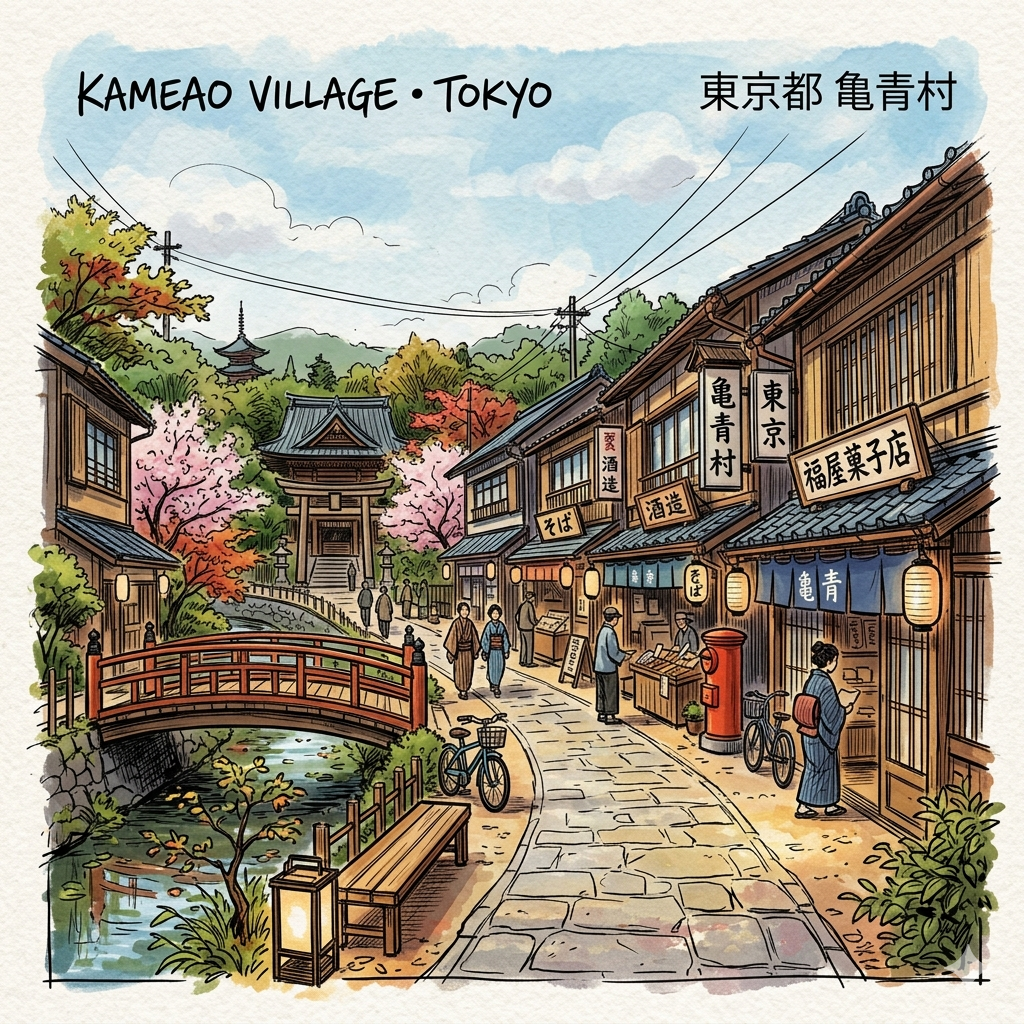
To the modern commuter, Kameari and Aoto are distinct points on the JR Joban and Keisei lines—places of bustling shopping arcades and the nostalgic, sun-faded charm of Tokyo’s shitamachi (lowlands). Yet, between 1889 and 1932, these neighborhoods existed as a single administrative heart: Kameao Village. This short-lived entity served as a historical bridge, binding the feudal memories of the Kanto Plain to the relentless machinery of industrial Tokyo.
The geography of the Nakagawa River’s west bank, a landscape of marshy lowlands and alluvial ridges, once dictated the military and economic fate of the region. This was not a destination, but a strategic chokepoint—a "water-land" where power was measured by the control of river veins and irrigation drainage. Today, the ghost of Kameao is a palimpsest, its history etched into the modern urban grid. By peeling back the layers of asphalt, we find a narrative arc that spans medieval warfare, ethical folklore, and the psychological trauma of modernization. To walk these streets is to cross a threshold into the strategic military heart of the medieval Kanto Plain.
Listen to the historical stories told in detail (For subscribers only)
The Lost Power Hub: From Water Castle to Shogun’s Retreat
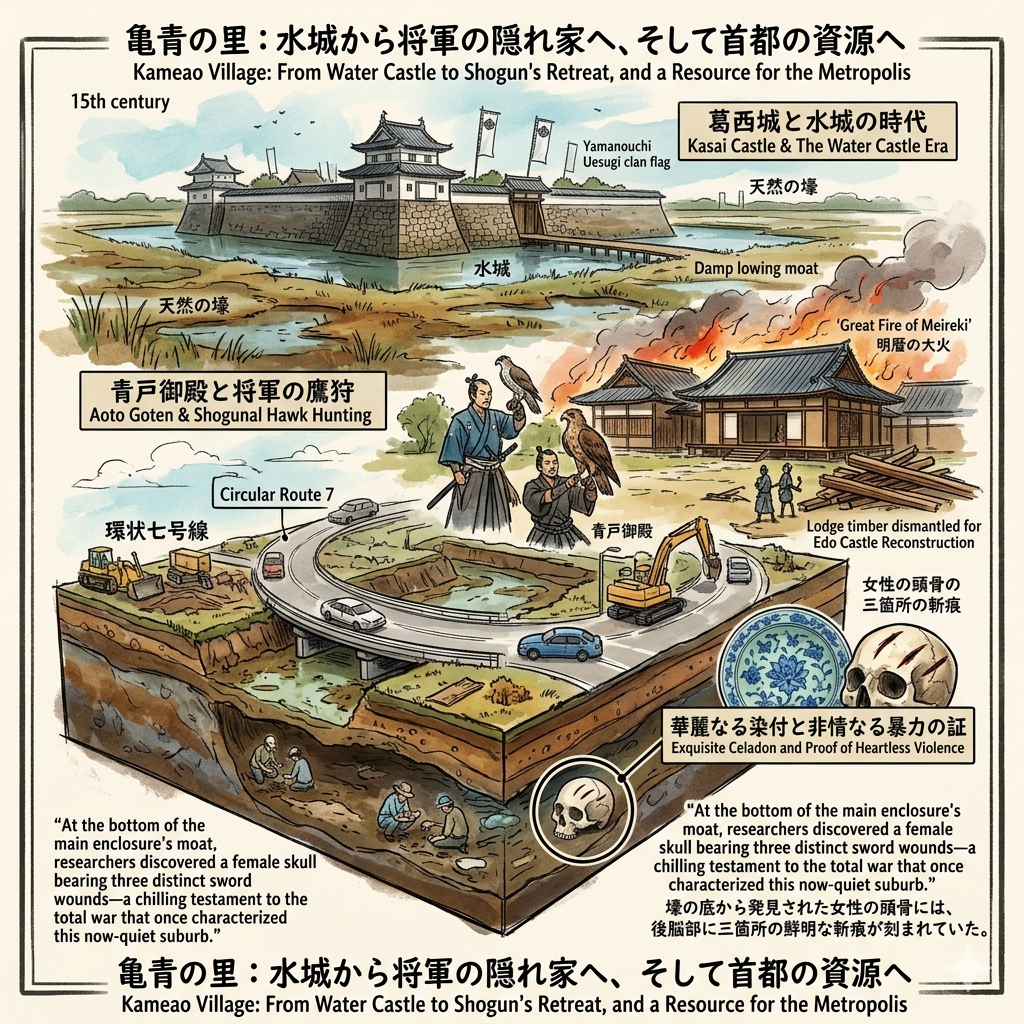
Long before the neon lights of Aoto Station, this district functioned as a vital military fortress. The most significant landmark was Kasai Castle, a 15th-century "water castle" built by the Yamanouchi Uesugi clan. Its design was a masterpiece of damp-land engineering, utilizing natural moats—some 20 meters wide—to create a formidable defense in the low-lying wetlands.
As the political tides shifted from the blood-soaked Sengoku period to the stability of the Tokugawa Shogunate, the site’s utility underwent a metamorphosis. It was transformed into the Aoto Goten, a shogunal "hawk-hunting" lodge. However, this palace of leisure was ultimately sacrificed for the capital's survival. Following the Great Fire of Meireki in 1657, the lodge was dismantled so its high-quality timber could be recycled to rebuild the ruins of Edo Castle. This cycle—the suburb as a resource reservoir for the metropolis—remains a defining theme of the region.
Era | Designation | Primary Function | Key Archaeological/Historical Signifier |
Medieval Defense | Kasai Castle | Military Stronghold | High-status Chinese celadon; 20m-wide moats. |
Early Modern Leisure | Aoto Goten | Shogunal Lodge | Timber recycled for Edo Castle (1657). |
The visceral reality of this transition was unearthed during the construction of Circular Route 7. In the mud of the former moat, archaeologists found a haunting juxtaposition: shards of brilliant blue-and-white Chinese celadon, signifying the high-status life of the castle elite, lay near a more macabre discovery.
"At the bottom of the main enclosure’s moat, researchers discovered a female skull bearing three distinct sword wounds—a chilling testament to the total war that once characterized this now-quiet suburb."
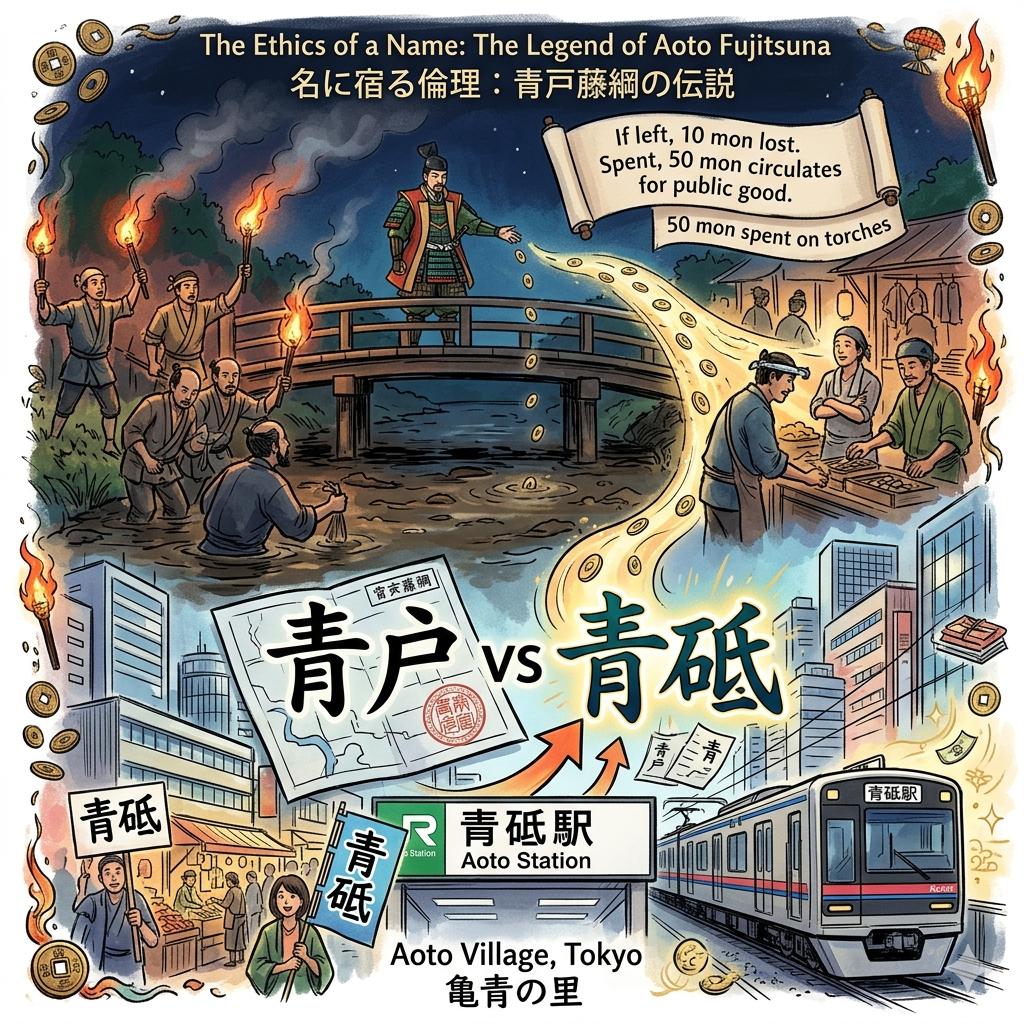
The Ethics of a Name: The Legend of Aoto Fujitsuna
The physical recycling of the Aoto Goten finds its moral parallel in the recycling of local legend. The district’s identity is inextricably linked to Aoto Fujitsuna, a 13th-century official whose story provides an ethical foundation for the region. As the story goes, Fujitsuna dropped ten mon (coins) into the Nameri River at night. He famously spent fifty mon on torches and labor to recover them.
When mocked for spending fifty to save ten, Fujitsuna replied that the ten mon would be "lost to the world" if left in the mud, whereas the fifty mon he spent were now "circulating in the hands of merchants" for the public good. This narrative of "circulating wealth" established an archetype for the Japanese bureaucracy.
The power of this collective memory is so potent that it overrode official records. While administrative documents used the characters 青戶 (Aoto), the community and the railway station insisted on the spelling 青砥 (Aoto), associated with Fujitsuna’s legend. It is a striking example of how myth can override bureaucracy in urban branding—a theme of "applied luck" that resonates through the neighborhood’s history.
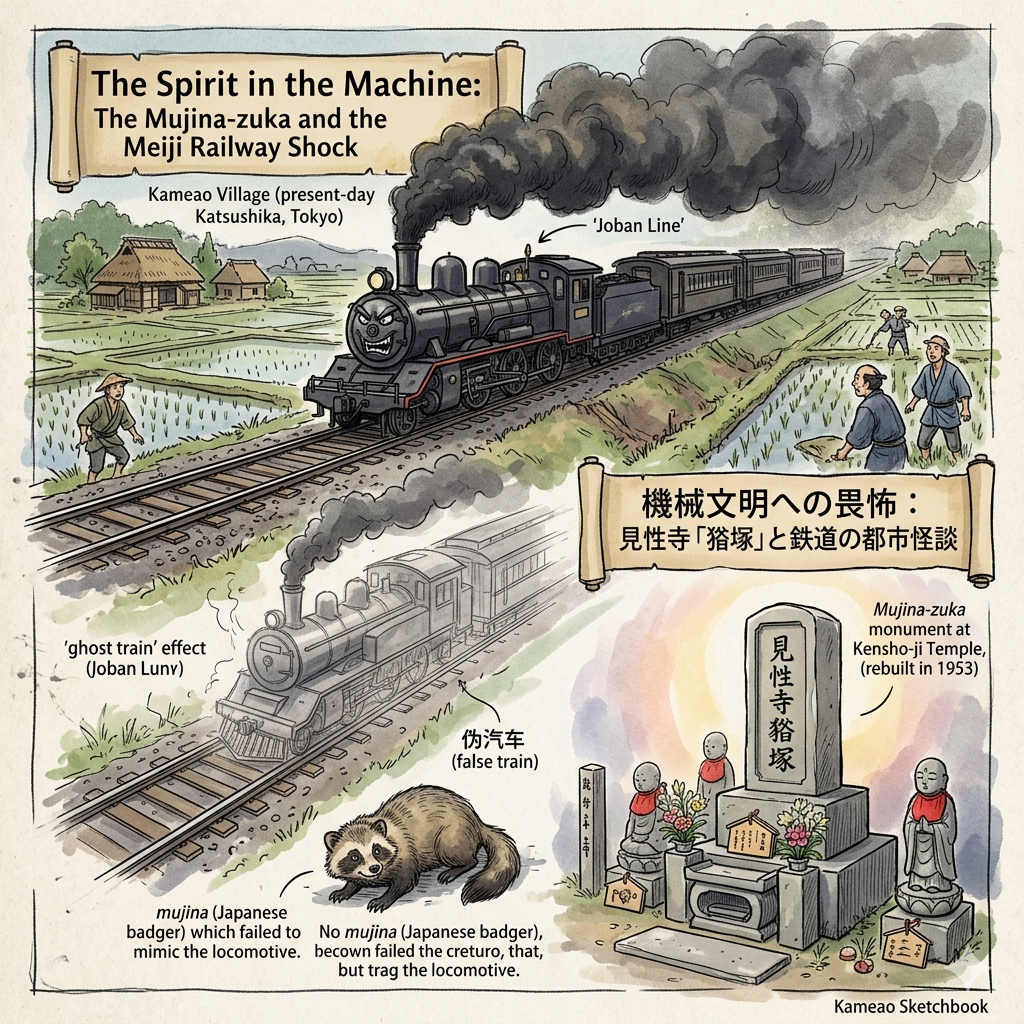
The Spirit in the Machine: The Mujina-zuka and the Meiji Railway Shock
In 1896, the silence of Kameao’s rice paddies was shattered by the opening of the Joban Line. To a community raised on the rhythms of the earth, the steam engine was an "alien invader," belching acrid black smoke and emitting an ear-splitting roar. This "civilization shock" manifested in the legend of the "Ghost Train" (伪汽车). Farmers reported seeing phantom locomotives on the tracks that would vanish into thin air.
The Mujina-zuka (Badger Mound) at Kensho-ji Temple is a site of reconciliation for this industrial trauma. Legend says a mujina (badger)—a shape-shifter of folklore—was found dead on the tracks, having failed in its attempt to "mimic" or confront the iron monster. The villagers viewed the creature not as a pest, but as a martyr of the changing landscape.
The current stone monument, rebuilt by local citizens in 1953, proves that this is not a forgotten ghost story but a living piece of neighborhood-level faith. It represents a long-term commitment to apologizing to the landscape for the violent intrusion of steam and iron, harmonizing ancient spirits with the relentless march of the Meiji era.
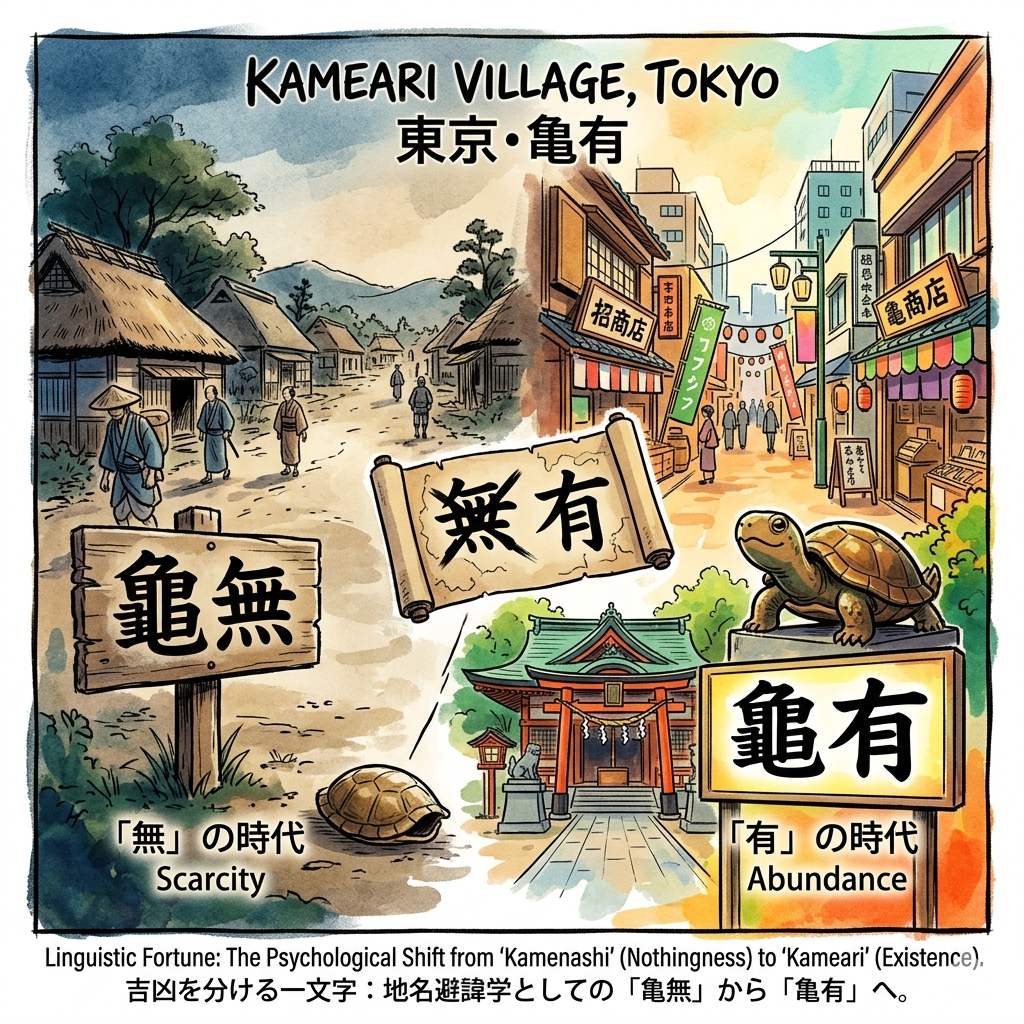
Linguistic Fortune: The Psychological Shift from "Kamenashi" to "Kameari"
The name "Kameari" is perhaps Tokyo’s oldest example of psychological "rebranding." Originally, the area was known as Kamenashi (龜無), meaning "Nothingness" or "No Turtle." In the Edo period, the concept of kotodama—the spirit of words—was taken with absolute seriousness. To live in a place of "nothingness" was to invite scarcity.
During the 1644 compilation of the Shoho Kunie-zu (National Map), the community engaged in an act of "applied luck," successfully petitioning to change the name to Kameari (龜有)—meaning "Existence" or "Abundance." This was a transition "from zero to one" that predates modern marketing by centuries. Today, the Kameari Katori Shrine continues to celebrate this linguistic fortune, serving as a guardian of a prosperity that was literally spoken into existence.
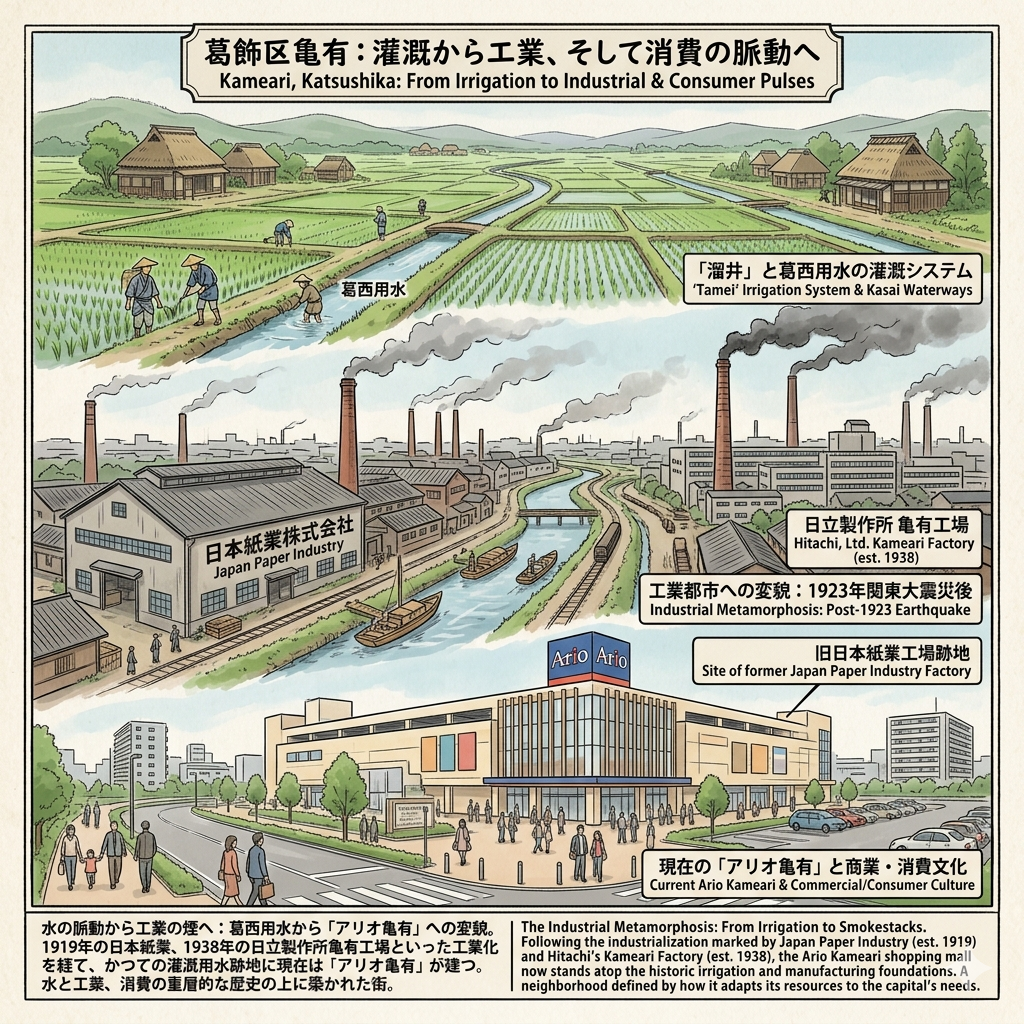
The Industrial Metamorphosis: From Irrigation to Smokestacks
For centuries, the lifeblood of Kameao was the "Tamei" (溜井) system. This was not merely a network of ditches, but a sophisticated engineering feat that utilized old riverbeds to capture upstream drainage for downstream irrigation. However, the 1923 Great Kanto Earthquake fundamentally altered this "water-land" trajectory. As businesses fled the devastated city center, they sought the cheap land and water access of these eastern suburbs.
The spatial continuity here is remarkable:
- Japan Paper Industry (now Nippon Daishowa Paperboard): Established in 1919, utilizing the area’s historic water management for manufacturing.
- Hitachi: Opened its massive Kameari factory in 1938, turning the "spirit train" village into a forest of smokestacks.
Today, the Ario Kameari shopping mall sits directly atop the foundations of the Japan Paper factory. The utility has shifted—from farming to manufacturing to consumption—but the site remains a hub of human activity, proving that the neighborhood’s "spatial continuity" is defined by how it adapts its resources to the needs of the capital.
Walking the Layers: Hidden Gems for the Historical Traveler
Step off the main thoroughfares and seek out the Goshintō (stone lanterns) and Koshin-to towers tucked near the old Mito Kaido road. These weathered stone monuments are the "secret handshakes" of history. They represent a neighborhood-level faith that survived the transition from the feudal Kameao Village to the modern Katsushika ward, standing as silent witnesses to the centuries of commuters, soldiers, and spirits that have passed this way.
Conclusion: The Wisdom of Layered Observation
Kameao is a palimpsest of the Japanese experience. To understand this corner of Tokyo requires looking past the surface of modern convenience to see the layers of military strategy, moral myth, and industrial trauma.
When we walk these streets today, are we stepping on the ruins of a 15th-century "water castle," the path of a Meiji spirit train, or the foundation of an industrial paper mill? The truth is that they all exist at once beneath our feet. The story of Kameao teaches us that the past is never truly lost; it is simply waiting for a keen eye to read the layers of the land.
Subscribe to our newsletter for more deep-dives into Tokyo's forgotten geographies or explore our regional guide at 'Historical Travel Stories'.
Travel Affiliate & Logistics
- How to Get There: Access the area via the JR Joban Line (Kameari Station) or the Keisei Line (Aoto Station).
- Recommended Accommodation: Stay in Ueno or Asakusa. These historical hubs offer easy access to the east side’s "deep maps" via a short train ride.
- Recommended Tours: Look for "East Tokyo Walking Tours" focusing on Edo-period water infrastructure (the Tamei system) and the hidden Koshin stone monuments of Katsushika.
Q & A
How did the opening of the railway create ghost legends?
The opening of the railway in the late 19th century created ghost legends primarily through the psychological shock and collective anxiety that sudden industrialization imposed on traditional rural societies.According to the sources, several factors contributed to the birth of these legends:
Modernity as an "Alien Intruder"
When the Joban Line was extended to the Kameari area in 1896 (Meiji 29), it introduced a massive, noisy, and smoke-belching machine into a quiet agricultural community. To the local residents who were accustomed to a rhythmic, nature-based lifestyle, the steam engine was perceived as an "alien" intruder.The "Phantom Train" (Nise-kisha) Legend
This cultural clash manifested as an urban legend known as the "Phantom Train" (Nise-kisha). It was widely believed across Japan that shape-shifting creatures with supernatural powers, such as foxes or badgers (狢, Mujina), were transforming themselves into phantom trains to trick or mock humans.
- Witness Accounts: People reported seeing trains on the tracks that were not on the official schedule.
- Driver Anxiety: There were even reports of train drivers seeing an oncoming train on the same track and applying emergency brakes, only to find that the "train" had vanished into thin air.
Symbolic Sacrifice and the "Mujina-zuka"
The ghost legend reached a resolution when a real badger was found dead on the tracks, apparently run over by a train. This event was interpreted by the community as a "martyrdom" where the badger had failed in its attempt to confront or mimic the powerful new machine.
- Atonement: The phantom sightings allegedly stopped after the creature's death.
- Sanctification: To appease the spirit and ensure the safety of the railway, the local community established the "Mujina-zuka" (Badger Mound) at Kensho-ji temple in the Meiji 30s (late 1890s).
In summary, these ghost legends served as a socio-psychological mechanism for villagers to process the terrifying speed of modernization. The "Mujina-zuka" remains a historical landmark representing the reconciliation between traditional folklore and industrial progress.
What other ghost stories are connected to old Tokyo railways?
While the specific legend of the "Mujina-zuka" badger is the central focus for the Kameari area, it belongs to a broader category of ghost stories that were connected to old Tokyo and Japanese railways during the Meiji era.
The "Phantom Train" (Nise-kisha) Urban LegendThe sources indicate that the "Phantom Train" (Nise-kisha) was a widespread urban legend that appeared throughout Japan, including the Tokyo area, as the railway system expanded. These stories were not limited to a single location but were a common cultural reaction to the introduction of steam technology.
- Phantom Collisions: A recurring theme in these stories involved train drivers witnessing oncoming trains on the same track in the dead of night. This would force the drivers to engage in emergency braking, only to discover upon stopping that the track was empty and the "oncoming train" had completely vanished.
- Unscheduled Night Sightings: Local residents frequently reported seeing or hearing trains running at midnight that were not on any official schedule. These were believed to be illusions created by supernatural beings.
- Supernatural Tricksters: These legends attributed the phantoms to shape-shifting creatures like foxes or badgers (狢, Mujina). Folklore suggested these animals used their powers to mimic the loud, smoke-belching machines as a way to "tease" or resist the human-made monsters (trains) that were encroaching on their natural habitats.
Related Infrastructure "Hauntings"
While not a railway ghost story in the traditional sense, the construction of modern transport infrastructure in the same region unearthed grim historical evidence that contributed to a sense of local haunting:
- The Victim of Kasai Castle: During the construction of the Kan-nana Road (Ring Road No. 7), which intersects the railway areas of Kameari and Aoto, archeologists discovered a female skull at the bottom of the old castle moat.
- Signs of Violence: The skull bore three distinct sword marks on the back of the head, indicating she was a victim of war during the site's military past.
The sources suggest that these legends served as a collective psychological defense mechanism. By creating stories of "Phantom Trains" or performing rituals like the "badger requiem," communities attempted to process the trauma and anxiety caused by the rapid shift from a quiet agricultural life to a noisy, industrial civilization.
Reference and Further reading
- 葛飾区郷土と天文の博物館 - 東京 - ジャパンナレッジ, accessed April 30, 2026,
- 文化財・かつしかの遺跡 | 葛飾区郷土と天文の博物館|Katsushika City Museum, accessed April 30, 2026,
- 環状7号線の下には「戦国城跡」が眠っている!? 高度成長時代に失われた歴史の痕跡を探して, accessed April 30, 2026,
- 葛西城の落城 | 郷土と天文の博物館ブログ, accessed April 30, 2026,
- 葛西城(御殿山公園と葛西城址公園) - 納得パソコン購入術!パソ兄さん, accessed April 30, 2026,
- 葛西城 - - お城散歩 - FC2, accessed April 30, 2026,
- 東京・葛飾区に巨大な城が?上杉や北条が取り合った葛西城の物語 - 和樂web, accessed April 30, 2026,
- 葛西城の見所と写真・200人城主の評価(東京都葛飾区) - 攻城団, accessed April 30, 2026,
- 葛飾区青戸は『太平記』で有名な、青砥藤綱ゆかりの地であると聞いた。区内に歴史的に証明できる物があるか... | レファレンス協同データベース, accessed April 30, 2026,
- 青砥藤綱(あおとふじつな)の 鎌倉滑川での銭拾い伝説 - 湘南える新聞社, accessed April 30, 2026,
- 青砥藤綱旧蹟 - 鎌倉史跡・寺社データベース, accessed April 30, 2026,
- 葛飾区史|第3章 地域の歴史, accessed April 30, 2026,
- 青砥藤綱屋敷 - 城郭図鑑, accessed April 30, 2026,
- 見性寺 狢塚 - 常磐線に現れた“偽汽車”伝説 - 日本伝承大鑑, accessed April 30, 2026,
- 化けむじなの「偽汽車」が走った街、葛飾区亀有の狢塚【週末民話研究】 - さんたつ by 散歩の達人, accessed April 30, 2026,
- 漫画『こち亀』の世界に浸る!両津勘吉ゆかりを巡る亀有1日モデルコース | GOOD LUCK TRIP, accessed April 30, 2026,
- 【龜有1日遊經典行程】在漫畫『烏龍派出所』的真實世界尋找兩津勘吉足的蹤跡! | 好運日本行, accessed April 30, 2026,
- 見性寺(東京都葛飾区) - 見どころ、アクセス、口コミ & 周辺情報 | GOOD LUCK TRIP, accessed April 30, 2026,
- 見性寺(東京都亀有駅)のアクセス・お参りの情報 (曹洞宗) - ホトカミ, accessed April 30, 2026,
- 古隅田川 - 水の行方を追って, accessed April 30, 2026,
- 亀有香取神社 / 東京都葛飾区 - 御朱印・神社メモ, accessed April 30, 2026,
- 龟有- accessed April 30, 2026,
- 歴史 | 葛西用水路土地改良区, accessed April 30, 2026,
- 掲載図版・資料出典一覧 - 葛飾区, accessed April 30, 2026,
- 葛飾区史|第2章 葛飾の成り立ち(古代~近世), accessed April 30, 2026,
- 庚申塔|稻城市官方網站, accessed April 30, 2026,
- 東京都 - 葛飾区 - 全国文化財総覧, accessed April 30, 2026,
- 葛飾区郷土と天文の博物館 - accessed April 30, 2026,
- 【東京景點】「龜有」完整觀光指南!烏龍派出所的兩津勘吉就在出口迎接 - MATCHA, accessed April 30, 2026
 Lawrence
 Lawrence
 Lawrence