
Tokyo 東京
Explore Tokyo through historical travel stories and guides. Discover castles, old towns, rivers and local legends across the country.

TOKYO — The Complete Authority Guide
A Historical and Cultural Journey Through Edo, Empire, Commerce, Modernity and the Hidden City
Tokyo is often described through its districts.
Shibuya.
Shinjuku.
Asakusa.
Ginza.
Ueno.
Harajuku.
But Tokyo is much more than a collection of neighbourhoods.
Beneath the world's largest metropolitan landscape lies a city repeatedly rebuilt by political power, religious belief, commercial ambition, disaster, migration and cultural reinvention.
Before Tokyo, there was Edo.
Before the skyscraper city, there was a castle town.
Before the neon districts, there were merchant streets, temple towns and samurai estates.
Before the global metropolis, there was a city repeatedly destroyed and rebuilt.
And beneath the contemporary city, fragments of these earlier Tokyos still survive.
This guide brings those layers together.
Rather than treating Tokyo as a list of attractions, TOKYO — The Complete Authority Guide explores the city as a connected historical and cultural system.
Tokyo Is Not One City
There is no single Tokyo.
There are many Tokyos occupying the same geographical space.
There is Edo, the political heart of the Tokugawa shogunate.
There is Sacred Tokyo, where temples, shrines and ritual landscapes shaped communities and political legitimacy.
There is Commercial Tokyo, where merchants, markets and consumption transformed the city's economic life.
There is Modern Tokyo, repeatedly reconstructed through reform, earthquake, war, economic growth and technological change.
And there is Hidden Tokyo, where old neighbourhoods, forgotten waterways, surviving traditions and overlooked communities preserve histories that the modern city appears to have erased.
These are not separate versions of Tokyo.
They are overlapping layers of the same city.
1. Feudal Tokyo — The City Designed Around Power
 Lawrence
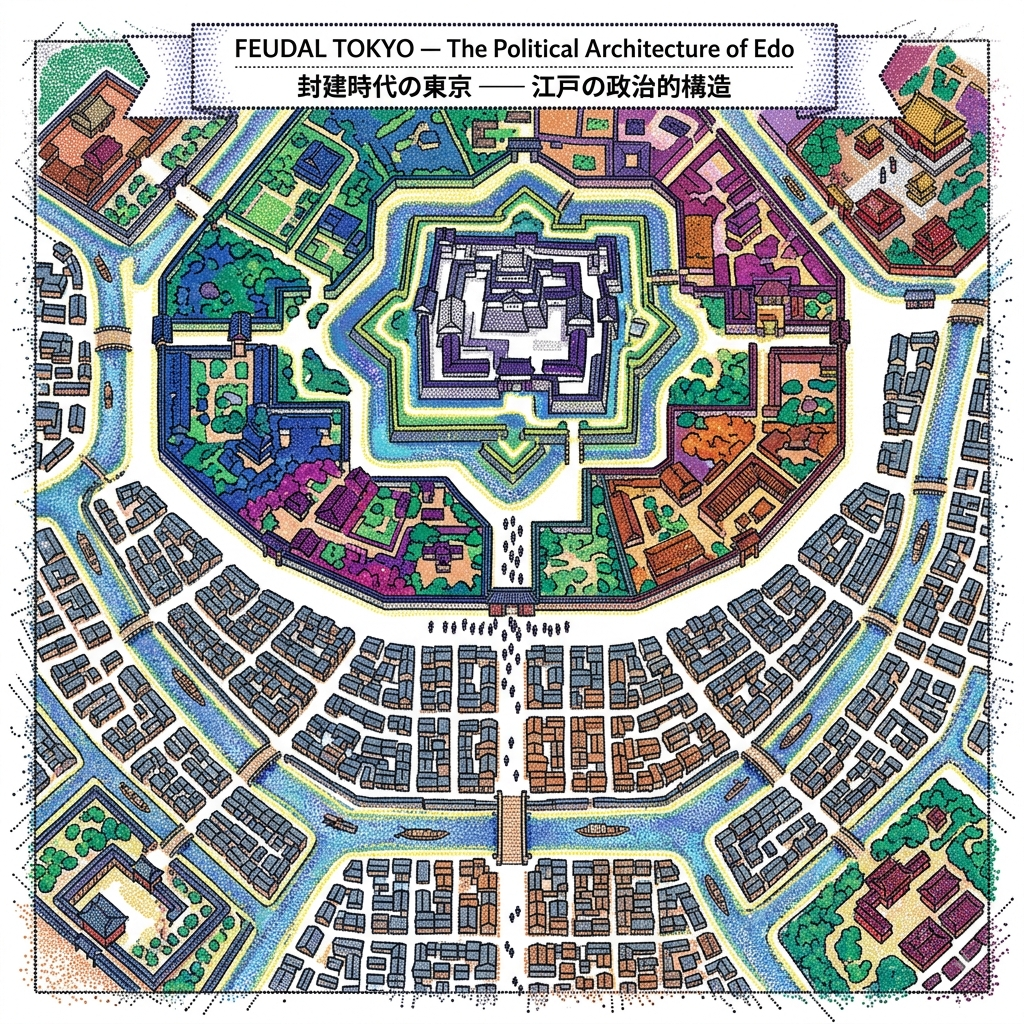
Before Tokyo became Japan's capital, it was Edo.
The arrival of Tokugawa Ieyasu and the establishment of the shogunate transformed Edo from a regional settlement into the centre of one of the world's most sophisticated early-modern political systems.
At the heart of the city stood Edo Castle.
Around it developed:
- Samurai residences
- Daimyo compounds
- Merchant quarters
- Temple districts
- Roads and waterways
- Administrative institutions
The geography of Edo was inseparable from political power.
Even the movement of people was regulated.
Through sankin-kōtai, regional lords were required to maintain residences in Edo and spend alternate periods there. The resulting flow of people, money and goods helped turn Edo into an enormous urban economy.
The city was therefore not simply a place where the shogunate happened to rule.
Edo itself was an instrument of governance.
Many characteristics of modern Tokyo—including its central geography, major roads, districts and institutional concentrations—are easier to understand once the spatial logic of Edo becomes visible.
Explore Feudal Tokyo
Discover:
- Edo Castle
- Tokugawa political power
- Samurai districts
- Daimyo estates
- Sankin-kōtai
- Edo urban planning
- The transition from Edo to Tokyo
2. Sacred Tokyo — The Spiritual Architecture of the City
 Lawrence
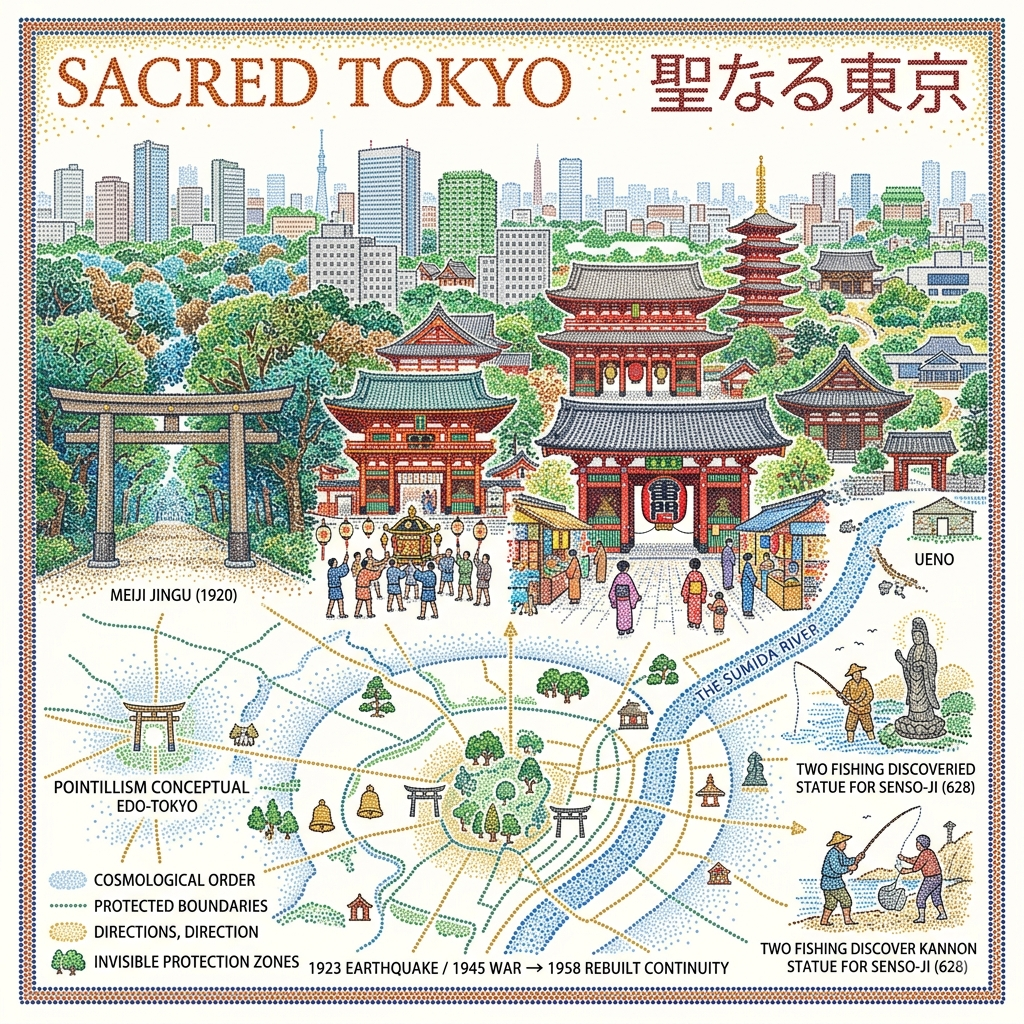
Tokyo's sacred landscape is older and more intricate than its modern skyline suggests.
Temples and shrines served multiple functions.
They were places of worship, but they were also:
- Community institutions
- Political symbols
- Protective structures
- Centres of pilgrimage
- Neighbourhood anchors
- Places where commerce and ritual intersected
The Tokugawa government understood the political importance of sacred geography.
Temples and shrines became part of the symbolic and spatial organization of Edo.
At the same time, popular religious centres such as Senso-ji connected spiritual life with merchants, artisans, entertainment and everyday urban culture.
Later, Meiji Japan transformed the religious landscape again, separating Shinto and Buddhism and incorporating sacred institutions into a new national ideology.
Modern Tokyo inherited all these layers.
That is why a small shrine hidden between office buildings can sometimes reveal as much about the city as a major landmark.
Explore Sacred Tokyo
Discover:
- Senso-ji
- Kanda Myojin
- Kaneiji
- Meiji Shrine
- Hie Shrine
- Temple towns
- Shrine communities
- Edo's spiritual geography
3. Commercial Tokyo — From Edo Consumption to Global Capital
 Lawrence
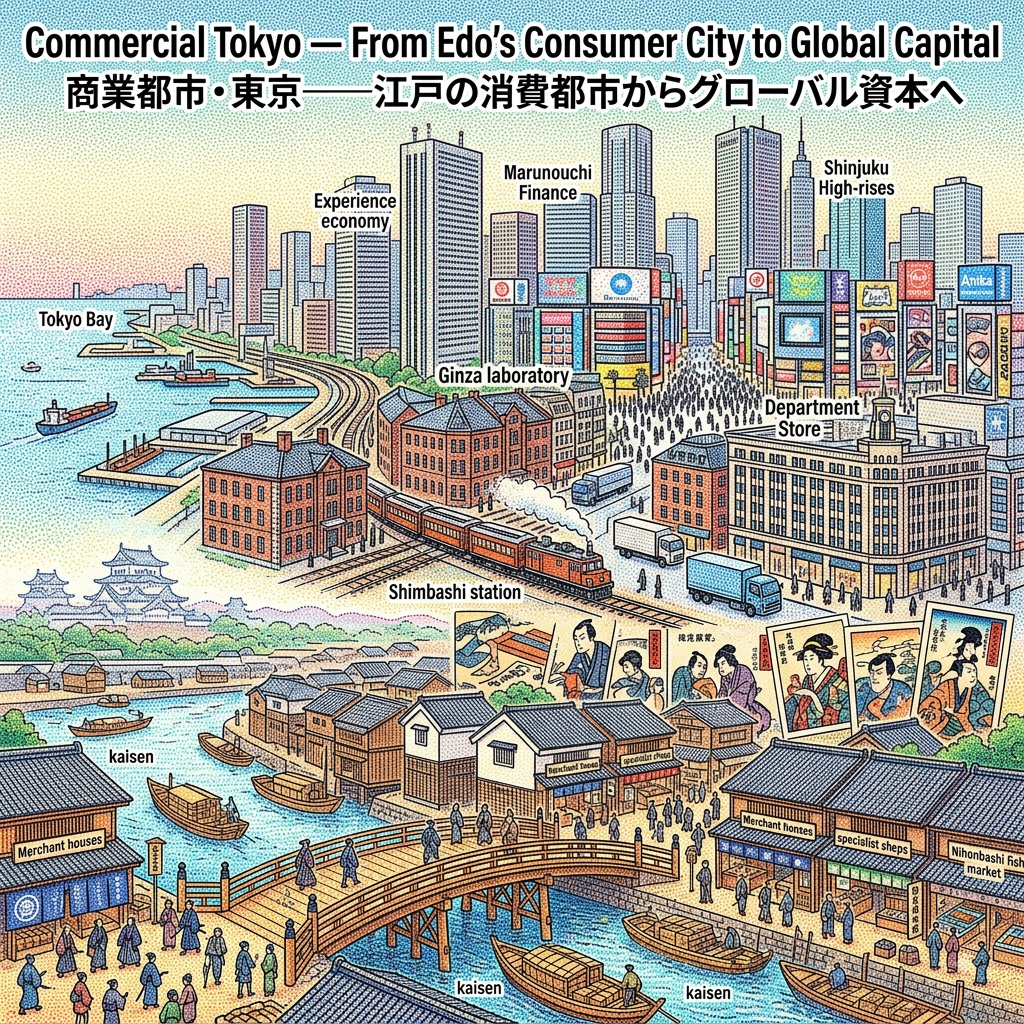
The political capital created an extraordinary commercial ecosystem.
Edo needed food.
It needed housing.
It needed clothing, entertainment, transport, services and luxury goods.
And merchants responded.
Nihonbashi became a major centre of commerce and transportation.
The city's growing population created enormous demand.
Merchant houses expanded.
Markets developed.
Entertainment districts flourished.
Over time, Edo's commercial culture evolved into modern Tokyo's consumer economy.
The transition can be traced through places such as:
Nihonbashi → Ginza → Tsukiji → Shinjuku → Shibuya
Each represents a different stage in the transformation of commercial Tokyo.
From traditional markets and merchant houses to department stores, corporate districts and global consumer culture, Tokyo's economic geography has continually changed while retaining connections to its earlier commercial foundations.
Explore Commercial Tokyo
→ Commercial Tokyo Theme Pillar
Discover:
- Nihonbashi
- Ginza
- Tsukiji
- Markets and merchant districts
- Department-store culture
- Shinjuku commerce
- Shibuya consumer culture
- Tokyo's evolution as a global marketplace
4. Modern Tokyo — A City Rebuilt Again and Again
 Lawrence
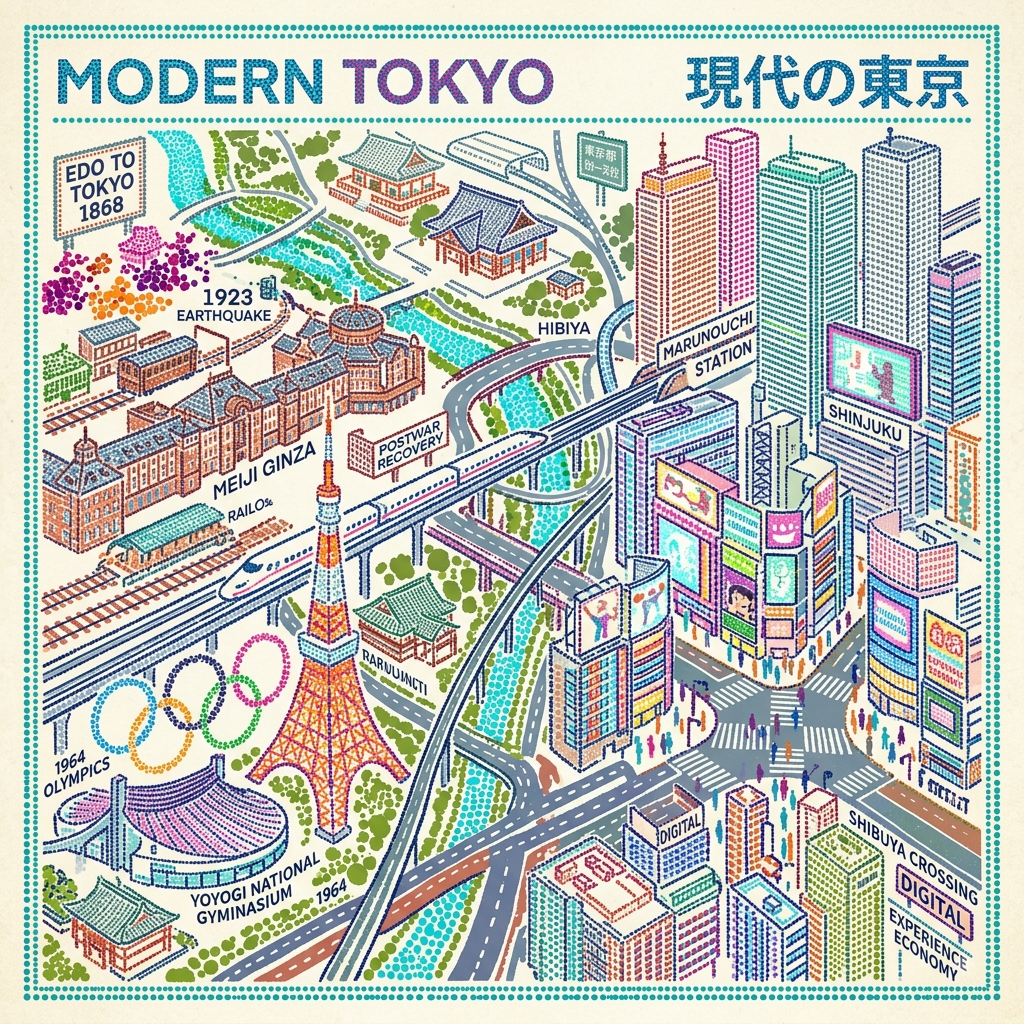
Tokyo's modern history is inseparable from destruction.
The Meiji Restoration transformed Edo into Tokyo.
The Great Kanto Earthquake of 1923 devastated much of the city.
The destruction of 1945 created another enormous break in the urban landscape.
Then came reconstruction.
The 1964 Olympics projected Tokyo onto the international stage.
The economic boom produced a new generation of infrastructure, corporate districts and consumer culture.
Later, technological development and globalization transformed Tokyo into one of the world's most influential metropolitan economies.
Yet modern Tokyo is not simply a new city replacing an old one.
Old structures survive.
Old streets persist.
Old religious institutions continue operating.
Old neighbourhood identities reappear beneath new developments.
Modern Tokyo is therefore better understood as continuous reinvention rather than complete replacement.
Explore Modern Tokyo
Discover:
- Meiji Tokyo
- The Great Kanto Earthquake
- Wartime destruction
- Postwar reconstruction
- 1964 Olympics
- Shinjuku
- Shibuya
- Akihabara
- Tokyo's technological transformation
- Contemporary urban development
5. Hidden Tokyo — What the Modern City Did Not Erase
 Lawrence
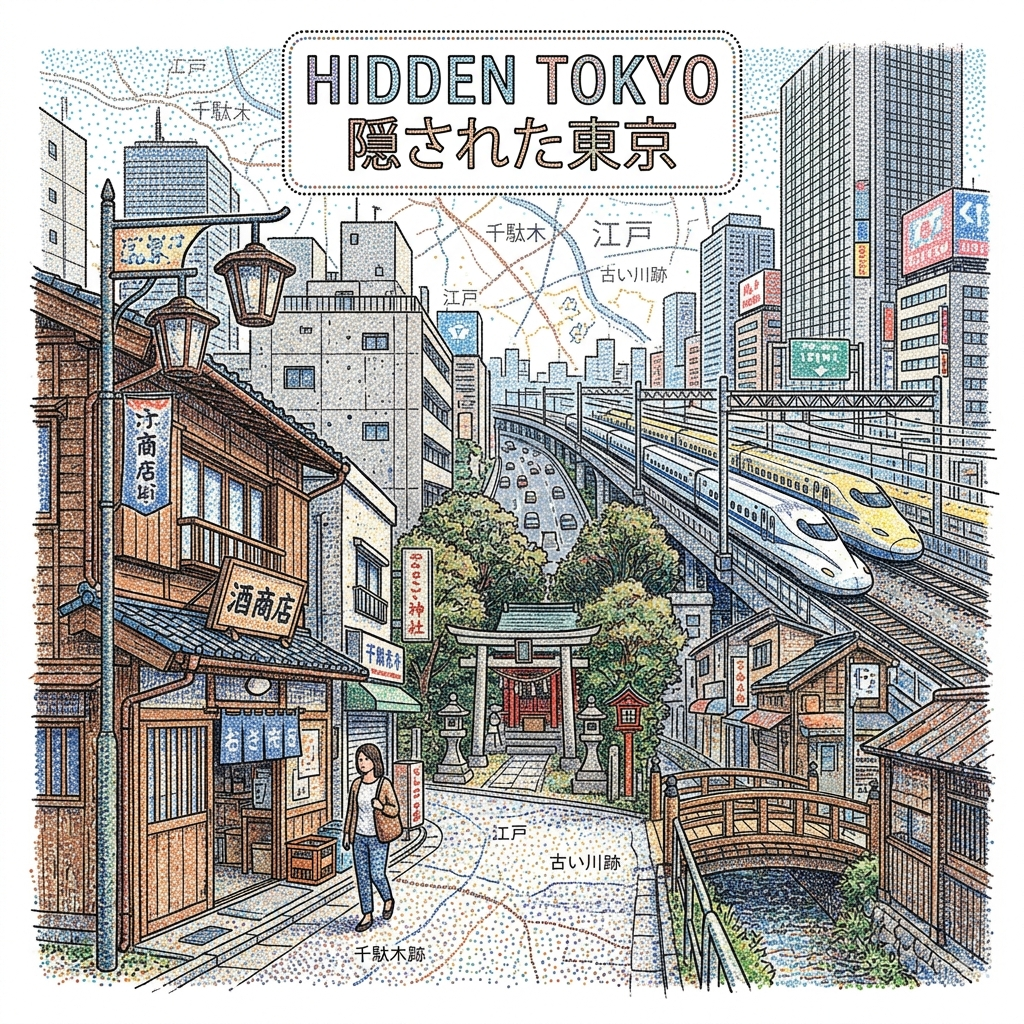
Tokyo's most famous districts reveal the city at its most visible.
But the city's deeper character is often found in places that receive less attention.
A narrow lane.
A small shrine.
A surviving wooden house.
An old market.
A former industrial site.
A neighbourhood that escaped redevelopment.
A street whose shape still reflects an earlier city.
Hidden Tokyo is not simply a collection of "secret places."
It is an investigation into urban survival.
Why did some places disappear while others remained?
Why did certain neighbourhoods survive earthquakes and war?
How did traditional communities adapt to modernization?
What happens when an old industrial district becomes a creative neighbourhood?
And what does a city lose when its historical layers are completely erased?
Explore Hidden Tokyo
Discover:
- Yanaka
- Kagurazaka
- Shimokitazawa
- Shitamachi neighbourhoods
- Forgotten waterways
- Old shopping streets
- Hidden shrines
- Industrial remnants
- Surviving urban communities
Tokyo as a Historical System
The real value of studying these five themes is not in separating them.
It is in connecting them.
A temple may stand where a political strategy once required it.
A commercial street may occupy the footprint of an Edo-era district.
A railway corridor may have accelerated the growth of a neighbourhood that began centuries earlier.
A modern skyscraper may stand beside a community that survived the postwar period.
An old shrine may preserve the memory of a village absorbed by the expanding metropolis.
This is why Tokyo should be read as a system.
Its political geography influenced its commercial geography.
Its religious geography influenced its community structure.
Its disasters influenced its urban planning.
Its economic growth transformed its neighbourhoods.
Its modernization created both new spaces and unexpected survivals.
Tokyo Through Five Interconnected Layers
Political Tokyo
How the Tokugawa system turned Edo into the political heart of Japan.
Spiritual Tokyo
How temples, shrines and ritual landscapes shaped the city's identity and social order.
Economic Tokyo
How merchants, markets, distribution networks and consumer culture transformed the city.
Transforming Tokyo
How reform, disaster, war, reconstruction, technology and globalization repeatedly reshaped the metropolis.
Remembered Tokyo
How older communities, overlooked places and surviving landscapes preserve the city's less visible histories.
Together, these five layers form the historical architecture of Tokyo.
Tokyo by Historical Period
Another way to understand the city is through time.
Edo
The age of the Tokugawa shogunate, samurai governance and engineered urban growth.
Meiji
The transformation from shogunal city to imperial capital.
Taisho
Modernization, mass culture and the catastrophic Great Kanto Earthquake.
Showa
War, destruction, occupation, reconstruction and extraordinary economic growth.
Postwar Tokyo
The rise of the megacity, mass consumer culture and new metropolitan identities.
Contemporary Tokyo
Technology, globalization, demographic change, cultural reinvention and the continuous negotiation between old and new.
Tokyo by Geography
You can also explore Tokyo through its neighbourhoods.
Asakusa reveals the relationship between religion, popular culture and old Tokyo.
Ueno reveals temples, cultural institutions and the transformation of historical space.
Nihonbashi reveals commerce, transport and the economic foundations of Edo.
Ginza reveals modern consumer culture.
Shinjuku reveals postwar transformation and the rise of the vertical metropolis.
Shibuya reveals youth culture, consumption and contemporary urban identity.
Yanaka reveals survival, memory and the quieter layers of old Tokyo.
The district is the physical space.
The theme is the historical meaning.
Both are necessary.
How to Explore Tokyo Through History
A conventional travel guide asks:
Where should I go?
A historical travel guide asks:
What happened here?
And then asks a second question:
Why does it still matter?
That change in perspective transforms the way you walk through Tokyo.
At Edo Castle, you are not simply visiting a historic site.
You are standing at the centre of a political system.
At Nihonbashi, you are not simply crossing a bridge.
You are standing where national transportation and commercial networks once converged.
At Senso-ji, you are not simply visiting a temple.
You are entering a district where belief, commerce and popular culture became intertwined.
In Yanaka, you are not simply walking through a charming neighbourhood.
You are examining what survived the transformation of a megacity.
The Historical Walking Philosophy
Tokyo is particularly suited to historical walking because its past remains embedded in its urban fabric.
The most rewarding journeys are often those where one historical layer gradually gives way to another.
For example:
Edo Castle → Nihonbashi → Asakusa
can become a journey from political power to commerce to popular religion.
Or:
Ginza → Shinjuku → Shibuya
can become a journey through modern consumer culture and the transformation of the metropolis.
Or:
Yanaka → Nezu → Ueno
can become an exploration of surviving historical neighbourhoods.
The purpose is not to see more places.
It is to understand the relationships between them.
Tokyo Is a City of Continuity and Rupture
Few cities have experienced so many dramatic changes while retaining so much historical continuity.
Tokyo has been:
- A castle city
- A samurai capital
- A merchant metropolis
- An imperial capital
- A wartime target
- A reconstructed city
- A global economic centre
- A cultural and technological powerhouse
Each transformation altered the city.
None completely erased what came before.
That tension between continuity and rupture is perhaps the defining historical characteristic of Tokyo.
Why Tokyo Is Worth Exploring Through History
Tokyo's famous attractions are impressive.
But its greatest richness lies in the relationships between them.
A temple beside a railway.
An Edo road beneath a modern boulevard.
A merchant district transformed into a luxury shopping street.
A postwar neighbourhood beside a corporate tower.
A surviving shrine surrounded by skyscrapers.
These juxtapositions are not random.
They are the visible result of centuries of political decisions, economic forces, cultural practices and ordinary human adaptation.
To understand Tokyo is therefore to understand how cities remember.
Continue Exploring Tokyo
Feudal Tokyo
 Lawrence
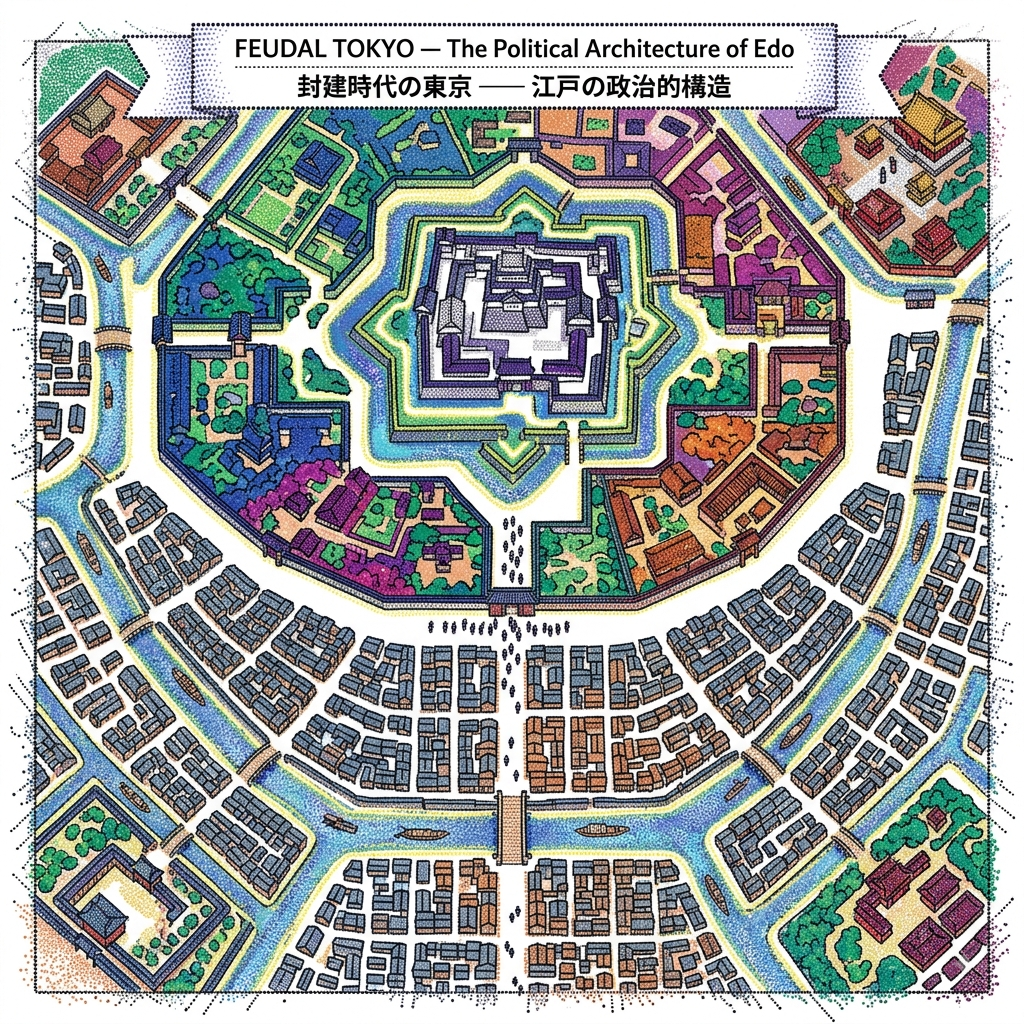
Samurai power, Edo Castle, Tokugawa governance and the political geography of Edo.
→ Read the Feudal Tokyo Theme Pillar
Sacred Tokyo
 Lawrence
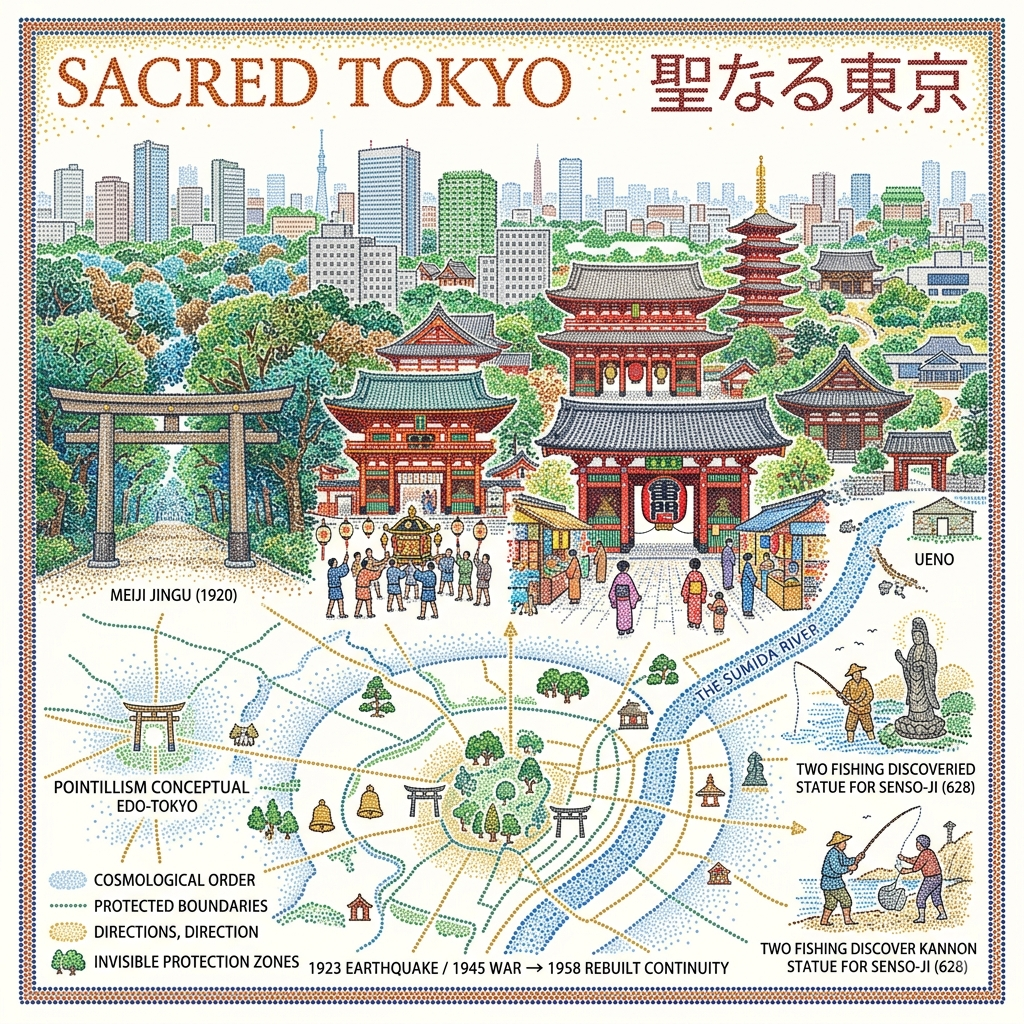
Shrines, temples, spiritual geography and the relationship between religion, politics and everyday life.
→ Read the Sacred Tokyo Theme Pillar
Commercial Tokyo
 Lawrence
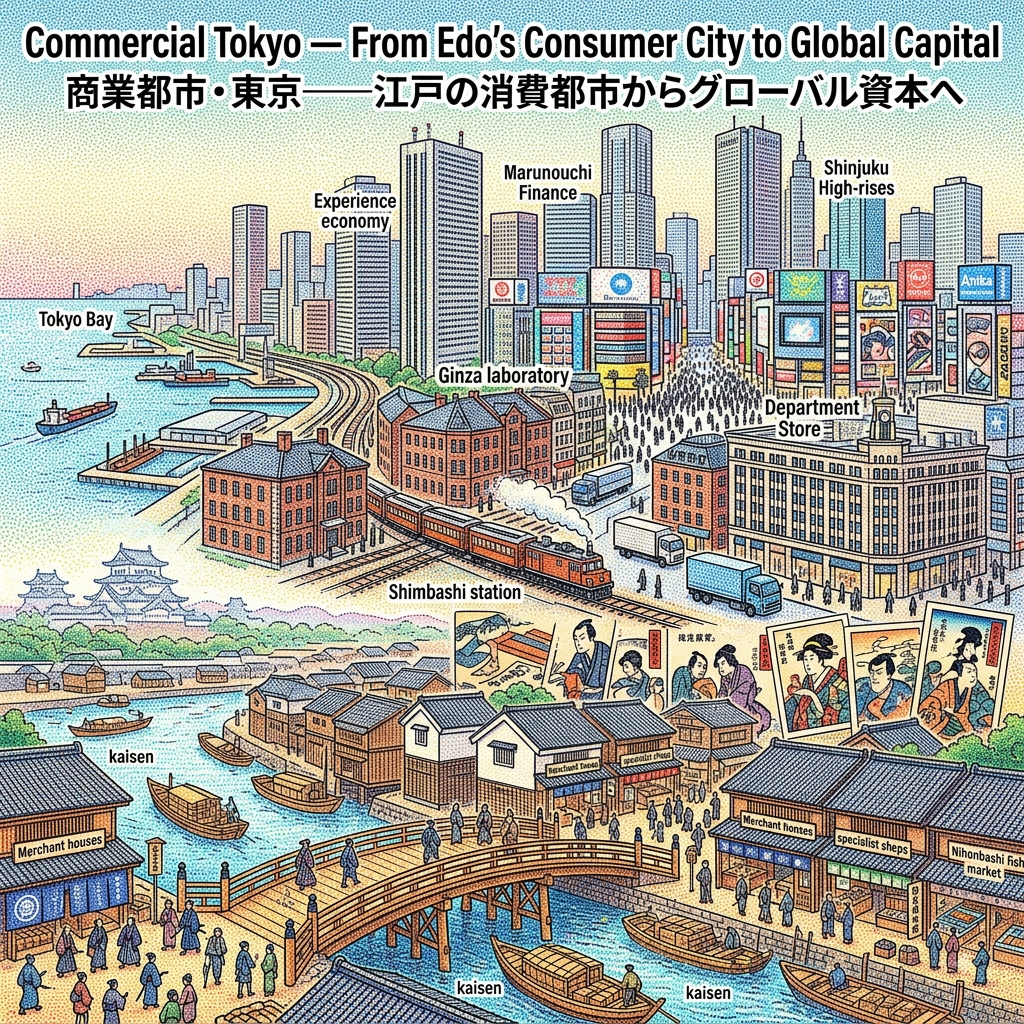
Merchants, markets, Nihonbashi, Ginza, Tsukiji and the evolution of Tokyo's economic life.
→ Read the Commercial Tokyo Theme Pillar
Modern Tokyo
 Lawrence
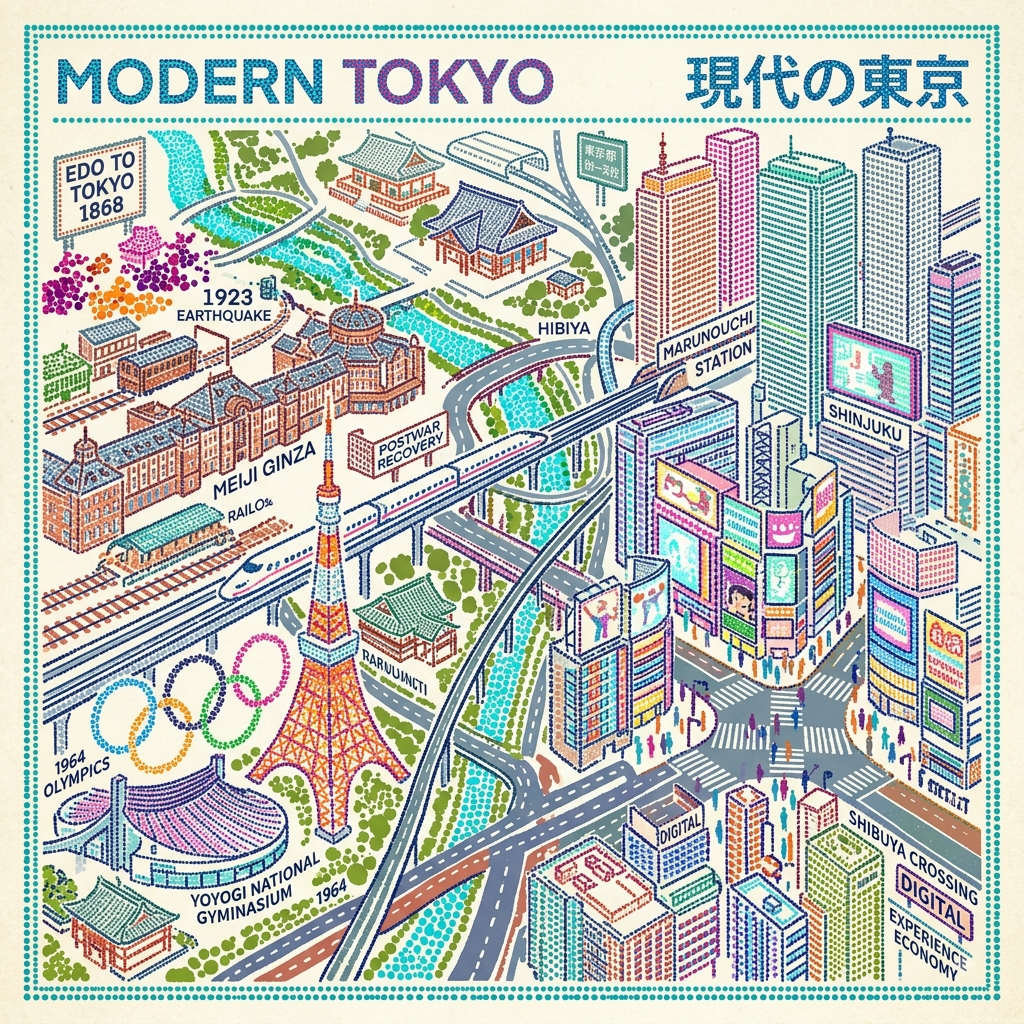
Meiji transformation, earthquake, war, reconstruction, economic growth, technology and global urban culture.
→ Read the Modern Tokyo Theme Pillar
Hidden Tokyo
 Lawrence
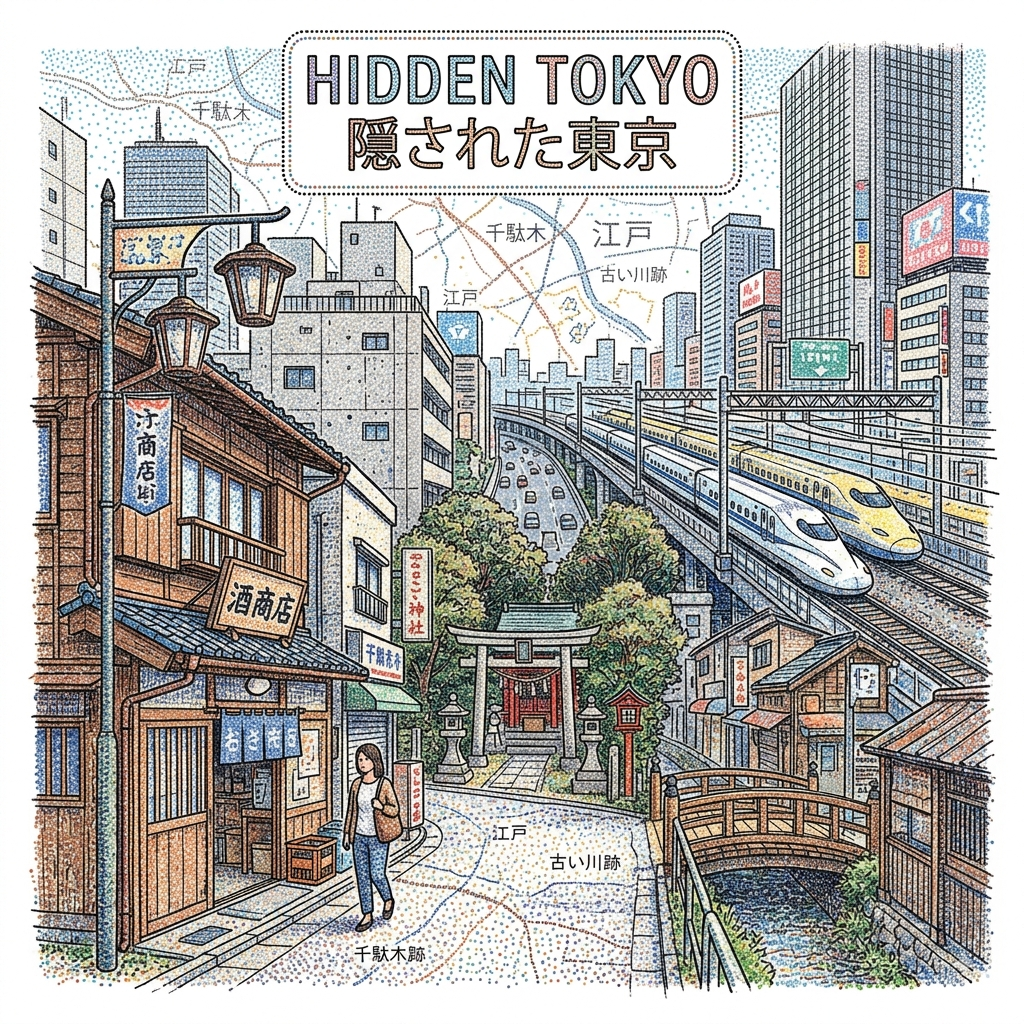
Forgotten neighbourhoods, surviving communities, lost waterways, old streets and the histories beneath the modern city.
→ Read the Hidden Tokyo Theme Pillar
Final Reflection — Learning to Read Tokyo
There are two ways to experience Tokyo.
You can move through it as a collection of attractions.
Or you can read it as a historical landscape.
The first reveals what Tokyo looks like.
The second reveals why Tokyo became what it is.
Once you begin to read the city historically, a bridge becomes a transportation story.
A temple becomes a community archive.
A shopping street becomes a merchant history.
A railway station becomes an instrument of urban transformation.
A surviving neighbourhood becomes evidence of resilience.
And the skyline becomes the latest layer of a city that has been rebuilding, adapting and reinventing itself for centuries.
Tokyo is not simply a place to visit.
It is a city to read.
Historical Sources & Further Reading
For deeper research, the Tokyo collection prioritizes:
- Tokyo Metropolitan Government historical and cultural resources
- Tokyo Metropolitan Central Library
- National Diet Library
- Agency for Cultural Affairs, Japan
- National Archives of Japan
- Museum and heritage institutions
- Academic research on Edo, Meiji and modern Tokyo
- Local community histories and documented oral histories
Each individual Historical Travel Stories article should provide contextual citations for significant historical claims, with the most authoritative sources given priority.
Explore the Tokyo Collection
TOKYO — The Complete Authority Guide
→ Feudal Tokyo — Power, samurai and the architecture of Edo
→ Sacred Tokyo — Temples, shrines and spiritual geography
→ Commercial Tokyo — Merchants, markets and the economic city
→ Modern Tokyo — Disaster, reconstruction and reinvention
→ Hidden Tokyo — Surviving communities and forgotten urban layers
Start with one layer. Then follow the connections.
That is how Tokyo reveals itself.
 Lawrence
 Lawrence