
Sacred Tokyo 神聖的東京
Sacred Tokyo — Shogun, Shrines & the Spiritual Geometry of Edo. Sacred Tokyo — The Invisible Structure Behind the City Tokyo is not only a political and economic capital. It is also a carefully structured spiritual landscape.
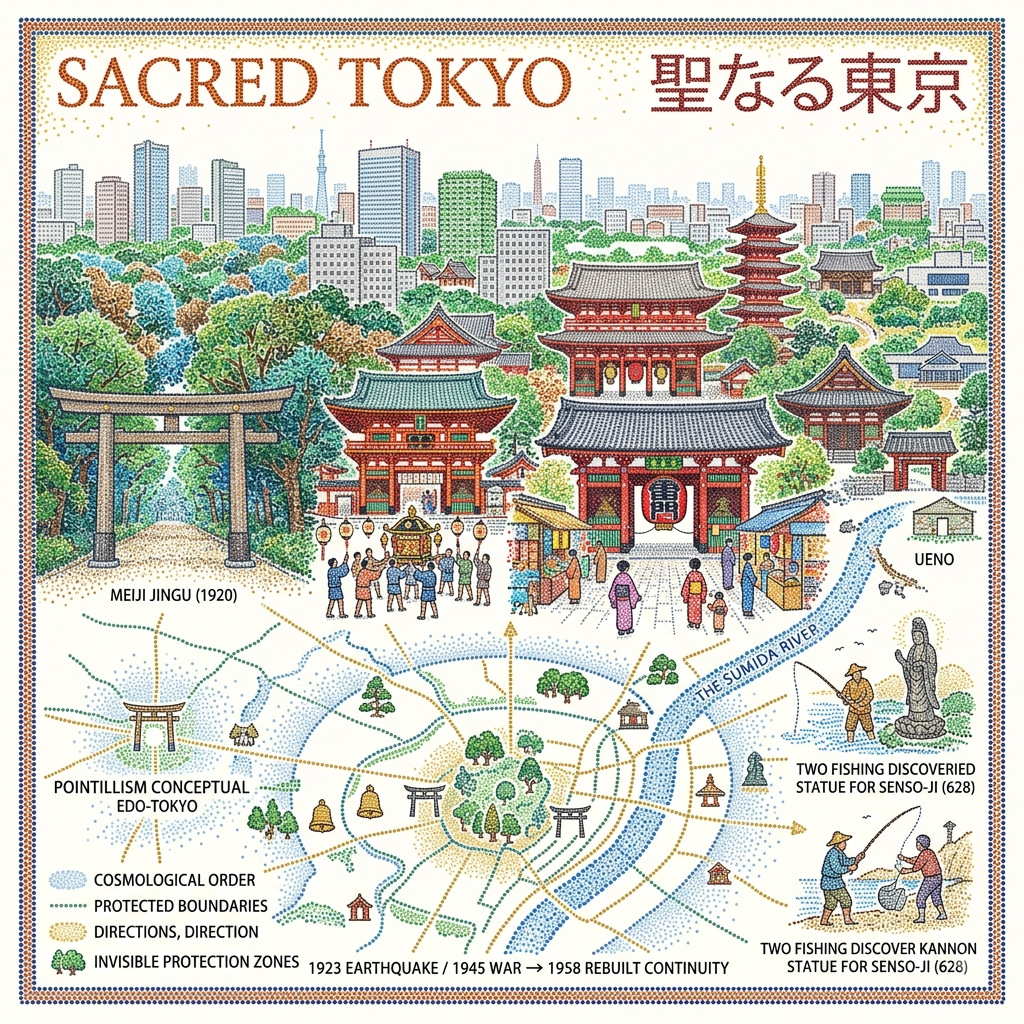
Sacred Tokyo — Shogun, Shrines & the Spiritual Geometry of Edo
Sacred Tokyo — The Invisible Structure Behind the City
Tokyo is not only a political and economic capital.
It is also a carefully structured spiritual landscape.
From the beginning of the Edo period, shrines and temples were not placed randomly.
They were part of a system designed to:
- Protect the city
- Legitimize authority
- Control social order
- Anchor everyday life
Sacred Tokyo is not about religion alone.
It is about how belief shaped the city itself.
I. Tokugawa Strategy — Religion as Political Infrastructure
When Tokugawa Ieyasu established Edo as his base of power,
he did not rely on military strength alone.
He built a spiritual system.
Key institutions such as Kaneiji Temple were positioned deliberately to protect the city and reinforce authority.
Temples and shrines served as:
- Political symbols
- Defensive alignments
- Instruments of social control
Sacred Tokyo begins as a form of governance.
👉 Recommended reading:
Feudal Tokyo Theme Pillar
Ueno / Edo planning related articles
II. The Demon Gate — Spiritual Defense of Edo
The Northeast Threat


In traditional cosmology, the northeast direction (kimon) was considered the “demon gate.”
To protect Edo, major temples were placed strategically in this direction.
This was not superstition.
It was urban planning based on belief systems.
The city itself was treated as a living entity that needed protection.
👉 Recommended reading:
Sacred Tokyo district articles (Ueno, temple zones)
III. Asakusa — Religion of the People
Where Faith Meets Daily Life


Senso-ji represents a different layer of Sacred Tokyo.
Unlike elite temples tied to the shogunate, Asakusa was:
- A center of popular religion
- A hub for merchants and artisans
- A space where faith and commerce merged
Festivals, markets, and entertainment all grew around it.
Religion in Edo was not separate from life.
It was embedded within it.
👉 Recommended reading:
Asakusa article
Commercial Tokyo Pillar
IV. Kanda and Merchant Faith
Spiritual Support for Commerce


Kanda Myojin became closely tied to merchant communities.
It reflects a key idea:
Economic life in Edo required spiritual backing.
Merchants prayed for:
- Prosperity
- Protection
- Stability
Sacred Tokyo and Commercial Tokyo are deeply connected.
👉 Recommended reading:
Commercial Tokyo Pillar
Nihonbashi article
V. Meiji Transformation — Religion Rewritten
From Shogunate to State Ideology


The Meiji Restoration transformed Tokyo’s religious landscape.
- Buddhism was separated from Shinto
- Shrines became tools of state ideology
- New institutions like Meiji Shrine symbolized national identity
Sacred Tokyo entered a new phase:
From political tool → national narrative.
👉 Recommended reading:
Modern Tokyo Pillar
Meiji-era Tokyo article
VI. Sacred Fragments in Modern Tokyo
Hidden Shrines in a Megacity


Even today, small shrines exist between office towers and residential buildings.
They represent:
- Continuity of place
- Cultural memory
- Invisible spiritual infrastructure
Modern Tokyo did not erase Sacred Tokyo.
It absorbed it.
👉 Recommended reading:
Hidden Tokyo Pillar
Hie Shrine / local shrine articles
VII. Sacred Tokyo Map — Understanding the Spiritual Network
To fully understand Sacred Tokyo, view it as a network:
- Ueno (defensive temples)
- Asakusa (popular religion)
- Kanda (merchant spirituality)
- Central Tokyo shrines (political symbolism)
- Meiji Shrine (modern identity)
This layered geography defines the city’s spiritual structure.
VIII. Sacred Tokyo Itineraries
Spiritual Core Route:
Ueno → Asakusa → Kanda
Political-Spiritual Route:
Imperial Palace area → Hie Shrine → Meiji Shrine
Hidden Shrine Route:
Central Tokyo → small neighborhood shrines → backstreets
These routes improve:
- Engagement
- Search intent capture
- Reader understanding
IX. Why Sacred Tokyo Matters
Tokyo is often seen as modern and secular.
But beneath its infrastructure lies a deeply embedded spiritual system.
Shrines and temples:
- Structured the city
- Supported political power
- Anchored economic life
- Preserved cultural continuity
Sacred Tokyo is not a separate layer.
It is the foundation that connects all others.
Final Thought
If you only see Tokyo’s buildings, you see the surface.
If you see its shrines, you begin to see its structure.
Sacred Tokyo is the invisible system that holds the city together.