(ENG) Kitahama: The Financial Heart of Meiji Japan—A Journey Through the Architecture of Ambition
Trace Japan’s journey from feudalism to capitalism through Kitahama. Discover how political rifts and trade guilds shaped a modern global powerhouse.


 Lawrence
To walk the streets of Kitahama today is to navigate a living palimpsest of Japan’s most volatile and visionary eras. Located in Osaka’s Chuo Ward, this district serves as the essential fulcrum upon which the nation pivoted from a feudal society into a modern capitalist powerhouse. These urban layers are best experienced on foot, where the physical architecture—ranging from traditional ryotei to British-inspired brickwork—serves as a silent witness to the profound political and economic shifts of the Meiji Restoration. Kitahama was never merely a modern office hub; it was a site of "frontier transformation," a place where the very identity of modern Japan was negotiated and built. By traversing these blocks, we observe how the reconciliation of fractured political wills provided the necessary stability for a radical economic metamorphosis.
Listen to the historical stories told in detail (For subscribers only)
The Flower in the Storm: The 1875 Osaka Conference
The stabilization of a fractured Meiji government did not occur in a sterile parliament building, but within the refined, discrete atmosphere of Kitahama’s high-end ryotei. In early 1875, the strategic importance of the Kagairo (the "Flower-Outside-Building") became paramount. This was the era of "ryotei politics," where the aesthetics of hospitality provided the necessary cover for high-stakes diplomacy. Following a political crisis triggered by debates over the invasion of Korea, the government was in shambles as key leaders like Kido Takayoshi and Itagaki Taisuke resigned in protest.
The ensuing "Osaka Conference" saw a month of intense negotiation between the dominant Okubo Toshimichi and the dissenting reformers. This was the "萌芽 (germination)" of Japanese constitutionalism, leading to the establishment of the Genrōin (Chamber of Elders) and the Daishin-in (Supreme Court). However, this compromise was famously fragile; historical records indicate that just half a year later, the government descended back into chaos, illustrating the uncertain path of the Meiji oligarchy.
"The compromise at Kagairo served to stabilize a fractured nation, yet its inherent fragility exposed the ongoing power struggles within the Meiji oligarchy and the uncertain path toward a true constitutional state."
Today, the Kagairo Kitahama Honten (1-chome) remains a site of continuity. While visitors often view it simply as a luxury restaurant, it stands as a monument to a moment when Japan narrowly avoided internal collapse. This political stabilization directly paved the way for the architectural westernization and financial machinery that would soon redefine the district's skyline.

Brick and Mortar Modernity: The Kitahama Retro Building
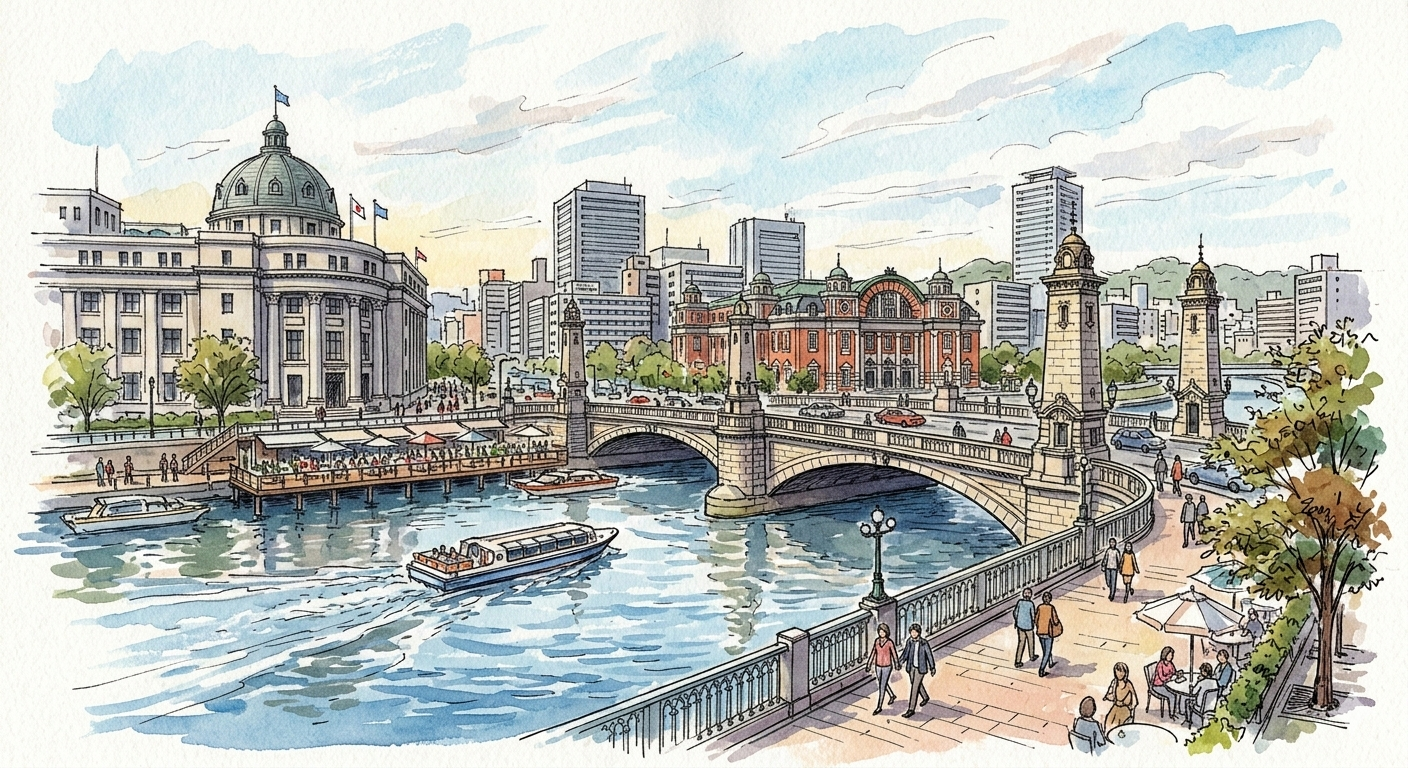
By 1912, the "active modernization" of the Meiji era had moved from policy to physical form. The Kitahama Retro Building, now a Registered Tangible Cultural Property, stands as a primary example of this shift. Influenced heavily by British Glasgow-style architecture, the building represents Japan’s decisive pivot from isolation to the global trade networks of the early 20th century.
This structure is a physical manifestation of a cultural and economic sea change. Originally commissioned for a securities brokerage firm, its solid presence symbolized the permanence of the new financial order. The "So What?" factor lies in its adaptive reuse: the transition from a hub for frantic stockbrokers to its current life as a British-style tea house illustrates a unique form of economic resilience. From its vantage point, the Nakanoshima Rose Garden is visible, offering a spatial experience that bridges the industrial city with the westernized "garden city" ideals of the time.

From Rice to Capital: The Birth of the Osaka Securities Exchange
The transition of Kitahama from an Edo-period hub to a modern capitalist engine was formalized in 1878 with the founding of the Osaka Securities Exchange. Crucially, the exchange was established on the site of the former Gold Exchange (金兌換市場), signaling a direct evolution from old-world currency exchange to modern shareholding.
The architect of this transition was Godai Tomoatsu. A visionary Meiji entrepreneur, Godai’s impact on the financial heart of Osaka cannot be overstated. His statue, standing outside the exchange, serves as a bridge between the feudal merchant tradition and the modern market. By replacing the traditional, land-based wealth of the "feudal rice trade" with a "modern shareholding system" of liquid capital, Godai facilitated a massive cultural disruption. This engine of capital allowed Osaka to move beyond regional trade, funding the very infrastructure that transformed the city into an industrial titan.

The Scent of Apothecaries: Doshomachi’s Pharmaceutical Legacy
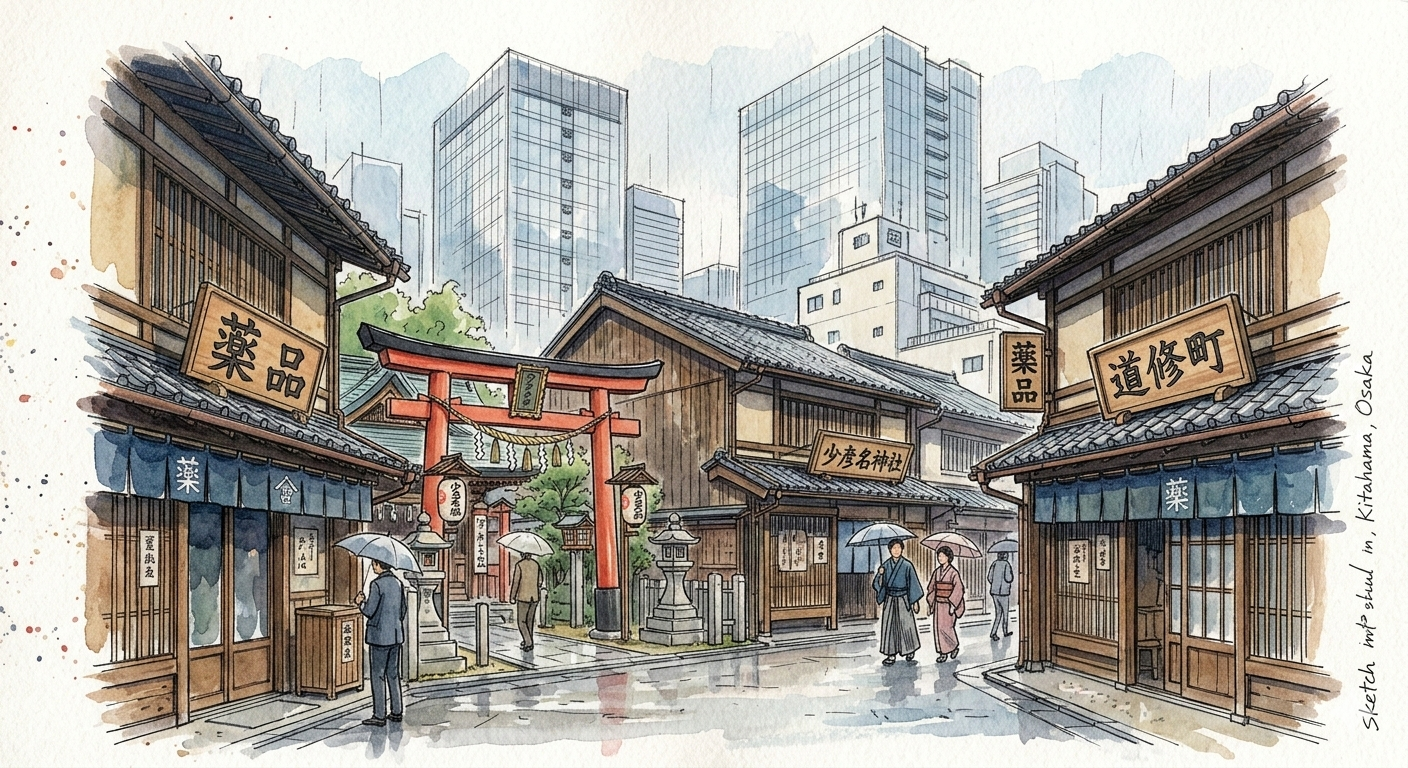
Just a few blocks from the high-finance bustle lies Doshomachi, a district that has defined the "monopoly of health" in Japan since the 1600s. It was here that the Sakai merchant Konishi Kichiemon opened the first shop, eventually leading to the formation of the Yakushu Nakama (medicine guild) which controlled the nation's drug distribution. During the Meiji era, this district underwent a "frontier transformation," shifting from import-dependency on Chinese and Dutch medicines toward indigenous production.
For the traveler, Doshomachi represents how private commerce funded public growth. The wealth generated by this pharmaceutical monopoly was a primary source of capital for Osaka's broader urban development. Today, the street is a "sacred-commercial" hybrid; global corporate headquarters sit adjacent to the Sukunahikona Shrine, dedicated to the deities of medicine. The presence of modern labs beside ancient altars confirms that the spiritual remains tucked between the high-rises, grounding the industry's global reach in local tradition.
The Spiritual Microcosm: Hidden Shrines of the Office District
Despite hyper-modernization, Kitahama retains a spiritual resilience through tiny "office shrines" tucked between towering glass structures. These are not relics of superstition, but artifacts of "cultural continuity." Modern salarymen often pause at these sites, mirroring the spiritual balance sought by Edo-period merchants. To find these manifestations of "frontier transformation," one must look for stone lanterns and small altars in courtyard corners, where the traditional rhythms of Osaka persist amidst the noise of the market.

 Lawrence
The Hidden Gem of Kitahama
For the observer of historical ironies, the most compelling detail is the specific juxtaposition of the bronze statue of Godai Tomoatsu against the sleek, curved glass façade of the modern Securities Exchange. It is a visual dialogue between a man in a Western frock coat—a symbol of Meiji ambition—and the digital, liquid reality of the 21st-century market he helped create on the site of the old Gold Exchange.
A Philosophical Reflection on Layered Observation
Understanding Kitahama requires a practice of "layered observation." To see the district truly is to see the Meiji politician at the ryotei, the British architect at the drafting table, and the Edo pharmacist at the shrine simultaneously. This urban fabric proves that history is not a chronological sequence of past events, but a living, spatial presence. The fragile compromise of 1875 still echoes in the legal structures of the nation, and the guild traditions of the 17th century underpin the modern pharmaceutical giants of Doshomachi.
Kitahama challenges us to recognize that our modern cities are built upon layers of negotiation, risk, and spiritual grounding. As you walk these streets, ask yourself: How much of the "invisible history" around you is still shaping the decisions, economies, and beliefs of your own modern world? To explore these layers further, we invite you to join our community by subscribing to our "Historical Travel Stories" newsletter, where we continue to unearth the narratives buried beneath the asphalt.
The Kitahama Traveler’s Toolkit
How to Experience Kitahama Today
Approaching the District Kitahama is most elegantly accessed via Kitahama Station, served by the Osaka Metro Sakaisuji Line and the Keihan Main Line. The exits deposit you directly into the heart of the financial district, near the Godai Tomoatsu statue.
Where to Stay The area is ideal for those seeking retro charm. The local hotels are situated within a landscape of Meiji-era brick and mortar, offering proximity to both the historical exchange and the serene Nakanoshima Park.
Recommended Walking Tours
- The Architectural Loop: Begin at the Osaka Securities Exchange to honor the site of the former Gold Exchange, move to the Kitahama Retro Building (a Registered Tangible Cultural Property), and conclude at Kagairo Kitahama Honten.
- The Apothecary Trail: Wander the museum-lined streets of Doshomachi, paying particular attention to the legacy of Konishi Kichiemon and the spiritual center at Sukunahikona Shrine.
 Lawrence
 Lawrence
 Lawrence