(ENG) Oku, Tokyo Historical Walk: Discovering the Overwritten Layers of a Forgotten Neighborhood
Take a slow walk through Oku, a hidden gem in Northern Tokyo. This guide explores the neighborhood’s "palimpsest" of history, tracing its transformation from scenic pleasure gardens to industrial heartlands and its quiet, multi-layered life today.

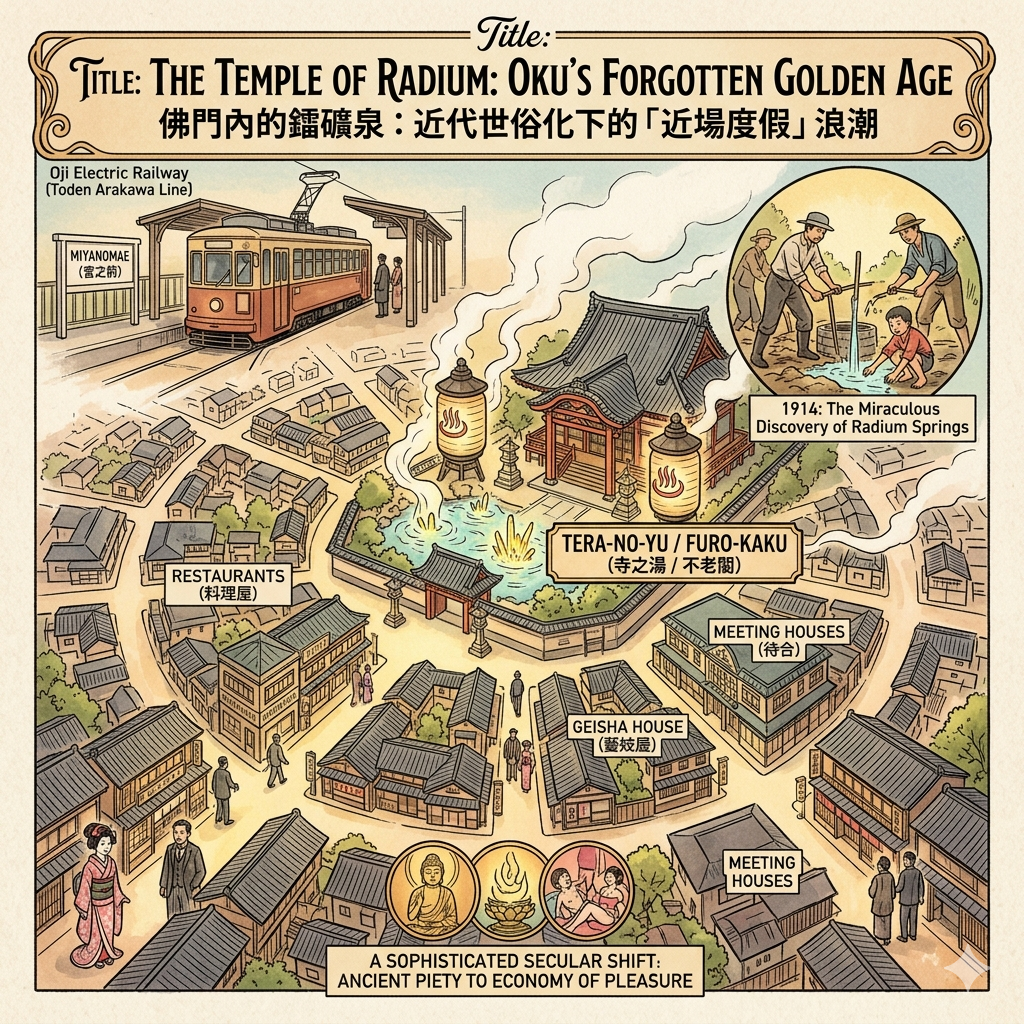
This is a historical travel story and walking guide to Oku, a quiet residential district in Northern Tokyo. By exploring its evolving landscape—from Edo-period pleasure gardens to industrial hubs and modern alleys—it reveals the hidden history and "overwritten" layers of one of Tokyo’s most overlooked neighborhoods.
 Lawrence
The Edge of the Deep Interior
Oku occupies a curious, shifting position on the northwestern fringe of Tokyo’s Arakawa Ward. Bordered by the Sumida River to the north and the Yamanote Line plateaus to the south, its name—etymologically rooted in the "deep interior" (Oku)—is a testament to its historical role as a gateway to the hinterlands of the Toshima District. In the cartography of Tokyo, Oku is a masterpiece of spatial overwriting. It has functioned as a strategic "edge" where the city’s ambitions and its anxieties are equally visible. Immediately to its south, the steel veins of the Yamanote Line pulse with modern energy, while the Sumida River provides a ancient, watery boundary. To walk through Oku today is to navigate a landscape that has been, in turn, a wild wetland, a manicured agricultural field, a thriving resort, and an industrial wasteland—a vertical stack of histories hidden beneath the modern asphalt.
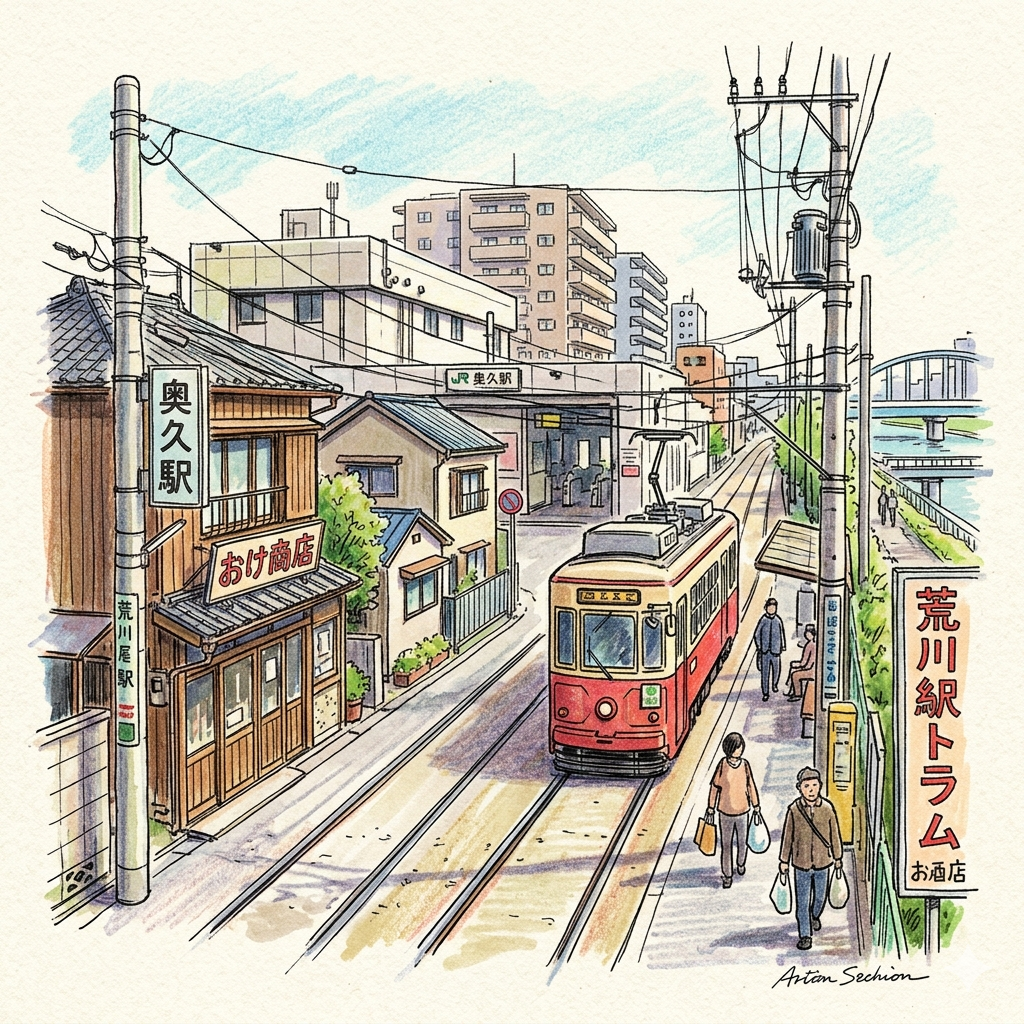
Listen to the historical stories told in detail (For subscribers only)
1. The Vanished Red Carpet: The Primroses of Oku-no-hara
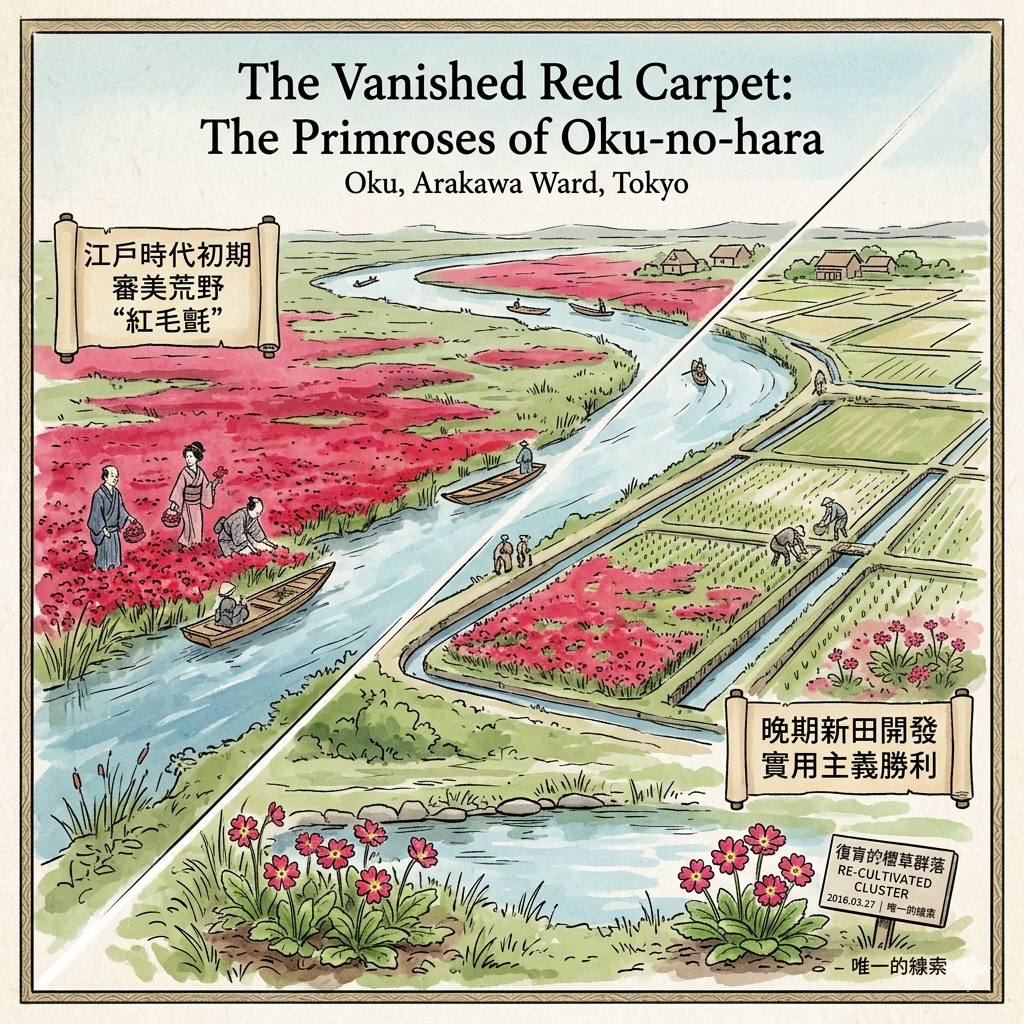
During the Edo period, the character of Oku was defined by the volatile relationship between the Sumida River and its floodplains. The area, then divided into Upper and Lower Oku villages, was a low-lying marshland subject to frequent inundation. This environmental instability fostered a unique ecological niche: every spring, the fertile silt deposited by the flooding river birthed a vast expanse of Sakurasou (Japanese Primrose).
There is a distinct historical differentiator between this "semi-natural" landscape and the "fully artificial" agricultural expansion that followed. In the early Edo period, the Sakurasou became a vital symbol of the city's aesthetic leisure. According to the 1837 Edo Meisho Hanagoyomi (A Calendar of Famous Flower Sites in Edo), the fields of Oku-no-hara were so densely blanketed in vibrant crimson blossoms they were likened to a "red carpet." Citizens participated in "Kusa-tsumi" (flower picking), an elegant seasonal excursion that linked the urban dweller to the rhythm of the river's wild whims.
By the time the Edo Meisho Hanagoyomi was published, however, the author lamented that the primroses had already vanished. This disappearance serves as a profound "So What?" moment in Tokyo's development: it signals the victory of utilitarianism over aesthetic wilderness. As Edo’s population exploded, the demand for food led to the aggressive drainage of wetlands for new rice fields. The aesthetic "wilderness" was sacrificed for the artificial productivity of the paddy, proving that in Tokyo, the soil must always labor for the city’s survival.
2. The Temple of Radium: Oku’s Forgotten Golden Age as a Resort
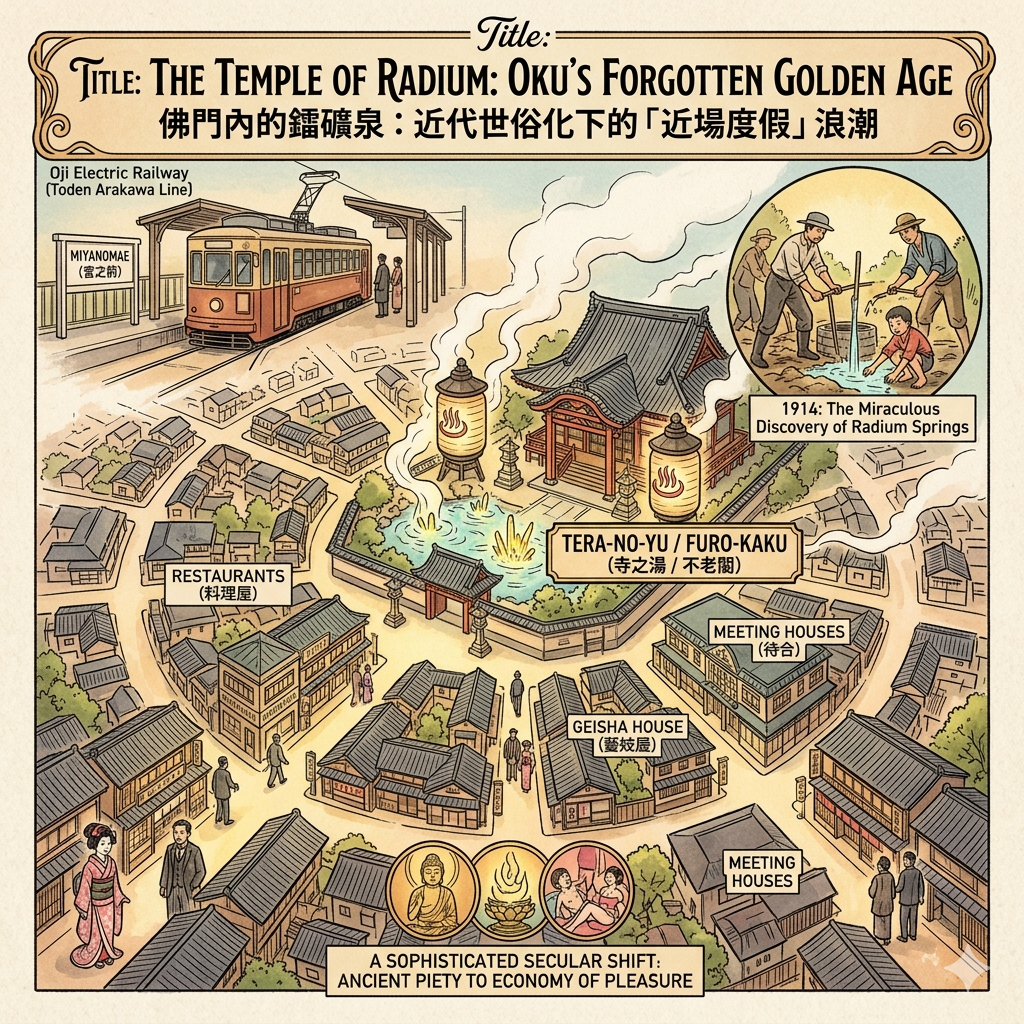
The Taisho era (1912–1926) brought a second radical transformation. With the 1913 opening of the Oji Electric Railway (now the Toden Arakawa Line), Oku was suddenly accessible to the masses. It transitioned from a quiet farming village into a "near-distance" tourism hub, a shift catalyzed by a miraculous discovery at a local place of worship.
In 1914, while digging a well at Shokun-ji, a Sōtō Zen temple, workers discovered radium-rich mineral springs. The impact was immediate: Oku was designated a "San-gyo-chi" (an entertainment district), eventually hosting over 300 establishments, including restaurants, meeting houses, and geisha houses. Shokun-ji’s transition to "Tera-no-yu" (The Temple Spa) represents a sophisticated secular shift in Japanese Buddhism. Here, the city’s burgeoning desire for leisure literally overwrote ancient piety, as the temple pivoted to the economy of pleasure to maintain its relevance in a modernizing Tokyo.
"Local legend tells of an injured child who washed their wounds in the temple’s well water and was healed instantly, prompting the scientific testing that revealed the radium springs."
Eventually, the public spectacle of the grand resorts began to give way to the more discreet, private operations of the neighborhood's many "Meeting Houses," where the layers of Oku’s history began to take on a darker hue.
3. The Ghost of "Masaki": Desire and the Shadow of 1936
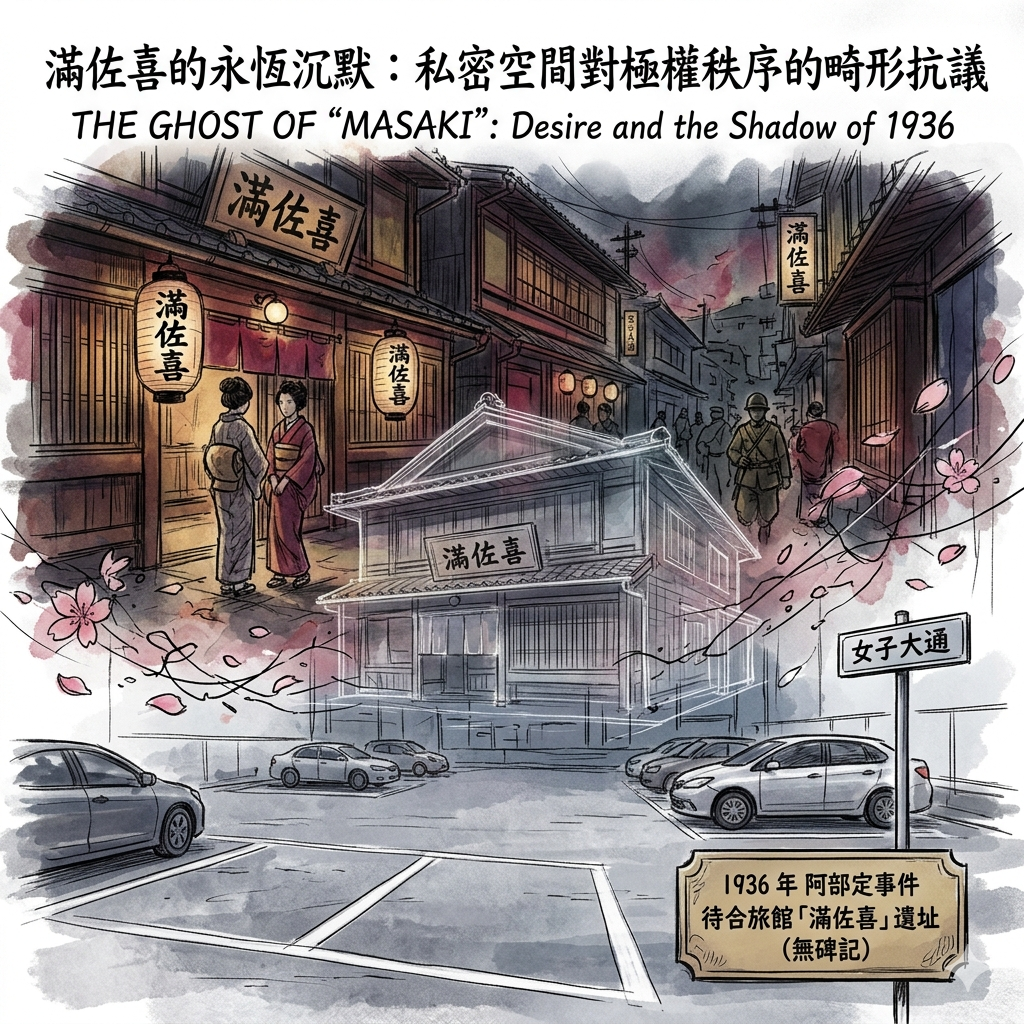
By 1936, Japan was gripped by national anxiety following the February 26 Incident. In this climate of military suppression, Oku’s entertainment district offered a "private buffer zone." It was here, at the Masaki tea house, that the infamous Abe Sada incident occurred—a crime of passion where a woman killed her lover and fled with his severed genitalia.
The spatial significance of the Machiai (meeting house) is paramount. These structures functioned as sites of absolute privacy where individuals could retreat from a fascist, collective reality into a world of extreme personal transgression. This event permanently altered Oku’s public image, shifting it from a "healthy resort" to a "place of dark, erotic obsession."
Today, the site of the Masaki tea house is a nondescript parking lot near West Oku’s Joshi-dai Dori. There is no plaque, no memorial marker. This "historical blankness" is intentional; the local community has chosen a tactical anonymity, preferring to let the darker layers of the palimpsest fade rather than inviting the gaze of grotesque tourism. In this nothingness, the shadow of 1936 remains most palpable.
4. The Railway Archipelago: The Technical Isolation of Oku Station
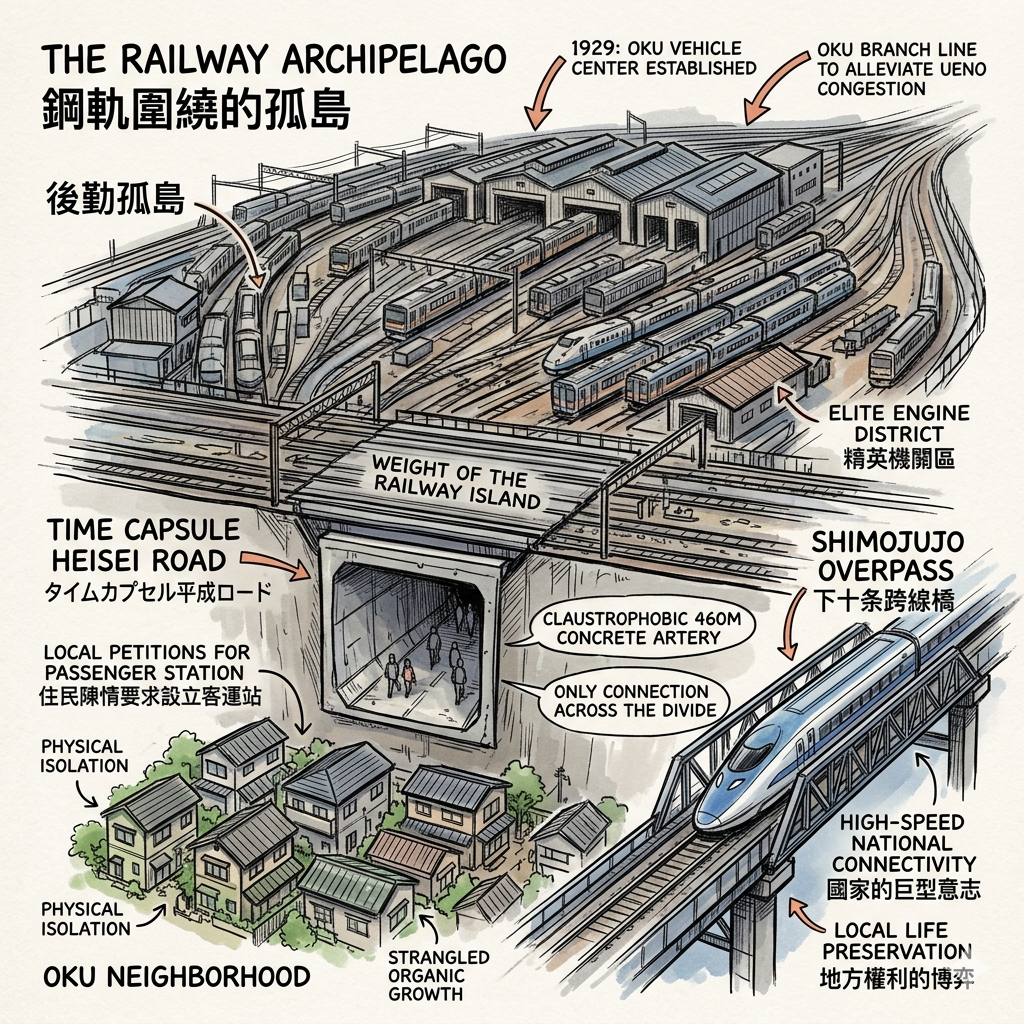
The physical layout of Oku was further fractured by the "technical determinism" of the Japanese railway expansion. In 1929, to alleviate congestion at Ueno, the national railway created the Oku Branch Line and the massive Oku Vehicle Center. This infrastructure created a "Railway Island"—a vast archipelago of tracks that physically isolated the neighborhood from the rest of the city.
The "Time Capsule Heisei Road," a narrow, 460-meter-long claustrophobic concrete artery running beneath the train yards, is the only way to traverse this divide. Walking through this tunnel, one feels the weight of the "Railway Island" above—a heterotopia that allows Tokyo to function as a global megacity while simultaneously strangling the organic growth of the neighborhood it occupies. The Shimojujo Overpass offers a view of this friction: high-speed national connectivity rendered in steel, looming over the quiet preservation of local life.
5. From Dioxin to Dragonflies: The Paradox of Modern Nature
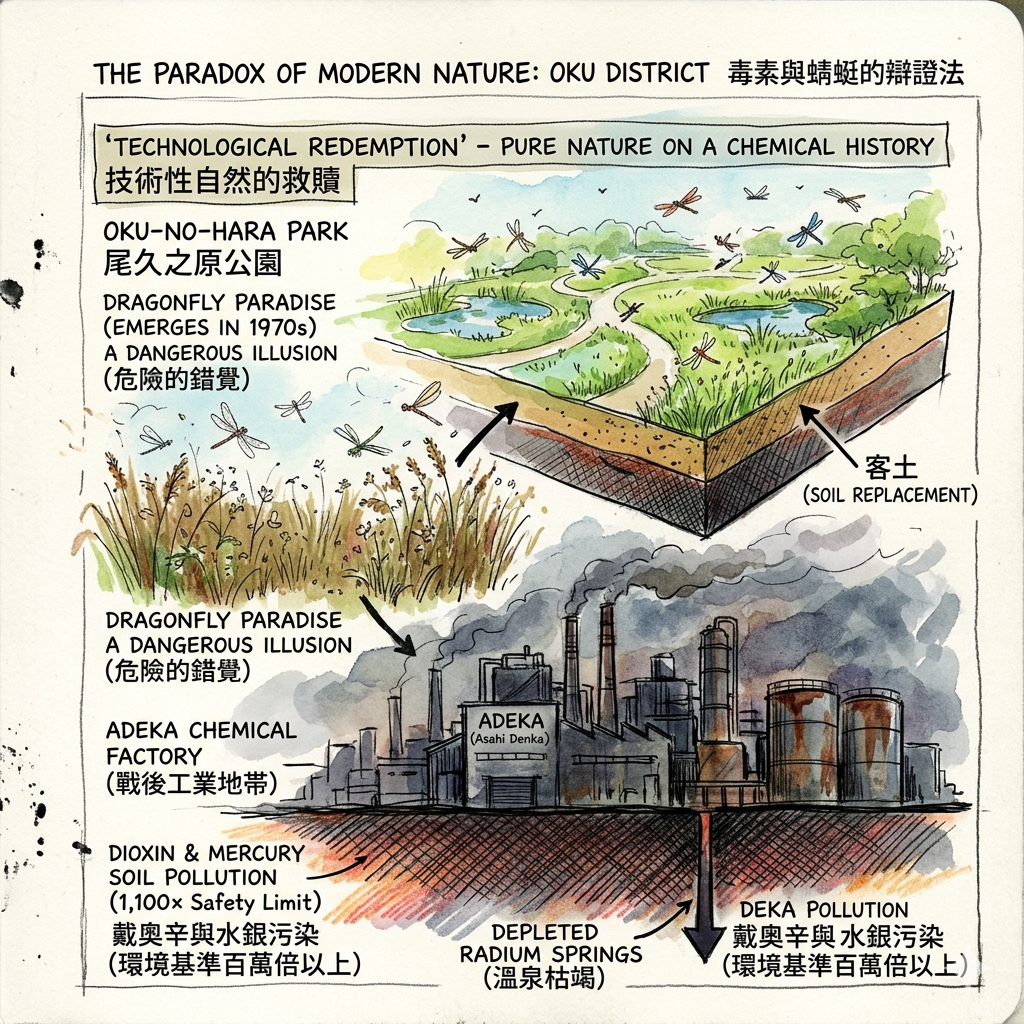
After WWII, Oku shifted into a heavy industrial zone. The massive groundwater extraction required by factories led to the depletion of the radium springs, effectively killing the resort era. The ADEKA (Asahi Denka) chemical factory became the site's industrial anchor, but when it closed in the late 20th century, a strange phenomenon occurred: a "Dragonfly Paradise" emerged in the vacant lot.
However, this "return to nature" was a dangerous illusion. Environmental surveys in the 1990s revealed the soil was saturated with toxins.
As reported in Weekly Kinyobi, mercury levels in the soil reached 1,100 times the legal safety limit, a staggering testament to the cost of Oku's industrial layer.
The current Oku-no-hara Park is not a return to the original Edo wilderness, but a site of "technological redemption." To create the park, the government conducted massive "客土" (soil replacement). The dragonflies that fly there today are supported by a landscape that is entirely engineered—a "pure" nature built upon a foundation of chemical history.
Walking the Narrative: Hidden Gems and Spatial Continuity
To truly feel the layers of Oku, one should walk the route from the "Railway Island" of Oku Station toward the Sumida River. This path moves through industrial-residential blocks that replaced the tea houses, finally opening into the reclaimed greenery of the park.
The Hidden Gem: Visit the "Tera-no-yu" Monument at Shokun-ji Temple. Located near the Miyano-mae tram stop, you must look closely to find it. Notice how the stone marker sits in the shadow of modern power lines, a humble and easily missed signpost of a lost watery world. It is the only physical evidence of the radium spring that once drew thousands, revealing to the observant traveler how quickly the city forgets its own miracles.
Conclusion: The Layered Observation of a City
Oku is a microcosm of the Tokyo experience. It is a place where the "soul of the city" is found not in a preserved monument, but in the invisible stack of its contradictions. In Oku, the ghost of a primrose field lies beneath a rice paddy, which lies beneath a hot spring, which lies beneath a chemical plant, which is finally capped by a modern park.
Understanding Tokyo requires us to move past the tourist highlights and find these overwritten histories. Oku teaches us that nature, desire, industry, and recovery exist in a single, invisible stack. As we continue to develop our urban spaces, one must wonder: what current layers are we adding to the stack today, and which of our own stories will be the first to be overwritten?
Join us for our next walk through the forgotten corners, where the history is deep and the path is never linear.
Accessing the Deep Interior
- Transport: Oku is accessible via the JR Oku Station (Utsunomiya and Takasaki Lines, one stop from Ueno) or the Toden Arakawa Tram (alight at Miyano-mae for Shokun-ji Temple).
- Historical Stay & Coffee: To capture the district's aesthetic, visit one of the Showa-era Kissaten (traditional coffee shops) along Joshi-dai Dori. These intimate, low-rise spaces still reflect the human scale of the old San-gyo-chi district, offering a quiet vantage point from which to contemplate the neighborhood's many lives.
Q & A
How did Oku-machi transform from a resort to a park?
The transition was a cycle of "spatial overwriting": the hot springs were destroyed by the water demands of the factories, and those factories were eventually replaced by a park after the resulting pollution necessitated a total environmental overhaul.
What are the most interesting industrial artifacts in Oku-machi?
1. Railway Logistics Landmarks
2. The Oku-no-hara Environmental "Artifacts"
3. Historical Markers of Resource Depletion
4. Modern Functional Symbols
What hidden secrets remain at the Oku railway yard and 'ghost' station?
1. The Geographic Identity Secret
2. The "Secret" Origin: A Result of Local Resistance
3. The "Isolated Island" (Railway Archipelago)
4. The "Ghostly" Duality of the Tracks
5. The Grand Industrial Relic
Reference and Further reading
- 7つしかない町名の一つ「東尾久(ひがしおぐ)」を歩いてみよう! - ゆる歴史散歩会とは, accessed March 21, 2026,
- 尾久八幡神社 / 東京都荒川区 - 御朱印・神社メモ, accessed March 21, 2026,
- Arakawa, Tokyo - accessed March 21, 2026,
- Ultimate Arakawa Ward Guide: Best Things To Do, History, Areas, And Recommended Accommodations - Flip Japan, accessed March 21, 2026,
- 尾久の原 - 荒川区立図書館, accessed March 21, 2026,
- 達人 | 一般財団法人 公園財団 - 公園文化Web, accessed March 21, 2026,
- 「昭和喪失」 ~あと数年も経つと「遺産」となる~ そのような時代 ..., accessed March 21, 2026,
- 碩運寺(せきうんじ) - 荒川区, accessed March 21, 2026,
- 荒川ゆうネットアーカイブ > 特集 > 荒川区再発見 都市観光編2「南千住」 > 碩運寺(寺の湯跡), accessed March 21, 2026,
- 碩運寺 | 東京 おすすめの人気観光・お出かけスポット - Yahoo!トラベル, accessed March 21, 2026,
- 「昭和喪失~尾久三業地・阿部定事件」|観光情報総合研究所 夢雨 - note, accessed March 21, 2026,
- 【荒川区③】震災後の娯楽と商業の発展が楽しい下町をつくった - ホームズ, accessed March 21, 2026,
- 日本中を震撼させた昭和11年の怪事件 舞台となった荒川区尾久は今 ..., accessed March 21, 2026,
- 尾久と越中島、都会「秘境駅」人気上昇の必然 不動産業者が熱視線、その判断材料は何か - 東洋経済オンライン, accessed March 21, 2026,
- 東北本線の二重区間「尾久支線」 - FreedomTrain, accessed March 21, 2026,
- どうして尾久駅はつくられたのか?(落書き帳アーカイブズ), accessed March 21, 2026,
- 【帝都初空襲の地】旭電化尾久工場跡地を歩く, accessed March 21, 2026,
- 東京・荒川区で環境基準の一一〇〇倍――公園からダイオキシン検出 - 週刊金曜日, accessed March 21, 2026
 Lawrence
 Lawrence
 Lawrence