(ENG) Ryuichi Kihara and the cultural origins of his birthplace, Ichinomiya City, Aichi Prefecture
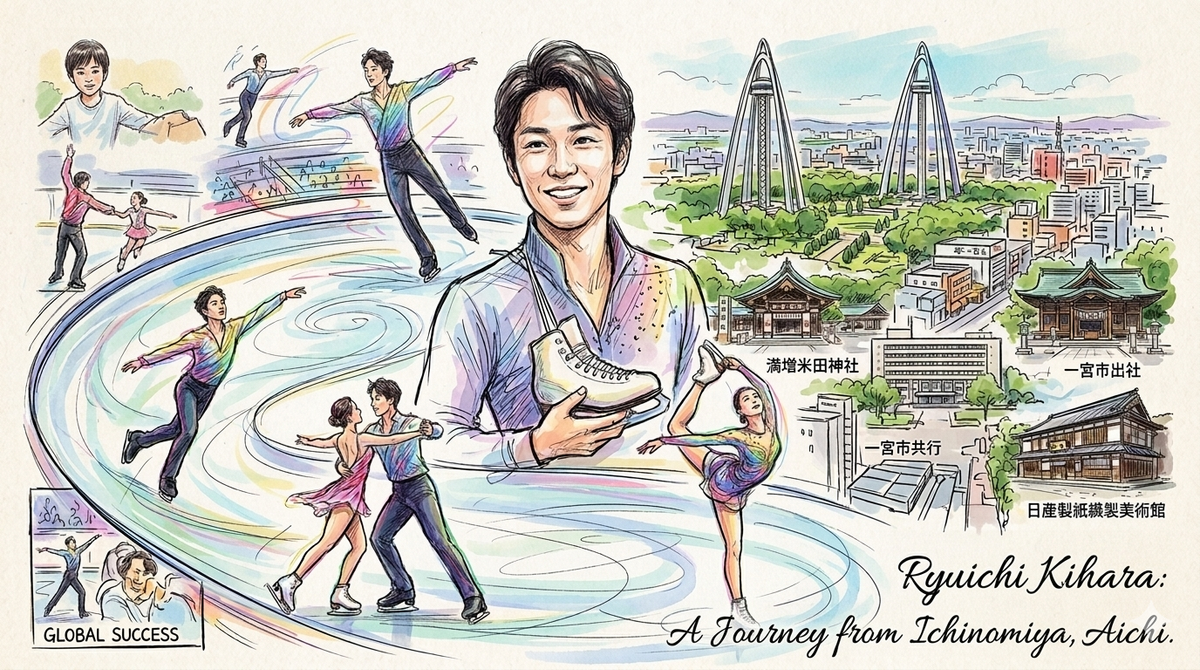
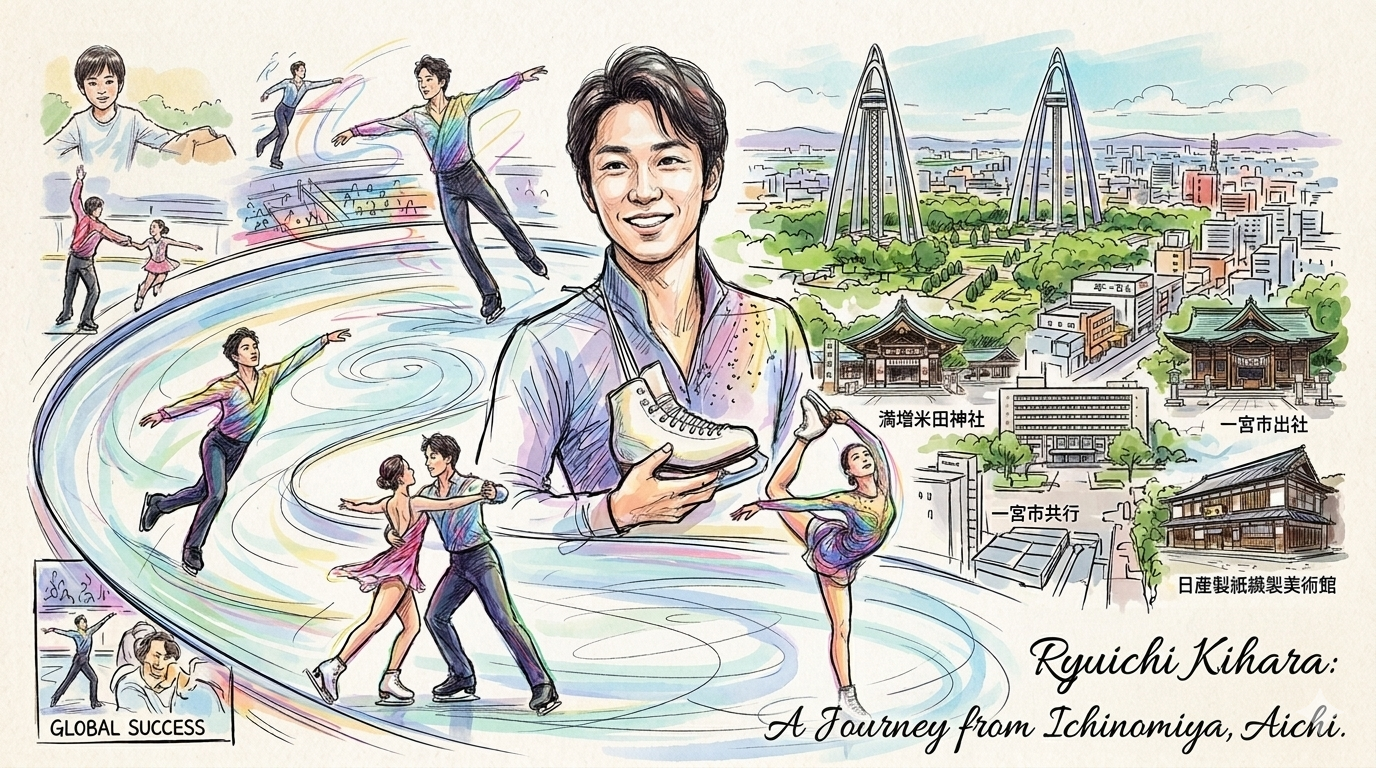
The Ichinomiya City ice rink where Ryuichi Kihara grew up has officially closed, and he has become its spiritual successor. His return to peak form after a severe concussion perfectly echoes the spirit of revival conveyed by the 1891 earthquake memorial.
How did the 'Gacha-man' era shape Ichinomiya's unique cafe culture?
What is the engineering marvel of the Okoshi ship-bridge?
How does Ichinomiya's history of resilience connect to Ryuichi Kihara?
 Lawrence
Ichinomiya’s Legacy: Shrines, Textiles, and the Golden Slam Legacy A journey through Ichinomiya’s sacred waters, "Gacha-man" industrial boom, and its connection to figure skating legend Ryuichi Kihara’s resilient spirit.
The Nobi Plain has always been a landscape defined by the rhythmic flow of water. At its heart lies Ichinomiya, a city whose name—meaning "First Shrine"—signals its status as the spiritual anchor of the ancient Owari Province. Here, the waters of the Kisogawa River did more than irrigate the soil; they baptized a culture of precision that would evolve from sacred ritual to industrial dominance. To walk Ichinomiya today is to traverse a living palimpsest. Beneath the modern facade, the "weaving" of history is palpable: the threads of millennial Shinto tradition are interlaced with the saw-tooth silhouettes of 20th-century textile mills. This city presents a fascinating paradox: an ancient sanctuary that reinvented itself as a global textile powerhouse, eventually becoming the cradle of a "Career Golden Slam" figure skating legend. It is a place that understands that to survive is to constantly reorganize, shifting its soul from the loom to the ice without ever losing its thread.
Listen to the historical stories told in detail (For subscribers only)
The Architecture of the Sacred
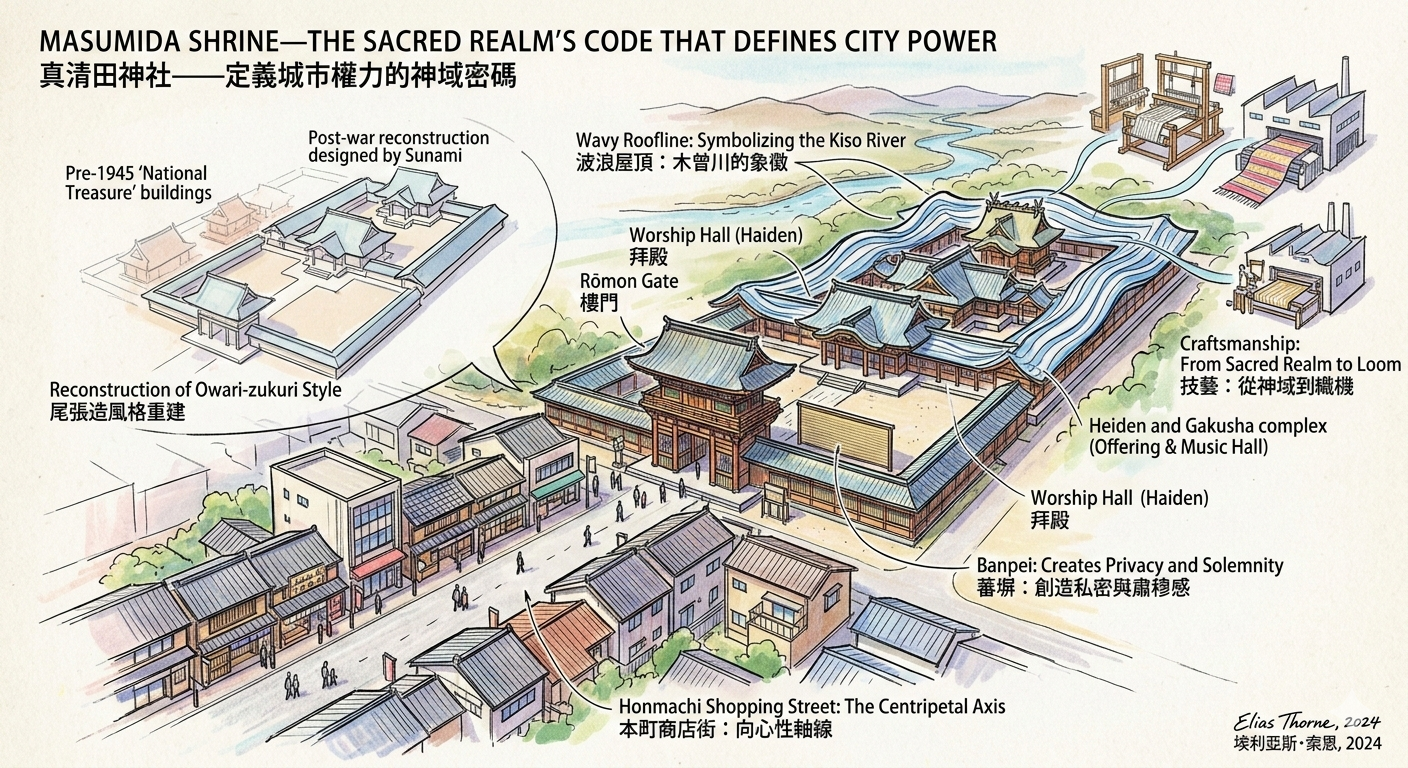
The spatial identity of Ichinomiya is dictated by the Masumida Shrine, where the "Owari-zukuri" architectural style provides a blueprint for the city’s disciplined character. Unlike many Japanese cities where the center shifted toward the railway station, Ichinomiya remains "centripetal," with its main commercial arteries still bowing toward the shrine’s gates. The "Owari-zukuri" layout is a masterclass in linear symmetry, guiding the visitor through a rigorous ritual path from the Romon (tower gate), past the Banpei (screening wall), the Haiden (offering hall), and the Watari-dono (bridge hall), to the Honden (main sanctuary).
Crucially, within this sacred complex lies the Hatori Shrine. Dedicated to the god of weaving, it serves as the literal physical link between the city’s spiritual origins and its industrial destiny. This "shrine-within-a-shrine" is where the town's weavers have for centuries prayed for the refinement of their craft, effectively hallowing the very act of production.
Historical Stage | Social Function & Status | Architectural Evolution & Symbolism |
Ancient | Ritual center for the Owari Clan; control of water rights. | Primitive "Yashiro" form, coexisting with natural water bodies. |
Heian to Kamakura | Established as "Owari-no-Kuni Ichinomiya"; Imperial patronage. | Early Owari-zukuri form; housing sacred Bugaku masks. |
Edo Period | Shogunal domain (333 koku); core of local order. | "Water-Spouting Dragon" dedicated by Tokugawa Yoshinao. |
Modern to Present | National shrine; post-war urban symbol. | Fusion of modern techniques with traditional lines; wave-like roofs. |
The shrine’s physical structure was nearly extinguished during the 1945 air raids. The philosophy of the subsequent reconstruction, envisioned by architect Sumitaka Tsunami, sought a resurrection that was more than a technical feat; it was a fusion of functional modern architecture with the ancestral "Owari-zukuri" spirit, where the undulating rooflines once again mirrored the vital currents of the Kisogawa River. This technical precision—balancing the old world with new materials—prepared the city for the precision of the looms that would define its next era.
The "Gacha-man" Boom and the Morning Ritual
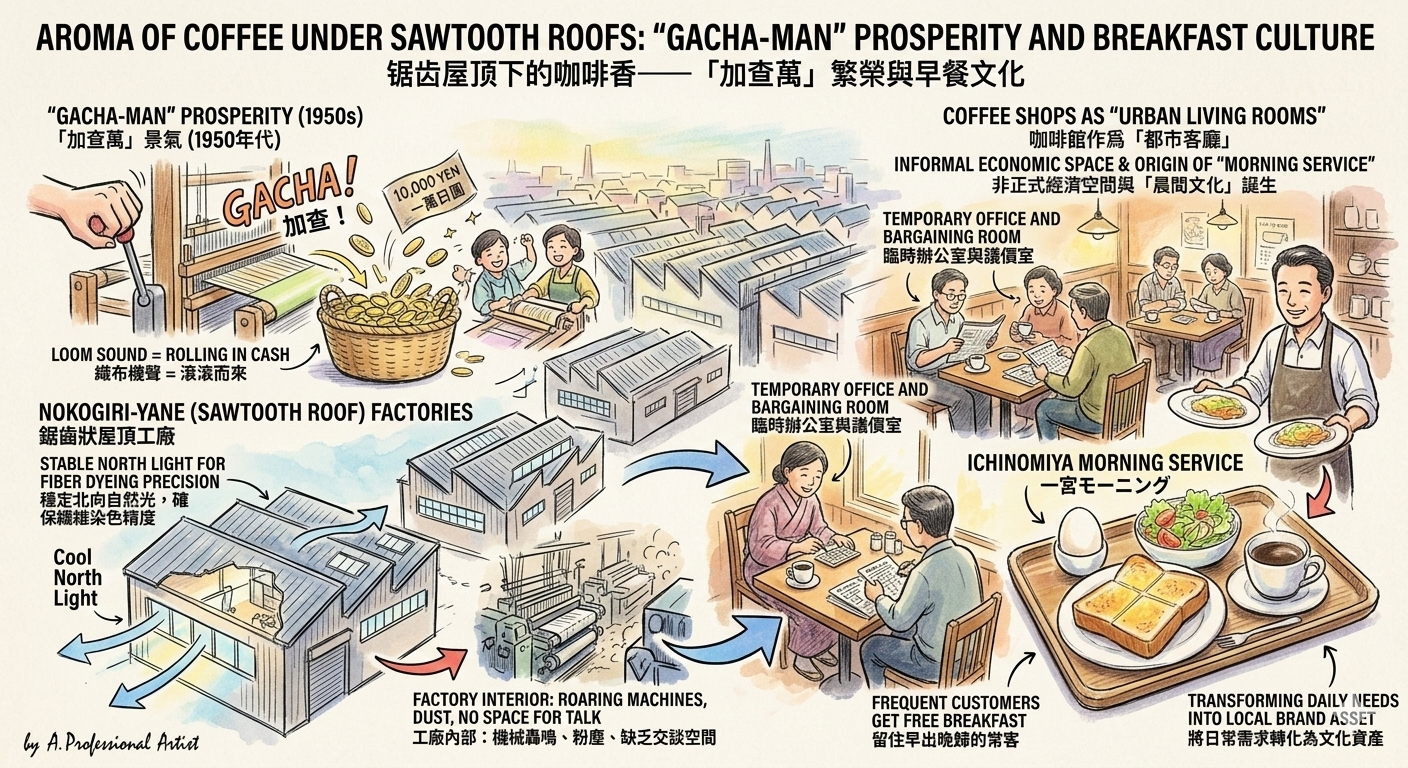
Following the devastation of WWII, Ichinomiya became the heart of the "Bishu" textile region. This era was defined by the "Gacha-man" phenomenon—a term describing how every "Gachan" (the sound of a mechanical loom) resulted in "Man" (ten thousand yen) flowing into the city. The landscape was dominated by Nokogiri-yane (saw-tooth) factories, specifically engineered with north-facing windows to provide the steady, neutral light required for millimeter-perfect color grading and textile precision.
However, the reality of these factories was a cacophony of rhythmic clatter and air thick with fiber dust. This industrial environment made the conduct of business impossible within the factory walls. Consequently, the local coffee shop (kissaten) was drafted as an essential piece of "business infrastructure." The famous Ichinomiya Morning Service was born of pragmatic necessity: weavers (機屋) met in these cafes at dawn to negotiate contracts in the only quiet spaces available. To keep these valuable clients, shop owners began offering free boiled eggs and toast, evolving into a sophisticated "city’s living room." This culture was the "grease" in the gears of the textile industry—a sanctuary of quietude that allowed the noisy industrial machine to function.
The Ghost of Ichinomiya Castle
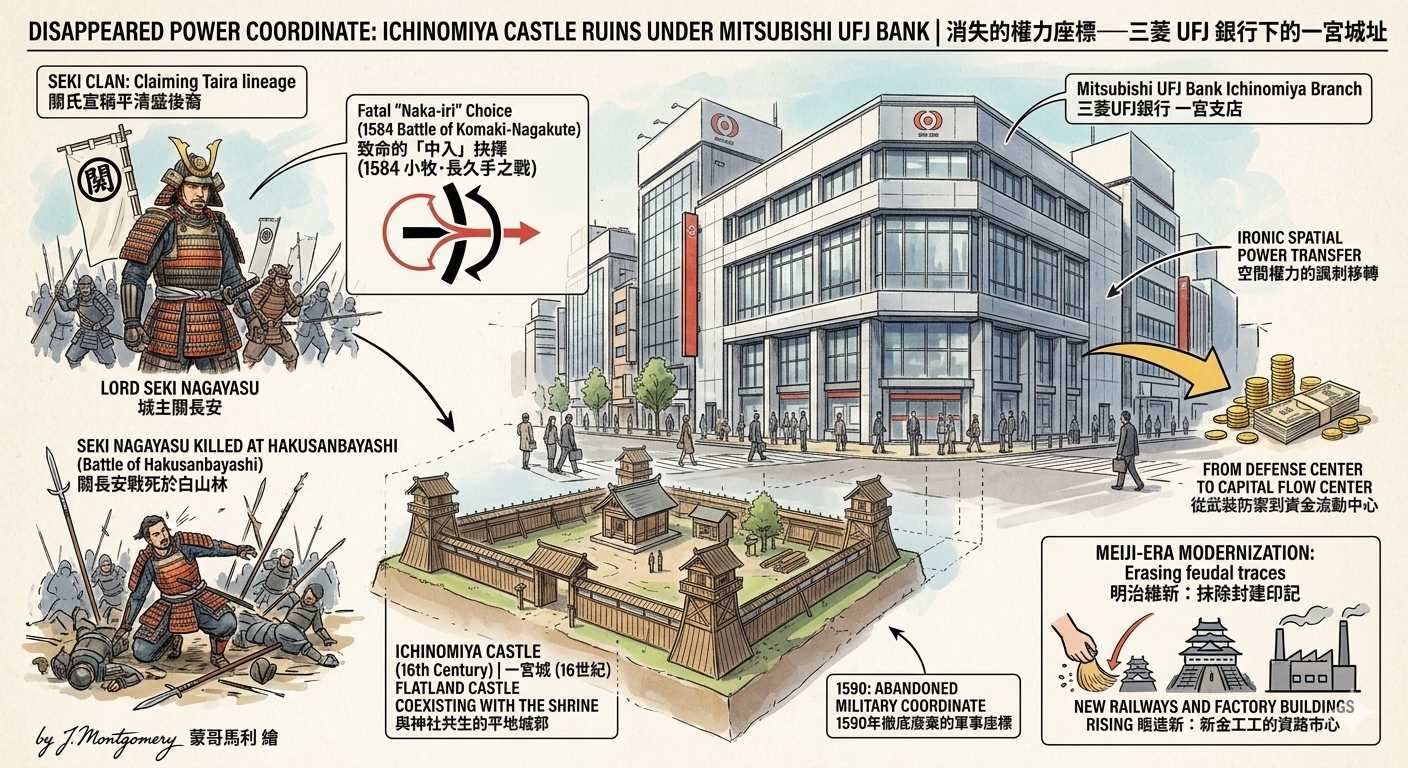
While the shrine remains visible, other power coordinates have vanished into the modern grid. At the entrance of the Mitsubishi UFJ Bank sits the site of the former Ichinomiya Castle. In the 16th century, this was a "flatland castle" (Heichi Jokaku) that was uniquely integrated with the shrine’s sacred lands, creating a tense proximity between military might and spiritual sanctuary.
The castle was the seat of the Seki Clan, whose lord, Seki Nagayasu, met a tragic end at the Battle of Hakusan-no-mori (1584) alongside the general Mori Nagayoshi. By 1590, the castle was decommissioned. Its "thorough disappearance" under the foundations of a modern financial institution is a poignant symptom of Meiji-era modernization, which prioritized industrial and financial flow over feudal spatial markers. Today, only a stone monument remains—a silent witness to a time when the city was guarded by the sword rather than the loom.
The Dragon on the Water (The Okoshi-shuku Boat Bridge)
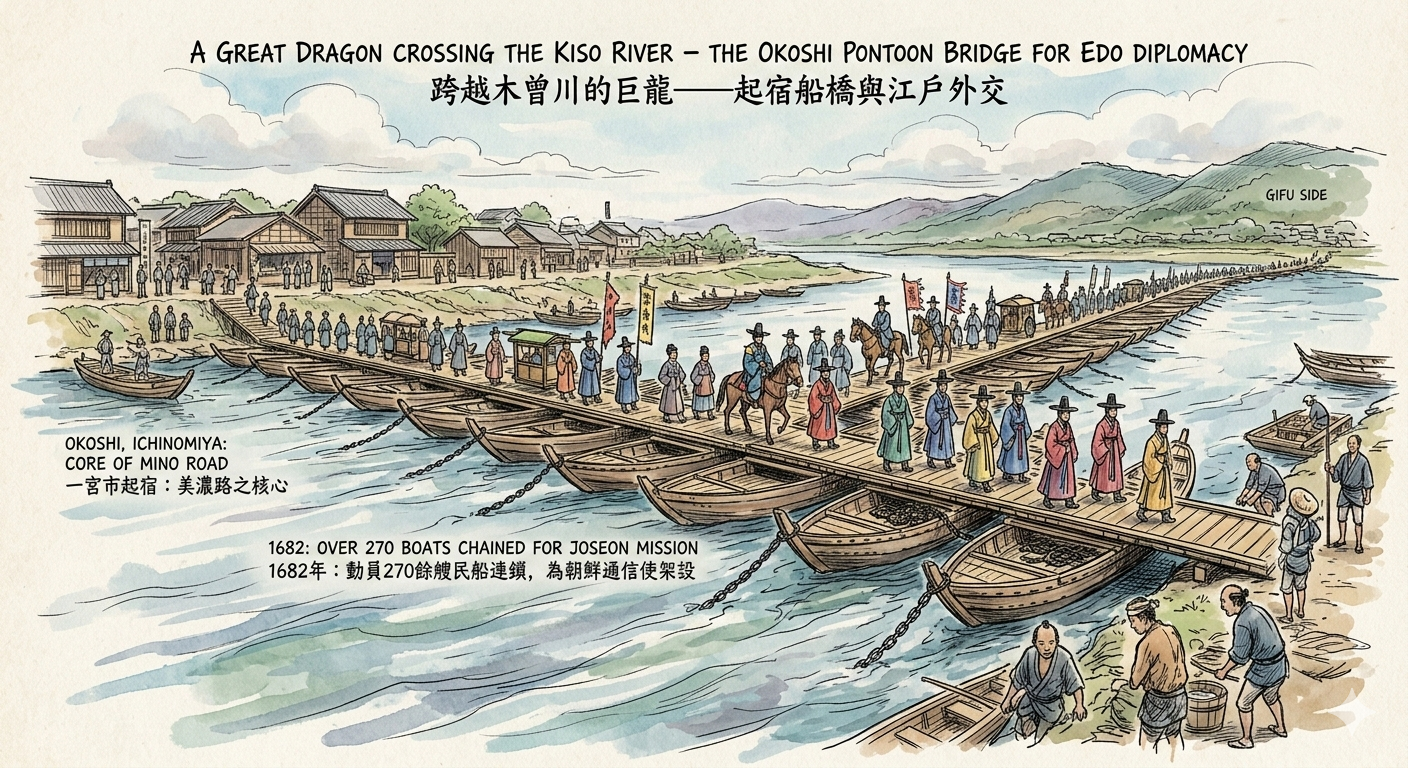
Engineering in Ichinomiya has always been "event-based" and adaptive, requiring massive mobilization. The most magnificent example was the Okoshi-shuku Boat Bridge. The Kisogawa River was a formidable hurdle for the Minoji Road, particularly for international diplomacy. In 1682, to welcome the Korean Envoys, the Shogunate ordered a temporary bridge of 270 local boats linked by heavy iron chains, spanning 850 meters.
In his journal, Haeyurok, the Korean Envoy described the structure as a "Sleeping Dragon" (Woryong) resting on the waves. While the bridge was a magnificent narrative of Shogunal power, it was a heavy "social burden" for local fishermen who provided the vessels and labor without compensation during the busy farming season. This history of mobilizing massive resources for high-precision, temporary events became the city's blueprint for resilience. It taught the population how to organize entire networks of people and equipment—a skill that would prove vital during the city's greatest trial.
Creative Destruction—The 1891 Nobi Earthquake
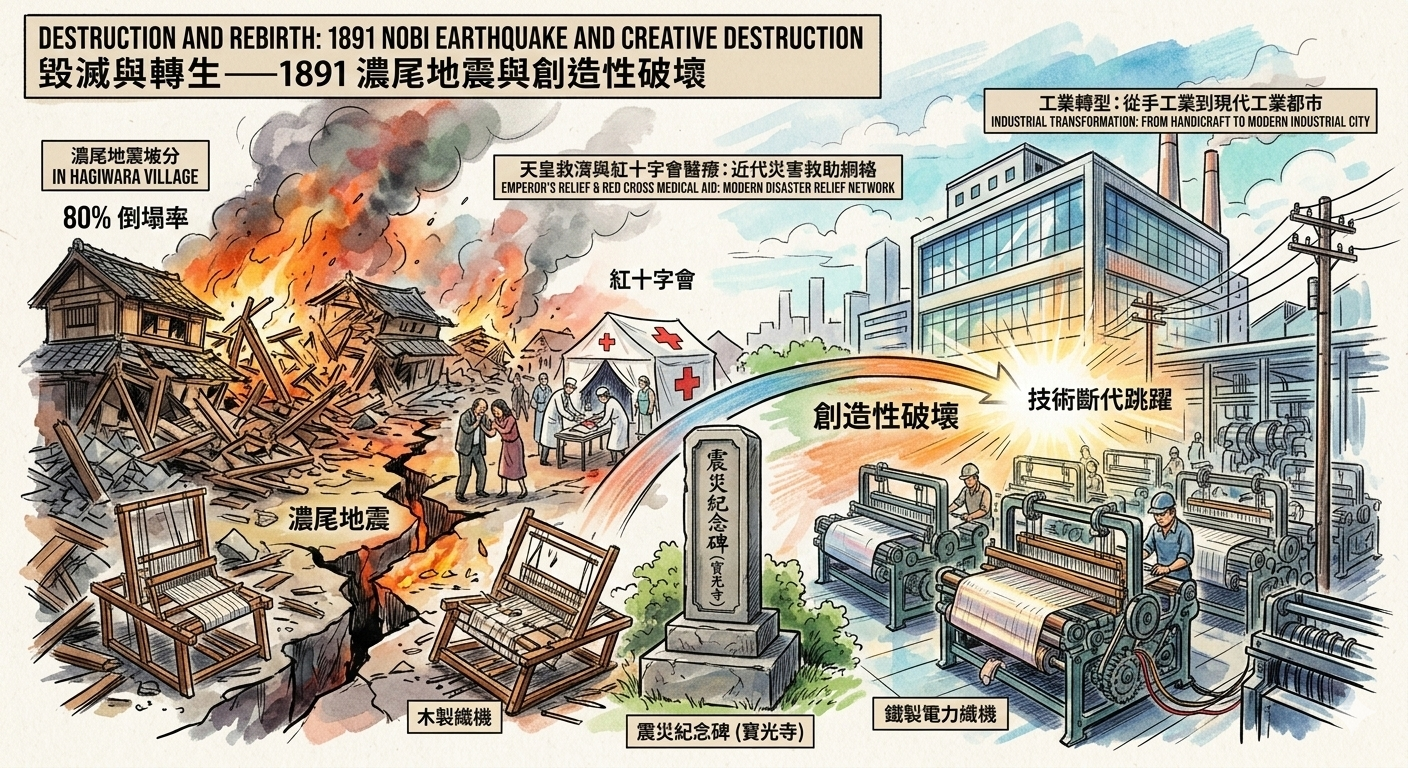
The city's capacity for mobilization was tested by the 8.0 magnitude Nobi Earthquake of 1891. In Hagiwara-cho, building collapse rates reached 80%. Yet, the city viewed this destruction as a catalyst for "creative destruction." The disaster destroyed the old wooden looms, but rather than rebuilding the past, industrialists used the recovery period to leapfrog technologically. Aided by an unprecedented Red Cross relief network and Imperial grants, the city replaced wooden frames with iron power looms, accelerating the shift to a modern industrial center.
Impact Metrics of the 1891 Disaster:
- Collapse Rate: ~80% of structures in Hagiwara-cho leveled.
- Mortality: Over 60 deaths in Hagiwara village alone.
- Technological Shift: Mass transition from wooden manual looms to iron power looms.
- Social Network: Rapid establishment of the Red Cross relief network.
Cultural Synthesis: The Skater and the City
The "Bishu" textile heritage and the lessons of resilience find a modern avatar in Ryuichi Kihara. A native of Ichinomiya, Kihara’s "Career Golden Slam" in pair figure skating is a cultural product of the city’s environment. There is a profound isomorphism between the craft of textiles and pair skating: the "micro-precision" of a high-quality weave—where synchronization is measured in millimeters—is the same discipline required for the micro-second timing of a pair’s synchronization on ice.
The closing of the Ichinomiya Skating Rink (1965–2022) marks a bittersweet transition. As the physical space where Kihara once practiced disappears, he has become the living embodiment of the rink’s legacy. His resilience, returning from a severe career-threatening concussion to reach the world’s peak, mirrors the city’s history of standing up from the ruins of earthquakes and air raids.
 Lawrence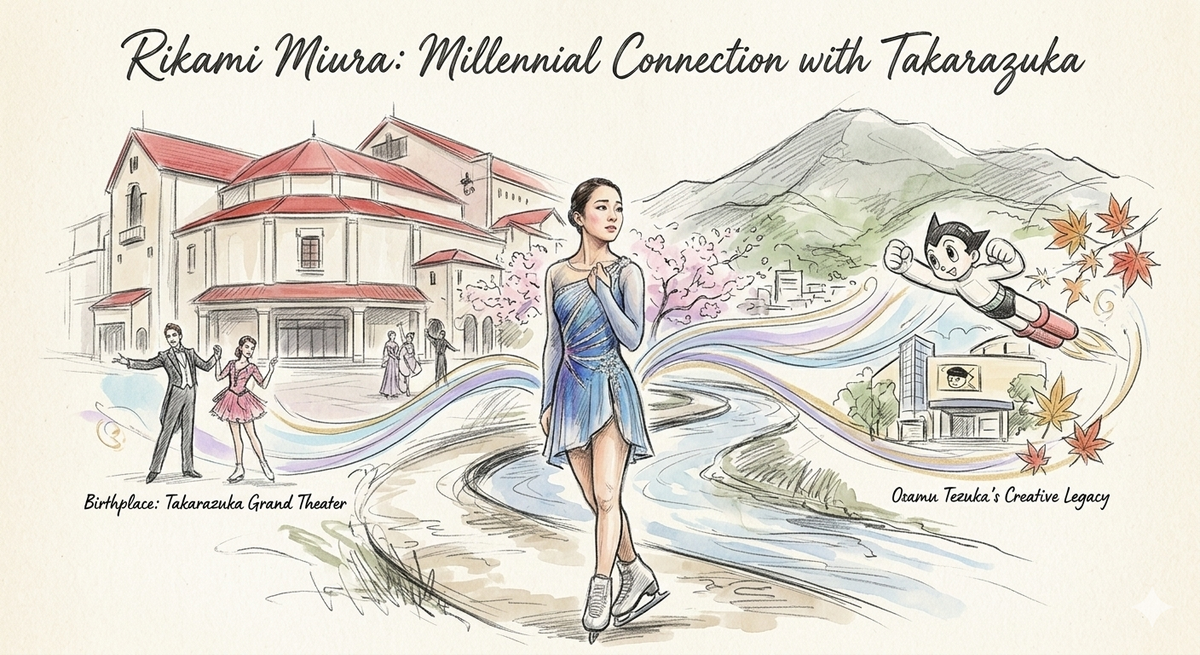
The Hidden Gem & Logistics
The Boat Bridge Site at Okoshi offers the most evocative sensory experience for the deep traveler. Standing on the banks of the Kisogawa, one can find the ferry landing remains and the historic Minoya Bun-emon residence. Amidst the river breeze, one can almost see the "Sleeping Dragon" of 270 boats spanning the horizon, a ghost of the city's engineering past.
The Historian’s Logistics
- How to get there: Meitetsu or JR lines (approx. 10–15 minutes from Nagoya Station to Ichinomiya Station).
- Recommended Accommodation: Business hotels near the Masumida Shrine offer the best proximity to the city's "centripetal" energy.
- Recommended Tours: Heritage walks focusing on "Bishu" textiles, including visits to remaining saw-tooth factories and the original morning-service coffee shops.
A Philosophical Reflection
To understand Ichinomiya is to practice "layered observation." It is a city of constant reorganization, where no destruction is ever final. The sacred waters of the Masumida Shrine have shifted form, flowing into the "Gacha-man" coffee cups and eventually freezing into the ice of the skating rink. Understanding this place requires seeing the earthquake’s fire in the factory’s electricity and the weaver’s precision in a skater’s leap.
As the mechanical roar of the mechanical loom fades into the quiet of a post-industrial era, we are left to wonder: how will the tenacity of the weaver’s soul manifest in the next century? Will the next pattern be woven in technology, or in a return to the sacred waters of the "First Shrine"?
Subscribe to Historical Travel Stories for more deep-dives into the hidden geography and resilient souls of Japan.
Further reading
- 成長した姿、心待ちに 木原選手:平昌オリンピック特集 - 中日新聞, accessed March 6, 2026,
- ふるさと大使(木原龍一)|東海市公式ウェブサイト, accessed March 6, 2026,
- 真清田神社の由緒歴史, accessed March 6, 2026,
- 真清田神社 -, accessed March 6, 2026,
- 清らかな空気に包まれて―こころのふるさと真清田神社を巡る〈一宮市〉 | おでかけ特集, accessed March 6, 2026,
- いちのみやの産業 - Industry of Ichinomiya, accessed March 6, 2026,
- ふらりと神社へ行ってみた。#1 尾張国一ノ宮「真清田神社」|紫苑の始まり - note, accessed March 6, 2026,
- 建物を楽しむために, accessed March 6, 2026,
- 真清田神社, accessed March 6, 2026,
- 真清田神社の由緒, accessed March 6, 2026,
- 尾張氏は、東日本を拠点とした大和朝廷に対峙するほどの大豪族であった。 崇神天皇妃、継体天, accessed March 6, 2026,
- はじめに - 一宮市, accessed March 6, 2026,
- 真清田神社(ますみだじんじゃ) | 【公式】愛知県の観光サイトAichi Now, accessed March 6, 2026,
- 一宮市史 : 新編 資料編 補遺 2 | NDLサーチ | 国立国会図書館, accessed March 6, 2026,
- 神前の塀(柵)の有無の理由が知りたい。なぜ、真清田神社(愛知県一宮市)には無く - レファレンス協同データベース, accessed March 6, 2026,
- 一宮の繊維の歴史, accessed March 6, 2026,
- 「モーニング」発祥の地、愛知県一宮市を語る - エアセルマットの和泉'ブログ, accessed March 6, 2026,
- 愛知県 宮市 - 中小企業庁, accessed March 6, 2026,
- 【特集】繊維の一大産地!?モーニングと繊維の関係!?名古屋の台所!?知っているようで実は知らない一宮を探しに行こう!|大ナゴヤツアーズ - note, accessed March 6, 2026,
- 住んでよし訪れてよし 飛躍するモーニングのまち 愛知県 一宮市 まちの解体新書, accessed March 6, 2026,
- 日本の繊維産業はこのまま衰退してしまうのか ~一宮市, accessed March 6, 2026,
- 一宮城の見所と写真・200人城主の評価(愛知県一宮市) - 攻城団, accessed March 6, 2026,
- 尾張 一宮城-城郭放浪記, accessed March 6, 2026,
- 一宮城跡 | 観光スポット - 一宮市の公式観光サイト IchinomiyaNAVI, accessed March 6, 2026,
- 一宮城 - 城びと, accessed March 6, 2026,
- 一宮城 (尾張国) - accessed March 6, 2026,
- 尾張低地部における 小規模古墳の様相 - 愛知県埋蔵文化財センター, accessed March 6, 2026,
- 小和田哲男オフィシャルサイト | 『戦国と現代をつなぐ』歴史学者・小和田哲男のオフィシャルサイトです, accessed March 6, 2026,
- 【美しき天守へ】城歩きが楽しくなる 天守の見方 小和田哲男 - たびよみ - 読売旅行, accessed March 6, 2026,
- i-バスで巡る「いちのみや」再発見の旅!【起宿】 - 一宮市の公式観光サイト IchinomiyaNAVI, accessed March 6, 2026,
- 起宿 - あいち歴史観光 - 愛知県, accessed March 6, 2026,
- 朝鮮通信使の舞台・相島 - 新宮町おもてなし協会, accessed March 6, 2026,
- 朝鮮通信使95 - 日朝文化交流史, accessed March 6, 2026,
- vol.94 (2022年2月) - 見てみよう!歴史災害記録と旬のあいち, accessed March 6, 2026,
- 宝光寺(震災紀念碑) - 歴史地震記録に学ぶ 防災・減災サイト, accessed March 6, 2026,
- 震災紀念之碑 -濃尾震災 愛知県西南部の惨状と支援 - 玉章文化財研究所, accessed March 6, 2026,
- 災害を今に伝える史跡など尾張地区 - 歴史地震記録に学ぶ 防災・減災サイト, accessed March 6, 2026,
- 第1節 濃尾地震 - 内閣府防災情報, accessed March 6, 2026,
- 56年の歴史に幕…地域に愛されたスケート場が3月末で閉鎖へ 世界で活躍する選手も輩出【愛知発】 - FNNプライムオンライン, accessed March 6, 2026,
- 大勢の人が「滑り納め」 街のスケートリンクが利用客減少で56年の歴史に幕 愛知・一宮市 (22/03/31 11:39) - YouTube, accessed March 6, 2026,
- 四大陸選手権で優勝した「りくりゅう」の木原龍一選手は東海市出身 - ちたまるNavi, accessed March 6, 2026,
- 56年の歴史に幕…地域に愛されたスケート場3月末で閉鎖へ「スケート大国で子供の憩いの場なくなるのは寂しい」 | 東海テレビNEWS, accessed March 6, 2026
 Lawrence
 Lawrence