(ENG) Taipei’s Zhongzheng District: A Journey Through the Architecture of Power and the Path to Rebirth
Discover five historical narratives in Taipei’s Zhongzheng District, exploring how colonial architecture and authoritarian monuments became symbols of democracy.
Did the Chiang Kai-shek Memorial Hall transform from a symbol of authoritarianism into a Freedom Square witnessing Taiwan's democracy?
Did Guling Street and Qidong Street preserve Taiwan's cultural resilience?
Did the February 28 Incident and the White Terror affect the fate of Taiwan's medical elite at the time?
To walk through Taipei’s Zhongzheng District is to traverse a landscape where the stones themselves are heavy with the weight of argument. It is more than a mere administrative center; it is a strategic battlefield of public memory. Here, the city functions as a living palimpsest, a parchment where the fortifications of the Qing Dynasty, the rigid administrative hubs of Japanese colonial rule, and the monumental structures of the post-war authoritarian era have been layered one atop another. For the historically minded traveler, these physical structures are not static relics but active participants in Taiwan’s ongoing democratic dialogue. To understand Taipei, one must experience this district on foot, reading the urban semiotics of a city that has spent decades transforming sites of absolute power into spaces of public will.
Listen to the historical stories told in detail (For subscribers only)
The Square’s Silent Revolution
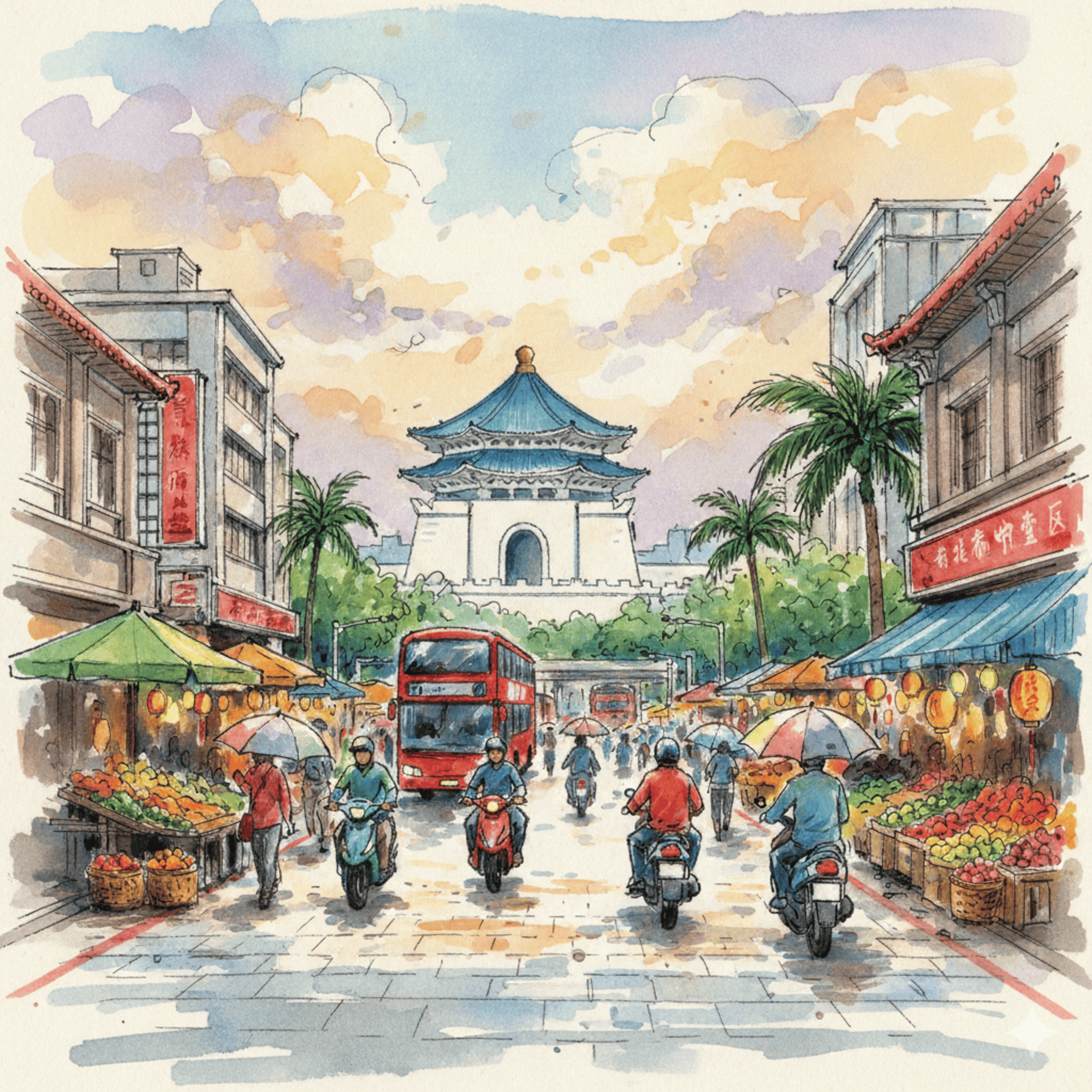
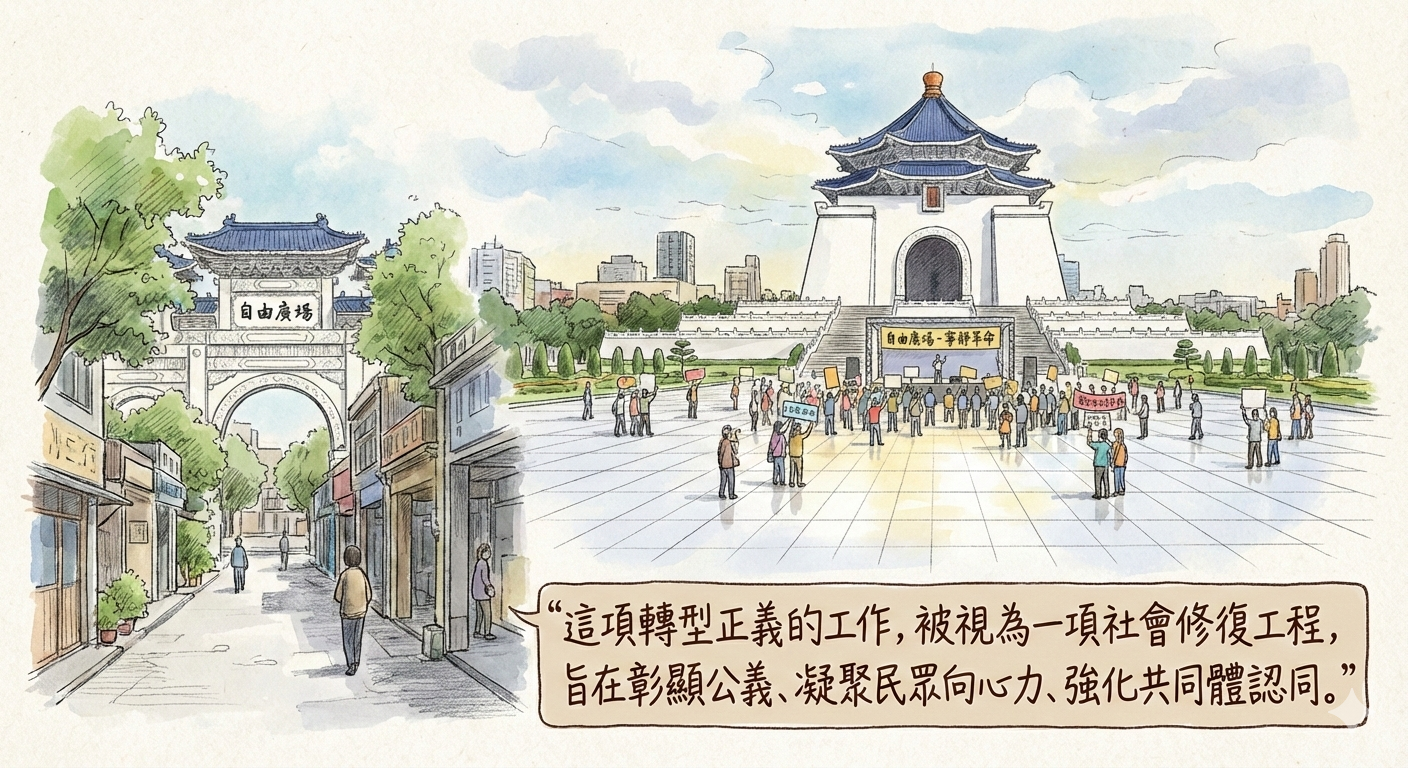
We begin at the grandest of scales: Liberty Square. The National Chiang Kai-shek Memorial Hall was originally conceived as a physical projection of political order—a manifestation of "Grandeur as Control." Its symmetrical, imposing design and vast white expanses were intended to enforce a sense of immutable authority and individual worship. Yet, in what is often called Taiwan’s "Quiet Revolution," the very scale intended to intimidate became the stage for a democratic awakening.
Beginning with the 1990 Wild Lily student movement and continuing through the 2008 Wild Strawberry protests, the public began a "democratic occupation" of this square. The architecture’s physical openness allowed the "rebellion volume" of society to amplify. However, the historian notes that this transition remains a "social repair project" in flux. The archives of the Memorial Hall themselves acknowledge the friction, stating:
"The transformation of the Memorial Hall faces a fundamental contradiction between its original authoritarian purpose and the current values of a free democracy... it is a social repair project aimed at manifesting justice and strengthening communal identity."
Because the transition from authority was negotiated rather than revolutionary, the "unmet transformation" of the square serves as a reminder that democratic identity is a constant effort of reclamation rather than a finished monument.
Blood, Tears, and the Scent of Ink: Guling Street
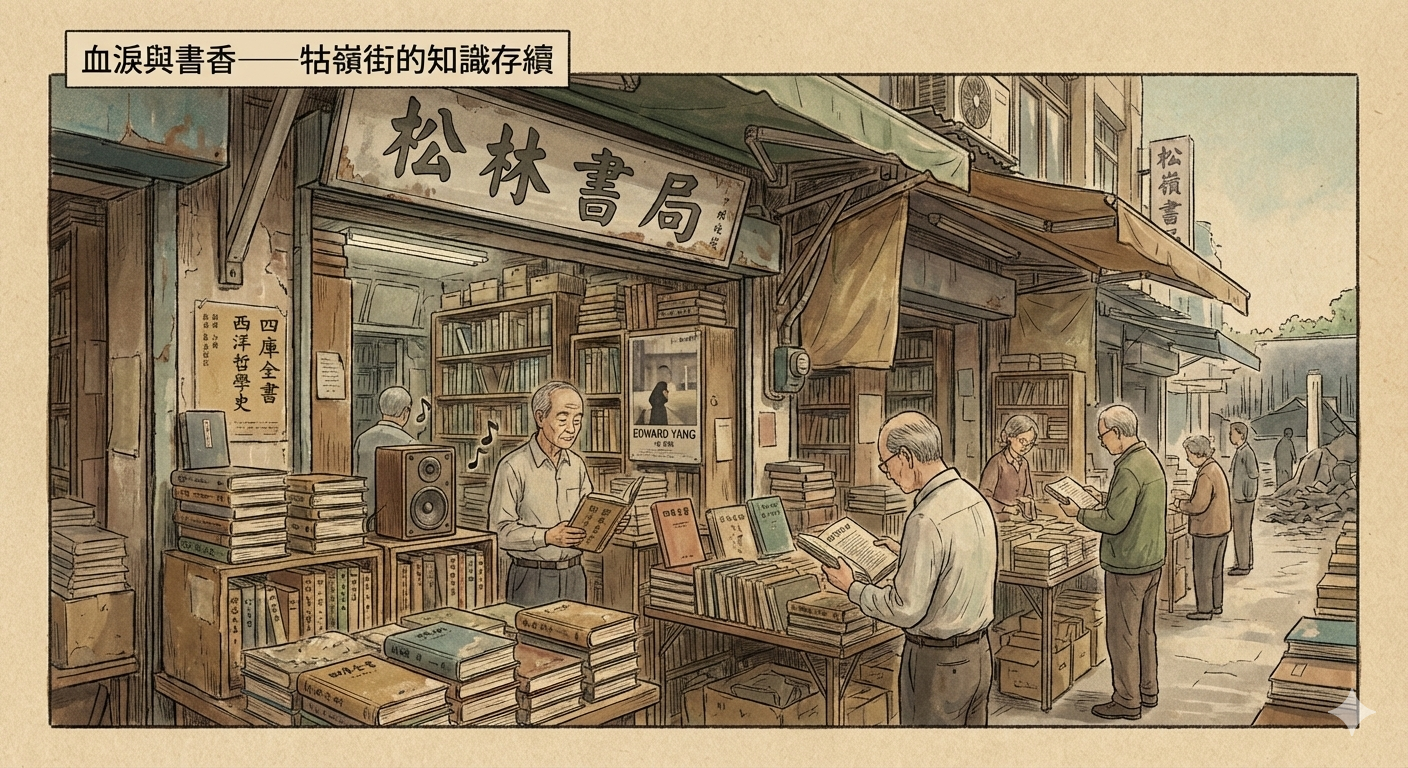
Moving away from the monumental, we enter the narrow veins of the city. Guling Street, once the premier knowledge market of Taipei, was born from the debris of transition. As Japanese forces retreated and mainland residents arrived, a secondary market for discarded books emerged. During the mid-summer heat of the White Terror, the scent of old paper and ink became the perfume of quiet resistance.
At the Songlin Bookstore, a landmark held by the Cai family for over 70 years, the act of selling books was an act of intellectual survival. In a climate of strict censorship, these stalls functioned as a "gray market" of ideas. One might find a copy of Kant or Hegel nestled beside a rare edition of the Siku Quanshu, served alongside iced coffee and green bean cakes. The books here are regarded not as commodities, but as a "heritage of blood and tears passed down through generations," witnessing the survival of knowledge in an era where thoughts were a liability. This was where the private transaction of a banned text bypassed the state’s gaze, preserving the intellectual life of a nation under siege.
The Price of Healing: The Medical Elite
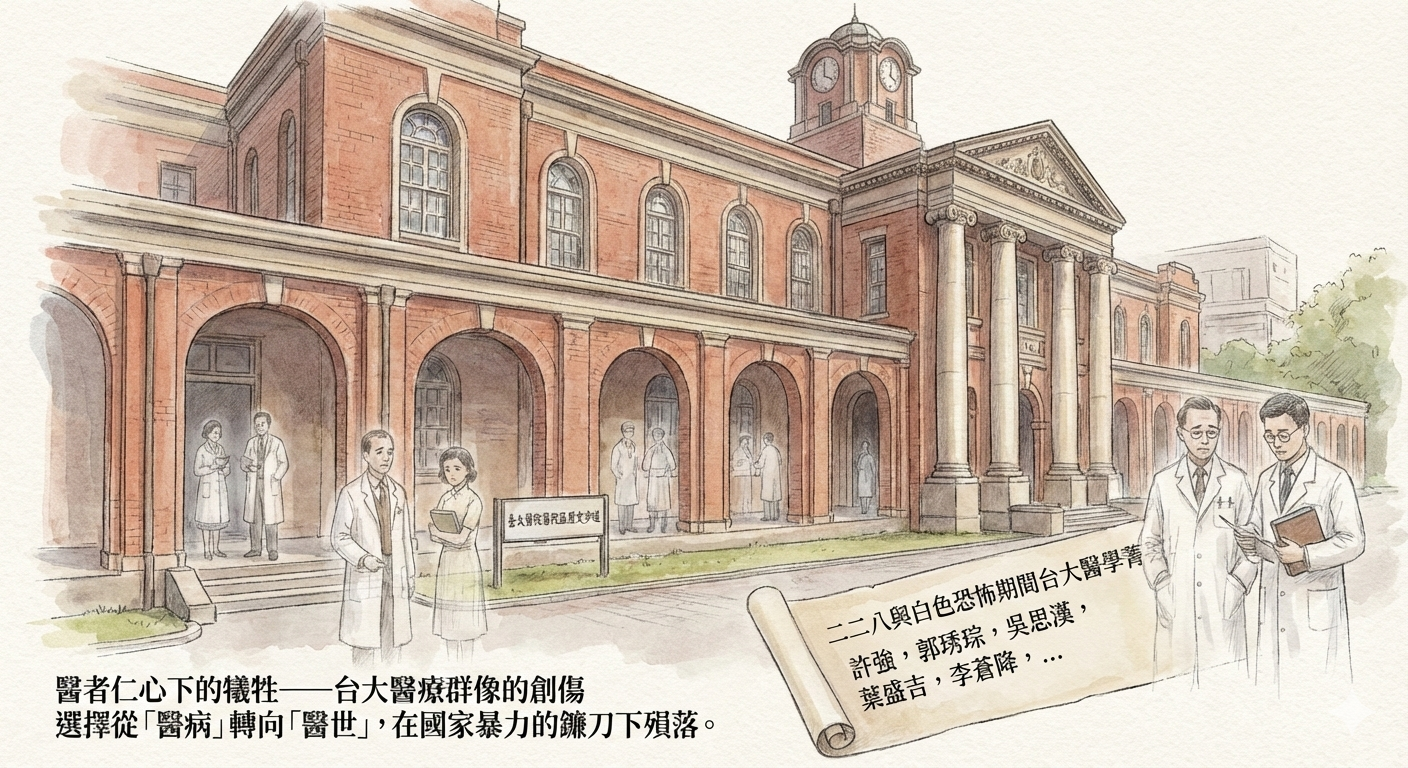
From the preservation of books, we move to the preservation of the body politic at the National Taiwan University (NTU) Hospital. The red-brick corridors of the hospital's old wing are a site where the highest intellectual achievement met the harshest state violence. Under the "Sovereign Logic" of the 228 Incident and the subsequent White Terror, the state targeted the medical elite—individuals whose education and social prestige made them natural leaders of dissent.
Facing maladministration, hyperinflation, and systemic discrimination, many physicians felt compelled to shift from "healing bodies" to "healing society." The state viewed this as a threat to its absolute control, leading to a purge that robbed Taiwan of its brightest minds.
Figure | Field | Trajectory of Dissent/Consequence |
Liu Zhao-guang | Assistant Professor, NTU Medicine | Formed the Student Autonomous Council; fled to Shanghai (1948), later Japan for underground work. |
Guo Xiu-cong | Physician, NTU Hospital | Engaged in social and political activism; executed by the state in 1950. |
Jiang De-xing | Surgeon (Japan-trained) | Arrested following the "Wuqi Fishing Port" incident; sentenced to death. |
Qiu Lin-yuan | Chief of Ophthalmology | Fled to mainland China following the 228 Incident to escape persecution. |
The Shape of Monopoly: Economics as an Architectural Tool
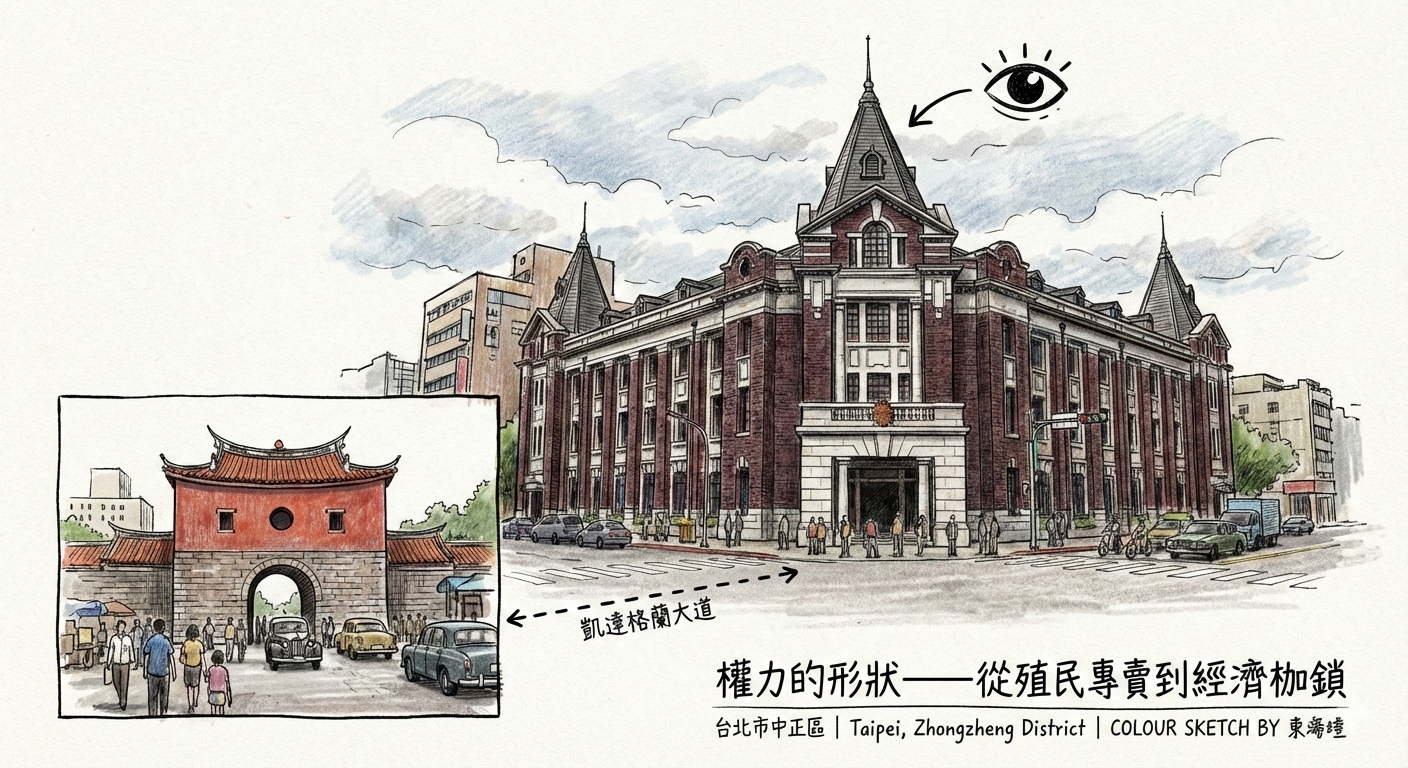
The urban layout of Zhongzheng is anchored by the historic Qing Dynasty gates—the Jingfu (East) and Lizheng (South) gates. These axes were reinforced by subsequent regimes to project dominance, nowhere more clearly than in the Taiwan Tobacco and Liquor Monopoly Bureau.
The bureau’s unique V-shaped architecture and distinctive spire symbolized the state’s totalizing grip on daily life. By controlling the monopolies of opium, camphor, salt, tobacco, and liquor, the colonial and subsequent post-war administrations centralized wealth and power. After 1945, the diversion of resources to the Chinese Civil War and the ensuing hyperinflation turned these buildings into physical artifacts of economic oppression. The 228 Incident itself was sparked by this very monopoly system, proving that the rigid structures of state economics often provide the dry tinder for social eruption.
The Philosophy of Symbiosis: Healing in the Quiet Alleys
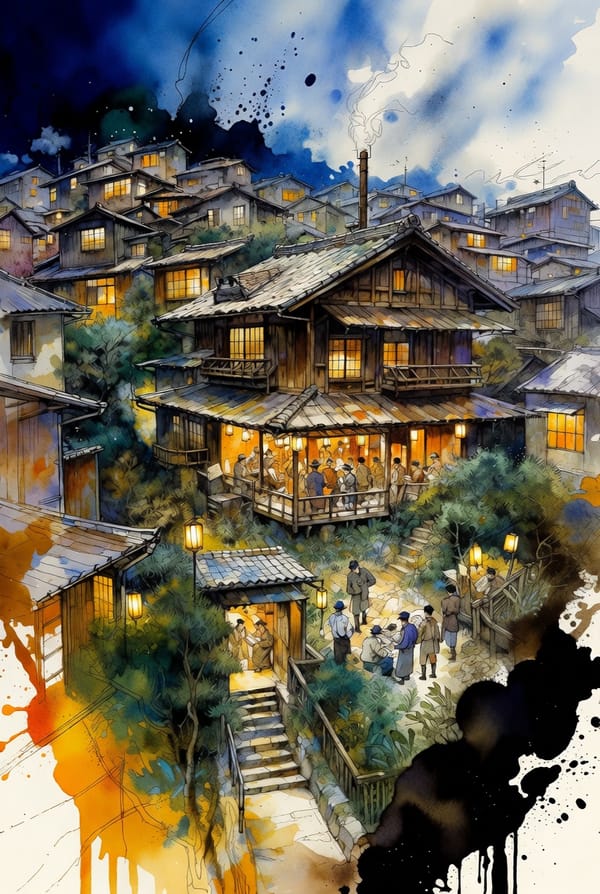
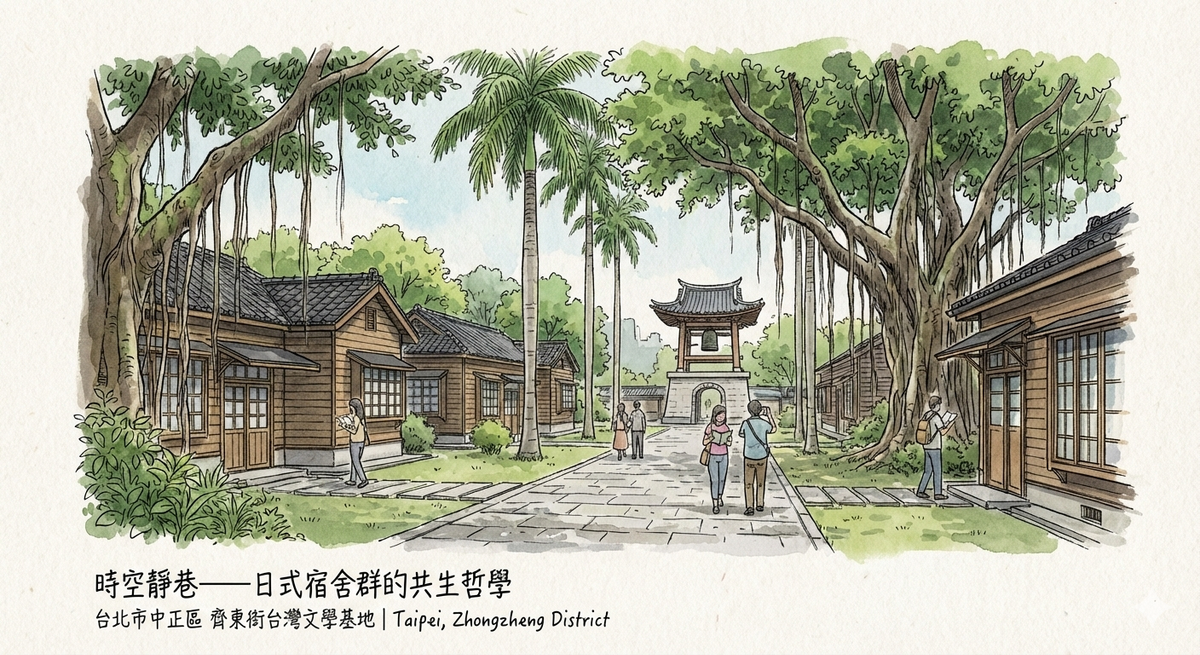
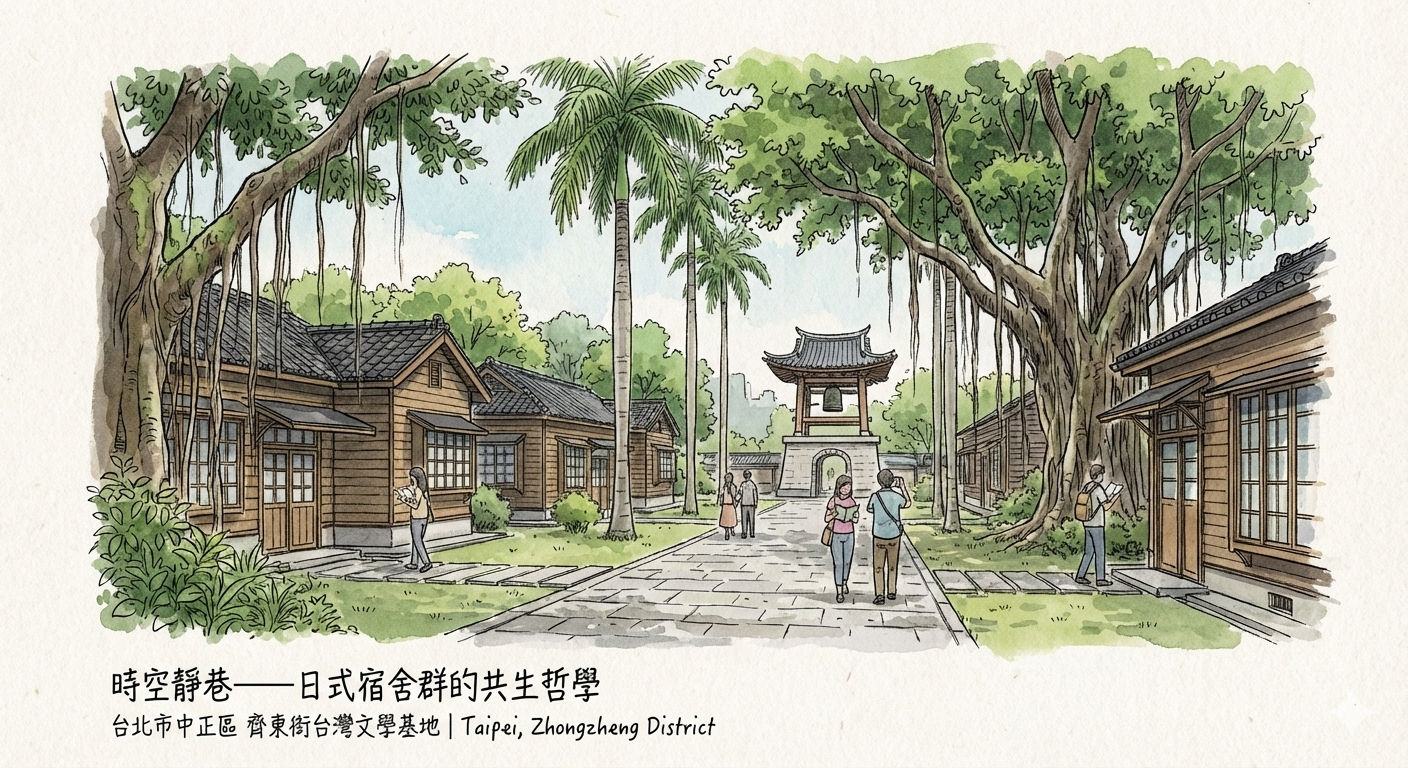
In the shadow of these "power spaces" lie the Japanese dormitory clusters of Qidong Street and Nanchang Road. These wooden structures, once housing colonial officials, have undergone a process of "spatial repair." Now transformed into the Taiwan Literature Base, they represent a "Philosophy of Symbiosis."
The visual metaphor here is striking: the aerial roots of ancient banyan trees intertwined with towering Royal Palm trees, all sheltering the low-slung eaves of the old houses. This botanical and architectural mingling, alongside the nearby Donghe Zen Temple Bell Tower (a remnant of the Cao-Dong Zong influence), suggests a multi-layered cultural identity. These quiet corners offer a "de-politicized" sanctuary where the grand traumas of the district find a soft, organic resolution. It is here that the city heals, moving from the rigid lines of authority to the organic complexity of cultural coexistence.
Insider Observations for the Historically Minded
For those seeking to touch the pulse of this history, the following experiences are essential:
- The Cultural Corridor at Liberty Square: Eschew the grand statue and look for the rotating exhibitions. These often tackle the "unmet transformations" of the state, providing a rigorous look at human rights and the evolution of Taiwanese democracy.
- The NTU Hospital Old Wing Historical Trail: Walk the red-brick corridors not as a patient, but as a witness. This path honors the medical elite who sacrificed their careers and lives for a vision of a free society.
- Nanchang Road Craft Settlement: Amidst the history of monopolies, this artisan cluster offers "healing time"—a space for manual creation that serves as a quiet antidote to the district’s grand political narratives.
- The Stacks of Songlin Bookstore: Engage with the Cai family legacy on Guling Street. To hold a book there is to hold a fragment of intellectual history that survived the White Terror.
The Layered Observation
Zhongzheng District is far more than a collection of administrative coordinates; it is a profound "social repair project" that remains ongoing. To understand its heart, one must move past the highlights and engage in "layered observation," recognizing the scars of the execution records, the whispered resistance of the bookstalls, and the vast, reclaimed expanse of the square.
As we walk these streets, we are forced to ask: What role do we play in interpreting the scars of the cities we visit? How do we honor the immense effort required to turn a site of enforced authority into a site of fragile, hard-won freedom? In Zhongzheng, the answer is written in the very layout of the city—a testament to a society that refuses to forget.
Travel Notes: Navigating the History of Zhongzheng
- Arrival: The district is best accessed via MRT Zhongzheng Memorial Hall Station (Red and Green lines).
- Stay: Consider boutique accommodations near the North Gate (Beimen), where the transition from the old walled city to the modern administrative hub is most palpable.
- The Walking Route: Begin at the expanse of Liberty Square, walk toward the NTU Hospital Old Wing, descend into the narrow history of Guling Street, examine the Monopoly Bureau on Nanchang Road, and conclude with the restorative silence of the Qidong Street dormitories.
Subscribe for more deep-dive narratives exploring the intersection of history, architecture, and the human spirit in the world’s most complex urban landscapes.
References
- 國立中正紀念堂-從威權到去威權, accessed on November 21, 2025
- 中正區- 台北, accessed on November 21, 2025
- 國立中正紀念堂, 從威權到去威權, accessed on November 21, 2025
- 「這些書,就是我爸的血。」——見證日治、中華民國政府來台、白色恐怖,牯嶺街舊書店「松林書局」70 年傳奇- 陳默安Unawrites, accessed on November 21, 2025
- 在二二八事變及白色恐怖時期受難之台大醫師校友 李彥輝| 台美人筆會, accessed on November 21, 2025
- 古亭隱藏景點【超級祕景帶你玩一整天】週末就這樣安排吧❤️台北就有微型日本網美景點❤️, accessed on November 21, 2025
 Lawrence
 Lawrence