(ENG) The Eastern Sentinel: Time, Memory, and the Fortress Mentality of Chai Wan
Discover the layers of Chai Wan’s history, from Hakka firewood gatherers and WWII batteries to maritime beacons on Hong Kong’s rugged eastern frontier.

Is "pulling firewood" a cultural taboo in Chai Wan?
What is the connection between Chai Wan's hidden military relics and its World War II history?
What are some attractions in Chai Wan and Siu Sai Wan that combine history with local cuisine?
Author’s Note: This exploration constitutes a vital chapter in our broader mapping of Hong Kong’s historical palimpsest. While mainstream narratives often gravitate toward the commercial triumphs of Victoria Harbour, this gaze turns toward the island’s rugged eastern frontier—a space for the intellectually curious traveler to observe how geographic isolation acts as a preservative for the city’s most complex memories.
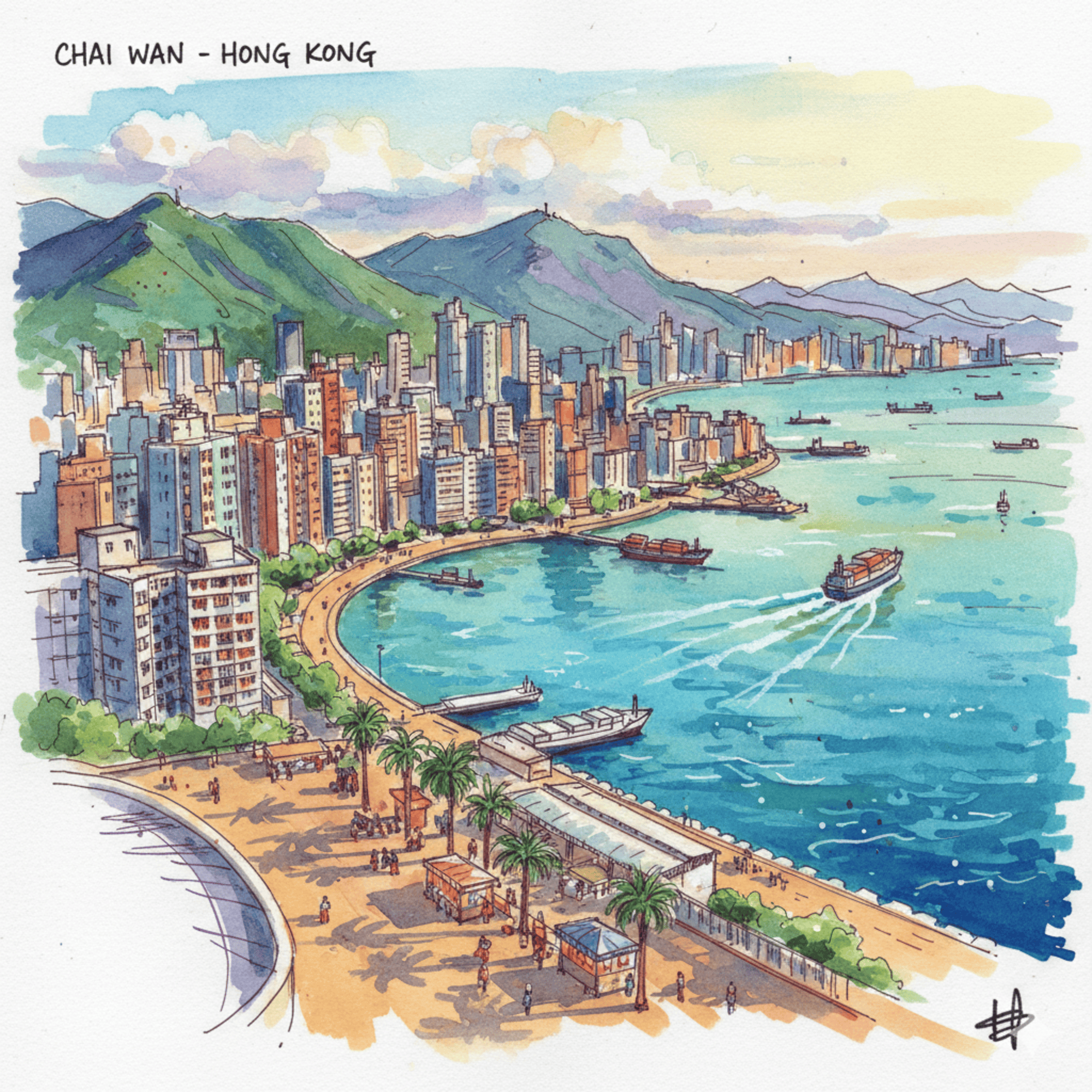
To stand at the easternmost reaches of Hong Kong Island is to encounter a landscape defined by its limits. Cradled by mountains on three sides and the vast, salt-sprayed expanse of the Pacific on the other, Chai Wan and Siu Sai Wan have long functioned as the city’s geographic buffer. This isolation, a result of being the "end" of the island, allowed for the preservation of complex historical strata: from the early Hakka settlers gathering firewood to the 19th-century sentinels of trade and the tragic 20th-century bastions of war. To the casual observer, these districts are merely high-density residential hubs; to the flâneur, they are a living museum. By tracing the transition from a labor-intensive "Free Port" to a fortified wartime edge, we uncover the evolution of Hong Kong itself—a story of resilience surviving in the cracks of the city’s expansion.
Listen to the historical stories told in detail (For subscribers only)
The Naming Paradox: From Labor to Cultural Taboo
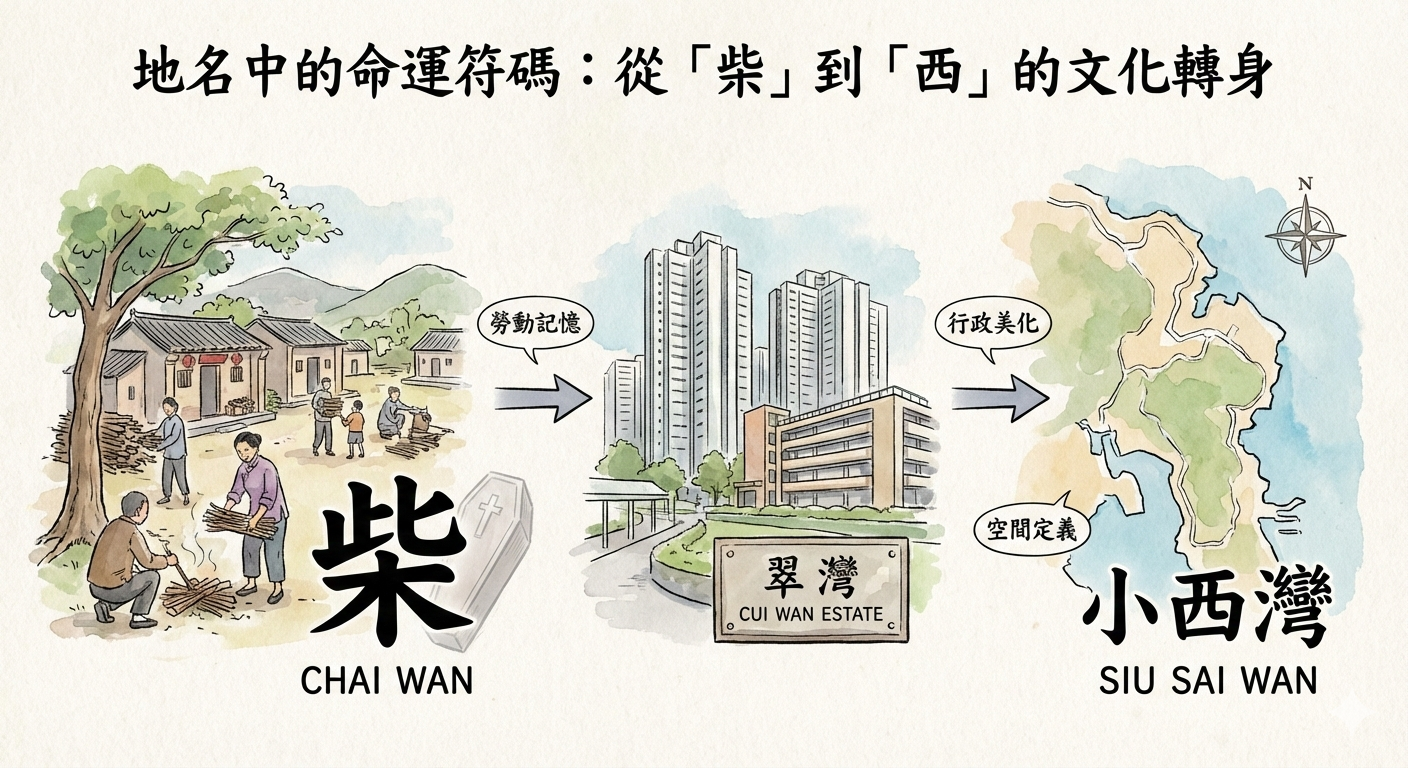
A city’s names are its first layer of history, yet they are rarely static. In Chai Wan, naming has been an ongoing act of cultural negotiation between local memory and administrative convenience. Because the district remained a distant "edge" for so long, its original identity rooted in Hakka labor survived the initial waves of colonial renaming. The name "Chai Wan" commemorates the "Chai" (firewood) gathered by early settlers to fuel the growing colony. However, as the city modernized, this linguistic heritage faced a peculiar struggle.
The transition from "Chai" to "Sai" (West) and "Tsui" (Emerald) represents a tension between identity and superstition. In Cantonese, the term for "pulling firewood" (la chai) is a potent colloquialism for death. This taboo prompted 1950s urban planners to attempt a "sanitization" of the area, proposing the name "Tsui Wan" to provide a more auspicious veneer. While the original name endured, Tsui Wan Estate remains today as a physical monument to this administrative discomfort. Similarly, the area once known as "Little Chai Wan" was rechristened "Siu Sai Wan" (Little West Bay). This shift was accelerated by a linguistic quirk: the Hakka pronunciation of "Chai" sounds remarkably like the Cantonese "Sai" (West), leading colonial mapmakers to favor the neutral geographic designation over the labor-centric original. In these names, we see the first evidence of the edge as a buffer—a place where the past lingers even as the state attempts to rewrite it.
The Sentinel of the Golden Age: Cape Collinson Lighthouse
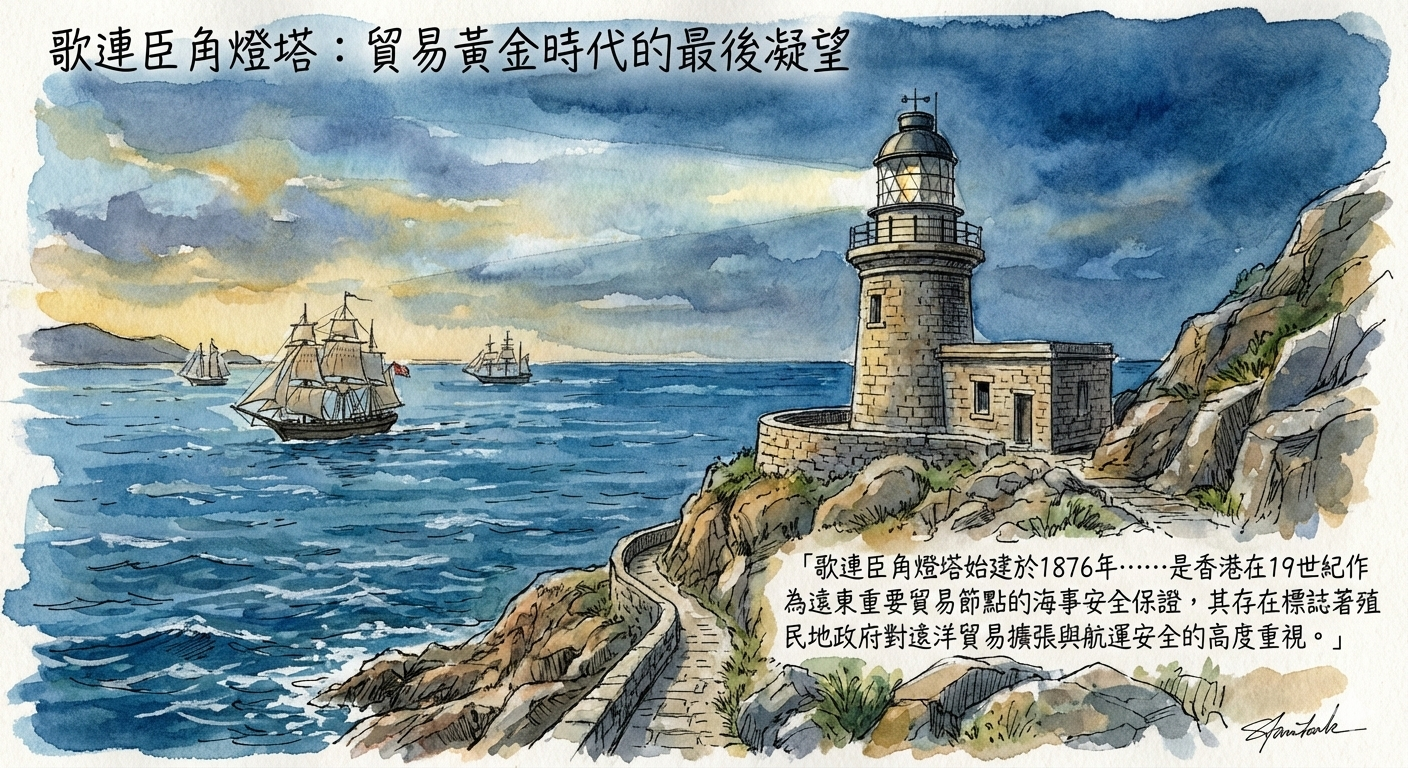
Perched on the furthest tip of the island, the Cape Collinson Lighthouse remains a poignant symbol of Hong Kong’s "Free Port" era. Established in 1876, this Grade III historic structure was the maritime sentinel for the massive trade expansion of the 19th century. Its salt-crusted white masonry represents an age of global connectivity and peaceful commerce, its light guiding vessels toward the prosperity of the harbor.
The lighthouse’s geographic isolation makes it a rare site for deep reflection, a liminal space where the land finally yields to the sea. It serves as a reminder that before this coast was a residential fringe, it was a vital node in global trade. As the historical records emphasize, the lighthouse was a:
"海事安全保證" (maritime safety guarantee)
This "guarantee" was more than practical; it was symbolic of a colonial era that prioritized trade and maritime dominance. Yet, the tranquility of the 1870s would eventually be shadowed by the encroaching "Fortress Mode" of the 1930s. The lighthouse’s very isolation—the buffer that kept it peaceful—would soon make it the ideal site for the dark machinery of war.
The Tragedy of the "Hidden" Battery
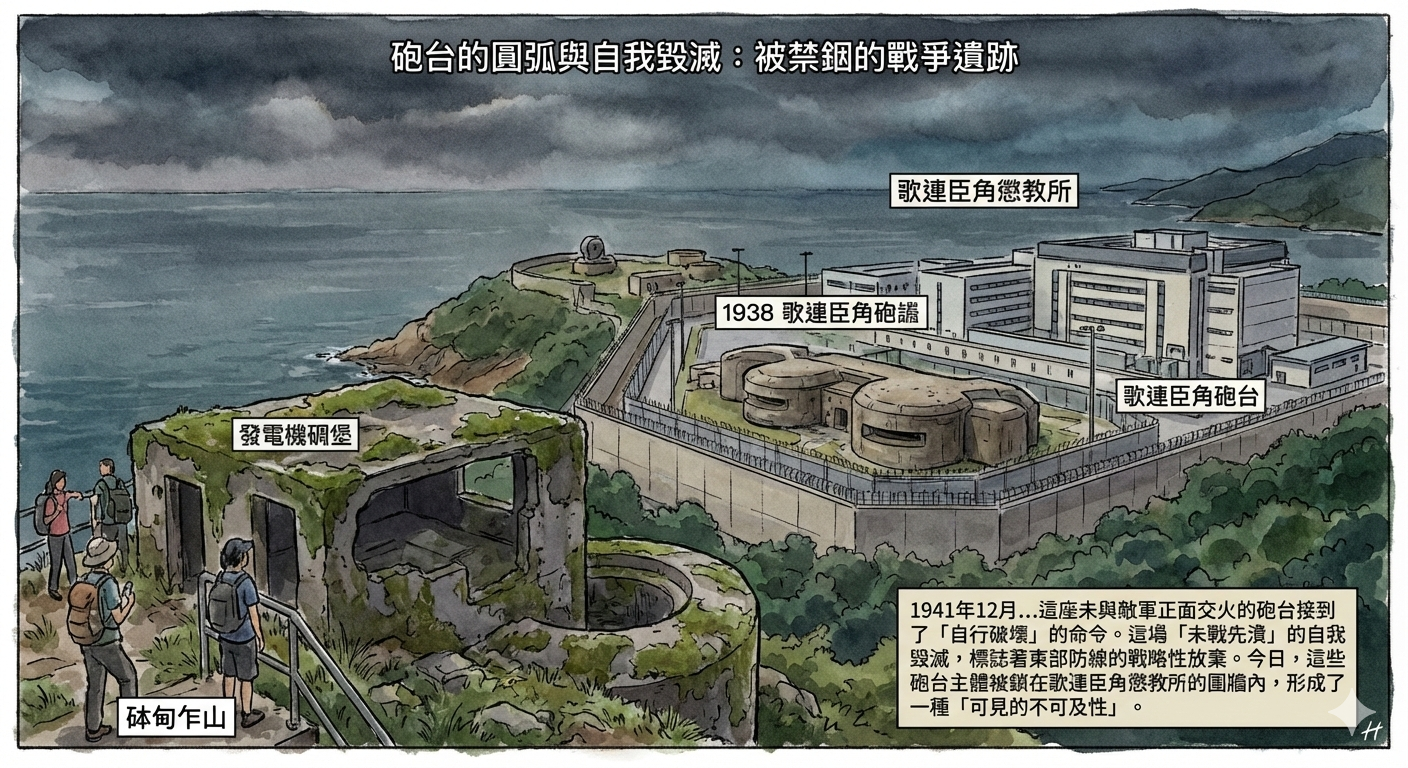
If the lighthouse represents the light of trade, the Cape Collinson Battery represents the shadow of defensive paranoia. Constructed in 1938 as the clouds of global conflict gathered, the battery was a masterpiece of "Fortress Mode" architecture. Unlike the vertical aspirations of the lighthouse, the battery sought the earth. Its bunkers featured unique rounded designs and narrow firing slits, specifically engineered to deflect impact and maintain "visible invisibility" against the rugged coastal backdrop.
The story of the battery is one of strategic withdrawal and quiet tragedy. In December 1941, as the defense of Hong Kong Island buckled under the Japanese advance, British forces were ordered to self-destruct the battery. Its two 6-inch guns never engaged in the combat they were built for; instead, they were sacrificed by their own creators to prevent their capture. Today, much of the battery exists in a state of suspended animation, locked behind the restricted perimeter of the Cape Collinson Correctional Institution. For the modern explorer, history here becomes a detective-like pursuit. One can only catch glimpses of the rounded concrete bunkers and the 90cm diameter searchlight platform on the cliffs below through security fences—a haunting reminder that on the edge of the state, history is often literally under lock and key.
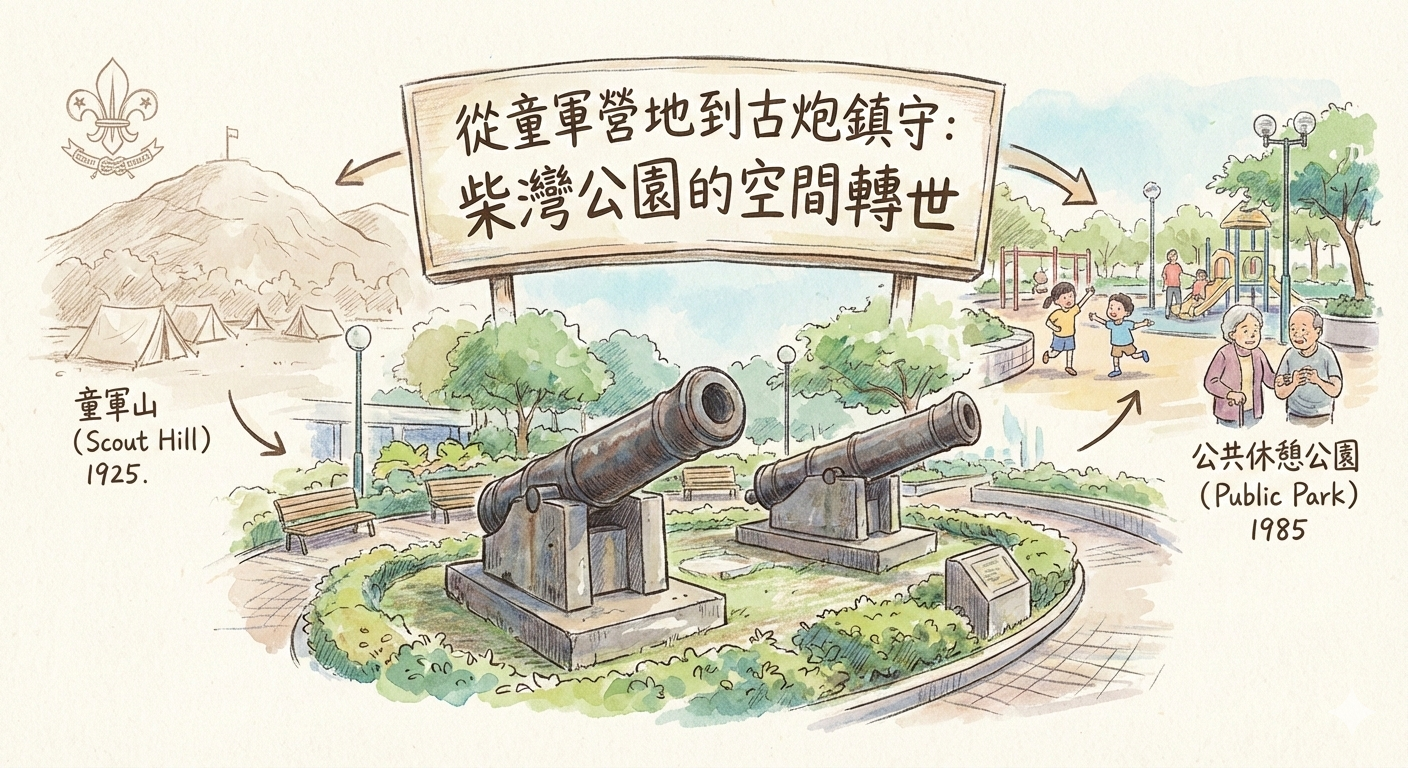
From Paramilitary Youth to Public Leisure: Chai Wan Park
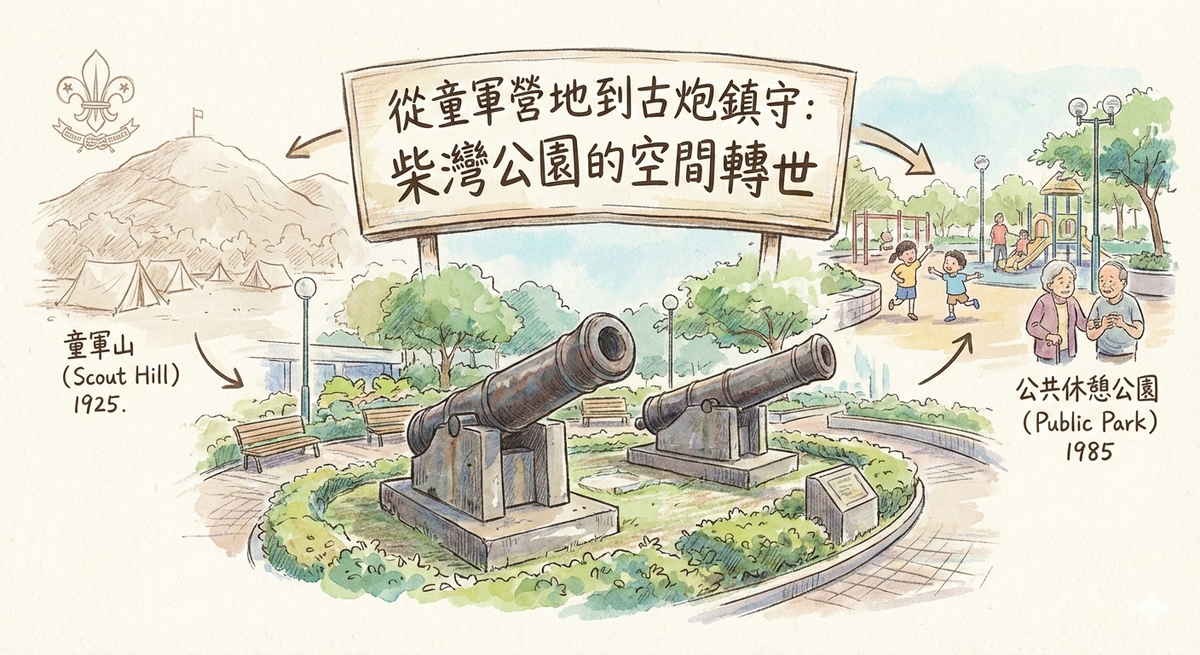
Urban planning often acts as a filter, transforming sites of discipline into spaces for public leisure. Chai Wan Park, once known as "Scout Hill," is the quintessential case study of this transformation. In 1925, this hill was a space for the Boy Scouts—a site dedicated to the paramilitary training and character-building of the colonial era’s youth.
In the 1980s, the hill was leveled and the surrounding sea reclaimed to meet the demands of a growing population. Yet, the park retains "historical debris" that complicates its recreational identity. Two British-made cannons, recovered from the seabed during 1973 dredging operations and placed in the park in 1985, serve as "peaceful symbols" of a former military era. This transition—from a site of disciplined youth training to a graveyard for maritime weaponry, and finally to a family playground—illustrates how the "edge" of the city is repurposed. The cannons are no longer weapons but public education tools, historical artifacts neutralized by the greenery of modern civil life.
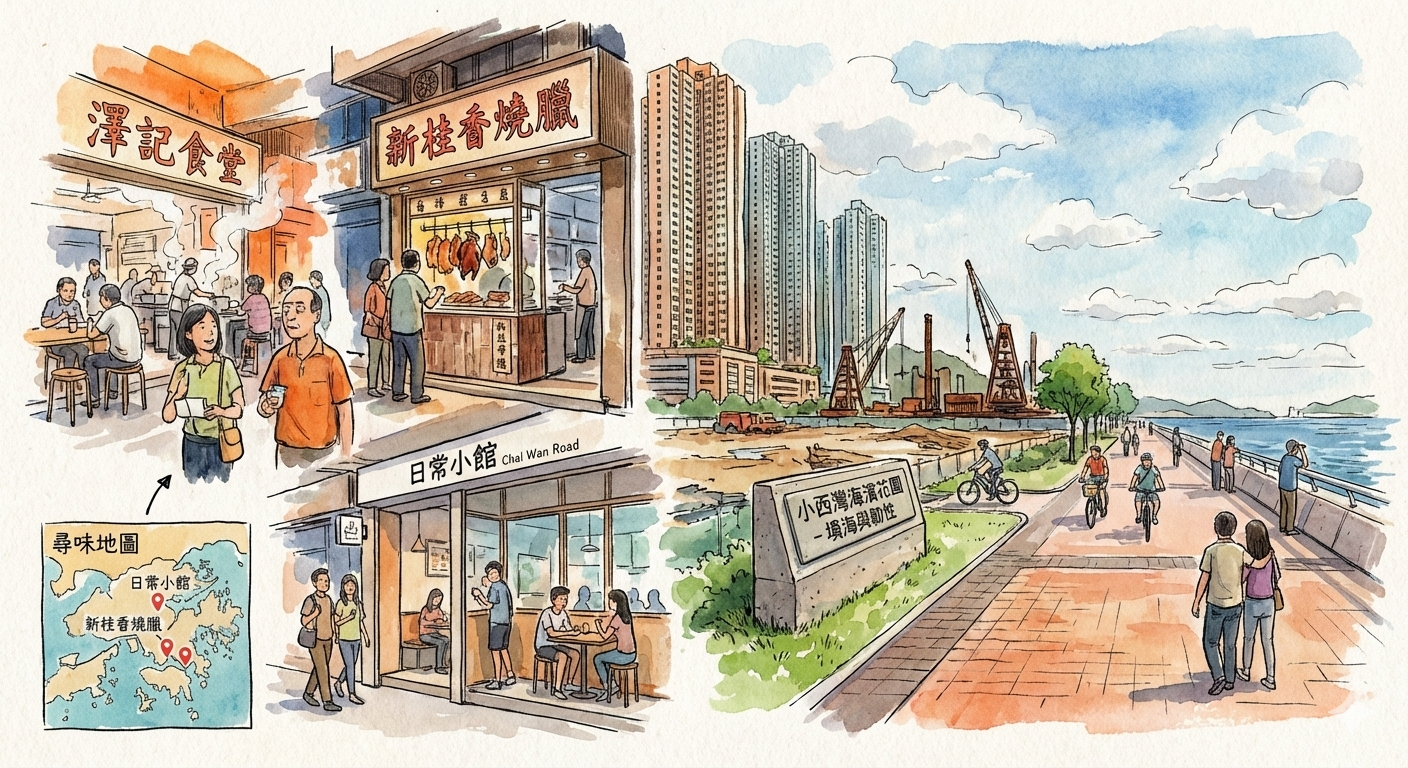
The Flavor of the Industrial Fringe
The history of Chai Wan is written not just in stone, but in the early-morning rhythms of its industrial kitchens. The 1980s reclamation created a unique "time-signature" in the local food culture, where the utilitarian needs of the workforce have crystallized into community heritage. This is the "Industrial Heritage Time" of the neighborhood, surviving despite the shift toward modern leisure.
The local eateries serve as markers of this resilience:
- Chak Kee: Tucked within the industrial sector, its 6:00 AM opening time is a direct legacy of serving early-shift laborers who built the modern district.
- Sun Kwai Heung: A local institution on Chai Wan Road, it represents the "persistence of craft," upholding the traditional standards of Cantonese roast meats amidst the surrounding industrial sprawl.
- Siu Sai Wan Cafes: In contrast, the modern establishments in Fu King Plaza represent the new "Leisure Consumption" of a residential generation, where the utilitarian dining habits of the past are being replaced by the slower pace of the contemporary cafe.
Spatial Synthesis: The Hidden Gems
The various historical layers of this eastern edge are physically connected by the Pottinger Peak trail. As one moves from the industrial heart of Chai Wan toward the coastal heights, the transition from urban density to rugged isolation becomes palpable. This path allows the flâneur to experience the continuity of the landscape—the "buffer" that kept these stories alive.
Essential Hidden Gems
- The Pottinger Peak Viewpoint: An essential stop for any serious observer, offering a panoramic view that allows one to "gaze across the wall" into the restricted battery sites and the lighthouse below. It provides the spatial context for the 1941 collapse.
- The Generator Bunker: Accessible via a rugged side-path, this bunker once powered the battery’s searchlights. Tucked away from the main trails, its heavy concrete walls offer a tactile connection to the mechanical details of the 1938 defense system, free from the sanitization of the public parks.
Philosophical Reflection & Conclusion
The journey through Chai Wan and Siu Sai Wan is, in a sense, a modern act of 尋柴 (searching for firewood). In the past, the Hakka gathered wood to sustain life; today, the urban explorer gathers fragments of memory to sustain a connection to the city’s identity. These districts prove that understanding a city requires observing its edges—the places where memory survives in the "cracks" of development because it was too distant, too taboo, or too fortified to be easily discarded.
The city is a palimpsest, a parchment where the old writing is never fully erased. From the cannons in the park to the rounded concrete of the bunkers peeking through the brush, the history of the eastern frontier reminds us that the "edge" is often where the most profound stories remain. As the beam of the Cape Collinson Lighthouse cuts through the dark, it illuminates not just the sea, but the persistent layers of a city that refuses to forget its origins.
To discover more deep-dives into the hidden narratives of our urban landscapes, subscribe to Lawrence Travel Stories.
Planning Your Pilgrimage
How to Get There Begin at MTR Chai Wan Station. The transition from the modern transit network to the historical terrain of the eastern edge is immediate.
Recommended Walking Route
- Chai Wan Park: Visit the "Scout Hill" garden to observe the 1973 recovered cannons.
- Cape Collinson Road: Walk past the cemetery complexes; the atmosphere here perfectly captures the "edge of the world" feeling that preserved these sites.
- Pottinger Peak Path: Ascend for the panoramic viewpoint and seek out the Generator Bunker via the rugged side-paths.
- Siu Sai Wan Promenade: Conclude your walk by looking back at the lighthouse and the sea.
Nearby Fuel
- The Industrial Start: Chak Kee (Industrial sector) for an early breakfast.
- Traditional Craft: Sun Kwai Heung (Chai Wan Road) for world-class roast meats.
- Modern Respite: Local cafes in Fu King Plaza or the Siu Sai Wan Promenade for a reflective coffee.
References
- 滄海桑田說柴灣| 昔日文章 - 《喜樂少年》 - 天主教香港教區, 檢索日期:10月 20, 2025
- 歌連臣角尋堡- 天行足跡Skywalker's footprints, 檢索日期:10月 20, 2025
- 哥連臣角-砲台遺址- FMD, 檢索日期:10月 20, 2025
- 柴灣公園檢索日期:10月 20, 2025
- 拍攝場地- 柴灣公園古炮 - CCIDAHK, 檢索日期:10月 20, 2025
- 柴灣美食|必食爆餡雪糕格仔餅/超巨型魚柳包/ 柴灣海景Cafe / 老字號店 - U Food, 檢索日期:10月 20, 2025
- 【區區有小店2025】柴灣、小西灣5間尚存本土餐廳美食!脆卜卜炸雞/重慶酸辣粉/街坊蛋包飯, 檢索日期:10月 20, 202
- 香港隱藏秘境景點|IG網美熱門推薦必去香港打卡景點,春秧街街市與柴灣公園童軍山石碑等,精選超人氣景點都在這! - KKday, 檢索日期:10月 20, 2025
 Lawrence
 Lawrence