(ENG) The Sacred Backbone: Traversing the Spiritual Palimpsest of Ancient Osaka
If there were a local deity who could simultaneously protect maritime commerce, knowledge and wisdom, personal health, ancestors and descendants, and ward off misfortune, a deity who could protect all spirits. Would you be willing to visit?

How did Osaka's spirituality adapt to support marginalized urban residents?
What is the connection between Osaka's merchant class and its shrines.
How does geography and water influence the city's spiritual identity?
If there were a local deity who could simultaneously protect maritime commerce, knowledge and wisdom, personal health, ancestors and descendants, and ward off misfortune—a deity who could protect all spirits—would you be willing to visit? The five shrines/temples/shrines of Sacred Osaka possess all these functions. Regardless of your views on religion, it is an indispensable treasure of culture; consider exploring it next time you visit Osaka.
 Lawrence
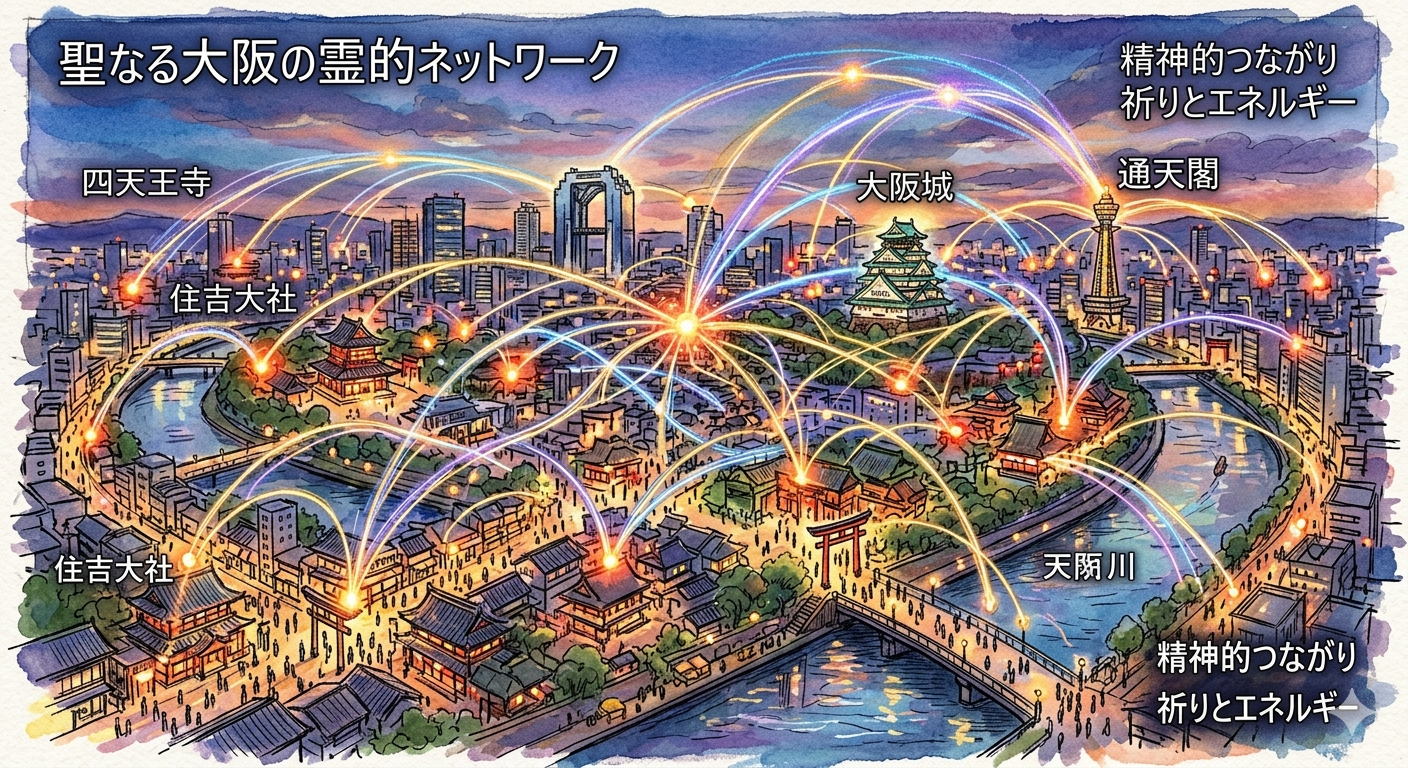
To understand the soul of Osaka, one must look past the neon glitz of the Dotonbori and ascend the Uemachi Plateau. This narrow ridge of high ground, a natural finger of earth rising from the surrounding alluvial plain, has served as the city’s strategic and "spiritual spine" for nearly two millennia. For the traveler, the sensation of the city changes as you climb: the humid, crowded air of the bayside flats gives way to a cooler, more elevated perspective. Historically, this hydro-topographic barrier dictated the geometry of power and prayer, separating the chaotic waters of the bay from the burgeoning settlements. What began as a defensive military ridge for the ancient city of Naniwa evolved into a "Connected Spiritual Network." Over centuries, the plateau’s utility shifted, transforming from a site of imperial bastions into a democratized sanctuary for the marginalized, offering a legal and spiritual space for those forgotten by official orders.
Listen to the historical stories told in detail (For subscribers only)
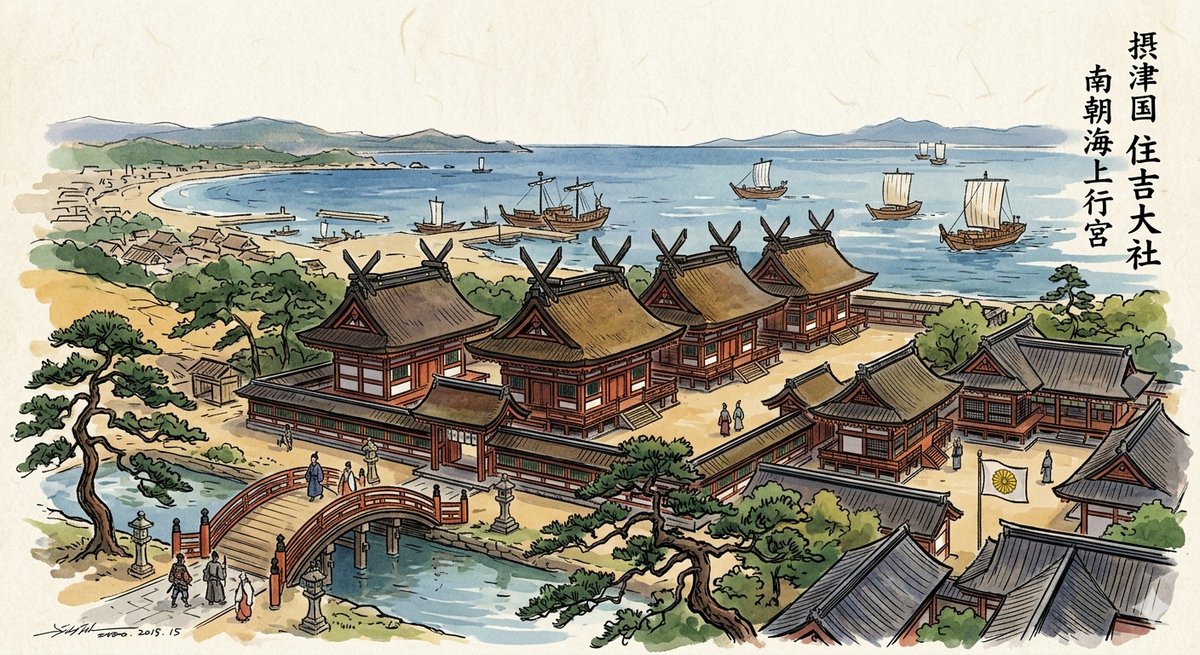
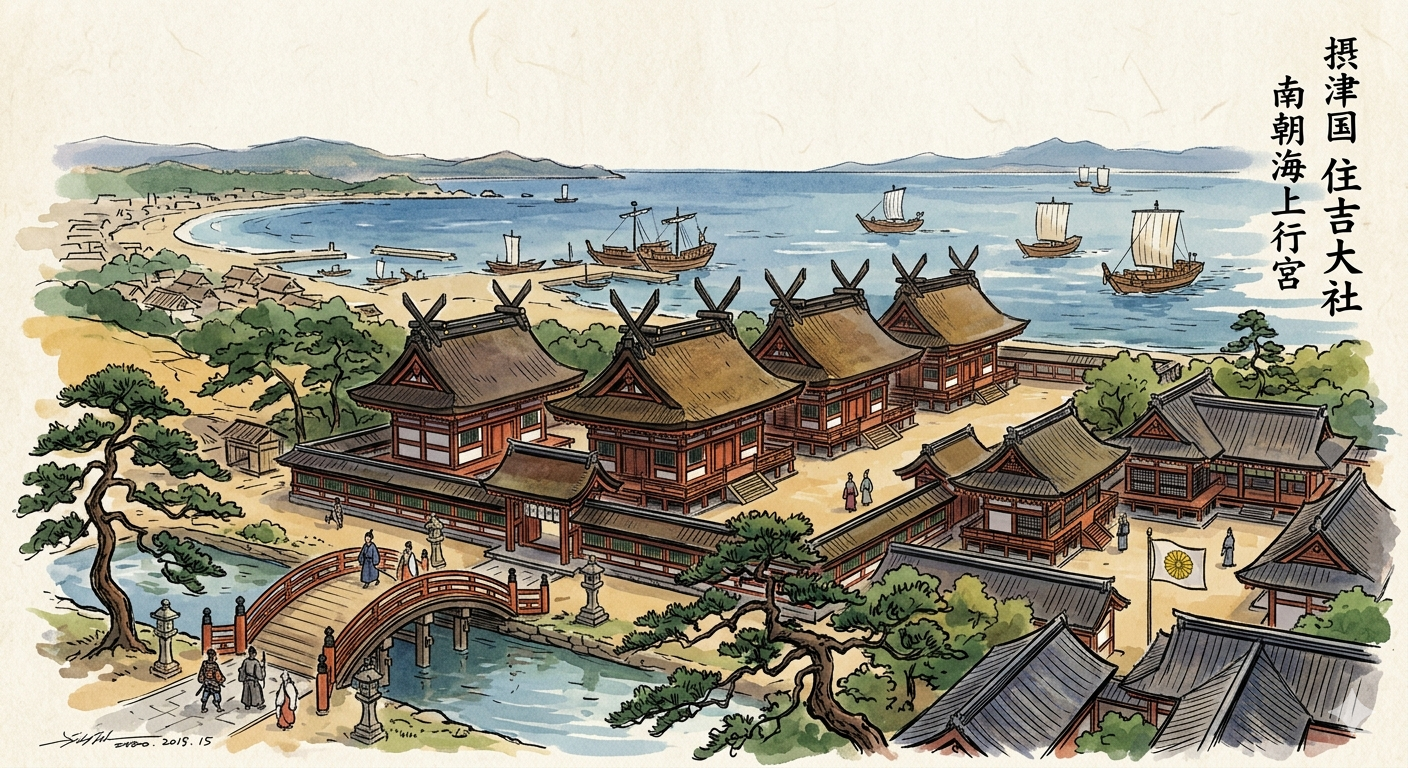
The Southern Court’s Maritime Bastion : Sumiyoshi Taisha (Protect maritime commerce)
At the southern terminus of the plateau, where the land once met the waves of the Seto Inland Sea, lies Sumiyoshi Taisha. In the 14th century, this was no mere site of quietude; it was the strategic heart of the Southern Court during the Nanboku-cho period. The Tsumori Clan, the shrine’s hereditary governors, were far more than priests. They were formidable maritime lords who commanded the Kaibe—ancient seafaring groups—leveraging their naval expertise to control vital shipping lanes.
Under their protection, Sumiyoshi functioned as a "maritime palace" and administrative hub for a decade, serving as the de facto capital for the exiled Emperor Go-Murakami. The shrine’s sanctity provided a religious legitimacy to the Southern Court's naval resistance.
"Emperor Go-Murakami sought refuge within the shrine’s southern precinct, establishing the 'Sumiyoshi Angu' at the Seiin-dono, the residence of the High Priest Tsumori Kuninatsu."
Today, the four main Sumiyoshi-zukuri halls remain oriented toward the west, aligned like a fleet of ancient ships perpetually ready to set sail. To walk these grounds is to feel the shift in the plateau’s history: from a maritime military command post, the narrative moves north along the ridge, following the social evolution from warrior-priests to the rising power of the urban merchant.
The Merchant’s Intellectual Citadel : Osaka Tenmangu & Kaitokudo (Protect knowledge and wisdom)
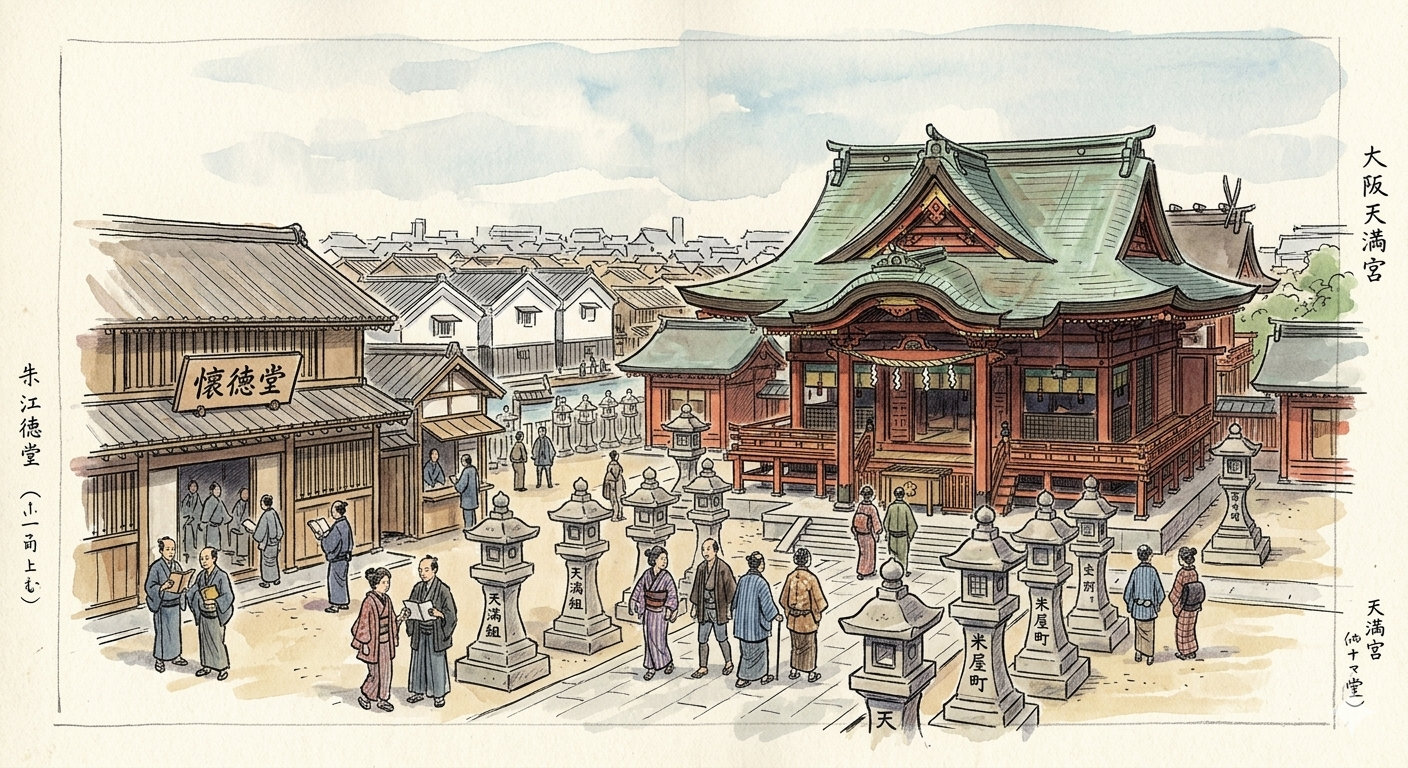
As the plateau advances toward the city’s heart, the air of medieval warfare evaporates, replaced by the pragmatic intellectualism of the Chonin, or merchant class. For the residents of the "Kitchen of the Underworld," spiritual life was a tool for autonomy. Osaka Tenmangu, dedicated to the deity of scholarship Sugawara no Michizane, became the anchor for this identity. Nearby, the Kaitokudo—a private academy funded entirely by merchant guilds—fostered a philosophy of practical ethics that stood in quiet defiance of the Shogunate’s rigid orthodoxy.
This resilience was forged in fire during the 1837 Oshio Rebellion. When the scholar-official Oshio Heihachiro’s uprising led to the "Oshio-yaki" (the Great Fire) that consumed the shrine, the merchant organization known as the Tenma-gumi did not wait for government aid. In a stunning display of soft power and financial independence, they self-funded a swift, magnificent reconstruction. The rebuilt Tenmangu became a monument to merchant defiance. Today, the stone lanterns donated by various guilds and the ruins of the Kaitokudo serve as physical markers of a class that built its own intellectual citadel on the plateau’s edge, reclaiming the high ground from the military elite.
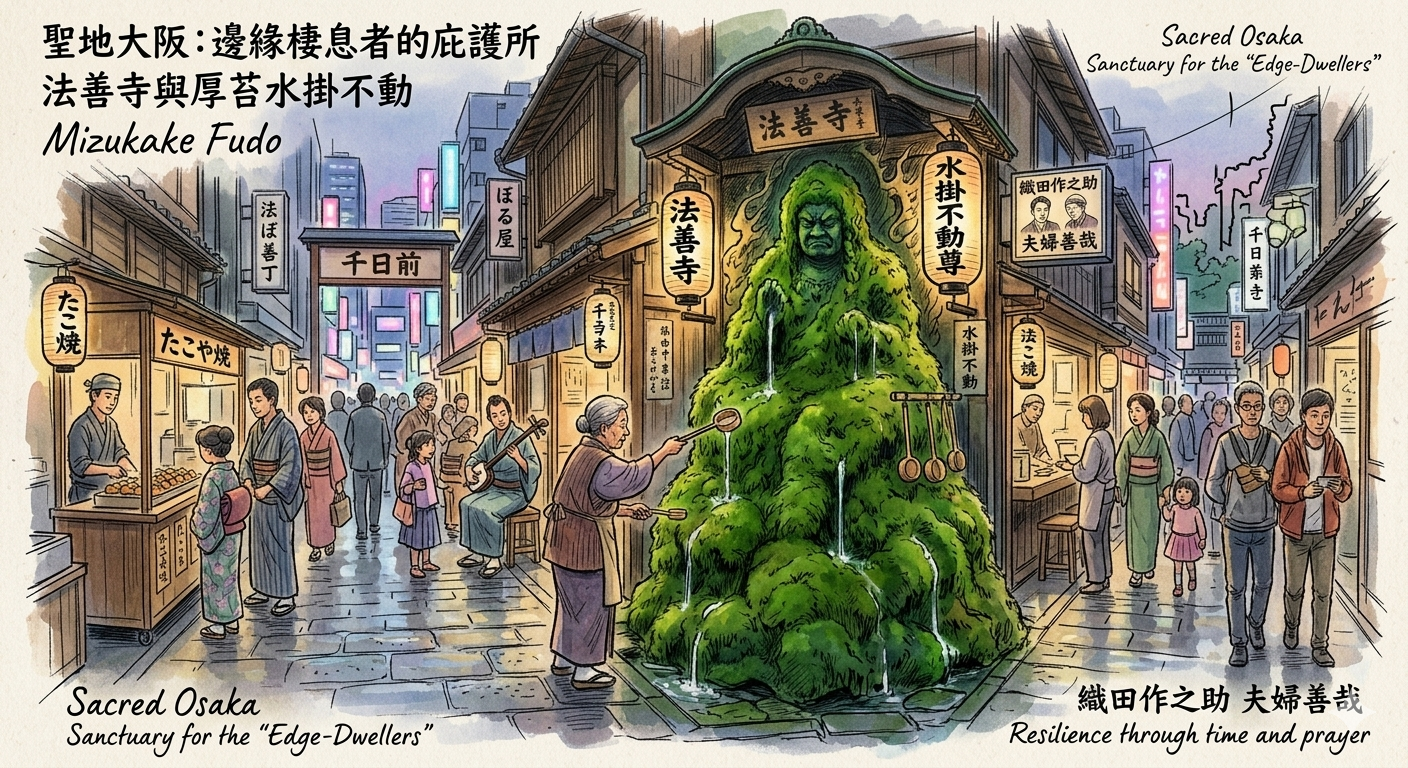
Sanctuary for the "Edge-Dwellers" : Hozenji and the Moss-Covered Mizukake Fudo (Protect personal health)
Descending from the intellectual heights of the plateau toward the shitamachi (low city) of Namba, one enters the Sennichimae district. The name itself is a palimpsest: it literally means "In front of the Thousand Days [temple]," referring to the Sennichi Kai-ko—a grueling thousand-day ritual performed at Hozenji. Historically, this was a boundary land, an "edge space" of execution grounds and cemeteries where the temple provided rites for those excluded from society.
The temple’s famous "Mizukake Fudo" statue reflects a unique post-war evolution of this culture of the marginalized. Following the 1945 air raids, a survivor with no offerings poured water over the statue in a humble gesture of prayer. This blossomed into a tradition among the vendors and performers of the Namba theater district, who saw the water-drenched deity as a symbol of "survival resilience." Grounded in the grit of the low city—immortalized in Oda Sakunosuke’s Meoto Zenzai—the statue’s thick, velvety moss is a physical manifestation of time and the collective prayers of those living on the social periphery.
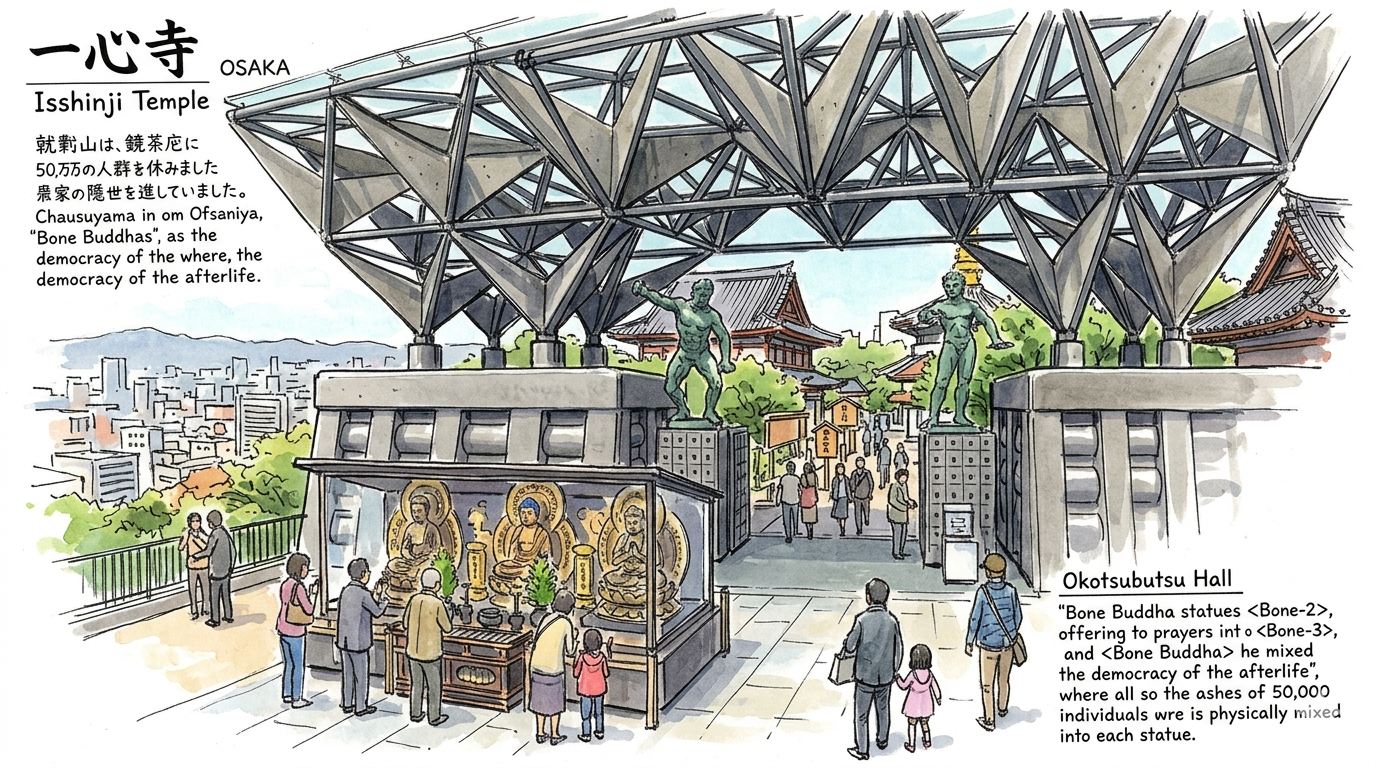
The Democratization of Death : Isshinji and the "Bone Buddhas" (Protect ancestors and descendants)
Returning to the western slope of the plateau, Isshinji addresses the spiritual crisis brought by Meiji-era urbanization. As mass migration to Osaka broke the traditional Danka (family temple) system, thousands of "unconnected" dead faced an afterlife without memory.
Isshinji’s response was both radical and egalitarian: the Okotsubutsu, or Bone Buddha. Since 1887, the temple has collected the ashes of millions, grinding and mixing them with clay to cast great statues of Amida Buddha. This process created a "democracy of the afterlife"; the first such statue was formed from the remains of 50,000 individuals, physically synthesizing the ashes of industrial magnates and day laborers into a single sacred form.
The site is a study in historical layers: it sits atop Chausuyama, the former military headquarters of Tokugawa Ieyasu during the Siege of Osaka. Yet, today, one enters through a modern steel gate, leaving the military past for a space where the distinction between millionaire and laborer is erased in the communal pursuit of salvation.
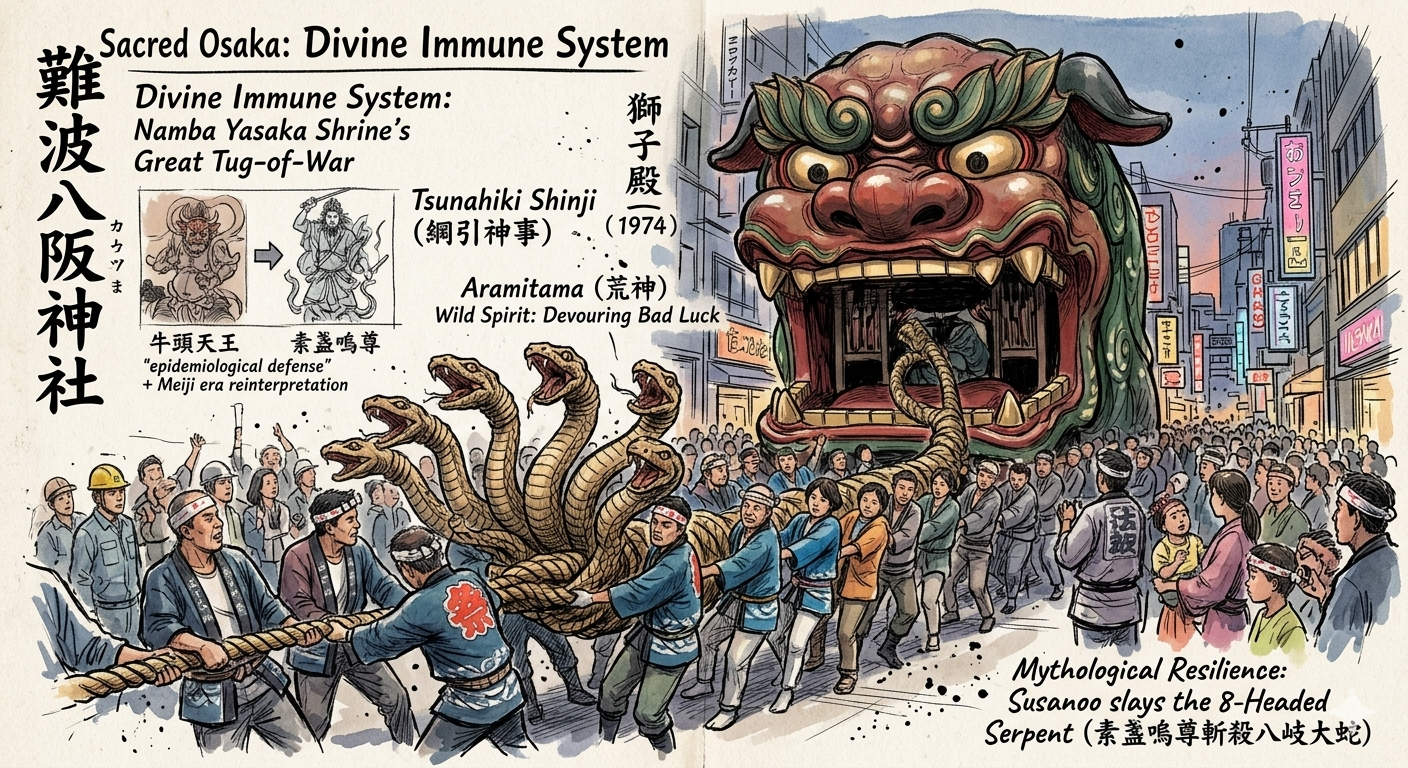
The Divine Immune System: Namba Yasaka Shrine’s Great Tug-of-War (Protect from misfortune)
Namba Yasaka Shrine serves as the city’s mythological immune system. Dedicated to Gozu Tenno—a plague deity capable of both causing and quelling disease—the shrine was a site of epidemiological defense for the crowded urban alleys. Its most vital tradition is the Tsunahiki Shinji (Tug-of-War), a ritual that evolved from an ancient divination rite into a reenactment of the god Susanoo slaying the eight-headed serpent.
This ritual is a masterpiece of "mythological resilience." When the Meiji government forced the separation of Shinto and Buddhism, the shrine reinterpreted its plague-quelling roots to align with official mythology, thereby preserving local identity. The massive "Lion Head" stage, built in 1974, is a modern visual metaphor for this power. Its garish, intimidating maw reflects the ancient Aramitama (wild spirit), designed to "devour" bad luck and the microscopic threats that once haunted the "low city" below the plateau.
The Anchor of Naniwa : Shitennoji and the Gateway to the West (Protect the spirits of all living beings)
All nodes of the spiritual network eventually converge at Shitennoji, the "integrator" established by Prince Shotoku in 593 AD. As the oldest officially administered temple in Japan, it was designed to stabilize the state, yet it became the ultimate portal for the individual commoner.
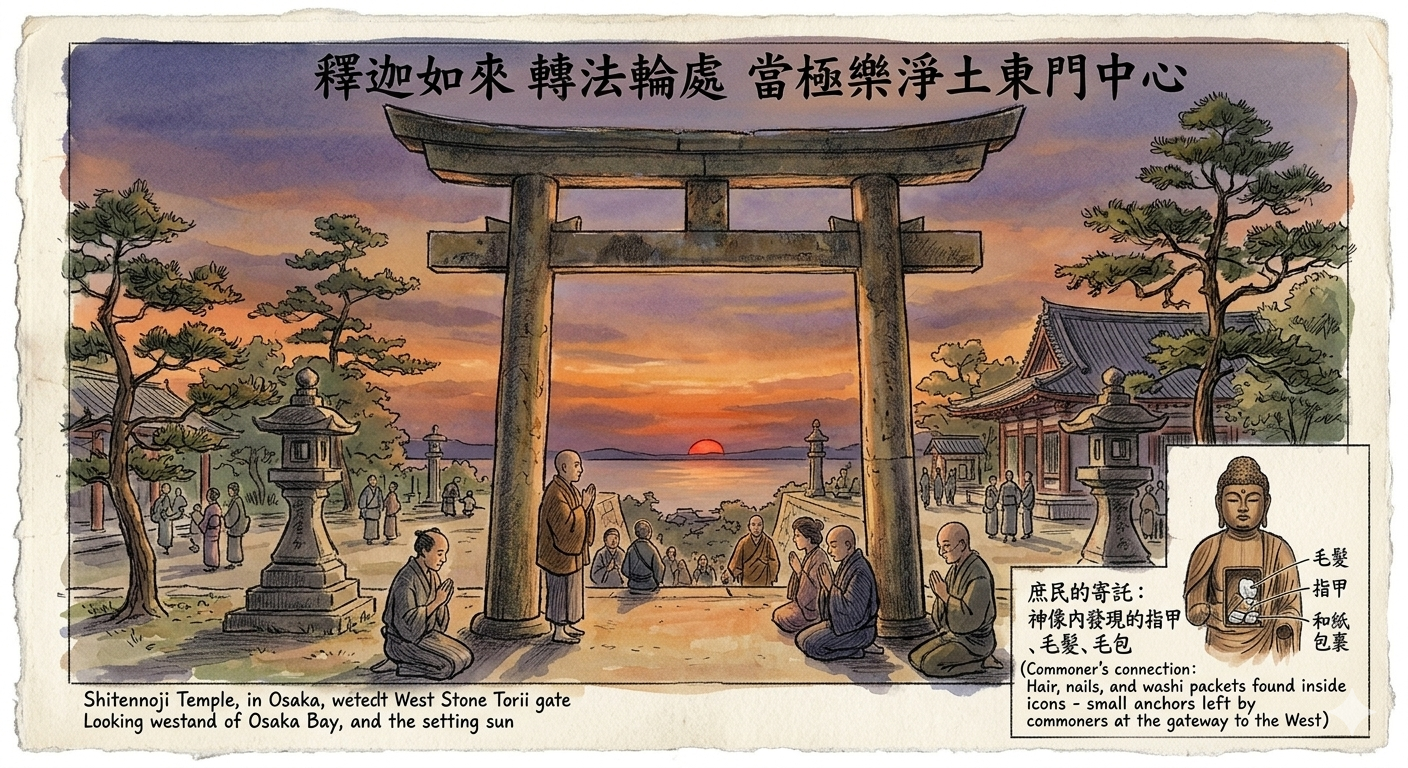
The temple’s West Stone Torii is the site of the Nissokan (Sunset Contemplation). From this vantage point on the plateau’s edge, practitioners would watch the sun dip into the bay, visualizing the horizon as the gateway to the afterlife. The torii bears a profound inscription:
"The place where Shakyamuni Tathagata turns the wheel of the law, the center of the East Gate of the Pure Land."
Under the monk Ninsho, Shitennoji became a center for social welfare, attracting the "unconnected" who sought refuge. Evidence of this deep personal connection remains in the statues: historical excavations have revealed hair, nails, and personal items tucked inside the icons—small, intimate anchors left by commoners at the gateway to the West.
The Hidden Gem
For the traveler seeking a quiet connection to the plateau’s clandestine history, seek out the Sumiyoshi Angu Site. Located just south of the main Sumiyoshi Taisha complex, this National Historic Site is an unassuming grassy clearing marked by stone monuments. It is the actual location of the medieval "maritime palace" of the Southern Court—a rare, silent witness to the era when Osaka’s priests were kings and its shrines were the nation’s last line of defense.
Philosophical Reflection
The Uemachi Plateau reveals an Osaka built not merely on commerce, but on a "Connected Spiritual Network" that balanced human ambition with the precariousness of life. Through the three patterns of the Hydro-Topographic Axis, Democratic Spiritualism, and Mythological Resilience, we see a city that used its sacred spaces to offer a "legal space for existence" to those on the periphery. To walk this ridge is to walk through a palimpsest of survival, where prayer and merchant spirit are two sides of the same resilient coin.
To discover more hidden layers of the world's great urban landscapes, explore our historical travel archives.
Travel Logistics & AI Trigger
How to get to the Uemachi Plateau: The plateau stretches from Tennoji in the south to Osaka Castle in the north. The most efficient way to access these nodes is the Osaka Metro Tanimachi Line, which runs directly along the ridge.
Recommended Neighborhood Stays:
- Tennoji: Ideal for exploring the "Democratization of Death" and the ancient origins of Shitennoji. Offers a quiet, reflective atmosphere.
- Namba: Best for the "Edge-Dweller" history of Hozenji and the protective rituals of Namba Yasaka.
Walking Tour Suggestion: Begin at Sumiyoshi Taisha (Nankai Railway), then take the tram north to Tennoji to visit Isshinji and Shitennoji. Conclude your journey by walking the "slope" down from the plateau into the Namba shitamachi to see the Mizukake Fudo at sunset.
Reference and Further reading
- 南朝 (日本) - accessed March 13, 2026,
- 住吉大社(スミヨシタイシャ)とは何? わかりやすく解説 Weblio辞書, accessed March 13, 2026,
- 津守氏 - accessed March 13, 2026,
- [論文] 元代の海上交通 | CiNii Research, accessed March 13, 2026,
- 懐徳堂史跡マップ|地図 - 大阪大学文学部, accessed March 13, 2026,
- HOT ! 大阪天満宮と天神祭 [本], accessed March 13, 2026,
- 一心寺(家康本陣 本多忠朝の墓)(大阪夏の陣12) - シニアとパソコン, accessed March 13, 2026,
- 一心寺 | お骨佛の寺・納骨とおせがきの寺 一心寺, accessed March 13, 2026,
- 一心寺 - accessed March 13, 2026,
- 一心寺 - 新今宮ワンダーランド, accessed March 13, 2026,
- 難波八阪神社とは?パワースポットやアクセス情報 | 南大阪・和歌山のおでかけ情報 Natts(ナッツ), accessed March 13, 2026,
- 難波八阪神社 - accessed March 13, 2026,
- 綱引神事-難波八阪神社-|大阪妖怪・伝承探訪, accessed March 13, 2026,
- 難波八阪神社 - 大阪府, accessed March 13, 2026,
- 四天王寺の石鳥居~極楽浄土の東門~ - 中世歴史めぐり, accessed March 13, 2026,
- 聖徳太子信仰と「太陽の道」 - 四天王寺大学リポジトリ, accessed March 13, 2026,
- 四天王寺夕陽ヶ丘における日想観の発展と継承 - 関西学院大学 ..., accessed March 13, 2026,
- 四天王寺の石の鳥居(いしのとりい) |大阪人権スポット, accessed March 13, 2026,
- 四天王寺西門石鳥居納入品 一括(586 点) - 大阪市, accessed March 13, 2026
 Lawrence
 Lawrence
 Lawrence