(ENG) Beyond the Asphalt: Deciphering the Watery Ghost of Tokyo’s Ancient Fuchie Territory
Uncover the watery ghost of Tokyo's ancient Fuchie territory! This historical walking guide explores modern Adachi Ward through 5 forgotten layers of time

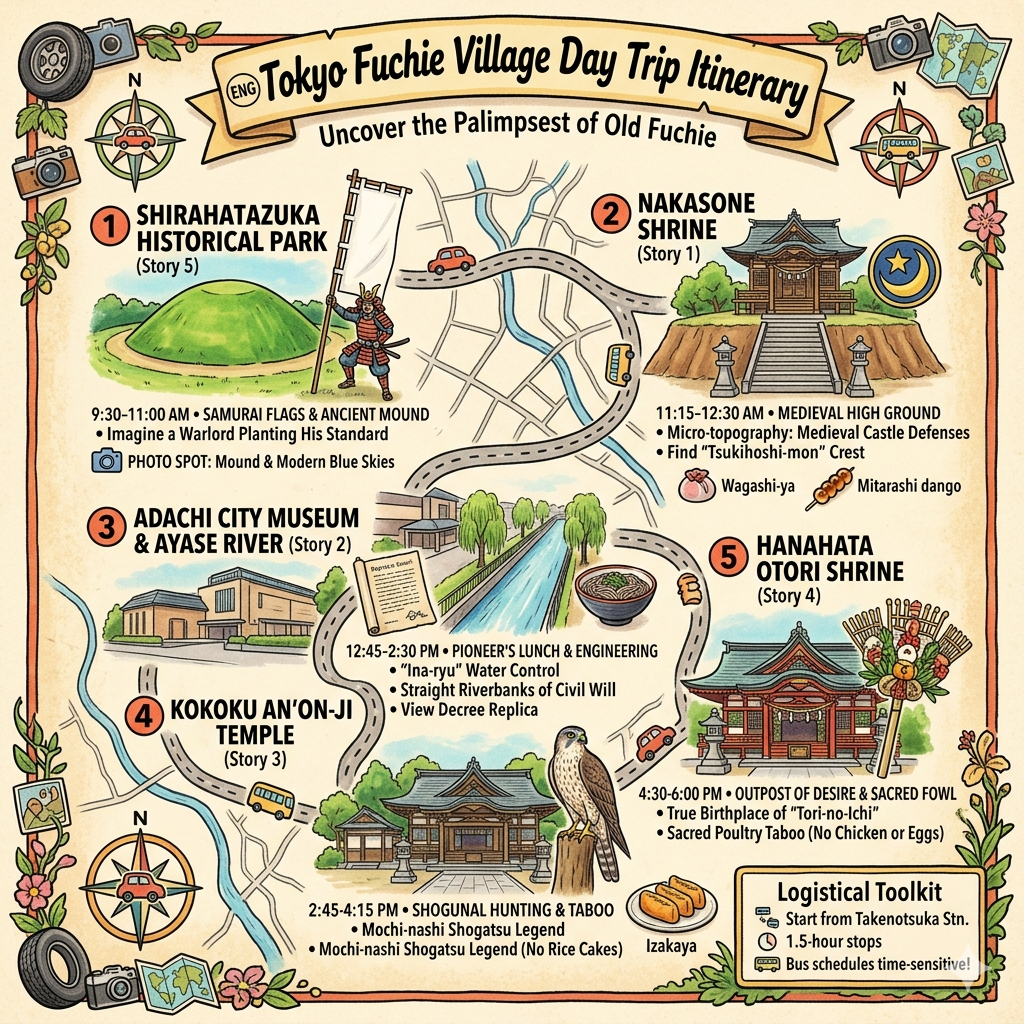
This is a historical travel story and walking guide to Fuchie, an ancient territory hidden beneath the asphalt of modern Adachi, Tokyo. Through five unexpected spatial secrets—including an invisible medieval water castle, engineered shogunal canals, and historical New Year food taboos—it explores the region's micro-topography to show how samurai strategy, bureaucratic willpower, and ordinary peasant survival intertwined on this reclaimed marshland.
 Lawrence
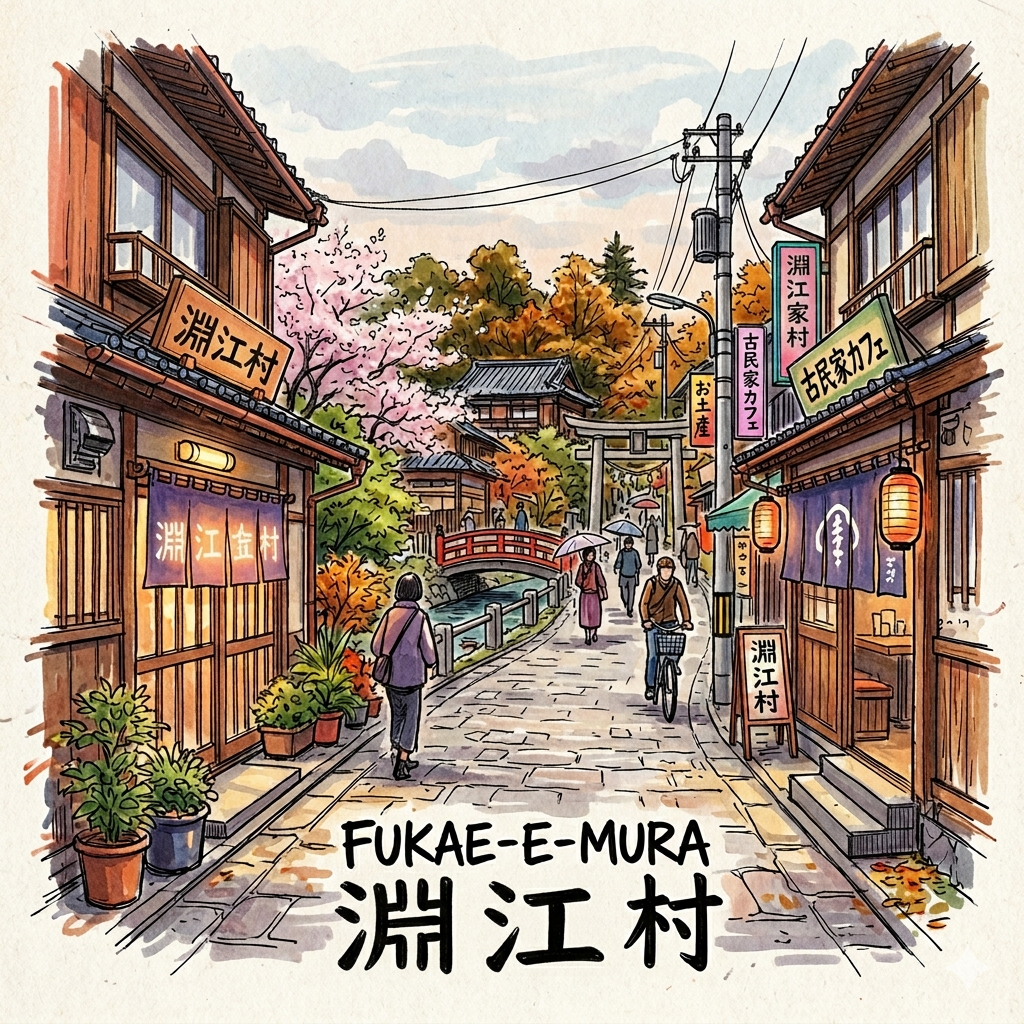
To the uninitiated, the northeastern reaches of Tokyo—the modern district of Adachi—appear as a resolute sprawl of mid-rise residential blocks and utilitarian transit corridors. Yet, to the flâneur-historian, this concrete veneer is a thin mask over "Fuchie," a name signifying a "deep, watery abyss." In antiquity, this territory marked the shifting edge of the "Inner Tokyo Bay," a landscape of treacherous marshes and silten estuaries. This was not merely a geographical hurdle to be overcome; the water dictated the survival strategies of every power that attempted to claim it, from medieval samurai to Tokugawa engineers.
Understanding Fuchie’s origins is the difference between seeing a flat suburb and a reclaimed landscape of power. It is an exercise in layered observation, where the modern city is revealed as a palimpsest—a parchment rewritten over centuries, yet still bleeding the ink of its previous authors. To find the first layer, one must look for a castle that left no stones behind, only a lingering change in the soil’s breath.
Listen to the historical stories told in detail (For subscribers only)
The Sunken Samurai: The Invisible Defense of Fuchie Castle
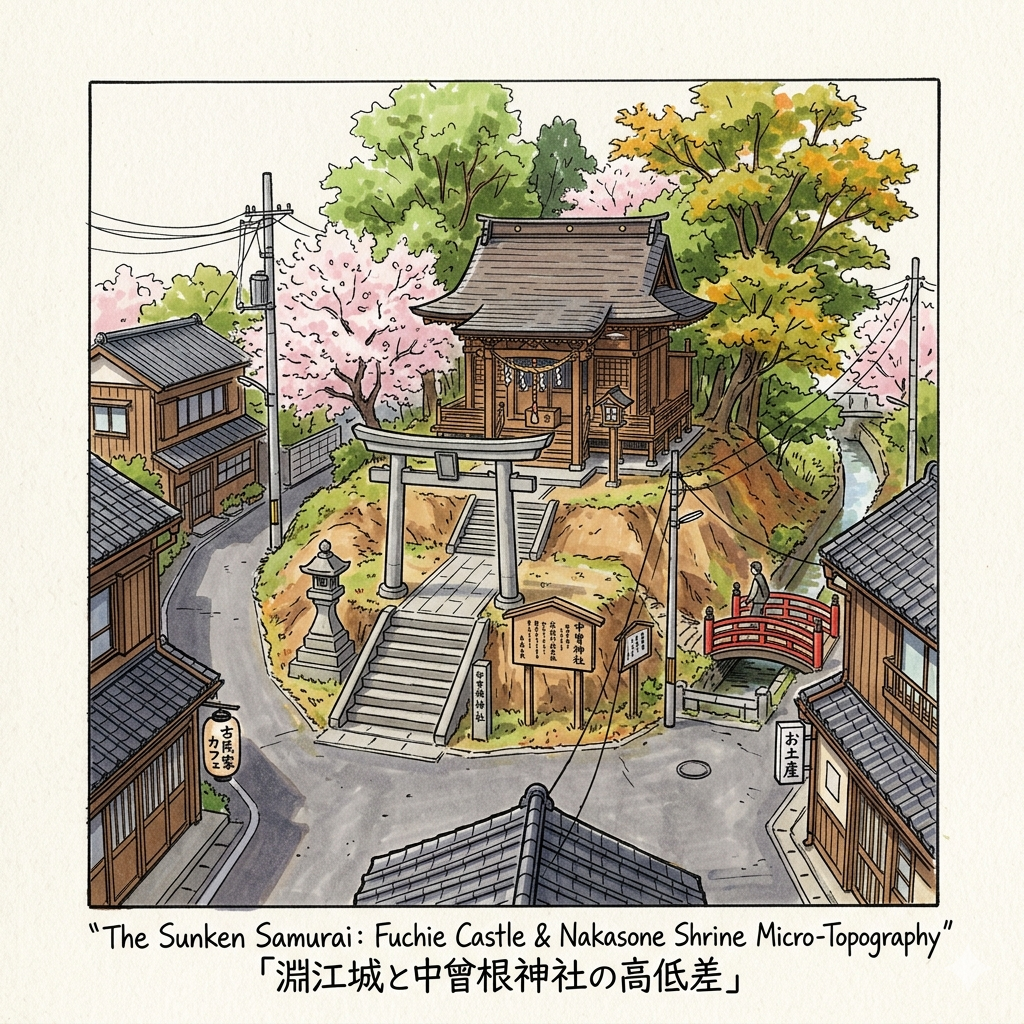
During the Muromachi period (14th–15th centuries), the Kanto Plain was a fractured theater of warring clans. Amidst the "享德之亂" (Kyotoku Rebellion), the Musashi-Chiba clan recognized that in a land of swamps, water was the most sophisticated armor. Unlike the stone-heavy fortifications of the later Sengoku era, Fuchie Castle was a mizushiro (water castle). Its defense relied on the strategic manipulation of the natural "watery abyss," turning the treacherous marshes into a labyrinthine shield.
The Chiba clan did more than build walls; they planted a culture of "belief architecture." They introduced the Myoken (North Star) faith, establishing a sanctuary to the North Star Bodhisattva to provide an eternal celestial anchor in a chaotic landscape. When the Tokugawa Shogunate rose in 1590, the castle’s military utility evaporated. Its physical form was dismantled, its timber recycled into farmhouses, and its memory dismissed as rural folklore.
In 1996, archeological excavations near Nakasone Shrine finally exhumed the truth: a massive moat (hori) measuring eight meters in width and depth. This was no mere drainage ditch, but a precisely engineered medieval defensive structure, proving that the "legendary" water castle was a physical reality of spatial governance.
Walking Connection: Navigate the narrow residential arteries of Motoki to find the elevated sanctuary of Nakasone Shrine (Motoki 2-chome). Stand within the grounds and observe the "micro-topography"—the land sits perceptibly higher than the surrounding streets. This elevation is the fossilized remains of the ancient castle's earthworks, still guarded by the "Moon and Star" crest of the Chiba clan.
The Bureaucrat’s Grid: Ina Tadaharu and the Rationalization of the Wild
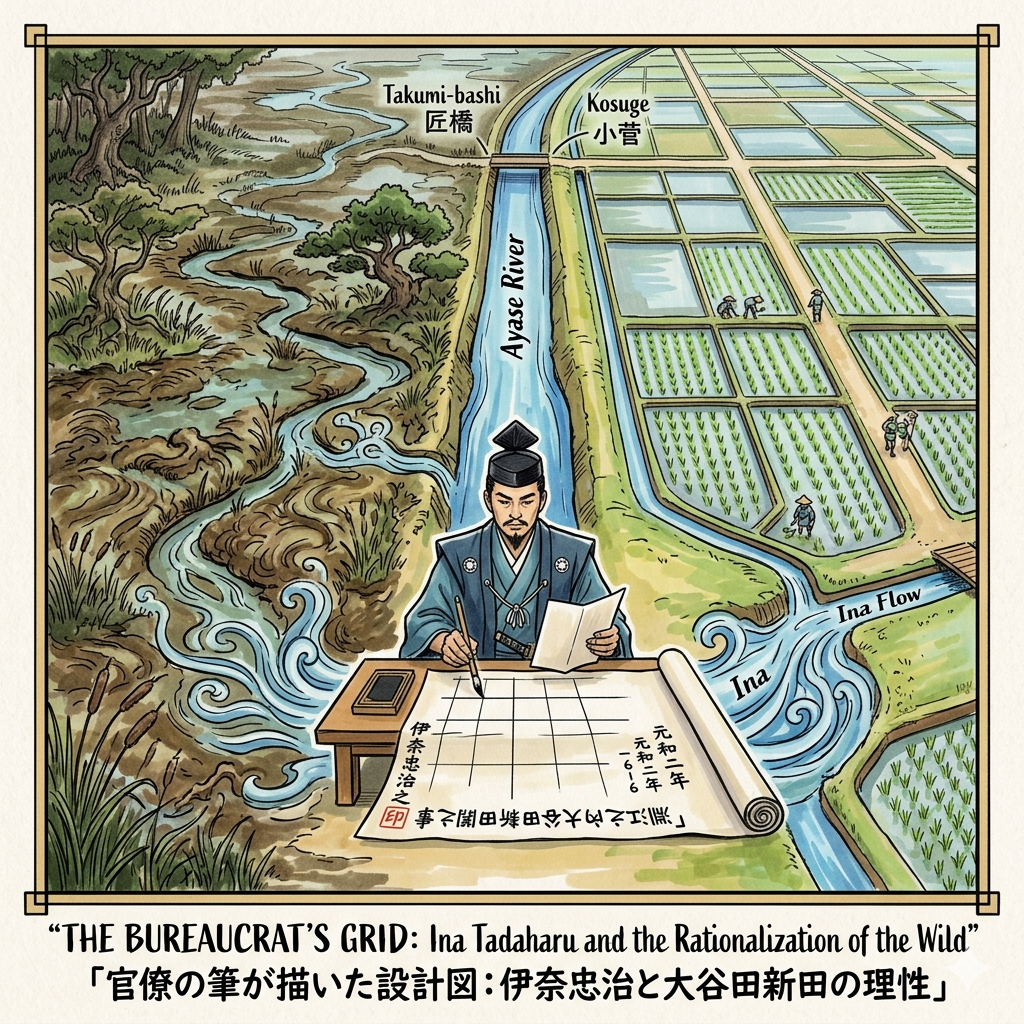
By 1616, the era of the samurai gave way to the era of the technical bureaucrat. The Shogunate required a granary to feed the ballooning population of Edo, and the task of taming the Fuchie wetlands fell to Ina Tadaharu. A master of "administrative technology," Tadaharu utilized the "Ina Flow" method—a philosophy that viewed hydraulic engineering and social engineering as a single discipline.
Tadaharu’s 1616 document, Ooyata Shinden Hiraki no Koto, was the blueprint for this transformation. He didn’t just drain the swamp; he designed an entire socio-economic ecosystem, turning a shifting silten marsh into a rationalized grid of productivity.
Policy Measure | Administrative Logic | Impact on the Modern Landscape |
Three-Year Tax Holiday | Lowering the entry barrier to attract labor to high-risk wetlands. | The birth of a satellite village network including Pugenji, Kita-Mitsuya, and Ooyata, fossilizing the 1616 social hierarchy into current street layouts. |
Strict Identity Vetting | Prohibiting "fugitive farmers" to maintain Shogunal order (ishidaka-sei). | Established a stable, loyal agricultural base that anchored the region’s identity for three centuries. |
The "Ina Flow" Engineering | Straightening the Ayase River and integrating drainage systems. | Created the linear, grid-like water corridors still visible today, replacing shifting silt with human intent. |
Walking Connection: Trace the Ayase River corridor between Takumi-bashi and Kosuge. The unnatural, crystalline straightness of the river is a 17th-century artifact of human will, a testament to the bureaucrat’s attempt to overwrite the watery ghost of Fuchie with a rationalized line.
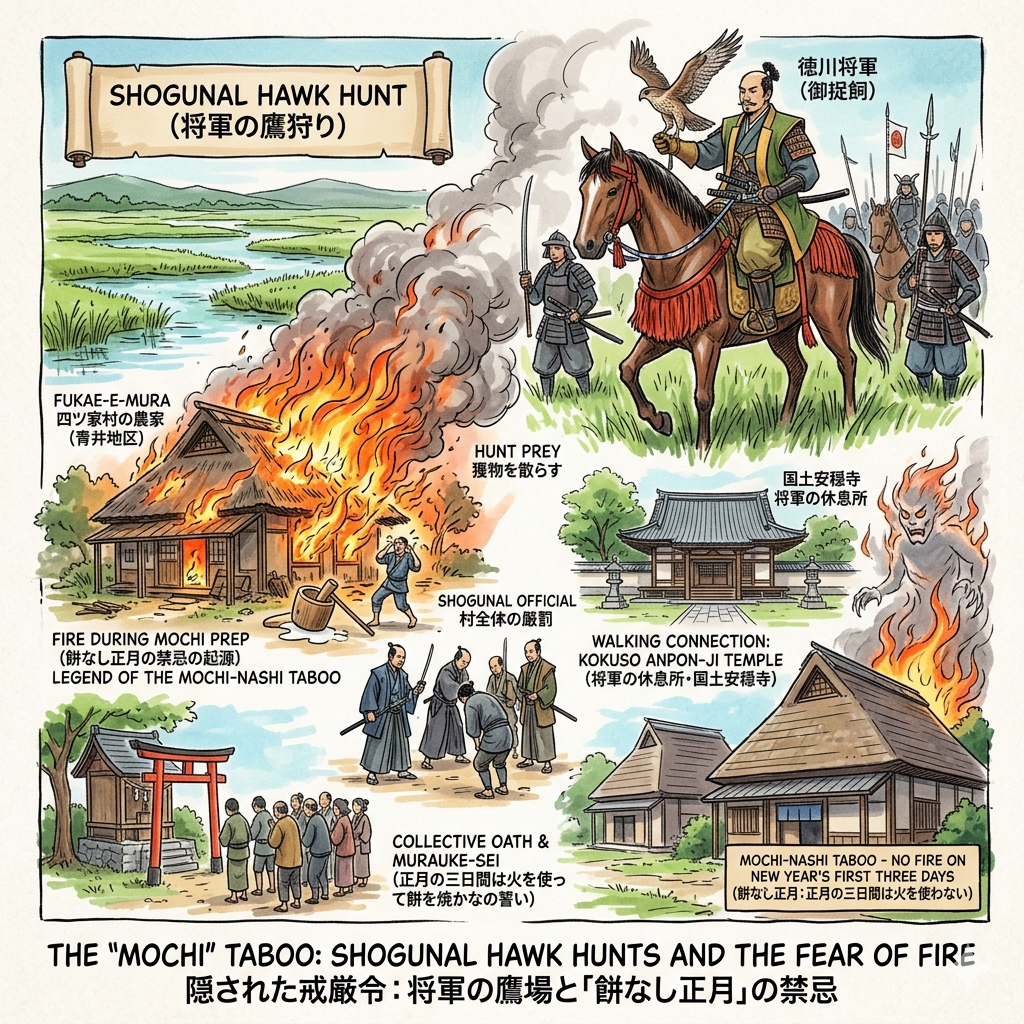
The "Mochi" Taboo: Shogunal Hawk Hunts and the Fear of Fire
Fuchie was not only a granary but also a Takagari (Hawk Hunting) ground for the Shogun—a "quasi-military exercise" where the sovereign performed his dominance over the land. This presence imposed an invisible martial law on the villages. In the Aoi district (formerly Yotsuya Village), this history manifested in the "Mochi-nashi" (No-Mochi) New Year tradition, a cultural taboo born from the trauma of murauke-sei (village collective responsibility).
Legend narrates that during a Shogunal visit on New Year’s Day, a villager’s house caught fire while they were preparing mochi (rice cakes). In the Shogun’s presence, smoke was a grave dereliction of duty—a threat to the safety of the prey and the dignity of the hunt. The entire village faced severe official punishment (otogame).
To survive, the villagers swore a collective oath to never use fire for mochi during the first three days of the year. What began as a performance of political obedience eventually morphed into a religious taboo, where the "God of Fire" was said to incinerate any home that defied the tradition.
Walking Connection: Visit Kokuso Anpon-ji, the temple designated as the Shogun’s Ozen-sho (rest house). The temple’s stillness belies the heavy historical pressure once placed on the surrounding farmers to maintain a "perfect" landscape for the Shogunal gaze.
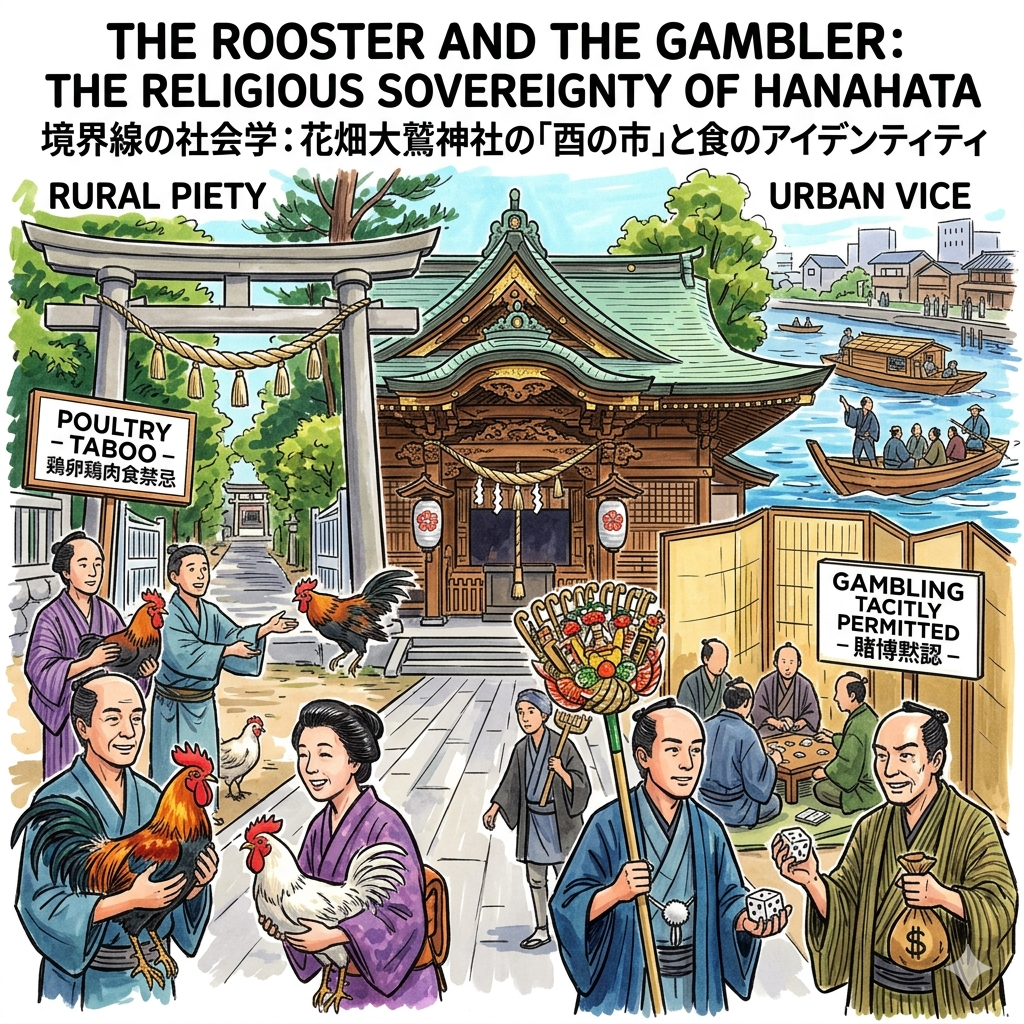
The Rooster and the Gambler: The Religious Sovereignty of Hanahata
On the rural fringe lies Ootori Shrine, the undisputed birthplace of the "Tori-no-ichi" festival. While modern iterations in Asakusa are defined by commerce, the original Hanahata festival was a bridge between rural piety and urban vice. A central feature was the "poultry taboo"—a prohibition on eating chicken or eggs that lasted into the mid-20th century. This dietary restriction was a method of "Boundary Construction," marking Fuchie as a distinct, sacred space.
The festival’s evolution reflects the region’s "extraterritorial" nature:
- Medieval Origins: A harvest festival where live roosters were offered to the gods, later released at Senso-ji as an act of mercy.
- Edo Prosperity: The ritual attracted urbanites seeking spiritual protection and agricultural tools.
- The Gambler’s Haven: In the mid-Edo period, the shrine grounds became a "safe zone" where gambling was tacitly permitted, drawing urban crowds from the city center via the Nakagawa water routes.
Walking Connection: At Ootori Shrine (Hanahata 7-chome), examine the cedar-wrought details of the main hall—a visual ledger of the wealth generated by Edo’s illicit gambling routes and the merchants who funded this pinnacle of local craftsmanship.
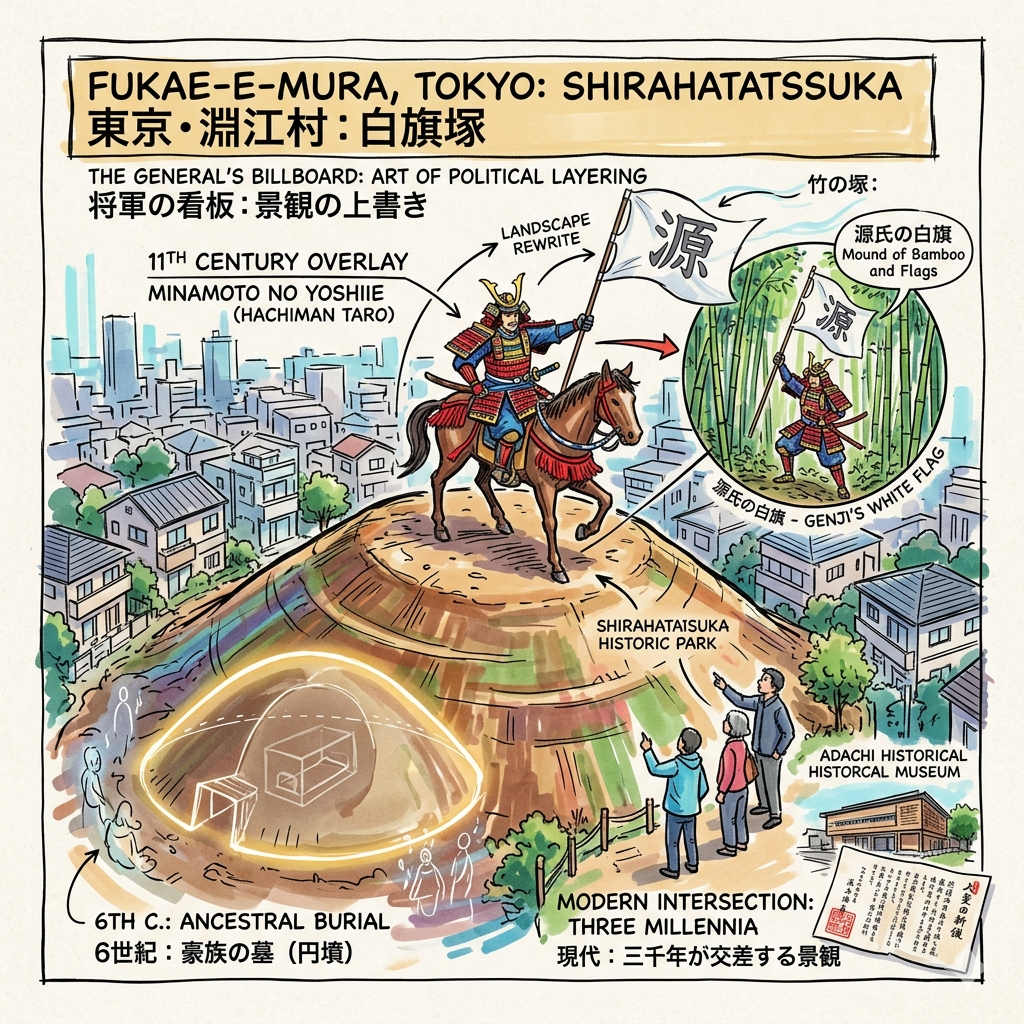
The General’s Billboard: Shirahatatsuka and the Art of Political Layering
The deepest layer of the Fuchie palimpsest is found in the Iko burial mounds. These 6th-century tombs are a masterclass in political layering. In the 11th century, the legendary general Minamoto no Yoshiie (Hachiman Taro) supposedly planted his "white flag" atop the Shirahatatsuka mound while marching north.
- 6th Century Meaning: Ancestral Burial – A round mound (圓墳 - enpun) serving as a resting place for local chieftains; a symbol of lineage.
- 11th Century Meaning: Military Landmark – A "billboard" for Minamoto power, legitimizing conquest by claiming the "high ground" of the past.
Yoshiie’s choice to use an ancient tomb as a flag-post was a "landscape rewrite." By planting his standards in the bamboo grove atop the mound, he gave birth to the name of the surrounding district: Takenotsuka (The Mound of Bamboo and Flags).
Walking Connection: Stand atop the mound at Shirahatatsuka Historic Park. Observe the modern residential sprawl from the same vantage point used by a medieval general to survey his troops, realizing that you are standing on the intersection of three different millennia.
The Adachi Historical Museum (Adachi-ku Kyodo Hakubutsukan) houses a rare, authentic replica of the 1616 "Ooyata Shinden" document. Standing before this artifact allows you to witness the actual ink and seal that transformed a watery abyss into the foundations of the modern city—an essential pilgrimage for any narrative cartographer.
The Layered Observation
The "watery" Fuchie persists, not as a flood, but as a ghost beneath the concrete. Its legacy is found in the slight rise of a shrine’s foundation, the unnaturally straight line of a canal, and the lingering traditions of a residential neighborhood that still fears the smoke of New Year's mochi. To truly understand Tokyo, one must practice "layered observation"—looking past the highlight-chasing of modern tourism to see how the white flag of a medieval general sits atop an ancient tomb, now framed by the steel of a transit line.
As we walk these streets today, we must wonder: what "layers" are we leaving behind? 500 years from now, will our transit lines be viewed as the new "earthworks," studied by future flâneurs trying to decipher the ghosts of our own era?
For those seeking to map the invisible histories of Tokyo’s fringe, we invite you to explore our deeper city guides or subscribe to our "Historical Travel Stories" series.
Practicalities
- Access: The Fuchie region is accessible via the Tobu Skytree Line (stations: Takenotsuka or Rokucho) or the Tsukuba Express (Aoi Station).
- Accommodation: We recommend staying near Kita-Senju Station. It serves as the historic gateway to the north and offers the most seamless access to the deeper Fuchie sites.
- Recommended Tours: Look for specialized "Medieval Tokyo Walking Tours" that focus on the Adachi and Iko archeological zones for a deeper dive into the region's micro-topography.
Q & A
What are the strangest local taboos caused by Shogunate rule?
Based on the historical records of the Fuchie territory (present-day Adachi Ward, Tokyo), the most peculiar local taboos arose from the Shogunate’s absolute control over land use, particularly through the system of "Hawk Fields" (御捉飼場/御領鷹場)—land reserved for the Shogun’s hunting expeditions.
The two strangest taboos recorded in the sources are:
. The "No-Mochi New Year" (Mochi-nashi Shogatsu)In the village of Yotsuya (now the Aoi district), a long-standing taboo prohibited residents from eating or grilling mochi (rice cakes) during the first three days of the New Year.
- The Origin: This was not a religious choice but a result of political fear. During the Edo period, the Shogun frequently conducted hawk hunting in Fuchie. Because fire was a massive risk that could disturb prey or threaten the Shogun's safety, fire management was strictly regulated.
- The Incident: Legend says that one New Year's Day, while the Shogun was expected for a hunt, a local family accidentally caused a fire while preparing New Year mochi. The entire village was severely punished (o-togame) by the Shogunate for this "dereliction of duty".
- The Evolution: To avoid future wrath, the villagers collectively vowed never to light fires for mochi during the New Year. Over time, this evolved into a folk superstition: it was said that when a newcomer family ignored the taboo and boiled mochi, their house immediately burned down, turning a Shogunate administrative penalty into a divine "fire god" curse.
2. The Strict Prohibition on Chicken and Eggs
In the Hanahata area (home to the Otori Shrine), residents observed an exceptionally strict taboo against consuming chicken or eggs, which lasted until the mid-20th century.
- The Origin: This stemmed from the "Tori-no-ichi" festival rituals at Hanahata Otori Shrine, which was the original site of the festival later popularized in Asakusa.
- The Ritual: Devotees would offer live chickens to the shrine. Instead of being slaughtered, these chickens were sent to Senso-ji Temple to be released as a religious act of mercy (hōjō).
- The Impact: This reverence for the birds created a "cultural boundary" where eating poultry became a local sin. This taboo served as a spatial sovereignty marker; walking into Hanahata required outsiders to change their dietary behavior, reinforcing a unique identity under the shadow of the Shogunate-sanctioned religious site.
The Logic Behind the Taboos
These taboos reflect the "Invisible Martial Law" of the Shogunate. Because of the Village Responsibility System (Murauke-sei), the mistake of one person (like starting a fire during a hunt) could lead to the destruction of the entire community. Consequently, the "strangest" local customs were often survival mechanisms developed by peasants to navigate the high-stakes pressure of living in the Shogun’s backyard.
What other penalties did villages face for Shogunate hunt interference?
Under the Shogunate’s Village Responsibility System (Murauke-sei), the penalties for interfering with a hawk hunt went far beyond individual fines; they often targeted the entire community's survival. While the sources highlight the "No-Mochi New Year" as a result of a fire-related incident, they also detail several other systemic penalties and burdens that villages faced:
1. Collective Destruction of the Community
The most severe penalty for any "dereliction of duty" during a Shogunate hunt was the collective punishment (o-togame) of the entire village. Because the Shogunate viewed the village as a single legal entity, the mistake of one household—such as failing to control a fire—could lead to the "destruction of the entire community". This existential threat is what transformed administrative penalties into deep-seated local taboos.
2. Forced Labor and Economic Interference
Villagers were legally obligated to serve as "Seko" (beaters or drivers), whose role was to flush out prey for the Shogun’s hawks. Failing to provide sufficient labor or perform this role effectively was a punishable offense. This requirement was particularly punishing because:
- It severely interfered with secondary businesses and side-jobs that farmers typically relied on during the agricultural off-season.
- The labor was mandatory and unpaid, acting as a "tax in sweat" that diverted resources away from the village economy.
3. Deprivation of Land Use Rights
To protect the ecological environment required for hawk hunting, the Shogunate imposed strict environmental penalties:
- Prohibitions on Hunting and Logging: Villagers were penalized if they were caught hunting birds or cutting down specific trees reserved for the Shogun's use.
- Loss of Sovereignty: These regulations essentially meant the deprivation of the farmers' rights to use their own land, as the Shogunate’s hunting needs took legal precedence over agricultural or survival needs.
4. Penalties for "Visual Pollution"
The Shogunate required the village landscape to be "theatrical"—a sanitized version of the countryside that would not offend the Shogun's sensibilities during his visit. Penalties could be issued for:
- Neglecting Road Maintenance: Failing to perform "grass cutting" (草刈) or weeding along the Shogun’s path.
- Failing to Hide "Unclean" Objects: Villagers were required to cover manure pits and hide other unsightly but necessary agricultural items. Failure to curate this performative landscape was seen as a sign of disrespect toward Shogunal authority.
Through these measures, the Shogunate maintained an "invisible martial law" over the Fuchie territory, where the threat of penalty dictated everything from land management to the most private aspects of daily life.
Reference and Further reading
- 鼠疫與香港殖民醫學下的華人女性病患(1841-1900), accessed May 14, 2026,
- 堅尼地城玻璃廠 - 香港記憶, accessed May 14, 2026,
- A Medical History of Hong Kong: 1842–1941 [1 ed ... - dokumen.pub, accessed May 14, 2026,
- Hues of Healing - Center for Interdisciplinary Studies in Science and Cultural Theory - Duke University, accessed May 14, 2026,
- 香港堅尼地城青蓮臺15 號, accessed May 14, 2026,
- 該廟備受地區人士重視。 - 據1873年的差餉冊記載,油麻地居民多經營船隻維修、理, accessed May 14, 2026,
- 古物古蹟辦事處- 香港法定古蹟- 香港島(764), accessed May 14, 2026,
- 香港魯班廣悅堂: 首頁, accessed May 14, 2026,
- 舊精神病院立面文物價值評估報告 - 歷史價值, accessed May 14, 2026,
- 【高街鬼屋】香港精神病院的故事- 港識多史|香港歷史社會研究社, accessed May 14, 2026,
- Towngas and CulinArt 1862 - Chestnut Journal, accessed May 14, 2026,
- The Hongkong and China Gas Company Ltd – early history from ..., accessed May 14, 2026,
- Possession Street - accessed May 14, 2026,
- Agreement to use PDF files from The Chinese University of Hong ..., accessed May 14, 2026.
 Lawrence
 Lawrence
 Lawrence