(ENG) Higashi Fuchie Historical Walk – Tracing the Water Heritage and Reclamation Stories of Suburban Tokyo
Discover the hidden history of Higashi Fuchie, a quiet corner of Adachi, Tokyo. This story traces the ancient Kasai Yosui irrigation canal to reveal how water shaped the land, from its agricultural roots to its identity as a modern Tokyo suburb. A perfect guide for lovers of deep, slow travel.

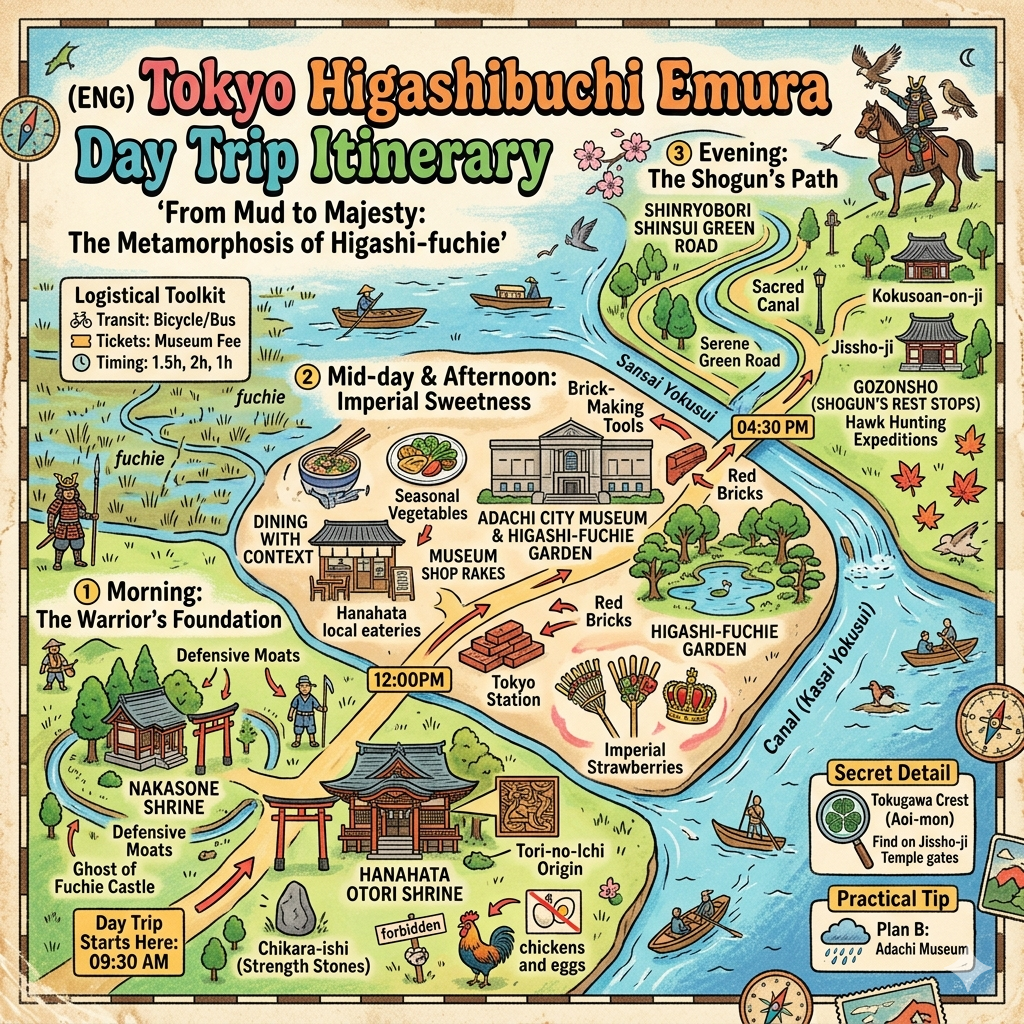
This is a historical travel story and walking guide to Higashi Fuchie in Adachi, Tokyo. By following the traces of the historic Kasai Yosui irrigation canal, it explores the transformation of this peripheral district from Edo-period farmland to a modern residential suburb. Readers will gain a unique perspective on Tokyo’s water management history and the quiet, layered narratives hidden within its everyday neighborhood landscapes.
 Lawrence
To understand the urban sprawl of modern Tokyo, one must first confront its edges. East Fuchie (Higashi-fuchie) exists today as a historical palimpsest—a landscape where the ink of the Shogun’s decree is layered over the viscous mud of the Sengoku-era marshes. This region, originally a desolate expanse of deep-water ponds and treacherous wetlands known simply as Fuchie, was transformed through centuries of human ingenuity into a strategic "Tenryo" (shogunal territory). It served as the literal and metaphorical foundation of the capital, providing the "Arakida" clay that would eventually form the bones of the city’s red-brick skyline. This mud-caked frontier was never merely a peripheral wasteland; it was the logistical soul of the Kanto Plain. For the thoughtful traveler, exploring this district’s [Complete Guide to Adachi District History] reveals how sacred traditions and industrial grit turned a spectral marsh into a cornerstone of Japanese modernization.
Listen to the historical stories told in detail (For subscribers only)
The Sacred Rooster: The Primordial Source of the Tori-no-Ichi
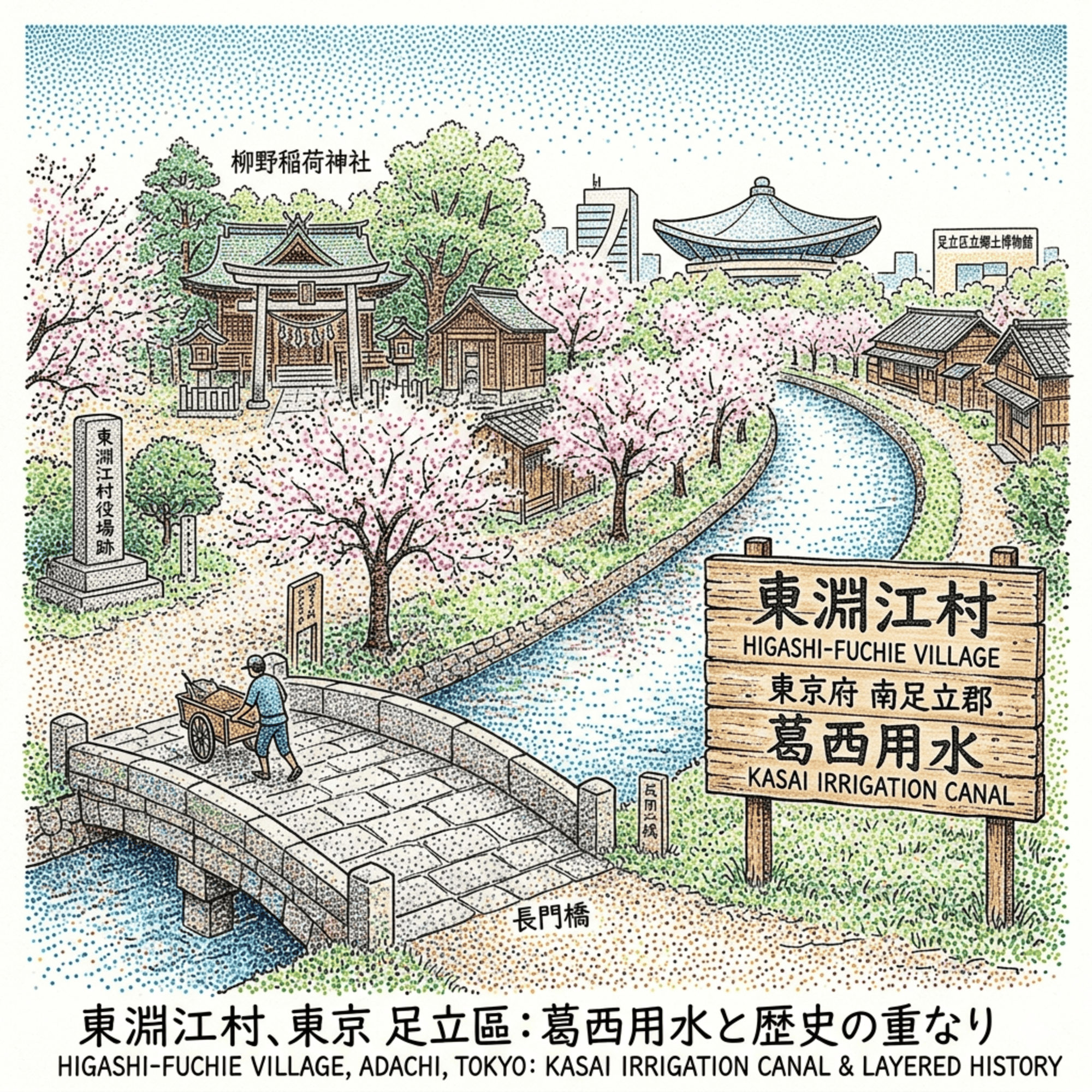
While the neon-lit "Tori-no-Ichi" (Rooster Market) of Asakusa attracts the modern masses, its historical "Hon-tori" (Original Source) is hidden within the Hanahata district at the O-washio Shrine. Established in the Muromachi period (1394–1428), this shrine was the spiritual vanguard of marshland reclamation. Its prestige was cemented by the patronage of the Satake clan of Akita, whose five-bone fan (Gohon-hone-ogi) heraldic crest still adorns the grounds—a prestigious link to the Minamoto line that elevates this "backwater" site to one of high-tier warrior patronage.
The identity of the East Fuchie peasantry was forged through a visceral "Chicken Taboo." The local ujiko (parishioners) viewed the shrine’s roosters as "Chicken Great Deities"—messengers of the sun whose presence warded off the chaotic spirits of the wetlands. To live in this territory was to abstain from eating chicken or eggs, a shared sacrifice that defined the community’s boundaries.
"The living roosters were viewed as divine messengers of the sun, possessing the power to guard boundaries and ward off evil. Every November on the 'Day of the Rooster,' farmers offered live birds to the shrine, eventually releasing them before the Kannon-do at Senso-ji Temple as an act of profound spiritual gratitude."
As Edo urbanized, this rural harvest ritual—anchored in agrarian taboos and the silence of the now-ruined Shukkai-goya (Cockerel House)—was distilled into the commercial spectacle of Asakusa’s "Lower Tori." This evolution reveals the Edo period’s genius for commercializing religious origins; the "lucky rakes" (kumade) once used to clear marsh debris were rebranded as talismans for commercial fortune, effectively turning a solemn territorial identity into urban entertainment.
The Emperor’s Red Gold: The Brief Bloom of the Royal Strawberry
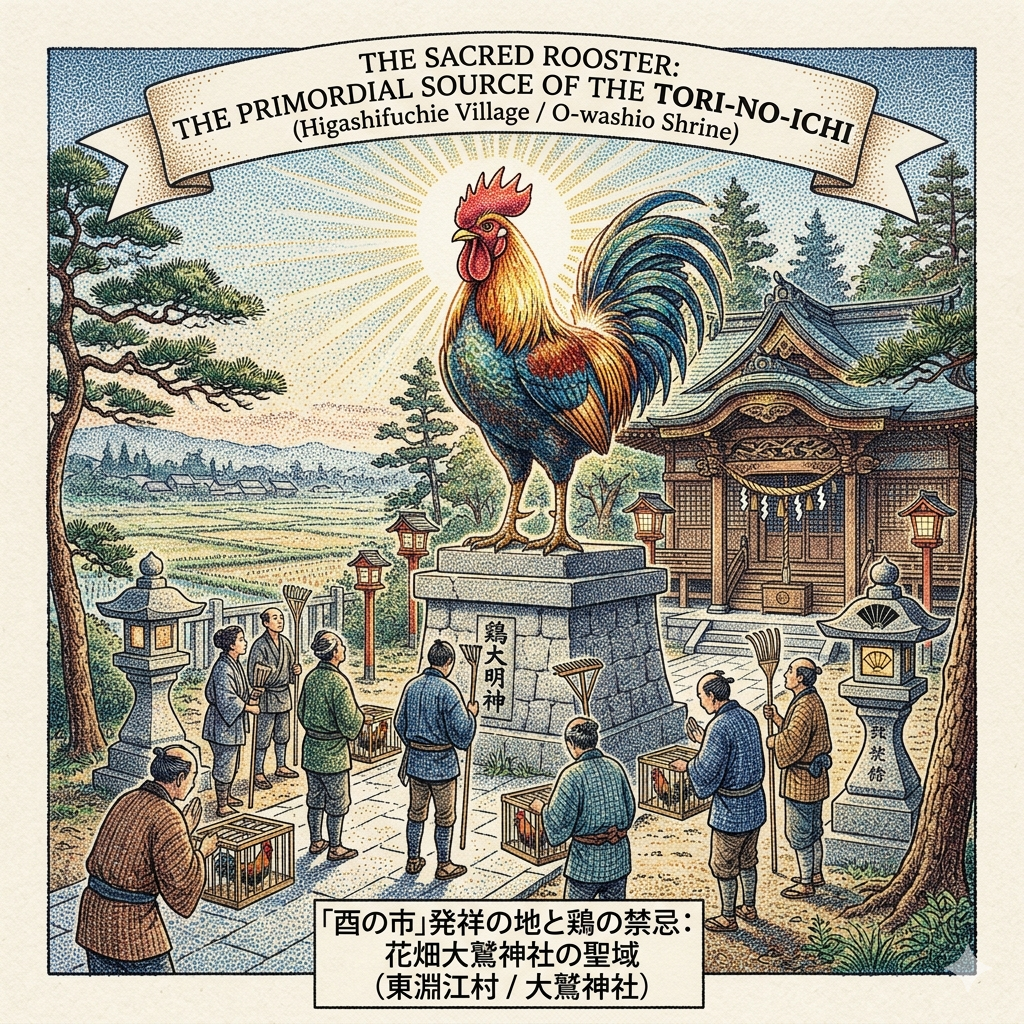
By the early 20th century, East Fuchie was trapped in a geographic paradox. The heavy, low-lying land was plagued by poor drainage, making traditional rice farming an exercise in futility. In a high-stakes pivot during the 1930s, local farmers turned to luxury horticulture, domesticating the "Fukuba Strawberry." Originally restricted to the Imperial Shinjuku Gyoen, this "King of Strawberries" was brought to the marshlands through the sheer technical mastery of the local farmers.
By successfully greenhouse-cultivating a fruit previously reserved for royalty, the farmers of East Fuchie engaged in a sophisticated form of "Imperial Branding." They bypassed local stalls to infiltrate the high-end markets of Ginza, even presenting their harvest to the Showa Emperor. This "Red Revolution" mirrors the rapid capitalist transformation of Tokyo's periphery. However, the prosperity was hauntingly brief. By 1935, the revolution stalled—not just due to industrial sprawl, but because the village workforce was diverted into the hungry machinery of military industries, signaling the end of East Fuchie’s delicate horticultural era.
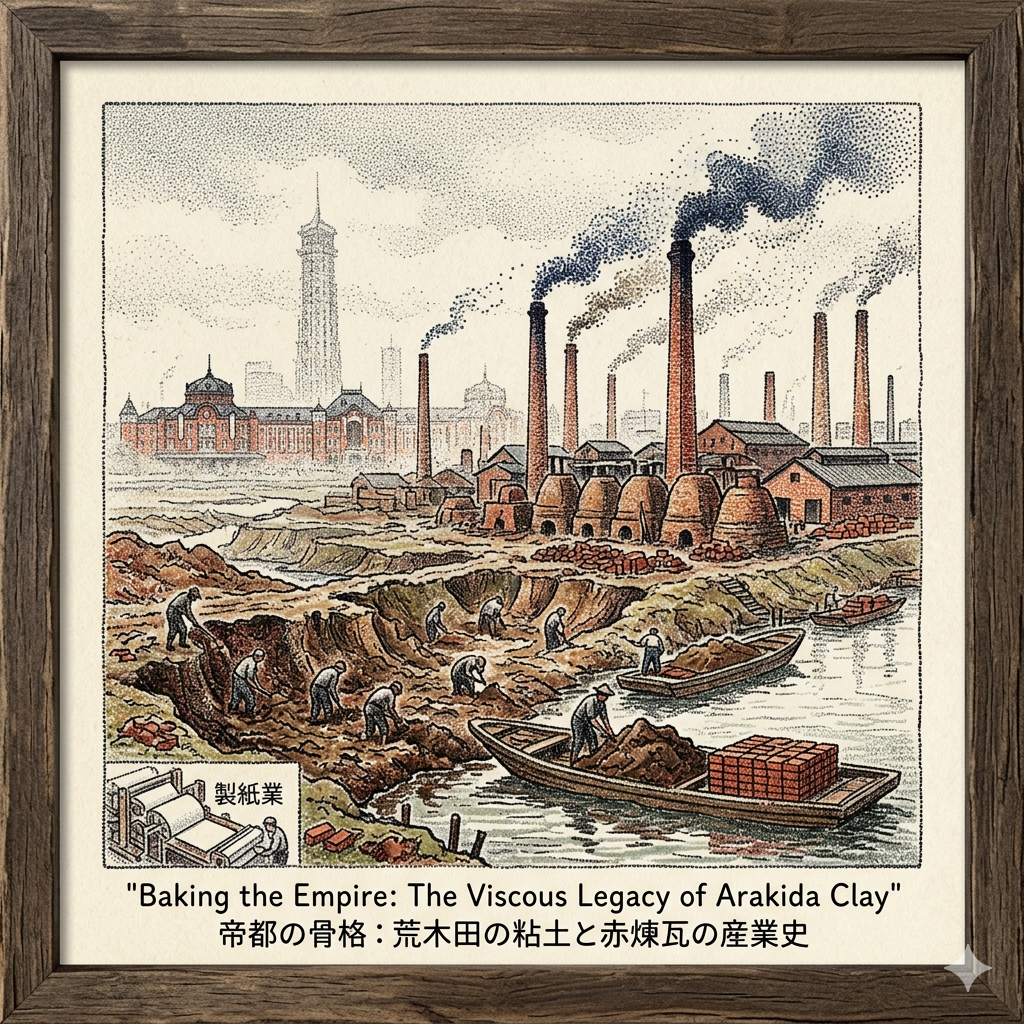
Baking the Empire: The Viscous Legacy of Arakida Clay
Beneath the vanished strawberry fields lay the "Arakida"—a heavy, viscous clay deposited by the ancient flooding of the Nakagawa. During the Meiji and Taisho eras, this mud became the "bone marrow" of Tokyo's modernization. The village transitioned into an industrial titan, dominated by the Japan Brick Manufacturing Company’s Otagaya factory. The red-brick facades of Tokyo Station and the spectral heights of the vanished Ryounkaku tower were, quite literally, extensions of East Fuchie’s earth.
Industrial Landscape of East Fuchie (c. 1929):
- Economic Dominance: Paper manufacturing (製紙業) was the village titan, accounting for over 60% of total industrial production value.
- Kiln Density: 14 major brick and tile manufacturers operated primarily along the Nakagawa riverbank.
- Environmental Toll: The extraction of Arakida clay was so intensive it led to severe land subsidence, permanently heightening the region’s vulnerability to the very floods that created the clay.
The extraction was a Faustian bargain: the village built the capital’s landmarks at the cost of its own physical elevation, sinking as the city rose.
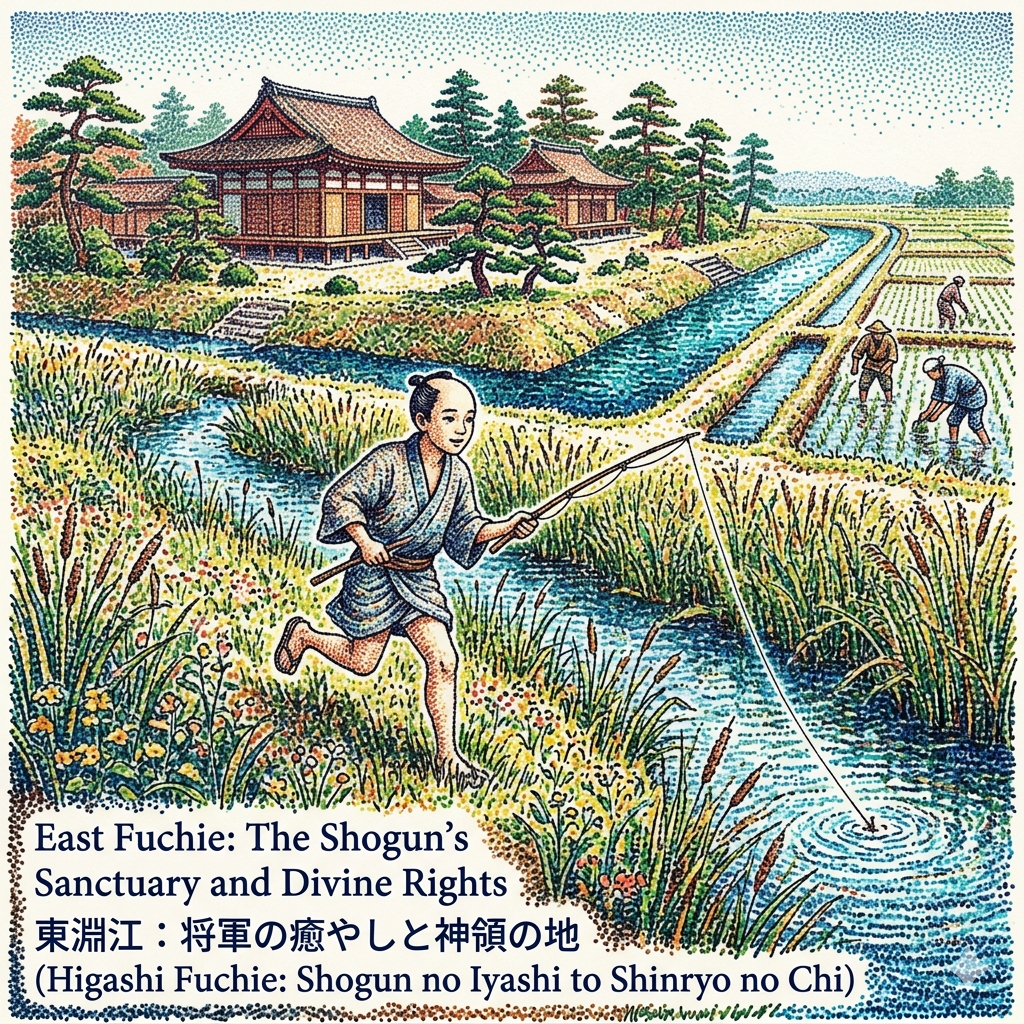
The Shogun’s Sanctuary: Healing Waters and Divine Rights
Long before the industrial kilns, East Fuchie was "Shinryo"—Divine Territory. Owned by the Kan’ei-ji Temple to support the Shogunal mausoleums, it served as a Takagari (hunting ground) where the Tokugawa performed rituals of power. A poignant narrative survives involving the 8th Shogun, Tokugawa Yoshimune, who commissioned the Kosuge Goten palace specifically for his frail son, Ieshige.
Ieshige, withdrawn and sickly, was sent here to recover. The "primitive healing power" of the marshland—fishing in the rivers and running through the reeds—was credited with transforming the 9th Shogun’s constitution. This healing narrative served a political purpose, branding the marsh as a sanctuary of Shogunal vitality. This status manifested in the Shinryo-bori (Divine Moat); because its water supplied "sacred" land, its water rights were prioritized over all neighboring villages. Labeling a canal "Divine" created a stratified landscape where religious status dictated survival and resource allocation for the local peasantry.
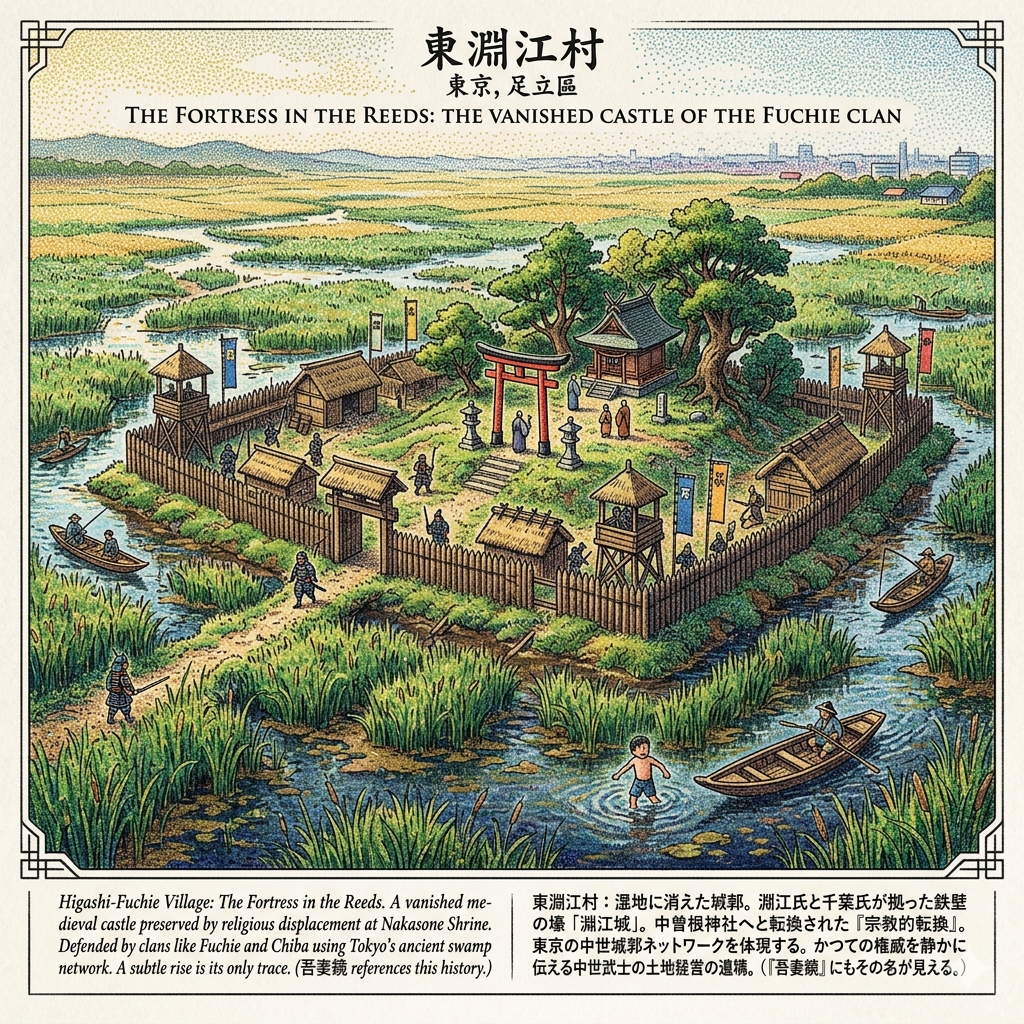
The Fortress in the Reeds: The Vanished Castle of the Fuchie Clan
Centuries before the Tokugawa, the land was a liminal borderland defended by the Fuchie and Chiba clans. They utilized a [Tokyo’s Medieval Castle Network] that relied on the geography of the marsh. Fuchie Castle, located at the site of today’s Nakasone Shrine, was a Hirajyo (flatland castle) that used impenetrable swamps as its primary defense.
Historical records like the Hojo-shi Yaku-cho confirm the castle’s strategic importance. When the fortress was decommissioned after 1590, its physical walls disappeared, but its authority was preserved through "religious displacement." By converting the fortress heart into a shrine, the community ensured the site remained sacred, preserving the memory of the medieval warrior class within a spiritual framework. Today, the subtle rise in the terrain at Nakasone Shrine is the final physical betrayer of its martial past.
Walking the Layers: A Traveler’s Spatial Guide
To walk through modern-day East Fuchie is to engage in an act of historical archaeology. A thoughtful traveler can trace the continuity of the landscape by following these markers:
- The Shinryo-bori Greenery: Follow the pedestrian paths in Enoki 3-chome; the modern greenway follows the exact irrigation lines of the ancient "Divine Moat."
- Nakasone Shrine’s Elevation: Stand at the shrine and notice the slight incline—the ghost of the Fuchie Castle foundations.
Hidden Gems:
- The Otagaya Riverbank Slopes: Look for the subtle inclines leading to the Nakagawa River. These are the last remnants of the brick-loading docks where the village’s clay was shipped to build the "Teito" (Imperial Capital).
- The "Five-Bone Fan" at O-washio Shrine: A heraldic link to the Satake clan of Akita, proving this marsh was once a site of high-tier patronage.
- The Shukkai-goya Ruins: The silent, empty center of the vanished chicken taboo that once governed every meal in the village.
A Reflection on the Vanishing Marsh
The story of East Fuchie is a study of the "Sacred and the Profane" layered upon the same soil. The same mud that healed a sickly Shogun was later baked into the bricks of the capital. The "Divine Water" withheld from peasants eventually irrigated the royal strawberries of Ginza’s elite. Modern Adachi is not merely a residential suburb; it is a logistical soul that has continuously adapted its geography—from fortress to shrine, from kiln to greenhouse—to support the heart of Japan. Understanding Tokyo requires this layered observation: recognizing that beneath the concrete lies a resilient, mud-caked history that refused to be washed away.
For more deep-history explorations of the Kanto Plain’s hidden narratives, subscribe to our monthly journal.
Travel Essentials
- How to Get There: Take the Tobu Skytree Line to Kita-Senju or Takenotsuka Station. Local buses provide frequent service to the Hanahata and O-washio Shrine area.
- Recommended Tours:
- Lowland Industrial Heritage Walk: Focuses on the Nakagawa riverbank and the Otagaya brick heritage.
- Medieval Borderland Exploration: A circuit of Nakasone Shrine and the ancient shrines of Hanahata.
- Stay: Consider boutique accommodations in Kita-Senju, a historic post-town that offers easy access to East Fuchie while maintaining a rich Shogunal-era atmosphere.
Q & A
What is the secret history behind the origins of Tori-no-Ichi?
The secret history of the origins of Tori-no-Ichi is rooted not in the famous city center of Asakusa, but in the remote rural marshes of Hanamata-mura (present-day Hanahata, Adachi-ku) at the Otorijinja Shrine.According to the sources, the following details define the hidden origins of this festival:
1. The Original Sacred Site ("Hon-Tori")
While modern visitors associate the festival with Asakusa, historical records such as the Shinpen Musashi Fudoki Ko confirm that the "true origin" (本源) is the Otorijinja Shrine in Adachi. During the Edo period, this original site was known as "Kami-no-Tori" or "Hon-Tori" (The True Tori), while the Asakusa location was referred to as "Shimo-no-Tori".
2. Connection to Samurai Authority
The festival’s sanctity was bolstered by the legend of the samurai Minamoto no Yoshimitsu (Shinra Saburo). In the 11th century, while on his way to the Later Three Years' War, he prayed for victory at this shrine. After returning triumphant, he dedicated his armor to the shrine, giving the site a dual identity of military authority and land-reclamation divinity.
3. The "Rooster Deity" and Extreme Taboos
The most distinctive "secret" of the original Tori-no-Ichi was the extreme divinization of the rooster, leading the shrine to be called "Tori Daimyojin" (Rooster Deity). This resulted in strict social controls:
- Dietary Bans: Believers (Ujiko) were strictly forbidden from eating chicken or eggs. This communal taboo served to define and strengthen the internal identity of the religious community within the Shogun’s direct territories.
- Ritual Release: Instead of being eaten, live roosters offered by farmers were transported to Senso-ji Temple in Asakusa to be released in an act of mercy.
4. Commercial Displacement
The original festival at Hanamata eventually lost its commercial dominance to Asakusa for two primary reasons:
- Geographical Isolation: The original site was considered a remote frontier.
- Gambling Bans: In the 1770s, strict bans on gambling at the original site drove crowds toward the more convenient and entertainment-focused Asakusa location near the Yoshiwara district.
This shift transformed Tori-no-Ichi from a rural harvest festival centered on strict religious taboos and agricultural tools (like the kumade or rake) into a modern urban commercial event focused on "harvesting fortune". Today, physical remnants like the "Shokukei Goya" (Rooster Hut) ruins at the Hanahata Otorijinja remain as silent witnesses to this original, taboo-driven history.
What led to the gambling bans at the original shrine?
The gambling bans at the original Otorijinja Shrine in Hanamata (now Hanahata) were primarily a result of the Aneyasu period gambling prohibition order (安永年間的賭博禁止令) issued by the Shogunate.
While the sources do not detail the specific social incidents that triggered the decree, they highlight the significant impact these bans had on the festival's history:
- Strict Enforcement in Remote Areas: The original site, known as "Kami-no-Tori" or "Hon-Tori," was located in a remote rural area. The strict application of the gambling prohibition at this location significantly dampened its commercial and social "heat".
- Shift to Asakusa: Because the original shrine was subject to these rigid restrictions and was geographically isolated, crowds began to favor the Asakusa Otorijinja (known as "Shimo-no-Tori").
- Commercial vs. Religious Focus: The bans facilitated a functional transformation of the festival. While the original Hanamata site remained a place of strict religious taboos (such as the ban on eating chicken), the Asakusa site—located near the Shin-Yoshiwara pleasure district—was better positioned to evolve into a center for urban commercial entertainment and the sale of "good luck" charms like kumade (rakes).
Ultimately, these gambling bans were a key factor in the commercial displacement of the original shrine, causing it to lose its status as the primary festival hub to the more "convenient" and entertainment-focused location in Asakusa.
Reference and Further reading
- 東淵江 - accessed May 5, 2026,
- 徳川家ゆかりの地を辿る - 足立区に遺る歴史の足跡 -|足立区, accessed May 5, 2026,
- 瓦づくりの道具 - 足立区, accessed May 5, 2026,
- 花畑大鷲神社 / 東京都足立区 - 御朱印・神社メモ, accessed May 5, 2026,
- 花畑大鷲神社〈酉の市〉'on フォトギャラリー - NPO法人 日本お祭り推進協会リアルジャパン'オン, accessed May 5, 2026,
- 酉の市③ 大鷲神社/鷲神社 - 歴史探訪と温泉, accessed May 5, 2026,
- 【酉の市発祥の地】足立区の花畑大鷲神社をご紹介します! | ハウスセイラーズブログ, accessed May 5, 2026,
- 酉の市(由来と歴史), accessed May 5, 2026,
- 東渕江庭園 - 岡山 太陽のそばの果樹園, accessed May 5, 2026,
- リニューアルオープン!【足立区立郷土博物館】をご紹介します | ハウスセイラーズブログ, accessed May 5, 2026,
- 東渕江村 - accessed May 5, 2026,
- 鷹狩御殿「江戸歴史散歩」 - asahi-net.or.jp, accessed May 5, 2026,
- https://www.asahi-net.or.jp/~JT7T-ENMT/teien/kosuge.html
- 足立区立郷土博物館だ よ り, accessed May 5, 2026,
- 戦国時代の城跡―武蔵千葉氏と淵江城 - 足立区, accessed May 5, 2026,
- 鎌倉幕府と武士団―足立氏一族の活やく, accessed May 5, 2026,
- 郷土博物館 | あだち観光ネット, accessed May 5, 2026,
- 足立区立郷土博物館(旧ページ)|足立区, accessed May 5, 2026
 Lawrence
 Lawrence
 Lawrence