(ENG) Kameido Historical Walk: 5 Layers of Soul, Industrial Ruins, and Resilience in Tokyo
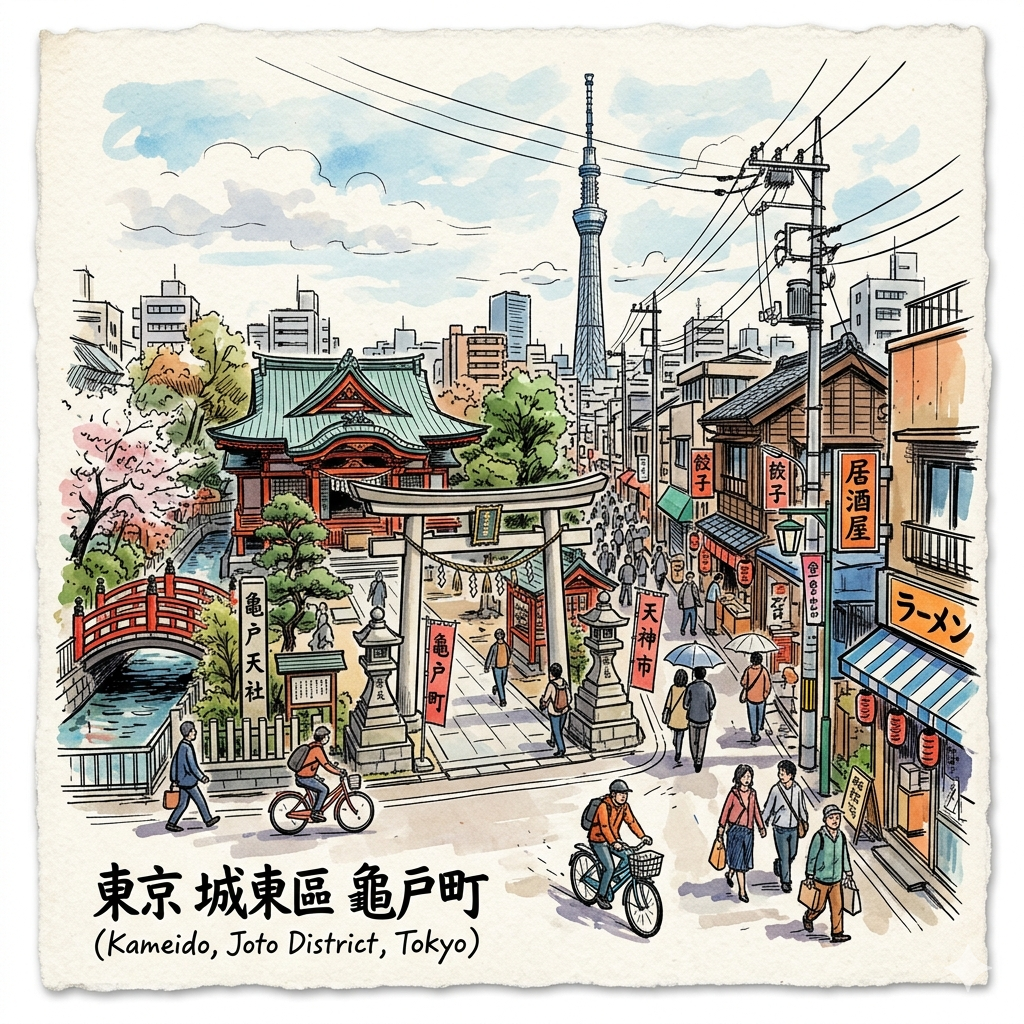
Walk through the temporal layers of Kameido, from the sacred heart of Edo to the echoes of industrial history. I will lead you to reveal how a former marshland became a site of state will, labor struggle, and ultimate rebirth in the heart of Tokyo’s Shitamachi.

 Lawrence
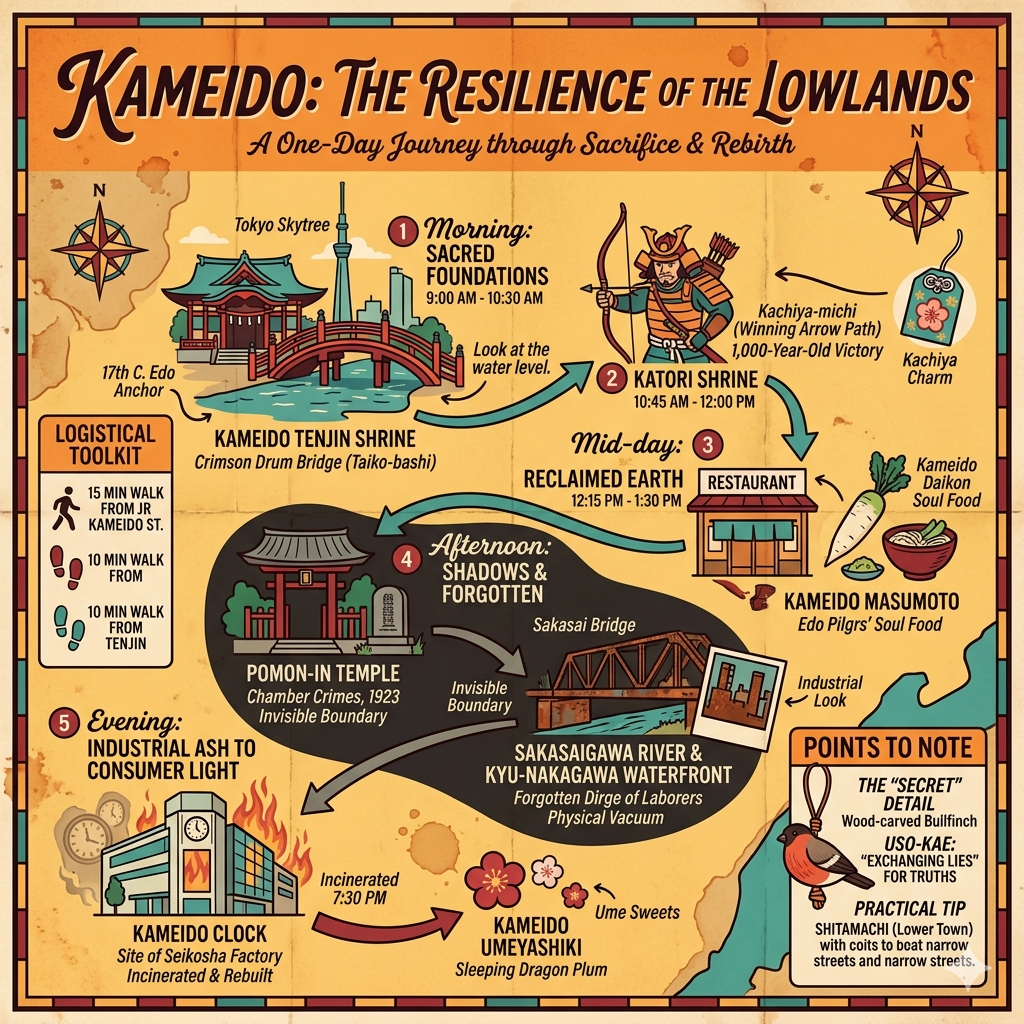
This is a historical travel story and walking guide to Kameido, a unique district on the edge of Tokyo’s lowlands. Through five historical layers—from the sacred grounds of Kameido Tenjin to the scars of industrial ruins—this walk explores how Edo spirits, state will, and wartime memories overlap. Readers will discover a hidden side of Tokyo’s resilience and a practical route to experience the city's deep history.
The Threshold of the Lowlands
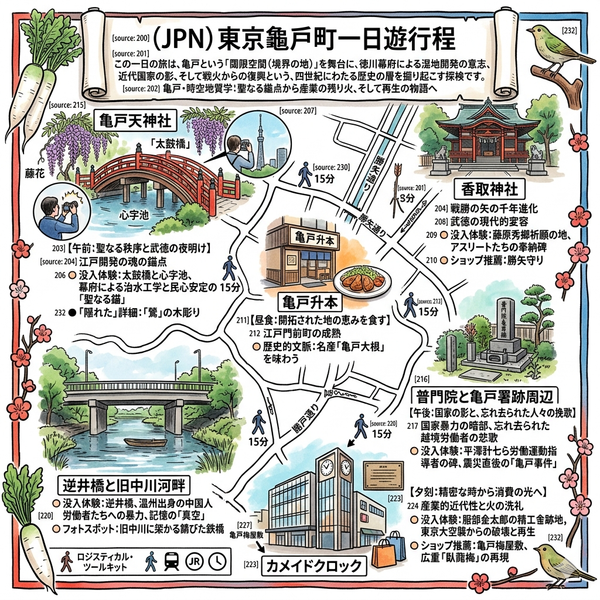
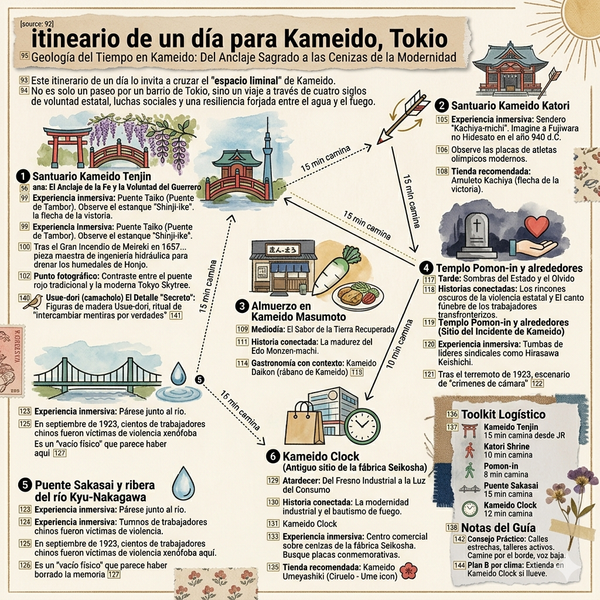
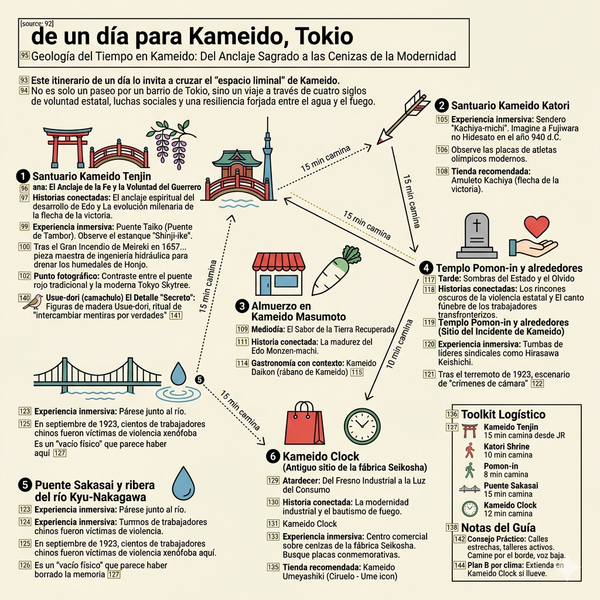
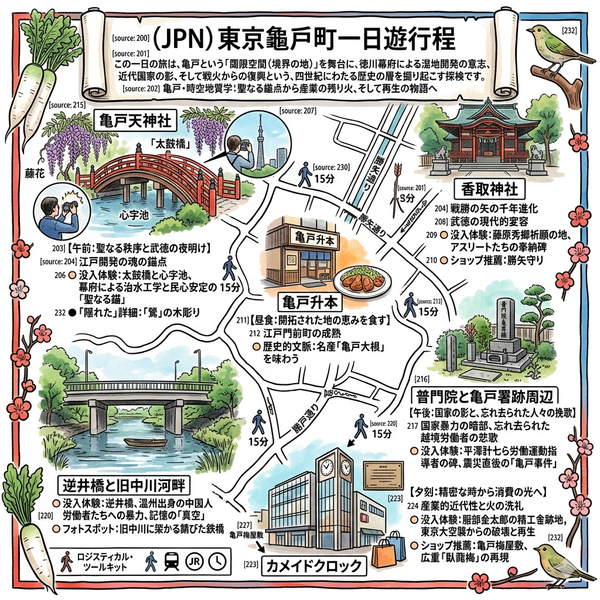
Kameido exists as a profound liminal space on the eastern periphery of Tokyo, a geographic and historical threshold where the alluvial delta of the lower Tone River meets the relentless expansion of the metropolis. Historically part of the "Joto" area, its identity was forged in the unstable, low-lying wetlands that dictated a destiny of constant transformation. This is a landscape of spatial archaeology, where the strategic ambitions of the Tokugawa Shogunate’s state power once converged with the gritty reality of industrial labor. The transition from a peripheral marshland to a vital urban center exemplifies the "Shitamachi" spirit—a specific brand of lowland resilience born from surviving repeated cycles of topographical trauma, from watery inundation to urban fire. To walk Kameido is to traverse the boundary between the sacred and the industrial, beginning at the very anchor that first stabilized this volatile landscape: the Kameido Tenjin Shrine.
Listen to the historical stories told in detail (For subscribers only)
The Soul Anchor: Urban Engineering and the Replication of Sacred Space
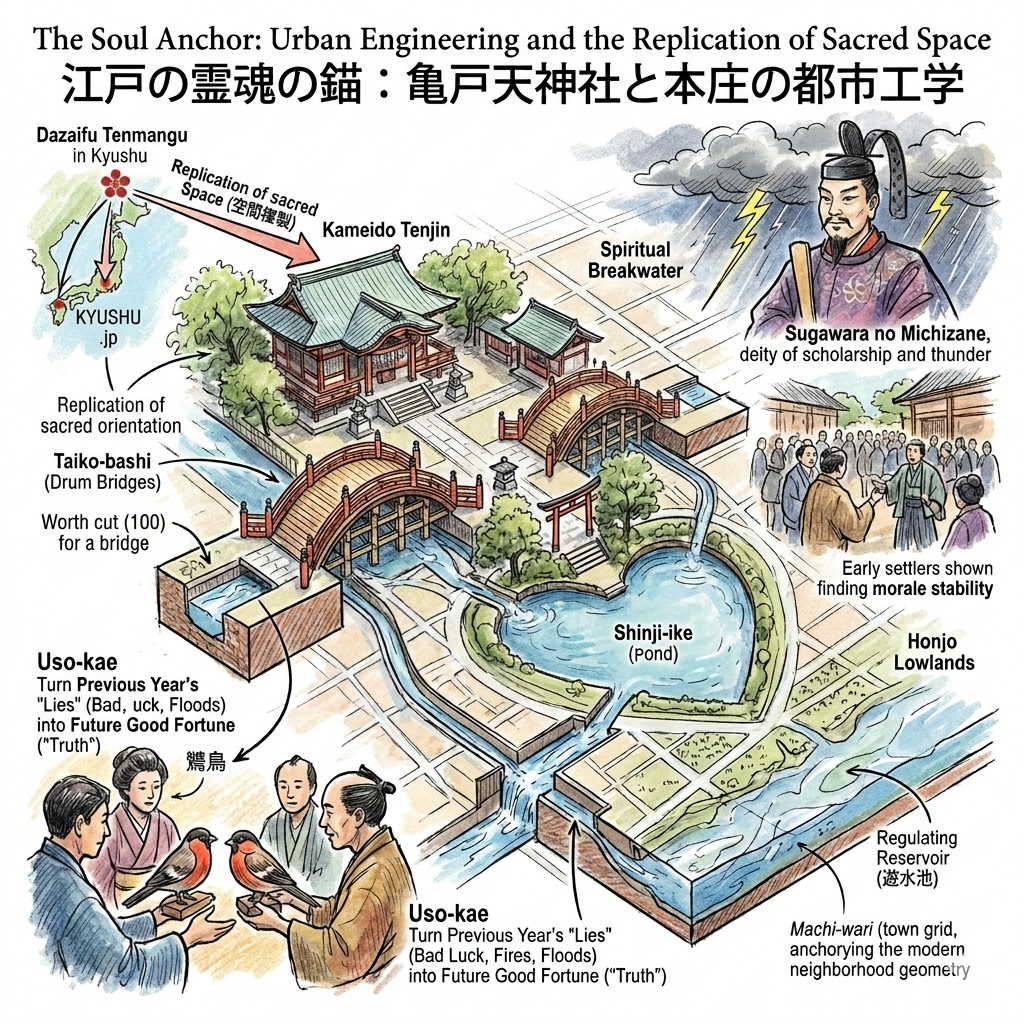
The development of modern Kameido began not with industry, but with a deliberate act of spiritual and urban engineering following the catastrophic Great Fire of Meireki in 1657. Seeking to decentralize the population and fortify the city against future disasters, the Shogunate initiated the Honjo Development Project. In 1662, the fourth Shogun, Tokugawa Ietsuna, established the Kameido Tenjin Shrine as the project's soul anchor.
The shrine was a masterclass in "spatial replication," meticulously copying the layout of the Dazaifu Tenmangu in Kyushu to provide the new settlers with a sense of continuity and protection. However, this was more than mere aesthetic homage; it was a sophisticated response to the challenges of building on a flood-prone swamp. The iconic "Taiko-bashi" (Drum Bridges) and the heart-shaped Shinji-ike pond functioned as vital drainage infrastructure, channeling water to mitigate the instability of the Honjo lowlands. By installing Sugawara no Michizane—the deity of scholarship and thunder—the Shogunate provided a psychological mechanism to stabilize the morale of a population living on the edge of the elemental.
"The 'Uso-kae' (Bullfinch Exchange) ritual, where participants exchange wooden carvings, serves as a collective psychological mechanism for the city's residents. It is an annual ritual of turning the previous year's 'lies'—representing bad luck, fires, and floods—into the 'truth' of future good fortune."
This spiritual center established the grid-like machi-wari (town grid) that still defines the neighborhood's geometry today, creating a ghostly blueprint for the martial and industrial layers that would follow.
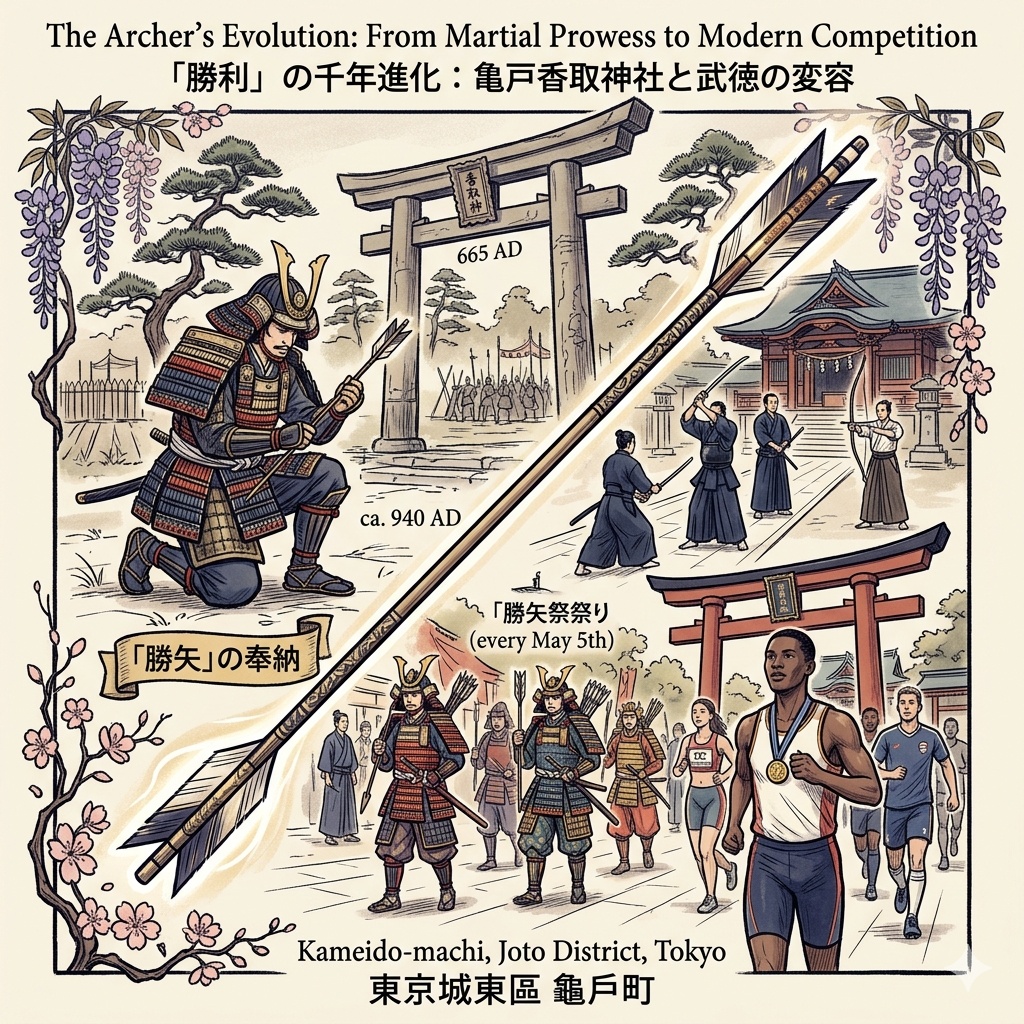
The Archer’s Evolution: From Martial Prowess to Modern Competition
Deep within the interstitial spaces of the neighborhood lies the Kameido Katori Shrine, a site of antiquity dating back to 665 AD. In the 10th century, it evolved into a critical political staging ground for the "Bando Musha" (warriors of the east). It was here that Fujiwara no Hidesato performed a ritual prayer before his campaign against the rebel Taira no Masakado in 940 AD. After his success, Hidesato offered a "Victory Arrow" (Kachi-ya), cementing the shrine’s status as a fountainhead of martial virtue.
Over a millennium, the Japanese concept of "victory" (Kachi) has undergone a fascinating transformation. What began as a symbol of the literal destruction of a political enemy evolved into a site of devotion for Edo-period martial artists. In the modern era, this narrative has shifted again; the shrine is now a pilgrimage site for Olympic athletes and sports enthusiasts. The Kachi-ya festival held every May 5th, featuring a procession in Heian-period armor, serves as a bridge between ancient military mobilization and contemporary athletic achievement, illustrating how the state and culture repurpose the spirit of triumph across the centuries.
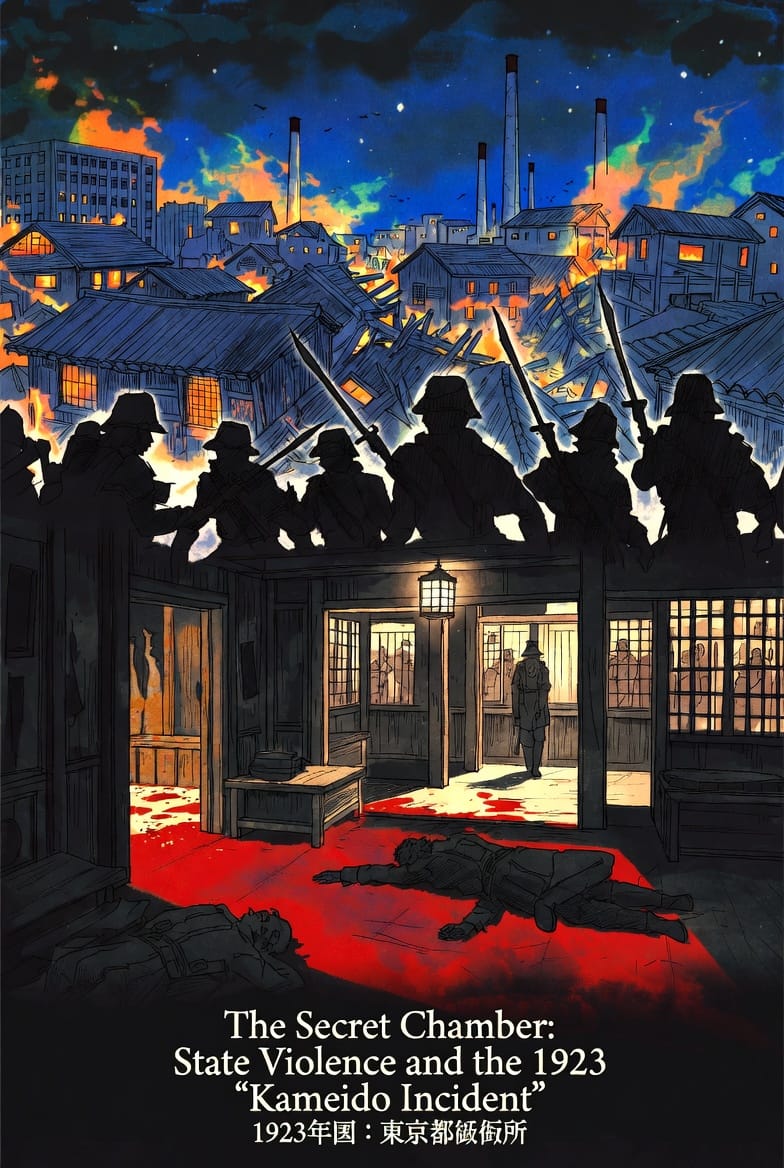
The Secret Chamber: State Violence and the 1923 "Kameido Incident"
The order established by shrines and shoguns was violently tested in the 20th century. Following the Great Kanto Earthquake of September 1, 1923, the Kameido district—then a dense industrial hub and the birthplace of the Nankatsu Labor Union—became a site of extreme state repression. Under the cover of martial law, the state exploited the post-disaster chaos to purge "internal threats."
On the night of September 4, 1923, ten labor activists, including Hirasawa Keishichi and Kawai Yoshitora, were executed within the Kameido Police Station. While official narratives often blamed civilian vigilantes for the chaos of that week, the "Kameido Incident" was a "Secret Chamber Crime" (密室の犯罪) perpetrated by the Cavalry 13th Regiment. The victims were systematically assassinated via bayonets inside a state facility, not in the lawless streets. This event signaled Japan’s dark shift toward fascism, as the state placed "order" above "law," a pivotal moment explored further in [A broader guide to Tokyo’s Taisho-era labor movements].
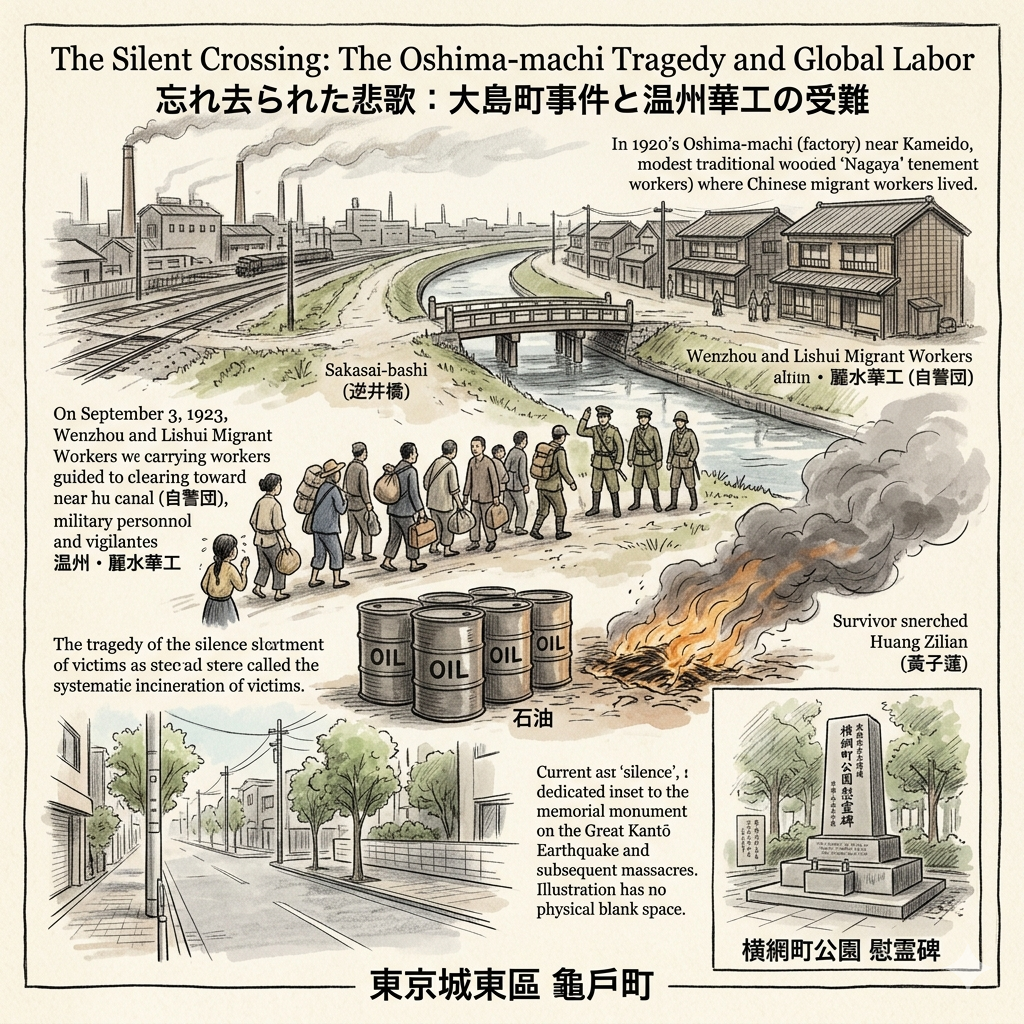
The Silent Crossing: The Oshima-machi Tragedy and Global Labor
The violence of 1923 extended to the vulnerable migrant populations who fueled Kameido’s industrial rise. Since the 1910s, workers from Wenzhou and Lishui, China, had settled in local Nagaya (tenements) to work on the rivers and railways of New Tokyo.
On September 3, 1923, at Oshima-machi 8-chome, near the Sakasai-bashi bridge, military personnel and vigilantes carried out an "organized predatory" massacre. Acting on xenophobic rumors, they lured Chinese workers into the open under the guise of protection.
"According to survivor Huang Zilian, the victims were deceived into bringing their savings to a clearing under the guise of being repatriated, only to be systematically slaughtered and their bodies burned with oil to erase the evidence."
The perpetrators used up to 30 barrels of oil to incinerate the remains, a haunting detail that underscores the premeditated nature of the violence. This tragedy remains a largely silent chapter in urban history, illustrating the absolute vulnerability of global labor in the face of nationalistic hysteria.
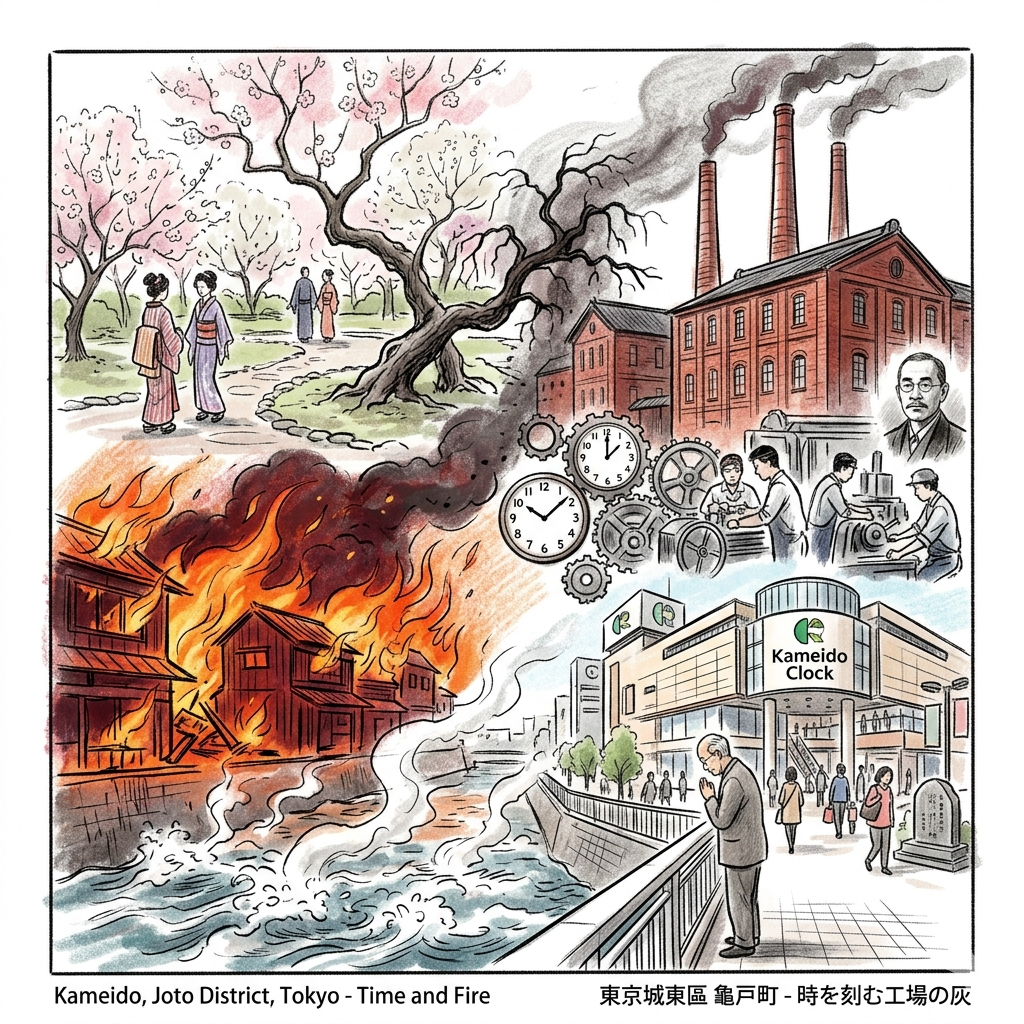
Time and Fire: From the "Plum Garden" to the Seikosha Ruins
The industrial modernization of Kameido is best represented by the transition from the Ume-yashiki (Plum Mansion)—a famous Edo-period garden celebrated in Utagawa Hiroshige’s prints—to the Seikosha clock factory. Founded by Hattori Kintaro, Seikosha turned Kameido into the center for producing "modern time" for the Japanese Empire.
This spatial evolution carries a tragic irony. The famous Garyu-bai (Sleeping Dragon Plum) eventually withered and died, a direct victim of the soot and pollution from the very factory smokestacks that signaled Kameido's economic rise. The industrial density that made Kameido a powerhouse also made it a primary target for the B-29 firebombings on March 10, 1945. The firestorms were so intense that residents jumped into the Yoko-jikkengawa canal, only to perish in the boiling waters. Today, the factory site has been transformed into the "Kameido Clock" shopping mall. Here, the "modern time" of industrial production has been replaced by "consumerist time," yet small markers remain as scars of the "Plum Mansion" and the fires that consumed it.
Walking the Invisible Memory
To experience Kameido today is to navigate a landscape of "absent presence." While the surface is a bustling modern district, the original 17th-century grid-like machi-wari still dictates the flow of the streets. A discerning visitor should look toward the riverbanks of the Yoko-jikkengawa, where the silence serves as a memorial for those lost in the firestorms of 1945.
Pumon-in Temple: Tucked away in Kameido 2-chome, this temple is a vital site for reflecting on the neighborhood's darker palimpsest. It houses the somber graves and memorial markers for Hirasawa Keishichi and the other activists murdered in 1923. It remains a site of quiet, heavy mourning, standing in stark contrast to the bright commercialism of the nearby station.
8. Philosophical Conclusion: The Geology of Memory
The history of Kameido is a narrative of cycles—destruction and rebirth, faith and fire. From the ashes of 1657 to the state violence of 1923 and the firebombs of 1945, the land has been repeatedly scarred by both natural forces and the cold ambitions of power. These stories reveal that a city is not defined by its modern highlights, but by its layers of labor and loss. Power carves the land into functional zones, but the land remembers what the state tries to erase. As we walk these streets, we must ask: Is the identity of a city found in its monuments of "victory," or in the quiet endurance of the people buried beneath its pavement?
Subscribe for more deep dives into the hidden histories of the world's great urban centers.
Practical Logistics: The Gateway to the East
- Getting There: Kameido is easily accessible via the JR Sobu Line or the Tobu Kameido Line (Kameido Station).
- Where to Stay: The nearby Kinshicho area offers excellent accommodation and serves as a strategic base for exploring the industrial heritage of the Sumida and Koto wards.
- Walking Tours: For those seeking a deeper synthesis, look for specialized walking tours focusing on Tokyo’s Industrial Heritage or the "Taisho-era labor movements" to see the sites of the 1923 incidents firsthand.
Q & A
How do local shrines connect ancient warriors to modern sports?
Local shrines, particularly the Kameido Katori Shrine, connect ancient warriors to modern sports by evolving the historical concept of "martial virtue" into a contemporary pursuit of competitive success. This transition is rooted in the following historical and cultural developments:
- The Legend of the "Victory Arrow": The shrine's status as a site for "victory" began in 940 AD, when the warrior Fujiwara no Hidesato prayed there before suppressing the rebellion of Taira no Masakado. After his success, he dedicated a "Victory Arrow" (Kachi-ya) to the shrine, establishing it as a sacred place for martial spirit.
- Redefining "Victory": While the term originally referred to the military destruction of political enemies, it underwent a "functional reshaping" over centuries. During the Edo period, it became a site for samurai to pray for progress in martial arts, and in the modern era, this narrative has shifted toward winning sports competitions and overcoming personal challenges like illness.
- Modern Athletic Pilgrimage: Today, the shrine is a prominent "sports sanctuary" frequented by Japanese Olympic athletes, professional football clubs, and marathon runners who come to pray for victory. The grounds are filled with sports-related banners and stone monuments dedicated by modern martial arts groups, such as those for Kendo and Judo.
- Ritualized Continuity: The connection is maintained through the annual Kachiya-sai (Victory Arrow Festival) held on May 5th. During this event, a "warrior procession" dressed in Heian-period armor marches through the streets of Kameido to recreate Hidesato’s triumphal return, effectively turning an ancient military legacy into a modern cultural asset that promotes sportsmanship,.
Through these practices, the shrine acts as a bridge where the "warrior heritage" of the past is utilized as "cultural capital" to inspire modern athletes.
How did Kameido transform from a swamp into a city?
The transformation of Kameido from a remote marshland into a modern city was a centuries-long process driven by massive shogunal engineering projects, religious centering, and industrial modernization.Based on the sources, the transformation occurred through several key phases:
1. The Post-Fire Urban Expansion (17th Century)Before the mid-17th century, Kameido was an unstable, low-lying marshland formed by the delta of the lower Tone River. The catalyst for its development was the Great Meireki Fire of 1657, which destroyed much of central Edo.
- The Honjo Development Project: To reduce population density and improve disaster resilience, the Tokugawa Shogunate launched a massive project to reclaim the marshlands east of the Sumida River and convert them into residential and commercial districts.
- Engineering through Faith: In 1662, the Shogunate established Kameido Tenjin Shrine as a "spiritual anchor" for the new territory. The shrine’s design was not merely aesthetic; its Shinji Pond and Taiko Bridges functioned as a vital part of the local drainage system, helping to drain and stabilize the surrounding low-lying land.
- The "Machi-wari" System: The establishment of the shrine led to organized zoning, known as machi-wari, which transformed the area from a rural village into a structured "monzen-machi" (shrine town) and eventually a bustling center for commerce and culture.
2. Meiji Era Industrialization (Late 19th Century)The Meiji Restoration pushed Kameido to the forefront of modernization.
- Infrastructure and Geography: The opening of the railway (now the Sobu Line), combined with cheap land prices and abundant water, made Kameido an ideal location for heavy industry.
- National Strategic Goals: Under the national policy of Fukoku Kyohei ("Enrich the Country, Strengthen the Armed Forces"), Kameido transitioned from a place of natural beauty to an industrial heartland.
3. The Rise of "Industrial Time" (20th Century)The establishment of Seikosha by Kintaro Hattori marked the definitive shift of Kameido into a city of machinery.
- From Plum Blossoms to Factories: Kameido was once famous for its "Waryu Plum" gardens, featured in woodblock prints. However, as industrialization intensified, environmental pollution caused the plum trees to wither, and the land was eventually sold to accommodate massive factories.
- A Center for Precision Machinery: Kameido became the center for producing "modern time" for Japan, manufacturing watches and clocks that reshaped the nation’s sense of punctuality.
4. Cycles of Destruction and RebirthKameido's urban history is characterized by a "cycle of destruction and rebirth". The city was largely leveled twice: first by the 1923 Great Kanto Earthquake and later by the 1945 Tokyo Air Raids, where the dense wooden factories and worker housing became fuel for firestorms. Each time, however, the area rebuilt with even greater industrial intensity, eventually evolving into the modern mixed-use urban landscape seen today, where former factory sites like Seikosha have been repurposed into contemporary shopping centers like "Kameido Clock".
Reference and Further reading
- 亀戸天神社 | 日本歴史改方, accessed April 11, 2026,
- 江戸三大天神-亀戸天神社 - 諸国放浪紀 - FC2, accessed April 11, 2026,
- 関東大震災時の朝鮮人虐殺における国家と地域 : 日本人民衆の加害 ..., accessed April 11, 2026,
- 一国史を超えて - 大原社研, accessed April 11, 2026,
- 关东大地震朝鲜人虐杀事件 - accessed April 11, 2026,
- 関東大震災をめぐる「朝鮮人が暴動を起こした」「虐殺はなかった」などの言説を検証 【ファクトチェックまとめ】, accessed April 11, 2026,
- 日本关东大地震背后隐秘90年的大屠杀 - 918爱国网, accessed April 11, 2026,
- コラム8 殺傷事件の検証 - 防災情報のページ, accessed April 11, 2026,
- 東京都慰霊堂 - 総務省, accessed April 11, 2026,
- 勝矢祭 | agata Japan.com, accessed April 11, 2026, https://agatajapan.com/event/ljn
- 【歴史コラム】藤原秀郷とお祭り(2024年4月12日更新) - 坂東武士図鑑, accessed April 11, 2026,
- 藤原秀郷の史実と伝説 - 坂東武士図鑑, accessed April 11, 2026,
- 二瓶治代氏ご体験文(書籍「あのとき子どもだった-東京大空襲 21 人の記録」より), accessed April 11, 2026,
- 新四季雑感 - k-unet (KDD OBネット ARCHIVE), accessed April 11, 2026,
- 東京大空襲・戦災資料センター, accessed April 11, 2026
 Lawrence
 Lawrence
 Lawrence