(ENG) Tokyo Nagasaki-machi Walk: The Avant-Garde Art and Geopolitical Shadows of Ikebukuro Montparnasse
Explore the hidden history of Ikebukuro's Nagasaki-machi. This guide connects the legacy of the "Ikebukuro Montparnasse" art colony with the turbulent geopolitical currents of the 20th century, offering a deep, analytical look at Tokyo’s cultural evolution.

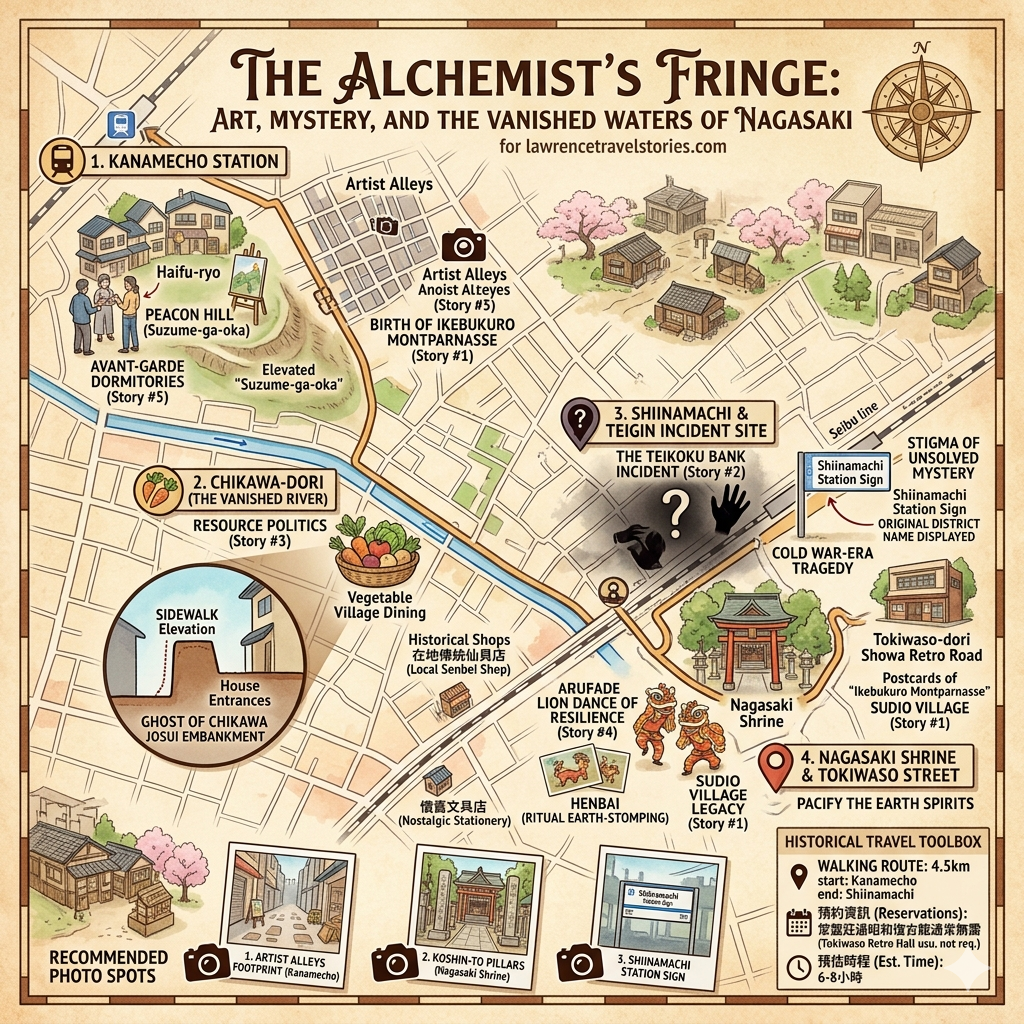
This is a historical travel story and walking guide to Nagasaki-machi in Ikebukuro, Tokyo, once celebrated as "Ikebukuro Montparnasse." By retracing the footsteps of pre-war artists, it explores how avant-garde creativity and complex geopolitical undercurrents shaped this unique urban landscape. Readers will discover a hidden side of Tokyo through its surviving atelier villages and the stories of those who lived between art and history.
 Lawrence
The modern landscape of Toshima-ku, defined by its quiet residential grids and unassuming commuter stations, conceals a history of radical transition and profound cultural tension. Historically known as Nagasaki-machi, this area serves as a premier site of "spatial storytelling," where the physical layout of the streets remains etched with the memories of an evolving metropolis. It is a neighborhood that transformed from Edo-period vegetable patches into a sanctuary for pre-war bohemianism, only to become a stage for Cold War-era trauma and geopolitical intrigue. This narrative is not housed in grand museums; rather, it exists in the "spatial continuity" of the streets themselves. For the discerning walker, Nagasaki-machi offers a rare glimpse into how resource politics, artistic fervor, and the shadows of occupation have layered themselves over the earth, refusing to be entirely paved over by the march of modern urban development.
Listen to the historical stories told in detail (For subscribers only)
The Spatial Economics of "Ikebukuro Montparnasse"
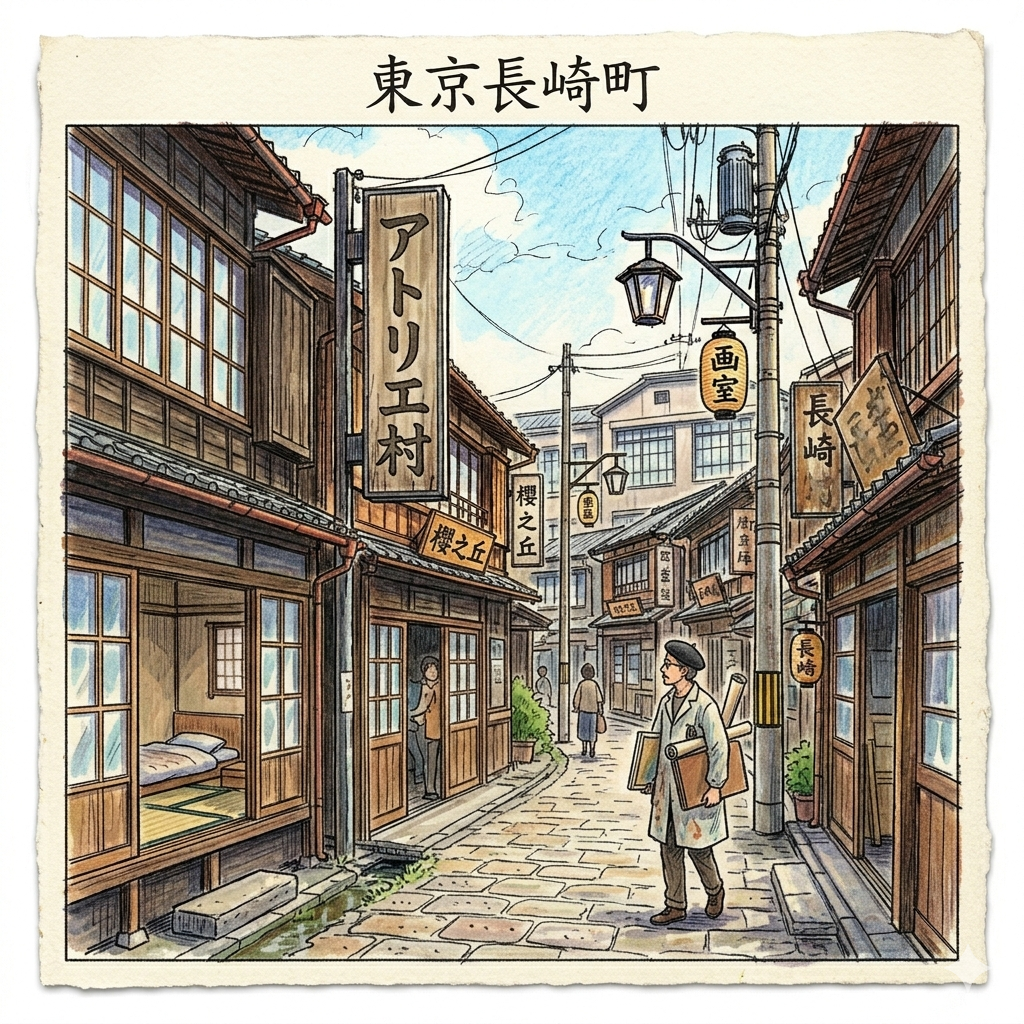
The emergence of Nagasaki-machi as a cultural hub was an accident of both geology and catastrophe. Following the 1923 Great Kanto Earthquake, the destruction of central Tokyo spurred a westward migration toward the Musashino Railway (now the Seibu Ikebukuro Line). Nagasaki-machi, still a marginal farming village at the time, offered low land prices that attracted developers and artists alike. Landowners like Rokuzaemon Hatsumi recognized a specific market: the "Atelier Villages." They utilized the low-lying, damp areas near the Yatabata River—land deemed unsuitable for high-end residential development—to build utilitarian clusters like Sakura-ga-oka Parthenon.
Comparison Item | Sakura-ga-oka Parthenon (Nagasaki-machi) | Mejiro Culture Village (Ochiai Region) |
Topography | Low-lying, damp Yatabata River valley; low value. | High-ground plateaus; well-drained and elite. |
Resident Class | Impoverished art students and nameless artists. | High-ranking bureaucrats, executives, and elites. |
Architectural Focus | Utilitarian studios; north windows as 'tools.' | Western-style houses; focus on luxury and privacy. |
Economic Model | Informal rental clusters for low-budget tenants. | Formal urban planning for the wealthy. |
The design of these studios reveals a "work-over-life" ethos. These were not homes in the traditional sense, but technological requirements for pre-war oil painting. Massive, north-facing windows were installed to capture the consistent, indirect light necessary for color accuracy, while living quarters were often compressed into a meager three or four mats. For the impoverished students of the Tokyo School of Fine Arts, the building was a tool first and a shelter second. Today, the narrow, gridded streets of Kanamecho and Chihaya still follow the boundaries set by these pre-war developments, holding the spatial heritage of a bohemian fringe that would eventually host even darker shadows.
The Shiinamachi Shadow: Geopolitics and the Teigin Incident
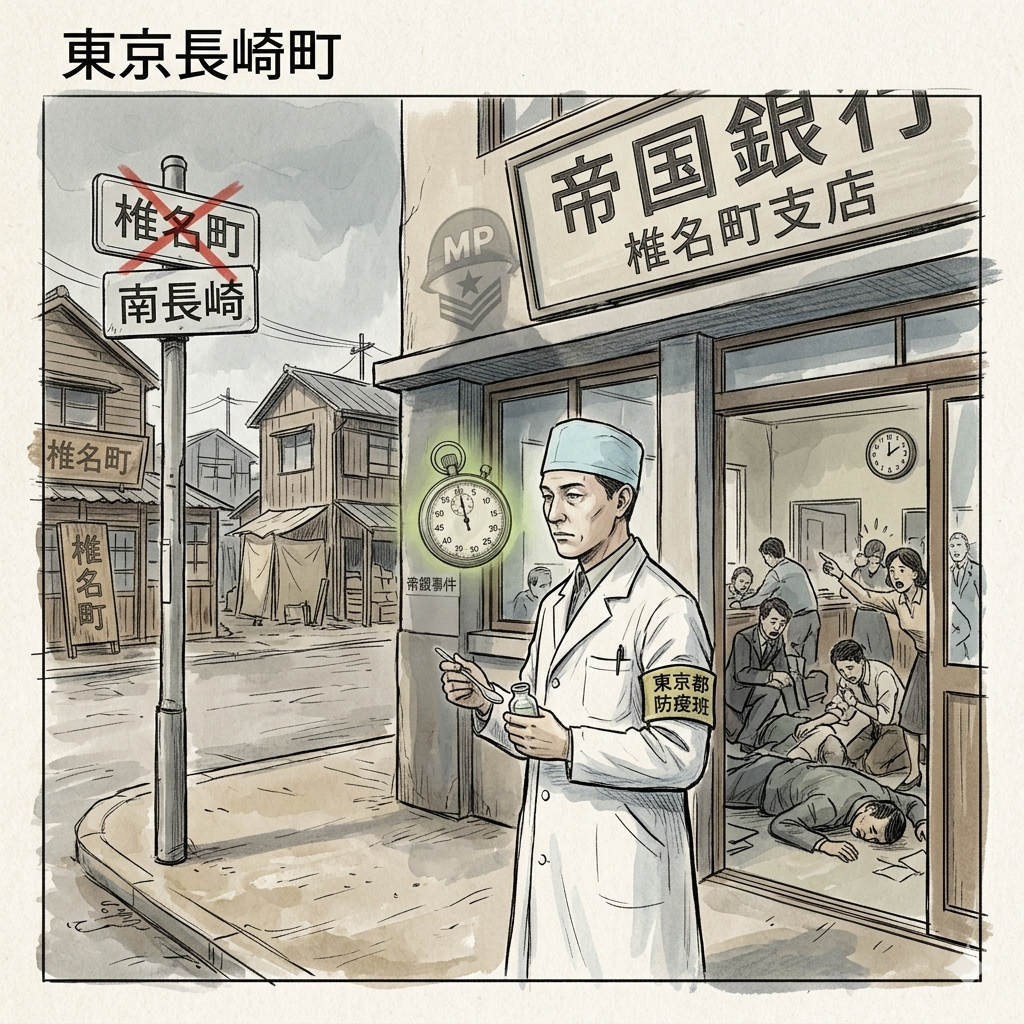
In January 1948, Tokyo was a city gripped by the uncertainty of GHQ occupation and a visceral fear of dysentery. On the afternoon of January 26, the absolute authority of the uniform was weaponized in the Imperial Bank’s Shiinamachi branch. A man wearing a "Tokyo Quarantine Team" armband entered, claiming he was there to administer a preventive vaccine. The sixteen employees, conditioned by the clinical efficiency of the era’s medical bureaucracy, followed his instructions without question.
Twelve died within minutes of drinking the toxin. The perpetrator, possessing a chillingly professional knowledge of chemicals, escaped with cash and checks. While the investigation initially looked toward military scientists from the infamous Unit 731 or the Noborito Institute, the geopolitical winds of the Cold War intervened. The GHQ’s desire to secure Japanese biological research data led to a sudden pivot in the case, resulting in the arrest and conviction of the painter Sadamichi Hirasawa.
"The man watched with clinical detachment—not a common thief, but a technician of death wearing the 'Tokyo Quarantine Team' armband. He timed their collapse with a stopwatch in his mind, knowing that the employees' conditioned obedience to uniformed authority would be his greatest weapon. It was a crime of professional precision that the state, under the shadow of the GHQ, preferred to blame on an artist than on its own military ghosts."
This "spatial trauma" led to the neighborhood’s administrative erasure. The name "Shiinamachi" became so synonymous with the poisoning that the area was officially renamed "South Nagasaki" in 1966 to distance it from the incident. Today, the name survives primarily as a railway station, while the physical infrastructure of the neighborhood—specifically the water that once fed the village—reveals a much older struggle for agency.
Resource Politics: The "Localization" of the Senkawa Waterway
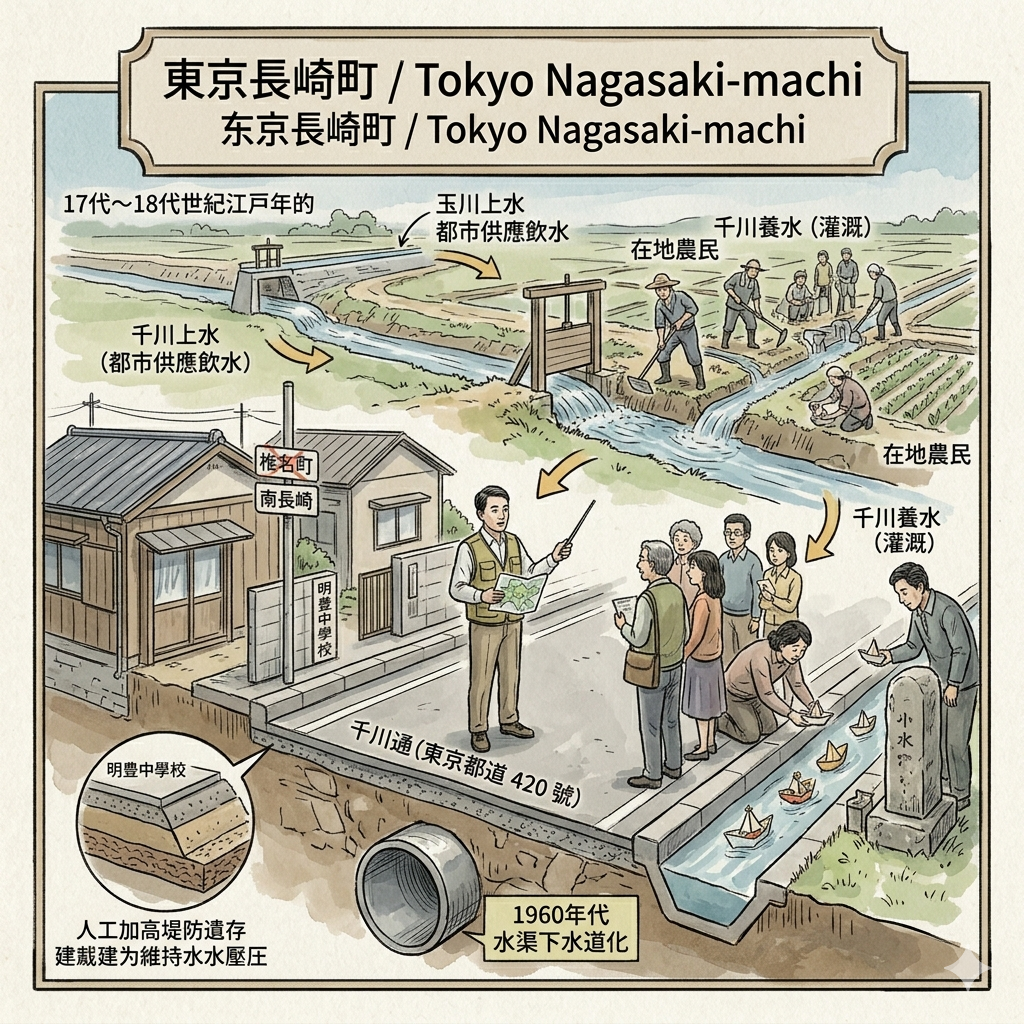
The physical foundation of Nagasaki-machi was shaped by the politics of water. In 1696, the Senkawa Josui was constructed as a colonial-style project, diverting water from the Tamagawa Aqueduct to feed the urban center at the expense of the periphery. However, a significant pivot occurred in 1786. When the Shogunate ceased using the Senkawa as a source of drinking water, local farmers successfully petitioned to reclaim it for irrigation.
This was a rare instance of an "edge" community asserting economic agency against the center. By transforming the urban waterway into a "life-line" for their fields, the farmers of Nagasaki village ensured their own survival. For the modern traveler, this history is visible in the micro-topography along Senkawa-dori. While the water was culverted underground in the 1960s, the sidewalks near Meihou Junior High School are still physically higher than the surrounding houses—a lingering scar of the artificial embankments built centuries ago to maintain water pressure. This physical persistence of the water’s path mirrors the cultural persistence of the community’s oldest rituals.
Stomping the Earth: The Nagasaki Lion Dance
Amidst the concrete sprawl, the Nagasaki Shishi-mai (Lion Dance) persists as a form of spiritual defense. Dating back to the 17th century, this shamanic ritual originated as a defense mechanism against plague and disaster. Its most striking feature is the Fungomi step—a rhythmic, forceful stomping of the earth.
The dancers’ feet strike the pavement with a percussive weight, a rhythmic thud that vibrates through the soles of the spectators’ shoes. This is not merely entertainment; it is an act of "awakening the land god" to suppress evil. As the village was swallowed by the concrete sprawl, the dance became a form of cultural resistance. Despite the disappearance of the rice paddies that provided the straw for their costumes, the community adapted. By binding the ceremony to modern identity, the residents prove that "identity is a performance of space" that refuses to yield to urban anonymity. This resilience is a trait shared by the informal intellectual hubs that preceded the great art villages.

Peifuryo: The Architecture of Productive Failure
Before the planned Atelier Villages, the area’s bohemian spirit was incubated in "informal" spaces like Peifuryo. Born in 1924 from the financial ruin of bookstore owner Kenji Hanaoka, Peifuryo was a boarding house built on the higher ground near Kanamecho. The failure of Hanaoka’s commercial bookstore in Ikebukuro allowed for the birth of this intellectual fringe.
Because of Hanaoka's literary background, the dormitory became a high-density "intellectual ecosystem." It provided a shelter for the pioneer of Japanese surrealism, Aimitsu (靉光), and other radical youths who debated art theory through the night. This highlights the power of "informality"; a failed commercial enterprise provided a more fertile ground for the avant-garde than any government-planned district. The "Peifuryo Highlands" topography near Kanamecho remains slightly elevated, the geographic reason why it originally attracted the students from nearby Rikkyo University who would define the neighborhood's character.
The Hidden Gem: Tokiwaso-dori Showa Retro Hall
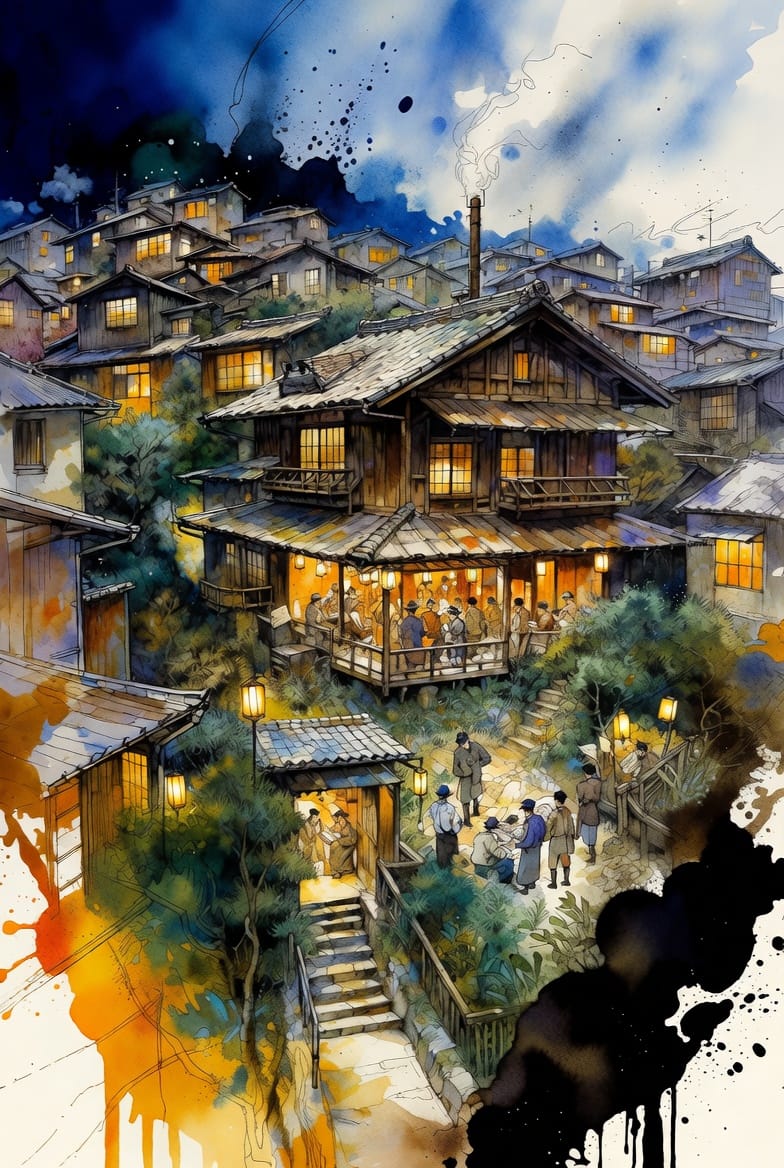
To truly decode the "invisible" history of these streets, a visit to the Tokiwaso-dori Showa Retro Hall (South Nagasaki 3-chome) is essential. While the original wooden studios have largely vanished, this site provides the necessary visual cipher to understand the surrounding blocks. It houses the maps and reproduced artworks of the "Ikebukuro Montparnasse" era, allowing you to see the revolutionary art world that still pulsates beneath the surface of the modern residential grid.
Philosophical Synthesis & Reflective Conclusion
The story of Nagasaki-machi proves that a city’s true character is found in its "layers of observation." Here, the irrigation rights of 18th-century farmers, the bohemian dreams of pre-war painters, and the clinical methodology of a Cold War-era poisoning overlap on the same narrow paths. Each era left a mark: a raised sidewalk, a renamed district, or a ritualized stomp on the ground.
In a city that so efficiently erases its names and paves over its waters, Nagasaki-machi stand as a testament to the persistence of the "edge." The spatial logic of the past continues to dictate the flow of the present. As you walk these gridded streets, consider this: In a city that relentlessly reinvents itself, what are we stepping on that still refuses to be forgotten?
For more deep-dives into the hidden layers of the urban fabric, subscribe to "Historical Travel Stories."
Exploring Nagasaki-machi Today: A Logistics Appendix
How to get there:
- Seibu Ikebukuro Line: Alight at Shiinamachi Station.
- Tokyo Metro (Yurakucho/Fukutoshin Lines): Alight at Kanamecho Station.
Recommended Walking Route:
- Nagasaki Shrine: Begin at the site of the ancient Lion Dance, located near the north exit of Shiinamachi Station.
- The Former Atelier Villages: Walk west through the residential grid of Chihaya and Kanamecho, looking for the boundaries of the old studio clusters.
- Senkawa-dori: Conclude your walk at the elevated road, observing the artificial height of the sidewalks relative to the housing.
Pro Tip: Look for weathered Koshin-to stone markers at street corners. These relics are often situated at the junctions of former water branches—the original signposts of the irrigation paths that defined this land long before the concrete arrived.
Q & A
How did Nagasaki-cho's cheap land prices create a bohemian art scene?
Nagasaki-cho’s transformation into a bohemian art scene was the result of a specific spatial economy where low land prices met the functional needs of a growing class of impoverished artists.The development of this scene was driven by several key factors:
- Post-Earthquake Geographic Shifts: Following the 1923 Kanto Earthquake, people migrated to the western suburbs. Nagasaki-cho, located along the newly opened Musashino Railway, offered extremely low land prices, making it a viable satellite residential area for those displaced from the city center.
- The "Atelier Village" Real Estate Model: Starting in 1931, local landlords began developing specialized rental housing for artists. Landowners like Chumi Rokuzo utilized low-lying, damp land along the Yatabata River—which was unsuitable for high-end "garden city" developments—to build affordable studio clusters like "Sakuragaoka Parthenon".
- "Heavy Labor, Light Living" Design: These studios were strategically designed to cater to poor art students from the countryside who lived on meager stipends. The architecture prioritized professional needs over comfort, featuring large 15-tatami studios with north-facing high windows for stable light and wide doors for large canvases, while living quarters were cramped into just three to four and a half tatami mats.
- Comparison with Elite Districts: Unlike the nearby "Mejiro Culture Village," which was built on high ground for the social elite, Nagasaki-cho's artist clusters were demand-driven, informal developments that focused on utility and low cost, breaking the traditional monopoly of wealthy patrons over the arts.
- Informal Cultural Incubators: Before the major villages were built, informal spaces like Heifuryo (a lodging house) provided a "protection shelter". Its low cost and peripheral location allowed avant-garde artists like Aimitsu to gather and debate theory in a space that tolerated poverty and encouraged "deviant" thinking.
- Bohemian Identity: This unique ecosystem—characterized by a mix of proletarian struggle, bohemian freedom, and poverty—was famously dubbed "Ikebukuro Montparnasse" by poet Oguma Hideo, likening it to the artistic heart of Paris.
Ultimately, the "spatial imperfection" of Nagasaki-cho—its cheap, marginal, and unregulated land—provided the necessary "cracks" for avant-garde culture to grow wildly during an otherwise oppressive pre-war era.
How has the Nagasaki Shrine Lion Dance survived modern urban expansion?
The survival of the Nagasaki Shrine Lion Dance amidst the rapid urban expansion of Tokyo is considered a "folk miracle," achieved through a combination of social adaptation, institutional protection, and the active involvement of the local community. Its endurance is defined by several key factors:
- Transformation of Social Meaning: Originally, the lion dance was a rural ritual focused on suppressing plagues and praying for harvests in the agricultural society of the Edo period. As Nagasaki-cho transitioned into a dense residential district after World War II and paddy fields disappeared, the ritual was successfully repurposed into a tool for community identity. It evolved from a harvest prayer into a form of "cultural resistance" against the social alienation common in modern urban neighborhoods.
- Adaptation to Resource Scarcity: The urbanization of the area led to the loss of natural resources essential to the tradition, such as the straw required to make practice lion heads. Despite these physical changes to the landscape, the residents maintained the tradition by shifting its value from an agricultural necessity to a vital living heritage.
- Institutional and Spatial Preservation: The ritual has been safeguarded by being designated as a Ward-designated Intangible Folk Cultural Property. Furthermore, the performance maintains its ritual integrity by creating a specific sacred physical boundary known as "Mogari" (a bamboo fence) within the Nagasaki Shrine grounds. This dedicated space allows the ancient ceremony to exist in stark contrast to the high-density urban environment surrounding it.
- Active Youth Participation: Continuity is ensured through the involvement of the younger generation. Every year on the second Sunday of May, local elementary, middle school students, and youth perform the dance. They continue to wear heavy lion heads made of black chicken feathers and perform the "fungomi"—a core foot-stomping movement intended to wake the earth god and suppress disease—preserving the ancient "Saman" (shamanistic) elements of the rite in a modern context.
Ultimately, the Nagasaki Shrine Lion Dance has survived by becoming a "cultural rebirth" sample, where the community's proactive adaptation allowed a traditional agricultural rite to find a new, essential role within a modern megacity.
Reference and Further reading
- 長崎 (豊島区) - accessed April 4, 2026,
- 長崎町 (東京府) - accessed April 4, 2026,
- 【豊島の風土を訪ねて 旧長崎町編「風薫る里」】(目録) - ADEAC, accessed April 4, 2026,
- 長崎・千早地域 - 豊島区, accessed April 4, 2026,
- 昔ながらの懐かしい空気が漂う「長崎」 | GU HOUSE, accessed April 4, 2026,
- 帝銀事件と日本の秘密戦 - 明治大学, accessed April 4, 2026,
- 長崎アトリエ村「さくらが丘パルテノン」の商品開発の観点から見 ..., accessed April 4, 2026,
- 池袋モンパルナスとよばれたまち - 豊島区, accessed April 4, 2026,
- 長崎アトリエ村跡 - 豊島区, accessed April 4, 2026,
- モンパルナスの軌跡と古き神社を巡る「千川・要町・高松コース」 - 豊島区商店街連合会, accessed April 4, 2026,
- 5:文化・芸術の拠点として ~ 池袋 | このまちアーカイブス, accessed April 4, 2026,
- 連携講座「池袋学」|池袋モンパルナスの時代~街が美術を育んだ~ | 立教大学, accessed April 4, 2026,
- radio_button_uncheckedとしま案内人長崎町 「池袋モンパルナス」複製画展, accessed April 4, 2026,
- 池袋モンパルナス・長崎アトリエ村跡まち歩き, accessed April 4, 2026,
- 帝銀事件とは? わかりやすく解説 - Weblio辞書, accessed April 4, 2026,
- 帝銀事件と日本の秘密戦 - 明治大学, accessed April 4, 2026,
- 明治大学平和教育登戸研究所資料館主催 オンライン講演会 「帝銀事件と日本の秘密戦-捜査, accessed April 4, 2026,
- 帝銀事件(テイギンジケン)とは? 意味や使い方 - コトバンク, accessed April 4, 2026,
- [ID:8] 帝銀事件の謎 : 資料情報 | 情報ライブラリ 昭和の事件 | 北九州市立松本清張記念館, accessed April 4, 2026,
- 千川上水と千川通りの秘密に迫る - 東京 - 練馬区, accessed April 4, 2026,
- 千川上水 - accessed April 4, 2026,
- 千川上水における流域環境の変化と宗教的 構築物について - ECHO-LAB, accessed April 4, 2026,
- 千川上水の分水を訪ねて(2) - 練馬わがまち資料館, accessed April 4, 2026,
- 千川上水記録フィルム 豊島区南長崎6丁目付近(せんかわじょうすいきろくふぃるむ としまくみなみながさきろくちょうめふきん) - 練馬区文化振興協会, accessed April 4, 2026,
- 千川上水(東長崎〜千川駅) - Natrium.jp, accessed April 4, 2026,
- 長崎神社獅子舞※区無形民俗文化財 - 豊島区, accessed April 4, 2026,
- 特集・ 誇り高き、このまちの伝統 長崎獅子舞, accessed April 4, 2026,
- 舞 1996年5月12日撮影日が落ちてあたりが薄暗くなる 頃行われる。 獅子が、 布を綱状にしたものにからみついて 舞う。あたりに笛の音が心地よく響く。 - 豊島区, accessed April 4, 2026,
- 東京都豊島区「長崎獅子舞」、大地を回りながら踏みしめる。暮らしから発生した舞い, accessed April 4, 2026,
- 獅子舞と虎舞 : 東アジアの民俗芸能論序説 - 國學院大學学術情報リポジトリ, accessed April 4, 2026,
- 長崎獅子舞 - 豊島区, accessed April 4, 2026,
- としま深堀り!長崎獅子舞を知る, accessed April 4, 2026
 Lawrence
 Lawrence
 Lawrence