(ENG) Nishi-Sugamo Historical Walk – 5 Surprising Stories of Redemption and Reform in Tokyo
Nishi-Sugamo serves as a historical "buffer zone" for Tokyo, holding stories of those once marginalized by the city. From the resting place of Yoshiwara courtesans to the birth of modern Buddhist scholarship and social welfare, revealing the resilient spirit of an often-overlooked district.

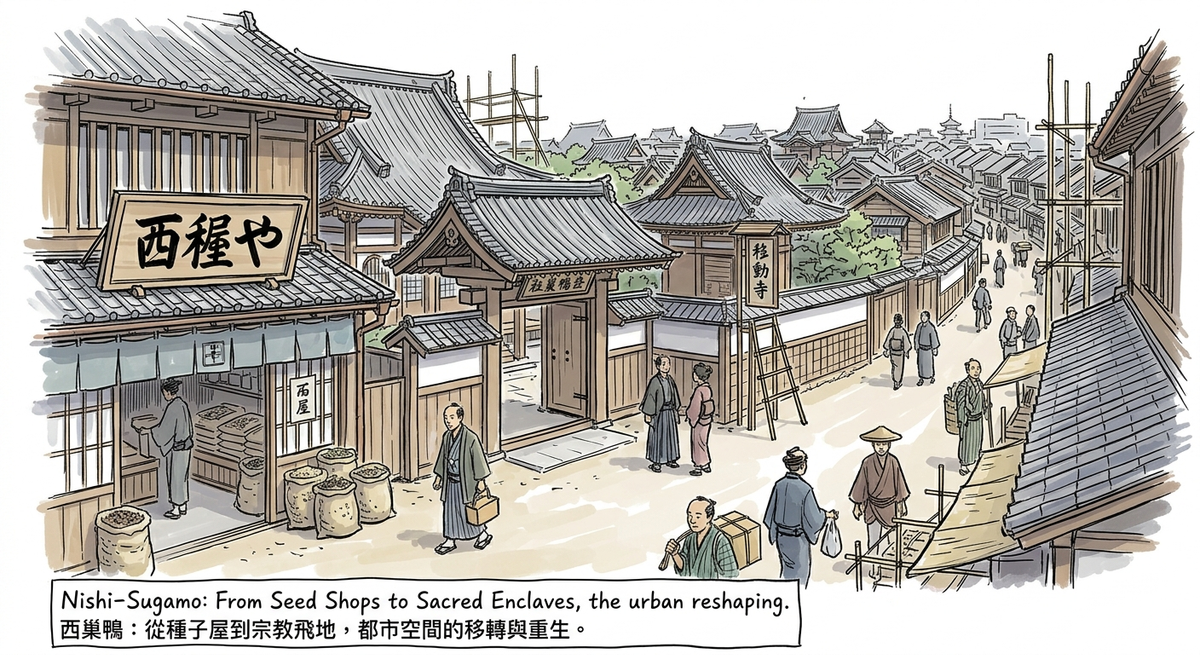
This is a historical travel story and walking guide to Nishi-Sugamo, a hidden layer of Tokyo along the old Nakasendo way. Through five surprising histories, it explores ancient temples, the legacy of the Yoshiwara courtesans, and pioneering social reforms to show how this urban "buffer zone" transformed from a rural edge into a center for spiritual and intellectual salvation.
 Lawrence
To the observer of urban morphology, Nishi-Sugamo is far more than a quiet residential enclave on the northern fringes of the Yamanote loop. It serves as a profound archive of Tokyo’s evolution—a "buffer zone" (緩衝帶) that historically processed the city’s excess: its dead, its marginalized, and its radical social experiments. The significance of this neighborhood is not housed within the glass cases of a museum but is embedded in the spatial stratification of the streets and the dense clusters of temples lining the old Nakasendo highway. As Tokyo expanded during the Meiji and Taisho eras, Nishi-Sugamo transitioned from an agricultural hub into a sanctuary for relocated traditions and modern intellectual inquiry. Engaging with the district's physical layout allows for an apprehension of five distinct layers of history that transformed this former periphery into a living repository of the Japanese capital’s soul.
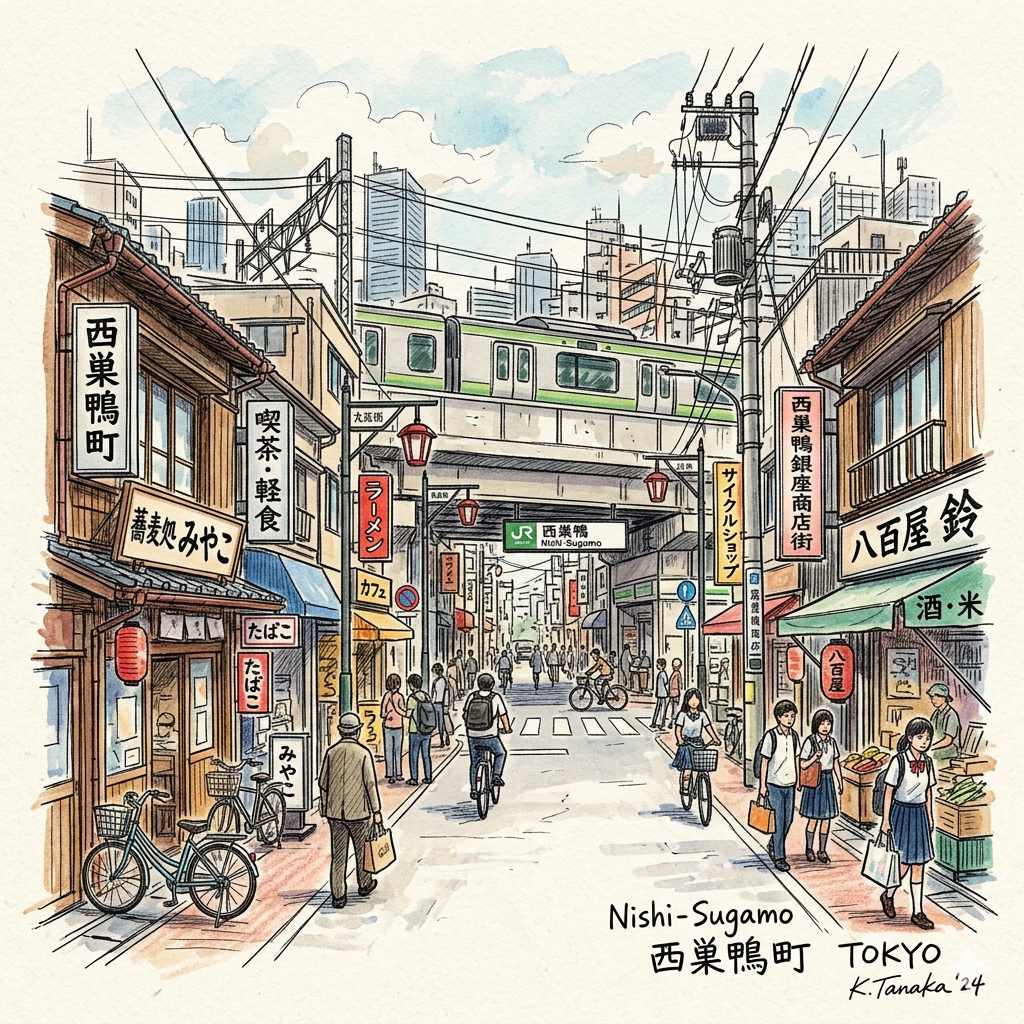
Listen to the historical stories told in detail (For subscribers only)
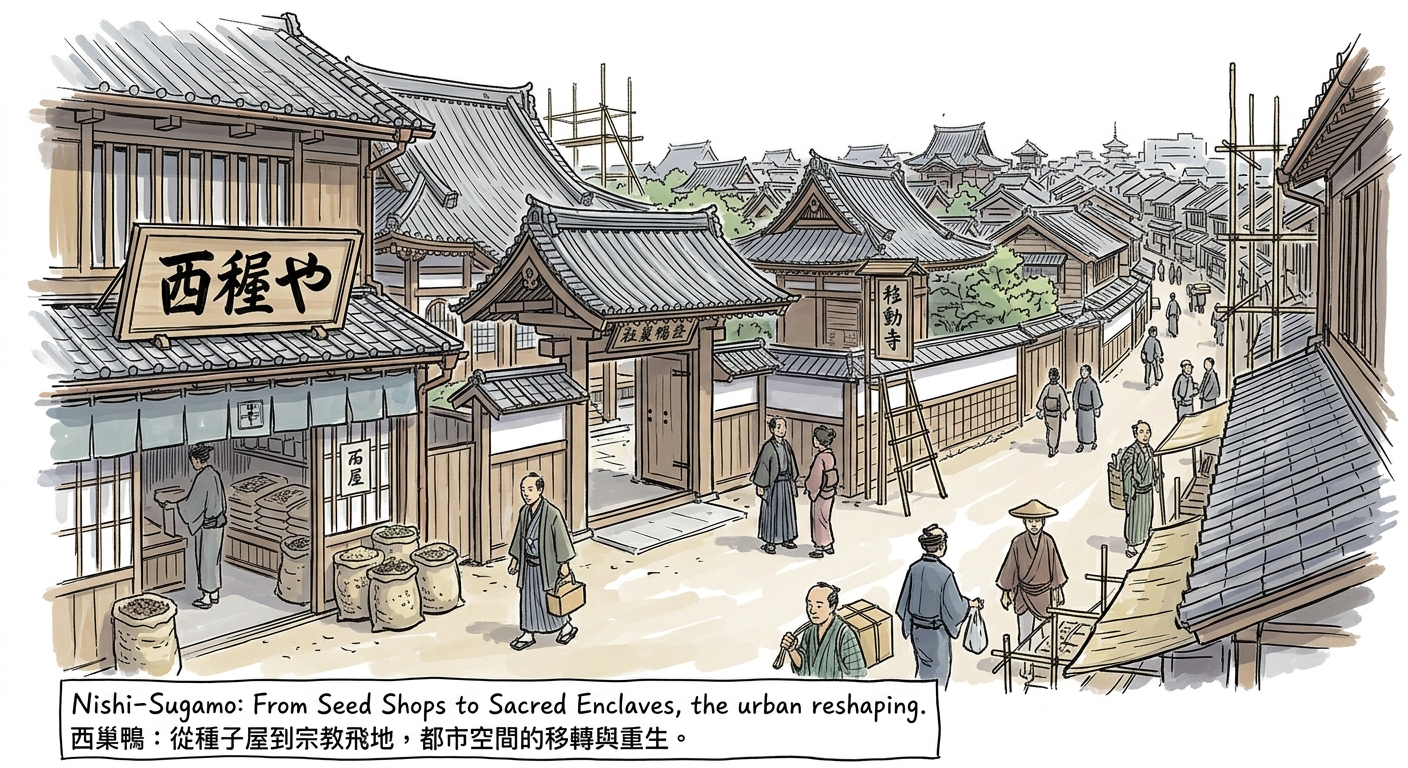
From Seed Shops to Sacred Enclaves: The Urban Reshaping
During the Edo period, Nishi-Sugamo’s identity was tied to its role as a terminal on the Nakasendo. It was a thriving agricultural nexus, famously populated by taneya (seed shops) that supplied the interior with crop seeds. However, the Meiji Restoration of 1868 initiated a radical restructuring of Tokyo’s urban core. To mitigate fire risks and modernize the city, the government implemented aggressive zoning policies in dense districts like Asakusa and Yotsuya, effectively pushing "sacred spaces" toward the periphery.
This geographic displacement signifies a calculated rationalization of the city. By re-territorializing these temples, the Meiji state transformed Nishi-Sugamo into a high-density Teramachi (Temple Town), effectively secularizing the center while concentrating religious life at the edge.
Temple Name | Original Location | Migration | Cultural Attributes & Historical Significance |
Sho-ho-ji | Ueno Shitaya | 1905 | A pioneer of the district; originally founded in the Tenpyo era. |
Myo-gyo-ji | Yotsuya | 1909 | Holds the grave of the historical "Oiwa," the woman whose tragic life inspired the Yotsuya Kaidan ghost story. |
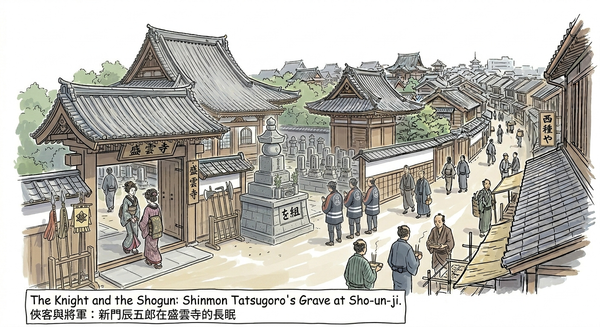
Sho-un-ji | Shitaya | 1908 | Final resting place of Shinmon Tatsugoro, the legendary chivalrous knight of Edo. |
Saipo-ji | Asakusa | 1927 | A historic Nagekomi-dera (Throw-in Temple) for the marginalized dead. |
Jigan-ji | Fukagawa | 1897 | Site of the family graves of literary giants Ryunosuke Akutagawa and Junichiro Tanizaki. |
This mass migration highlights the pragmatism of the Meiji state. For the contemporary traveler, the district offers a rare, concentrated view of religious geography that was once scattered across the city, now preserved in a dense urban weave that reflects the state’s early efforts to sanitize the capital.
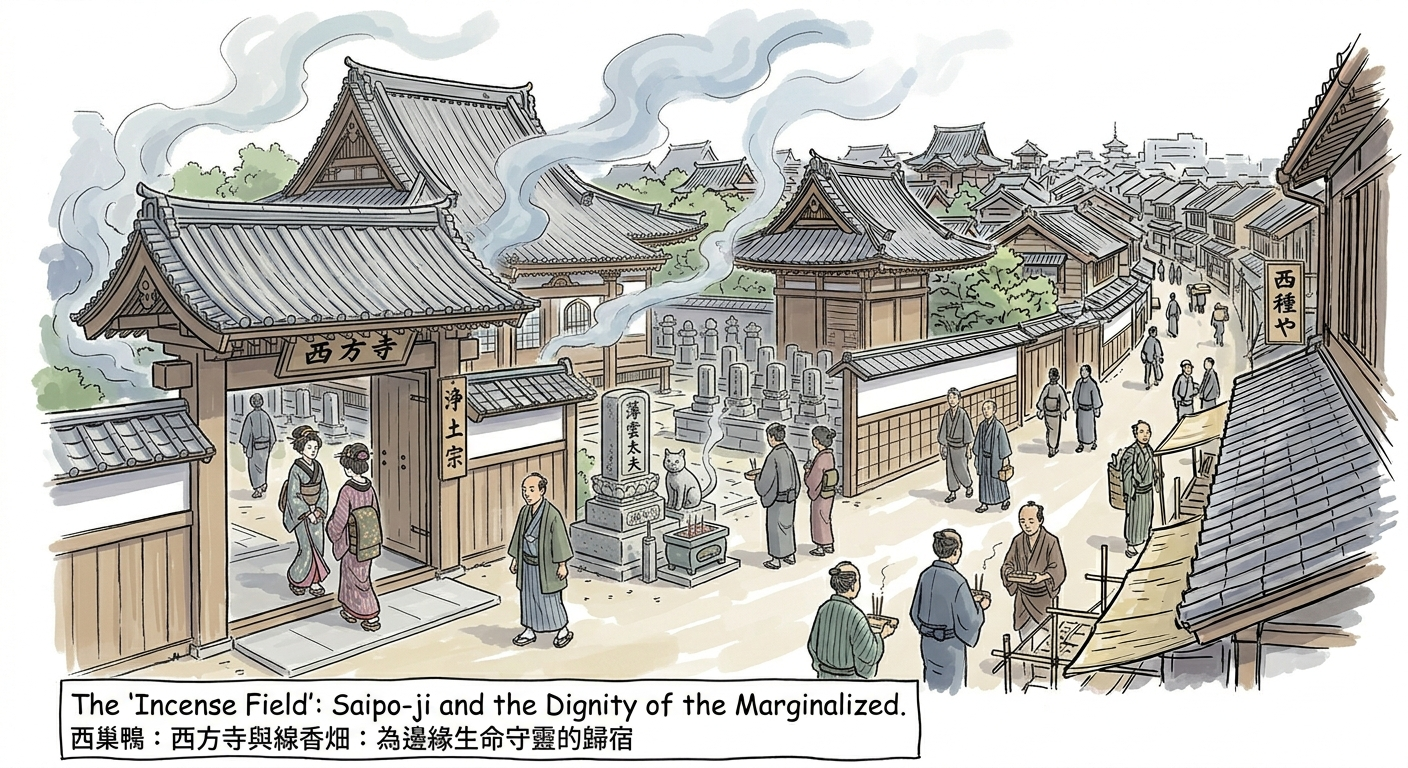
The "Incense Field": Saipo-ji and the Dignity of the Marginalized
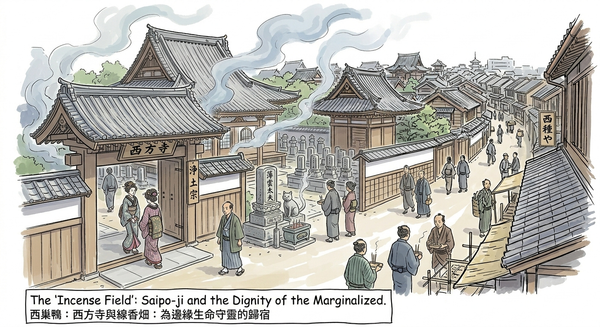
As the city pushed its temples outward, it also exported the memory of its most vulnerable citizens. Near the gates of the Yoshiwara pleasure districts, thousands of women lived and died in anonymity. In the eyes of the Edo state, these courtesans and executed criminals were muenbotoke—unclaimed souls with no place in traditional family graves.
Saipo-ji, formerly of Asakusa, rose to address this systemic neglect. However, its history is marked by intellectual ambiguity; while some records credit its 1622 founding to the disciples of the monk Donryu (Shoko and Tensho), other sectarian narratives attribute it to the priest Nenyo Shonin. Regardless of its origin, the temple's second priest, Dotsu—a former samurai—instituted a radical act of humanism. He offered dignity to those the state deemed "refuse," establishing a tiered fee structure: two shu for girls from large brothels and one shu for those from smaller shops.
The local community eventually bestowed the moniker "Incense Field" (Senko-batake) upon the grounds. This was a sensory recognition of the site's reality: so many marginalized dead were being laid to rest that the heavy, permanent scent of burning incense became a fixed element of the local atmosphere.
The presence of the cat monument dedicated to the courtesan Usugumo Dayu and her loyal cat "Tama," alongside the memorial towers for Yoshiwara’s fallen, transforms Saipo-ji. It is no longer just a religious site, but a monument to humanistic empathy that survived the rigid hierarchies of feudal Japan.
The Knight of the Nakasendo: Shinmon Tatsugoro’s Last Stand
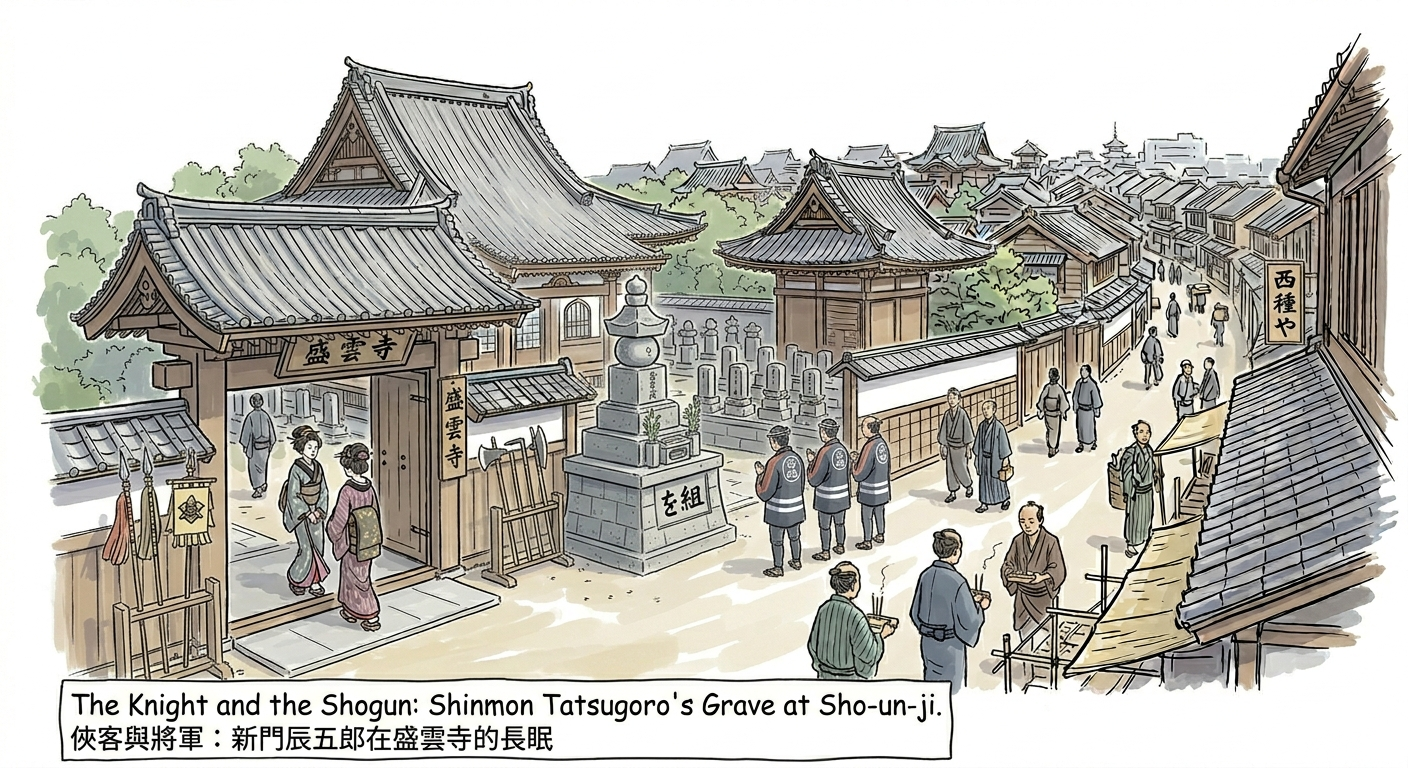
Nishi-Sugamo also guards the legacy of the Machibikeshi—the town firemen who functioned as the "chivalrous knights" (Kyakkaku) of the Edo underworld. Foremost among them was Shinmon Tatsugoro. A man of immense influence whose daughter became the concubine of the last Shogun, Tokugawa Yoshinobu, Tatsugoro moved between the underworld and the highest echelons of power.
Following the Ueno War, the bodies of the fallen Shogitai (loyalist soldiers) were left abandoned by the new government. Tatsugoro risked execution to gather, cremate, and bury these "enemies of the state." His grave at Sho-un-ji features a pedestal inscribed with the characters "を組" (Wo-gumi), the mark of his firefighting troupe, providing a physical anchor for his legend.
The historical records regarding Tatsugoro contain notable discrepancies, with birth years cited variously as Kansei 4, 9, or 12, and his age at death recorded as either 76 or 83. This ambiguity reinforces his status as a figure whose life exceeded official documentation. Visiting his grave offers a window into the "political agency" of the commoner class, proving that even as the Shogunate fell, the "knights" of the city maintained an independent code of ethics.
Rationalizing the Divine: Taisho University and the End of Sectarianism
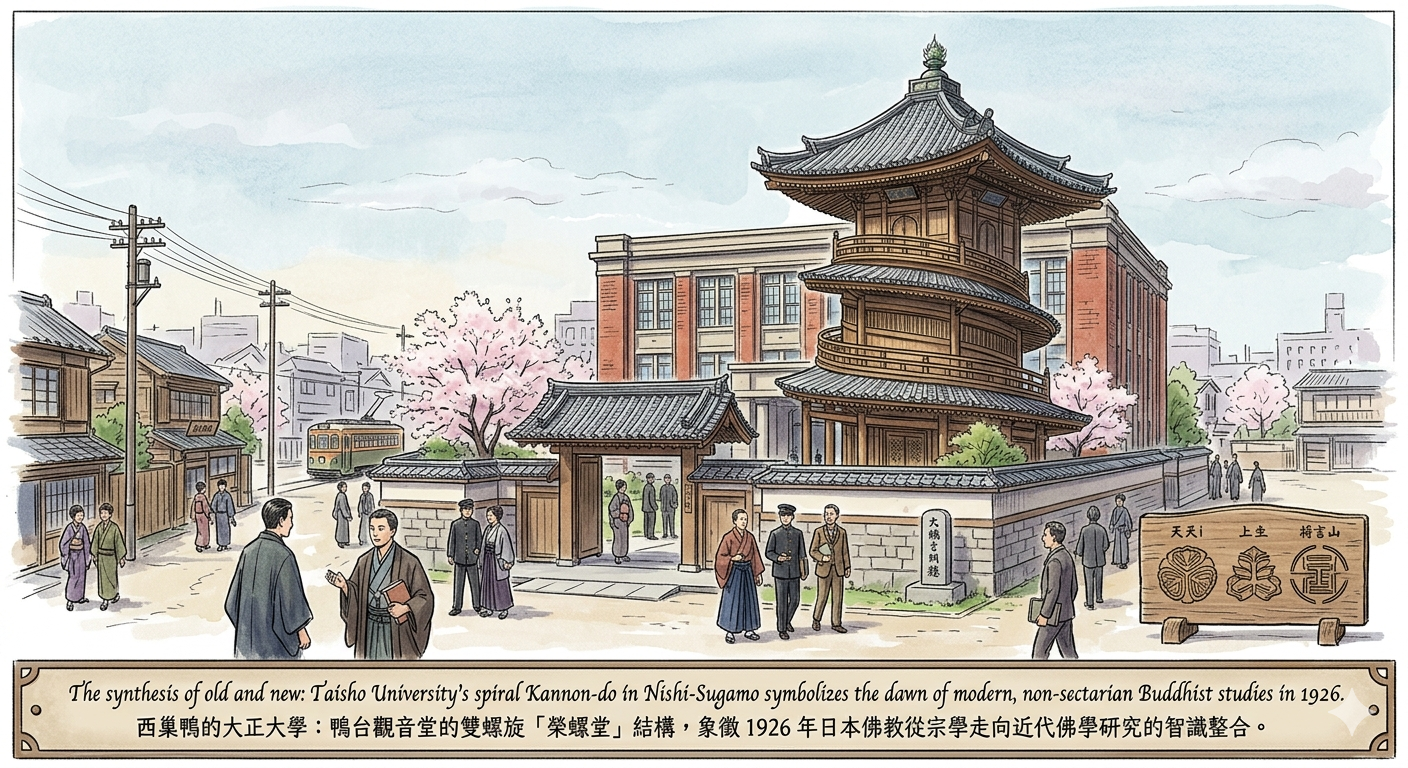
By the Taisho era, the pressure on Japanese Buddhism to adapt to modern academic standards became acute. Following the 1918 University Order, a historic merger occurred in 1926: the Tendai, Jodo, and Shingon-Buzan sects consolidated their resources to form Taisho University in Nishi-Sugamo.
This move signaled a pivot from "Sectarian Studies"—the insular teaching of specific dogmas—to "Modern Buddhist Studies," an academic discipline utilizing comparative and critical methods. The campus reflects this synthesis of tradition and modernity; the Sazae-do (Double Helix) architecture of the Kamo-dai Kannon-do uses a traditional structural form to house a modern intellectual mission, symbolizing the rationalization of the divine for a new century.
The "Family School" Experiment: Tomeoka Kosuke’s Vision of Reform
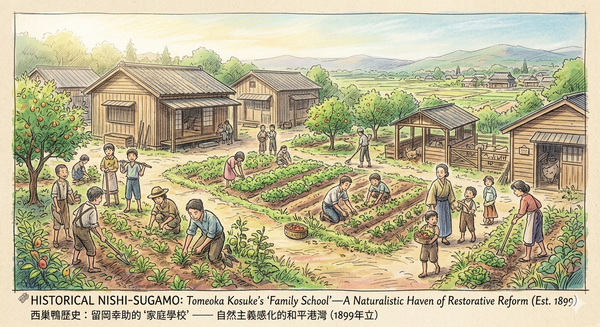
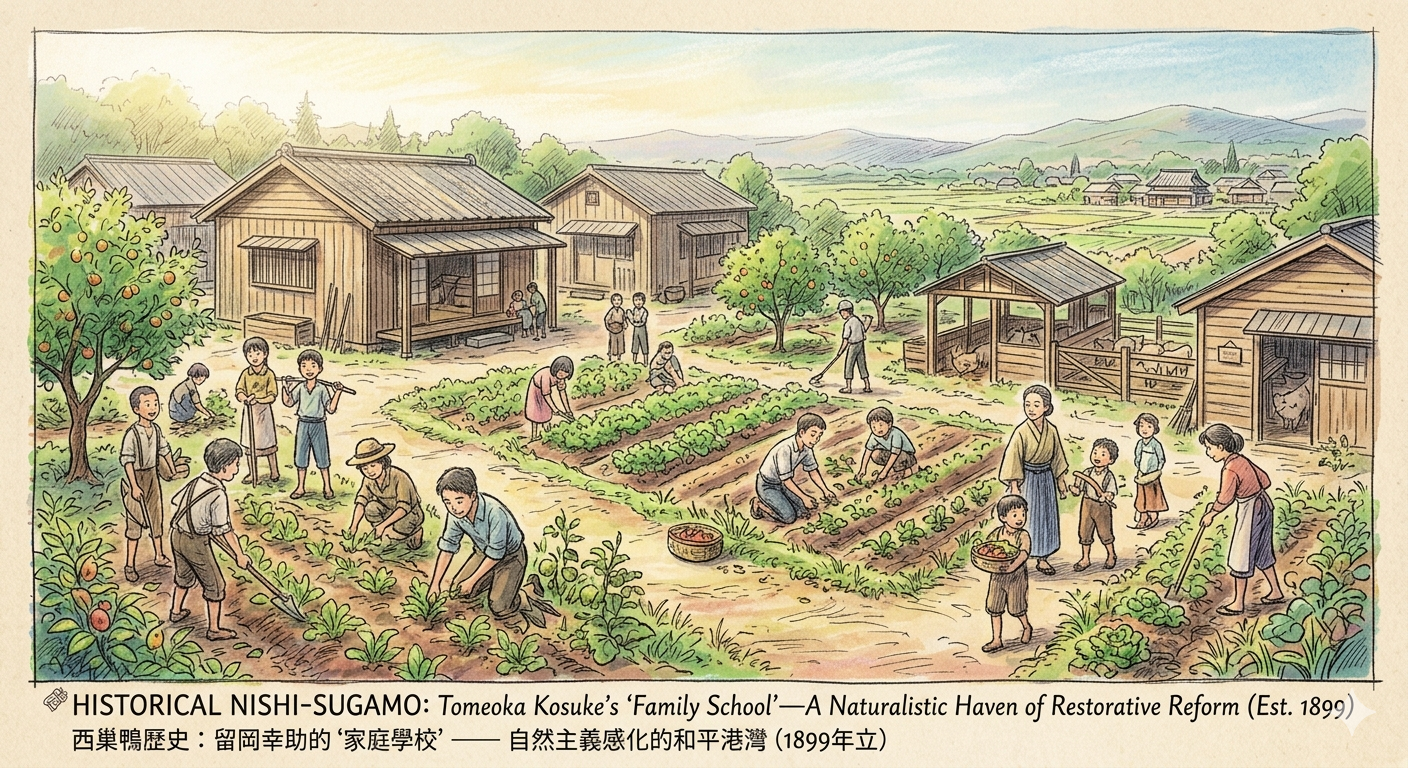
The final layer of Nishi-Sugamo’s history is found in the social welfare experiments of the late Meiji era. As industrialization triggered a rise in juvenile delinquency, Tomeoka Kosuke, a Christian chaplain at Sugamo Prison, proposed a "naturalistic" alternative to punitive justice.
Tomeoka founded the Katei Gakko (Family School) in 1899, rejecting bars in favor of farming, labor, and a "family-like" environment.
- 1899: Founded in Sugamo Village.
- 1909: Designated as a surrogate reformatory for Tokyo.
- 1914: Expanded with a naturalistic farming branch in Hokkaido.
- 1935: The school relocated to Suginami; the site was later occupied by the Japanese Foundation for Cancer Research.
The "Katei Gakko Trace" marker in Kami-Ikebukuro Higashi Park remains a quiet reminder of this pivot toward modern social welfare, representing a moment when Japan began to view its "deviant" youth as citizens to be restored rather than criminals to be hidden.
Hidden Gems & The Walking Perspective
To grasp the spatial continuity of Nishi-Sugamo, one should walk the old Nakasendo path toward the Koshinzuka crossing. Look for the Koshinzuka seed shop legacy—one of the few remaining traditional storefronts that recalls the area’s agricultural roots before its transformation into a Teramachi.
The recommended route begins at the Toden Arakawa tram line and proceeds toward the temple clusters. As you move, the atmosphere shifts from the bustle of modern commerce to a dense, quiet enclave where the architecture of different eras—Edo monuments, Meiji temples, and Taisho university halls—exists in a state of suspended animation.
Philosophical Synthesis & Conclusion
Nishi-Sugamo functions as a vital "Buffer Zone" for the collective memory of Tokyo. Throughout the modernization of Japan, this neighborhood absorbed what the city’s center could no longer contain: the tragic history of the Yoshiwara courtesans, the radical chivalry of leaders like Tatsugoro, and the intellectual evolution of the Buddhist faith. It was a site where the marginal was re-territorialized and given a permanent home.
The lesson for the modern traveler is that understanding a city comes from layered observation, not from visiting curated highlights. Nishi-Sugamo demonstrates that a neighborhood’s identity is formed by its ability to hold contradictory truths—the sacred and the profane, the punitive and the reformative—within the same physical space.
How do our modern cities treat their "edges" today? In the Meiji era, the edge was a place for inclusive re-territorialization—a place to move important, if inconvenient, parts of the soul. As we look at the glass-and-steel homogeneity of modern urban centers, we might ask what is lost when we no longer allow our cities to maintain such complex, sacred buffers.
To walk deeper into Tokyo's layered past, subscribe to our weekly dispatches from the field.
Plan Your Journey
- How to Get There: Access via the Toei Mita Line (Nishi-Sugamo Station) or the Toden Arakawa Line (Koshinzuka Stop).
- Recommended Accommodation: The nearby Otsuka or Sugamo areas offer a blend of traditional guesthouses and modern business hotels.
- Nearby Historical Points: Explore Sugamo Jizo-dori (the "Old Ladies' Harajuku") or take the tram toward Yanaka Cemetery for further exploration of Tokyo's historic burial grounds.
Q & A
Tell me about the 'throw-in temple' and its role for Yoshiwara's women.
In the history of Edo-era Tokyo, the "throw-in temple" (known as Nagekomi-dera or Doteotsu Nagekomi-dera) refers to a religious institution that served as a final resting place for marginalized individuals, most notably the women of the Yoshiwara pleasure district,. Saipo-ji (西方寺) is the most prominent temple associated with this role.
The Role of Saipo-ji for Yoshiwara's Women
During the Edo period, the Yoshiwara district was a place where thousands of women lived in harsh conditions, often dying from disease or abuse. Because many of these women were considered "Muen-butsu" (unclaimed spirits) with no family or status to warrant a proper burial, their remains were frequently discarded.Saipo-ji, originally located in Asakusa Shoten-cho near the Yoshiwara main gate, stepped in to provide the following:
- Sanctuary and Burial: The temple's second chief priest, Doteotsu, a former samurai, vowed to offer salvation and burial to these women regardless of their status. He accepted the bodies of unclaimed Yoshiwara women for a nominal fee—charging "large houses" two shu and "small houses" only one shu.
- Constant Prayer: Because of the staggering number of deceased women brought to the temple, incense was burned continuously for their souls. The resulting clouds of smoke were so persistent that locals nicknamed the temple "Senko-batake" (the Incense Field).
- Restoring Dignity: While the official state system viewed these women as social "residue," Saipo-ji functioned as an unofficial social safety net, providing institutionalized low-cost funerals and lasting memorial services that granted these women a final measure of human dignity,.
Legendary and Historical FiguresThe temple's connection to Yoshiwara is also preserved through specific legends and gravesites:
- The Beckoning Cat Legend: Saipo-ji is home to a cat mound (Neko-zuka) dedicated to Usugumo Dayu, a famous oiran (high-ranking courtesan). Legend says her beloved cat, Tama, died saving her from a snake; the oiran subsequently established a memorial for the cat at the temple, contributing to the "beckoning cat" (Maneki-neko) folklore,.
- Famous Graves: In addition to the collective memorial towers for the thousands of anonymous women, the temple also holds the grave of the legendary oiran Takao (Miuraya Manji Takao).
Modern LegacyIn 1927, Saipo-ji was moved to its current location in Nishisugamo due to urban reorganization,. Today, it remains a site of historical pilgrimage where the Yoshiwara Women's Memorial Tower and the cat mound continue to stand as physical witnesses to the "life elegies" of these marginalized women.
How did Nishisugamo transform from a farming village into a temple district?
The transformation of Nishisugamo from a rural agricultural settlement into a high-density temple district was a result of modern urban planning and the systemic relocation of religious institutions from central Tokyo during the late 19th and early 20th centuries.
1. The Original Farming Settlement (Edo Period)During the Edo period, Nishisugamo was part of the vast Sugamo Village, located on the outskirts of the Edo city core. Because it sat along the Old Nakasendo, a vital transportation hub connecting the city to the interior, the area developed a specialized agricultural economy. It was particularly famous for its "seed shops" (seed sellers), which clustered along the highway to serve travelers and local farmers.
2. Modernization and Policy Drivers (Meiji Era)Following the Meiji Restoration in 1868, the new government sought to modernize Tokyo. Several factors drove the decision to push urban functions outward to areas like Nishisugamo:
- Land Pressure: Relieving overcrowding in central districts like Asakusa, Shitaya, and Yotsuya.
- Public Safety: Improving urban sanitation and creating firebreaks to prevent the devastating fires common in the dense city center.
- Urban Reorganization: Reclaiming central land for modern infrastructure and state purposes,.
3. The Collective Migration of TemplesBetween the late 1890s and the early 1900s, Nishisugamo underwent a rapid spatial restructuring. Traditional Buddhist temples were moved from the city center to the urban fringe in what became a collective relocation. Notable examples of this migration include:
- Jigen-ji: Moved from Fukagawa in 1897.
- Shoho-in: Moved from Ueno Shitaya in 1905, becoming an early pioneer of the new temple district.
- Seiun-ji: Moved from Shitaya in 1908.
- Myogyo-ji: Moved from Yotsuya in 1909.
- Saipo-ji: Moved from Asakusa later, in 1927.
4. Societal and Symbolic SignificanceThis shift was more than just a geographic move; it represented the marginalization of "sacred spaces". In the Edo period, temples were central to local administration and social life. However, modernizing authorities viewed them as remnants of a traditional order and pushed them to the city's periphery. This process effectively turned Nishisugamo into a "religious enclave" or a "buffer zone" for the expanding metropolis,.5. Modern-Day LegacyToday, the area around Nishisugamo 4-chome retains a remarkably high density of temples, standing in sharp cultural contrast to the surrounding modern residential buildings. While most current temple structures date from the Meiji or Taisho eras, a single traditional seed shop still operates along the Old Nakasendo, serving as a rare physical reminder of the district's ancient agricultural roots.
Reference and Further reading
- 西巣鴨 - FC2, accessed April 1, 2026,
- 巣鴨の庚申塚は、中山道の本街道であり、板橋宿の一つ手前の立場として上り、下りの旅人の往来が激しく、休息所として賑わい簡単な茶屋も在り - 巣鴨庚申堂奉賛会, accessed April 1, 2026,
- 妙行寺 (豊島区) - accessed April 1, 2026,
- 西巣鴨の街角, accessed April 1, 2026,
- 西巣鴨の歴史散歩, accessed April 1, 2026,
- 西方寺 - 豊島区観光協会, accessed April 1, 2026,
- 盛雲寺(新門辰五郎の墓) - 歴史探訪と温泉 - FC2, accessed April 1, 2026,
- 人々を助け愛された猫たち。江戸に伝わる“福猫伝説”「西方寺」(豊島区)|裏・東京スポット〈招き猫誕生秘話〉 | 男の隠れ家デジタル, accessed April 1, 2026,
- 巣鴨庚申塚 - 歴史探訪と温泉 - FC2, accessed April 1, 2026,
- 巣鴨・西方寺の可愛すぎる猫と薄雲太夫 - 東京散歩トリビア, accessed April 1, 2026,
- 吉原遊廓・遊女達の投込み寺の一つ「西方寺」について|橘京 - note, accessed April 1, 2026,
- 彰 義 隊 士 の 墓・碑 (円通寺), accessed April 1, 2026,
- (注)新門辰五郎(1800~75), accessed April 1, 2026,
- 110 新門辰五郎墓(豊島区西巣鴨4・善養寺、盛雲寺), accessed April 1, 2026,
- 大正大学 - 新纂浄土宗大辞典, accessed April 1, 2026,
- 【大正大・上】仏教3宗4派が連合し開校 - 福祉新聞Web, accessed April 1, 2026,
- 2024年 |大正大学 - 豊島区, accessed April 1, 2026,
- 大学沿革丨大正大学[公式サイト], accessed April 1, 2026,
- 大正大学(タイショウダイガク)とは? 意味や使い方 - コトバンク, accessed April 1, 2026,
- 大正大学 - accessed April 1, 2026,
- 近代日本における戦争と仏教教団 ―日清・日露戦争期を中心に― 論文要旨, accessed April 1, 2026,
- 留岡幸助創設・家庭学校跡 - 歴史探訪と温泉 - FC2, accessed April 1, 2026,
- 留岡幸助とペスタロッチ: 巣鴨家庭学校を舞台にした教育実験 - 藤井常文 - Google Books, accessed April 1, 2026
 Lawrence
 Lawrence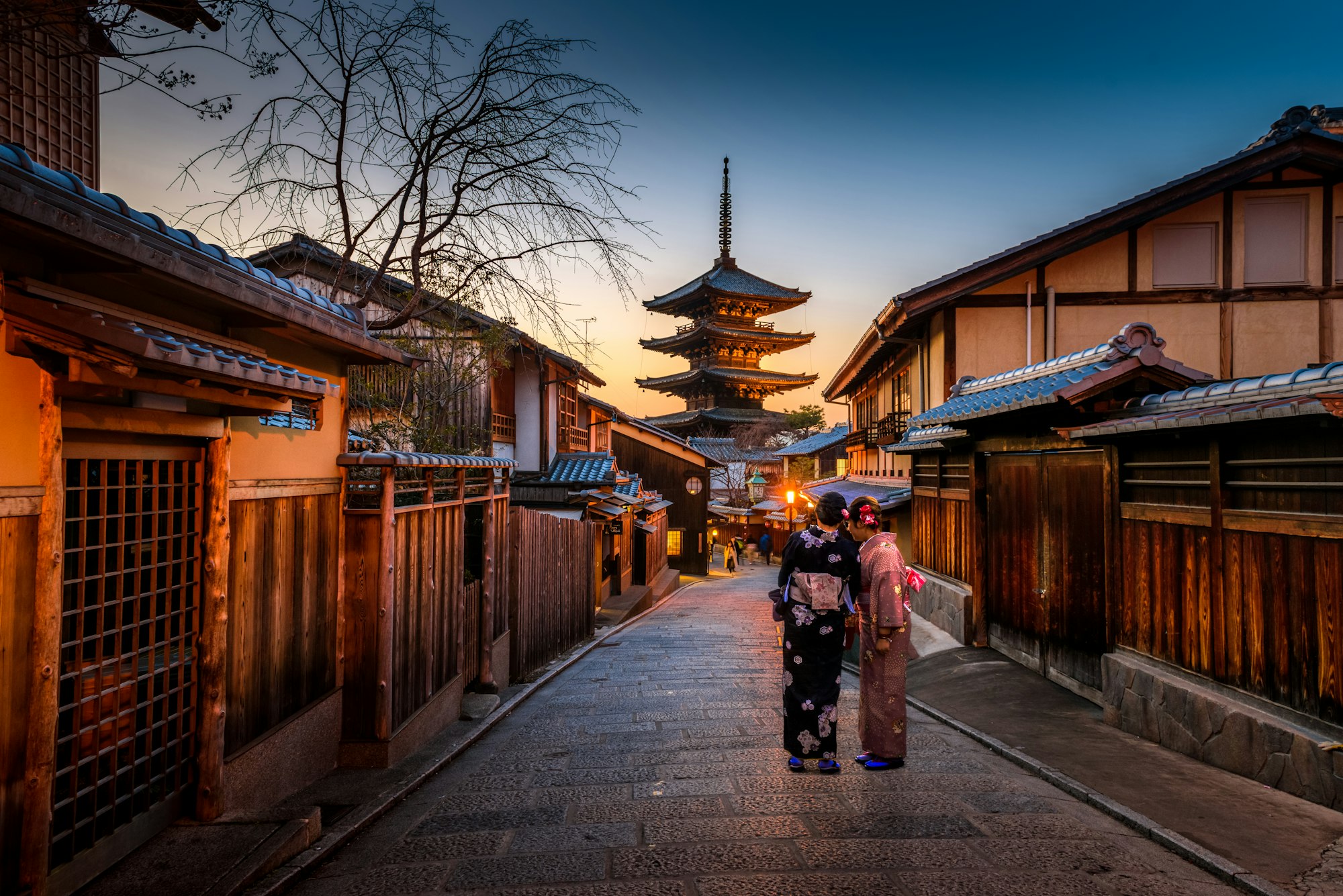
 Lawrence