(ENG) Tokyo’s Nishiarai Walk – 3 Nostalgic Layers of a Sacred Shitamachi Suburb
Take a slow walk through Nishiarai, a nostalgic suburb in northern Tokyo. This travel guide explores sacred temples, a vintage one-station train line, and quiet alleys to reveal the authentic Shitamachi charm and local history away from modern crowds.

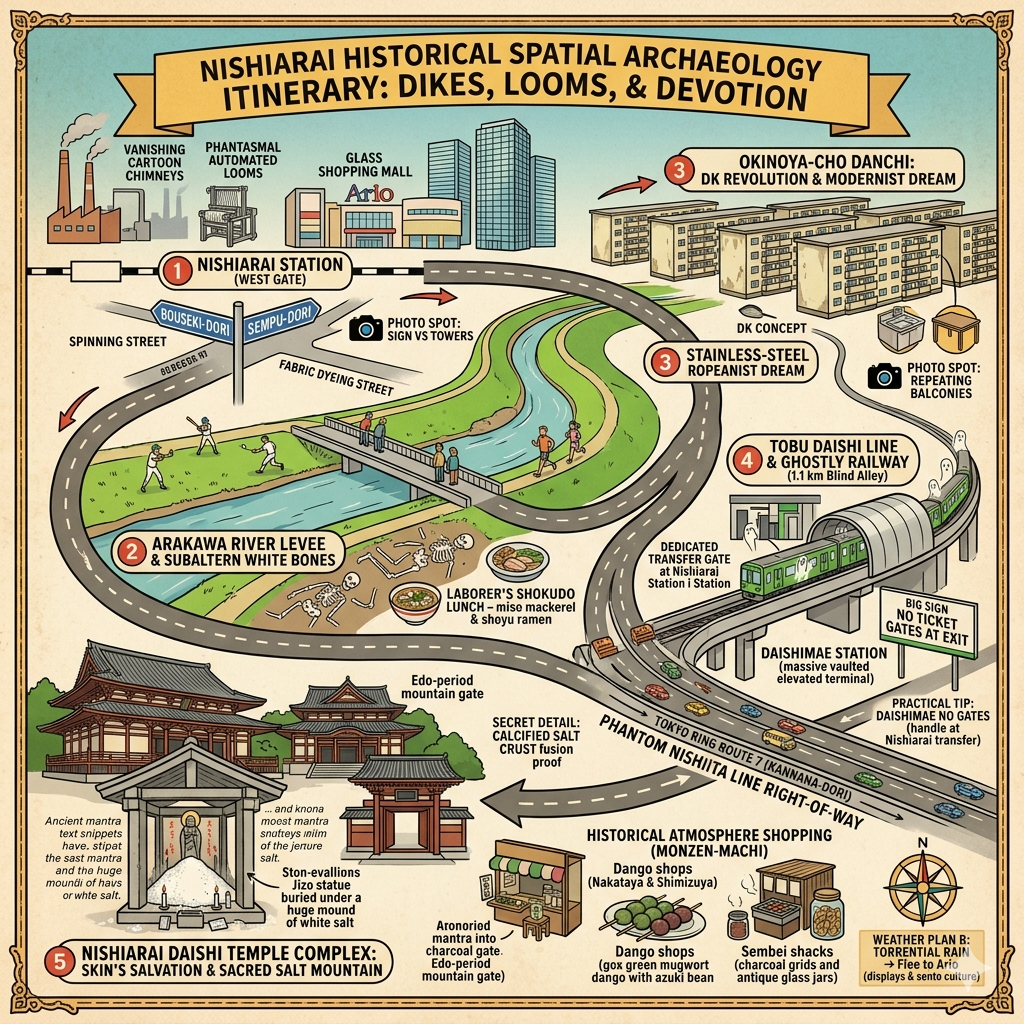
This is a cultural travel story and walking guide to Nishiarai, a nostalgic suburb hidden in northern Tokyo. Through three unique layers of local life, it explores historic temples, a vintage one-station train line, and quiet residential alleys to show how sacred Buddhist traditions and everyday Shitamachi warmth endure away from the city's modern crowds.
 Lawrence
In the northern Adachi borderlands, where the dense sprawl of Tokyo begins to fray toward the suburban horizon, lies Nishiarai. To the casual visitor, it is merely the site of a celebrated temple; to the historian and urban geographer, it is a profound site of industrial rupture and radical urban experimentation. This district demands a method of "layered observation"—a commitment to looking past the glossy surfaces of modern consumption to identify the physical archive etched into the asphalt. Nishiarai’s geography is defined by interruption. Today’s streets are a map of failed dreams, from truncated transit networks to the hollowed-out footprints of vanished industrial empires. By examining these strata, we see how the "Shitamachi" (lower town) identity was not merely preserved in temple rituals, but aggressively forged in factories and eventually standardized within the concrete housing blocks of the mid-20th century.
Listen to the historical stories told in detail (For subscribers only)
The Ghost of the "Second Yamanote Line": A Transit Dream Interrupted
Transportation infrastructure—or its notable absence—acts as the primary architect of a district’s social geography. The ease of movement determines which neighborhoods are integrated into the city's pulse and which are left to develop in isolation. In Nishiarai, the transit map remains a fossilized record of a grand 1920s ambition that collapsed under the weight of catastrophe and economics.
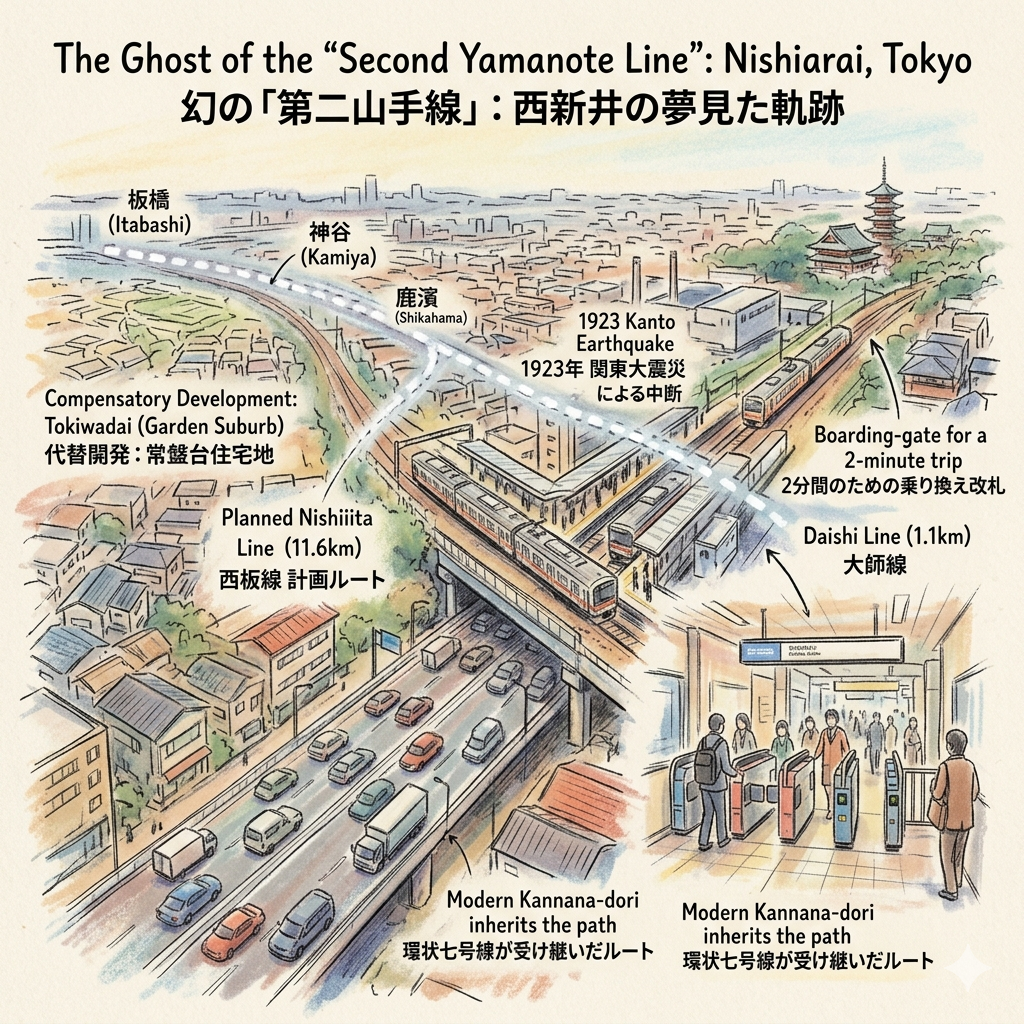
The "Nishiita Line" was once envisioned as a 11.6km "Second Yamanote Line," a vital ring-link connecting Nishiarai to Kami-Itabashi. However, the 1923 Kanto Earthquake shattered this vision. Capital was diverted to emergency repairs of existing lines, and as land prices surged during the post-quake resettlement, the project was abandoned. What survived is the 1.1km "appendix" known as the Daishi Line. The spatial consequence of this failure is felt immediately at Nishiarai Station. Here, the traveler encounters a unique operational quirk: a "boarding-gate" system where one must clear ticket gates to enter a platform for a train that travels a mere two minutes to a dead-end station. This cognitive dissonance—clearing security for a blind-alley track—is a living remnant of the line's truncated destiny.
This "failure" of rail led directly to a "compensatory development" elsewhere; the vacant land intended for the Western terminus in Itabashi was instead transformed by Tobu Railway into the high-end Tokiwadai garden suburb. Today, the modern Ring Road 7 (Kannana-dori) physically inherits the path those trains never took, moving cars along a route once promised to the rail. As the transit dreams stalled, however, the movement of people was being accelerated by an industrial empire on the station’s western flank.
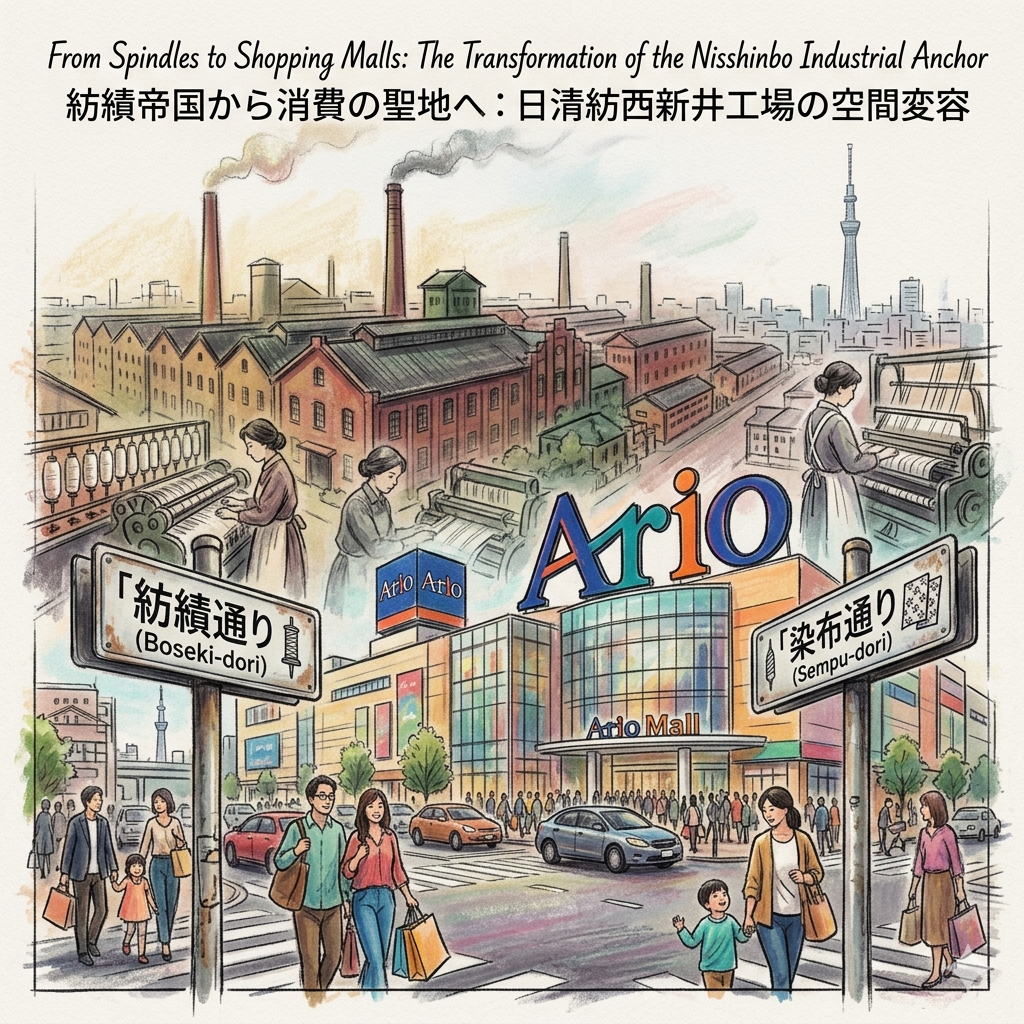
From Spindles to Shopping Malls: The Transformation of the Nisshinbo Industrial Anchor
Urban spaces are frequently the product of "creative destruction," wherein industrial zones are hollowed out to facilitate modern consumption. In Nishiarai, this transition is personified by the site of the former Nisshinbo West Nishiarai plant. For eighty years, this 20-hectare "industrial forbidden zone" was the district’s economic anchor, a self-contained world of research labs and worker dormitories.
Established in 1924, the plant dominated the local landscape, absorbing labor from across Japan. The shift from production to consumption is starkly visible in the site's reconfiguration:
Feature | 1924: Industrial Empire | 2007: Modern Consumption |
Primary Function | Cotton spinning & female worker dormitories | Ario Shopping Mall & public parkland |
Social Structure | Research labs & institutional worker housing | "Nouveau Nishiarai" luxury housing |
Linguistic Ghosts | Factory floor layout for spinning & dyeing | Boseki-dori (Spinning Road) & Sempu-dori (Dyeing Road) |
Walking the perimeter of the massive Ario Mall today, the historian notes that while the machinery is gone, the scale of the corporate "forbidden zone" remains. The road names Boseki-dori and Sempu-dori serve as micro-topographical clues—linguistic ghosts that developers could not fully erase. This industrial growth, however, was only made possible by a violent reconfiguration of the natural landscape just to the south.
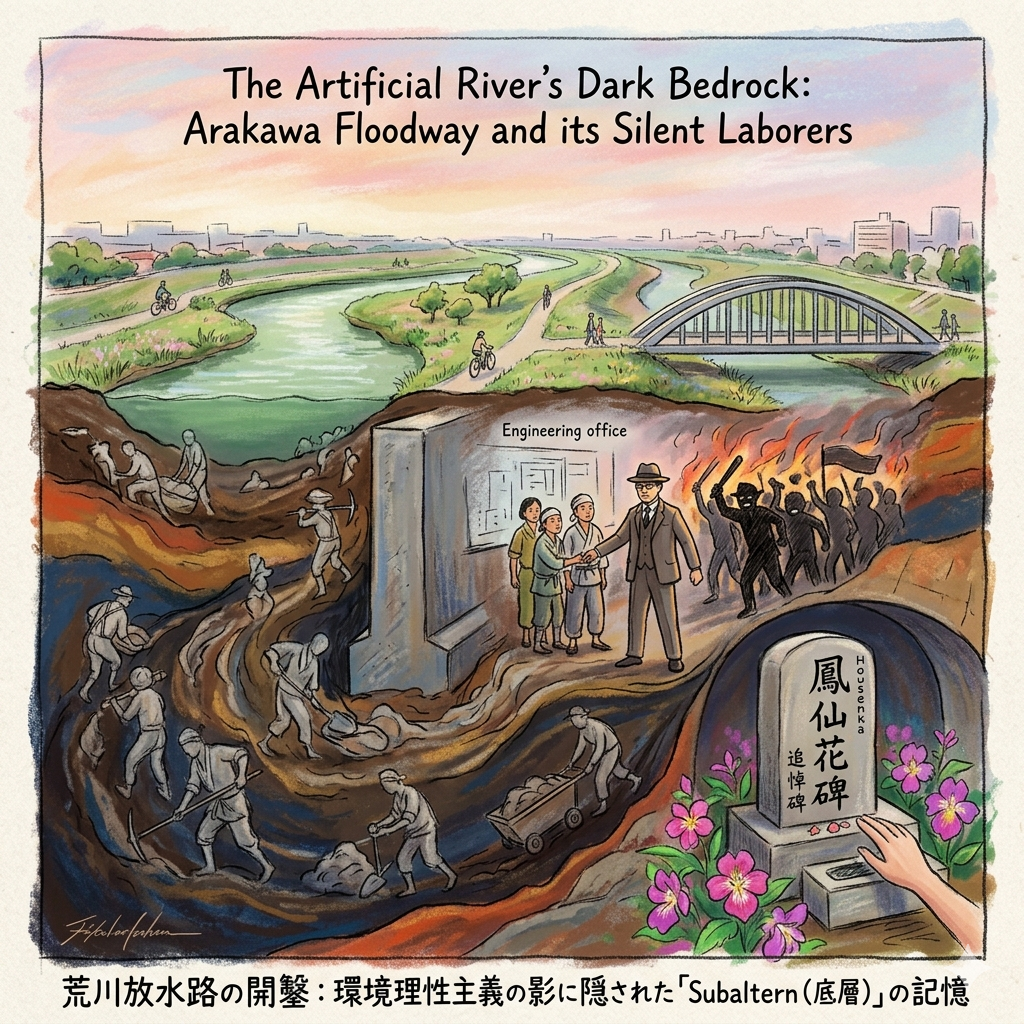
The Artificial River’s Dark Bedrock: The Arakawa Floodway and its Silent Laborers
The Meiji government’s "Environmental Rationalism" sought to tame nature to protect the capital's heart, but this safety was bought at a high human cost. Following the devastating floods of 1910, the 22km Arakawa Floodway was carved into the earth. While celebrated as a technocratic triumph of flood control, its bedrock is built upon a subaltern narrative of colonial exploitation.
The project relied upon the grueling labor of thousands of Korean and Chinese workers. Among the engineers was Akira Aoyama—the only Japanese engineer to have worked on the Panama Canal. Aoyama brought a rare humanitarian lens to the project; during the horrific 1923 Kanto Earthquake massacre, when false rumors led to the killing of ethnic Koreans along the riverbanks, Aoyama famously risked his life to protect his workers from vigilante violence.
Today, the peaceful greenery of the riverbanks conceals these traumas. To find the necessary counter-monument, one must look to the "Housenka" memorial, located under the Mikenagawa Bridge on the border of Katsushika and Sumida. It stands as a silent witness to the laborers whose blood is mixed with the concrete of Tokyo's primary flood defense. The serene river view is a mask for a history of institutionalized violence and colonial labor.
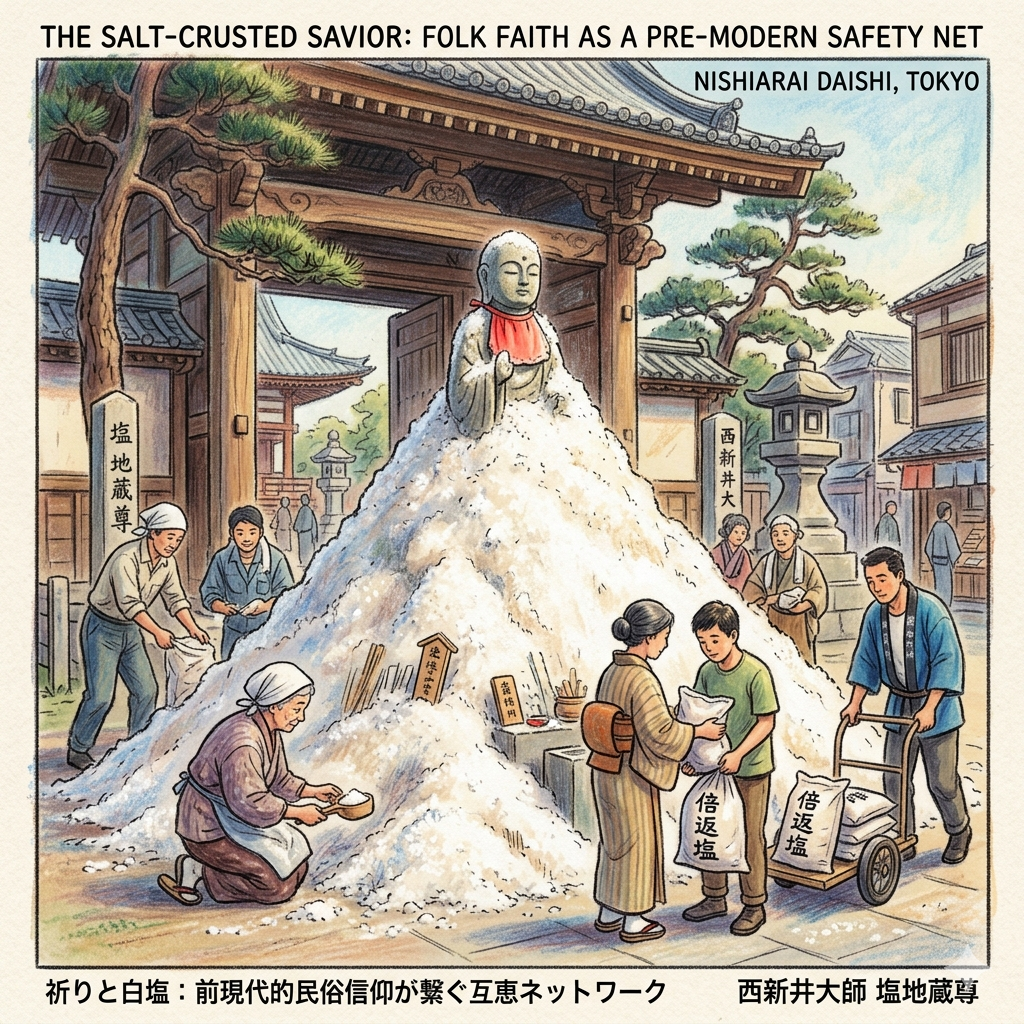
The Salt-Crusted Savior: Folk Faith as a Pre-Modern Safety Net
Before the state institutionalized healthcare, folk religion functioned as a vital psychological and physical coping mechanism. This is nowhere more evident than at Nishiarai Daishi, an institution once so prominent that a popular proverb claimed: "Male to Kawasaki, female to Nishiarai."
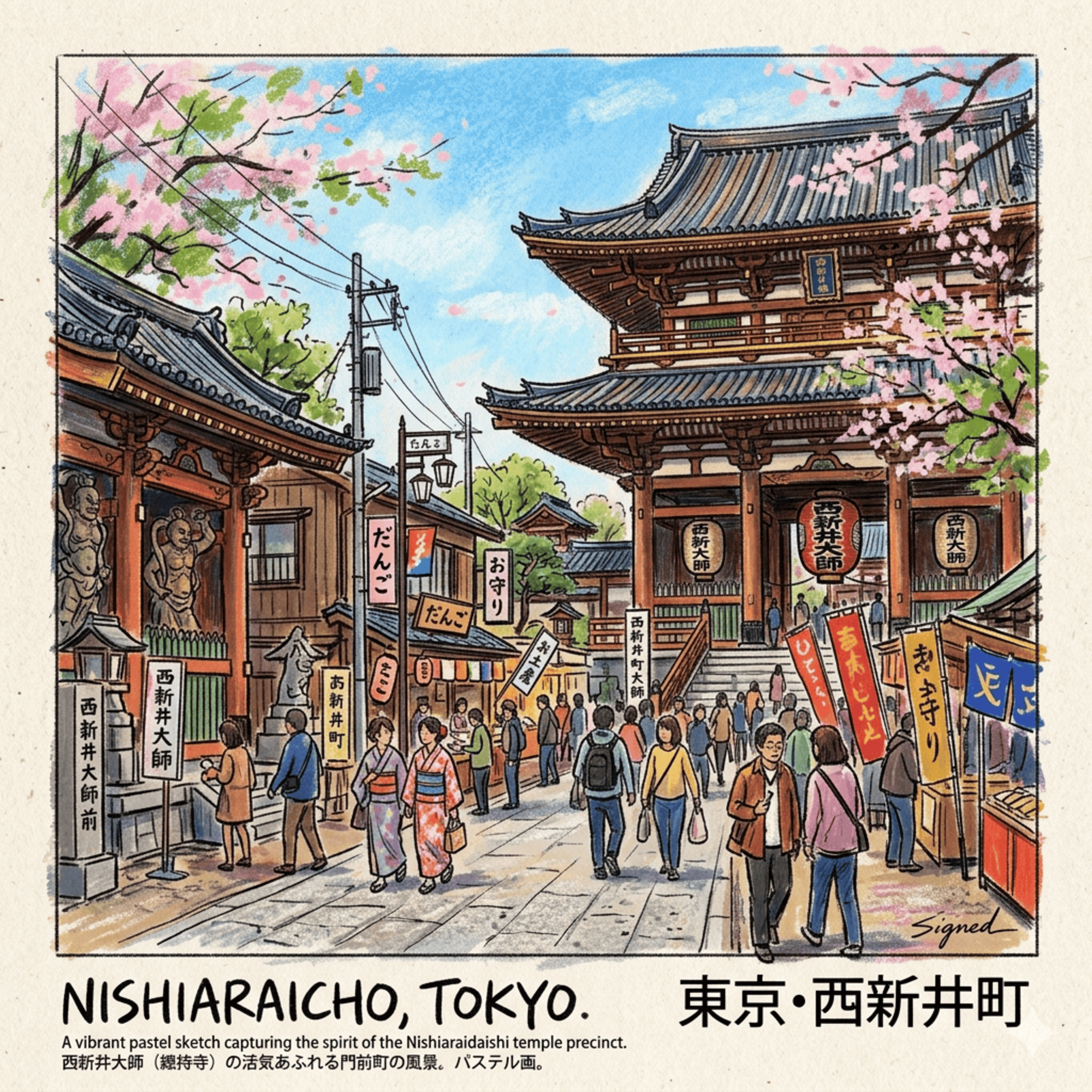
At the mountain gate, the observer encounters the Salt Jizo (Shio-jizo), a site of sacred, reciprocal healing. In an era when skin ailments were rampant and doctors unaffordable, the ritual provided a spiritual safety net. Practitioners would chant the mantra “on-ka-ka-kabi-san-ma-ei-so-wa-ka,” take sacred salt to treat their sores, and return double the amount upon healing.
The resulting visual is that of a "salt sculpture." The stone Jizo is nearly buried under white mounds of coarse salt, with only the faint outline of its head visible. This salt mountain is a striking physical manifestation of centuries of collective suffering and the Shitamachi working class’s desperate pursuit of bodily salvation.
This spiritual management of the body eventually transitioned into the state-led management of the family unit during Tokyo's post-war reconstruction.
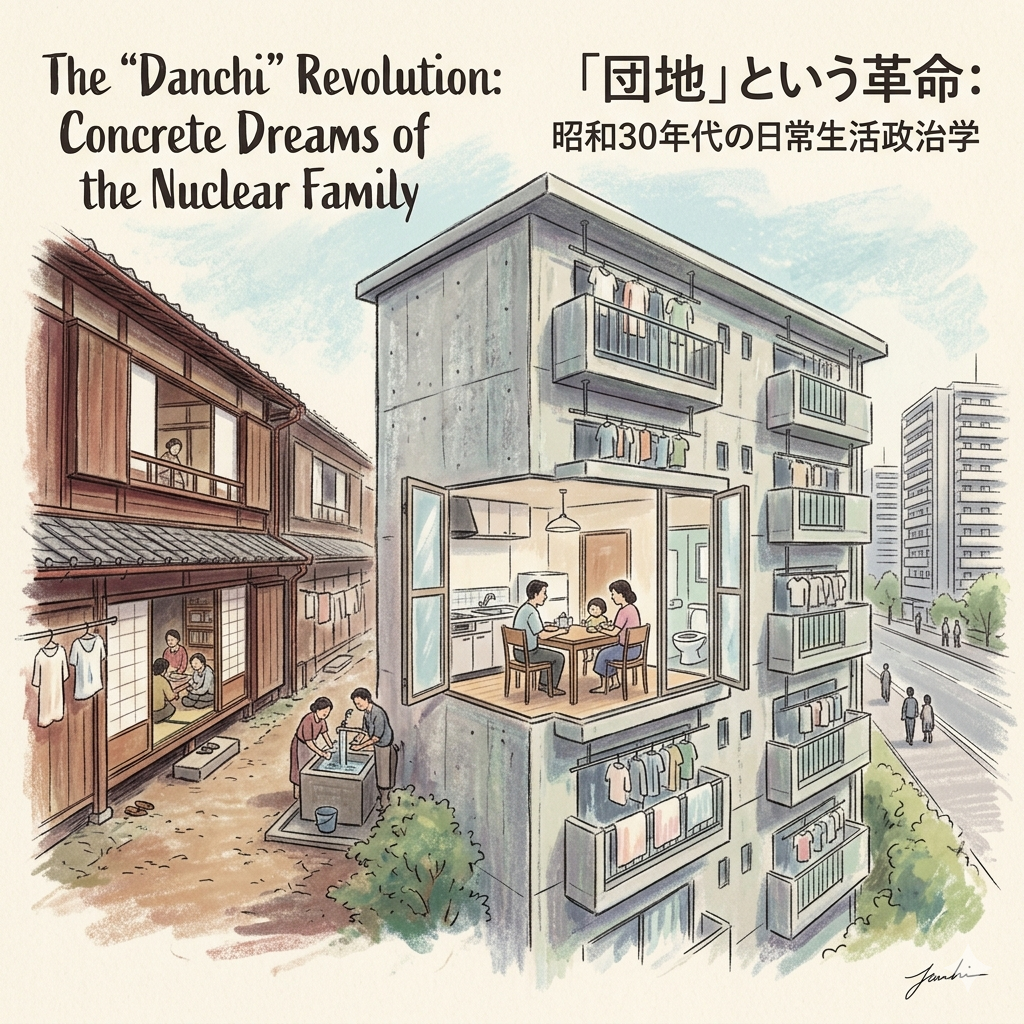
The "Danchi" Revolution: Concrete Dreams of the Nuclear Family
The post-war housing crisis ushered in the "Daily Life Revolution," a period where the Japan Housing Corporation sought to standardize Japanese existence. In 1958, the Koyano-cho housing complex arrived in Nishiarai, introducing the radical "DK" (Dining Kitchen) concept. This architectural shift shattered the traditional Nagaya (longhouse) social structures, replacing communal living with the private, standardized nuclear family.
These units—ranging from a mere 27.3 to 29.9 square meters—represented a leap into "modern" living, featuring individual toilets and stainless steel sinks. Yet, this modernization brought an "urban alienation," as the porous boundaries of the old neighborhoods were replaced by thick reinforced concrete. Today, the surviving 4-story blocks of Koyano-cho stand in stark contrast to the barrier-free "Frere Nishiarai," marking the transition from a mid-century dream of modernity to the reality of an aging society.
Archaeological Anomaly: The Koyano-cho Public Housing Complex
To observe the "living fossils" of 1950s modernist architecture, a visit to the Koyano-cho Public Housing complex (Nishiarai Honcho 4-chome) is essential. Here, the original scale of the post-war dream is palpable in the faded beige walls and the generous, albeit weathered, green spaces between buildings. These gaps were designed to provide light and air—a mid-century luxury now facing the quiet reality of an aging demographic. Walking through this complex allows the traveler to feel the transition from a rural "borderland" to the institutionalized, standardized Tokyo that defined the late 20th century.
Conclusion: A Philosophical Reflection on the Urban Archive
Nishiarai is a dynamic spatial archive where competing eras of human priority are stacked upon one another. We see the domestication of water in the Arakawa, the compensatory development of transit in the truncated Daishi Line, and the institutionalization of life from the Salt Jizo to the Danchi blocks.
How does the ground we walk on—the shopping malls over spinning mills, the ring roads over ghost tracks—shape our understanding of what it means to be a "modern" citizen? To walk Nishiarai is to realize that our contemporary life is built upon the ruins of failed plans and the silent labor of those the official archives often forget.
If you value these layered explorations of our urban landscape, consider subscribing to the Historical Travel Stories newsletter for more journeys into the depths of history.
Planning Your Historical Walk
- How to get there: Take the Tobu Skytree Line to Nishiarai Station. Experience the "boarding-gate" quirk before taking the one-stop Daishi Line journey.
- Recommended Tour: Begin at the Salt Jizo within Nishiarai Daishi. Walk south along the "Boseki-dori" industrial trail to see the former Nisshinbo site, and conclude at the Koyano-cho housing complex to observe 1950s modernism.
- Note on Accommodation: Stay in nearby Kita-Senju for better historical continuity; its river history and railway junctions provide the perfect context for your exploration of the Adachi borderlands.
Q & A
Tell me about the salt-covered Jizo and local healing traditions.
In Nishiarai Daishi (Gochizan Soji-ji), the Salt Jizo (Shioshizo) is a prominent fixture of local folk healing traditions, representing a unique intersection of religious faith and pre-modern public health. Located to the left of the temple's main Sanmon gate, this stone statue is famously encased in thick layers of white salt, often appearing like a "salt sculpture" where only the head of the Jizo is visible.
The Healing Ritual of Salt
The tradition centers on a specific "sacred contract" between the believer and the deity to treat persistent skin conditions.
- The Petition: Historically, lower-class citizens in Edo suffered from nutritional deficiencies and water pollution, leading to chronic skin diseases such as warts (ibo) and scabies. To seek a cure, a believer visits the Jizo and recites the mantra: “On ka-ka-kabi sanmaei sowaka”.
- The Remedy: The practitioner is permitted to take a small bag of consecrated salt from the base of the statue for free to apply or rub onto the affected area of their skin.
- The Repayment: If the ailment is cured, the believer is bound by a "sacred reciprocal network" to return to the temple and offer double the volume of salt originally taken. This practice has resulted in the massive accumulation of salt seen today, symbolizing centuries of collective gratitude and the relief of physical suffering.
Cultural and Symbolic Significance
In Japanese tradition, salt carries the dual function of purification (kiyome) and acting as a physical medicinal agent. During the Edo period, when professional medical care and kanpo (herbal medicine) were prohibitively expensive, the Salt Jizo provided a low-cost "spiritual coping strategy" for the marginalized. It allowed commoners to manage their anxieties regarding diseases that were often stigmatized as "unclean".
Other Local Healing Traditions
The healing reputation of Nishiarai extends beyond the Salt Jizo to several other sacred sites within the temple grounds:
- The Origins of Nishiarai: The name "Nishiarai" (meaning "West New Well") itself comes from a legend involving Kobo Daishi (Kukai). In 826 AD, he reportedly dug a well to the west of the main hall to provide miraculous spring water that cured a local plague. This well, the Kajisui no Ido, is still a site of veneration for those seeking to prevent epidemics or cure stubborn illnesses.
- Enmei Mizuarai Jizo-son: This is another "healing Jizo" where devotees use sacred water to wash the specific part of the stone statue's body that corresponds to their own physical ailment, praying for longevity and the washing away of karmic hindrances.
These traditions collectively contributed to the Edo-period saying, "Men to Kawasaki, Women to Nishiarai," as the temple’s focus on mercy, washing, and skin-deep purification particularly resonated with women who managed family health and hygiene. Today, despite modern medicine, the salt-covered Jizo remains a powerful "spatial archive" of the historical longing for relief from physical pain.
Why was the temple considered a sanctuary for women?
Nishiarai Daishi (Gochizan Soji-ji) became widely known as a sanctuary for women, particularly during the Edo period, due to a combination of its specialized healing rituals and its standing in popular folk culture. This reputation was encapsulated in the common saying, “Men to Kawasaki, Women to Nishiarai” (男適川崎,女適西新井), which distinguished it from the Kawasaki Daishi temple in Kanagawa.
The temple was considered a sanctuary for women for the following reasons:1. Focus on "Mercy" and Healing Traditions
The temple’s foundational legend is rooted in a narrative of compassion and physical relief. According to tradition, in 826 AD, Kobo Daishi (Kukai) carved a statue and prayed at a well to cure a local plague. This emphasis on benevolent rescue and the curing of illness resonated deeply with women, who were traditionally responsible for the health and well-being of their families and children.
2. Addressing Social Stigmas through "Salt Jizo"
The temple houses the Salt Jizo (Shioshizo), which became a crucial spiritual resource for those suffering from skin diseases like warts and scabies. In the Edo period, these conditions were not only painful but were often stigmatized as signs of "impurity" or "divine punishment".
- A Private Space for Healing: The Salt Jizo offered a low-cost, ritualistic "spiritual coping strategy".
- The Ritual: Women could take sacred salt to treat ailments at home and, upon recovery, return double the amount. This accessible, reciprocal system provided a sense of agency and relief for women managing the "unclean" illnesses that modern medicine could not yet treat.
3. Rituals Centered on Domestic and Personal Care
Several other sacred sites within the temple grounds catered to the physical and spiritual anxieties of the time:
- Enmei Mizuarai Jizo-son: A statue where believers wash specific body parts to pray for longevity and the "cleansing of karmic hindrances".
- Kajisui no Ido: The "Well of Consecrated Water," believed to prevent epidemics and cure stubborn diseases. These water-based, domestic-oriented rituals were more aligned with the daily lives and hygiene concerns of women compared to the more "masculine" or formal protective rituals of other major temples.
4. Postwar "Liberation" of Domestic Labor
While the temple's reputation began centuries ago, its role in the lives of local women evolved with the surrounding landscape. The postwar development of "danchi" (public housing complexes) in Nishiarai introduced modern kitchens and standardized living, which the sources note liberated women from significant domestic labor time. This social shift allowed women more freedom to engage with the temple as a social and spiritual hub, reinforcing its identity as a space centered on their needs and community life.
Today, the massive mound of salt covering the Jizo statue serves as a "spatial archive" of centuries of people—historically led by the women of the Edo and Meiji eras—seeking relief from physical pain and social exclusion.
Reference and Further reading
- 「第二山手線」の夢なぜ消えた 「東武大師線」ミニ支線で終わる ..., accessed June 3, 2026,
- 第 6 章 幻の西板線と常盤台住宅地, accessed June 3, 2026,
- 鉄道トリビア(209) 東武東上線と東武スカイツリーラインをつなぐ ..., accessed June 3, 2026,
- 東武大師線、乗車2分の「超ミニ路線」に長い歴史 わずか1km、巨大無人駅へ「草だんご列車」が走る, accessed June 3, 2026,
- 東武大師線 - accessed June 3, 2026,
- 環七沿いに鉄道があったかも!?幻の計画線「西板線」を知っていますか たった2駅の「東武大師線」…歴史に翻弄されてミニ支線に - まいどなニュース, accessed June 3, 2026,
- Traveling along Tobu Railway's unfinished Nishiita Line (between Nishiarai Station and Kamiitabas... - YouTube, accessed June 3, 2026,
- Blog Archive » 東武大師線開通90周年「コロナ禍を吹き飛ばせ!」 地元に愛される草だんご列車 記念乗車券も発売中! - 足立朝日, accessed June 3, 2026,
- 荒川放水路の建設 - 足立区, accessed June 3, 2026,
- 荒川がもたらした?現代的な西新井 - 尊い東京の姿, accessed June 3, 2026,
- 西新井の街の特徴や歴史について解説 - 東京事務所探しプラス, accessed June 3, 2026,
- 日清紡ホールディングス - accessed June 3, 2026,
- “Unity in Diversity” - 日清紡ホールディングス, accessed June 3, 2026,
- 西新井”は徐々に東へ?“北野武氏の故郷“お大師さま”の街(東京都足立区/東武スカイツリーライン・大師線) - マンション図書館, accessed June 3, 2026,
- 再開発事業 | 日清紡都市開発ホームページ, accessed June 3, 2026,
- 沿革 | 会社案内 - 日清紡ケミカル株式会社, accessed June 3, 2026,
- ニッシンボー の工場へと続く線路があった時代、ぼうせき通りの街にわずかに残るカーブ, accessed June 3, 2026,
- 西新井の住みやすさとは?再開発で魅力高まる街を実際に歩いた情報やマンション情報とともにご紹介 - Lnote(エルノート) Presented by 東急リバブル, accessed June 3, 2026,
- 万象ニ天意ヲ覚ル者:その高邁な実践倫理 - 大林組, accessed June 3, 2026,
- 第10回里川文化塾 船でゆく荒川〜人工水路と暮らしの接点, accessed June 3, 2026,
- 「殺さない」「殺させない」という生き方/『関東大震災朝鮮人虐殺の記録』編著者、西崎雅夫氏インタビュー - SYNODOS, accessed June 3, 2026,
- 知っていますか?荒川放水路のこと「荒川放水路通水100周年」 - 足立区, accessed June 3, 2026,
- 荒川で灯籠流し 韓国人労働者に感謝 - 民団新聞, accessed June 3, 2026,
- 関東大震災102周年 荒川河川敷で韓国・朝鮮人犠牲者追悼式 - 社民党 SDP Japan, accessed June 3, 2026,
- 1 関東大震災朝鮮人犠牲者名簿の生成 - 同志社大学学術リポジトリ, accessed June 3, 2026,
- 時期外れ、藤に牡丹に初詣 《 東京都・西新井大師 》 - フォートラベル, accessed June 3, 2026,
- 西新井大師 | 立ち寄りスポット - 東京都電さんぽ, accessed June 3, 2026,
- 【日本厄除三大師】東京「西新井大師」・神奈川「川崎大師」もう一箇所は?はじまりや見どころは?, accessed June 3, 2026,
- 西新井, accessed June 3, 2026,
- 足立区西新井大師門前の町並, accessed June 3, 2026,
- 【西新井大師(總持寺)とは?】「関東三大師」で厄除けが有名な理由とご利益・見どころ徹底解説, accessed June 3, 2026,
- いぼ取りや病気平癒にご利益のある祈り地蔵|西新井大師 總持寺(東京都足立区)|ぞえのBlog, accessed June 3, 2026,
- 西新井大師(境内) - 歴史探訪と温泉 - FC2, accessed June 3, 2026,
- 集合住宅歴史展示棟 (施設移転作業中) - UR都市機構, accessed June 3, 2026,
- フレール西新井第一, accessed June 3, 2026,
- 村から町へ2~都営住宅と団地 - 足立区, accessed June 3, 2026,
- 興野町住宅とは|JKKxTDUリノベーションチャレンジ - JKK東京, accessed June 3, 2026,
- 【公団誕生70年】集合住宅をもっと快適にするJSの研究開発拠点 団地クローズアップ2, accessed June 3, 2026
 Lawrence
 Lawrence
 Lawrence