(ENG) Senju Historical Walk – The Raw Vitality and Edo Spirit of Tokyo’s First Post Town
Journey through Senju, the historic gateway to Northern Japan. This story captures the "rough elegance" of a former Edo-period post town, weaving together its river-crossing heritage, spiritual landmarks, and the resilient everyday life that defines this authentic corner of Tokyo.
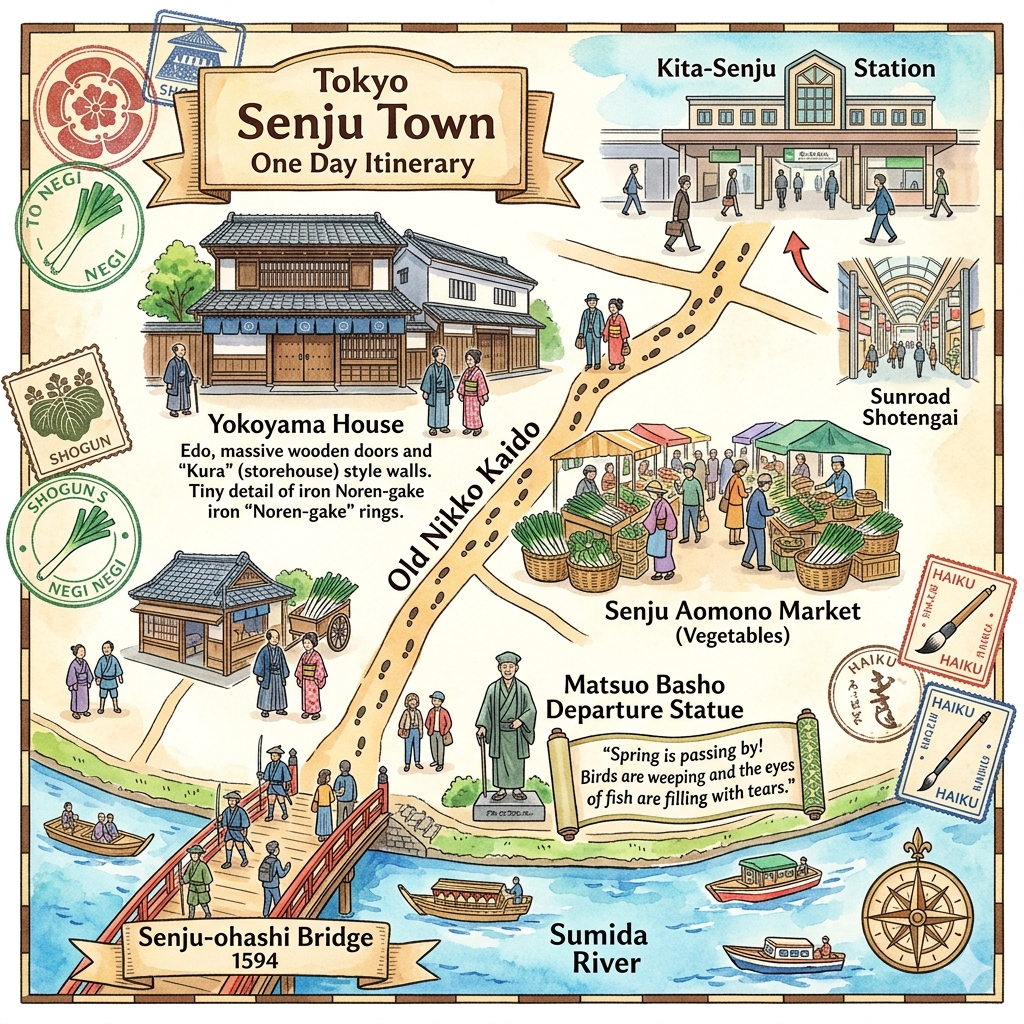
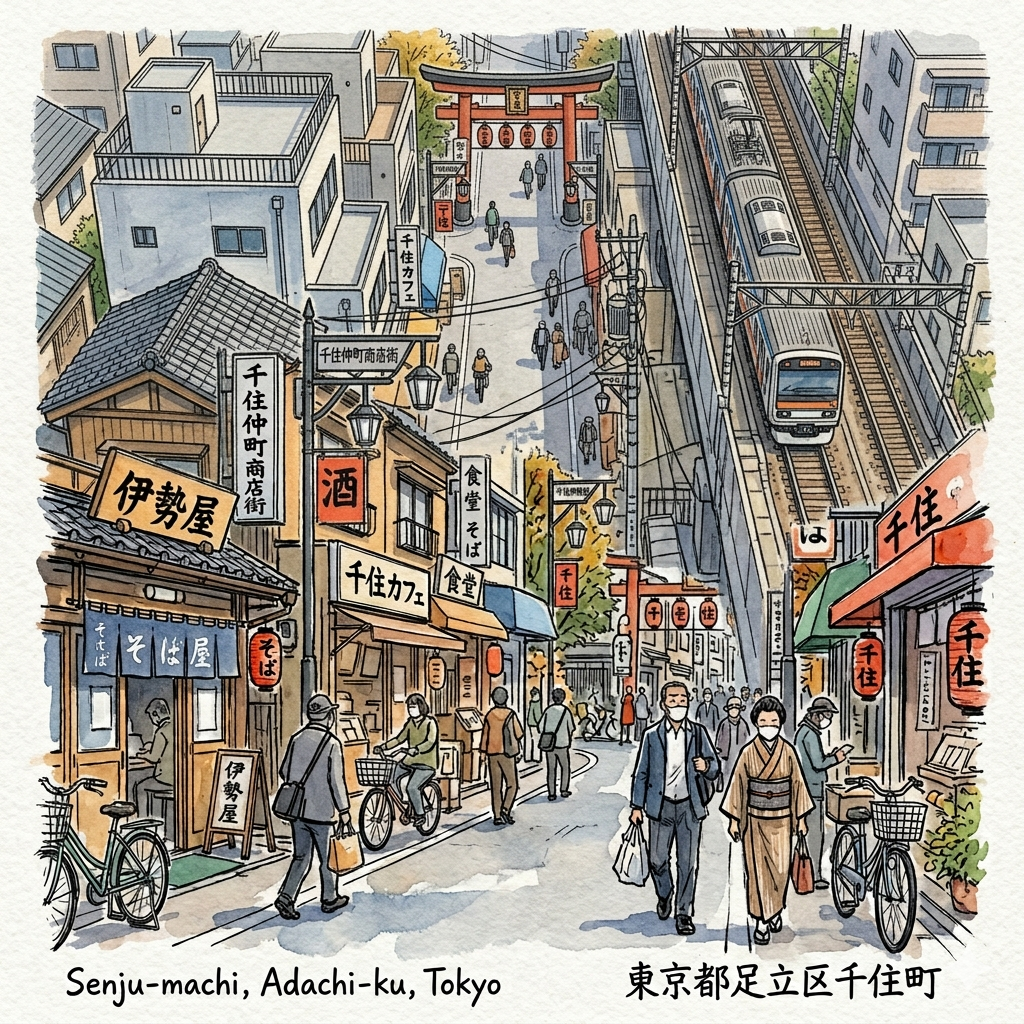
This is a historical travel story and walking guide to Senju, the foremost of the "Four Post Towns" of old Edo. By exploring its legacy as a vital gateway to the north and its modern, unpretentious "shitamachi" atmosphere, this narrative uncovers hidden shrines, local resilience, and the deep-rooted cultural identity of this riverside district. Readers will gain a unique perspective on Tokyo’s history through the lens of a neighborhood that balances historical weight with a gritty, authentic urban life.
 Lawrence
The Gateway to the North: A Walk Through Senju’s Layered History
To understand the evolution of Tokyo, one must first stand at its threshold. Senju, a district straddling the border of modern Adachi and Arakawa, served as the first of the Edo Shishuku—the four preeminent post towns anchoring the Shogunate’s capital. For centuries, this area functioned as a vital "threshold," a transitional space where the organized urbanity of Edo yielded to the rugged, uncertain prospects of the northern provinces. It was a place of departure and arrival, a strategic bottleneck where trade, politics, and the weight of human transit converged.
This guide is not a checklist of superficial landmarks or tourist curiosities. Instead, it is a spatial exploration of a "palimpsest"—an urban surface that has been written on, erased, and rewritten over centuries. History here is not relegated to museums; it is visible to those who know how to look for the "ghosts" within the physical structures of the present. As we peel back the layers of time—from the calculated loyalty of the Tokugawa Shogunate to the brutal industrialization of the Meiji era—we find that Senju is a landscape defined by sacrifice, a gateway that paid the toll for the capital’s relentless progress.
Listen to the historical stories told in detail (For subscribers only)
The Bridge of Loyalty: Power and the Koyama-maki Legend
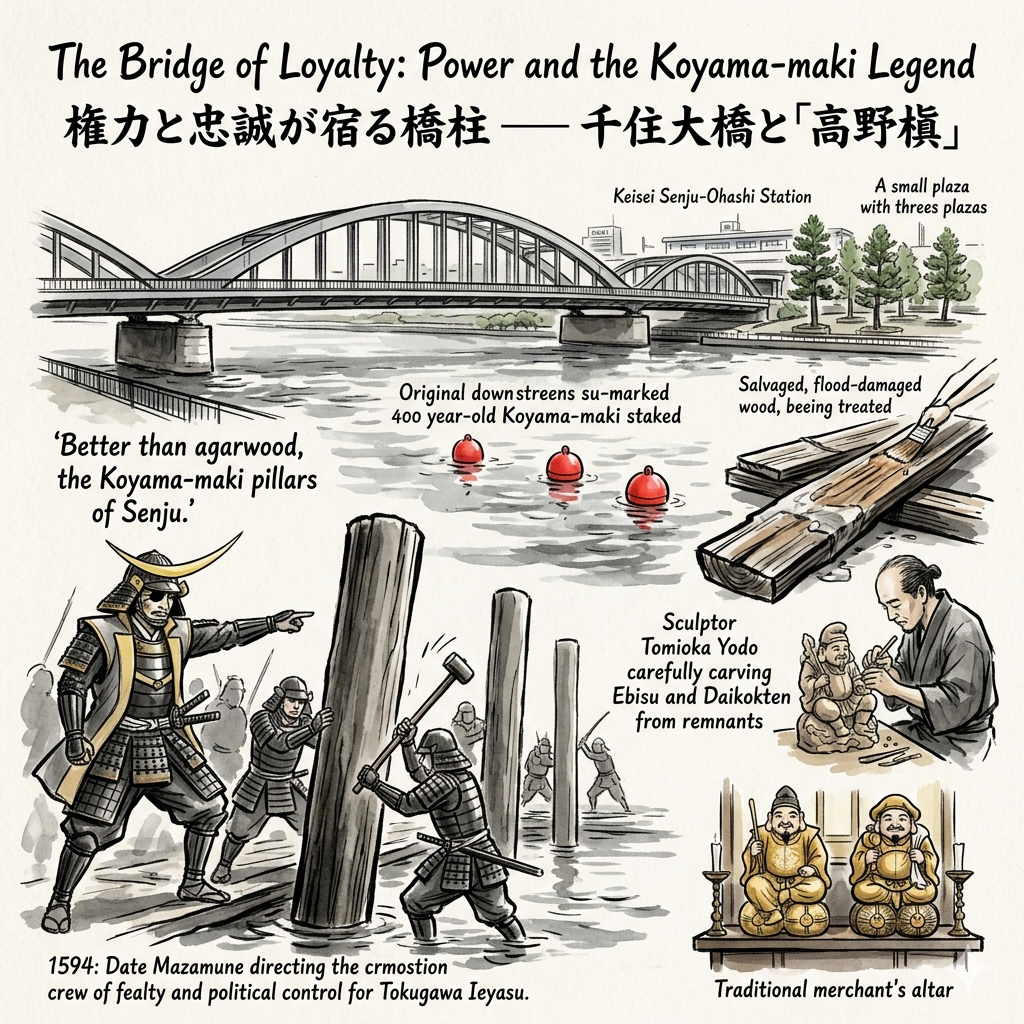
In the Edo period, infrastructure was a calibrated instrument of political control. In 1594, Tokugawa Ieyasu ordered the construction of the Senju Ohashi Bridge. As the first span across the Iruma River (now the Sumida), it was a strategic artery designed to project authority over the northern daimyos, signaling that the Tokugawa reach was expanding beyond the city’s core.
The construction became a theater of political allegiance. Date Masamune, the formidable "One-Eyed Dragon" of the north, sought to demonstrate his fealty by contributing Koyama-maki (Japanese Umbrella Pine) for the bridge’s pillars. This was no ordinary timber; in the hierarchy of woods, Koyama-maki was prized for its extraordinary resistance to water rot, ranked just below the legendary agarwood.
"Better than agarwood, the Koyama-maki pillars of Senju." — Traditional Senryu Poem
The material choice was a physical manifestation of an "unrottable" political alliance. Yet, there is a profound Sebaldian irony in the afterlife of these objects: nature eventually reclaimed the tribute during the catastrophic flood of 1885. The wood, once a symbol of immovable power, was salvaged from the mud and transformed from a political instrument into a religious one. The sculptor Tomioka Yodo carved the remnants into statues of Ebisu and Daikokuten, moving the story from the realm of the Shogun to the local merchant’s altar.
Spatial Anchor: As you cross the modern steel structure, look toward the downstream side at the three red buoys. They mark the location of the original 400-year-old Koyama-maki stakes still embedded in the riverbed. At the Keisei Senju-Ohashi Station plaza, you will find Koyama-maki trees—a living memorial to a story of loyalty that outlived the bridge itself.
The Anatomy of the Edge: Enlightenment at Kozukappara
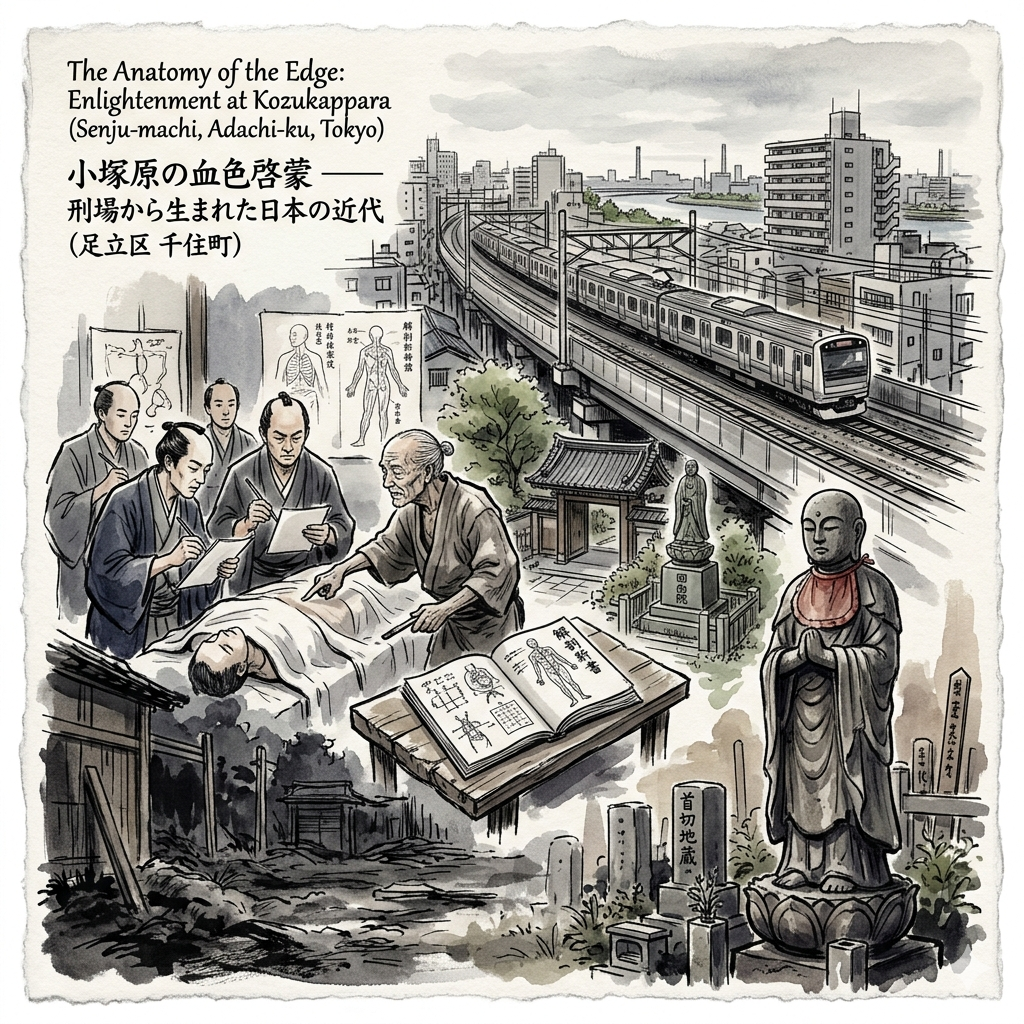
If the bridge was the gateway of trade, the southern entrance of Senju at Kozukappara was the gate of exclusion. From 1651 to 1873, this was one of Edo’s primary execution grounds, a "borderland" where over 200,000 souls were discarded. It was a place of pollution and shadow, managed by the Burakumin—the outcast class who handled the grim business of death.
Yet, in this site of terminal endings, Japanese modern science found its beginning. In 1771, scholars Sugita Genpaku, Maeno Ryotaku, and Nakagawa Junan gathered here to observe a dissection. History often highlights the scholars, but the "missing link" was the elderly executioner—a man from the outcast class whose hands-on knowledge of human anatomy allowed him to point out the errors in traditional Chinese medical charts. This collision of elite curiosity and "untouchable" expertise led to the publication of Kaitai Shinsho (A New Book of Anatomy). The death of the criminal facilitated the birth of Japanese Enlightenment.
Spatial Continuity: Today, the JR Joban Line tracks physically bisect the execution site. Standing near the tracks, the roar and vibration of modern trains often drown out the silence of the spirits beneath. Visitors can find the Kubikiri Jizo (Neck-chopping Ksitigarbha) at Enmei-ji, a 3.6-meter stone figure that has watched over the site since 1741, and the Kanzō Monument at Ekō-in. These sites have transitioned from markers of "pollution" to sacred sites of science and martyrdom, housing the graves of political dissidents like Yoshida Shoin.
The Drowned Village: The Arakawa Floodway and the "Ganseki-hi"
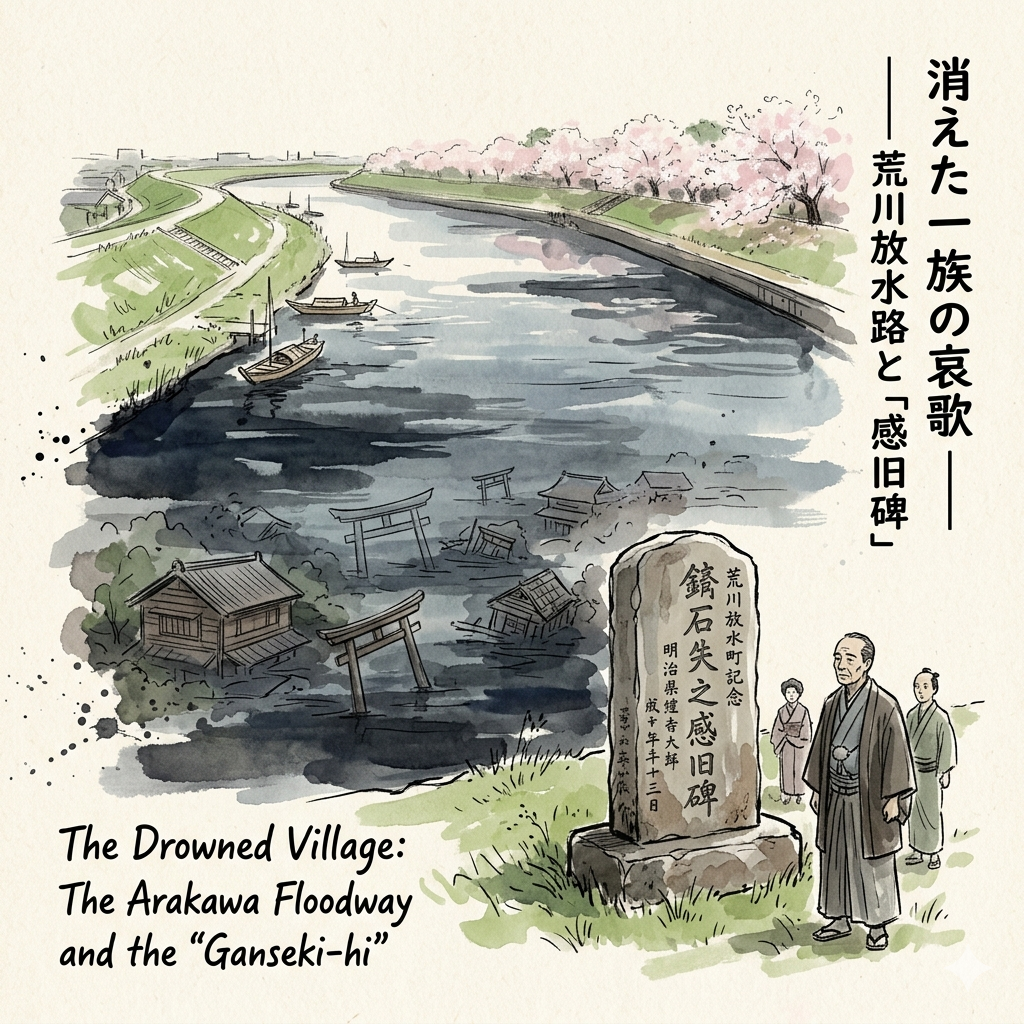
In 1910, a catastrophic flood devastated the Tokyo lowlands, prompting the Meiji government to perform a radical "surgical" intervention on the landscape. To prioritize "imperial safety," the state decided to carve the Arakawa Floodway through the heart of Senju, creating a massive man-made river to bypass the capital’s center.
This project was a triumph of state progress over local heritage, resulting in the total erasure of ancient communities and 11-generation lineages.
Metric of Change | Impact of the Arakawa Floodway (1911–1930) |
State Progress | A man-made river costing 31.47 million yen—roughly 1.7% of the national income. |
Human Cost | 22 deaths and 998 injuries during construction; 1,300 households forcibly removed. |
Land Acquisition | 1,088 hectares of ancestral land seized, including the historical market core. |
Local Loss | Destruction of 400-year-old estates, ancient wells, and the physical memory of a village. |
The human element of this displacement is captured by the Suzuki family, who had farmed this soil since the 16th century. Before their world was submerged, the patriarch erected the Ganseki-hi (Monument of Old Sentiments).
"Our clan is scattered, and the feelings of love for our home cannot be suppressed." — Suzuki Clan Patriarch
This monument, preserved near the riverbank, serves as a poignant reminder that the serene cherry blossoms along the modern Arakawa levee grow atop the drowned memories of 1,300 families.
The Shadows of Prosperity: The Meshimori-onna and Kinzo-ji
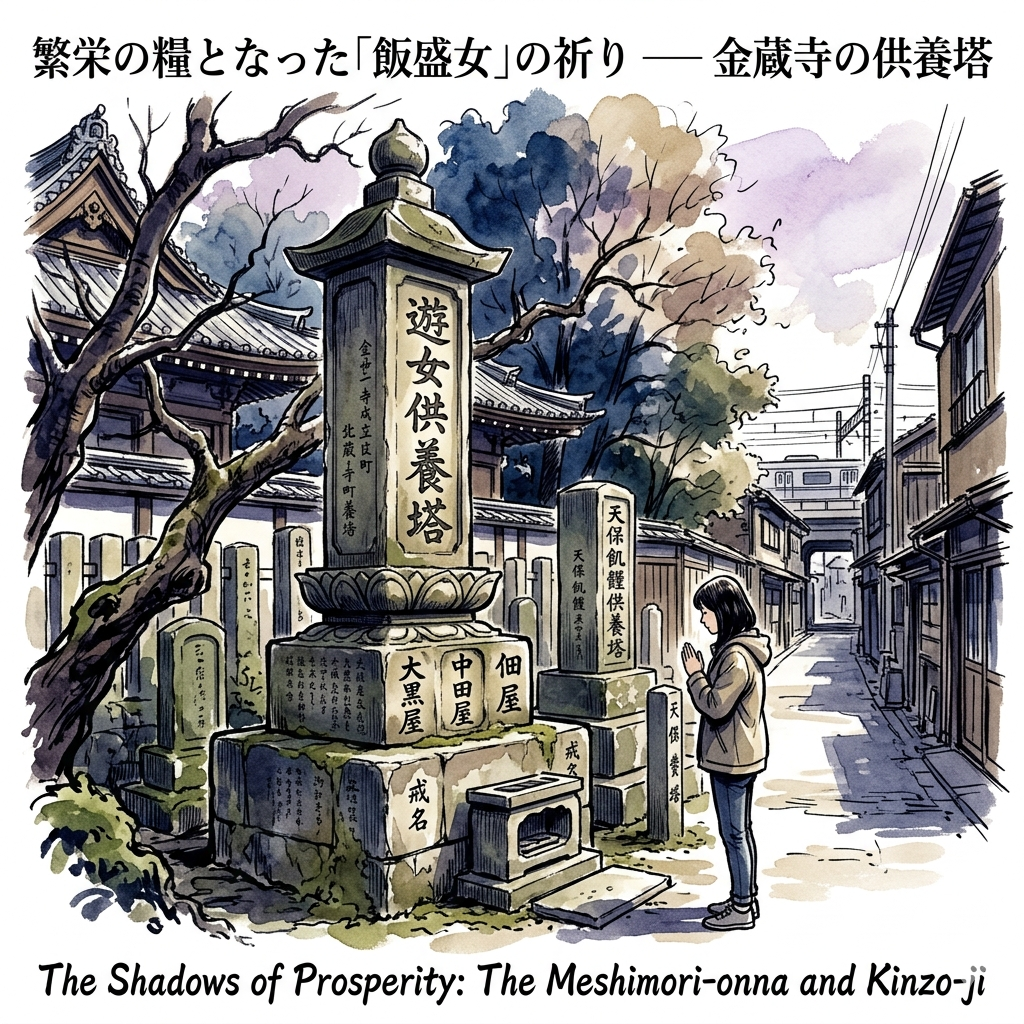
The economic engine of the shuku was the hatago (inns). While these establishments provided rest for travelers, they were powered by the labor of the Meshimori-onna—officially "food-selling women" (shokubai-jo), but in reality, prostitutes. This was not a story of urban decadence, but a buffer for rural despair; these women were the daughters of failing farms, sold into service to support families back home.
Symbolic Remains: At Kinzo-ji Temple, one finds the Memorial Tower for Prostitutes. If you look closely at the weathered stone base, the names of the inns—Daikoku-ya, Nakata-ya, Tsukuda-ya—are still legible, their business titles outliving the individual women who labored within them. Nearby stands the Tenpo Famine Memorial, marking the horrific year of 1837 when 828 people died of starvation on Senju’s streets. The temple served as the final social safety net, providing a burial place for 370 of those victims. Together, these stones identify Senju as a graveyard for those the capital’s systems discarded.
The Red Brick Fortress: Industrial Warfare at the Senju Seijuso
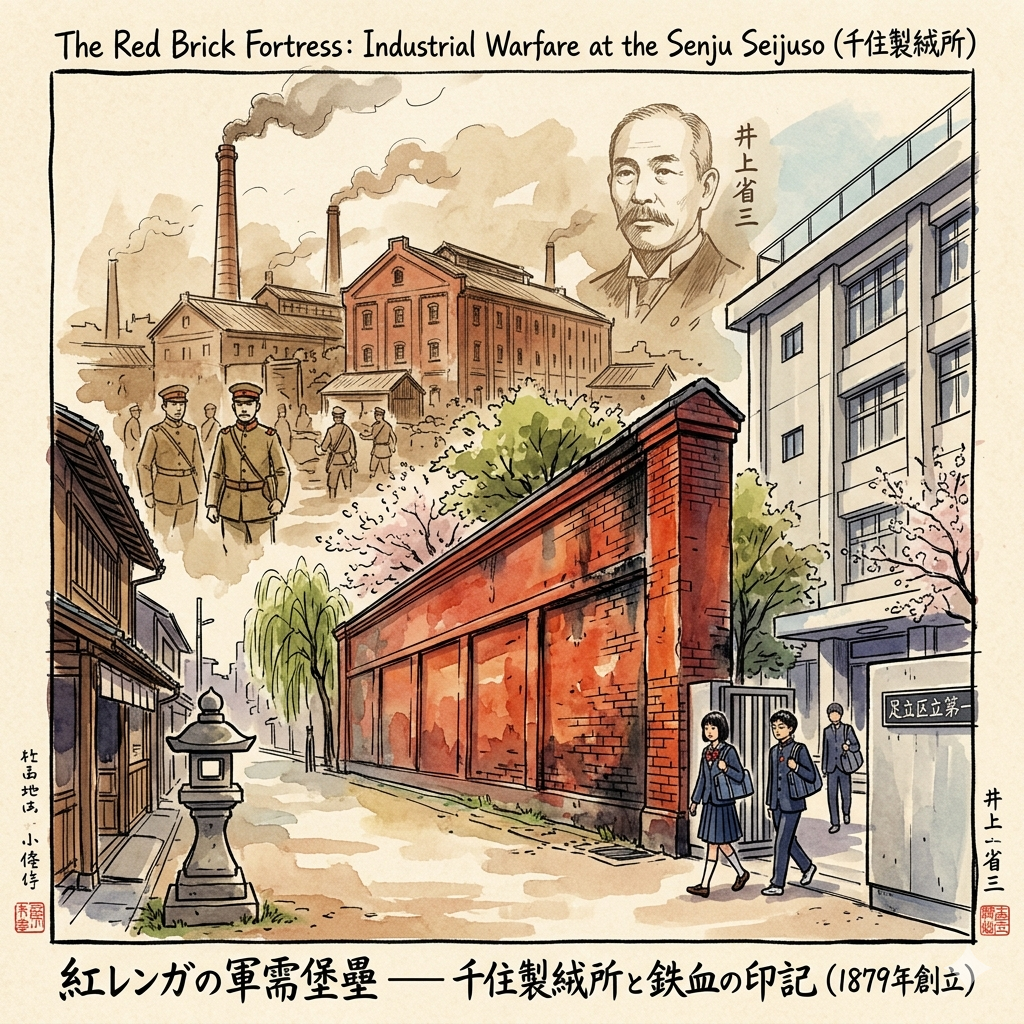
In the late 19th century, Senju transitioned from a town of inns to an industrial "cradle." Under the Meiji policy of Fukoku Kyohei (Rich Country, Strong Army), the Senju Seijuso (Woolen Mill) was established in 1879. It was the first government-operated wool factory, essential for producing the Western-style uniforms required for Japan’s modernized police and military.
This was an industrial "fortress" that signaled a hard-power shift from kimono culture to the standardized attire of the modern state. The project was spearheaded by Inouye Shozo, the father of the Japanese wool industry, who envisioned Senju as the heart of national production.
Spatial Experience: The chimneys have long since fallen, but the "last line of defense" for this memory is the Red Brick Wall located next to Adachi First Middle School. Standing 3 meters high and weathered by a century of soot and rain, these bricks offer a sharp visual contrast to the surrounding modern school buildings—a fragment of the industrial fortress surviving in the middle of a neighborhood.
The Hidden Gem of the Gateway
For the traveler seeking the most visceral experience of the past, step into the Drinking Alley (Nomia-yokocho) near Kita-Senju Station. While the storefronts are modern izakayas, the narrow, claustrophobic layout is a direct spatial relic of the Edo-period post-town scale. This network of alleys survived the fires, floods, and industrial redevelopments of the 20th century, offering a rare chance to feel the physical density of the ancient gateway.
Philosophical Reflection & Conclusion
The history of Senju is defined by what we might call the "Gateway Mechanism." It is a site that has consistently served as the location of sacrifice for the "progress" of Tokyo. Whether it was the Koyama-maki wood surrendered to the river, the bodies of the executed given to science, the 1,300 homes sacrificed for flood control, the labor of the shokubai-jo, or the industrial output for the military—Senju has always paid the toll for the capital’s survival.
To truly understand a city, one must develop the capacity for "layered observation"—the ability to see the bridge stake beneath the buoy, the famine victim beneath the temple stone, and the factory wall behind the schoolyard. The beauty of Senju lies not in pristine preservation, but in its scars. It is a palimpsest where every layer of modern progress reveals a ghost of what was taken to achieve it.
To continue your journey through the hidden layers of the Japan, subscribe to our monthly dossiers or explore our guides.
Planning Your Visit: Logistics
- How to Get There: Kita-Senju Station is a massive transit hub where five lines intersect: JR Joban Line, Tokyo Metro (Chiyoda & Hibiya), Tobu Skytree Line, Tsukuba Express, and Keisei Line (accessible at nearby Senju-Ohashi).
- Recommended Tours: A "Self-Guided Walking Route: From the Red Brick Wall to the River’s Edge" allows you to trace the industrial and hydrological history of the district in a single afternoon.
- Accommodation: To experience the "spatial continuity" of the area, consider staying in one of the district’s converted traditional structures, which maintain the intimate, human scale of the historical post town.
Q & A
How did the Kozukahara execution grounds spark a scientific revolution?
The Kozukahara execution grounds sparked a scientific revolution in Japan by providing a unique, albeit grim, experimental space where traditional medical beliefs were challenged by empirical evidence. This transformation occurred through several key developments:
1. The Validation of Western Anatomy
In 1771, the scholars Sugita Genpaku, Maeno Ryotaku, and Nakagawa Jun'an visited Kozukahara to observe a "Fu-wake" (dissection) of an executed criminal while carrying a Dutch medical text, Tafel Anatomia. During the observation, they discovered that the actual internal structures of the human body perfectly matched the Western anatomical drawings, which stood in stark contrast to the erroneous descriptions found in traditional Chinese medical charts.
2. The Role of Practical Knowledge from Marginalized Classes
The "scientific" breakthrough was made possible by the practical expertise of the marginalized "Eta" and "Hinin" classes who lived near the execution grounds and were tasked with handling corpses. The actual dissection was performed by an elderly laborer from this class who possessed intimate, hands-on knowledge of human organs and was able to point out the inaccuracies in traditional medical texts to the samurai-class scholars. This intersection of elite theoretical curiosity and lower-class practical experience was a catalyst for the shift toward evidence-based science.
3. The Birth of "Rangaku" and the Kaitai Shinsho
The findings at Kozukahara led to the translation and 1774 publication of "Kaitai Shinsho" (New Book of Anatomy). This work did more than update medical knowledge; it shook the dominance of traditional Chinese medicine and ignited the Rangaku (Dutch Learning) movement. This movement served as the foundation for Japan’s scientific enlightenment, shifting the intellectual focus from ancient traditions to modern, empirical observation.
4. The Utilization of "Marginal Space"
Kozukahara’s location at the boundary of "civilization" and "barbarism" allowed it to function as a "structural gap" in Edo society. Because it was a place of death and social taboo, it became the only site where the legal and social restrictions against human dissection could be bypassed, effectively turning a "defiled" execution ground into a laboratory for modern medicine.
Today, this scientific legacy is honored by the "Kanzō Memorial" (Observation of Organs Monument) at Ekō-in temple, which marks the site as the cradle of the Kaitai Shinsho.
Who were the marginalized laborers who assisted in the dissections?
The marginalized laborers who assisted in the dissections at the Kozukahara execution grounds belonged to the "Eta" and "Hinin" classes, which were the "outcaste" or discriminated-against social groups of the Edo period.
According to the sources, these individuals played a vital role in the birth of modern Japanese medicine:
- Role and Identity: While the samurai-class scholars like Sugita Genpaku provided the theoretical interest, the actual manual labor of the "腑分け" (fu-wake or dissection) was performed by these laborers. Specifically, the sources identify them as the "Koro" (elders) of these marginalized classes.
- A "Venerable" Laborer: The records, specifically in Rangaku Kotohajime, mention an elderly base-level laborer who performed the operation during the landmark 1771 dissection.
- Practical Expertise: Despite their low social status, these laborers possessed intimate, practical knowledge of human anatomy gained from years of handling corpses and executing punishments. Their hands-on experience was so advanced that the elderly laborer was able to point out the locations of internal organs and correct the errors found in traditional Chinese medical charts, which ultimately verified the accuracy of Western anatomical texts for the scholars.
The sources emphasize that the scientific enlightenment of Japan was deeply dependent on the practical knowledge of these socially excluded classes, whose unique expertise in a "defiled" space provided the necessary evidence for a medical revolution.
Reference and Further reading
- 城市寶典~足立區篇~ - WA MARE, accessed May 2, 2026,
- 歴史散歩:掃部堤-千住大橋-下谷道-日光街道を歩く - Edo-Tokyo Walking(Top), accessed May 2, 2026,
- 千住大橋 - accessed May 2, 2026,
- 「千住宿」開宿400年コラム その2~千住大橋は千住の町の生みの親~ | 足立成和信用金庫, accessed May 2, 2026,
- 伊達政宗伝説の高野槙橋杭 - NPO法人 千住文化普及会, accessed May 2, 2026,
- 佐藤 貴浩 | 研究者情報 | J-GLOBAL 科学技術総合リンクセンター, accessed May 2, 2026,
- 「日本毛織物工業の父」井上省三と千住製絨所(荒川区) - 戦跡紀行ネット, accessed May 2, 2026,
- 延命寺・小塚原刑場跡「首切地蔵」 - 荒川区, accessed May 2, 2026,
- 荒川ゆうネットアーカイブ > 特集 > 荒川区再発見 都市観光編2「南千住」 > 延命寺, accessed May 2, 2026,
- 英国における皮革業の社会史:, accessed May 2, 2026,
- 【荒川区】南千住 小塚原刑場跡|nama - note, accessed May 2, 2026,
- 回向院/小塚原刑場 | 杉田玄白(小浜市-小浜藩医), accessed May 2, 2026,
- 首切り地蔵尊(延命寺) - お地蔵さんブログ, accessed May 2, 2026,
- 首切地蔵(延命寺) - 東京都荒川区の歴史 - SHINOBI.JP, accessed May 2, 2026,
- 荒川放水路変遷誌[PDF - 関東地方整備局 - 国土交通省, accessed May 2, 2026,
- 知っていますか?荒川放水路のこと「荒川放水路通水100 ... - 足立区, accessed May 2, 2026,
- 千住特集荒川 - 千住いえまち, accessed May 2, 2026,
- 明治・大正・昭和期に行われた荒川放水路開削工事と 市民の生活, accessed May 2, 2026,
- 龍馬の許嫁が住んだ街「北千住」を再訪 - ぶらっと東京食べ歩き 「街発見くらぶ」, accessed May 2, 2026,
- 千住の飯盛女, accessed May 2, 2026,
- 【 歩く地図でたどる日光街道 】千住宿から草加宿へ 5.千住仲町(足立区)~千住新橋(足立区), accessed May 2, 2026,
- 天保飢饉供養塔と遊女供養塔ほか(足立区千住2丁目・金蔵寺)東京都23区の庚申塔 #78, accessed May 2, 2026,
- 金蔵寺 | あだち観光ネット, accessed May 2, 2026,
- 足立区千住にある金蔵寺。游女供養塔があります。 路地猫さんちょっと|yumiパンダ - note, accessed May 2, 2026,
- 日本最保守的秘密北千住!完整攻略:這座慶祝400週年的歷史驛站小鎮有哪些獨特的體驗?, accessed May 2, 2026,
- 千住宿の絶妙串だんご - 週刊あんこ, accessed May 2, 2026,
- 江戸街道 特集 東京の日本橋から1番目の宿場町「千住宿」の魅力を楽しむ旅。, accessed May 2, 2026,
- 観光ボランティア ガイドマップ - 荒川区, accessed May 2, 2026,
- 旧千住製絨所煉瓦塀 - 荒川区, accessed May 2, 2026,
 Lawrence
 Lawrence
 Lawrence