(ENG) Tokyo’s Sumida Frontier – A 1,000-Year Historical Walk Through Legends and Resilience
Discover the hidden layers of Tokyo’s Sumida-cho, where ancient legends, Edo-period gardens, and industrial history meet. Explores how a thousand years of resilience shaped a riverside frontier into a modern architectural fortress, offering a deep perspective on Tokyo’s enduring spirit.

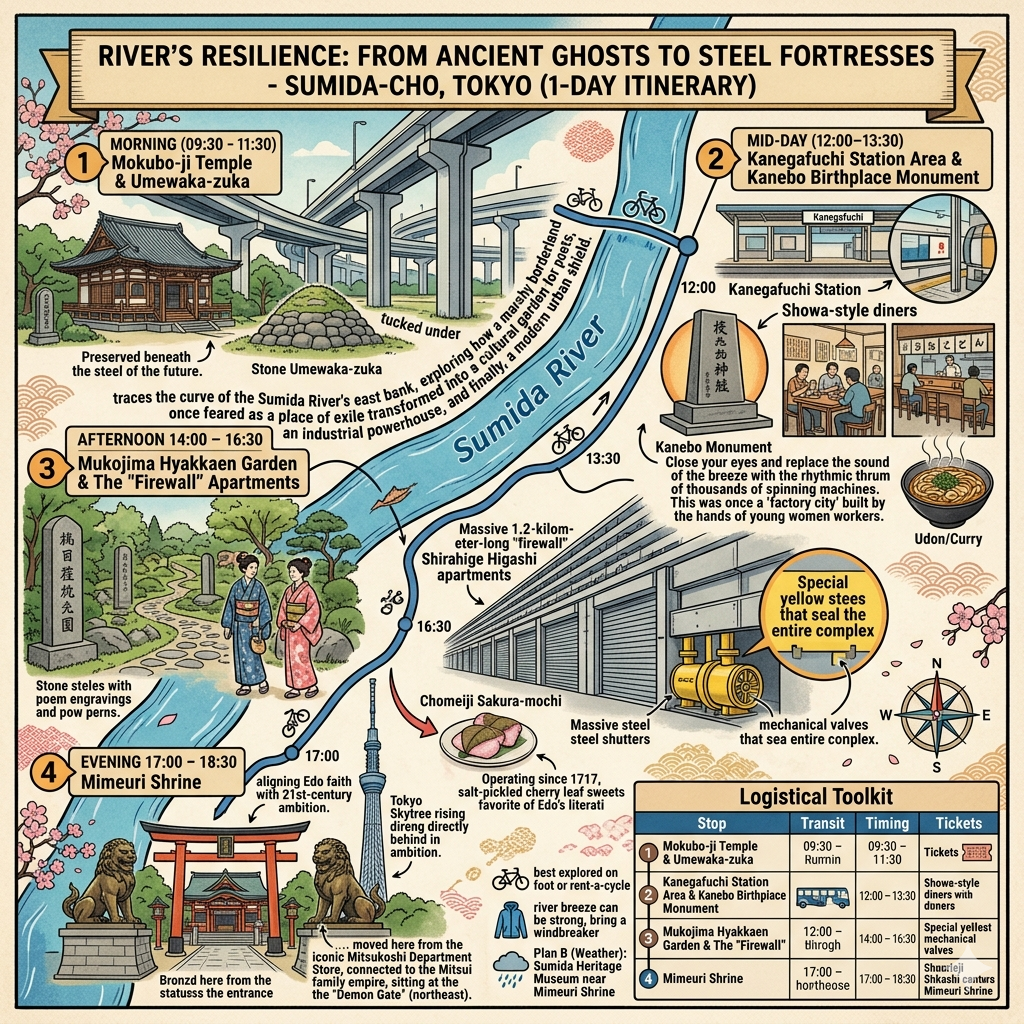
This is a historical travel story and walking guide to Tokyo’s northern Sumida-cho, a district that has served as a resilient frontier for over a millennium. Through five distinct historical layers, it explores ancient riverside tragedies, literati garden revolutions, industrial powerhouses, and modern architectural fortresses to reveal how this riverbank transformed from a peripheral boundary into a spiritual and physical shield for the city.
 Lawrence
To the casual observer, the northern reaches of Sumida-cho—modern-day Sumida 1-5 chome and the Tsutsumidori corridor—might appear as a peripheral residential pocket. Yet, for the urban flâneur, this district reveals itself as a profound frontier and a resilient hub. Since the 8th century, when the implementation of the Taiho Code established the Sumida River as the strategic border between Musashi and Shimosa provinces, this riverbank has served as the threshold where the known world met the "eastern wilds."
This is not merely a place of transit but a site of deep spatial narrative. Over a millennium, Sumida has transformed from a vital ferry crossing for state officials into a literati playground, an industrial powerhouse, and ultimately, a modern architectural fortress. This history is not locked in archives; it is a "travelable history" etched into the very stones and concrete of the district. The walk commences where the river’s physical edge blurs into the metaphysical, at a site defined by a tragedy that transformed a simple riverbank into a cornerstone of national memory.
Listen to the historical stories told in detail (For subscribers only)
The Ghost at the Ferry: Umewakamaru and the Tragedy of the Border
In the medieval period, the eastern bank of the Sumida was a site of profound loss and crossing. For the refined courtiers of Kyoto, traveling east (Azuma-kudari) meant entering a precarious realm of exile and harsh realities. Here, the sophisticated culture of the capital met its limit, often with devastating results.
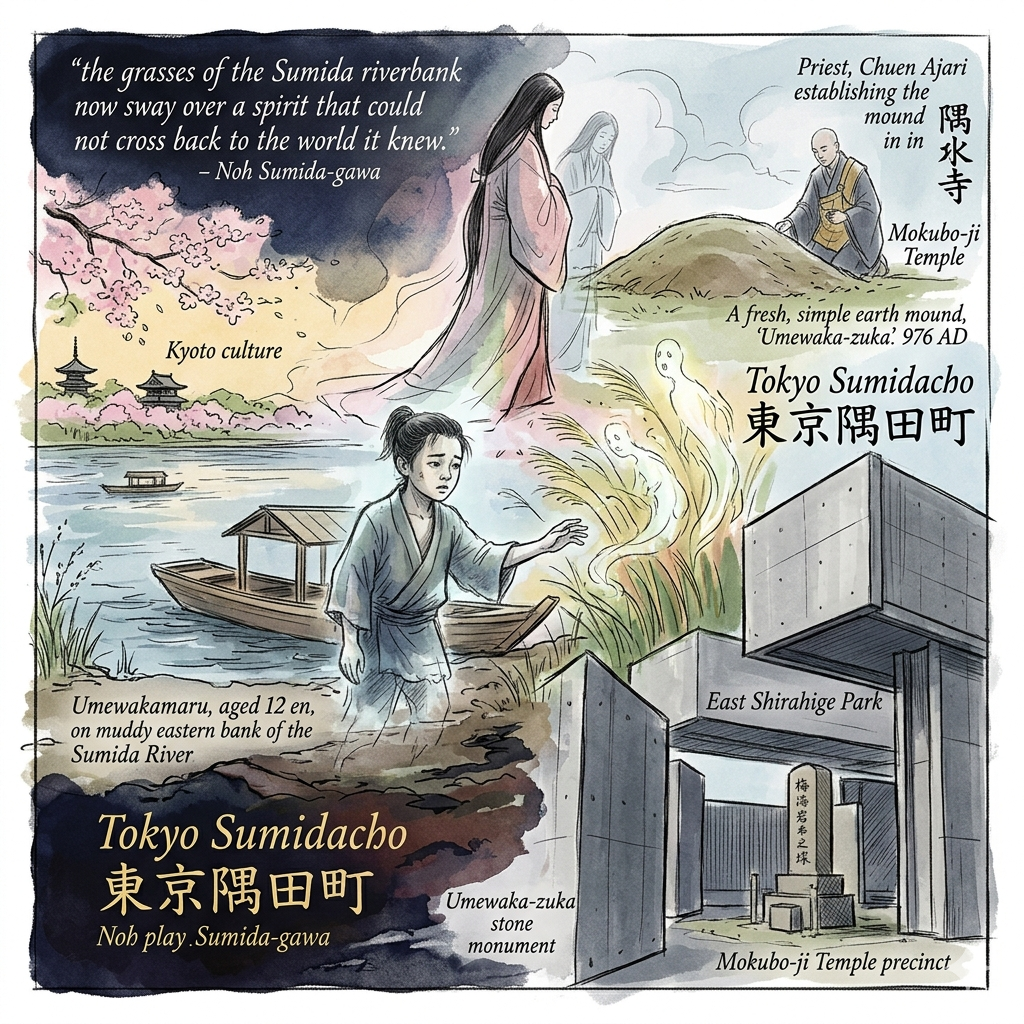
In 951 AD (the 5th year of the Tenryaku era), this border claimed a young life and birthed a legend. Umewakamaru, the twelve-year-old son of a Kyoto nobleman, was kidnapped by a human trafficker and forced toward the eastern frontier. Weakened by the journey, the boy perished on the banks of the Sumida. His mother, Hana-gozen, traveled a thousand miles in search of him, only to find his fresh grave. In 976 AD (Jogan 1), the priest Chuen Ajari established the "Umewaka-zuka" mound to appease the boy's spirit, marking the origin of Mokubo-ji Temple.
This "border tragedy" evolved into a cultural archetype, providing the foundational narrative for the Noh play Sumida-gawa. Mokubo-ji was established specifically to care for muen-botoke—those unconnected spirits who died far from home without kin to mourn them.
"The ferryman speaks of a child who died here... the grasses of the Sumida riverbank now sway over a spirit that could not cross back to the world it knew." — Reflective synthesis of the Noh play Sumida-gawa
Today, the Umewaka-zuka stone monument stands within the quiet precinct of Mokubo-ji. It offers a striking spatial contrast: the ancient site of mourning is now framed by the massive, functionalist concrete of East Shirahige Park, bridging a millennium of human vulnerability.
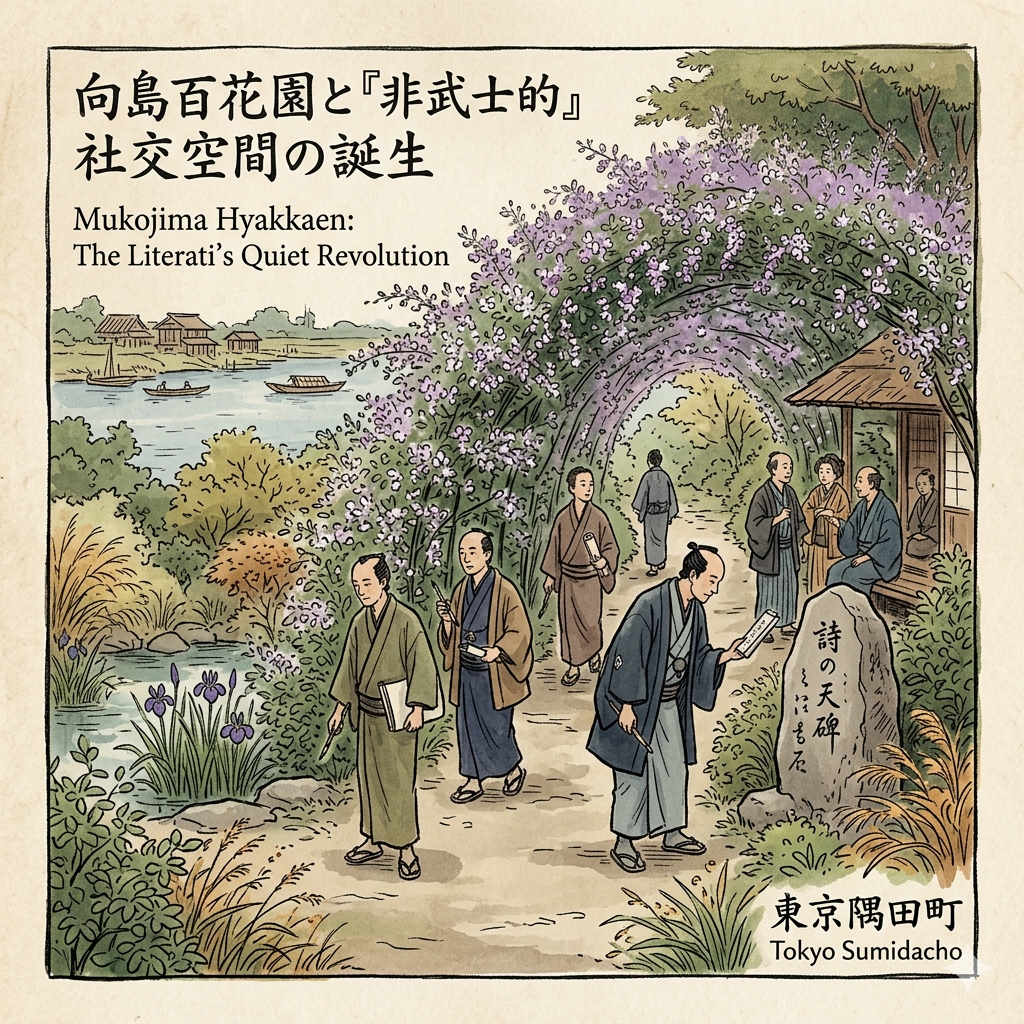
Mukojima Hyakkaen: The Literati’s Quiet Revolution
By the early 19th century, the sociopolitical winds of Edo had shifted. While the Shogunate’s power remained, cultural authority began to migrate from the samurai class to the Bunjin (literati) and wealthy merchants. Seeking a "free Utopia" away from the rigid hierarchy of the city center, these intellectuals looked to the quiet riverbanks of Mukojima.
In 1804, an antique dealer named Sawara Kikuu founded the Mukojima Hyakkaen, or "Flower Mansion." Unlike the grand "Daimyo gardens" of the ruling elite—which utilized vast space and rare stones to project authoritative power—Hyakkaen was a space of private, intellectual revolution. The merchant class made a provocative claim to status by calling the garden a Yashiki (mansion), a term traditionally reserved for samurai. This was a deliberate erosion of the shi-no-ko-sho class system, a non-samurai space where doctors and poets formed new social networks.
The spatial experience of the garden remains remarkably intact. Walking through the "Hagi (Bush Clover) Tunnel" or pausing at the 29 poetry monuments—carved by master stonemason Kubo Seshō—one finds the physical remnants of a 200-year-old intellectual network that prioritized aesthetic freedom over feudal rank.
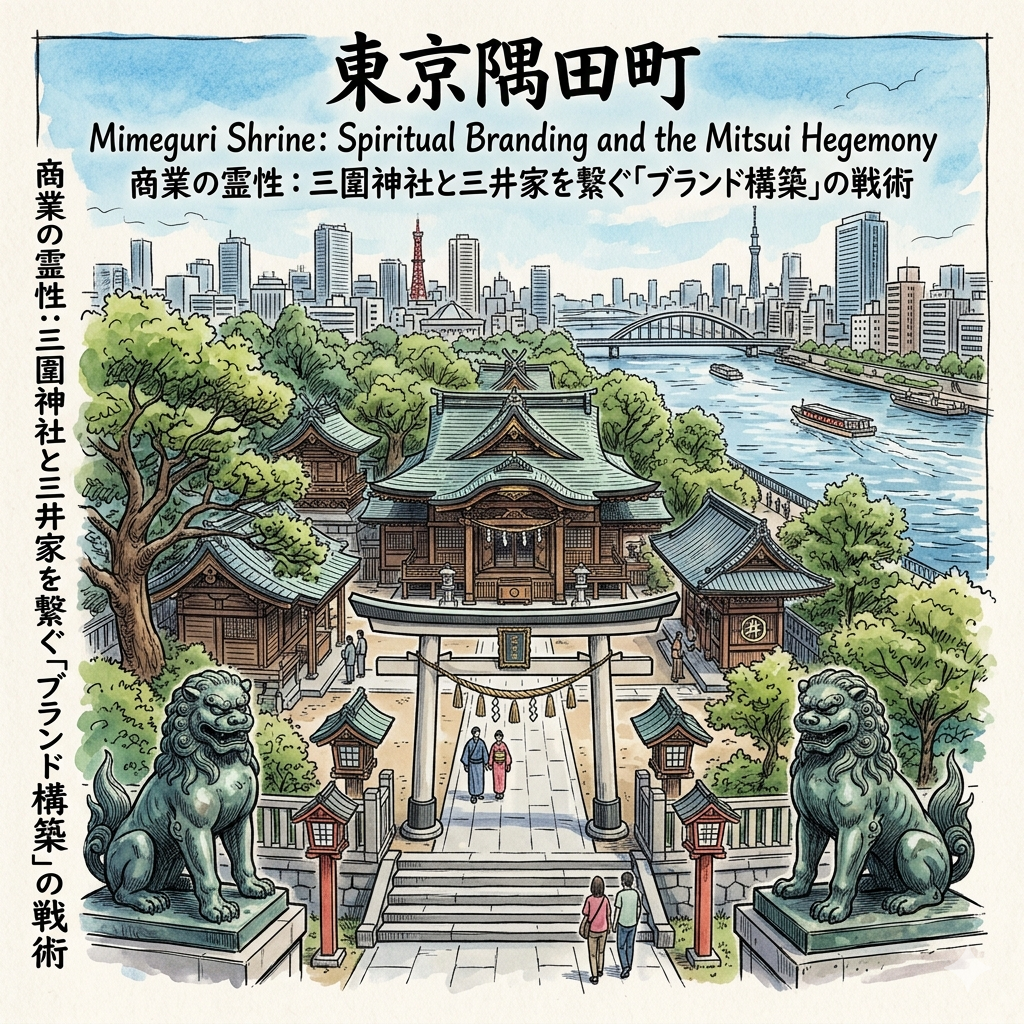
Mimeguri Shrine: Spiritual Branding and the Mitsui Hegemony
As the district evolved, the frontier was increasingly fortified through spiritual defense. The Mimeguri Shrine, situated on the river embankment, represents a fascinating intersection of ancient myth and the spiritual branding of Japan's greatest commercial dynasty, the Mitsui family.
In urban planning terms, the shrine occupies the Kimun (Demon Gate) orientation for Nihonbashi, the heart of Edo's commerce. In 1693, the poet Takarai Kikaku famously performed a "rain-making" miracle here during a severe drought, cementing the shrine’s reputation. However, it was the Mitsui family who turned it into a spiritual fortress. They found a protective sigil in the name "Mimeguri" (Three Enclosures); the kanji for "Enclosure" (囲) physically surrounds the "Well" (井) of the Mitsui name (三井).
This "spiritualized" corporate branding is still visible today. The bronze lions flanking the shrine were moved here from the closed Mitsukoshi Ikebukuro store, symbolizing the return of modern commercial power to its ancestral and spiritual roots.
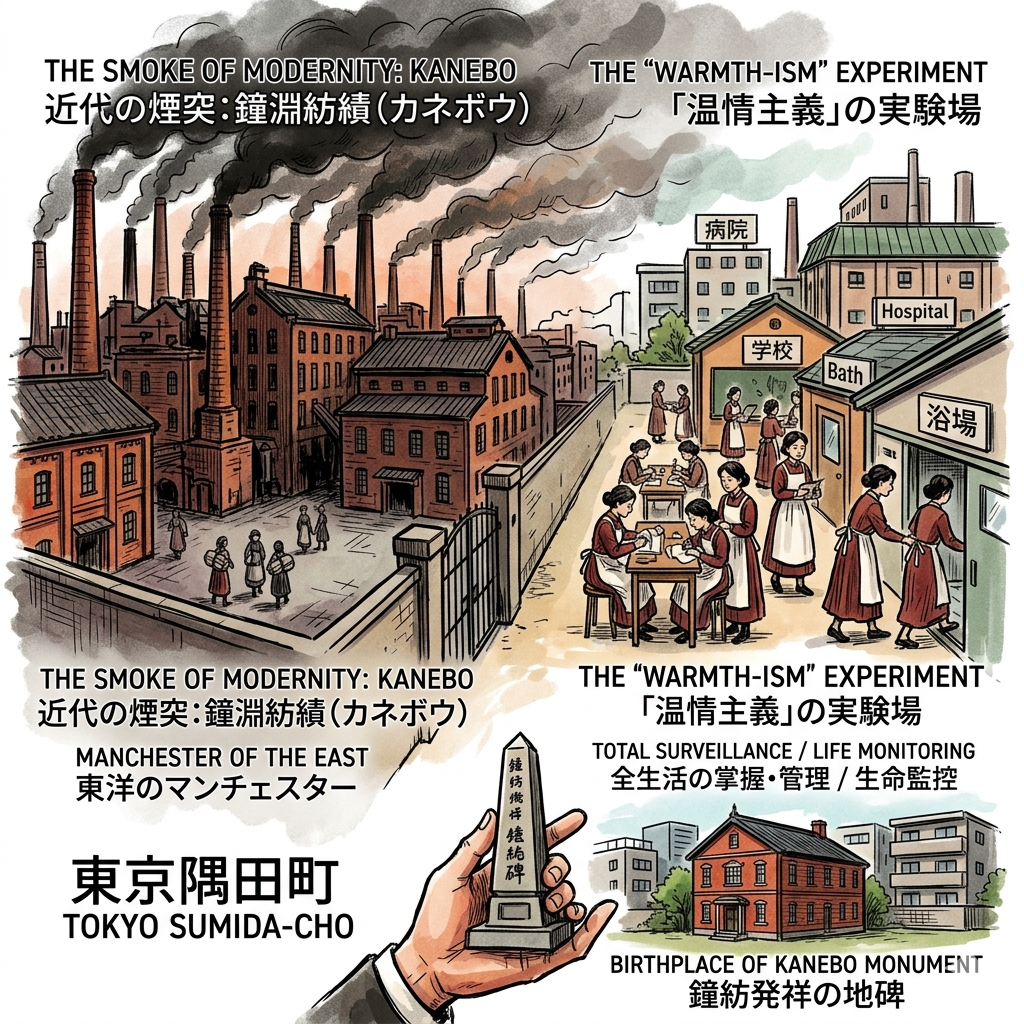
The Smoke of Modernity: Kanebo and the "Warmth-ism" Experiment
In 1889, the leisure district of the literati was abruptly redefined by the smoke of industry. The founding of the Kanebuchiya Spinning Company (later Kanebo) transformed Sumida into the "Manchester of the East." This was no longer a place of quiet gardens, but the engine of Japan’s Industrial Revolution.
Under the leadership of Muto Sanji, Kanebo implemented a management philosophy known as "Warmth-ism" (Onjo-shugi). At a time of intense labor disputes, the company built on-site hospitals, schools, and public baths for its "factory girls." While this "enterprise as family" model provided unprecedented welfare, it also enabled a total surveillance system where the worker’s life was entirely contained within the company’s walls.
While the chimneys have long since vanished, the ghost of this industrial era remains in a hidden, Western-style red brick building in Sumida 5-chome (19-1) and the "Birthplace of Kanebo" monument. This concentration of industry made the area a vital hub, but it also painted a target on the district, leading to the ultimate architectural response to the threat of fire.
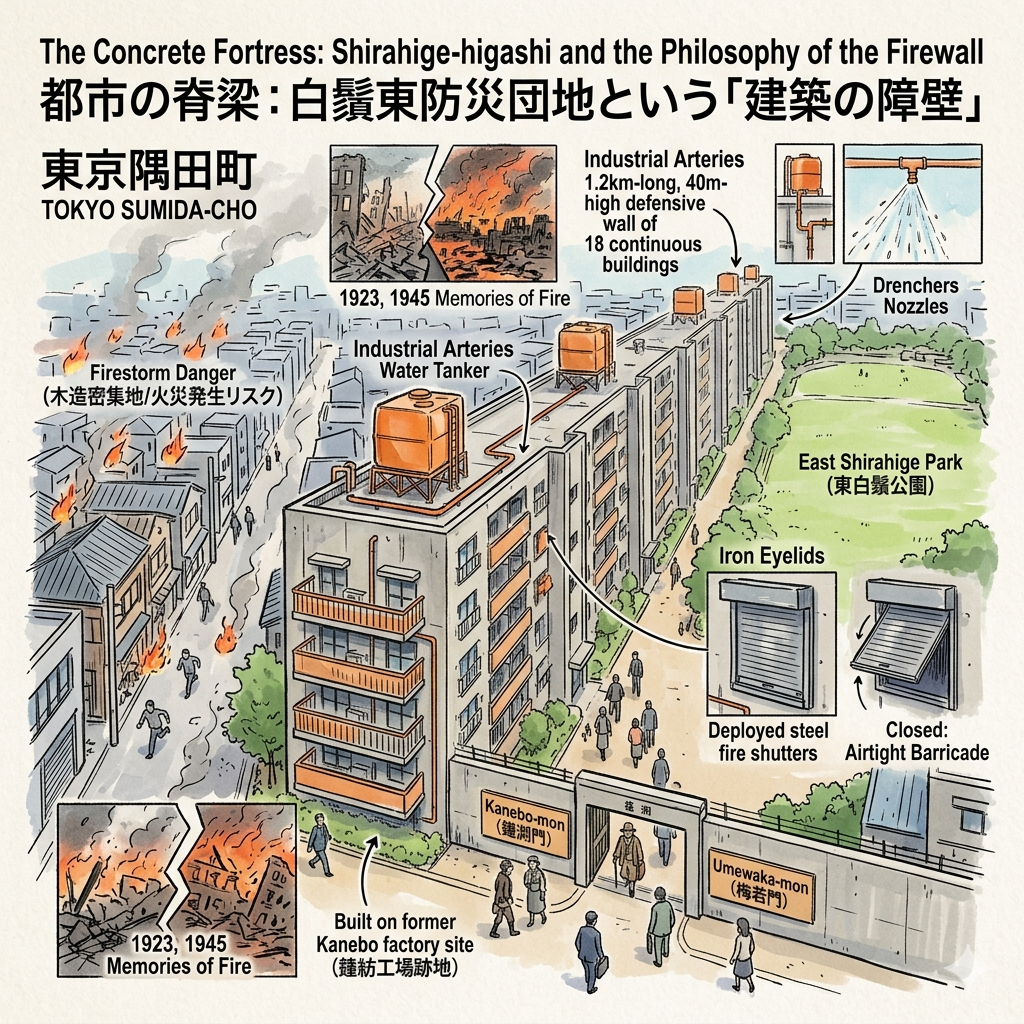
The Concrete Fortress: Shirahige-higashi and the Philosophy of the Firewall
In Sumida’s urban memory, fire is the primary antagonist. The district was virtually erased during the 1923 Great Kanto Earthquake and again during the 1945 firebombing. In response, the 1970s saw a radical "architectural militarization" of the landscape: the Shirahige-higashi Apartments.
Built on the former Kanebo factory site, this is a 1.2km-long defensive wall consisting of 18 continuous buildings rising 40 meters high. This is not merely housing; it is a rigid commitment to life, a literal firewall designed to protect the evacuation zone of East Shirahige Park from the firestorms of the residential wards to the west.
The building functions as a machine. Its balconies are equipped with "industrial arteries"—massive drenchers (sprinkler systems)—and its openings are guarded by steel fire shutters that act as massive iron eyelids, turning the complex into an airtight barricade. Even the gate names—"Kanebo-mon" and "Umewaka-mon"—literally gate the district’s historical layers into this modern defense system. It is a place where the searing memory of the past has been forged into a concrete spine for the future.
Synthesis and Reflection: The Resilient Layers of Sumida
To walk through Sumida is to observe a thousand years of resilience. This district does not simply survive; it converts. It converts the tragedy of a lost child into national literature; it converts the ambition of merchants into spiritual faith; and it converts the fear of fire into an architectural fortress.
What can modern cities learn from a place that builds its history into its bones? Sumida suggests that a city’s strength lies in its layered observation. By acknowledging the border, the garden, the shrine, and the factory, the district has created a landscape that is both a protective shield and a cultural archive. It is a reminder that the most resilient urban spaces are those that do not erase their past, but rather use it as the foundation for their defense.
Travel Logistics and Hidden Gems
Hidden Observation: The Industrial Red Brick Ghost While visiting the "Birthplace of Kanebo" monument near the river, seek out the hidden Taisho-era Western-style red brick building at Sumida 5-chome 19-1. Though not open to the public, its presence among the modern residences is a silent, physical anchor to the era of "Warmth-ism" and Sumida's industrial peak.
Walking the Frontier: Logistics
- Access: Take the Tobu Skytree Line to Kanegafuchi Station.
- Recommended Route: Begin at Mokubo-ji Temple (Sumida 5-chome), walk south through East Shirahige Park to observe the firewall architecture and its specific gates (Umewaka-mon and Kanebo-mon), visit Mukojima Hyakkaen, and conclude at Mimeguri Shrine.
- Suggested Stay: Seek out boutique accommodations in the adjacent Asakusa/Sumida area to experience the river’s historical continuity over several days.
Subscribe to the "Historical Travel Stories" newsletter for more layered explorations of the world's most resilient urban landscapes.
Q & A
How did Sumida-cho transform from a borderland to a disaster fortress?
The transformation of Sumida-cho from an ancient borderland to a modern disaster fortress is a narrative of geographic necessity, tragic memory, and extreme urban engineering. This evolution occurred through several distinct stages:
1. Ancient and Medieval: The Frontier of CivilizationIn the 8th century, Sumida-cho served as a strategic river crossing on the national official road, marking the boundary between Musashi and Shimousa Provinces. During the Heian period (10th century), the east bank of the Sumida River was viewed by the Kyoto elite as a "barbarian" periphery. The Umewakamaru legend—a tragedy about a kidnapped noble child who died by the river—symbolized the clash between the "fragility of Kyoto civilization" and the "cruelty of the Eastern wilderness," cementing the area's identity as a spiritual and physical borderland.
2. Edo to Meiji: Cultural Escape and IndustrializationBy the 19th century, the area shifted from a desolate border to a cultural refuge for Edo’s literati, exemplified by the "non-samurai" social space of Mukojima Hyakkaen,. In 1889, this pastoral landscape was dramatically reshaped by the arrival of Kanebo (Kanegafuchi Spinning),. The factory's massive footprint and chimneys turned Sumida-cho into the "Manchester of the Orient," creating a dense industrial core that would later provide the space for modern redevelopment.
3. The Catalyst: The Trauma of FireThe 20th century brought two catastrophic events that fundamentally altered the area's urban philosophy: the 1923 Great Kanto Earthquake and the 1945 Great Tokyo Air Raid. Because of the dense wooden housing and narrow streets, fire proved more lethal than the initial disasters; specifically, a fire whirlwind in a neighboring area killed approximately 40,000 people during the 1923 earthquake. These "blood and tears lessons" convinced planners that the city had to be physically armed against fire.
4. Modern Era: The "Steel Wall" Disaster FortressIn the 1970s, the former site of the Kanebo factory was repurposed for the Shirashige-higashi District Redevelopment Project. This resulted in the creation of a literal disaster fortress:
- The Defensive Firewall: The Toei Shirashige-higashi Apartments is a continuous wall of 18 buildings stretching 1.2 kilometers long and 40 meters high.
- Mechanical Defense: The complex is not just a residence but a massive firewall equipped with powerful drenchers (sprinklers) on balconies and giant fire gates that can seal off the complex.
- Strategic Protection: The design logic is that this concrete barrier will block fire and heat radiation from western residential areas, protecting the Higashi-shirashige Park, which serves as a massive evacuation shelter for tens of thousands.
Today, the names of the fortress's gates—such as "Umewaka Gate" and "Kanegafuchi Gate"—serve as a bridge between the ancient frontier legends, the industrial past, and the modern identity of a city built on materialized memory and resilience.
How did Sumida evolve from a literary retreat to industrial hub?
The evolution of Sumida from a literary retreat to a modern industrial hub was driven by its unique geography and the shifting economic needs of Japan during the late 19th century.
1. The Literary Retreat: A "Liberal Utopia"During the late Edo period (early 19th century), the area known as Mukojima became a spiritual haven for wealthy townsfolk and progressive literati seeking to escape the rigid, bustling center of Edo.
- Mukojima Hyakkaen: In 1804, the "Garden of a Hundred Flowers" was established as a private cultural experiment. Unlike the hierarchical and authoritative gardens of the samurai class, this space emphasized "literary taste" and grass-roots aesthetics, focusing on wildflowers mentioned in ancient poetry rather than rare stones or exotic animals.
- Social Significance: It functioned as a "non-samurai" social space where people from various classes—merchants, doctors, and artists—could network freely, creating what was essentially a "liberal utopia" on the edges of feudal society.
2. The Geographic PivotThe very features that made Sumida a peaceful retreat eventually made it the ideal site for industrialization. The area offered vast stretches of flat land and convenient water transportation via the Sumida River, which was essential for moving raw materials and finished goods.
3. The Industrial Transformation: "Manchester of the Orient"As Japan entered the Industrial Revolution in the late 19th century, the pastoral landscape was rapidly reshaped:
- Establishment of Kanebo: In 1889 (Meiji 22), the Kanegafuchi Spinning Company (Kanebo) began operations, funded by major merchant houses.
- Landscape Shift: The quiet fields and flower gardens were replaced by a dense network of factories, worker dormitories, and smoking chimneys. This dramatic transformation earned the area the title of Japan's "Manchester of the Orient".
- Social Restructuring: The rise of industry brought a massive influx of young laborers from rural areas. To manage this new urban workforce, Kanebo implemented a management style known as "Warmth-ism," building hospitals, schools, libraries, and even public baths within the factory complex. While this provided social welfare, it also established a system of all-encompassing social monitoring over the workers' lives.
Ultimately, the transition was so complete that by the early 20th century, Sumida had moved from being a symbol of cultural "non-samurai" independence to becoming the core fortress of Japan's modern industrial capitalism.
Reference and Further reading
- 墨田区の通史年表 墨田区公式ホームページ, accessed April 9, 2026,
- すみだスポット - 鐘紡記念碑 | 一般社団法人 墨田区観光協会【本物が ..., accessed April 9, 2026,
- 墨田区 - accessed April 9, 2026,
- 本所 (墨田区) - accessed April 9, 2026,
- 隅田川 - きまぐれスケッチ, accessed April 9, 2026,
- 歴史と伝説が交差する 幻の道を歩こう! - 墨田区観光協会, accessed April 9, 2026,
- 都市・東京の記憶 向島百花園 - 東京都立図書館, accessed April 9, 2026,
- 大田蜀山人ら当代一流の江戸文人たちが集った「向島花屋敷」異聞 - 企業実務オンライン, accessed April 9, 2026,
- 【墨田区】向島百花園とその周辺|nama - note, accessed April 9, 2026,
- すみだスポット - 向島百花園 | 一般社団法人 墨田区観光協会【本物が生きる街 すみだ観光サイト】, accessed April 9, 2026,
- すみだ郷土文化資料館 | 一般社団法人 墨田区観光協会【本物が生きる街 すみだ観光サイト】, accessed April 9, 2026,
- 向島《三囲神社》優しい顔立ちの”三囲のコンコンさん”が迎えてくれる|湘南乃風 SHOCK EYEさんと聖地巡礼 | Discover Japan, accessed April 9, 2026,
- 三井財閥のパワーをいただける神社~三囲神社|神社大好き - note, accessed April 9, 2026,
- 三囲神社 - 三越伊勢丹オンラインストア, accessed April 9, 2026,
- 向島の「三囲(みめぐり)神社」 by えだまめ | 中央区観光協会特派員ブログ, accessed April 9, 2026,
- 三井高棟 | 三井広報委員会, accessed April 9, 2026,
- あのブランドのルーツは「水没した鐘」?!すみだ北端の地 の大きな移り変わりとは。, accessed April 9, 2026,
- 東京都立図書館 - accessed January 1, 1970,
- 団地の地理学 - テンプラスワン・ウェブサイト, accessed April 9, 2026,
- 10.墨田の防災団地 ―関東大震災・被服廠の「記憶の形象」― | 「東京人」観察学会, accessed April 9, 2026,
- 白鬚東アパート - accessed April 9, 2026,
- 白髭東 アパート 都市防火壁として計画された隅田川岸の連結団地, accessed April 9, 2026,
- 【都営住宅】白鬚東アパートでおすすめのインターネット回線・電気・ガス - note, accessed April 9, 2026,
- 行った記憶が無い場所を、再訪する|キハ2222 - note, accessed April 9, 2026
 Lawrence
 Lawrence
 Lawrence