(ENG) Takadanobaba Historical Walk – Finding Astro Boy and Samurai Shadows along Kanda River
A slow walk through Takadanobaba, where the futuristic dreams of Astro Boy meet the flowing history of the Kanda River. Discover how this Tokyo district evolved from a samurai training ground into a beloved cultural landmark filled with academic charm and Showa memories.

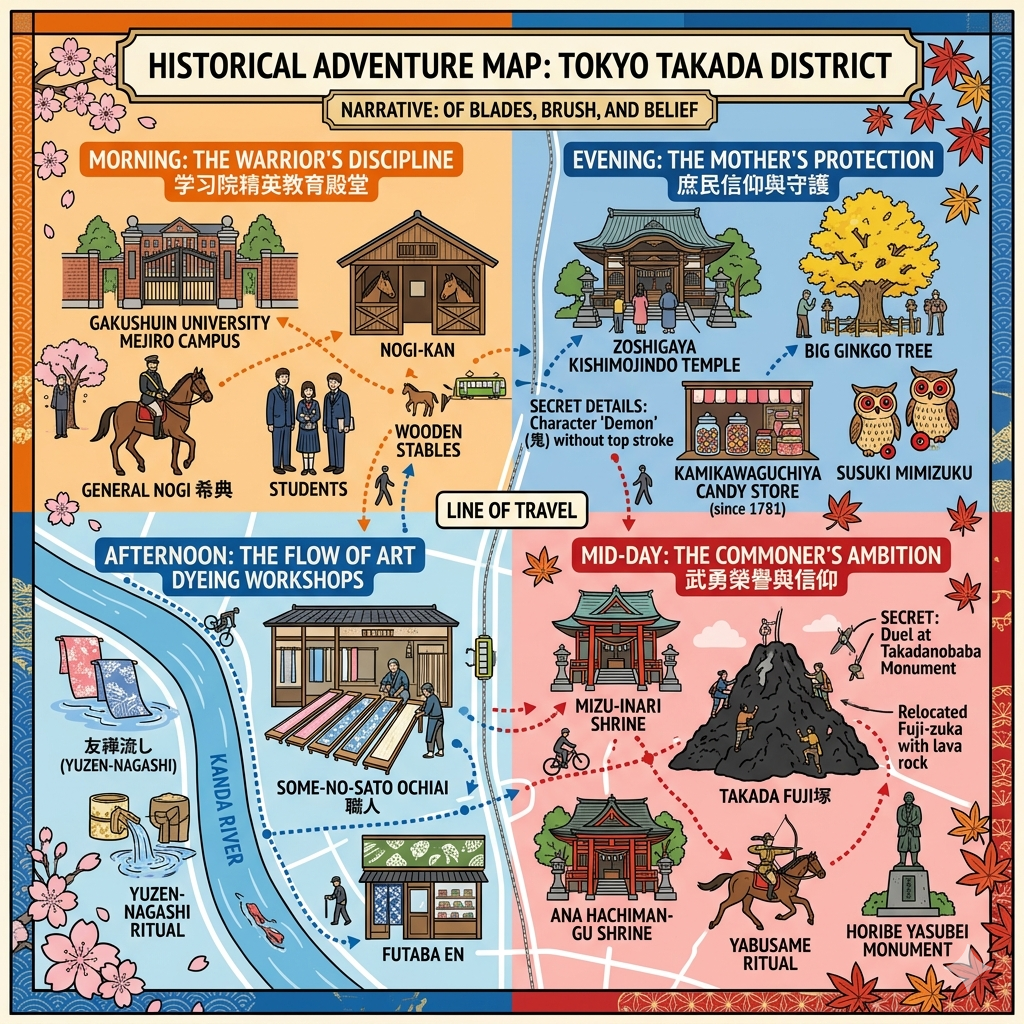
This is a historical travel story and walking guide to Takadanobaba, a Tokyo neighborhood where academic energy meets Showa-era nostalgia. By exploring the banks of the Kanda River and the legacy of Osamu Tezuka, this guide reveals how Edo-period samurai training grounds transformed into a vibrant cultural hub. Readers will discover a unique route through hidden shrines and local stories that define this storied district.
 Lawrence
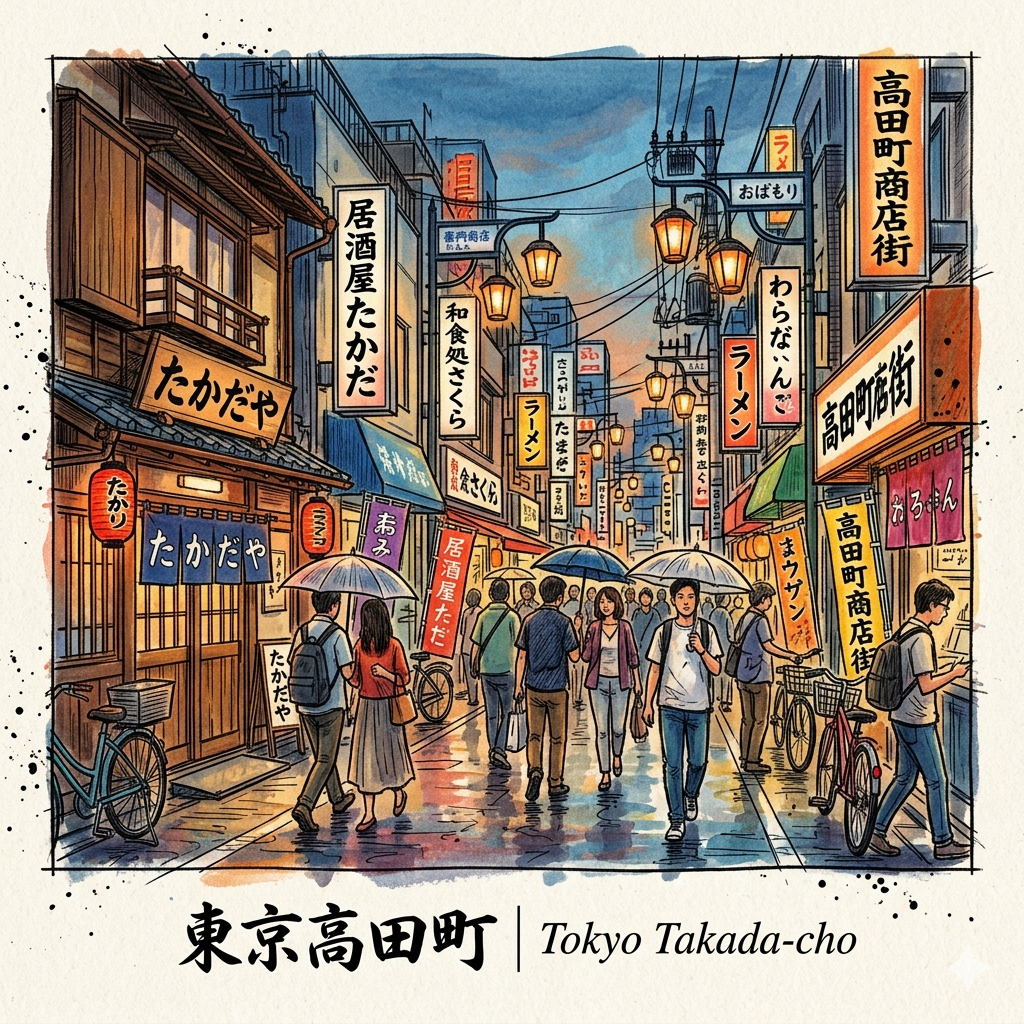
The history of Tokyo is often narrated through its glittering center, yet its true character frequently resides at its edges. Takada, a district defined by the dramatic topographical shift where the Musashino plateau descends into the Kanda River lowlands, serves as a profound historical intersection. Once the fringe of the Shogunate’s capital, this area acted as a laboratory for urban expansion, social experiments, and cultural preservation. By traversing its slopes today, one can still experience the physical remnants of the 18th century hidden beneath the veneer of a modern university town. Here, the democratization of religious pilgrimage meets the architectural stoicism of the Meiji elite, while the industrial migration of dyeing artisans coexists with the folk medicine of the vulnerable and the ritualized honor of samurai duels. To walk Takada is to step off the modern asphalt and onto a terrain still shaped by unresolved ambitions.
Listen to the historical stories told in detail (For subscribers only)
The Democratization of the Sacred—The High Rise of Takada Fuji
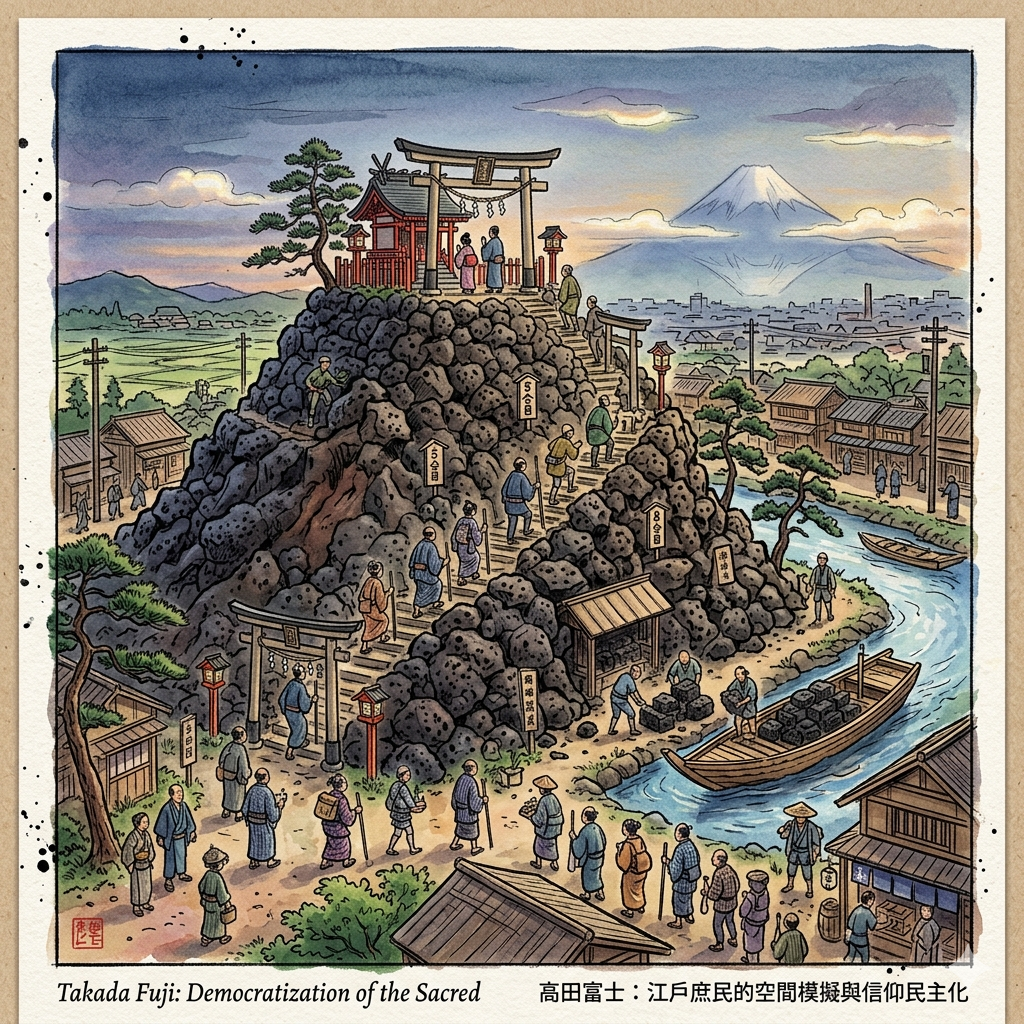
In the late Edo period, the "Fuji-zuka"—miniature replicas of Mt. Fuji—emerged as a sophisticated response to the Shogunate’s strict controls on movement and the high costs of travel. These mounds were not merely garden features; they were tools of religious democratization, allowing the common person to achieve the spiritual merit of a pilgrimage without crossing a single provincial checkpoint or securing an expensive travel permit.
The "Takada Fuji," initiated in 1779 by the gardener Takada Toshiro, represented a massive spatial simulation. To ensure the mound's spiritual authenticity, practitioners undertook a logistical feat, transporting actual volcanic lava from the base of Mt. Fuji via the Sagami and Kanda Rivers. This was a tactile, geological transplant; by walking upon actual Fuji stone, the pilgrim was not merely observing a symbol but engaging in a physical reality.
"The 'Takada Fuji,' completed in 1780, was consecrated as the 'East Mizuroku Mountain.' It stood as a sacred topographical mirror to the western peak, ensuring that the merit of the ascent was accessible to all who reached its summit."
While the original site now sits beneath Waseda University’s Campus, the mound survives at the nearby Mizuinari Shrine. Its existence proves that the urban "edge" was a space where the marginalized could innovate, creating a sense of Geographical Parity that bypassed the rigid hierarchies of the Shogunal capital.
While the Fuji mound offered a spiritual ascent for the masses, the nearby Mejiro plateau would later host an entirely different kind of elevation—one of social and educational exclusivity.
The Architecture of the Elite—Gakushuin and the "Stoic Noble"
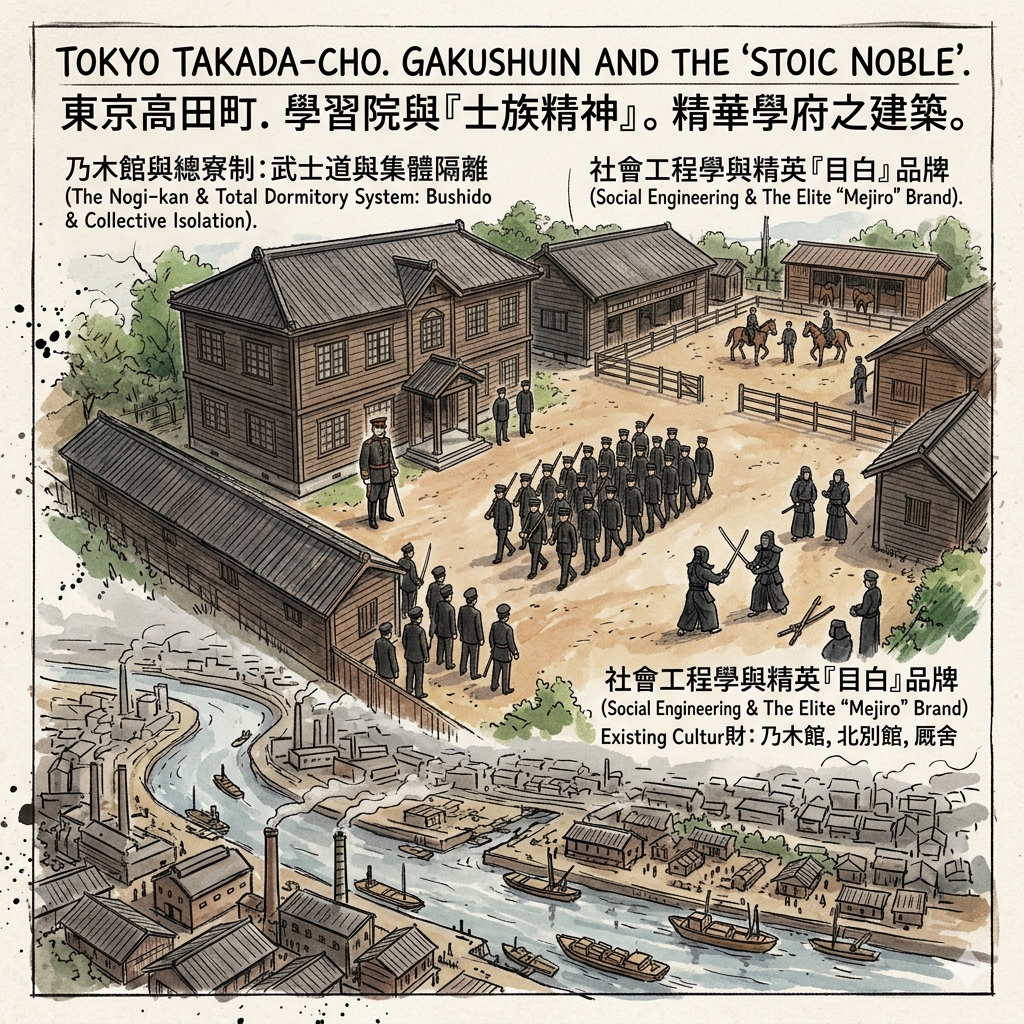
The social geography of Tokyo underwent a radical shift in 1908 when the Gakushuin school migrated to the Mejiro plateau. This move was not merely a relocation of a school for the nobility; it was an intentional act of social engineering designed to cultivate a new class of "Stoic Nobles" fit for a modernizing, imperial Japan.
Central to this vision was the "Nogi-kan," the dormitory managed by General Nogi Maresuke. The architecture here served as a calculated rejection of luxury. By utilizing simple wood and implementing a "total dormitory system," the school attempted to fuse Western academic modernity with the austere, semi-militarized values of the samurai. There is a profound irony in the Meiji elite choosing such material austerity; it was a performance of "samurai spirit" intended to maintain their moral authority in an age of rapid Westernization.
This education-driven development fundamentally redefined the area, creating the high-end "Mejiro" brand—a reputation for quietude and culture that persists in Tokyo’s real estate today. From the plateau’s heights, the Meiji elite looked down upon the city, physically and socially removed from the industrializing lowlands where the river’s utility was being harnessed by a different class of Tokyoite.
The Indigo River—Environmental Necessity and the Dyeing Exodus
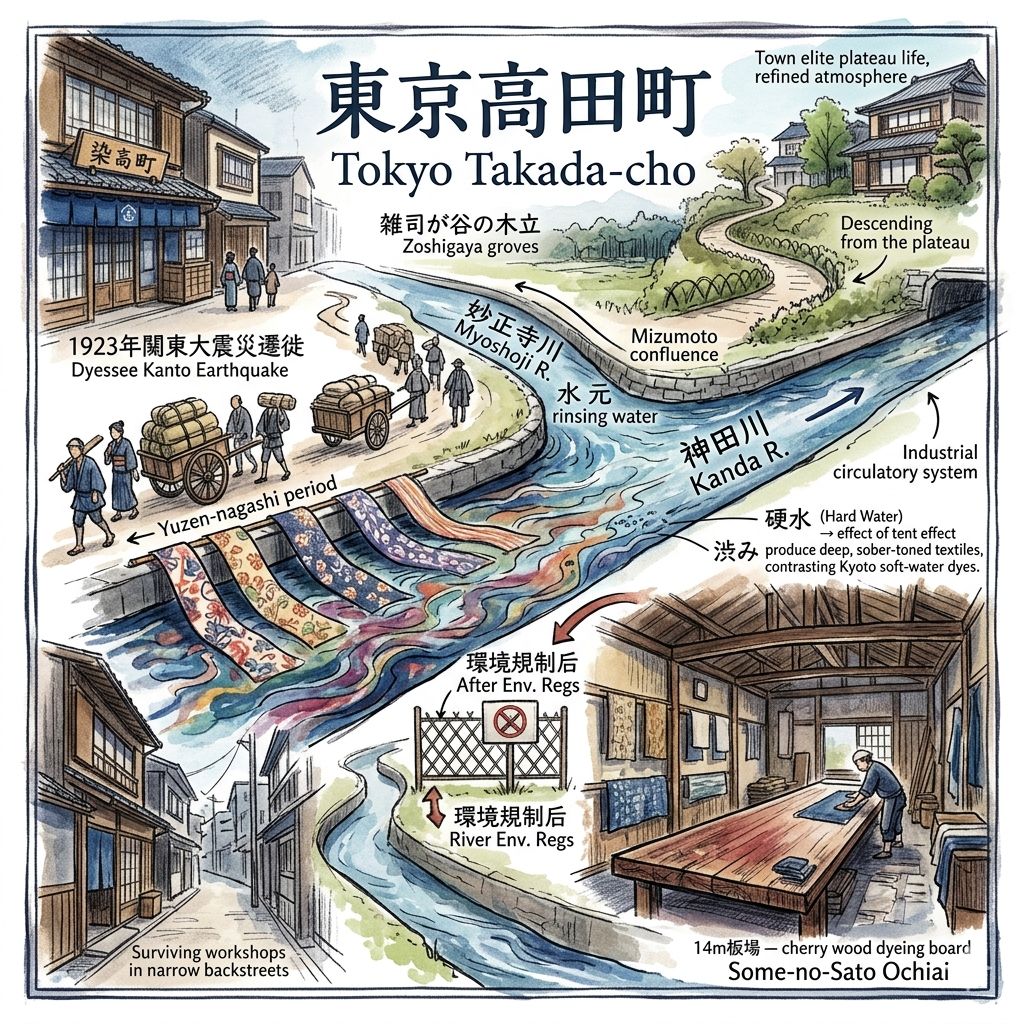
Descending from the plateau brings one to the Kanda River, which functioned as the industrial circulatory system of early 20th-century Tokyo. Following the 1923 Great Kanto Earthquake, a "Great Migration" occurred: dyeing artisans, forced out of central Kanda by overcrowding and pollution, sought the "Mizumoto" (clean rinsing water) of the Takada and Ochiai confluence, where the Kanda meets the Myoshoji River.
This industrial geography was dictated by the specific chemistry of the water. The "hard water" found in Takada was particularly suited for "Edo Sarasa," providing the textiles with their characteristic "shibumi"—a deep, sober tone that distinguished the city's craft from the bright, soft-water dyes of Kyoto. For decades, the landscape was defined by "Yuzen-nagashi," where long strips of vibrant fabric were rinsed in the open river, turning the water into a moving canvas.
While environmental regulations in the 1960s eventually banned river washing to combat pollution, the industry survived by moving its complex chemical processes indoors. The river today is a quiet channel, but the surviving workshops in the backstreets of Ochiai remain a testament to a time when the quality of a river’s flow dictated the economic destiny of the city. While the river provided a livelihood for the industrious, the nearby Zoshigaya groves offered a different kind of sanctuary for the vulnerable.
The Owl of Mercy—Folk Medicine and Religious Social Safety Nets
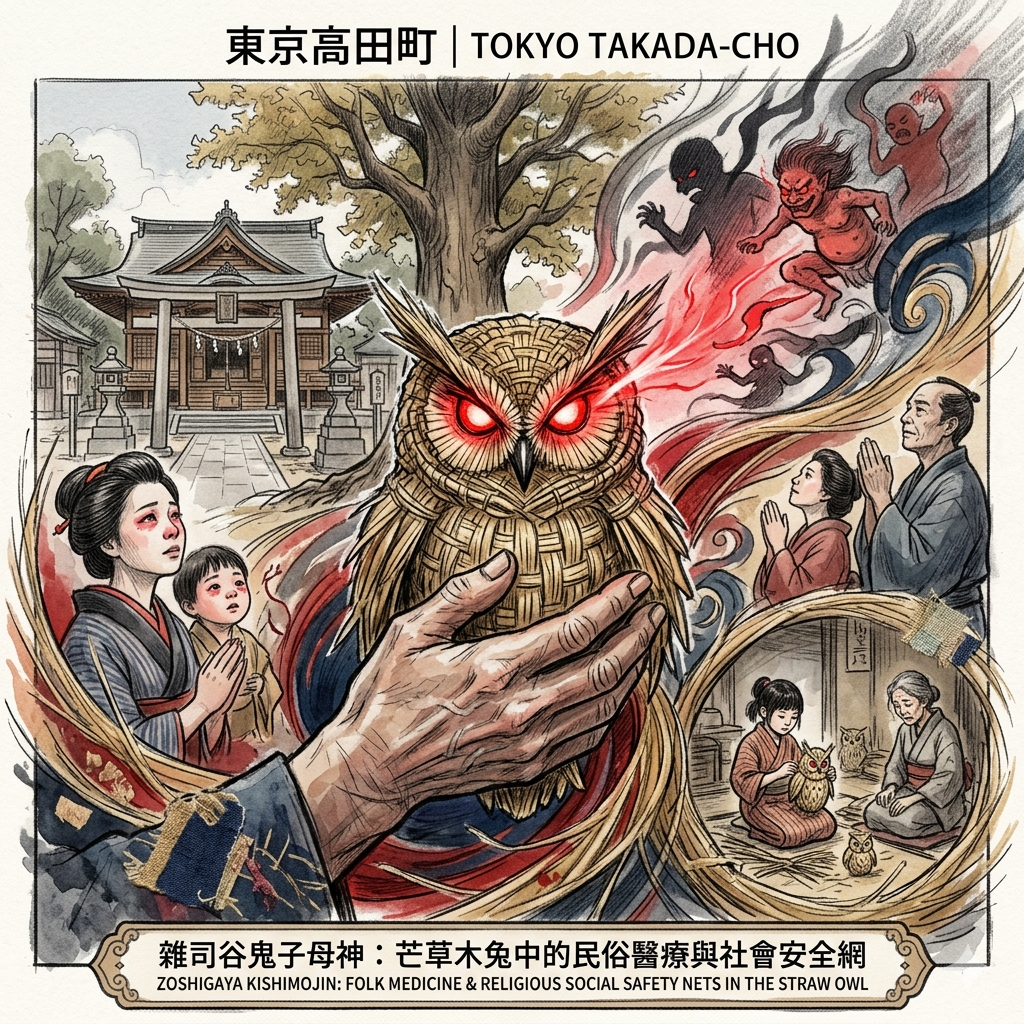
In an era of high mortality and frequent epidemics, the Zoshigaya Kishimojin temple served as a critical religious social safety net. Kishimojin, a protector of children, became the focal point for parents seeking protection against smallpox—the "Smallpox God" that haunted the crowded streets of Edo.
The "Susuki Mimizuku" (Straw Owl), sold at the temple’s gates, should be interpreted not as a simple souvenir, but as a vernacular medical talisman. The legend of the girl Kume-jo, who wove these owls to fund her mother’s medicine, underscores how religious sites provided informal welfare for the poor. These owls were crafted with distinctive red eyes, a color traditionally believed to ward off the Smallpox God.
The continued production of these owls today, using straw brought in from Chichibu, represents a remarkable "cultural resilience." It highlights how religious sites turned local flora into a spiritual shield against biological threats. While these quiet prayers of mothers echoed through the temple groves, a different kind of ritualized life was taking shape on the nearby flats of the horse grounds.
The Duel and the Ritual—Takada-no-baba’s Performance of Power
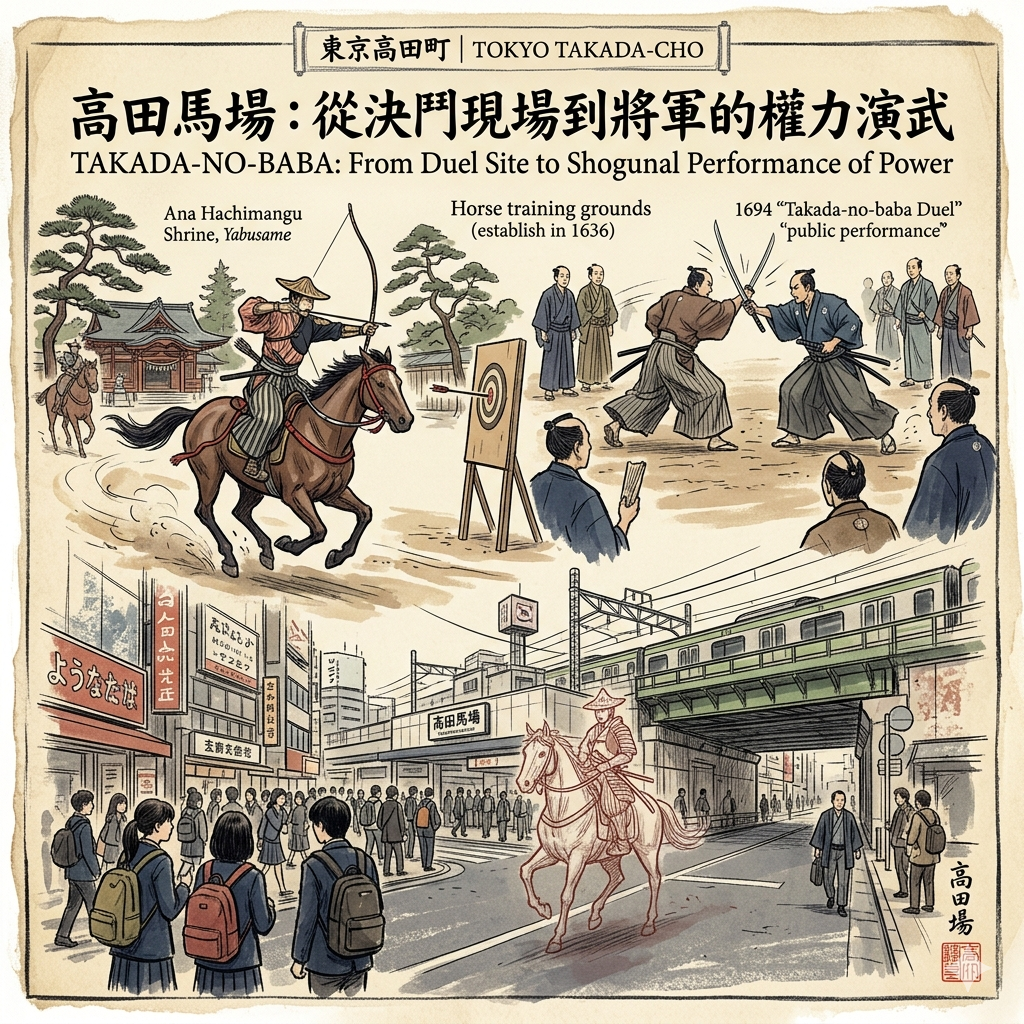
The name "Takada-no-baba" evokes the horse grounds established in 1636 for the training of the Shogun’s cavalry. It became legendary in 1694 as the site of the "Takada-no-baba Duel" involving Horibe Yasubei. This duel was more than a private dispute; it was a public performance of samurai honor that captivated the city, proving that the "baba" was a stage for ritualized violence and public justice.
Later, in 1728, Shogun Yoshimune utilized this ground to revive "Yabusame" (horse archery) at the nearby Ana Hachimangu Shrine. This was a calculated political ritual—a "revival of ancient rites" intended to consolidate Shogunal power through military display.
There is a poignant disconnection in modern Takada. The current Takada-no-baba station—a bustling transit hub and student district—is located several hundred meters from the original training grounds. This migration of the name to the station illustrates how modern urban nomenclature often preserves the ghost of a history that the physical city has long since built over. Today’s students hurry across asphalt that rests upon the "highest hall" of Shogunal military display.
The Hidden Gems of Takada & Mejiro
In the quiet corners of this district, history is not just recorded in books but is rooted in the earth itself.
- The 700-year-old Great Ginkgo of Zoshigaya Kishimojin. This ancient tree stands as a living witness to the Edo-era pilgrimages. Its massive canopy literally dwarfs the modern structures around it, serving as a physical anchor for the layered history of the area. It provided shade to the mothers and artisans described in these stories long before the first train lines reached the plateau.
Philosophical Conclusion: The Palimpsest of Takada
Collectively, these stories reveal Takada not as a static neighborhood, but as a palimpsest—a city of translucent vellum sheets where the ink of 1694 is still bleeding through the asphalt of 2024. We see a recurring theme of "Edge Compensations": the outskirts of Tokyo consistently handled what the center could not, whether it was the simulated sacred space of a Fuji mound, the stoic isolation of elite education, or the industrial necessity of river-based crafts.
Takada teaches us about spatial continuity. The slopes that once challenged samurai on horseback now challenge students on bicycles; the river that once rinsed indigo silks now flows through a concrete channel, yet it remains the same geographical artery. In a city that builds over its past so relentlessly, are we walking on asphalt, or are we walking through the unresolved ambitions of the samurai and the artisans who preceded us?
To uncover more layers of Tokyo’s hidden history, subscribe to the "Historical Travel Stories" newsletter for monthly deep-dives into the urban past.
Travel Logistics: The Modern Footpath
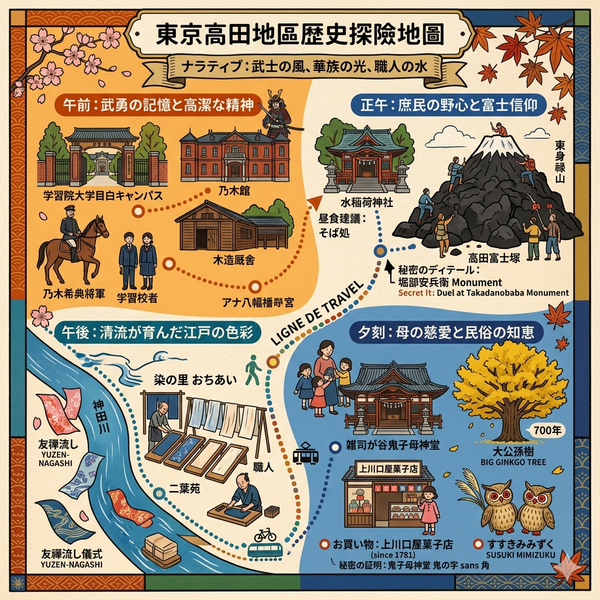
Access: Takada is easily reached via Waseda Station (Tozai Line) or Mejiro Station (Yamanote Line). These stations represent the historical contrast between the "lowland" industrial zone and the "plateau" elite district.
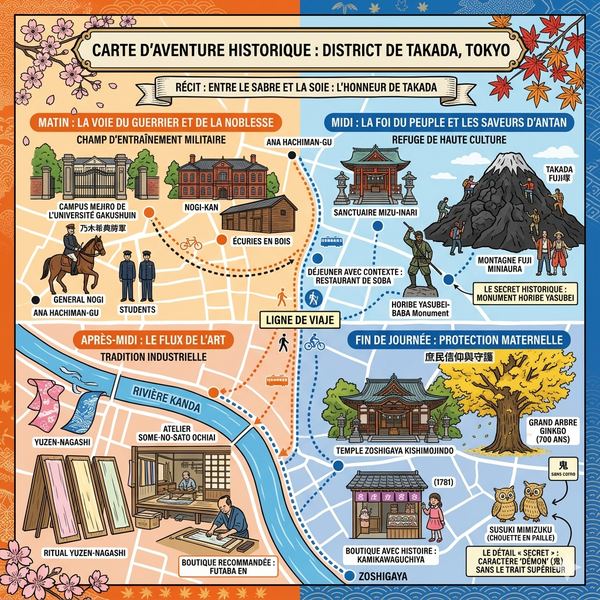
Recommended Walk: Begin at the Mizuinari Shrine to view the relocated Takada Fuji, then ascend the slope toward the Gakushuin University Campus to view the historic Nogi-kan and the stables. Conclude your journey by walking to Zoshigaya, visiting the Kishimojin Temple, the Kamikawaguchiya candy shop (est. 1781), and the ancient ginkgo tree.
Tours & Stays: The Mejiro area offers several boutique accommodations that provide a quieter, more "cultured" alternative to the chaos of nearby Shinjuku. It is an ideal base for the traveler who prefers reflection over spectacle.
Q & A
Tell me about the connection between Kanda River's water and Tokyo's traditional dyeing industry.
The connection between the Kanda River and Tokyo’s traditional dyeing industry (specifically Edo Komon, Yuzen-zome, and Edo Sarasa) is rooted in the essential physical and chemical requirements of the dyeing process.The following details the historical and industrial relationship between the river's water and this craft:
1. The Necessity of "Mizumoto" (Water Rinsing)The most critical link between the industry and the river is the process known as mizumoto. This stage requires rinsing dyed silk or fabric in clear, flowing river water to wash away anti-dye paste (防染糊) and excess pigments. Because this process requires a large volume of clean, cold, and steady-flowing water, the geography of the river directly dictated where the industry could survive.
2. The Great Migration UpstreamWhile dye workshops were originally concentrated in central areas like Kanda Konyacho during the Edo period, the industry underwent a massive relocation to the Takada and Ochiai regions (upstream Kanda River) during the Meiji and Taisho periods. This was driven by two main factors:
- Water Quality Degradation: As downstream Tokyo became more densely populated, the water became too polluted for delicate dyeing work.
- 1923 Kanto Earthquake: The destruction of old workshops in central Tokyo accelerated the collective move to the confluence of the Kanda and Myojosiji Rivers (the name "Ochiai" refers to this merging), where groundwater was abundant and the river water remained clear.
3. Chemical Properties and "Edo Sarasa"The specific quality of the water in the Takada area influenced the aesthetic of the final product. The Kanda River in this region is characterized by "hard water" (containing more minerals). This chemical composition allowed "Edo Sarasa" to achieve a unique, deep, and steady tone known as "shibumi". This stands in contrast to the bright, vivid colors produced by the soft water used in Kyoto’s dyeing industry.
4. The Vanished Landscape of "Yuzen-nagashi"Until the 1960s, the Kanda and Myojosiji Rivers were famous for the sight of "Yuzen-nagashi"—long, colorful strips of fabric being rinsed and floating in the current. This was not just a scenic tradition but a major industrial activity, with hundreds of workshops forming a complete "craft ecosystem" that included related trades like steam ironing and pattern carving.5. Transition to Modern PreservationThe direct physical connection to the river water was severed in the 1960s when environmental laws banned the rinsing of fabric in public rivers to prevent water pollution. Consequently:
- Technological Shift: Workshops moved to indoor, closed-circuit water systems.
- Cultural Legacy: Although the number of workshops has dwindled, locations like "Some no Sato Ochiai" maintain century-old traditions.
- Modern Rituals: The annual "Some no Komichi" festival in February recreates the historical connection by hanging dyed fabrics over the Myojosiji River, symbolically restoring the "Yuzen-nagashi" landscape to the community.
How did Edo commoners use 'simulated mountains' to practice religious pilgrimages at home?
Edo commoners utilized "simulated mountains," known as Fuji-zuka, as sophisticated physical and spiritual substitutes for the actual Mount Fuji to overcome significant barriers to religious pilgrimage. This practice, known as "simulated climbing," allowed the masses to gain religious merit without leaving the city,.The following details how these structures functioned and their significance to Edo society:
1. Overcoming Geographical and Political BarriersDuring the late 18th century, the "Fuji-ko" (Fuji faith) was immensely popular, yet a physical pilgrimage to the actual mountain was impossible for most commoners due to:
- Economic Costs: The funding required for long-distance travel far exceeded the means of average artisans or farmers.
- Political Restrictions: The Shogunate enforced a strict checkpoint system (sekisho) and required travel permits (往來手形), which severely limited the movement of the population.
2. Physical Construction for "Authentic" ExperienceTo make the experience feel spiritually valid, these mounds were not just simple hills; they were materially linked to the sacred site.
- Volcanic Rock Logistics: Devotees, such as those led by gardener Takada Toshiro, transported actual lava rocks from the base of Mount Fuji. In the case of the Takada Fuji, these rocks were shipped via the Sagami River, around the Miura Peninsula, and up the Kanda River to the construction site.
- Architectural Replication: The mounds were designed to mirror the actual mountain's topography. The Takada Fuji, standing about 10 meters high, featured a "landscape replication" that included specific markers for the 5th station (gogome), 8th station, and the Sengen-sha shrine at the summit,.
3. Religious and Social DemocratizationBy creating these "simulated mountains," the commoners successfully practiced "belief democratization."
- Geographical Equality: The Takada Fuji was designated as "Higashi-miroku-san" (East Miroku Mountain) to correspond with the "West Miroku Mountain" in Shizuoka, elevating the local site to the same spiritual status as the real Fuji.
- Cross-Class Social Space: During the annual "Yamabiraki" (mountain opening) from June 15th to 18th, the area became a bustling social hub where people from various social classes could gather and perform rituals, breaking down the exclusivity of religious merit.
4. Cultural Resilience and "Landscape Replication"The creation of Fuji-zuka reflected a broader trend in Edo society where marginalized groups used their professional skills—such as gardening and artisan techniques—to reshape the urban religious landscape. This allowed edge territories like Takada to develop cultural capital that could rival the center of Edo (the Shogun's city), transforming a peripheral agricultural village into a major religious landmark.In summary, these simulated mountains served as a spiritual infrastructure that bypassed the economic and political monopolies on sacred travel, providing the Edo commoners with a "home-based" pilgrimage that was considered just as holy as the real journey.
Reference and Further reading
- 区の歴史・年表 - 豊島区, accessed April 6, 2026,
- 【北豊島】高田豊川町 - 江戸町巡り, accessed April 6, 2026,
- 北豊島郡 - accessed April 6, 2026,
- 高層ビルを見下ろす高台の邸宅街「目白」の真価 | 人生を豊かにする ..., accessed April 6, 2026,
- 染の里おちあいの歩み | 新宿区落合で染色体験 染め着物小物販売 染 ..., accessed April 6, 2026,
- 歴史|学校法人学習院, accessed April 6, 2026,
- 富士講/東京の富士山登頂 - 探検コム, accessed April 6, 2026, https://tanken.com/fujiko.html
- 〜第13回〜 高田富士 – 早稲田ウィークリー, accessed April 6, 2026,
- 富士塚の諸相, accessed April 6, 2026,
- 「江戸庶民の憧れ―富士講」 - 横浜歴史研究会, accessed April 6, 2026,
- 『富士塚考 ― 江戸高田富士 築造の謎を解く』 竹谷 靱負(拓殖大学名誉教授)著者, accessed April 6, 2026,
- 高田富士 | 東京とりっぷ, accessed April 6, 2026,
- 「高田富士」以前に存在した静岡県内の富士塚 - 富士山世界遺産センター, accessed April 6, 2026,
- 検索結果書誌詳細:蔵書検索システム - 静岡県立中央図書館, accessed April 6, 2026,
- 学習院目白キャンパス建造物の文化財登録化について, accessed April 6, 2026,
- 霞会館記念 学習院ミュージアム・永青文庫 珈琲茶館 集 イトシアプラザ有楽町店 2025/03/27, accessed April 6, 2026,
- No.1402 『ブラタモリクイズ!東京・目白~目白ブランドの正体とは?~編』 | 中学受験鉄人会, accessed April 6, 2026,
- 江戸の染色文化と河川 :里川文化塾 開催レポート ミツカン 水の文化センター, accessed April 6, 2026,
- 江戸の染色文化と河川, accessed April 6, 2026,
- 170豊島区 雑司が谷 雑司が谷 鎌倉時代以後に起こった地名で古い文献には、「曹司谷」「 - 名島会, accessed April 6, 2026,
- 安産や子育(こやす)のお守り「すすきみみずく」の言い伝えをご存知ですか?【郷土玩具の心意気】, accessed April 6, 2026,
- 江戸時代から雑司が谷に伝わる郷土玩具「すすきみみずく」 保存継承に姉妹都市秩父市 - ADEAC, accessed April 6, 2026,
- 「雑司ヶ谷のすすきみみずく」 | 日本玩具博物館, accessed April 6, 2026,
- すすきみみずく物語 - 豊島区, accessed April 6, 2026,
- 高田馬場と流鏑馬 : 大江戸歴史散歩を楽しむ会, accessed April 6, 2026,
- 穴八幡神社と五木寛之伝説, accessed April 6, 2026,
- 高田馬場の決闘 - accessed April 6, 2026,
- 堀部安兵衛 高田馬場の決闘 - YouTube, accessed April 6, 2026,
- 流鏑馬の意味と歴史、楽しみ方~日本に伝わる神事を知る - 家族葬のファミーユ, accessed April 6, 2026,
- 騎馬隊と流鏑馬/ホームメイト - 刀剣ワールド, accessed April 6, 2026,
- 7 落合第一地域 - 新宿区, accessed April 6, 2026,
- 6:高級住宅地になった目白・落合 ~ 池袋 | このまちアーカイブス - 三井住友トラスト不動産, accessed April 6, 2026
 Lawrence
 Lawrence
 Lawrence