Lacock, Wiltshire: How an Abandoned Nunnery Fixed an English Village in Time
Step into Lacock, Wiltshire with this historical walking story. Discover how an abandoned medieval nunnery, the wool trade, and the birthplace of photography preserved a timeless English village across centuries.

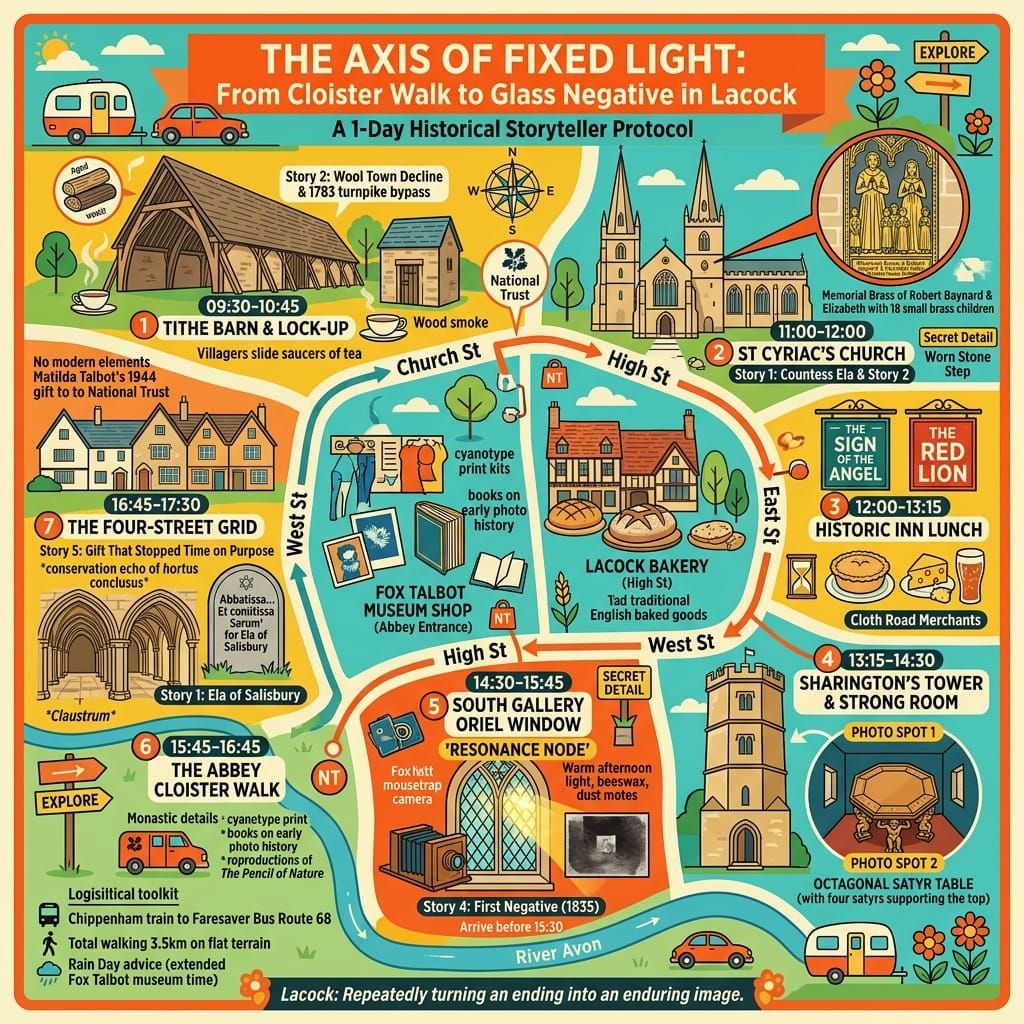
This is a historical travel story and walking guide to Lacock, a remarkably preserved medieval village in Wiltshire, England. Through rich historical narratives, sensory cues, and a curated 1-day itinerary, it explores how an abandoned nunnery, the medieval wool trade, and the birth of photography combined to fix this timeless village in history. Readers will discover secret local corners, architectural layers, and the cinematic charm that makes Lacock a living museum.
I still remember driving for two hours from Rotherhithe, London, to the village of Lacock over four years ago to meet a friend who had driven there from Taunton; we spent the afternoon together in this quaint village, which was steeped in an atmosphere of old-world charm. Walking along its medieval streets felt truly dreamlike.
💡 Join a community of discerning travelers. Simply enter your email to instantly unlock audio guides and one-day itineraries, and carry our exclusive historical walking maps with you on your journey.
 Lawrence
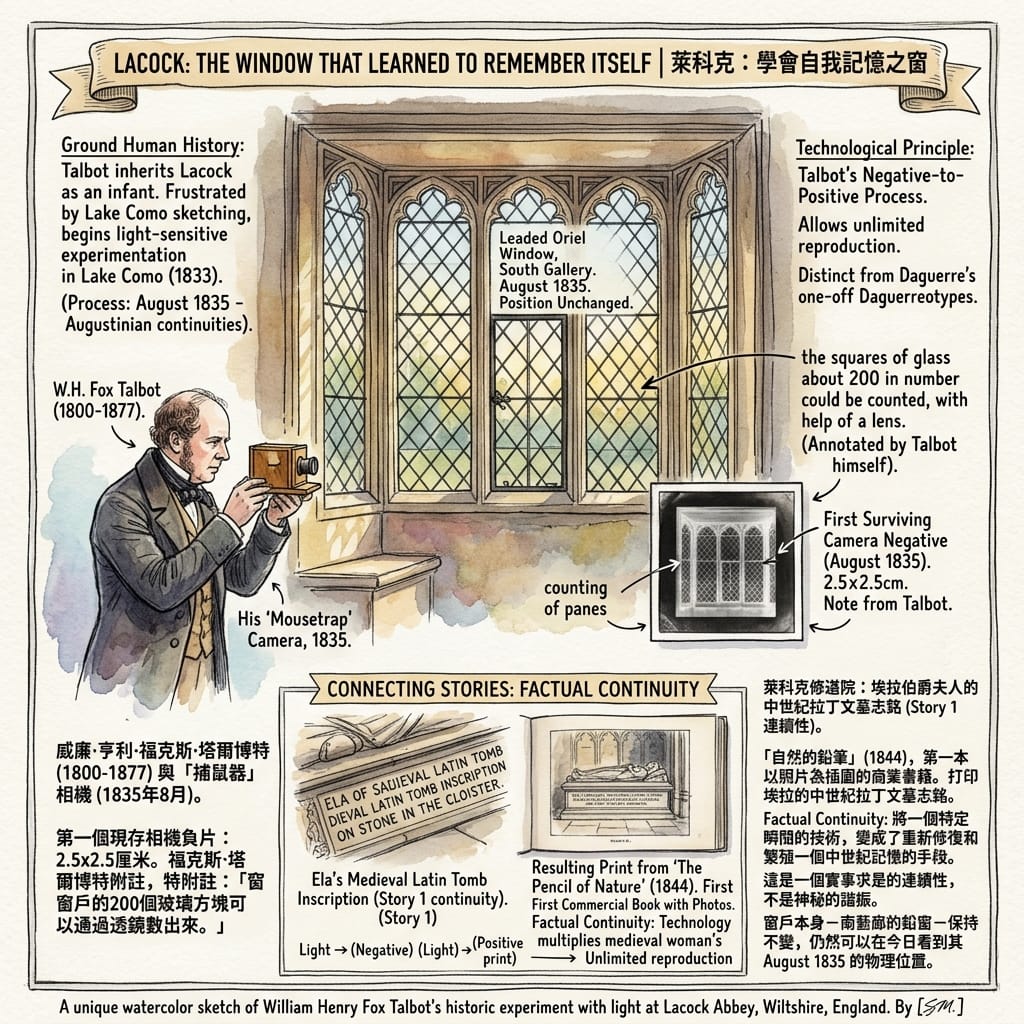
The window is still there. Not a replica, not a rebuild — the same leaded, diamond-paned oriel in the South Gallery of Lacock Abbey, the glass still holding its two hundred small squares to the light. In August 1835, a frustrated amateur draughtsman pointed a wooden box no bigger than a cigar case at this window and, for the first time in the history of the world, kept what he saw. Stand under it today and the strange thing isn't that the window is old. It's that it is exactly this window — the same panes, the same eleven o'clock light — that taught the human race how to stop time from moving on without asking first.
Lacock doesn't announce itself. It's a grid of four stone streets in Wiltshire, a tithe barn, a church, an abbey at the edge of a water meadow. But look closer and the village turns out to be built, almost entirely, from things that were supposed to end and didn't.
The Countess Who Would Not Disappear
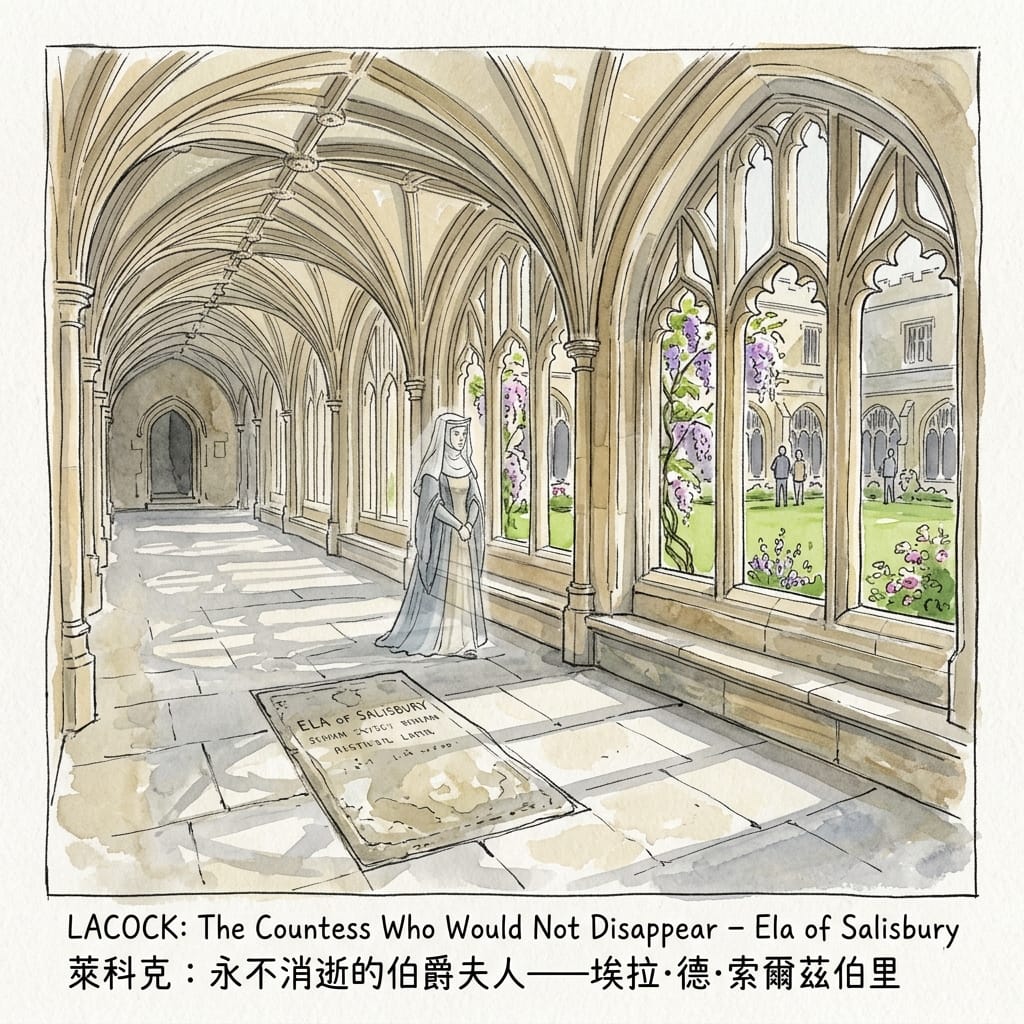
In 1196, a nine-year-old girl inherited an earldom. Ela of Salisbury was the sole heir to her father's title and estates, and for a period the record grows uncertain — later tradition says she was hidden away by relatives who wanted the inheritance for themselves. What's documented is plainer and, in its way, stranger: she surfaced, married William Longespée, an illegitimate son of Henry II, and when he died in 1226 — some said poisoned, though this was never proven — she did not remarry. She became Sheriff of Wiltshire, an office built for men, and held it twice. In 1232 she founded two religious houses in a single day, one in the morning and one in the afternoon, both in her husband's memory. The morning one was Lacock.
The Countess Who Built Her Own Kingdom
She didn't stop at founding it. In 1238 she entered the abbey herself, and in 1240 she became its abbess, ruling the community of canonesses she had built until 1257. She died at seventy-four, an old woman by any medieval measure, and was buried not in the ordinary churchyard but inside the cloister itself — the enclosed, four-square walk that Augustinian tradition held to mirror the order of heaven. Her tomb carried a Latin epitaph naming her, in the same breath, abbess and countess. Two titles that, for anyone else in thirteenth-century England, would have belonged to two different women.
Holographic Sensory Cue: Cold flagstone underfoot, worn smooth in a narrow central track by six centuries of sandalled and booted feet. The cloister's four walks trap sound — a single set of footsteps returns faintly off the vaulted stone before it fades. Even at midday, the shadowed arcade holds a few degrees less warmth than the open garth at its centre, the temperature drop a visitor's skin registers before their eyes adjust to the dimmer light.
The Wool Town That Refused to Grow
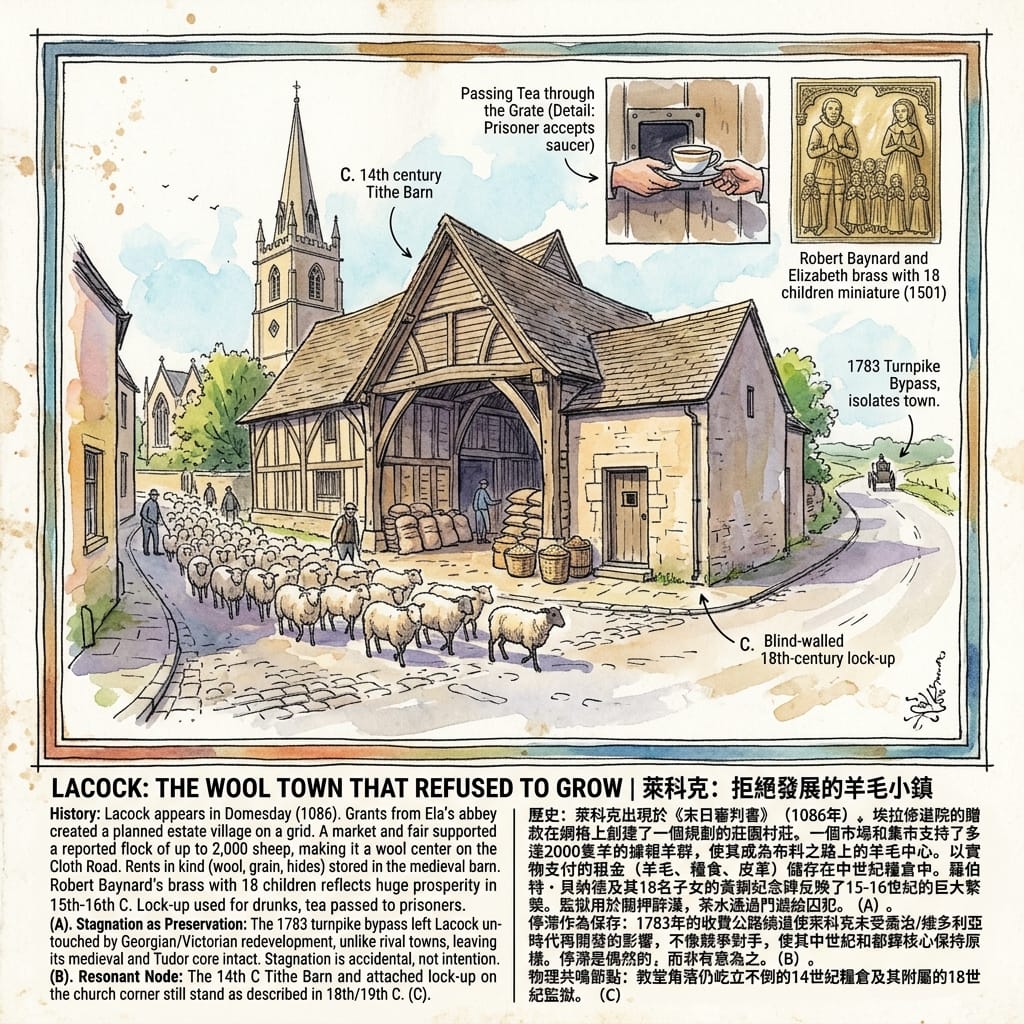
The nuns needed tenants, and tenants needed rent, and for three centuries that rent came in wool. Lacock sat on the road clothiers called the Cloth Road, running between London and Bath, and its abbey kept flocks two thousand strong. The tithe barn where farmers deposited their tenth still stands at the corner by the church — a barn with a dirt floor and cruck beams bent like ribs, built to hold grain and fleece, not sermons. Attached to it, almost as an afterthought, is a small stone dome no bigger than a garden shed: the village lock-up, where drunks were shut in overnight. The door was too narrow to pass a teacup through, so villagers who felt sorry for whoever was inside would pass in saucers instead.
The Town Saved By Bankruptcy
Robert Baynard, a wool merchant, died in 1501 and is remembered in St Cyriac's Church by a brass memorial showing him and his wife Elizabeth with all eighteen of their children ranked in miniature beside them — sons on one side, daughters on the other. Eighteen children is not a symbol. It is a family, and it is also a measure of what the cloth trade could support in a good century.
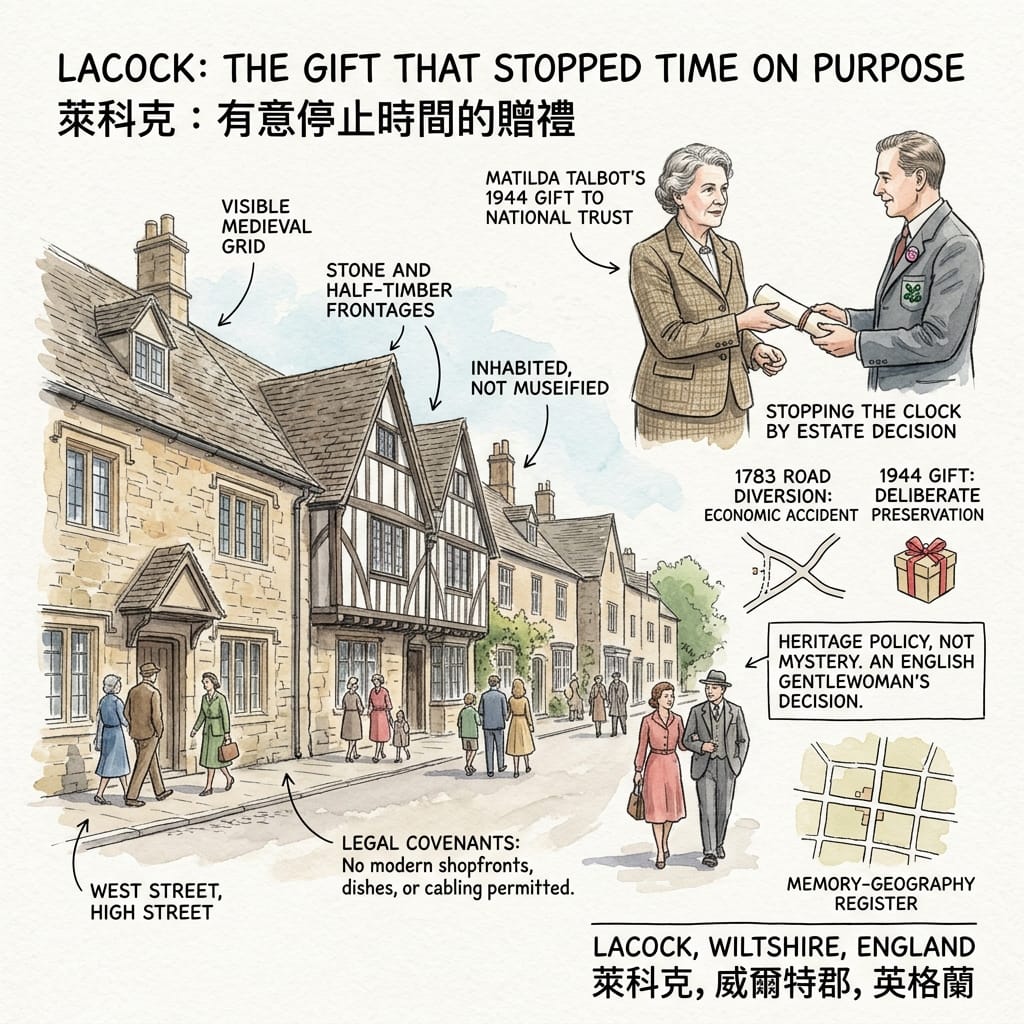
Then, in 1783, a new turnpike road to Bath was cut a few miles away, and Lacock was quietly left off the map that mattered. The trade moved to bigger towns with better roads. Lacock's clothiers packed up. And because nothing came to replace them, nothing came to rebuild the streets either. The village that failed commercially is the reason the village that survives physically looks the way it does.
The Counterfeiter's Tower
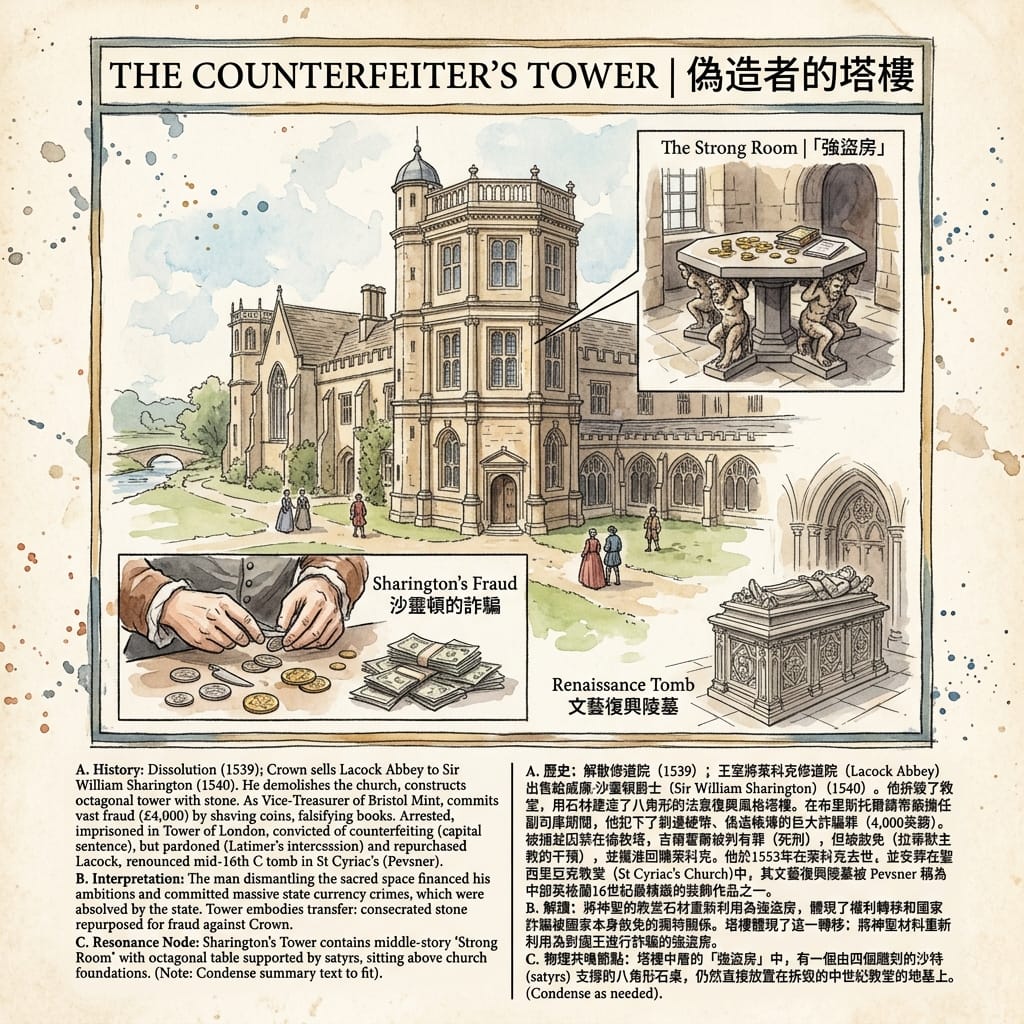
When Henry VIII dissolved the monasteries in 1539, Lacock's canonesses were turned out and the abbey was sold, a year later, to a courtier named Sir William Sharington for £783. Sharington tore down the abbey church — selling its bells, it's said, to fund a bridge — and built himself a house out of the stone, crowning it with an octagonal Renaissance tower unlike anything else in the county.
The Tudor Counterfeiter S Tower
He also, as it turned out, ran the Bristol Mint into the ground. As vice-treasurer from 1546, Sharington shaved coins, minted more than he was authorised to, and falsified the mint's own books to hide it, quietly making a fortune while funding the political conspiracy of Thomas Seymour, a royal favourite with ambitions of his own. It caught up with him. In January 1549 the abbey was searched, and Sharington was hauled to the Tower of London. Tried and convicted of counterfeiting the king's currency — a capital offence — he confessed everything, was pardoned through a bishop's intercession, and was allowed to buy his own confiscated estate back. He died at Lacock in 1553 and lies in a tomb in St Cyriac's so ornate that the architectural historian Nikolaus Pevsner called it one of the finest pieces of decoration surviving from its century anywhere in England.
Climb into his tower today and you're standing in a strongroom built from a demolished church, paid for with a crime the Crown chose to forgive.
The Window That Learned to Remember Itself
Two and a half centuries later, an infant named William Henry Fox Talbot inherited that same abbey at five months old. Grown, married, and honeymooning at Lake Como, he found he simply couldn't draw — his sketches of the lake were, in his own words, melancholy to behold — and began hunting for a way to let light fix an image by itself. Back at Lacock in August 1835, using a small homemade camera his wife called a "mousetrap," he photographed the oriel window in the South Gallery. The resulting negative, barely an inch across, is the oldest surviving photographic negative in the world. He wrote beside it, in his own hand, that the two hundred small panes of glass could still be counted with a lens.
What made Talbot's process matter wasn't the first image — it was the second, and the third, and every one after. Unlike his rival Daguerre's one-off metal plates, a Talbot negative could be printed again and again. He had not just captured a moment; he had built a machine for repeating it.
The Window That Learned To Remember
Nine years later, publishing the first commercially illustrated photograph book in history, Talbot turned his camera on the abbey's own cloisters — the same cloisters where Ela had been buried six centuries earlier — and printed her Latin epitaph as an illustration. A technology invented to fix a single vanishing instant of light had, in the hands of the man who grew up beside her grave, reprinted a medieval abbess's memorial for a new century.
Resonance Node: The Tithe Barn Door
If there is one point in Lacock where the village's whole method reveals itself, it is not the abbey — it is the lock-up door beside the tithe barn. A door built too small on purpose, so that even mercy had to be improvised, passed through in a saucer rather than a cup. It is the smallest structure in the village and the one that most exactly states what the larger story keeps repeating: something ends here — a night's freedom, a trade, a monastery, a dynasty — and what's left afterward is kept, deliberately, exactly as it was found.
The Present-Day Place
Walk Lacock's four streets today and almost nothing you see postdates the eighteenth century. There are no satellite dishes on the stone frontages, no plastic shopfronts, no overhead cables — not by accident, but by covenant.
The Village Legally Trapped In Time
In 1944, Matilda Talbot, the last of the family to hold the estate, gave the abbey, its farmland, and the entire village to the National Trust rather than sell it off in pieces. People still live behind those stone walls, pay rent, run the pub, walk to the shop. It is not a museum. It is a village that made a legal decision, eighty years ago, to keep looking like itself.
The Philosophical Anchor
A widow's grief built an abbey that outlived the kingdom that later seized it. A fraud financed the one building in the village still called beautiful. A ruined trade preserved the streets that a thriving one would have knocked down. And a man who couldn't draw built, by accident, the machine that could remember for him — then pointed it, without needing to explain why, at the grave of the woman who started it all.
Lacock keeps almost nothing on purpose. What it keeps, it keeps because something else, first, had to stop.
If you'd like more places like this — where a single window, door, or tower turns out to be holding centuries — Historical Travel Stories sends one a week. No noise, just the places worth standing still in.
Accessing the Physical Node
Lacock is in Wiltshire, about 3 miles south of Chippenham, and roughly 20 minutes by car or taxi from Chippenham railway station, which has regular direct trains from London Paddington and Bristol. There is no train station in the village itself; the 234/235 local bus service connects Chippenham to Lacock, and a paid National Trust car park sits at the village edge (the streets themselves are largely pedestrianised or lightly trafficked). Lacock Abbey, the cloisters, the Fox Talbot Museum and the walled garden are run by the National Trust and open on a seasonal schedule with an admission charge (free to National Trust members); St Cyriac's Church and the village streets, tithe barn exterior and lock-up are freely accessible year-round. Several historic inns in the village, including the 15th-century Sign of the Angel, offer rooms for an overnight stay, and Lacock sits within easy reach of Bath, Castle Combe and the Cotswolds for a longer trip.
Accessing the Physical Node
Buckingham Palace sits in central London; the nearest stops are St James's Park and Green Park on the London Underground. The Mall itself closes to traffic on weekends, public holidays, and ceremonial occasions, making a walk from Trafalgar Square straight down to the palace gates the most direct way to feel Nash and Webb's engineered sightline for yourself. For an overnight base, Westminster and Mayfair put you within easy walking distance of every site mentioned above. If you want to go deeper than the standard tour, several London walking-tour operators run itineraries specifically built around the palace's unofficial history — the perimeter wall, the corridor seams, the protected viewpoints — routes that don't show up on the standard itinerary.
💡Core Historical Geospatial Entities & Research Q&A
Q1|Is Lacock Village merely a movie set built for Harry Potter, or a medieval wool hub preserved by history? (Cloth Road, Dissolution of the Monasteries & National Trust Preservation)
Answer: Lacock Village is not a fictitious film set constructed for modern cinema, but a remarkably intact medieval settlement in Wiltshire, England. While globally famous as a filming location for Harry Potter and Pride and Prejudice, its historical foundations run deep as a vital wool-trading hub along the Cloth Road connecting London and Bath. When King Henry VIII dissolved the monasteries in the 16th century, courtier William Sharington purchased Lacock Abbey and converted it into a Tudor manor, sparing the abbey and surrounding village from industrial demolition. This unique transition of ownership preserved its 13th-century street layout and stone architecture untouched by modern urbanization. Rather than a hollow Hollywood facade, Lacock's timeless appearance is the product of centuries of continuous rural tenancy and protective estate management.
Q2|How did 13th-century Countess Ela of Salisbury establish Lacock Abbey in one day and break medieval gender barriers? (Ela of Salisbury, Augustinian Cloisters & Wiltshire Sheriff History)
Answer: Thirteenth-century noblewoman Ela of Salisbury played a pivotal role in redefining medieval female authority. Inheriting the earldom at age nine in 1196, she later married William Longespée, the illegitimate son of King Henry II. Following his death in 1226, she famously remained unremarried and twice served as Sheriff of Wiltshire—an administrative office traditionally reserved for men. In 1232, she founded two religious houses in a single day, with the morning foundation becoming Lacock Abbey. From 1240 to 1257, she served as its Abbess and was ultimately buried within the Augustinian cloister, with her Latin epitaph uniquely uniting the titles of Abbess and Countess. Her life reflects a rare convergence of feudal power, religious devotion, and administrative independence in medieval England.
Q3|Was the world's first photographic negative truly captured at Lacock Abbey in 1835? (William Henry Fox Talbot, South Gallery Window & Early Photography History)
Answer: Yes, the world's first successful photographic negative was indeed captured in August 1835 at Lacock Abbey. Disappointed by his own drawing skills, polymath and amateur scientist William Henry Fox Talbot pointed a tiny wooden camera box—no larger than a cigar case—at the leaded lattice window in the abbey's South Gallery. Through light-sensitive chemistry, the window's grid of over two hundred small glass panes was permanently fixed onto paper, marking humanity's historic breakthrough of making light record its own image. Today, standing under that exact window connects visitors directly to the birth of modern photography, bridging medieval monastic architecture with the dawn of optical science.
Want to follow the historical routes I’ve selected right from your phone as you walk? Click to join the exclusive Google map of historical tours titled "Historical Travel Stories"—import it to Google Maps on your phone with a single tap and let it guide you as you visit each historical site in person.


📖Reference and Further reading📖
First layer – Main sources of literature and institutions:
- Calendar of Patent/Close Rolls references to Ela as Sheriff of Wiltshire;
- The 13th-century "Book of Lacock" (abbey register), as summarised in the Victoria County History of Wiltshire, vol. 3 (British History Online).
- Domesday Book entry for Lacock; Historic England listing for the Church of St Cyriac (list entry 1198216), which documents the Baynard brass and other memorials directly.
- Calendar of State Papers, Domestic, 1547–1581;
- Sharington's own confessions of 2, 11 and 16 February 1549 (referenced in the Dictionary of National Biography entry and the History of Parliament biography, both drawing on state record).
- The original negative, held by the Science Museum Group / National Science and Media Museum, Bradford, with Talbot's own handwritten inscription on the mount;
- Talbot's The Pencil of Nature (1844–46), Part 4, plate 16, reproducing the cloister and its Latin epitaph.
- National Trust deed of gift records (referenced in National Trust institutional history) and Historic England listing data for the village conservation area.
The second layer – secondary academic materials:
- Victoria County History, Wiltshire vol. 3, pp. 303–316;
- Entries in the Foundations for Medieval Genealogy and Order of Medieval Women projects.
- Victoria County History, Wiltshire vol. 3; British History Online's History of Lacock;
- Medieval Travels' documented account of the Cloth Road and 1783 turnpike diversion.
- History of Parliament Online biography of William Sharington;
- National Trust's institutional history of Lacock Abbey;
- Dictionary of National Biography (1885–1900).
- National Science and Media Museum's published institutional history of the negative;
- National Trust's history of the Fox Talbot Museum, Lacock. No significant unresolved gaps in this story.
- History of Lacock (Wikipedia, sourced to Victoria County History and National Trust materials);
- National Trust's published visitor history of Lacock. No significant unresolved gaps.
Third layer – Supplementary information:
- The Longespée-poisoning tradition and the "search for the hidden countess" story are oral/antiquarian tradition, not primary-source fact — flagged here as legend.
- Local guided-walk accounts of the "tea through the lock-up door" tradition — treated as local oral tradition, not verified municipal record. No unresolved major gaps.
- The story of Sharington's niece Olive leaping from an abbey window into the arms of her suitor John Talbot, her skirts billowing "like a parachute," is a well-attested local legend explaining how the estate passed to the Talbot family — flagged explicitly as legend, not verified event;
- The Talbot family's actual acquisition of Lacock through marriage is separately documented.
Historical gap:
- The precise circumstances of Longespée's death are unresolved; the widely repeated claim that his exhumed skull (at Salisbury Cathedral, not Lacock) showed arsenic traces in a rat's remains circulates in popular sources but is not verified here to primary forensic documentation — further archival verification recommended.
 Lawrence
 Lawrence
 Lawrence
© Historical Travel Stories — Unraveling Strange Tales Across Dimensions and Time