Iogi-machi, Tokyo: The Vanished Suburb and the Spring That Ran Late
For 43 years Iogi was a town in its own right. Then Tokyo absorbed it, and the name went. What stayed is a street grid, a spring legend, a prince's study and a Gundam.

 Lawrence
💡 Join a community of discerning travelers. Simply enter your email to instantly unlock audio guides and one-day itineraries, and carry our exclusive historical walking maps with you on your journey.
Iogi-machi was a small town on the western edge of Tokyo that officially existed for just forty-three years, from 1889 to 1932, and whose name has since vanished from addresses and maps. It repays a visit all the same: this article follows five stories, from a mayor's street grid to a doomed statesman's villa and a bronze Gundam, that show how a farming district became a modern suburb. It also tells you which corners to seek out on foot.
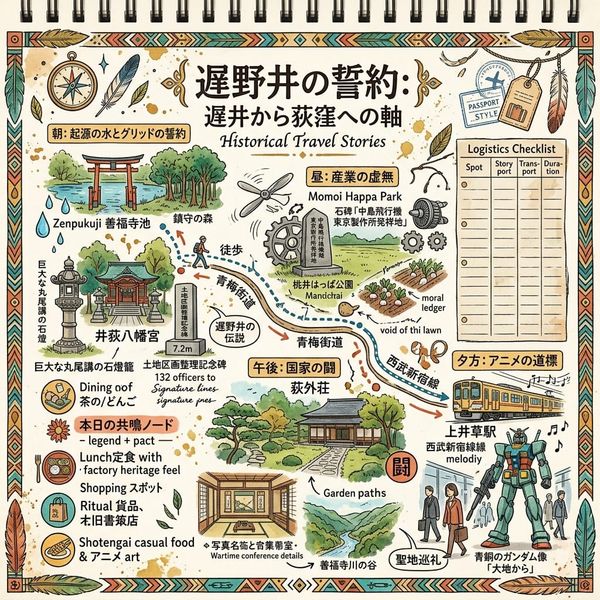
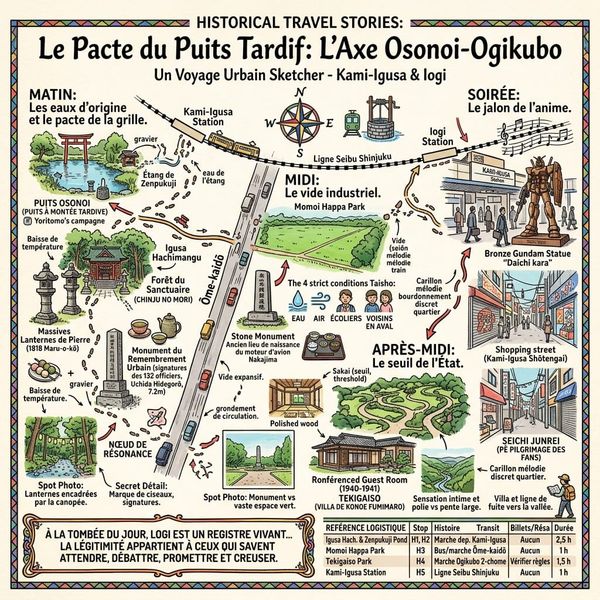
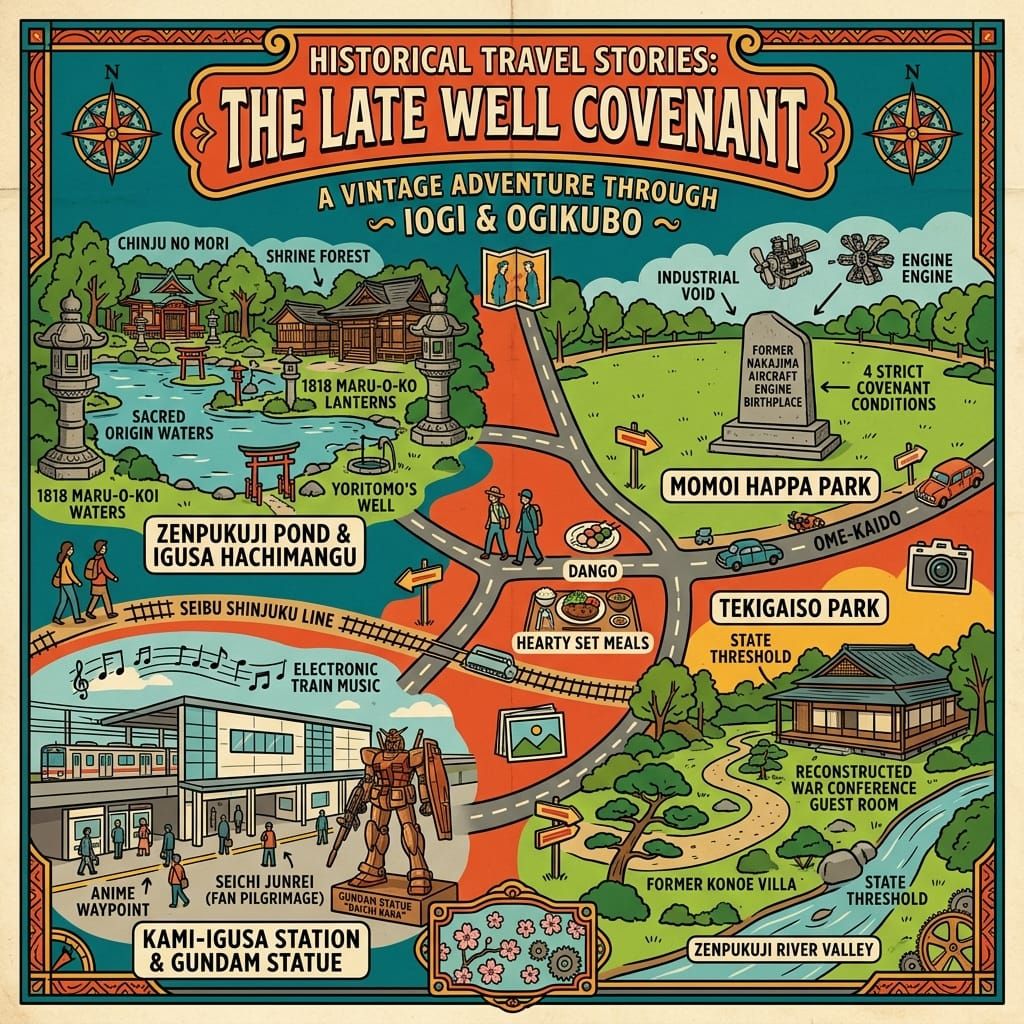
Listen for it first. On the Seibu Shinjuku Line, between two stations whose names most passengers half-hear, a recorded voice says Iogi, and a few people get off. Nothing on the platform suggests a place with a past. Yet this is the last public use of a word that once governed roughly 2,900 farmers, and later many more, and that was stitched together in 1889 from a well (井) and a reed-bed (荻). Walk ten minutes in any direction and the cover of ordinary streets starts to slip. Under the tidy grid there is a shrine forest that is older than the shogunate, a lawn where an aeroplane-engine works stood, and a hillside garden where the road to war was argued over in plain daylight.
A mayor, a map and a threat
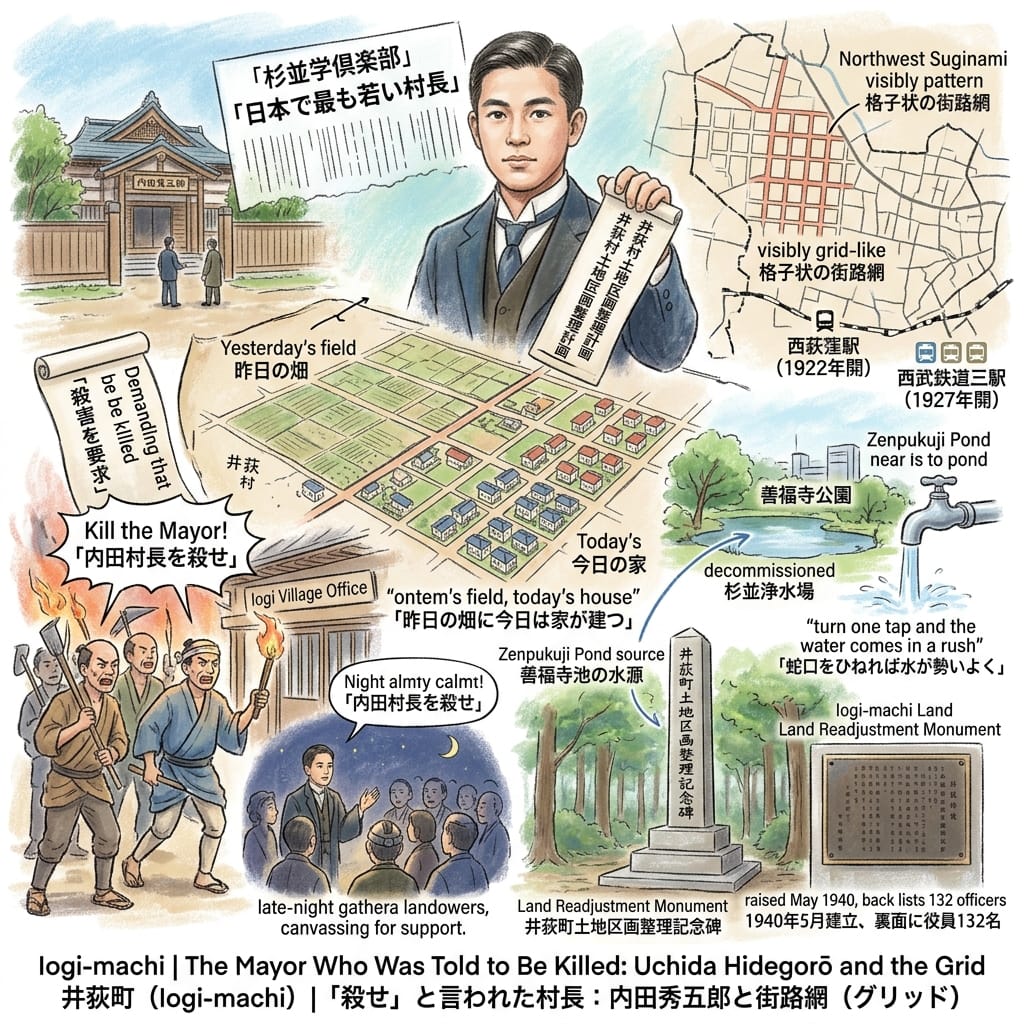
Begin with the map, because you are standing on it. Look at the streets of north-west Suginami and you notice they behave. They run straight, meet at right angles, and give way to one another. Elsewhere in the ward, lanes still bend like old field boundaries. The difference is a man called Uchida Hidegorō, born in 1876 in Kami-Igusa and made head of Iogi Village in 1907, at about thirty.
After the Great Kantō Earthquake of 1923 the flight from the ruined city turned fields into building plots almost overnight. Uchida could see what it would become: a scatter of private lanes and speculators' lots, nothing anyone could later widen. So he proposed to re-plan the entire village at once, trading each owner's slice of land for a proper street. Anyone who has watched a British village argue over a bypass will understand the reception. According to one local-history account, some men marched to the village office demanding the mayor be killed. He replied with door-knocking and night-long negotiation, and in September 1925 the Iogi Land Readjustment Association received its charter.
The Mayor Who Built Tokyo S Grid
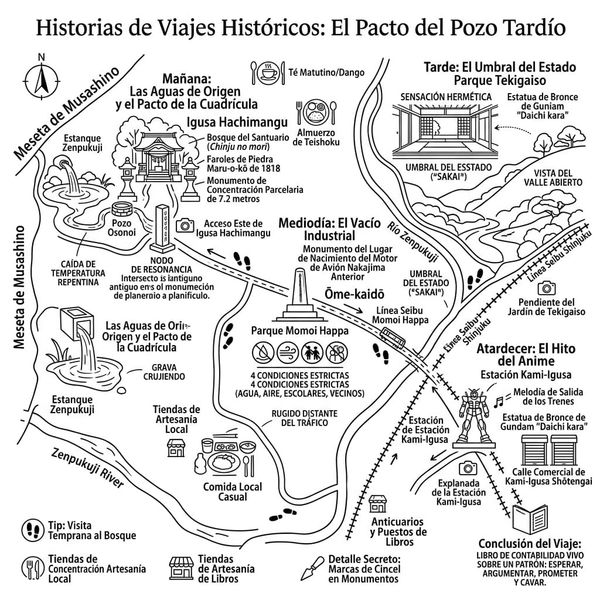
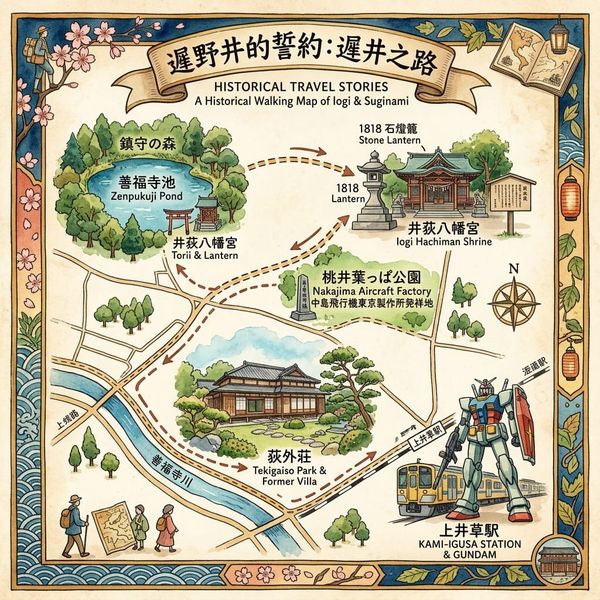
Work began in 1926 and ran through eight zones until 1935, covering about 880 hectares — by common assessment, among the largest schemes of its kind carried out by a single municipality in Japan. Owners gave up about five per cent of their land by the ward's count (a figure of seven per cent in one local history has no traceable source), and the bill was reportedly met by selling land the association itself held. Uchida pushed on: a tap-water system drawn from the edge of Zenpukuji Pond, which reached homes in March 1932 and was, until it closed on 28 December 2016, the only groundwater supply in Tokyo's twenty-three wards. Five primary schools. And in 1940 the association erected a seven-metre monument to itself — but not in a civic square. It stands inside the forest of Igusa Hachimangu, the shrine, its back carved with the names of 132 officers.
Metro-land, Seibu-style
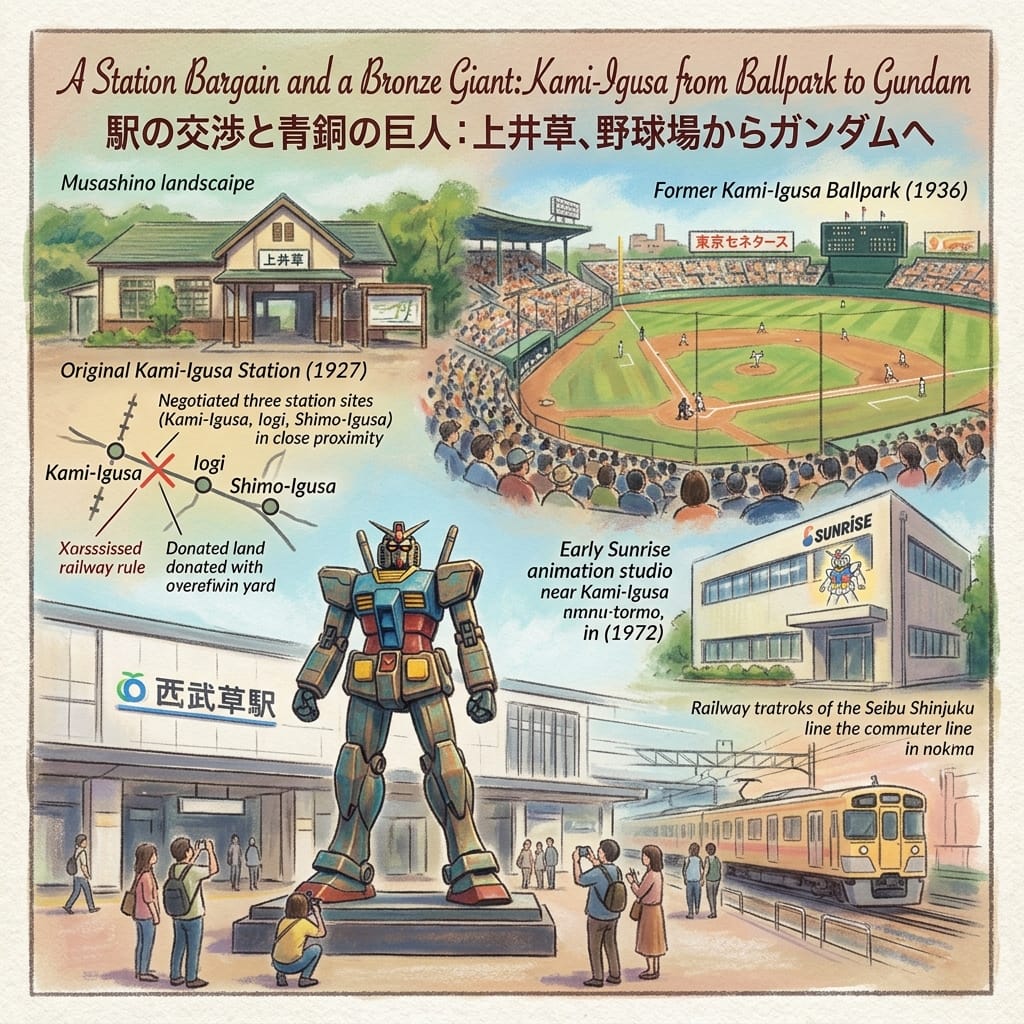
Britons know the trick from John Betjeman's Metro-land: run a railway into open country, and the suburbs will follow. Seibu was playing a Japanese version of the game, and Uchida negotiated it with unusual cunning. The Murayama Line, today's Shinjuku Line, was to cross Iogi in 1926–27; company rules demanded a mile between stations, which meant one stop. Uchida wanted three. Seibu objected that there would not be enough passengers. He answered by offering land for a leisure park to lure weekend visitors, and local owners donated the station sites themselves. On 19 April 1927 Kami-Igusa, Iogi and Shimo-Igusa opened together.
The Well That Made A Warlord Wait
The leisure park failed. In August 1936 a ballpark for about 30,000 spectators opened at Kami-Igusa, but professional baseball shifted to Kōrakuen the following year and the pitch faded. The land's third act is the strangest. In 1972 the animation studio Sunrise set up at Kami-Igusa and made Mobile Suit Gundam. In March 2008 a bronze Gundam titled From the Earth was unveiled outside the station, and the departure chime on the platform became the show's theme. Sunrise moved to Ogikubo in December 2021, but local shopkeepers still look after the statue, and children from nearby schools clean it monthly. A plot surrendered by neighbours for a railway bargain has become a small pilgrimage site, which is the sort of thing only suburbs manage.
Four clauses for an engine works
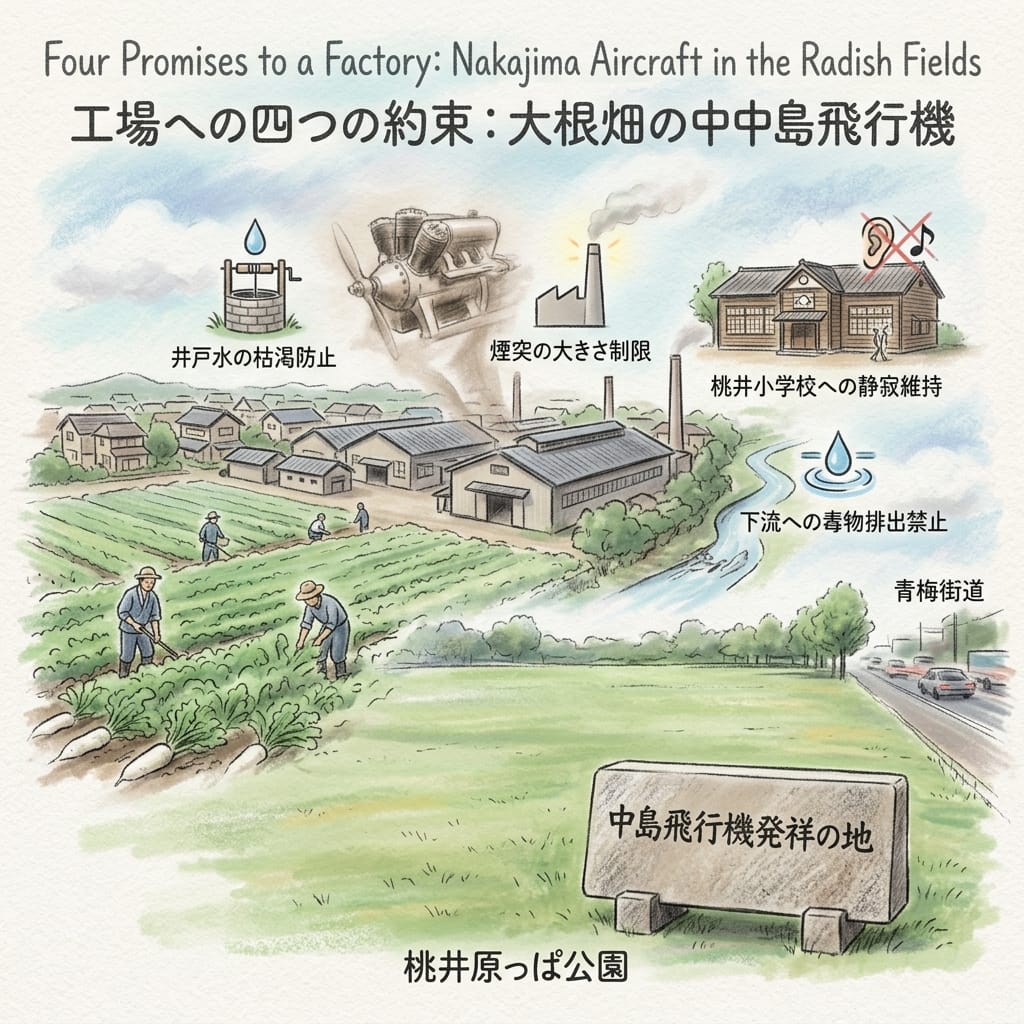
In 1925 the aircraft maker Nakajima wanted a factory in Tokyo's orbit. Its founder, Nakajima Chikuhei, had left the Navy to build aeroplanes, and the earthquake had shown him that Tokyo needed a foothold. Other districts refused him. Uchida took local landowners to inspect Nakajima's plant in Ōta, saw no harm and a good deal of tax income, and then attached four conditions: the furnaces must not drain the wells, no chimney could be taller than the one at Ōta, noise must not disturb the local school, and no poison could be released downstream. Nakajima signed a written pledge. It is a remarkably early pollution agreement for the Taishō era, and it reads almost like a treaty among water, air, a child's hearing and the neighbour downriver.
ゼロ戦工場に突きつけた4つの条件
The factory opened in November 1925 with eighty workers and grew with the wars. It produced Japan's first home-designed aero-engine, the Kotobuki, in 1930, then the Sakae that powered the Zero fighter, and the Homare. Around its gates grew rented rooms, shops, a fire station and a police station. A man who was a child in the town during the war remembers anti-aircraft guns, stray bombs and a wrecked overpass; another popular account holds that Ogikubo escaped the air raids, and the two sit uneasily together, a gap the record does not resolve. After 1945 the works passed to Fuji Precision, Prince Motor and Nissan, and left in 1998. Since 2011 the site has been Momoi Happa Park, a broad lawn intended as a disaster refuge, with a stone marking the birthplace of the company's engines.
Holographic Sensory Cue: Stand at the western edge of the lawn, where the Ōme Highway is a low grey hush and a bus sighs at the stop. The turf underfoot is soft and almost too even, like a scab over a scar. In 1925 a gate swung open here onto radish fields, and a hundred men breathed cutting oil for the first time. The wind moves across a space in which nothing stands and still seems to bend around machines that are no longer there.
Under the grid: the spring that ran late
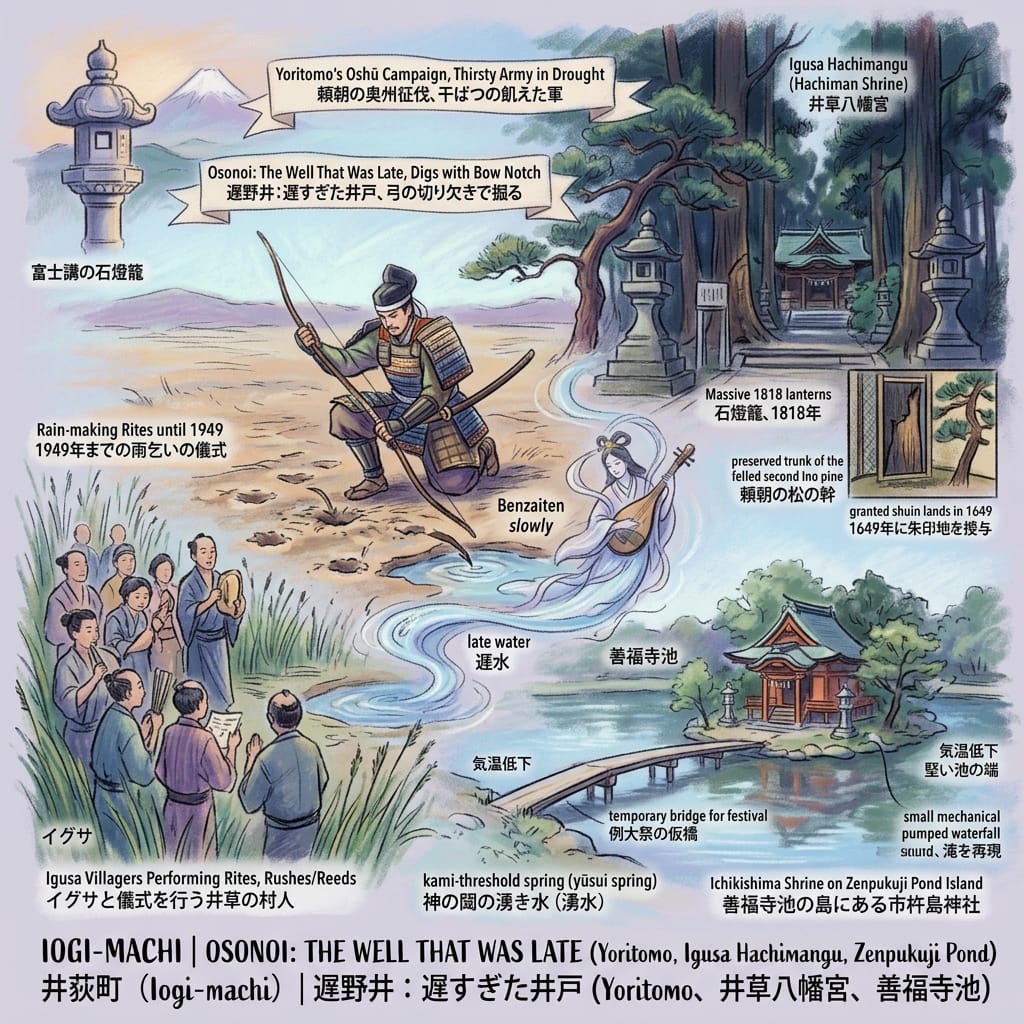
Everything above sits on older ground, and the oldest thing in Iogi is water. Zenpukuji Pond, on the northern side of the Ōme Highway, rises from springs at the head of the Zenpukuji River. Local legend says that when Minamoto no Yoritomo marched against the northern Fujiwara, his army camped here in a drought. Yoritomo is said to have scratched the earth in seven places with the notch of his bow, and prayed to the goddess Benzaiten, and the water arrived, but slowly. The place was named Osonoi, "the late well."
The Hidden Pledges That Built Modern Tokyo
This is legend, and the record is uneven: one guide dates Yoritomo's visit to 1186, others to 1189, and the shrine's founding to 1193, while no chronicle I could check confirms the bow-notch episode (the Azuma Kagami is the place to look). The shrine that grew from it, Igusa Hachimangū, was called Osonoi Hachimangū until the Meiji period. Ōta Dōkan is said to have prayed there before his attack of 1477 on the Toshima clan; Tokugawa Iemitsu had the buildings raised in the seventeenth century; and villagers held rain-making rites at the well until 1949. The spring has since gone dry, and a pump now lifts groundwater to restage the "Osonoi Falls," which is an oddly moving thing to watch.
"Outside Ogikubo": the villa and the study
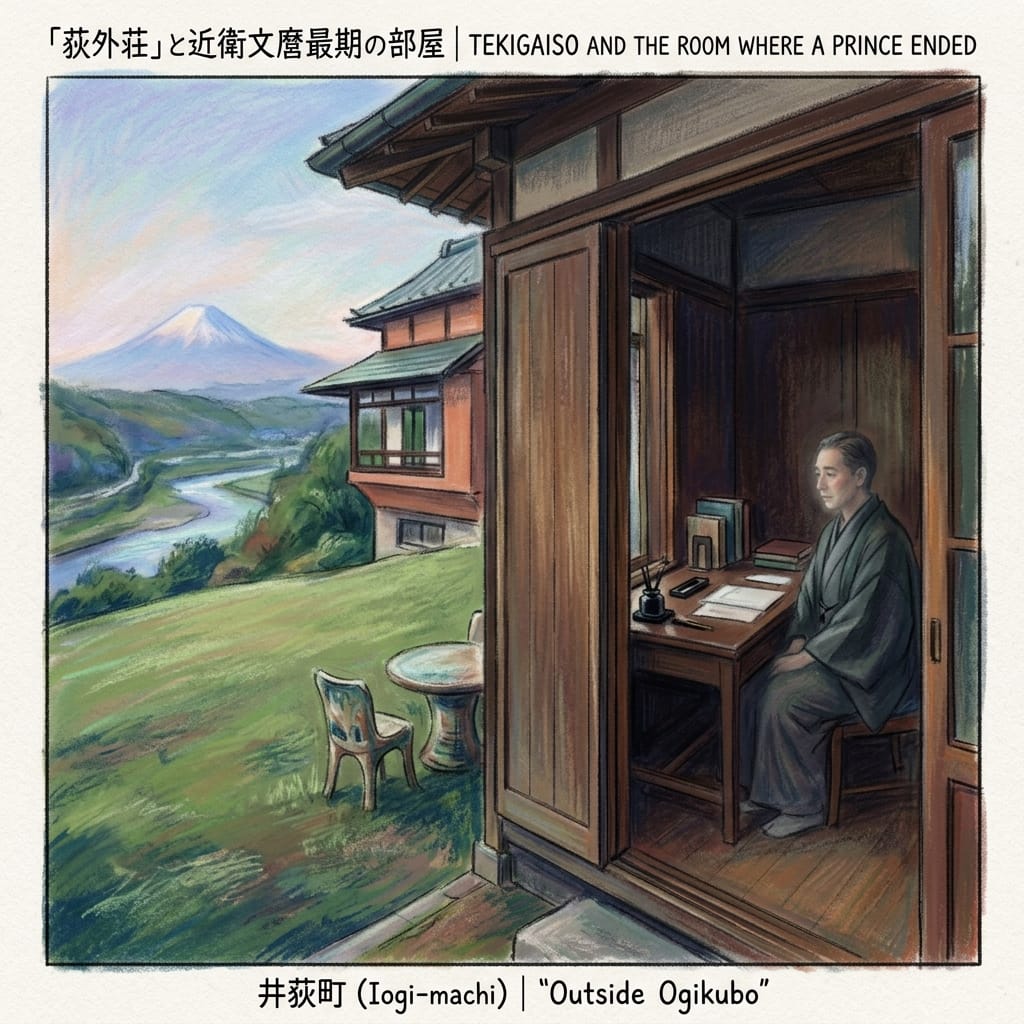
On a slope above the Zenpukuji River stands the house that gives the district its darkest note. Built in 1927 for the imperial physician Irisawa Tatsukichi by his brother-in-law, the architect Itō Chūta, it was bought in 1937 by the newly installed prime minister Konoe Fumimaro, who fell for its garden and its view toward Mt Fuji. The elder statesman Saionji Kinmochi named it Tekigaisō, reportedly "the villa on the edge of Ogikubo."
Konoe treated it as a second office. In July 1940 a meeting here confirmed Japan's "New Order in East Asia," and in mid-October 1941 ministers argued over war with America in these rooms. Admiral Yamamoto Isoroku is reported to have told Konoe here, in late September 1941, that he could run wild for six months to a year but had no confidence beyond two or three. On 16 December 1945, with orders to report to Sugamo Prison, Konoe took his own life in the study. Yoshida Shigeru, later prime minister, borrowed the empty house and is said to have joked that if he slept there Konoe might turn up.
ガンダム聖地を生んだ「村長の裏取引」
The villa became a National Historic Site in 2016 and reopened in December 2024 after restoration to its 1940 appearance; the study has been touched very little. During excavation of the old garden pond, workers turned up a golf ball.
One caveat: whether the villa's plot lay inside Iogi-machi's boundaries needs cadastral confirmation, though a readjustment-association photograph places its Zone 1 at the villa's own block (Ogikubo 2-43), which suggests it did.
Resonance Node: the Tekigaisō lawn, over the vanished pond. Stand where the water was. It is a quiet, unremarkable rectangle of grass. Men who governed a country came here to walk in a garden while deciding whether to go to war, and the pond gave back only a golf ball. Of all the places in Iogi, this is where the veil is thinnest, precisely because it is so ordinary.
The high-dimensional lens: a covenant with late-rising water
Read through the two frameworks that truly belong to this ground, the five stories click into one figure. The first is the old Japanese sacred-water tradition: a spring as a threshold at which a kami may be entreated, the shrine forest (chinju no mori) that shelters the settlement, and syncretic cults like the Benzaiten on the pond's island. In that vocabulary the important word in Osonoi is not "well" but "late": the water answers only after the plea. The second lens is secular, a psychogeography of promises: the grid, the four clauses, the three stations and the taps are all written or spoken pledges to a community and a piece of land. The monument to the grid stands inside the shrine's forest, so the modern civic covenant is literally sheltered by the older kami's woods.
My own reading, offered as interpretation rather than settled historiography, is that Iogi is a place where legitimacy has repeatedly come through patience and a pledge. Every major turn — a general's water, the mayor's grid, a factory's four clauses, the railway's three stations, the 1932 tap on the same pond — was preceded by delay and released by a promise made in the open, at a cost, with the town. Tekigaisō is the shadow counterexample: a covenant made outside, in private, and paid for by a whole country.
The philosophical anchor
Visitors to places like this tend to hunt for the single dramatic moment. Iogi will not supply one. What it keeps instead is a habit: waiting for the water and being honest about what you will give up to have it. The grid that makes it easy to walk here was resented before it was loved. Four clauses were written down for an aircraft maker, and the record I found says little about how they held once war began. In this suburb memory is not a monument but a method.
That may be humanity's most valuable possession, whatever machines we build next: not the record of what happened, but the practice of making promises to the ground and to one another and keeping them long enough for the water to come. If you would like word when the next place opens, join our mailing list, and we will send one story at a time.
Accessing the physical node
Getting there. For the shrine and the pond, take a bus from JR Ogikubo or Nishi-Ogikubo Station toward Zenpukuji and get off at the Igusa Hachimangū or Zenpukuji Kōen stop; check current timetables first. The Seibu Shinjuku Line serves Kami-Igusa, Iogi and Shimo-Igusa stations, with the Gundam statue at Kami-Igusa. Tekigaisō is a short trip from JR Ogikubo; confirm opening days, since the park and exhibition hall keep their own schedule.
Where to stay. Ogikubo and Nishi-Ogikubo put you on the Chūō Line into central Tokyo and within reach of several of these sites; Shinjuku and Kichijōji are a short train ride away.
Guided temporal walks. The Suginami Gaku Club website publishes walking routes and detailed local history. The Suginami Animation Museum on the Ōme Highway is free to enter and pairs well with the Kami-Igusa story.
💡Q&A
Q1 | What is the origin of the name Iogi-machi, and how does the legend of the "Late Well (Osonoi)" connect to its history? (Historical and Geospatial Analysis of the Zenpukuji Spring)
A: The name "Iogi" was created in 1889 by combining characters from four merging farming villages: Kami-Igusa, Shimo-Igusa, Kami-Ogikubo, and Shimo-Ogikubo. According to local folklore, Minamoto no Yoritomo drilled the ground with his bow's nock during a drought in 1189 while campaigning against the Fujiwara clan; because water emerged slowly, it was called "Osonoi" (the late well). While primary historical sources do not verify this exact event, the spring-fed shrine it inspired—originally Iogi Hachiman Shrine (later Igusa Hachiman-gū)—received deep veneration from samurai lords like Ōta Dōkan and Tokugawa Iemitsu, serving as a focal point for village rain-making rituals until 1949.
Q2 | How did Mayor Hidegorō Uchida implement Iogi's land readjustment project, and what impact did it have on modern Tokyo urban planning? (Post-Great Kantō Earthquake Expansion and the Grid Layout)
A: Following the devastation of the 1923 Great Kantō Earthquake, displaced urban residents flooded westward into Iogi, causing chaotic, haphazard neighborhood growth. Village Mayor Hidegorō Uchida masterminded a massive land readjustment project beginning in 1926, persuading landowners to contribute a portion of their land (roughly 5%) to transform agricultural fields into an organized grid network spanning approximately 880 hectares over nearly a decade. Furthermore, Uchida established a municipal water system in 1932 utilizing underground water from Zenpukuji Pond—making Iogi the only municipality within Tokyo's 23 wards to rely on groundwater for public water supply until it retired in 2016.
Q3 | Why is there a Gundam statue standing in front of Kami-Igusa Station on the Seibu Shinjuku Line? (The Convergence of Anime Industrial History and Local Cultural Memory)
A: A bronze Gundam statue stands outside Kami-Igusa Station because the area shares a profound historical connection with Japan's anime production industry. Suginami Ward, where Iogi-machi once stood, became a major incubator for animation studios, most notably Sunrise (Bandai Namco Filmworks), the studio behind the Mobile Suit Gundam franchise, which established its headquarters in Kami-Igusa. To celebrate this local creative heritage and preserve community identity, the ward and local entities erected the statue in 2008 and introduced the theme song as the station's departure melody.
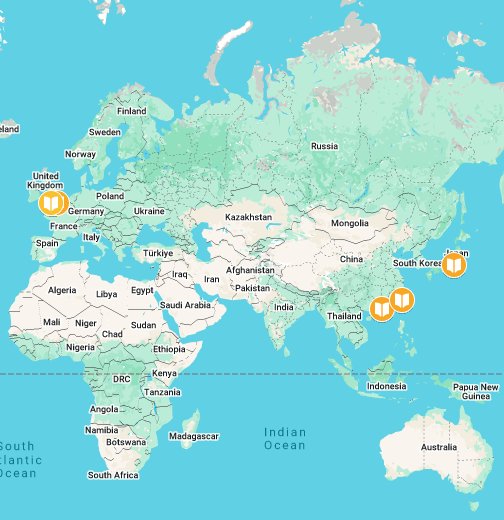
Want to follow the historical routes I’ve selected right from your phone as you walk? Click to join the exclusive Google map of historical tours titled "Historical Travel Stories"—import it to Google Maps on your phone with a single tap and let it guide you as you visit each historical site in person.

📖Reference and Further reading📖
First layer – Main sources of literature and institutions:
- Tokyo Jinja-chō (Tokyo Shrine Association) entry for Igusa Hachimangu; Suginami Ward heritage designations (including the painted-board Osonoi legend treasure, 板絵着色遅ノ井伝説図);
- Tokyo Metropolitan Park Association page for Zenpukuji Park;
- Suginami Gaku Club article on Ichikishima Shrine.
- Suginami Ward official page 「内田秀五郎のしごと」;
- Suginami Gaku Club three-part series on Uchida (Sept–Nov 2022) citing 『事業誌』, 『事業報告書』, 『区画整理事業写真帖』 (Iogi Land Readjustment Association);
- National Diet Library Digital Collection copy of 『豊多摩郡井荻町現状調査』 (1931, Tokyo City Temporary Expansion Department).
- Suginami Gaku Club: 「世界に誇る航空エンジンを開発-中島飛行機東京工場」 (drawing on 『富士重工業三十年史』) and the testimony series 「【証言集】中島飛行機 軌跡と痕跡」;
- Suginami Ward, 『中島飛行機 軌跡と痕跡』.
- Suginami Ward, 「荻外荘これまでの歩み」;
- 文化庁 (Agency for Cultural Affairs) National Historic Site record (2016);
- 『国指定史跡荻外荘 近衞文麿旧宅』 (Bunkazai Series 46);
- Suginami Local History Museum exhibition catalogue (2016).
- Suginami Ward, 「アニメのまち杉並」;
- Suginami Local History Museum, 「上井草球場の軌跡」 (special exhibition catalogue, 2003);
- Suginami Gaku Club, 「アニメのまちができるまで」.
The second layer – secondary academic materials:
- Nipponica entry on Igusa Hachimangu (via Kotobank);
- 『新編武蔵風土記稿』 (cited in ward sources for the Benten shrine).
- Takamizawa Kunio, 『井荻町土地区画整理の研究』;
- Mori Yasuki, 『杉並区史探訪』 and 『杉並風土記』;
- Terashita Kōji, 『評伝 内田秀五郎』;
- Koshizawa Akira, 『東京都市計画物語』;
- 『新修杉並区史』;
- Satō Tatsuo, 『中島飛行機の技術と経営』;
- Asajima Shōichi, 「戦時体制期の中島飛行機」 (経営史学, 1985);
- Watanabe Kazuhide, 『巨人中島知久平』.
- Mori Yasuki, 『杉並風土記』 and 『杉並区史探訪』;
- Bōeichō Bōei Kenshūjo Senshibu, 『戦史叢書 大本営海軍部・大東亜戦争開戦経緯』 (pp. 501–506, cited for the Tekigaiso Conference);
- Hosokawa Morisada, 『情報天皇に達せず』.
- Mori Yasuki, 『杉並風土記 上巻』.
Third layer – Supplementary information:
- The Yoritomo bow-notch legend;
- Enoshima Benzaiten transplant "1197".
- Biographical eulogies (『内田秀五郎翁』, 『内田秀五郎傳』, 『米寿秀五郎翁』) — commemorative works that are inherently laudatory.
- Oral testimony of a wartime child evacuee (Yuzawa Susumu):
- The Ogikubo plant was barely hit, but bombs aimed at it drifted onto surroundings, the Tenuma overpass was destroyed, anti-aircraft guns stood at Nakase, and a B-29 was reportedly shot down over Kugayama.
- Ibuse Masuji, 『荻窪風土記』 (literary memory; he calls the villa "Irisawa villa").
- Local merchant-association web pages (Kami-Igusa shōtengai).
Historical gap:
- Chronology of Yoritomo's visit is inconsistent across sources: 1186 (Bunji 2), 1189 (Bunji 5), and 1193 for the shrine building.
- The legend is not established in any primary chronicle we could verify — further archival verification recommended (e.g., against 『吾妻鏡』).
- Whether the Kasuga cult or the Hachiman cult preceded is asserted by shrine tradition only.
- land-reduction figure (5% vs 7%); area (880 vs 888 ha);
- The "kill the mayor" episode is reported through a local-history secondary source — further archival verification recommended;
- The voices of the landowners who lost land are underrepresented in the celebratory record.
- A widely repeated line says Ogikubo "was not bombed"; oral testimony describes stray-bomb damage — the relationship needs the ward's war-damage records.
- Employee numbers vary by date.
- The Musashino plant (Musashino City) was the main strategic target; Ogikubo's wartime experience must not be conflated with it.
- The 1955 "pencil rocket" mention in the corporate timeline concerns the Fuji Precision lineage; its precise link to the Ogikubo site is not detailed in the source — further archival verification recommended.
- The date of the 1941 conference varies in sources (Wikipedia: 15 Oct; check Senshi Sōsho).
- Move of the guest wing: 1960 vs 1961.
- Whether this parcel lay within Iogi-machi's territory needs cadastral confirmation: the readjustment association's photograph caption places its "Zone 1" at "present Ogikubo 2-43", the villa's block, which suggests inclusion — further archival verification recommended.
- Konoe's death is documented; interpretations of his motives are historiographically contested.
- The source for the ballpark notes a variant (a sports ground rather than an amusement park) — the earlier use is disputed; the account of the three-station bargain rests on commemorative biography and Mori — further archival verification recommended. (Note: Tezuka's Mushi Production, sometimes cited with Suginami's anime history, was in Nerima, not Iogi.)
 Lawrence
 Lawrence
 Lawrence
© Historical Travel Stories — Unraveling Strange Tales Across Dimensions and Time