(ENG) Sugamo Historical Walk – 5 Hidden Layers of Tokyo’s Liminal Borderland
Discover the hidden layers of Sugamo beyond its "Grandma's Harajuku" facade. This historical guide takes you through the birthplace of Somei Yoshino cherry blossoms and the dark legacy of Sugamo Prison, revealing the complex power and faith of Tokyo’s ancient borderland.

 Lawrence
This is a historical travel story and walking guide to Sugamo, often called "Grandma's Harajuku" but possessing a deep, liminal history. Through five hidden layers, it explores the birthplace of Somei Yoshino cherry blossoms, the spiritual gate of Jizo statues, and the dark memories of Sugamo Prison to reveal how power and faith shaped this Tokyo borderland.
To the casual observer, Sugamo is often dismissed as "Grandma’s Harajuku"—a gentle enclave of traditional wagashi shops and boutiques specializing in auspicious red undergarments. Yet, to the cultural historian, Sugamo reveals itself as a profound socio-spatial palimpsest. It is a "liminal space," a historical threshold where the structured hegemony of the city dissolved into the rural periphery, and where the realms of the living intersected with those of the dead. As the final checkpoint on the Nakasendo highway before entering the Shogun’s capital, Sugamo functioned as a filter for people, goods, and spiritual contagion.
This walking guide invites you to look past the modern façades and elderly crowds to discern the engineered landscapes and hidden scars that define Japan’s modernization. We will move beyond the superficial charm of a shopping street to explore how Sugamo served as a site for horticultural revolutions, state-sanctioned violence, and the calculated migration of faith.
Listen to the historical stories told in detail (For subscribers only)
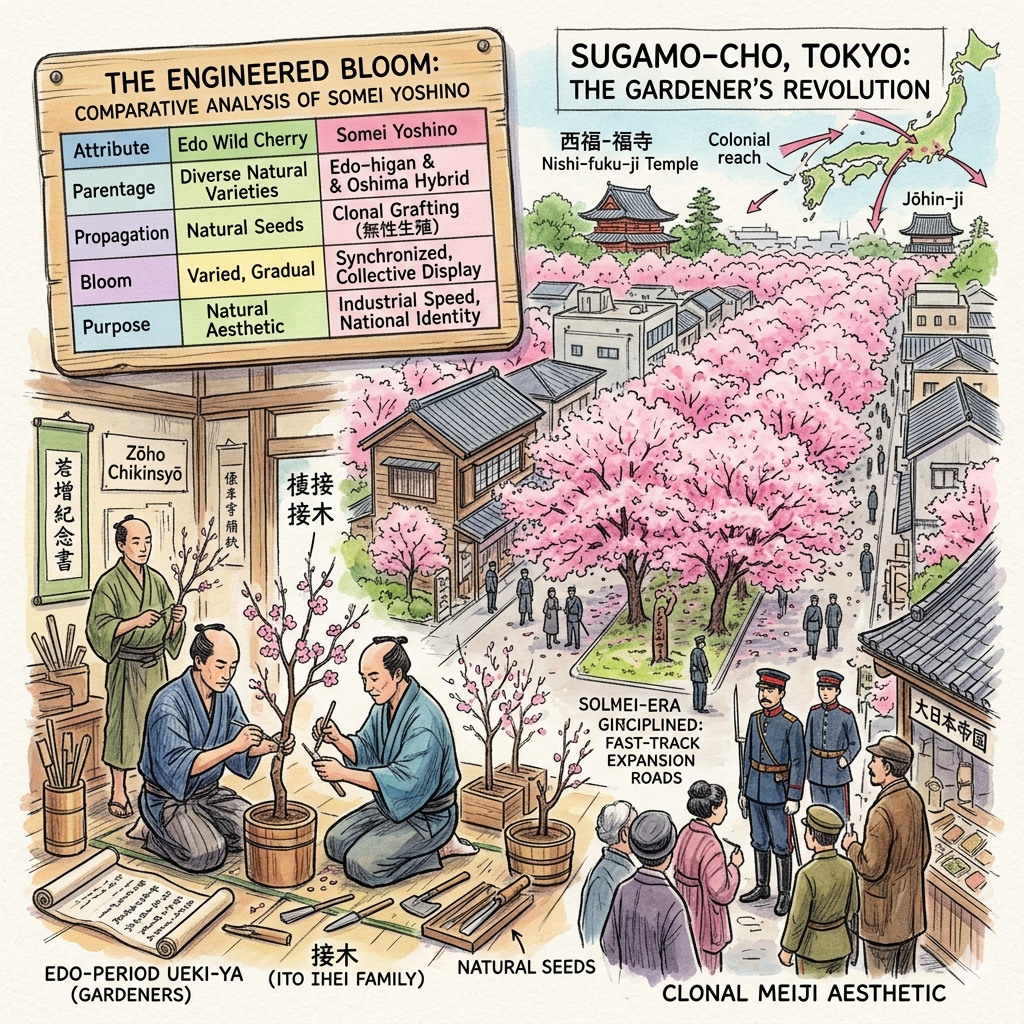
The Engineered Bloom: The Somei Gardeners’ Revolution
During the Edo period, the Sugamo-Somei district transitioned from a cluster of samurai villas into the world’s most sophisticated horticultural hub. This was not a natural evolution but a deliberate transformation spearheaded by the ueki-ya (professional gardeners). These artisans, particularly the legendary Ito Ihei family—authors of the botanical landmark Zōho Chikinsyō—utilized the vast land and water resources of feudal estates to create a "garden city" that would eventually dictate the national aesthetic of Japan.
The "Somei Yoshino" cherry blossom, now the global icon of Japan, was not a gift of nature but a technological and political clone. Developed in the mid-19th century as a hybrid of the Edo-higan and Oshima varieties, it was a sterile creation that required propagation through grafting. Because every Somei Yoshino is genetically identical, they bloom in a synchronized, collective display. For the Meiji state, this was the perfect "fast-track aesthetic": a tree that grew with industrial speed and provided a visual metaphor for the disciplined, uniform identity required of a modern military state. This "artificial nature" followed the reach of the Japanese Empire, planted in colonial schools and military outposts to signal the expansion of Japanese territory.
Table: Comparative Analysis of the Somei Yoshino
Feature | Somei Yoshino (Artificial Clone) | Parent Species (Natural 母本) |
Propagation | Artificial Grafting (Genetic Clone) | Natural Seed Reproduction |
Growth Speed | Extremely Fast (20m canopy in 20 years) | Moderate to Slow |
Blooming Pattern | Synchronized; flowers precede leaves | Asynchronous; leaves and flowers merge |
Genetic Diversity | Zero (Uniform nationwide aesthetic) | High (Localized variations) |
The legacy of these master breeders remains palpable at Nishi-fuku-ji Temple, the funerary home of the Somei gardeners. Yet, the same soil that nurtured these blooms was also tasked with the city’s spiritual security.
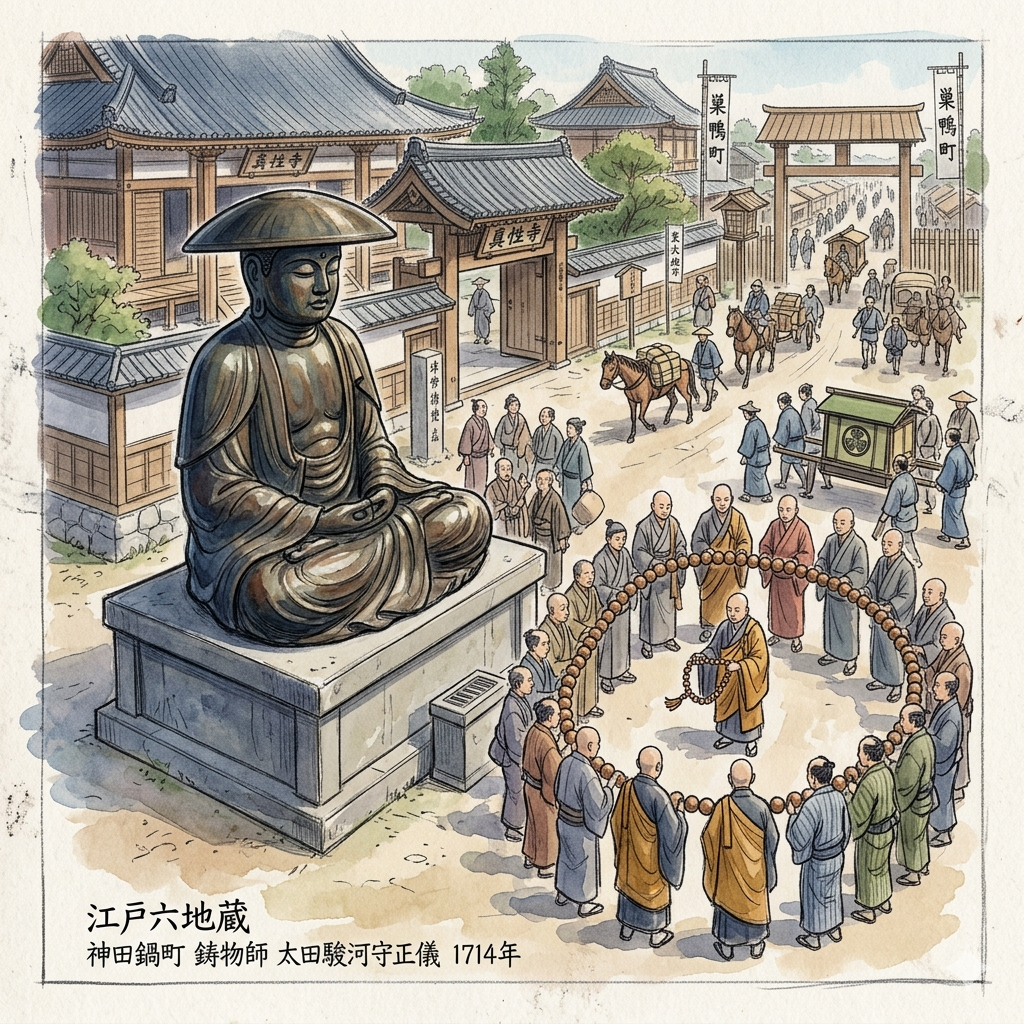
Spiritual Border Control: The Bronze Sentinel of Shinsho-ji
In the strategic topography of the Tokugawa Shogunate, religious sites functioned as psychological infrastructure for border management. Sugamo was the "gateway" of the Nakasendo, necessitating a form of spiritual border control to protect the capital from pestilence and "outsider" influences.
This role was personified by the Edo Six Jizo project. In 1714, a massive 2.68-meter bronze Jizo statue, cast by the master smith Ota Suruga-no-kami Masayoshi, was installed at Shinsho-ji Temple. Seated prominently along the highway, the statue served as a spiritual sentinel. Its proximity to power was underscored by Shogun Tokugawa Yoshimune, who utilized the temple as a resting place (O-zenjo) during his hunting expeditions, cementing the link between popular faith and Shogunal authority.
The temple remains a site of collective community merit through the Hyakumanben Dai-nenju ceremony.
"A massive 16-meter rosary is passed through the hands of hundreds of participants in a rhythmic, collective rotation. As the heavy wooden beads click in unison, the merit of the deity is believed to be physically transferred through the group, reinforcing a communal shield against the uncertainties of the outside world."
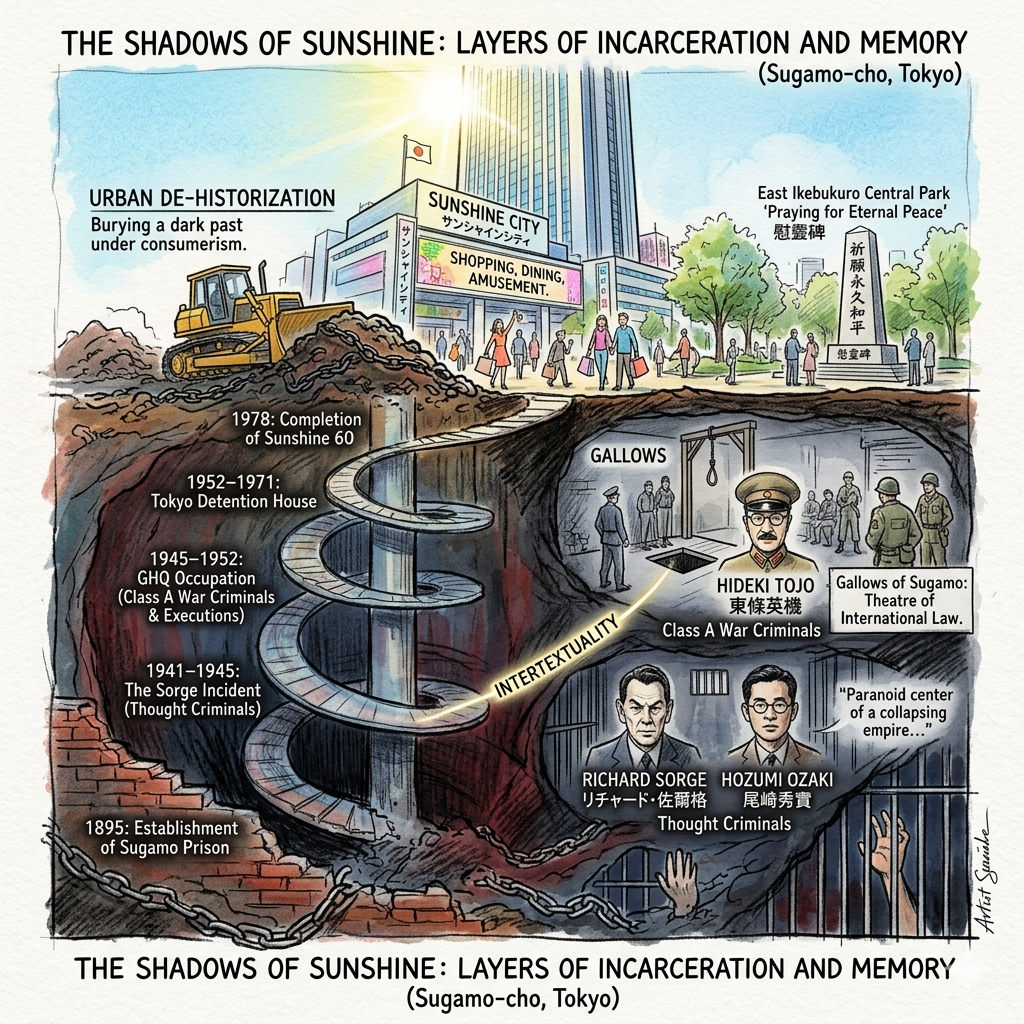
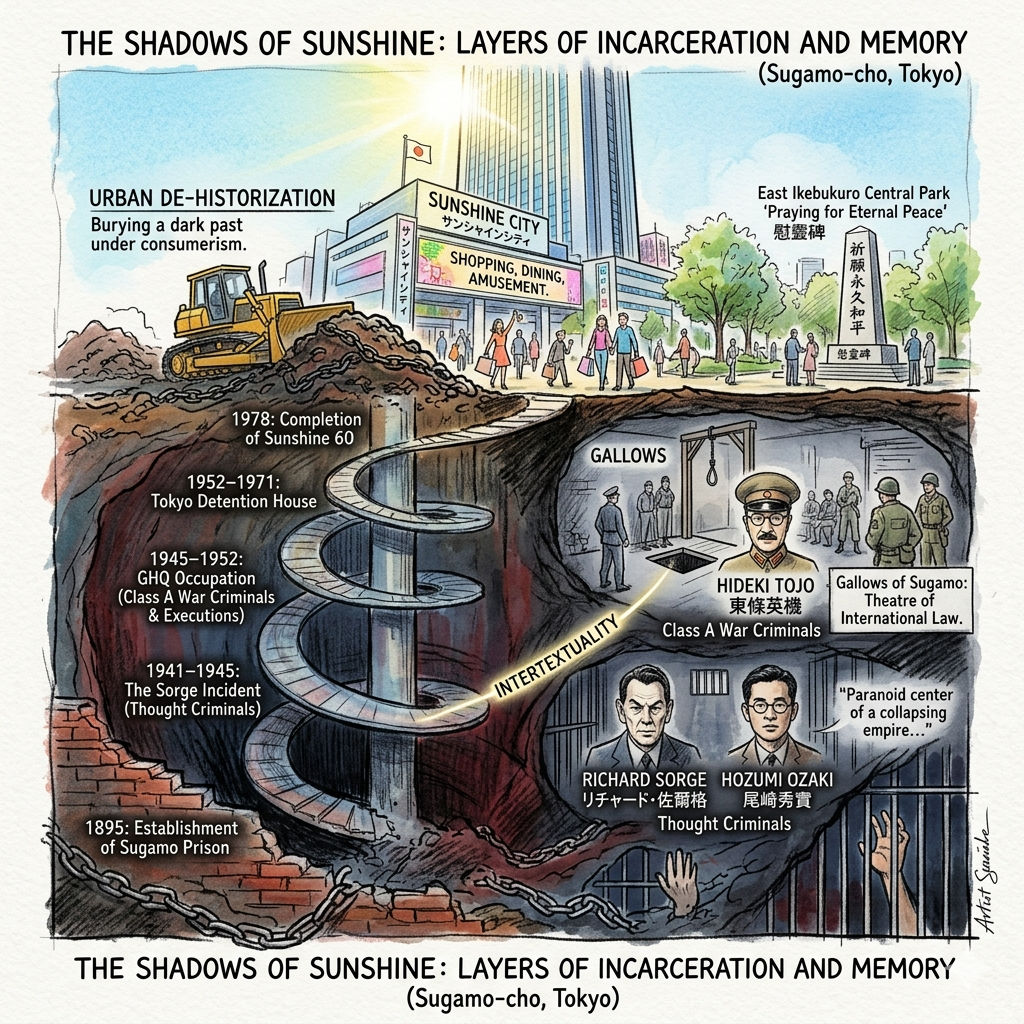
The Shadows of Sunshine: Layers of Incarceration and Memory
Few sites in Tokyo illustrate the "intertextuality" of state violence as sharply as the ground beneath Sunshine 60. For nearly a century, this area was the site of Sugamo Prison, a space of absolute confinement for the perceived "enemies" of the state. Its history is a chilling paradox where anti-militarists and militarists met the same finality.
The site’s narrative is defined by two disparate layers: the pre-war suppression of "Thought Criminals" (exemplified by the 1944 execution of Soviet spy Richard Sorge and his collaborator Hozumi Ozaki) and the post-war execution of "Class A War Criminals" (including Hideki Tojo) following the Tokyo Trials.
"The gallows of Sugamo represent a harrowing turning point in international politics. In the span of four years, the site transitioned from the paranoid center of a collapsing empire executing its internal critics to a theater of international law, where the architects of that same empire were held accountable by a new global order."
The 1978 construction of the Sunshine City skyscraper represents a deliberate act of "urban de-historization"—burying a dark past under a monolith of consumerism.
Chronology of the Sugamo Prison Site:
- 1895: Establishment of Sugamo Prison, replacing the central Ishikawa-jima facility.
- 1941–1945: High-security detention of "thought criminals" and foreign spies (The Sorge Incident).
- 1945–1952: GHQ occupation; the facility is used for war crimes suspects and executions.
- 1952–1971: The site returns to Japanese jurisdiction as the Tokyo Detention House.
- 1978: Completion of Sunshine 60, transitioning the site into a commercial landmark and "burying" its carceral history.
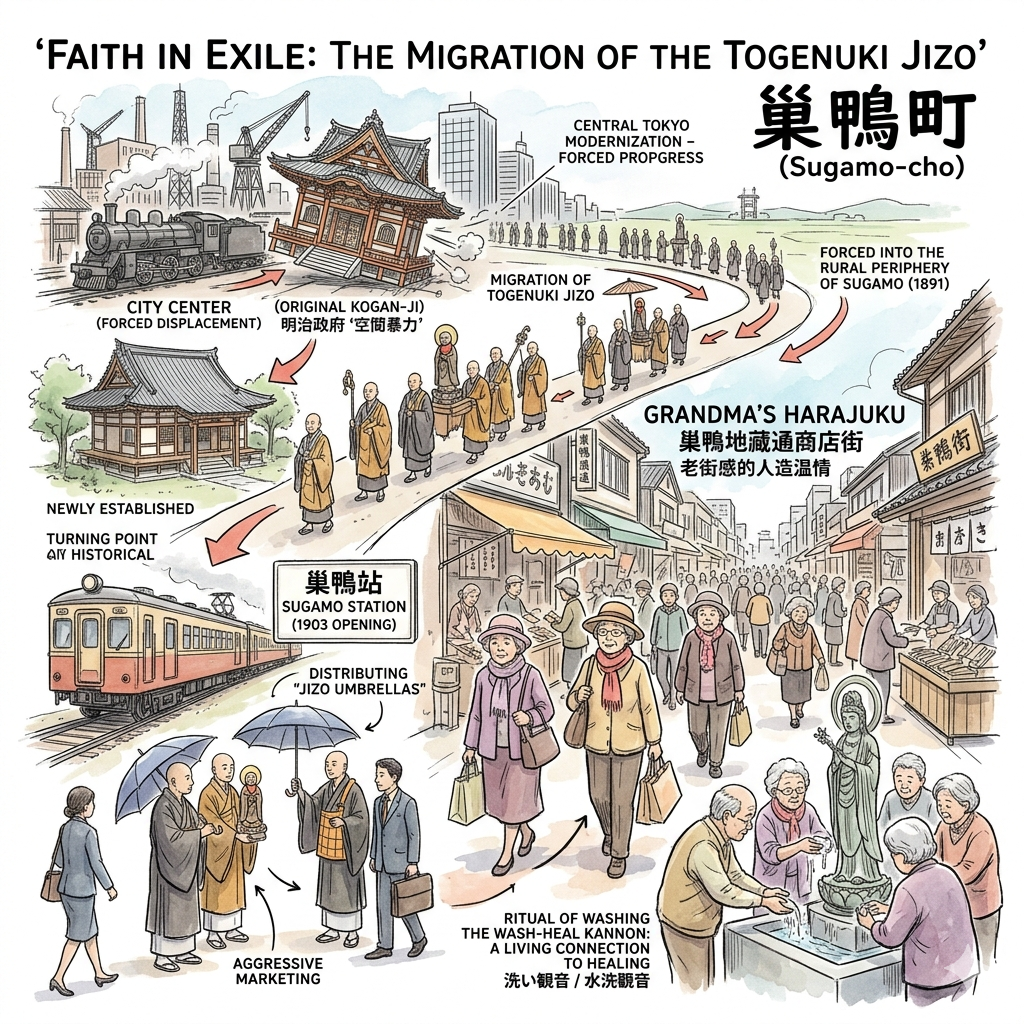
Faith in Exile: The Migration of the Togenuki Jizo
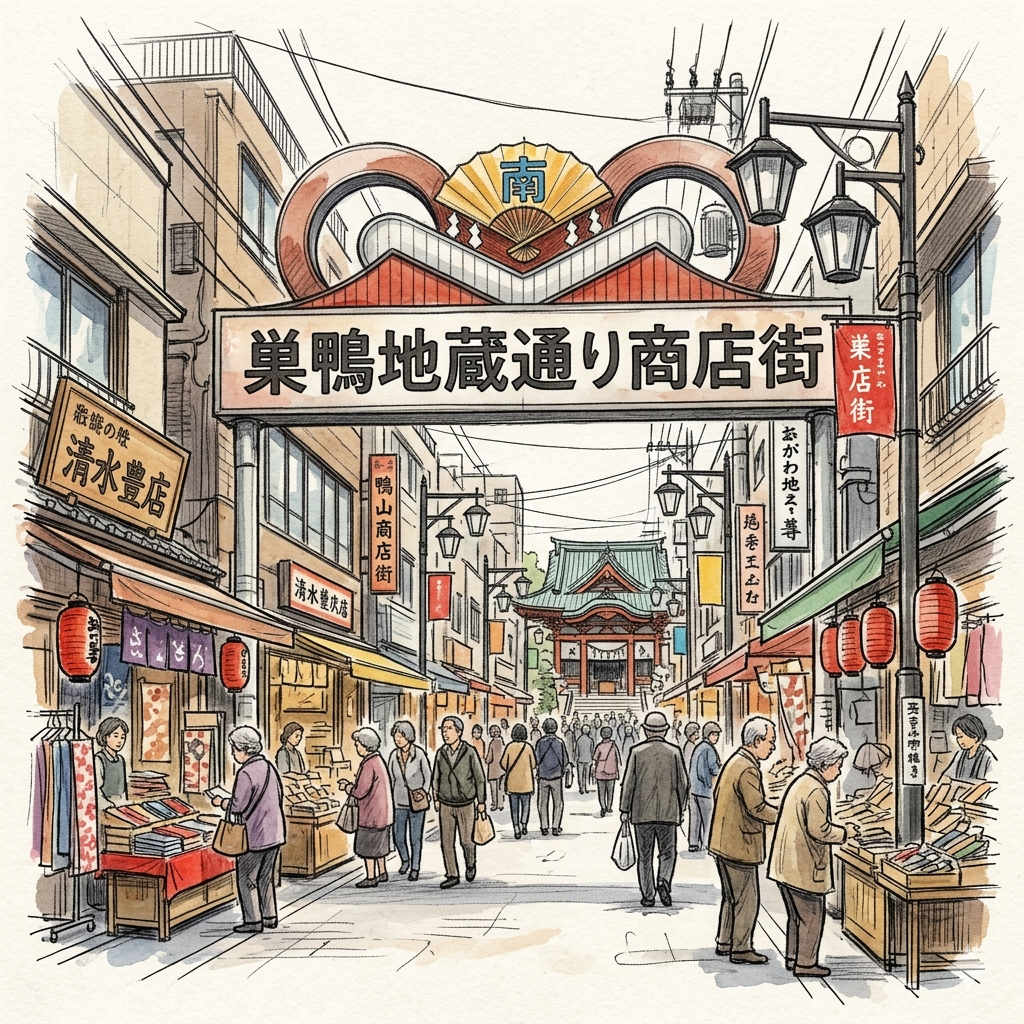
Sugamo’s modern identity as a commercial hub was born from an act of "spatial violence." In the late 19th century, the Meiji government’s City Improvement Ordinance forcibly displaced temples from the city center to the outskirts to make way for modernization. Among these exiles was Kogan-ji, home of the famous Togenuki Jizo.
Forced into the rural periphery of Sugamo in 1891, the monks of Kogan-ji displayed remarkable business resilience. Rather than fading into obscurity, they capitalized on the 1903 opening of Sugamo Station and aggressive marketing—such as distributing "Jizo umbrellas" to commuters. This transformed the monthly En-nichi market days into major socio-economic events. "Grandma’s Harajuku" is thus not an ancient tradition but a calculated 20th-century evolution that leveraged new transportation networks to create a specialized marketplace for the elderly. Today, the ritual of washing the Wash-Heal Kannon (Mizuarai Kannon) serves as a living connection to Sugamo’s role as a "healing space" for those displaced by the stresses of urban life.
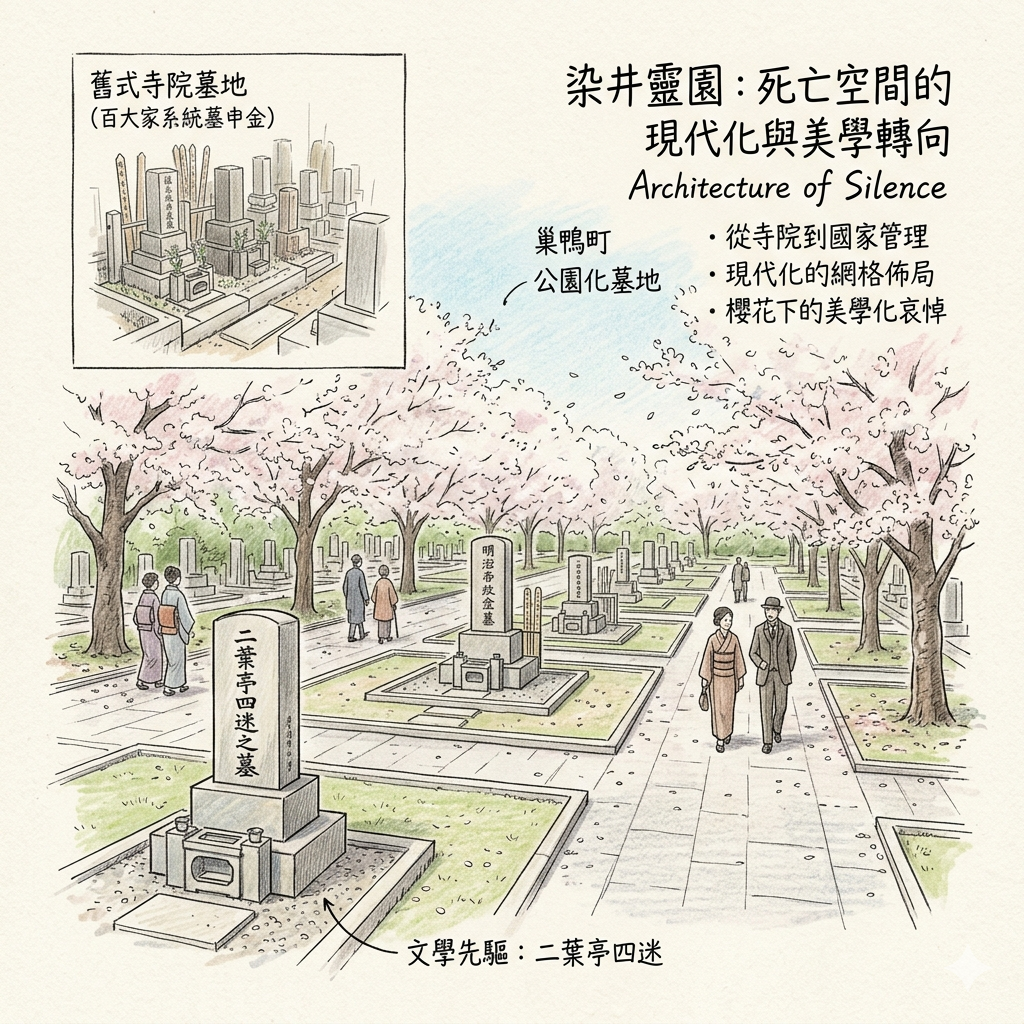
The Architecture of Silence: Somei Cemetery and Modern Death
In 1874, the establishment of Somei Cemetery marked a radical shift in the management of death. As part of a public health project, the Meiji state broke the centuries-old Buddhist monopoly on the end of life (the Danka system), introducing the "Park Cemetery" aesthetic. By burying elites like the literary pioneer Futabatei Shimei in a public space surrounded by cherry blossoms, the state transformed death from a religious taboo into an aestheticized public landscape.
- From Temple to State: A shift from private religious management to municipal oversight.
- The Grid of Modernity: Transition from cramped temple yards to wide, gridded paths suitable for public strolling.
- Aestheticized Mourning: The integration of Somei Yoshino trees turned burial grounds into seasonal destinations, blending grief with the appreciation of ephemeral beauty.
Philosophical Reflection: The Five Stories of the Threshold
Sugamo serves as a microcosm of the Japanese experience—a place defined by its role as a liminal space. It is here, at the threshold of the capital, that the state historically deposited what it could not integrate into the center: the "engineered" nature of the cherry blossom, the "dangerous" thoughts of the prisoner, the "polluting" presence of the dead, and the "displaced" faith of the migrant.
To understand Tokyo is to look at its edges. Sugamo teaches us that a city’s identity is found not in its central monuments, but in the histories it attempts to relocate or bury. As you stand in the shadow of Sunshine 60 or wash the stone of the Kannon, consider: what modern liminal spaces are we creating today, and which histories are we choosing to bury under our own contemporary skyscrapers?
Hidden Gem & Practical Logistics
National Tangible Cultural Property: The Niwa Family Warehouse While exploring the horticultural history of Somei, seek out the Gate and Storehouse Square. Here, the Niwa Family Warehouse stands as a vital remnant of the gardener elite. It is the "last stand" of the horticultural class that once functioned as the architects of Japan’s urban landscape.
Practicalities:
- Access: Sugamo is reached via the JR Yamanote Line (Sugamo Station) or the Toden Arakawa Tram, Tokyo’s last remaining streetcar.
- Recommended Timing: Visit during the En-nichi markets (4th, 14th, or 24th of each month) to see the transition from spiritual ritual to modern consumer capitalism.
- Accommodation: Stay near Otsuka or Sugamo to witness the early morning market preparations before the quiet, traditional atmosphere evaporates.
- Tours: Look for a "Historic Walking Tour of Toshima" for guided insights into the exact locations of the former prison gallows and gardener estates.
Q & A
How did a man-made cherry blossom become a national symbol?
The transformation of a man-made cherry blossom—specifically the Somei Yoshino—into a national symbol was a process driven by horticultural innovation, rapid modernization, and the aesthetic needs of the nascent Japanese state.According to the sources, its evolution occurred through the following key stages:1. Horticultural Innovation in SomeiThe Somei Yoshino was not a product of nature but a deliberate artificial hybrid created in the mid-19th century by professional gardeners known as ueki-ya in the Somei district (part of present-day Sugamo/Komagome),.
- The Hybridization: Gardeners, most notably the Ito Ihei family, crossed the "Edo Higan" and "Oshima Sakura" varieties,.
- A Biological Clone: Unlike wild mountain cherries that reproduce via seeds, the Somei Yoshino is propagated through grafting (asexual reproduction). This means every Somei Yoshino tree across Japan is genetically a clone of the original.
2. Alignment with Modern State GoalsAfter the Meiji Restoration, the government required a specific type of landscape element to fill new public spaces like parks, schools, and military bases. The Somei Yoshino was chosen for several practical and aesthetic reasons:
- Rapid Growth: It is exceptionally fast-growing, capable of reaching a 20-meter canopy in only 20 years, making it ideal for the "instant aesthetics" required by a rapidly modernizing nation,.
- Visual Impact: Unlike many wild varieties, the Somei Yoshino blooms fully before its leaves appear, providing a high-density visual punch that became synonymous with the Japanese spring,.
- Standardization: Because the trees are clones, they bloom and wither at the exact same time, facilitating a "collective aesthetic" of blooming and falling that the state could utilize as a symbol of national unity,.
3. A Symbol of Imperial Identity and ExpansionThe Somei Yoshino eventually transitioned from a local horticultural product to a visual label for the Great Japanese Empire.
- Imperial Export: As Japan expanded its territory, this "man-made nature" was brought to the Korean Peninsula, Northeast China, and other parts of the world.
- Spatial Identity: Planting these specific trees served as a way to mark territory and project a unified Japanese spatial identity in both domestic and colonial landscapes.
4. Cultural Integration with Death and MemoryThe nationalization of the blossom was further cemented through its association with modern mourning practices. At sites like the Somei Cemetery—one of Tokyo's first public cemeteries—the mass planting of Somei Yoshino trees created a new "aesthetic of rest under the cherry blossoms",. This integrated the flower into the Japanese "view of life and death," transforming it from a mere garden plant into a cultural and spiritual archetype.Today, the legacy of this "man-made" symbol is preserved in Sugamo at sites like Saifuku-ji Temple, the burial place of the Ito Ihei family, and the Gate and Warehouse Plaza, which preserves the history of the horticulturalists who engineered Japan's most iconic flower.
What is the dark history beneath the Sunshine City skyscraper?
The "dark history" beneath the Sunshine City skyscraper is rooted in its former identity as the site of Sugamo Prison, a place that functioned for decades as a core facility for state imprisonment and execution,.
The site's history is characterized by layers of state violence and ideological control:
1. A Hub for Ideological Control
Before and during World War II, the facility (then known as the Tokyo Detention House) was the primary site for imprisoning "enemies of the state". It served as a physical extension of the Peace Preservation Law, symbolizing the state's absolute confinement of individual thought.
One of its most famous cases was the Sorge Incident. Richard Sorge, a Soviet spy posing as a German journalist, and his collaborator Ozaki Hotsumi were imprisoned here. On November 7, 1944, both were executed at the grounds on the northwest side of the facility.
2. The Execution of War Criminals
Following Japan’s surrender in 1945, the GHQ took over the facility and renamed it Sugamo Prison. It became the site for housing and trying war crime suspects. On December 23, 1948, seven Class-A war criminals, including former Prime Minister Hideki Tojo, were executed by hanging at this location.
The sources note a profound "historical intertextuality" here: the same execution grounds witnessed the deaths of both those who resisted militarism (like Sorge) and those who orchestrated the war (like Tojo).
3. "De-historicization" Through Development
The prison was demolished in 1971 to make way for the Sunshine 60 skyscraper, which opened in 1978. This urban transformation is viewed as a psychological act of "burying" dark memories under the weight of high-speed economic growth. By replacing a site of confinement and death with a high-density commercial landmark, the urban landscape underwent a process of "de-historicization," where the pleasure of consumption masks the gravity of the past.
4. Remaining Traces of the Past
Despite the commercialization, a small physical reminder of this history remains. In Higashi-Ikebukuro Central Park, located directly next to the skyscraper, stands a stone monument inscribed with the words "Pray for Eternal Peace". This monument is placed at the exact location of the former execution grounds, serving as a quiet counterpoint to the bustling shopping and viewing decks of Sunshine City.
Reference and Further reading
- 豊島区が発祥の美しい桜 ソメイヨシノのふるさと|豊島区公式 ..., accessed March 28, 2026,
- ソメイヨシノの古里・染井 - myluxurynight.com, accessed March 28, 2026,
- ソメイヨシノの発生地, accessed March 28, 2026,
- 【ホームズ】【山手線の魅力を探る・巣鴨駅 1】とげぬき地蔵通りは ..., accessed March 28, 2026,
- 板橋~巣鴨, accessed March 28, 2026,
- 江戸六地蔵尊 眞性寺 - 巣鴨地蔵通り商店街, accessed March 28, 2026,
- 江戸六地蔵尊 眞性寺 | 駒込・巣鴨エリア|すてきな街を、見に行こう。, accessed March 28, 2026,
- 巣鴨拘置所 - accessed March 28, 2026,
- ゾルゲ、最後の戦い・巣鴨:伝説のスパイの足跡を訪ねて(4) | nippon.com, accessed March 28, 2026,
- https://www.nippon.com/ja/guide-to-japan/gu007004/
- ゾルゲ事件(ゾルゲと尾崎秀実) - 國民會館, accessed March 28, 2026,
- ゾルゲ事件 - accessed March 28, 2026,
- ゾルゲ事件とは?, accessed March 28, 2026,
- 曹洞宗 とげぬき地蔵尊 - 寺社探訪, accessed March 28, 2026,
- 巣鴨とげぬき地蔵の由来 - とげぬき地蔵尊高岩寺, accessed March 28, 2026,
- 【歴史シリーズ】「巣鴨」の由来。にぎわいの街を支えたお地蔵さまの歴史 - マンスリー48, accessed March 28, 2026,
- 都市観光と商店街, accessed March 28, 2026,
- 染井霊園|豊島区公式ホームページ, accessed March 28, 2026,
- 【豊島区】染井霊園周辺|nama - note, accessed March 28, 2026,
- 豊島区立郷土資料館 - accessed March 28, 2026,
- CiNii 雑誌 - 生活と文化 : 研究紀要, accessed March 28, 2026
 Lawrence
 Lawrence
 Lawrence