The London Underground: What the City Buried, and Where It Still Shows
Beneath the Central line's ordinary rattle lies a plague pit, a prime minister's hidden room, a terminus that never mattered enough to close, and the one stone every layer of the city has built itself around.

 Lawrence
Accustomed to the convenience, sophistication, and efficiency of life in Hong Kong, those arriving in the UK—specifically in London—must first adapt to two aspects of the London Underground that Hong Kongers often find particularly challenging: the lack of mobile network coverage inside the train carriages, and the piercing, high-pitched screech caused by the friction between the wheels and the tracks whenever a train rounds a curve. It is little wonder, then, that the operation of the Elizabeth line—the newest addition to the London Underground network—was entrusted to Hong Kong’s MTR Corporation for its first decade. Once you grow accustomed to it, however, you begin to realize that the age of the London Underground is not without reason; the system is steeped in history, with stories woven into its very fabric.
💡 Join a community of discerning travelers. Simply enter your email to instantly unlock audio guides and one-day itineraries, and carry our exclusive historical walking maps with you on your journey.
The Underground opened in 1863 as an engineering solution to Victorian traffic, and every timetable since has described it the same dry way: a transport network. It is that. It is also something else, harder to put on a map — a record, cut in tunnel and platform, of everything London could not process above ground and had to put somewhere below it instead. You cannot dig two thousand years of a city's dead, its oaths, its silences, and its bombed nights without hitting some of them, and in five places the Tube hit more than most.
Stand still at the right platform and the ordinary hum of the network changes register slightly — not into anything supernatural, but into something more precise: the sound of infrastructure built directly on top of what a city could not otherwise resolve.
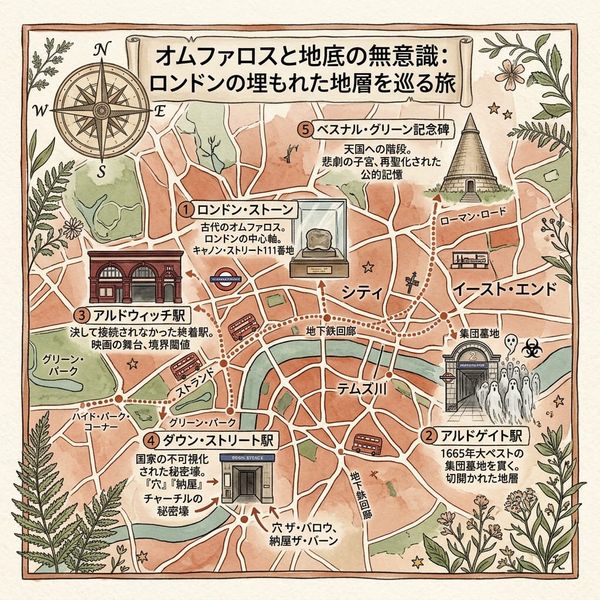
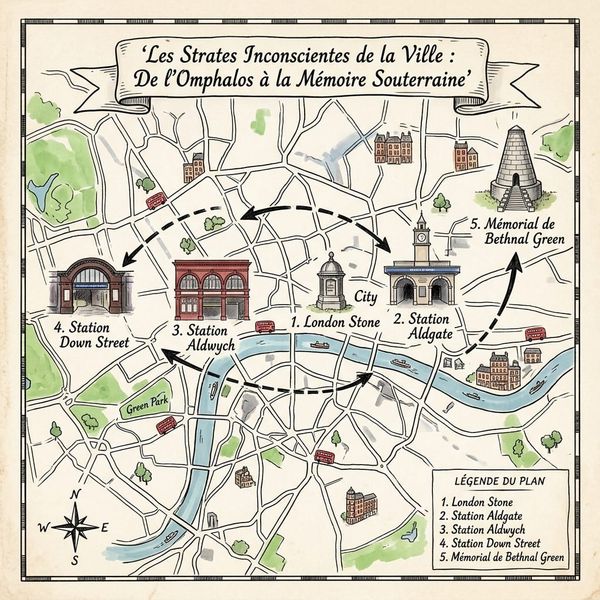
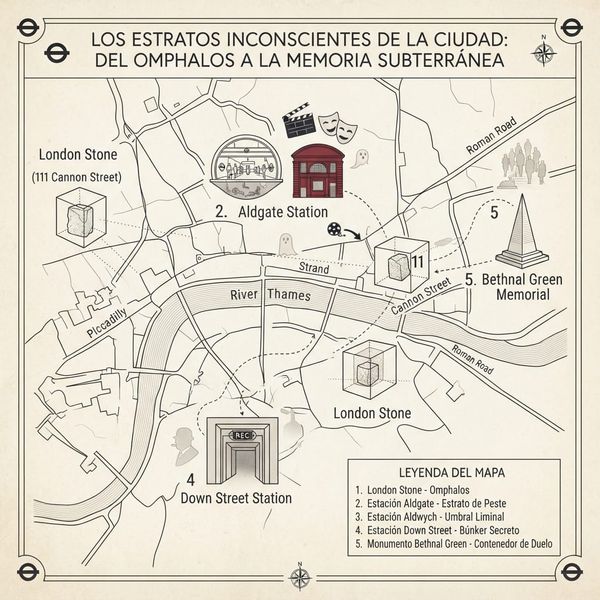
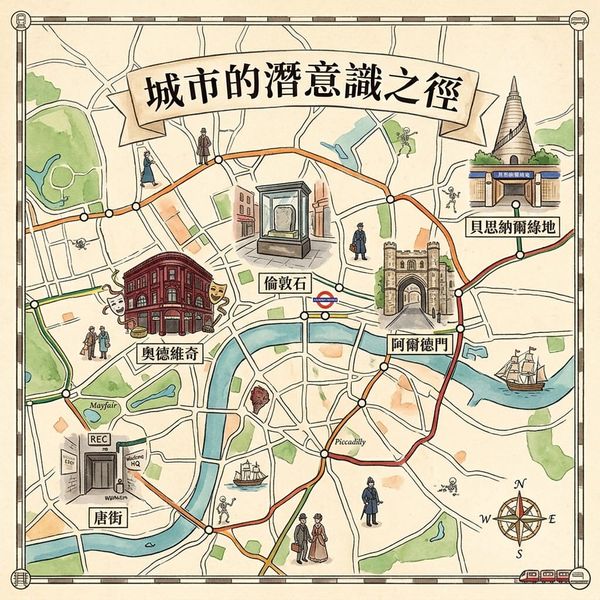
I. Bethnal Green — The Silence the Council Kept For Fifty Years
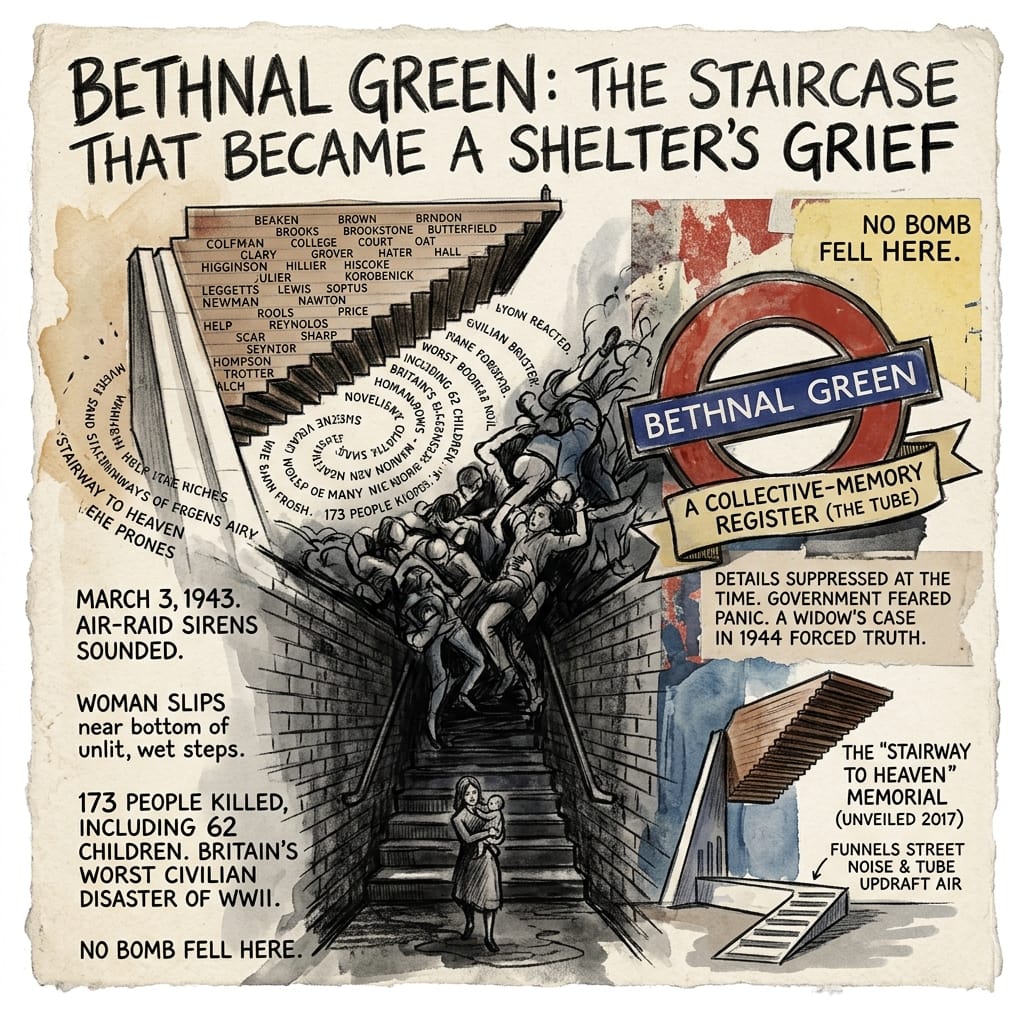
On the night of 3 March 1943, an air-raid siren sent hundreds of East Enders down the unfinished stairwell of Bethnal Green station, still being built as a Central line extension and pressed into service as a deep shelter. A woman slipped near the bottom of the wet, unlit steps; a man fell over her; and in under a minute a crush had killed 173 people, 62 of them children — Britain's worst civilian disaster of the Second World War, and to this day the single greatest loss of life anywhere on the Underground, without a bomb ever falling on the site.
What makes Bethnal Green different from a bombing raid is what happened next: nothing, officially, for decades. The government withheld the details to protect wartime morale. It took a 1944 civil suit by a bereaved widow to force the facts into the record, and it took until 2017 — seventy-four years — for a permanent memorial to be built at all.
The Deadliest Night Without A Bomb
Stand today on the "Stairway to Heaven," the cone-shaped monument above the original stairwell, and you are standing over an event London effectively refused to grieve in public until a single generation had nearly passed out of living memory. That gap — between the disaster and its naming — is the actual resonance of the site. This is not a haunted staircase. It is a grief-container, sealed for fifty years and only recently, deliberately, reopened.
Holographic Sensory Cue: the narrow brick stairwell still funnels a single directional gust of Tube-warmed air upward into Roman Road — the same bottleneck geometry, unchanged, that made the crush possible in 1943.
II. Down Street — The Room the City Was Built To Forget
A ten-minute walk from Green Park sits a station almost nobody has heard of, because it was designed to be forgotten twice. Down Street opened on the Piccadilly line in 1907, failed to attract passengers because it stood too close to its neighbours, and closed in 1932. Its very uselessness — tucked back from Piccadilly, deep below street level — is precisely what made it, in the words of one London Transport Museum historian, "absolutely perfect for secret bunkers."
Within days of the 1939 declaration of war, Down Street became the covert headquarters of the Railway Executive Committee, coordinating all of Britain's wartime rail movement from forty desks lit only by tunnel bulbs. Winston Churchill sheltered there on eight occasions that winter, while the purpose-built Cabinet War Rooms were still being finished, sleeping under a reinforced roof built to withstand a direct hit — the same kind of hit that struck the working Bank station nearby in January 1941, killing 69 people on a platform with no such protection.
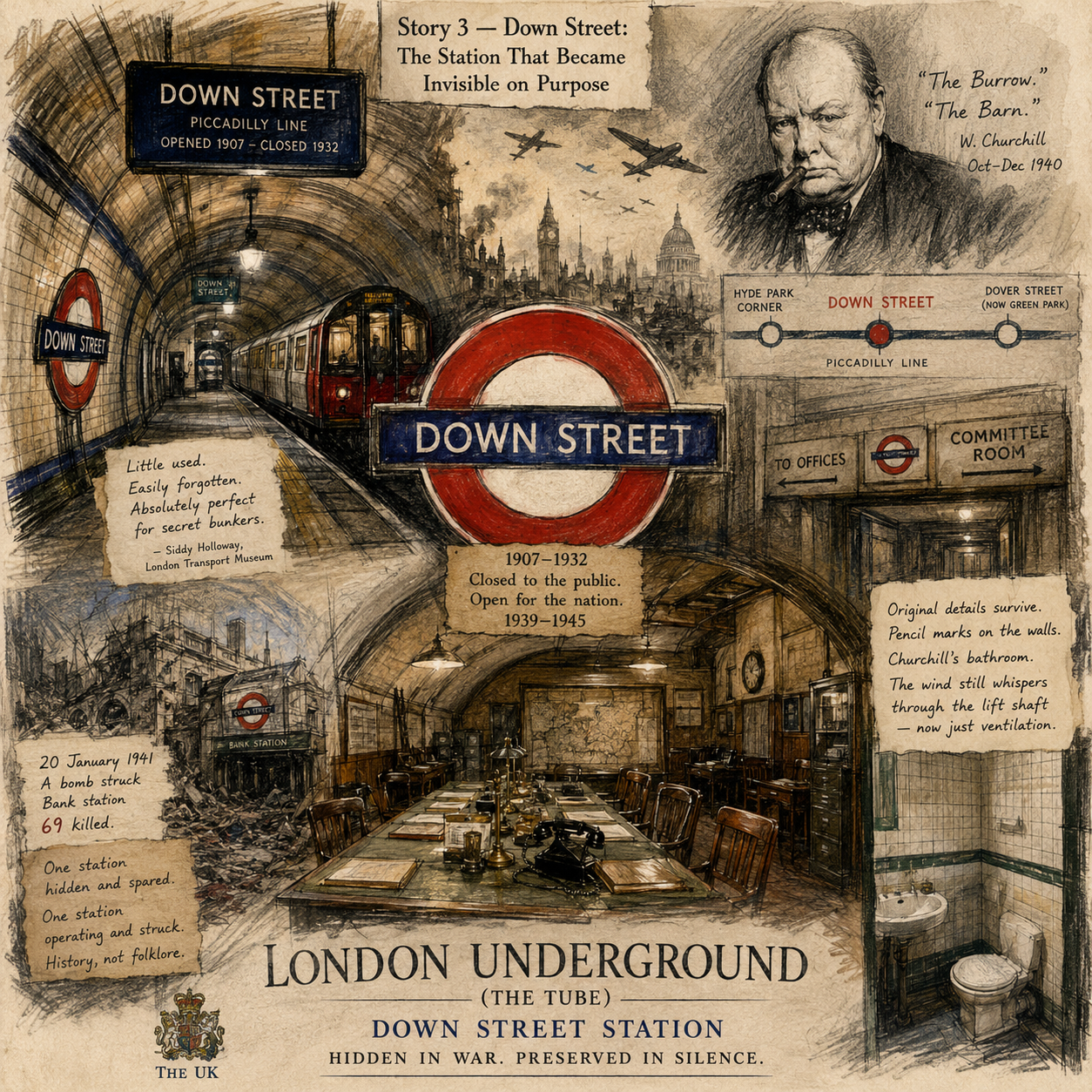
Down Street's power as a site is the inversion of everywhere else on this list: not a place London remembers too late, but a place London was actively required to forget in real time, at the exact hour its geography mattered most.
Holographic Sensory Cue: warm, mineral-smelling tunnel air still moves through the abandoned Committee Room — the same ventilation draft that once carried away cigarette smoke from men deciding how to keep a country's trains running under bombardment.
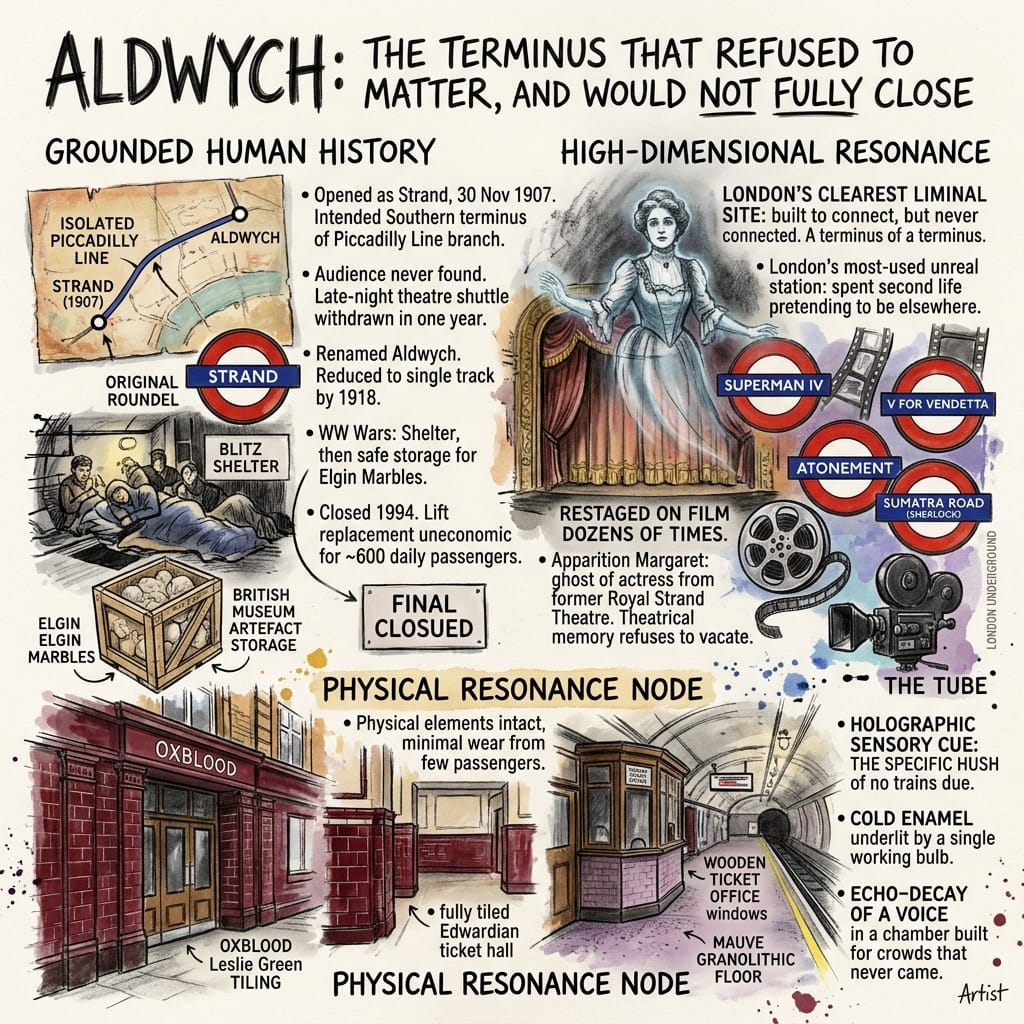
III. Aldwych — The Terminus That Spends Its Afterlife Pretending
Opened in 1907 as Strand station, the short Piccadilly branch to Aldwych never found a purpose. Its late-night theatre shuttle was cancelled within a year; a nearby station took the "Strand" name for itself before it could; by 1918 it ran a single track. It survived, barely, on a peak-hours-only service until 1994, when Transport for London judged a lift replacement uneconomic for its six hundred daily passengers and closed it for good.
The Tube Station That Failed Upward
What happened after closure is the more interesting story. Aldwych has become London's most reused unreal station — restaged on film as Superman IV's set piece, as a station in The Patriot Games and V for Vendetta and Atonement, as Sherlock's fictional "Sumatra Road." A terminus that connected to nothing now spends its second life connecting to everywhere, on camera, as somewhere else. Staff and visitors have long reported an apparition nicknamed "Margaret," said to be the ghost of an actress from the Royal Strand Theatre that stood on this exact site before the station replaced it — inherited local memory, perhaps, of a building that changed use but never entirely gave up being a stage.
Resonance Node: the original ticket hall, its 1907 oxblood tiling and wooden windows almost untouched, because so few passengers ever passed through to wear it down — the only station on the network where the "before" and the "after" occupy the same unweathered room.
IV. Aldgate — Standing Room on the Plague Dead
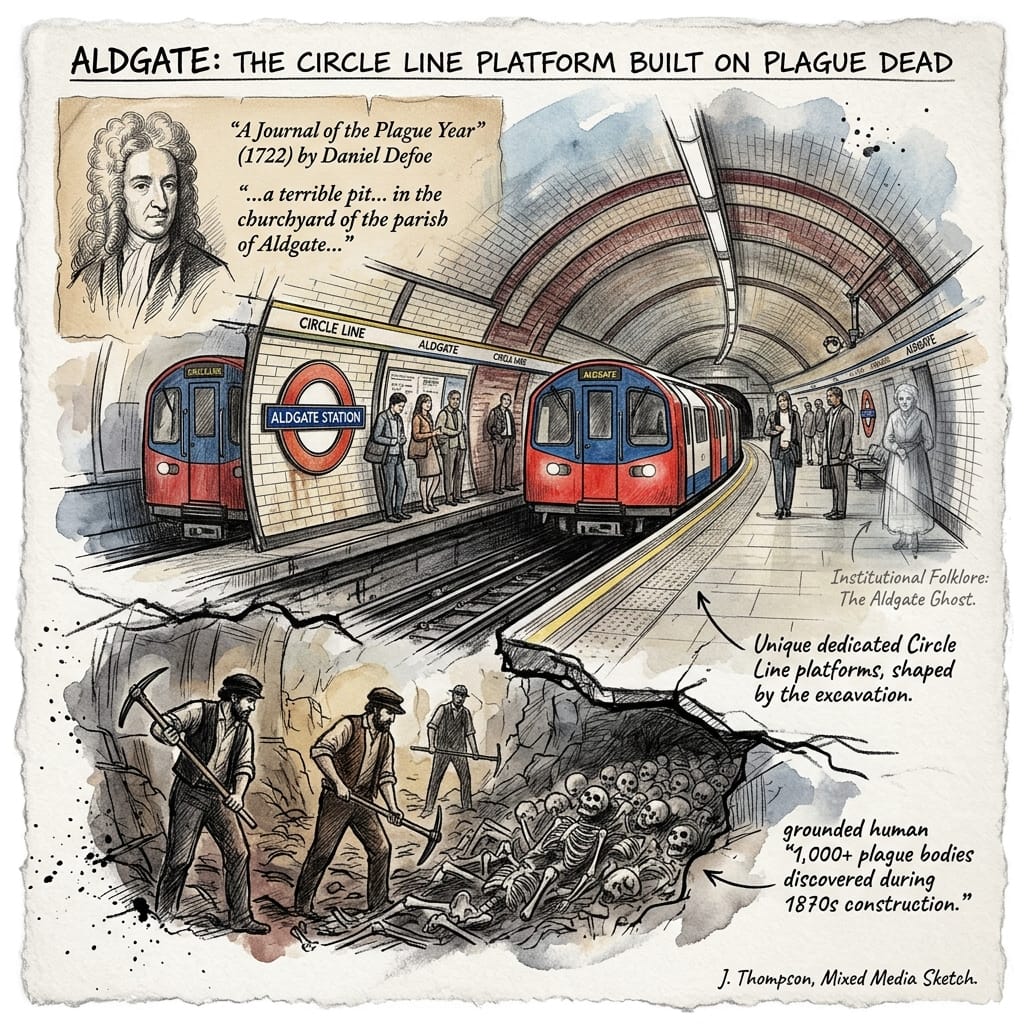
Aldgate opened in 1876 on ground behind St Botolph's church that had served, roughly two centuries earlier, as an emergency burial ground during the Great Plague of 1665, which killed a fifth of London's population in a single year. Nineteenth-century navvies cutting the new Metropolitan Railway found what contemporary accounts describe as a dense, haphazard mass of skeletons — buried in evident haste, not in the ordered, east-facing rows of a normal churchyard — and construction was delayed as a result. Daniel Defoe had separately written of a "terrible pit" at this same Aldgate churchyard decades earlier.
The Commute Through A Plague Pit
This is the one site in the dossier where two layers of the city collide underground rather than simply stack: a Victorian transport future, tunnelling directly into a seventeenth-century emergency the parish was never fully able to consecrate, because the dying outpaced the rites available to bury them properly. Aldgate remains the only station on the entire network with platforms dedicated exclusively to the Circle line — a structural quirk of the same 1870s dig that met the pit. Staff have long described a partially transparent "old lady" seen beside an electrician who survived a severe accidental electrocution, and footsteps in the tunnels that end without explanation.
Holographic Sensory Cue: the specific cold, mineral damp of the sub-street brick platform after the last Circle line service has gone, when the ambient hum drops nearly to nothing.
V. London Stone — The Point Everything Else Was Measured From
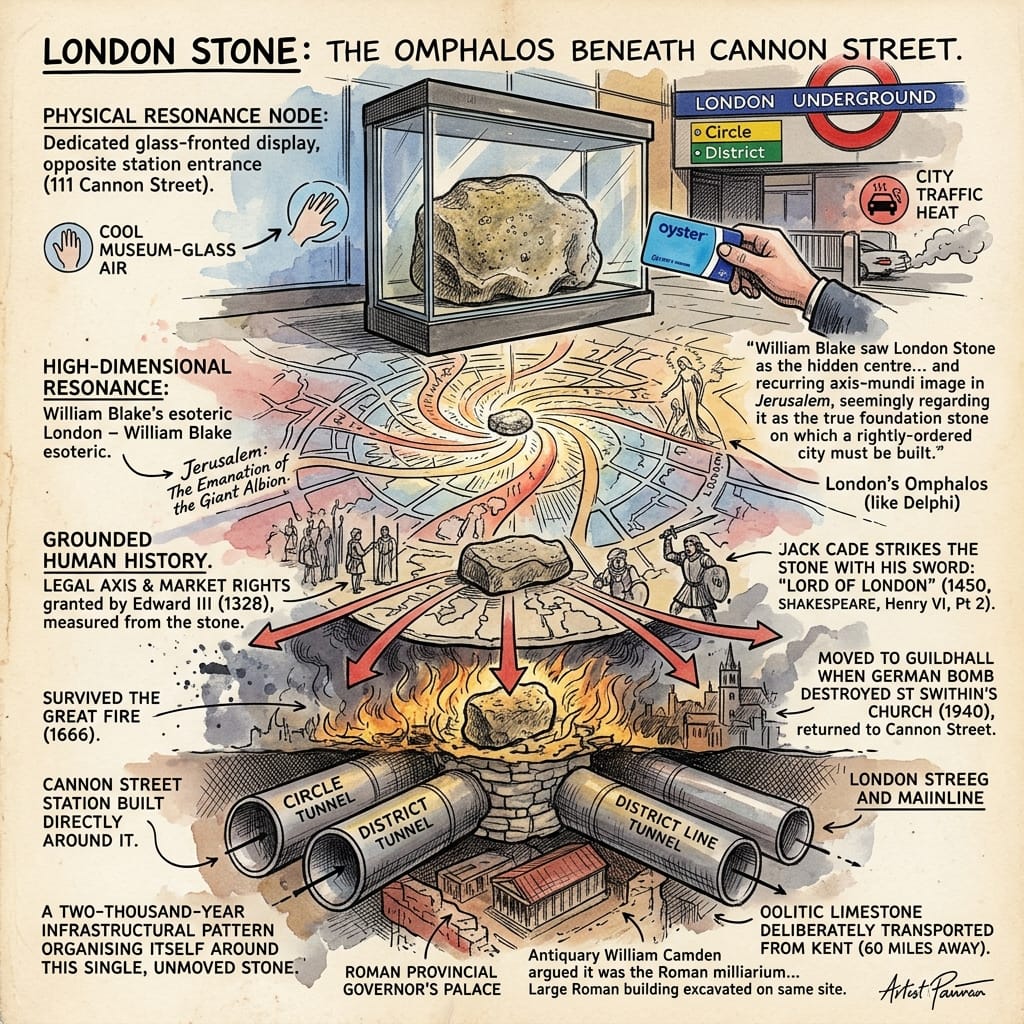
Opposite the entrance to Cannon Street station sits a weathered, fist-sized fragment of limestone, quarried some sixty miles away in Kent and deliberately carried here — not native rock, not an accident. It has stood at or near this exact spot for at least a thousand years, and quite possibly close to two thousand. The antiquary William Camden argued it was the Roman milliarium, the fixed point from which all distances across Roman Britain were measured, and archaeologists have found the remains of a large Roman building, likely the provincial Governor's palace, on the very site now occupied by Cannon Street station. By 1328, Edward III had made it the legal centre of the city's trade, granting market rights within seven miles of the stone; in 1450 the rebel Jack Cade struck it with his sword to proclaim himself "Lord of London," a scene Shakespeare later dramatised in Henry VI, Part 2.
William Blake, walking this same City two centuries later, called it the hidden centre of London and of the world — his own city's equivalent of the Omphalos at Delphi — and made it a recurring image of the true foundation stone a rightly-ordered city must be built upon. Read the way London's own literary tradition reads it, London Stone is the documented omphalos at the historical centre of Roman, medieval, and mercantile London alike: the one fixed point every subsequent measurement, oath, market boundary, and rebel's claim to the city radiated outward from, or struck against. Cannon Street station — Underground and mainline together — is simply the newest layer built around a stone that has never once moved.
Holographic Sensory Cue: cool museum-glass air against City traffic heat on the other side of a thin pane, and the unmistakable physical sense of a stone too heavy to have shifted itself — sitting exactly where it has always sat, while every building around it has been destroyed and rebuilt at least twice.
The Pattern Beneath the Pattern
Ordinary histories of the Tube treat each of these as an isolated oddity — a spooky platform here, a wartime curiosity there. Read together, they say something more specific: the Underground did not create London's underground; it inherited one, and nearly every genuinely strange station on the network is a place where a pre-existing layer of the city's sacred, funerary, or civic memory refused to be fully paved over. London Stone shows what the Victorians built around. Aldgate shows what they built through, out of necessity, and never resolved. Bethnal Green shows a grief the state built over, in silence, until a community forced its proper interment seventy-four years late. Down Street shows a threshold the state made invisible precisely when the city's survival depended on it. Aldwych shows a terminus that never mattered enough to close, so it now spends its afterlife pretending, on film, to be every station that does.
The Underground, in other words, is less a network laid beneath a modern city than it is London's own memory made structurally legible — a place where the tunnels went where the city's unresolved history let them, and no further. Two thousand years after the first Roman milestone was set into this ground, we are still, in a very literal sense, finding our way by it.
If pieces of a city's unfinished memory are worth carrying with you, subscribe below — we go looking for the next one soon.
Accessing the Physical Node
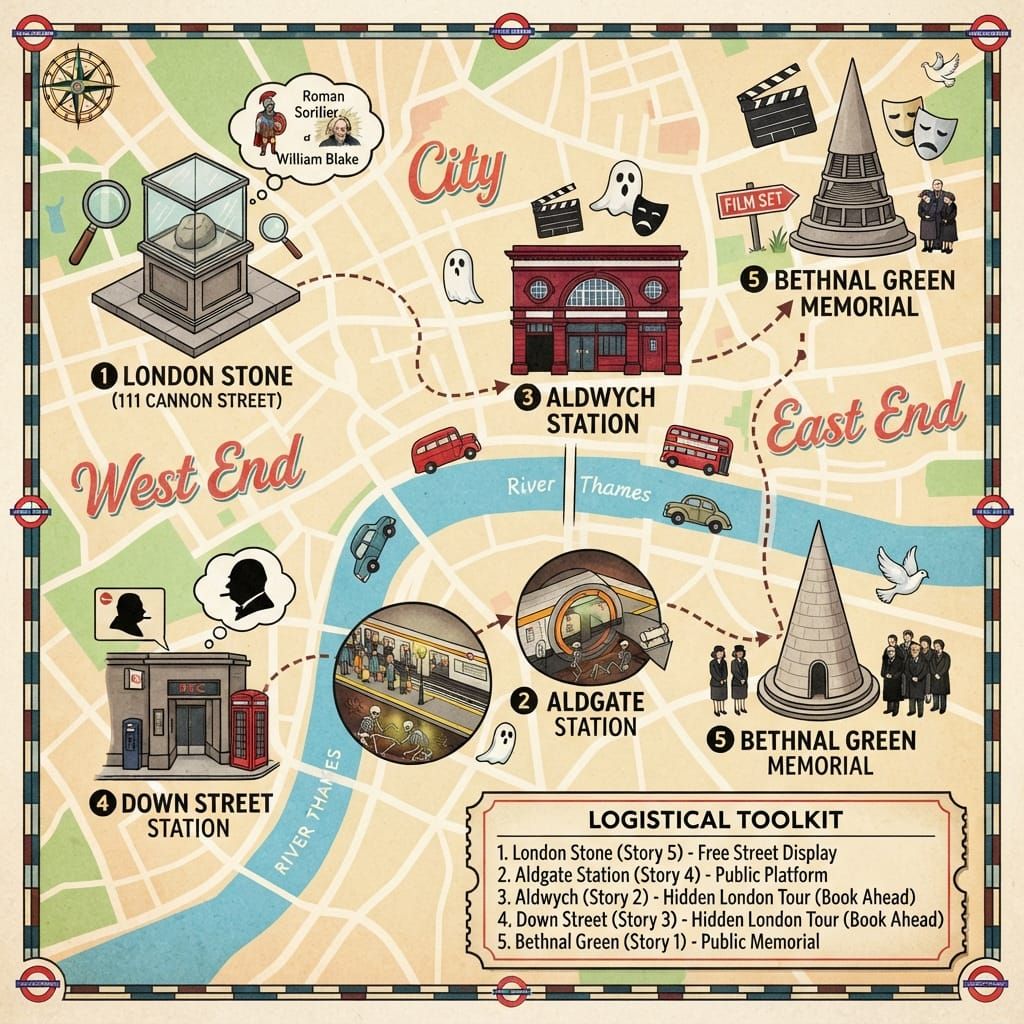
Bethnal Green — the "Stairway to Heaven" memorial stands above the station entrance on Roman Road, E2, freely visible at street level at any hour.
Down Street — not open to the public on a walk-in basis; entry is only via London Trans
port Museum's occasional "Hidden London" guided tours, which sell out and should be booked well ahead.
Aldwych — likewise accessible only via London Transport Museum's Hidden London tour programme; check current tour listings, as availability rotates.
Aldgate — a fully working Circle and Metropolitan line station in the City of London; freely accessible any time trains run, with St Botolph's church immediately outside.
London Stone — displayed in a street-level glass case at 111 Cannon Street, directly opposite Cannon Street station's main entrance, visible free of charge at any hour.
For an overnight base near this cluster, the City of London and Shoreditch both put you within a short ride of every site above; the London Transport Museum in Covent Garden is the single best starting point for planning a "Hidden London" tour around your visit.
💡 Q&A
Q1 | Is the Bethnal Green Tube Station air-raid disaster true? What is the tragedy behind the Stairway to Heaven memorial? (Bethnal Green Shelter Tragedy & Government Secrecy)
A: Yes. On March 3, 1943, 173 people (including 62 children) died in a human crush on the unlit stairs of Bethnal Green station while fleeing an air-raid siren. It remains the deadliest civilian disaster on the London Underground, despite no bombs dropping. To maintain war morale, the British government suppressed full details for decades until a 1944 civil suit began uncovering facts. The 'Stairway to Heaven' memorial was finally unveiled in 2017, acknowledging a long-sealed collective trauma.
Q2 | Why did Down Street Underground Station become Winston Churchill's wartime bunker? (Piccadilly Line Disused Station & Railway Executive Committee Bunker)
A: Down Street opened on the Piccadilly line in 1907 but closed in 1932 due to low passenger usage and proximity to adjacent stations. Its deep, disused subterranean profile made it an ideal covert bunker. Following the 1939 declaration of war, it served as the secret headquarters for the Railway Executive Committee. Prime Minister Winston Churchill sheltered and slept in its bomb-fortified subterranean space eight times during the winter of 1939 while the Cabinet War Rooms were being built.
Q3 | What was the original historical purpose of the London Underground? How did Victorian transit engineering transform into a repository for urban memory? (London Underground 1863 Opening & Subterranean Historical Layers)
A: The London Underground opened on January 10, 1863, strictly as a Victorian engineering solution to relieve severe surface traffic congestion. Over more than a century of expansion, its subterranean tunnels inevitably cut through historical strata containing plague pits, wartime shelters, and forgotten structures. The physical network transformed into a subterranean container for events, losses, and memories that the city above could not easily process on the surface.
Want to follow the historical routes I’ve selected right from your phone as you walk? Click to join the exclusive Google map of historical tours titled "Historical Travel Stories"—import it to Google Maps on your phone with a single tap and let it guide you as you visit each historical site in person.


📖Reference and Further reading📖
First layer – Main sources of literature and institutions:
- The National Archives, “Bringing the Bethnal Green disaster to light” covers the 1943 Dunne inquiry (HO 205/233) and the 1944 Baker v Bethnal Green Council case.
- Mayor of London, Request for Mayoral Decision MD1332 is the TfL donation to the “Stairway to Heaven” memorial.
- Transport for London, Art on the Underground: Aldgate station records the plague pit and the Circle-line-only platforms.
- Stairway to Heaven Memorial Trust and its background page are the memorial trust’s own records.
- The National Archives, HO 207/518 (Ministry of Home Security, Bethnal Green shelter disaster files) is cited in the scholarly article under Tier 2 but has no direct link.
- London Metropolitan Archives (St Botolph Aldgate parish burial records), London Transport Museum “Hidden London” records, and the Guildhall/Museum of London custodial records for London Stone are named as sources. I did not retrieve them, so I recommend further archival verification.
The second layer – secondary academic materials:
- “The Bethnal Green Shelter Disaster,” Taylor & Francis (journal article) cites Toby Butler (ed.), The 1943 Bethnal Green Tube Shelter Disaster: An Oral History (University of East London, 2015), and Lucy Noakes, Dying for the Nation (Manchester University Press, 2020).
- Subterranea Britannica, Down Street station is a specialist society survey with layout maps. I only saw this link quoted on another page, so it was not read directly.
- Hidden London, Cannon Street / London Stone covers Camden’s milliarium theory, Edward III’s 1328 market grant, Jack Cade, and Blake.
- City Matters, “Unearthing the facts of the fabled Aldgate station plague pit” tests the folklore against the record.
- Icy Sedgwick, Charterhouse plague pit covers the Crossrail-era excavations near Liverpool Street and Charterhouse.
- Strandlines, Aldwych station draws on British Newspaper Archive material.
- Military History Now, Down Street covers the Railway Executive Committee’s staffing, Churchill’s eight stays, and the “Burrow” nickname.
- CNN Travel, Down Street quotes London Transport Museum historian Siddy Holloway.
- East London History, Bethnal Green disaster gives the sequence of events on the night.
- Historic UK, London Stone flags that the Arthur-and-the-stone legend is very recent.
- Look Up London, London Stone sets out the Roman Governor’s Palace and Alfred-era street-grid theories.
Third layer – Supplementary information:
These are treated as cultural-interpretive data, not verified fact.
- Stairway to Heaven Memorial Trust, survivor testimony includes Babs Clark’s account.
- Higgypop, Aldwych haunted history has the “Margaret” apparition and the 2002 Most Haunted episode.
- Mysterious Britain, Aldgate station has the electrician and “old lady” account and the Defoe reference.
- Mysterious Britain, London Stone covers the Druidic-altar and Brutus legends.
- Atlas Obscura, Aldwych and Atlas Obscura, London Stone give visitor-oriented context.
- Wikipedia, Down Street tube station, Aldgate tube station, Aldwych and London Stone are aggregators. They are useful for dates and leads, but I did not treat them as authoritative.
- Defoe’s A Journal of the Plague Year (1722), Blake’s Jerusalem (c.1821), Camden’s Britannia, and Strype’s 1720 account of London Stone have no links. I only saw them quoted in other sources, so I recommend further verification.
 Lawrence
 Lawrence
 Lawrence