(ENG) Osaka Castle: A Spatial History of Power, Erasure, and Civic Identity

How did the 1959 excavation reveal hidden Toyotomi history?
What is the engineering behind the castle's massive stones?
How did the public help rebuild Osaka Castle in 1931?
 Lawrence
THE UEMACHI PLATEAU AND THE LOGIC OF ASCENT
To understand Osaka is to understand the Uemachi Plateau. This diluvial upland, the only stable high ground rising above the marshy Osaka plain, serves as a natural fortress of immense strategic value. Flanked by the Yodogawa River to the north and the expansive Osaka Bay to the south, it has dictated the strategic movements of Japanese history for centuries. It is the inevitable site for power—a geological stage where every rising hegemon felt compelled to plant their standard.
For the thoughtful walker, the castle grounds are not a single historical site but a "palimpsest"—a layered manuscript where the past has been physically overwritten. Beneath the current stone walls and manicured lawns lie at least three distinct versions of the city’s identity. To walk here is to traverse a landscape of religious autonomy, deliberate political erasure, megalithic competition, industrial warfare, and eventually, a shared civic pride. Our journey begins by descending through this stratigraphy, moving from the horizon into the very ground beneath your feet.
Listen to the historical stories told in detail (For subscribers only)
THE FORGOTTEN BUDDHA KINGDOM: ISHIYAMA HONGAN-JI AND THE END OF AUTONOMY
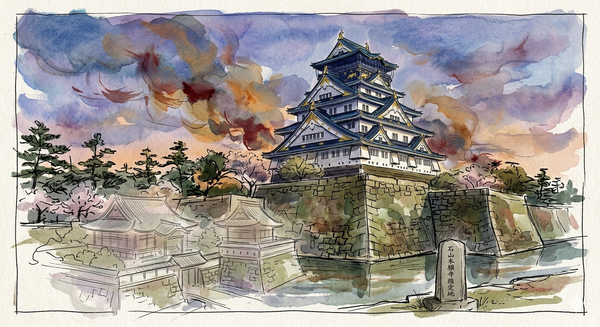
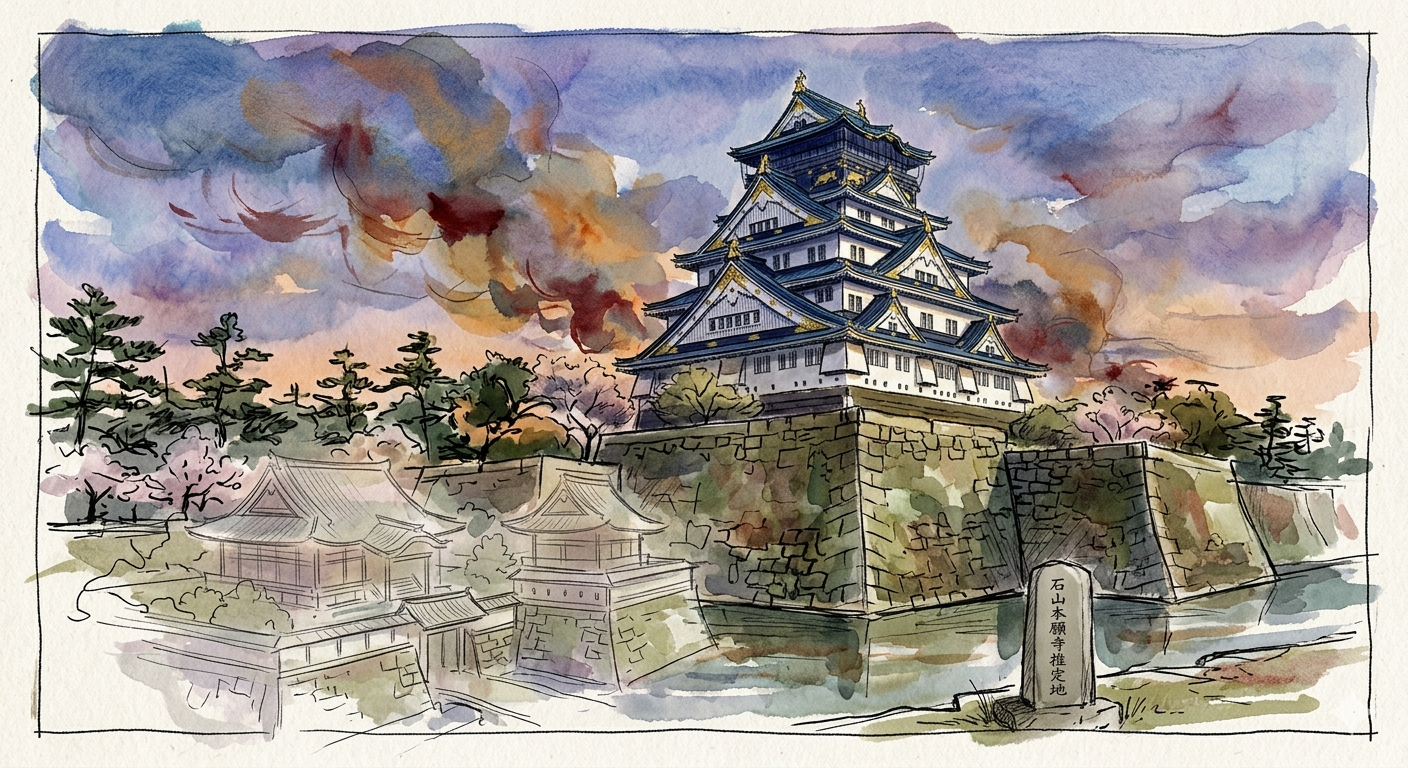
Long before the first stone of a castle was laid, the Uemachi Plateau belonged to a different kind of power. In the mid-16th century, the site was occupied by the Ishiyama Hongan-ji, the headquarters of the Jodo Shinshu Buddhist sect. This was not merely a temple; it was a Jinaicho (Temple-Town), a highly autonomous city-state with its own judiciary, taxation, and advanced defenses. It represented a medieval logic of self-governance—the "Buddha Kingdom"—that stood in direct opposition to the emerging national unification sought by the warrior class.
The resulting Ishiyama War (1570–1580) was the longest siege in Japanese history. It was a clash of civilizations: Oda Nobunaga’s vision of a centralized "Warrior State" versus the Hongan-ji’s "Logic of the Commons." Nobunaga recognized that to rule Japan, he had to control the trade and military arteries of Osaka. Recent excavations between 2021 and 2023 at the nearby Osaka City Higashi Middle School have unearthed layers of burned soil and tiles, visceral evidence of the conflagration that marked the end of this religious independence.
Stages of the Ishiyama War | Key Events | Impact on Power Structure |
Initial Conflict (1570) | Abbot Kennyo declares a "Holy War" against Nobunaga. | Demonstrated the potent threat of religious mobilization against secular lords. |
Naval Turning Point (1578) | Battle of Kizugawaguchi: Nobunaga’s ironclad ships break the Mori clan's naval supply line. | Marked the dawn of modern naval warfare and the loss of the temple's maritime lifeline. |
Final Mediation (1580) | Emperor Ogimachi mediates a settlement; the temple is vacated and burned. | The total collapse of medieval religious autonomy, clearing the stage for central absolute rule. |
The Legacy of the Commons The destruction of the Ishiyama Hongan-ji was the necessary clearing of the stage. By dismantling this religious state, Nobunaga—and his successor Toyotomi Hideyoshi—eliminated the final barrier to a centralized Japan. However, the commercial spirit of the original Jinaicho was not extinguished; it was secularized, becoming the enduring DNA of Osaka’s merchant prosperity.
THE ARCHAEOLOGY OF ERASURE: THE BURIED WALLS OF 1583
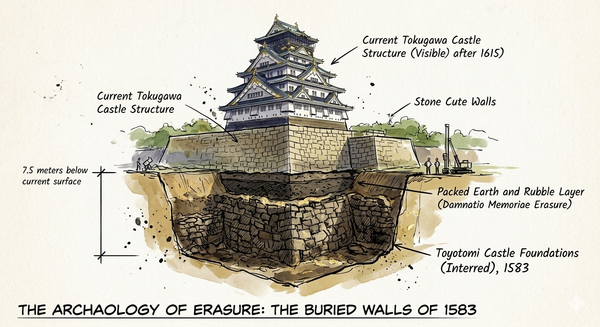
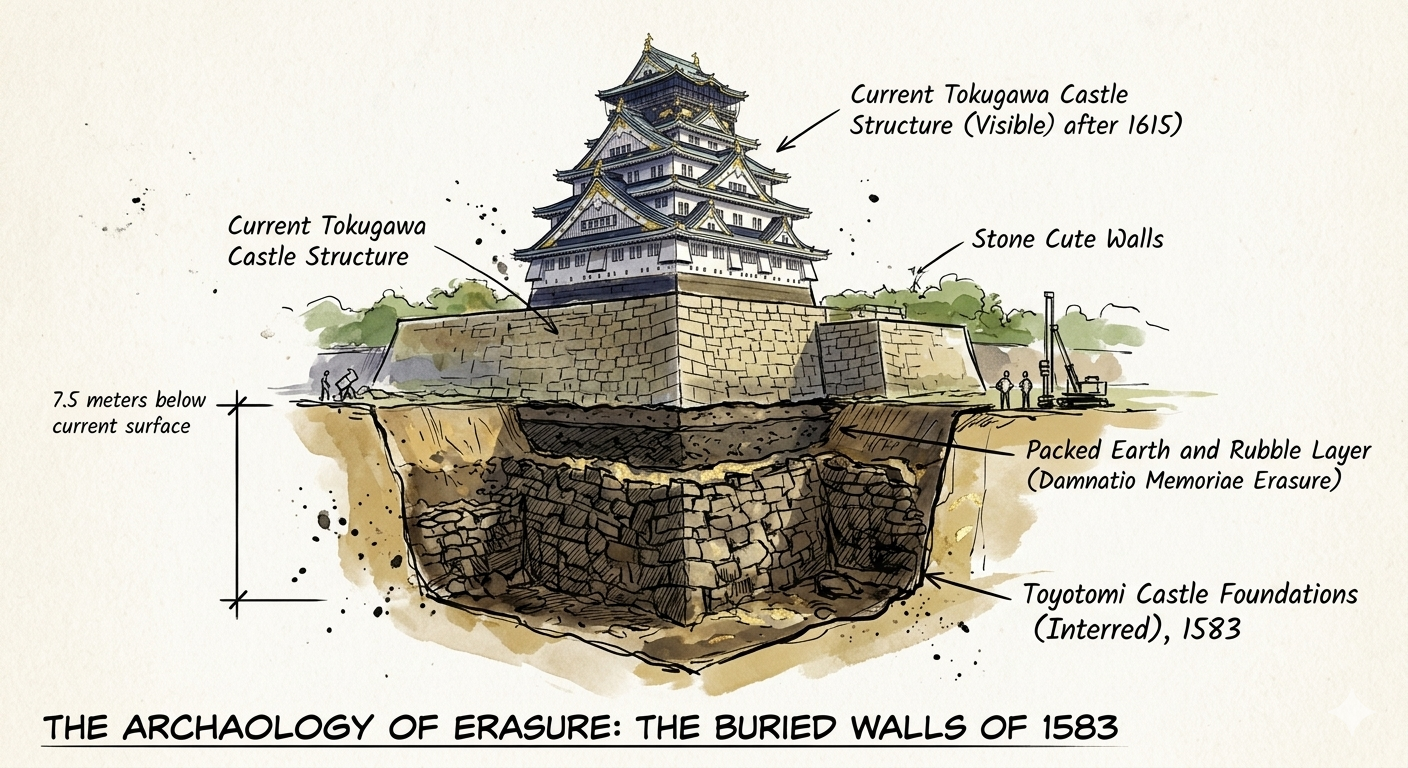
For centuries, the public believed that the current Osaka Castle was the work of Toyotomi Hideyoshi. However, the 1959 "Osaka Castle Comprehensive Academic Survey" shattered this narrative. Excavations revealed that the castle we see today is actually a Tokugawa-era reconstruction that physically and symbolically buried the Toyotomi legacy.
Archaeologists drilling 7.5 meters below the current surface discovered perfectly preserved stone walls belonging to Hideyoshi’s original 1583 fortress. Following the destruction of the Toyotomi clan in 1615, the Tokugawa Shogunate did not just rebuild; they employed a spatial Damnatio Memoriae (the erasure of memory). They used meters of earth to inter the original foundations, placing their own structures directly on top to ensure the previous regime was silenced by the weight of new stone.
"The stones found in the lower depths utilize the Nozura-zumi (natural stone) technique, where unrefined granite is stacked with a raw, primal energy—a stark contrast to the precision of later eras." — 1959 Comprehensive Academic Survey
The Two Osakas: A Contrast
- The Toyotomi Castle (Interred): Located 7.5 meters underground, characterized by gold-leafed accents and the rough, primal energy of Nozura-zumi masonry.
- The Tokugawa Castle (Visible): The current surface structure, defined by white-plastered walls, massive megaliths, and a slightly shifted spatial alignment.
MEGALITHIC POLITICS: THE "TAXATION BY STONE" AND THE ANOUSHU MASONS
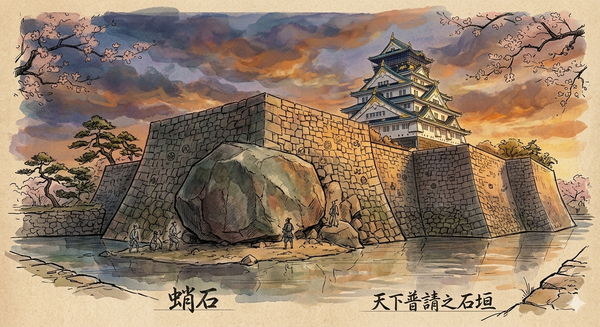
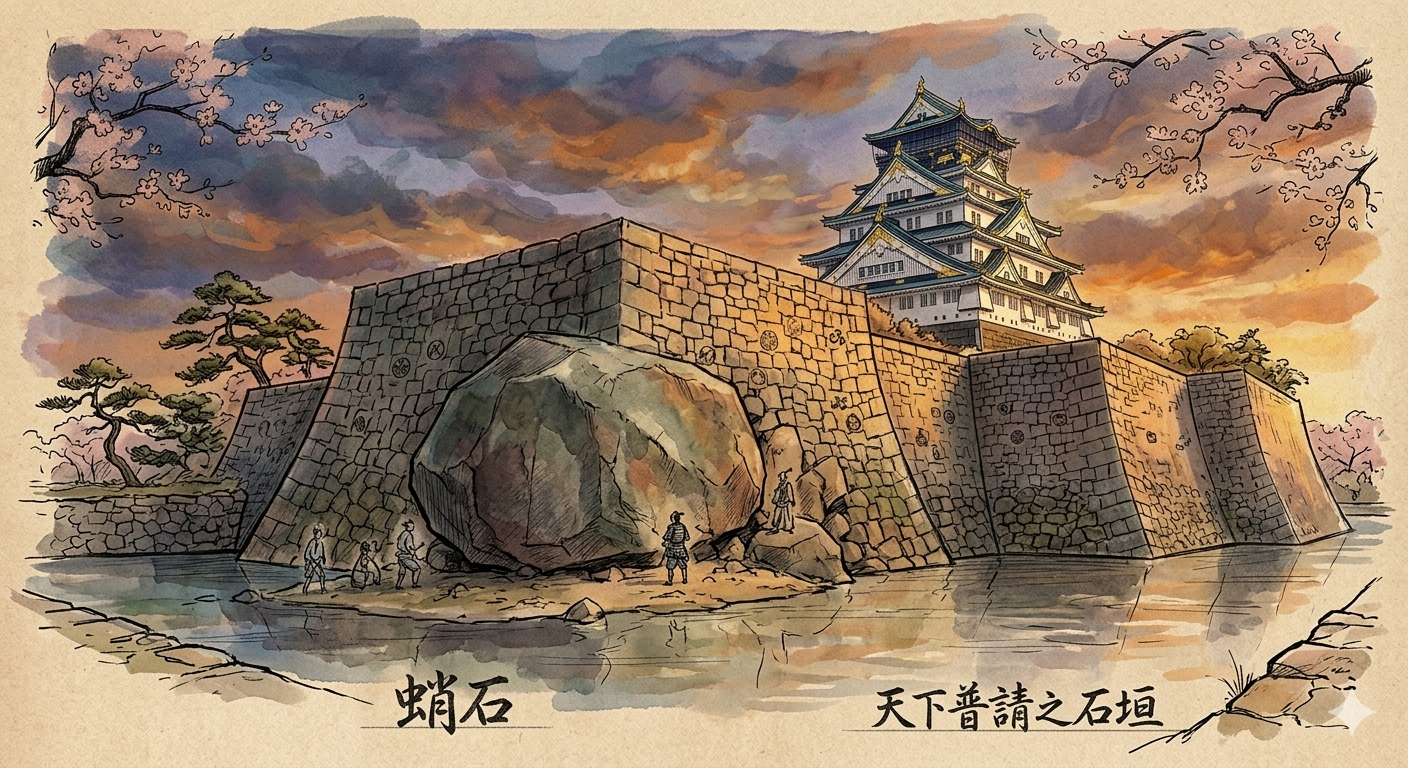
The massive walls that surround the castle today were the product of the Tenka Fushin system—a masterpiece of political management. The Shogunate commanded 64 rival lords (daimyo) to provide the funds, labor, and materials for the reconstruction. This was construction as a weapon; by forcing lords to drain their treasuries on stone and logistics, the Shogunate effectively preempted rebellion.
The architectural geniuses behind these walls were the Anoushu masons from Lake Biwa. Known as "stone-listeners," they possessed the oral secrets to stacking natural stones so they could withstand earthquakes. In the Tokugawa era, this evolved into the precision of Uchikomi-hagi, where joints are so tight a business card cannot fit between them.
In this competitive landscape, size was the ultimate metric of loyalty. The "Tako-ishi" (Octopus Stone), provided by Ikeda Tadao of the Okayama Domain, is the castle's largest, boasting a surface area of 54.93 square meters and weighing an estimated 130 tons. These stones were "hostages" of the lords, quarried from islands like Inujima and Shodoshima in the Seto Inland Sea, transported on massive wooden sleds known as Shura, and shipped on specialized barges. To stand before the Tako-ishi today is to see the physical embodiment of 17th-century power dynamics.
THE MANCHESTER OF THE ORIENT: THE RISE AND FALL OF THE ARMY ARSENAL
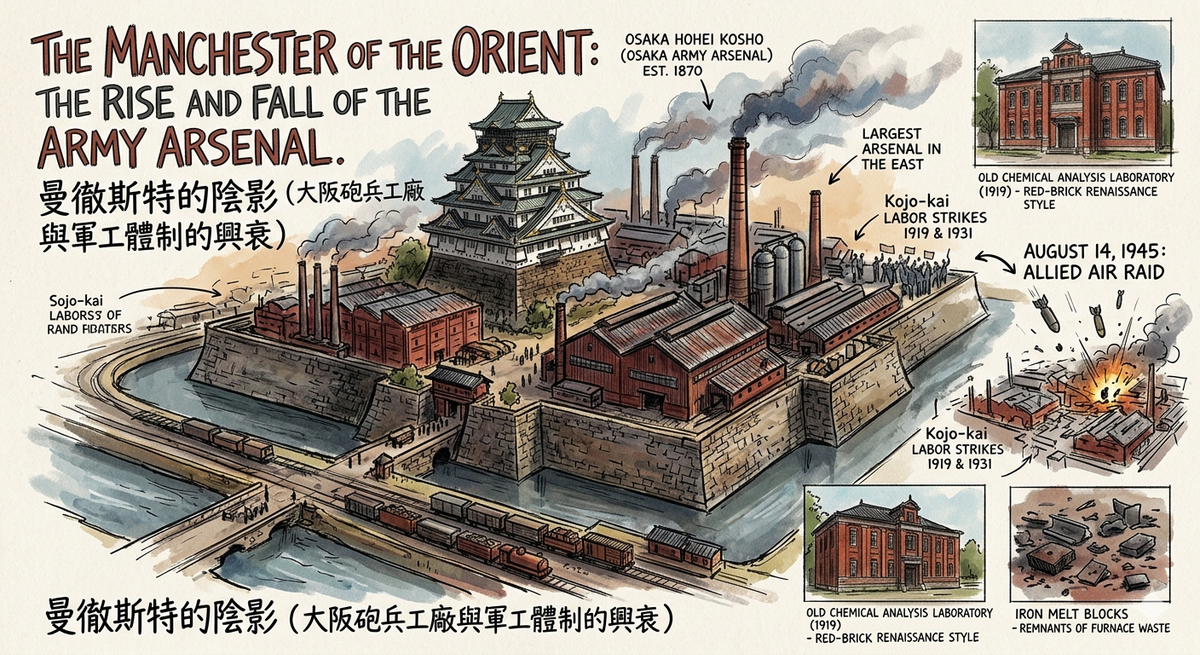
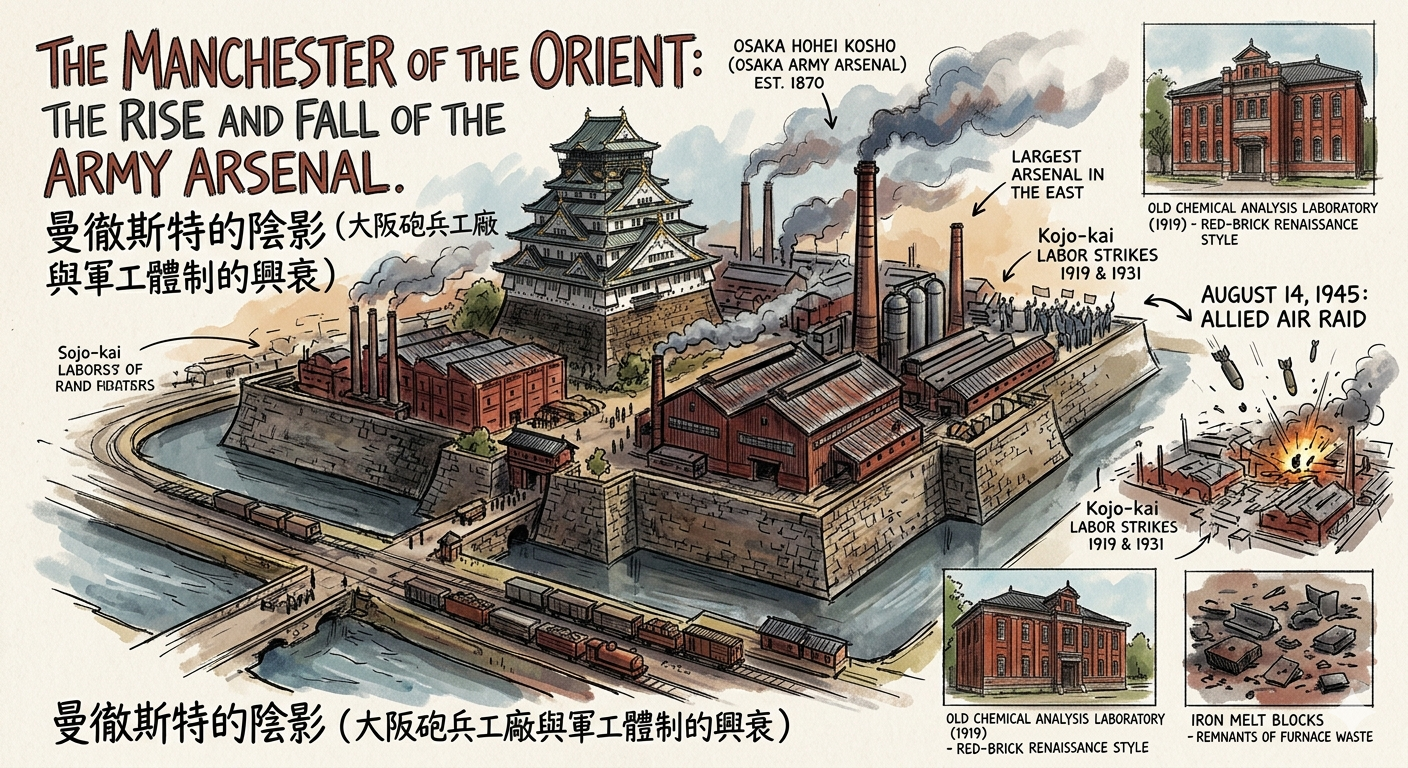
With the Meiji Restoration, the castle transitioned from a feudal relic into the engine of a modernizing state. In 1870, the Osaka Hohei Kosho (Osaka Army Arsenal) was established within the grounds. Because of its existing defenses and proximity to water and rail, the castle became "The Largest Arsenal in the East," earning Osaka the moniker "The Manchester of the Orient."
During this era, the castle was the industrial heart of "Military City Osaka." It was also a site of social friction; the rise of the "Kojo-kai" labor strikes in 1919 and 1931 revealed the tension between the military state and the emerging worker class. This industrial identity reached its terminal point on August 14, 1945. A massive Allied air raid targeted the arsenal just one day before Japan’s surrender, destroying 90% of the facilities. Today, structures like the Old Chemical Analysis Laboratory—a red-brick Renaissance-style building—stand as silent witnesses to an era when the castle was more factory than fortress.
THE COMMON HEARTH: THE 1931 RECONSTRUCTION AS CIVIC DEFIANCE
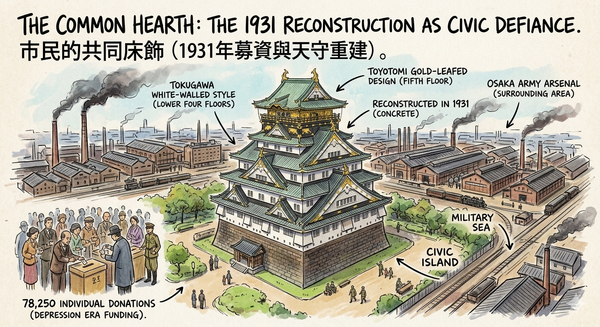
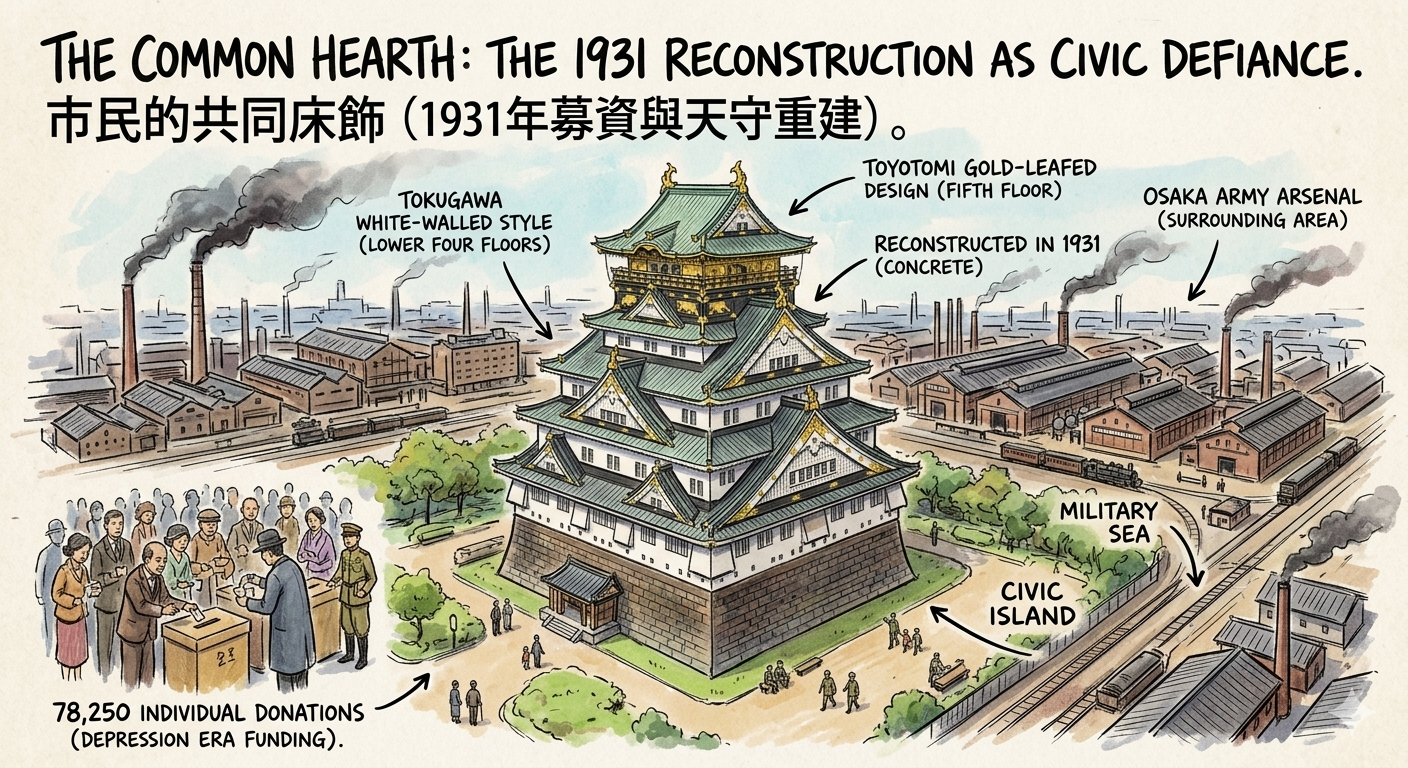
The current Main Tower is a miracle of the "Great Osaka" era of the 1920s. Led by Mayor Seki Hajime, the city sought to reclaim the castle from the military and return it to the people as a "Citizen’s Park."
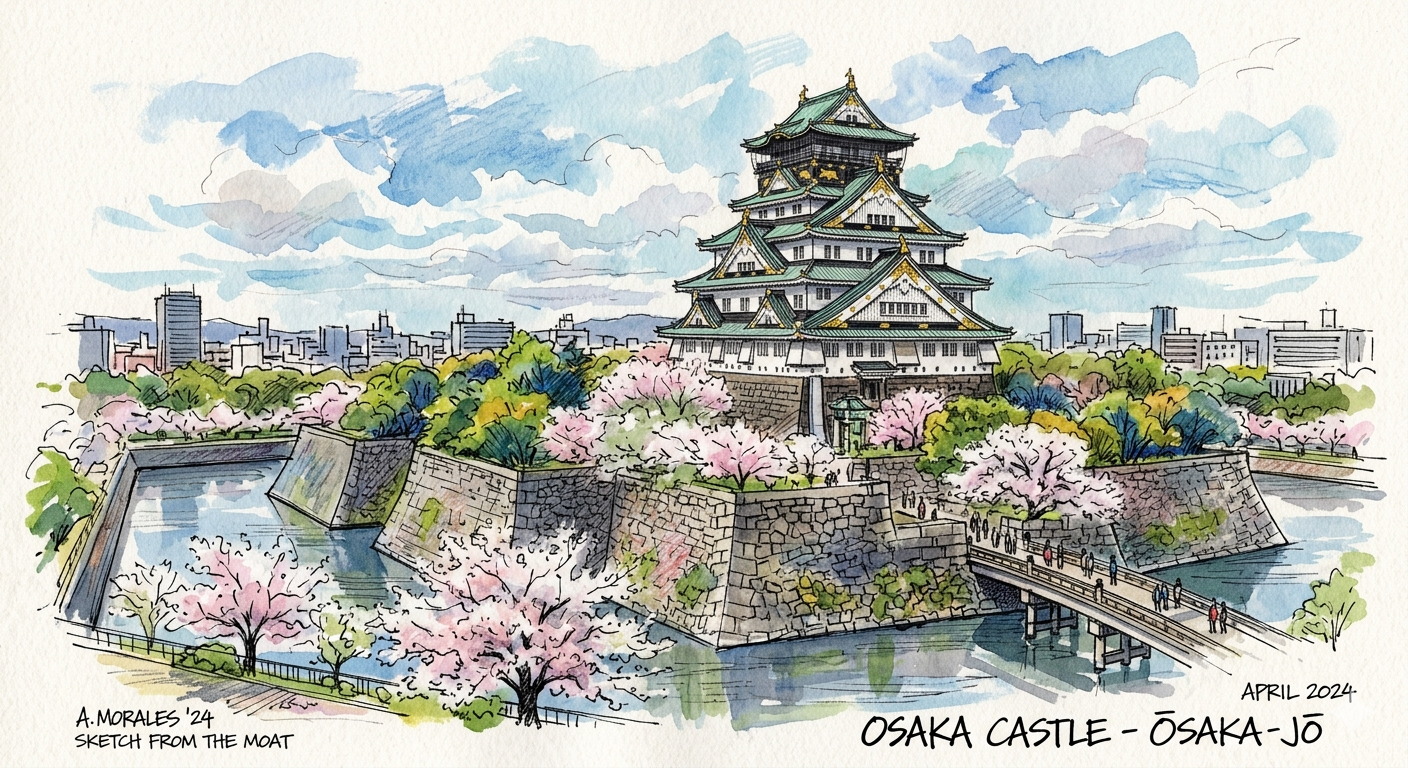
This 1931 reconstruction was an unprecedented act of civic identity. Funded entirely by 78,250 individual donations during the depths of a global depression, the tower rose as a "civic island" in the middle of a military sea—the arsenal still surrounded the site and would remain until 1945.
The architecture is a deliberate architectural syncretism: the lower four floors follow the Tokugawa white-walled style, while the fifth floor recreates Hideyoshi’s gold-leafed Toyotomi design. This historiographic reconciliation blended two rival eras into a single monument for the public. Remarkably, this concrete reconstruction has now stood for over 90 years—longer than either of the "real" historical towers that preceded it.
THE REFLECTIVE WALKER’S GUIDE (HIDDEN GEMS)
To truly see the palimpsest, look beyond the Main Tower. Seek out the Toyotomi Stone Wall Exposure Project, a specialized archaeological shelter that allows you to view the original 1583 masonry interred beneath the ground. Visit the Old Chemical Analysis Laboratory to feel the industrial weight of the Meiji era, or examine the perimeter walls for Kokuin (engraved stone markings)—family crests carved by feudal lords to mark their contributions to the "taxation by stone."
CONCLUSION: THE PALIMPSEST OF THE SOUL
Osaka Castle is not a static museum; it is a living dialogue between different eras of ambition. It is a place where a Buddhist "Kingdom of the Soul" was buried by a Warrior’s "Gold City," which was in turn interred by a Shogun’s "Stone Hegemony," only to be transformed into an industrial arsenal and finally reborn as a park for the common citizen.
It is a monument to the fact that in Japan, the past is never truly erased; it is simply the foundation for the next layer of the present. As you walk the Uemachi Plateau, ask yourself: what are we building today that will become the next layer of the palimpsest for those who follow?
To dig deeper into the forgotten corners of Japan's history, subscribe to our monthly journal for the curious traveler.
PRACTICAL TRAVEL FRAMEWORK
Accessing the Layers
- Getting There: Accessible via the Tanimachi or Chuo subway lines.
- Recommended Accommodation: Stay near the Osaka Business Park (OBP). This modern district sits on the literal footprint of the former Army Arsenal, offering a stark visual contrast between the feudal walls and the modern skyline.
- Walking Route: To experience the chronology spatially, begin at the south near the Ishiyama Hongan-ji marker, move toward the Main Tower and the Toyotomi Stone Wall Exposure Project, and finish at the northern Arsenal ruins and the Old Chemical Analysis Laboratory.
Reference and Further reading
- <石山本願寺之戰>, accessed March 16, 2026,
- 石山合戰- accessed March 16, 2026,
- 大 坂 城 跡 ⅩⅩ - 全国文化財総覧, accessed March 16, 2026,
- 大阪城的歷史, accessed March 16, 2026,
- 大坂城の天守(大阪城天守閣) | 大阪城のガイド - 攻城団, accessed March 16, 2026,
- 戦後の大阪城における「豊臣の城」の発見 ―1959 年の大坂城総合学術調査を中心事例に―, accessed March 16, 2026,
- 特別史跡大坂城跡下層に想定される古代の遺跡 - 大阪歴史博物館, accessed March 16, 2026,
- 24652143 研究成果報告書 - KAKEN, accessed March 16, 2026,
- 大阪城公園パークマネジメント事業 令和6年度 事業報告書 - 大阪市, accessed March 16, 2026,
- 豊臣時代の大阪城を現代に!築城時の石垣を公開するプロジェクトが始動 - ホームズ, accessed March 16, 2026,
- 穴太衆積みの石垣 - 比叡山・びわ湖 観光情報サイト<山と水と光の廻廊>, accessed March 16, 2026,
- 「穴太衆(あのうしゅう)」って何をした人たちなの?ー「超入門! お城セミナー」第48回【歴史】, accessed March 16, 2026,
- 「穴太衆」伝説の石積み技を継ぐ末裔に立ちはだかる壁とは | 中川政七商店の読みもの, accessed March 16, 2026,
- 大阪城は400年前の全国巨石見本市 - デイリーポータルZ, accessed March 16, 2026,
- Q.1 早月川からどうやって大きな石を運んだのですか? A, accessed March 16, 2026,
- 巨石運搬!海をこえて大阪城へ - 日本教育新聞電子版 NIKKYOWEB, accessed March 16, 2026,
- 【超入門!お城セミナー】こんなに大きな石材をどうやって運んだのか?, accessed March 16, 2026,
- 大阪城の石垣 | October 2021 | Highlighting Japan, accessed March 16, 2026,
- 【大阪城】城内の巨石はどのように船で運ばれたのか【日本100名城】 - note, accessed March 16, 2026,
- 大阪砲兵工廠 | 錦絵と写真でめぐる日本の名所 | Digital Exhibitions, accessed March 16, 2026,
- 大阪砲兵工廠跡 - 大阪市 City of Osaka, accessed March 16, 2026,
- 大阪城に旧日本軍の軍需工場!?「大阪砲兵工廠」をめぐる旅 | 大阪府 | トラベルjp 旅行ガイド, accessed March 16, 2026,
- 旗を残した戦前の労働組合, accessed March 16, 2026,
- モデルコース A 大阪城公園内の史跡と戦跡を訪ねる - ピースおおさか, accessed March 16, 2026,
- 大阪に残る軍事遺跡!東洋最大の兵器工場もあった軍都の名残 - まっぷるウェブ, accessed March 16, 2026,
- 旧大阪砲兵工廠化学分析場 - 特別史跡 大阪城公園, accessed March 16, 2026,
- 住み続けられるマチヅクリ | SDGsへの取り組み | 株式会社ポジティブドリームパーソンズ, accessed March 16, 2026,
- 温故知新 大大阪時代を歩く 第6回 大阪城天守閣/大阪府庁舎本館/旧大阪放送会館 | 活動報告, accessed March 16, 2026,
- 大坂城 - accessed March 16, 2026
 Lawrence
 Lawrence
 Lawrence