(ENG) The Palimpsest of Daan: A Sensory Archaeology of Taipei’s Hidden History
Taipei’s Daan District on foot: 5 layers of history, from hidden water paths to camphor-scented sanctuaries and the sensory memory of damp earth.


Listen to the historical stories told in detail (For subscribers only)
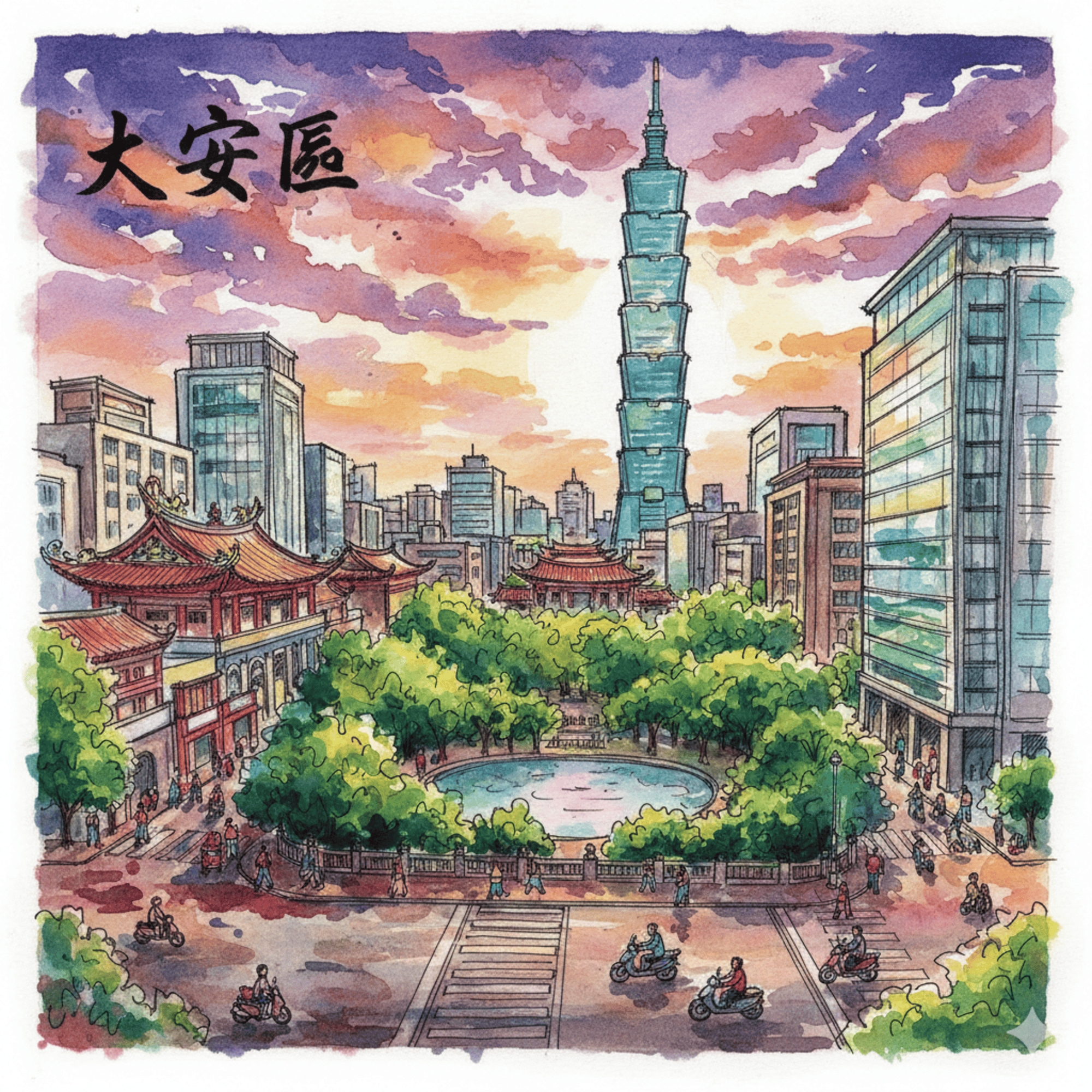
To walk through Taipei’s Daan District is to navigate a site of profound internal tension. It is a space where the commercial glitz of the East District intersects with the intellectual gravity of Taiwan’s premier academic institutions. This "Daan problem"—the friction between luxury and grit, academia and commerce—defines its character. To truly understand this neighborhood, one must look past the modern asphalt and engage in a sensory archaeology. The identity of Daan is captured in three distinct olfactory markers: the warm, resinous scent of camphor wood from colonial-era faculty housing; the sharp, intellectual aroma of hand-brewed specialty coffee; and the faint, ghostly memory of damp earth from its days as a wetland. This guide serves as a framework for exploring five "time faults" beneath the surface, revealing how layers of history and social struggle have overlapped to create the Daan we experience today.
The Memory of Water: From Great Bay to Urban Veins
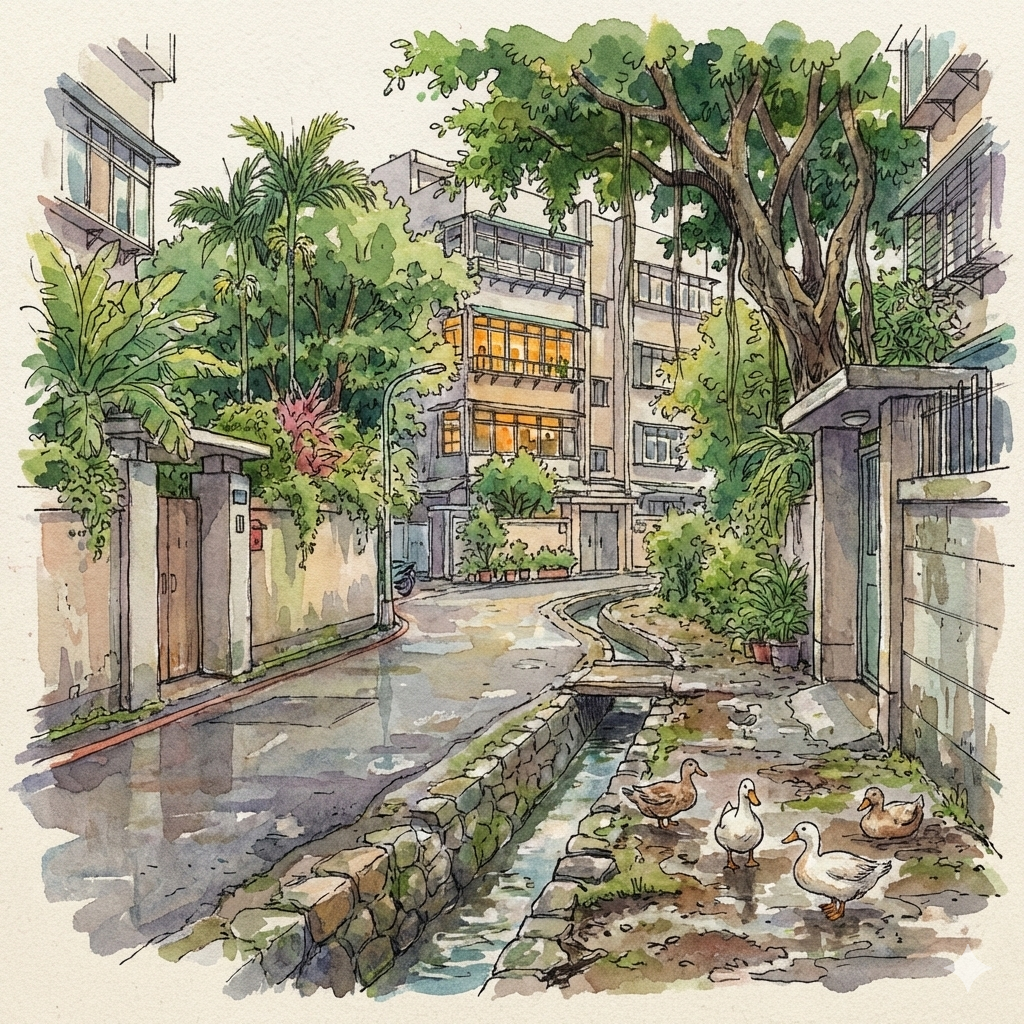
The transition from the watery "Daban" to the paved "Daan" represents a systematic "spatial purification" of the city's geography. For the traveler, uncovering this foundation is essential; it reveals that the modern city is built upon a wild, fluid geography that was once systematically tamed to facilitate agricultural and political order. The contemporary name "Daan" (Great Peace) is an aspirational linguistic evolution from the Minnan term "Daban," meaning "Great Bay" or "Wide Waterway," revealing the area’s original identity as a marshy wetland.
The Liugong Canal is not merely a dry historical fact; it is a ghost that haunts the city's layout. In the quiet alleys of Wenzhou Street, the history of the canal becomes "spatial archaeology." The irregular, winding paths of these streets follow the original contours of the water, resisting the rigid, square grids of modern urban planning. This irregularity has become a form of cultural luxury; it is why spaces like AGCT apartment specifically choose third-floor locations—to overlook these surviving "urban veins." This spatial rebellion offers a rare sense of quietude and mystery, providing a physical escape from the standardized urban experience.
The Sensory Memory of Damp Earth "Beneath the high-rises and boutiques, the memory of damp earth remains—a ghostly reminder that this intellectual and commercial center was once a wild wetland, defined by the flow of water rather than the flow of capital."
As the wild waters were channeled and the soil was stabilized, the area transitioned from a natural resource to a structured intellectual sanctuary, paved with the order of the Japanese colonial administration.
The Camphor-Shaded Sanctuaries: Intellectual Resistance
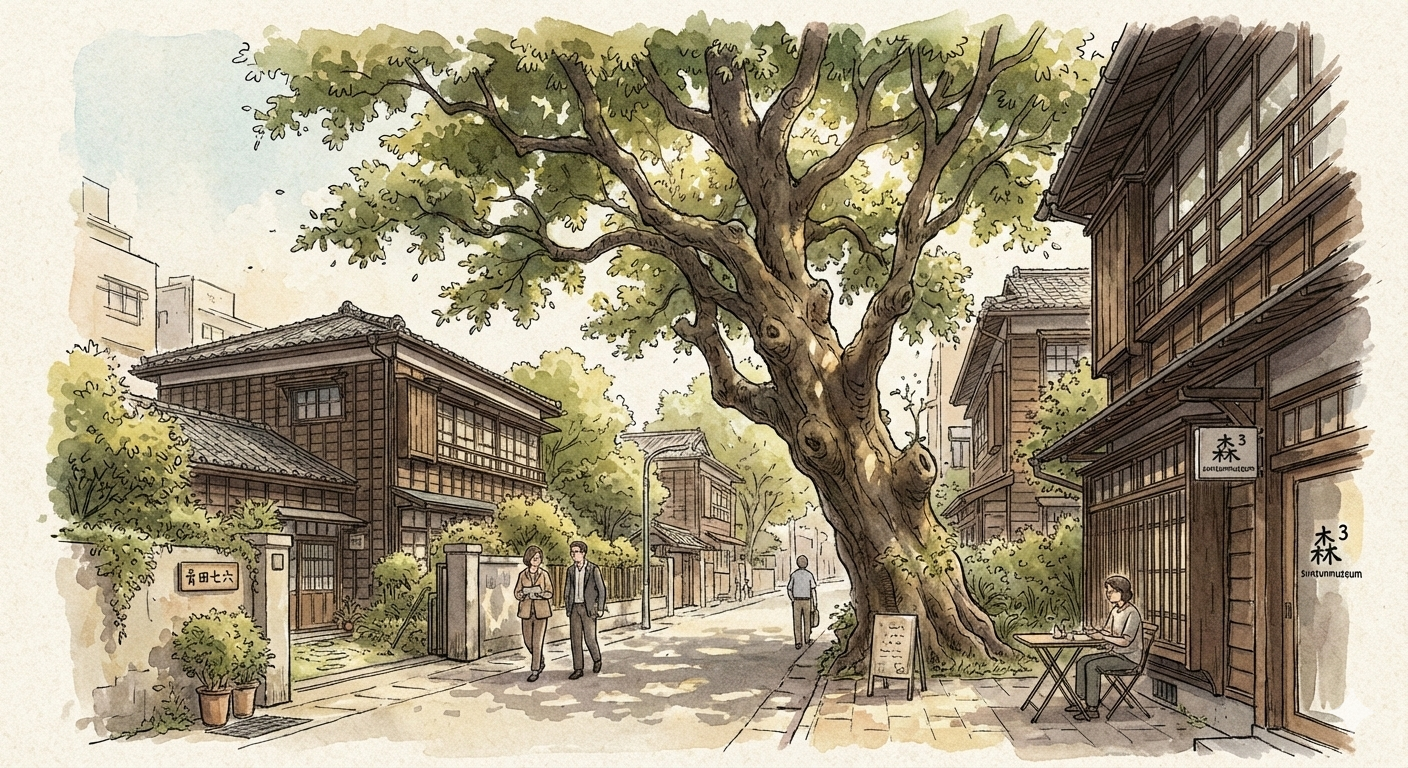
It was during the Japanese colonial era that Daan was codified as Taipei’s intellectual heart. The construction of faculty housing for the Taipei Imperial University transformed the landscape into a series of quiet, shaded retreats for the scholarly elite. The scent of camphor is the olfactory ghost of the Showa era, a resinous shield against the humidity of both the climate and the changing political tides.
The faculty residences of Qingtian Street were constructed using high-quality camphor wood, a signifier of intellectual preservation and academic rigor. Sites like Qingtian 76 and the Yin Haiguang Residence represent the "architecture of thought." These gardens provided a buffer against the political storms of the mid-20th century. The residence of Yin Haiguang, a pioneer of liberal thought, stands as a testament to the intellectual rebellion sheltered within these tranquil spaces—a contrast to the authoritarian pressures outside their gates. Today, the "curation" of these spaces—epitomized by the "mountain hut" aesthetic of Mori 3 sunsunmuseum—allows modern residents to consume "intellectual capital." Visiting these sites is an act of participating in a curated intellectual atmosphere, where the "Showa-era jazz kissa" style becomes a sanctuary for the modern urban thinker.
While the academic elite found shelter under camphor trees, a grittier reality of post-war migration began to reshape the social fabric of the district nearby.
The Edible Map of Migration: Taste Buds of the Resilient
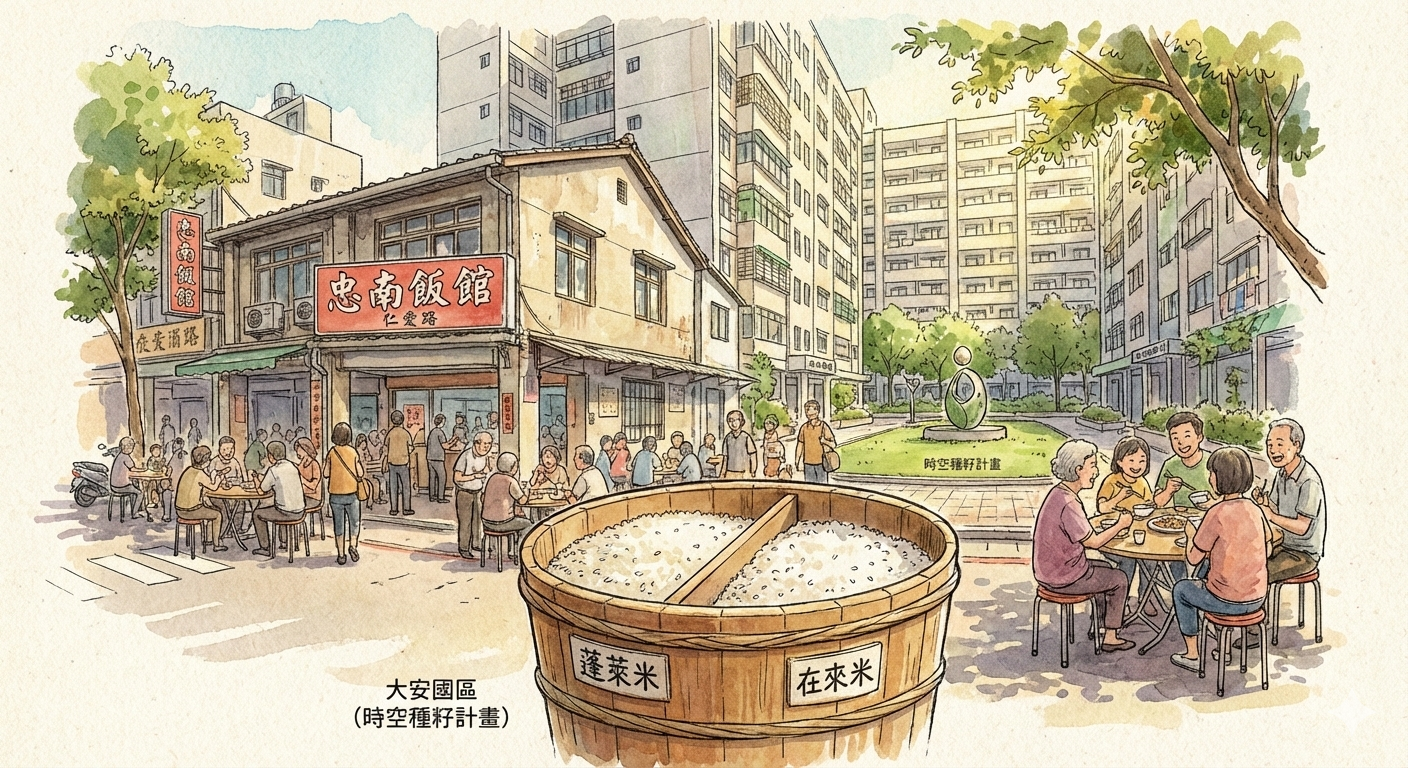
The post-war era introduced "Military Dependents’ Villages" (眷村), such as Success Village (Chenggong), into the Daan landscape. Initially intended as temporary spatial solutions for displaced military families, these villages became permanent cultural anchors. Success Village was eventually demolished and replaced by the modern Success Public Housing in 1985, a transition from low-slung shanties to high-rise blocks that represents a radical shift in urban geometry.
To bridge this gap, the Seed of Time art project in the housing complex’s courtyard uses sensory triggers to reconnect visitors with the vanished village landscape. However, the most resilient map of this displaced community is found in its flavors. Zhongnan Restaurant stands as a bastion of migrant memory, serving a daily act of preservation through its choice of grains.
Rice Type | Historical Context | Significance in Daan |
Ponlai Rice | Represented the modernization of Taiwanese agriculture. | The standard "tasty" rice of the urban consumer; a symbol of agricultural progress. |
Chailai Rice | The traditional, fluffier grain favored by older generations. | A symbol of the migrant’s simple, rugged past; the flavor of survival. |
Flavor functions as the public memory of a displaced community. When the physical village is erased by development, the heavy, savory profiles of Zhongnan’s lion’s head meatballs become the only remaining link to a lost home. From these intimate, private memories, we move to the grandest and most contested public space in the district: the city’s green lungs.
The Political Lungs: The Conflict of Daan Forest Park
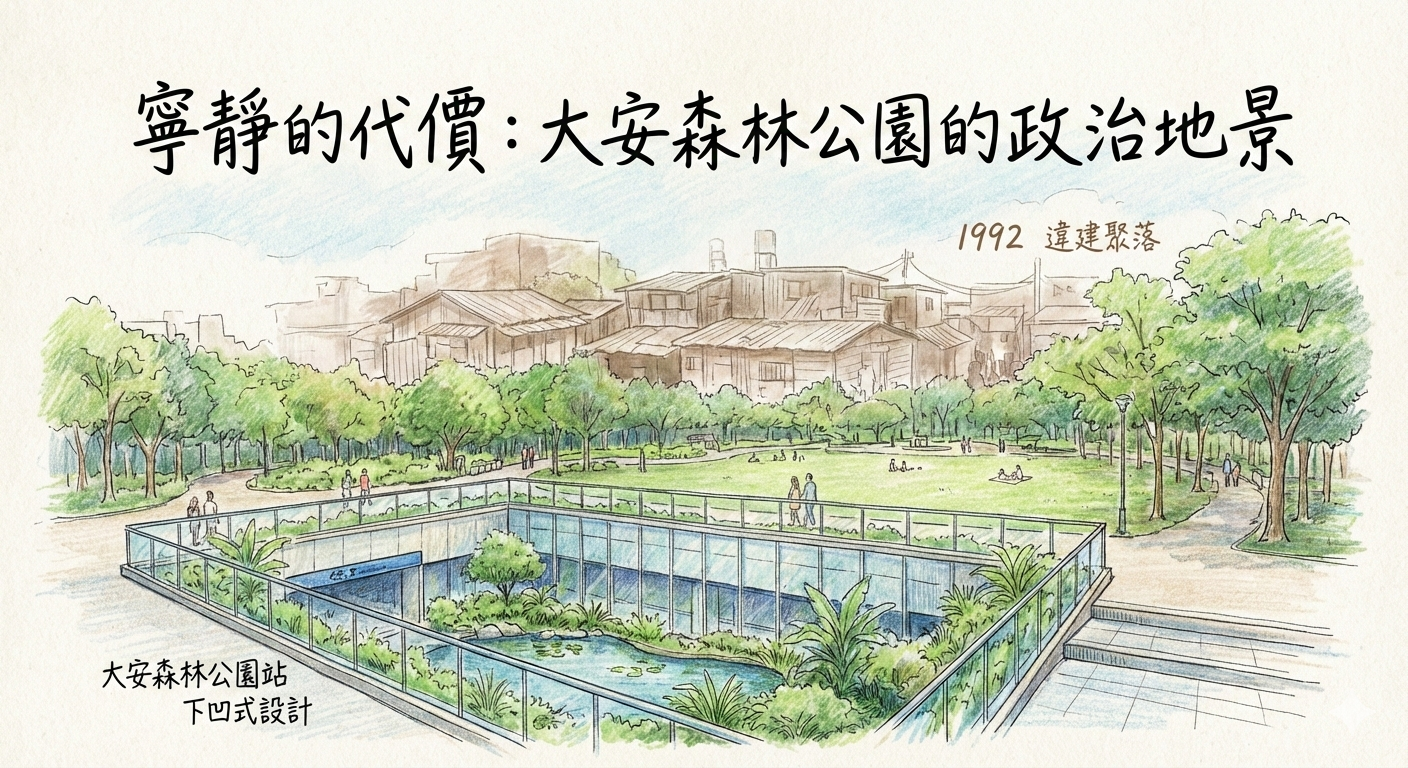
Daan Forest Park is often viewed as a natural oasis, but it is a "political landscape" born of struggle. Its creation was the result of intense social engineering and "spatial purification." The serenity enjoyed by park-goers today was purchased at the social cost of displacing an entire community of low-income residents who occupied the unauthorized dwellings on this site.
The project was confirmed in 1989, but the "quiet violence" of modernity reached its peak on April 1, 1992, when the city government initiated the massive demolition of the existing settlements. The creation of "Taipei’s Lungs" was an act of clearing away the grit to make room for a manufactured nature. The Daan Forest Park MRT station, opened in 2013, serves as a technological response to this historical conflict. Its sunken garden and eco-pool attempt to heal the surface-level trauma of the site’s history through high-quality public architecture. Understanding Daan requires acknowledging this social cost; the park is a masterpiece of urban planning, but it is also a site where the collective need for nature overrode the individual right to housing.
The grand political movements that created the park eventually gave way to the youth-led social movements of the nearby university district, which in turn birthed the neighborhood’s modern coffee culture.
The Intellectual Pulse: From Street Protest to Coffee Shop
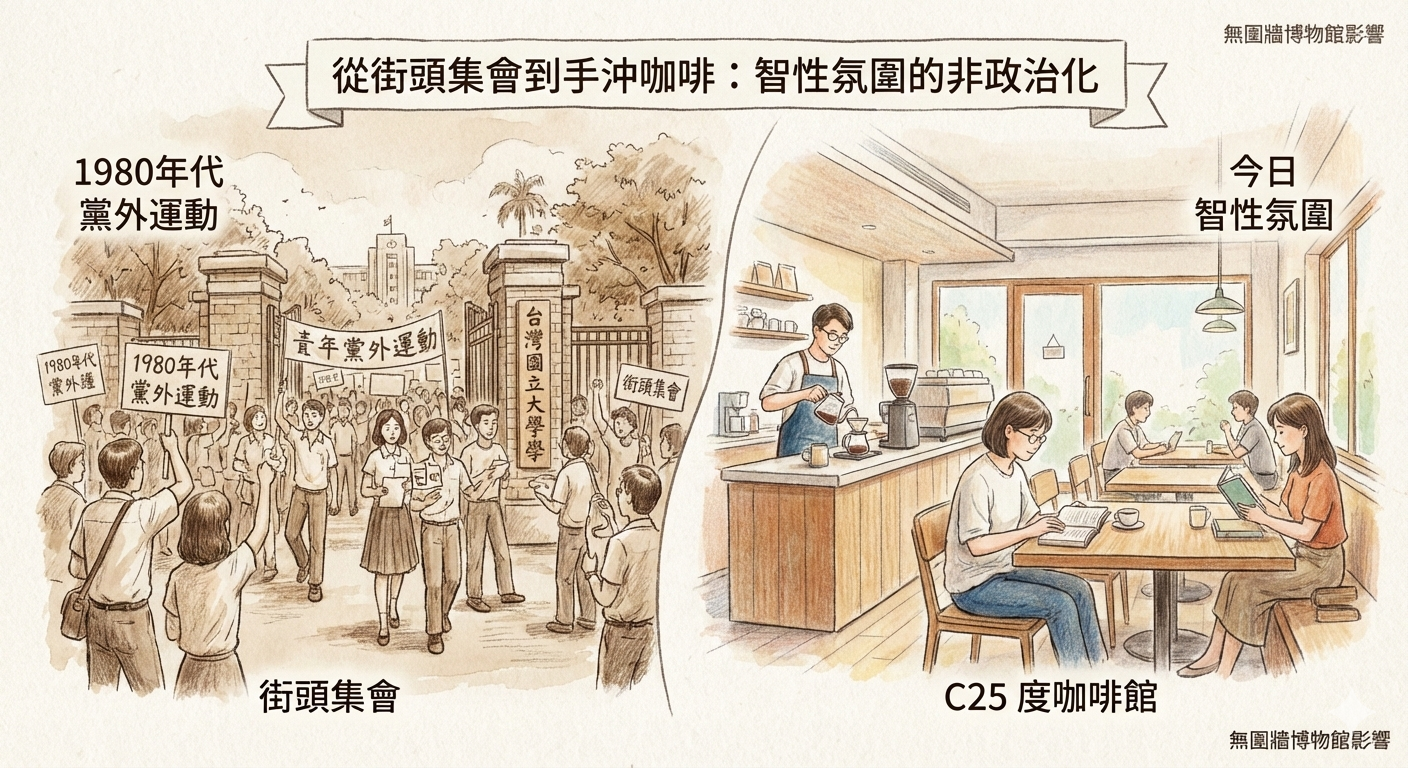
The final layer of Daan is its youthful energy, which has evolved from the 1980s street movements at the National Taiwan University (NTU) gate to the "curated individualism" of today’s specialty coffee scene.
The NTU gate, built in 1931, was once the center of political assembly and democratic protest. Today, its transformation into a "scenic photo spot" represents the "aestheticization of rebellion"—where a site of historical conflict becomes a backdrop for digital memory. Intellectual activity has since migrated from the streets into the "Third Space" of independent bookstores and cafes like C25. These venues serve as curated stages for a new kind of intellectual life—one that is personal, aestheticized, and deeply tied to the quality of a hand-brewed cup. This shift from street protest to specialty coffee reflects a broader transition from collective political struggle to the pursuit of private intellectual taste. In Daan, knowledge is no longer just fought for; it is curated and consumed.
The Palimpsest of Daan
The beauty of Daan does not lie in its individual landmarks, but in the "layered observation" required to see them all at once. It is a district where a design-forward cafe sits atop a hidden Qing dynasty watercourse, and where a tranquil park masks a history of forced relocation. As you walk these streets, you are not merely moving through space, but through time, navigating a city that constantly rewrites itself without ever truly erasing what came before.
Which "layer" of your own neighborhood remains hidden beneath the asphalt of your daily routine? To uncover these stories is to truly inhabit the city.
For more explorations of the world’s hidden urban layers, subscribe to the Lawrence Travel Stories newsletter.
Practical Footnotes
How to Arrive
- MRT Xinyi Line (Red): Use Daan Forest Park Station for exploring Layer 4 and the sunken garden.
- MRT Bannan Line (Blue): Use Zhongxiao Dunhua Station for Layer 3 (Zhongnan Restaurant) and Layer 5 (C25 Cafe).
The "Sensory Archaeology" Walking Route
- Wenzhou Street Alleys: Seek out the irregular paths and the AGCT apartment to witness the "Memory of Water."
- Qingtian 76 & Yin Haiguang Residence: Experience the "Camphor Sanctuaries" and the architecture of intellectual resistance.
- Success Public Housing & Zhongnan Restaurant: Explore the "Edible Map" of migration and the Seed of Time project.
Nearby Recommended Tours
- Non-Walled Museum Explorations: Deep dives into the university faculty housing architecture and the "urban geography" of the Daan district.
- Historical Walking Tours: Focused on the democratic movements surrounding the NTU Gate and the environmental politics of the "Green Heart."
Reference:
- EP.028 層疊顯影:從水鄉澤國到時尚伸展台- 臺北大安區的風味與歷史密碼 - YouTube, accessed on November 21, 2025
- 台北公館下午茶推薦*AGCT apartment~設計風咖啡館,窗邊風景優美!近台大溫州街, accessed on November 21, 2025
- 甦醒的夢想眷村!造訪2020台北地景藝術「朝霧記」,打造治癒 ..., accessed on November 21, 2025
- 隱身日常巷弄山林系咖啡館!森³山屋風質感展覽空間 - 奇摩新聞, accessed on November 21, 2025
- 忠南飯館.台北大安區美食|滿載老台北人一甲子回憶!仁愛路NO.1懷舊平價眷村菜!招牌泡菜炒牛肉太好吃!內用兩種白飯吃到飽!捷運忠孝復興站~中肯‧食記! - 包子爸の食尚攝影手札, accessed on November 21, 2025
- 大安森林公園, accessed on November 21, 2025
- 【台北】台灣大學校園景點&公館商圈美食餐廳,親子出遊造訪第一學府 - 波比看世界, accessed on November 21, 2025
- 【赤峰街-島內散步】如果在午後,一個文青:跨越時空的赤峰街|漫步在台北閱讀歷史、品嚐無圍牆之美|臺北晶華酒店、島內散步、IG熱門打卡景點2020 – 皮皮爬爬GO, accessed on November 21, 2025
- 【台北忠孝敦化站美食】南村私廚小酒棧2025:林青霞、張清芳都上門,新派創意眷村風味餐廳,連年米其林入選,融合中菜與台菜,獨樹一幟的創意料理6948 @貓大爺, accessed on November 21, 2025
 Lawrence
 Lawrence