Hong Kong, 2016: The Year Every Dragon Vein Lit at Once
In 2026, a nostalgia movement looks back at 2016. For Hong Kong, that year wasn't merely an aesthetic — it was the moment every spatial layer of the city reached threshold simultaneously. Five stories. One burning year.
"2026 is the New 2016" Series · Volume II
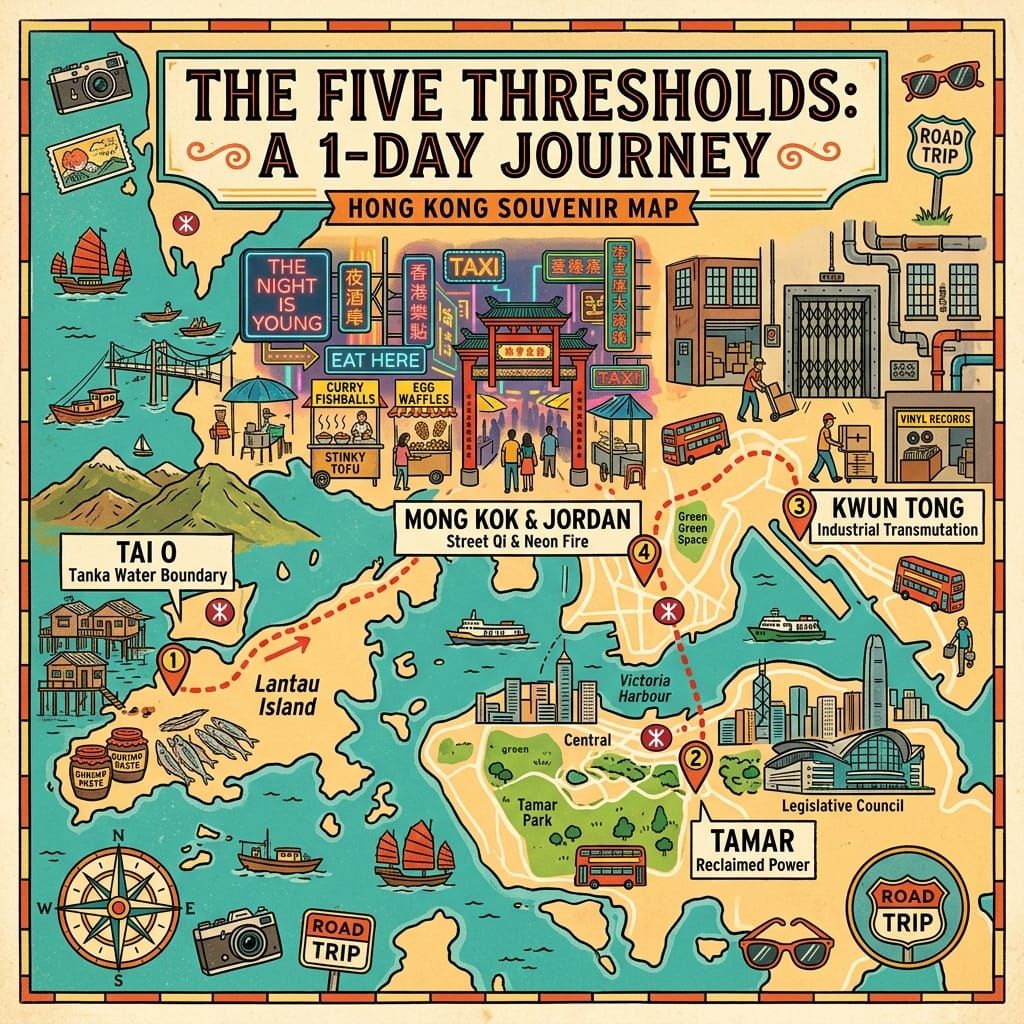
This is a deep historical travel narrative about Hong Kong in 2016, tracing five defining events — the Fishball Revolution in Mong Kok, the underground music scene in Kwun Tong's industrial buildings, the Legislative Council oath-taking crisis at Tamar, the Tanka stilt-house community at Tai O, and the extinction of Hong Kong's hand-crafted neon signs — through the lens of Cantonese folk cosmology and the city's living feng shui tradition. It is less a checklist of destinations than a map of a city in the act of becoming fully aware of itself. Whether you are planning a visit or trying to understand what makes 2016 Hong Kong such a charged object of retrospective longing, this article offers a different kind of guide: one that reads the streets the way the streets were always meant to be read.
The Year That Became a Frequency
Sometime in late 2025, a peculiar form of nostalgia began circulating across social media platforms. Users started sharing artefacts of 2016 — the fashion, the music, the internet aesthetics — captioned "2026 is the new 2016." The phenomenon spread quickly across languages and regions. On its surface it resembled the decade-cycling nostalgias that digital culture has made familiar: the way 2000s fashion keeps returning as the Y2K aesthetic, the way the 1990s have never quite stopped being recirculated. But for Hong Kong, the movement carried a different weight — one that exceeded the aesthetics of a particular moment and reached toward something that fashion cycles cannot explain.
The 2016 that Hong Kong is remembering was not a year of innocence. It was the year that street food vendors were cleared from Mong Kok on Chinese New Year's eve, and the city's streets burned for a night. The year a cultural venue in a disused factory kept being evicted and kept returning. The year two newly elected legislators took their oaths while holding a banner that read HONG KONG IS NOT CHINA, and Beijing intervened in the territory's legal proceedings within thirty-five days. The year the last generation of hand-blown neon sign craftsmen passed definitively beyond replacement, their knowledge ceasing to exist in the most total sense available.
To understand why 2016 lodges in the memory the way it does — why it registers not merely as a political moment but as something more spatial, more physical, more fundamental — you need to read it through the city's own cosmological framework. Through feng shui (風水). Not feng shui as it appears in airport bookshops; not a system of interior arrangement or auspicious ornament. But feng shui as Hong Kong actually practices it: as a living theory of how energy (氣) moves through mountains and water and the spaces human beings build between them — a theory that has quietly shaped the orientation of Hong Kong's oldest temples, influenced the design of its most significant corporate towers, and continues to animate the spiritual life of every street corner in the city.
The Dragon's City: A Note on Hong Kong's Spatial Cosmology
Before we enter 2016, a brief account of the invisible geography.
In the classical vocabulary of Cantonese geomancy (堪輿), Hong Kong is configured as a near-perfect example of the armchair position (四靈格局): mountains at its back, water before it, the Kowloon Range and Hong Kong Island's peaks forming the dragon's spine, and Victoria Harbour serving as the bright hall (明堂) — the open, light-receiving space in which the mountain's energy pools and concentrates. The city's vitality, in this reading, is not incidental to its geography. It is a product of how earth energy (地氣) descends from the peaks through the urban tissue into the harbour. Lion Rock (獅子山) is not merely a geological landmark: it is, in the fullest sense of the tradition, a sacred mountain — a site that has accumulated the psychic weight and collective aspiration of a city over generations, which is why its silhouette has become the secular icon of Hongkonger identity in a way no other landform has.
This is not a system most visitors bring with them, but it is the system that has been consistently present in the decisions of Hong Kong's builders. The HSBC headquarters on Statue Square was designed with documented feng shui consultation; the Bank of China Tower, when it rose in 1990, generated a territorial controversy across the neighbourhood when its triangular glass faces were interpreted by practitioners as projecting negative energy toward surrounding buildings — a controversy that rippled through the financial and residential communities for years. Every neighbourhood shrine to the Earth God (土地公) that you will see at the foot of stairwells and the corners of markets in Mong Kok, Sham Shui Po, and Sheung Wan is a functional element of this cosmological infrastructure: a locally venerated deity whose spiritual vitality is nourished by the daily commerce and human activity of the block around it. And the more than 150 Tin Hau temples (天后廟) distributed across the territory — honouring the Cantonese sea goddess who protects maritime communities — form one of the densest concentrations of active maritime worship in East Asia.
To walk Hong Kong without knowing this layer is like listening to a symphony while deaf to its bass register. The melody is still audible. But the music makes no sense.
With this spatial cosmology as the interpretive frame, 2016 in Hong Kong begins to look less like a political crisis and more like a cosmological event: the simultaneous activation, across five distinct spatial registers, of a city's accumulated tensions. What follows are the five thresholds.
Listen to the historical stories told in detail (For subscribers only)
I. Mong Kok: When the Earth Gods Fired Back
The Grounded History
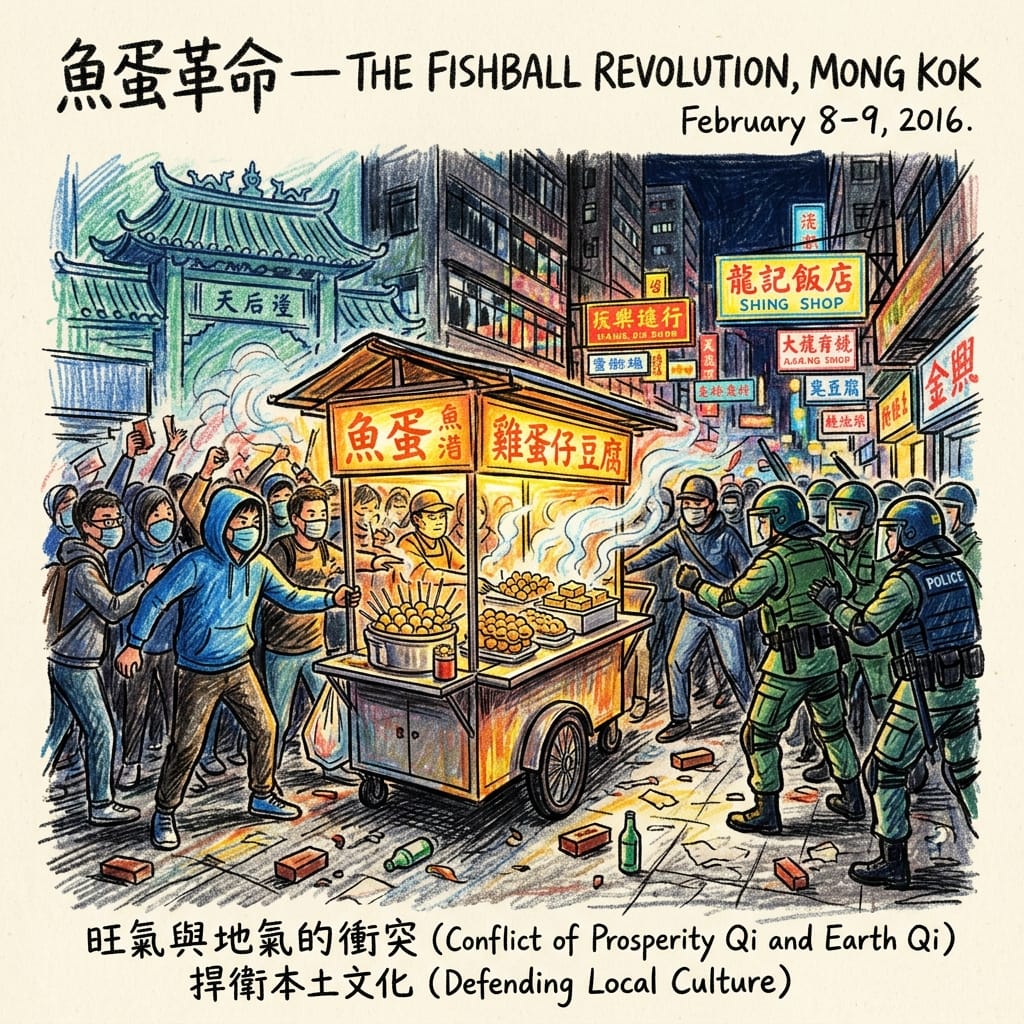
The night of February 8, 2016 was Chinese New Year's eve: the Year of the Monkey beginning in the old way, with the specific charged stillness of a city balanced at the edge of festivity.
In Mong Kok (旺角), the festivity had a specific geography. Every year on this night, unlicensed street food vendors set up in the blocks around Sai Yeung Choi Street South and Portland Street: fishball carts, stinky tofu fryers, egg waffle griddles operating in the deliberately maintained grey zone that the city had always found a way to sustain. The Food and Environmental Hygiene Department knew. The police knew. The city knew. This was not disorder. It was a form of collective local ordinance, the pragmatic Cantonese genius for negotiating between the letter of the rule and the life of the street — negotiating it year after year, across generations, until the negotiation itself became the tradition.
On February 8, 2016, the FEHD decided to enforce.
What followed lasted through the night. Localist groups who had come to defend the hawkers, police attempting crowd control, and eventually — for the first time since the 1980s — warning shots fired into the Hong Kong night sky. Bottles and bricks. More than 130 arrests, more than 90 injuries reported across both sides. By dawn, the streets of Mong Kok were littered with the debris of what commentators would immediately name the Fishball Revolution (魚蛋革命): a name that sounds almost comic until you understand what the fishball was standing for. Edward Leung Tin-kei (梁天琦), one of the most publicly visible faces of the localist movement present that night, was later sentenced to six years' imprisonment on riot charges. The pot of fishball broth that was never finished became the symbol of an era.
The fishball was standing for the right of a street to be alive.
The Hidden Magic Of The Fishball Revolution
The Feng Shui Reading
旺角 — Mong Kok — translates, with satisfying literalness, as Prosperous Corner. In Cantonese geomantic theory, wòng (旺) denotes a specific energetic condition: the state in which a site's inherent earth qi has reached full circulation — active, generating, and sustaining the dense human vitality that makes a commercial district a commercial district rather than merely a collection of buildings. By most feng shui analyses, Mong Kok is the highest-density commercial qi node in Kowloon, a confluence of arterial streets at a point on the dragon vein (龍脈) that descends from the Kowloon peaks southward toward the harbour.
Temple Street (廟街) takes its name from the Tin Hau temple at its northern end. This is not an accident of urban nomenclature. In Cantonese commercial-sacred spatial logic, the sea goddess anchors the northern terminus of the market corridor, providing protective spiritual coverage for the commerce that extends from it. The hawkers and the temple are not adjacent by coincidence: they are functionally integrated elements of the same spatial organism — the commerce is the temple's economic body, the temple is the commerce's spiritual ground.
In the folk religious practice of the street, each city block is inhabited by its own Earth God (土地公), whose spiritual vitality is nourished by the daily rhythms of activity on that block. A cleared street is a weakened Earth God. An administrative clearance operation conducted on Chinese New Year's eve — the night of maximum prosperous qi (旺氣), when the year's commercial energy completes its annual renewal — is, in these terms, more than an enforcement action. It is a structural interruption of the energetic metabolism that keeps the spiritual ecology of the district viable.
Whether or not this framework explains why the city burned that night, it explains why the burning felt, to those who were there, like something larger than a dispute about vendor permits. Some eruptions of collective energy resist purely political explanation. They make more sense as spatial ones.
Holographic Sensory Cue: The intersection of Portland Street and Sai Yeung Choi Street South, Mong Kok, 2:00 a.m., Chinese New Year. The air is wet with the specific Hong Kong humidity that concentrates all smells simultaneously: fishball broth warm and savoury from the brass pots, fermented tofu in oil rendered many times over, the slight sweetness of egg waffle batter on cast iron. The ground is worn grey Hong Kong pavement, damp, reflecting the orange-white light of shop fluorescents at a low angle. After the warning shots: two seconds of absolute silence across approximately two hundred people. Then broken glass, then footsteps resuming, then the sound of the crowd reforming.
II. Kwun Tong: The Metal Transmutation, Interrupted
The Grounded History
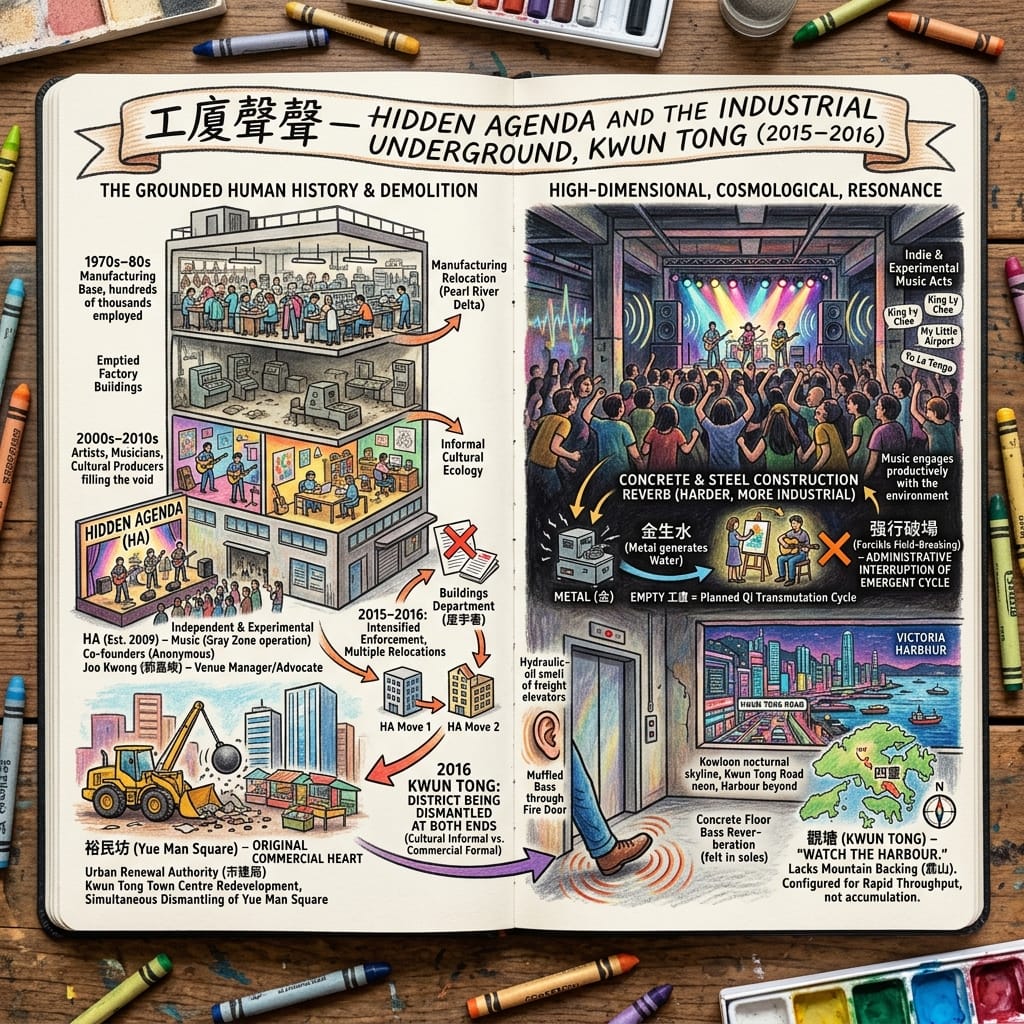
Kwun Tong (觀塘) — the name translates as Watch the Harbour — was built on reclaimed land in the 1950s as Hong Kong's first planned industrial town. At its peak in the 1970s and 80s, its multi-storey factory buildings (工廈) housed textile mills, electronics assemblers, and the light manufacturing operations that made Hong Kong one of the world's great export economies. Then manufacturing migrated to the Pearl River Delta, and the buildings emptied.
Into that emptiness, beginning in the early 2000s, came a generation that could not afford the rents of the commercial districts: artists, musicians, craftspeople, independent designers. The most significant institution of this informal cultural economy was Hidden Agenda — HA — an independent music venue operating from a succession of industrial-building tenancies across Kwun Tong, hosting local acts including King Ly Chee, My Little Airport, and Serrini alongside international touring bands — Yo La Tengo, Swans, Lightning Bolt — who would otherwise have had no viable Hong Kong venue. HA occupied the grey zone between industrial use classification and public entertainment licensing: technically illegal in precisely the same way that the Chinese New Year hawkers were technically illegal, by a negotiated tolerance that both sides understood to be reasonable.
By 2015 and 2016, the Buildings Department's enforcement actions against industrial-building cultural spaces were intensifying. HA relocated multiple times. Each relocation was documented in real time by the community that followed it with the fidelity of a congregation tracking its displaced church. Simultaneously, the Urban Renewal Authority's Kwun Tong Town Centre project was dismantling Yue Man Square (裕民坊), the district's original 1960s commercial heart — the open market where working-class Kwun Tong had conducted its daily commerce for three generations. The district in 2016 was being taken apart from both ends at once: its cultural present disappearing from the factory floors upward, its commercial past being demolished at street level below.
Silencing Hong Kong's Industrial Underground
The Feng Shui Reading
In the Five Elements cosmological framework (五行) that underlies Cantonese geomancy, industrial manufacturing is classified as a Metal (金) activity: structured, reductive, organised around the systematic transformation of raw material into finished product through disciplined process. Kwun Tong's factory buildings — vertical, rectangular, designed to maximise functional volume — embody Metal-element spatial aesthetics in their most literal architectural form. The district's industrial period was the complete, coherent expression of Metal qi in this particular landscape.
Five Elements theory contains a generative sequence, one of the tradition's most elegant observations: Metal generates Water (金生水). When a Metal-dominant space is emptied of its Metal function, it becomes available to generate Water-type activities — fluid, improvisational, resistant to formal definition. Artist studios, music venues, independent cultural spaces are Water activities. They flow into available voids, take the shape of their containers, and resist categorisation by the institutional vocabularies designed for Metal activities. The cultural colonisation of Kwun Tong's empty factories was, in Five Elements terms, the natural completion of a geomantic cycle: Metal transmuting into Water, industrial energy becoming creative energy. The cycle is elegant. It takes time. It requires the space and tolerance to reach its conclusion.
The Buildings Department enforcement — cutting the cycle short before the transmutation could complete — created what practitioners might call a forced field-break (強行破場): an administrative intervention interrupting a natural energetic transformation at its most vulnerable midpoint, leaving the district suspended between its industrial past and any possible cultural future. The suspension is still visible in Kwun Tong. The factory buildings still stand. The cultural tenants are largely gone. The cycle was never allowed to finish.
Holographic Sensory Cue: A freight elevator in a Kwun Tong industrial building, ascending toward an upper floor where something is playing. The smell: hydraulic oil, metal cable, old cleaning fluid. The elevator's slight mechanical hesitation at irregular intervals, registering in the body as a weight shift rather than a sound. Then the doors open onto a corridor. Initially only the sub-bass reaches you, muffled through a fire door, the specific frequency that travels through concrete rather than air. Then the outline of a bass line. Then the kick drum's impact. Then the fire door is pushed open and every frequency arrives simultaneously. The concrete floor resonates differently than the air above it. You feel it through your soles before you hear it through your ears.
**Resonance Node: The upper-floor corridor windows in the industrial buildings between Lai Yip Street and Hung To Road, Kwun Tong, at night. Looking out from an upper storey across the harbour toward the Hong Kong Island ridgeline, you stand at the precise intersection of three eras of the same district: the sight lines of the 1970s factory worker looking up from the production floor during a break; the geography of the 2016 music community, arriving by industrial freight lift to find something alive in the emptied Metal frames; and the post-renewal present, where neither industrial function nor cultural tenancy fully occupies the space. The view from these windows has not substantially changed across all three. What has changed is what was being made in the building around the window, and what was being heard through its walls. Stand here long enough, in sufficient quiet, and the sense of all three eras simultaneously inhabiting the same structure becomes something close to palpable — the way a chord is present in all its notes at once, even when the ear focuses on only one.
III. Tamar: The Oath Taken on Ungrounded Earth
The Grounded History
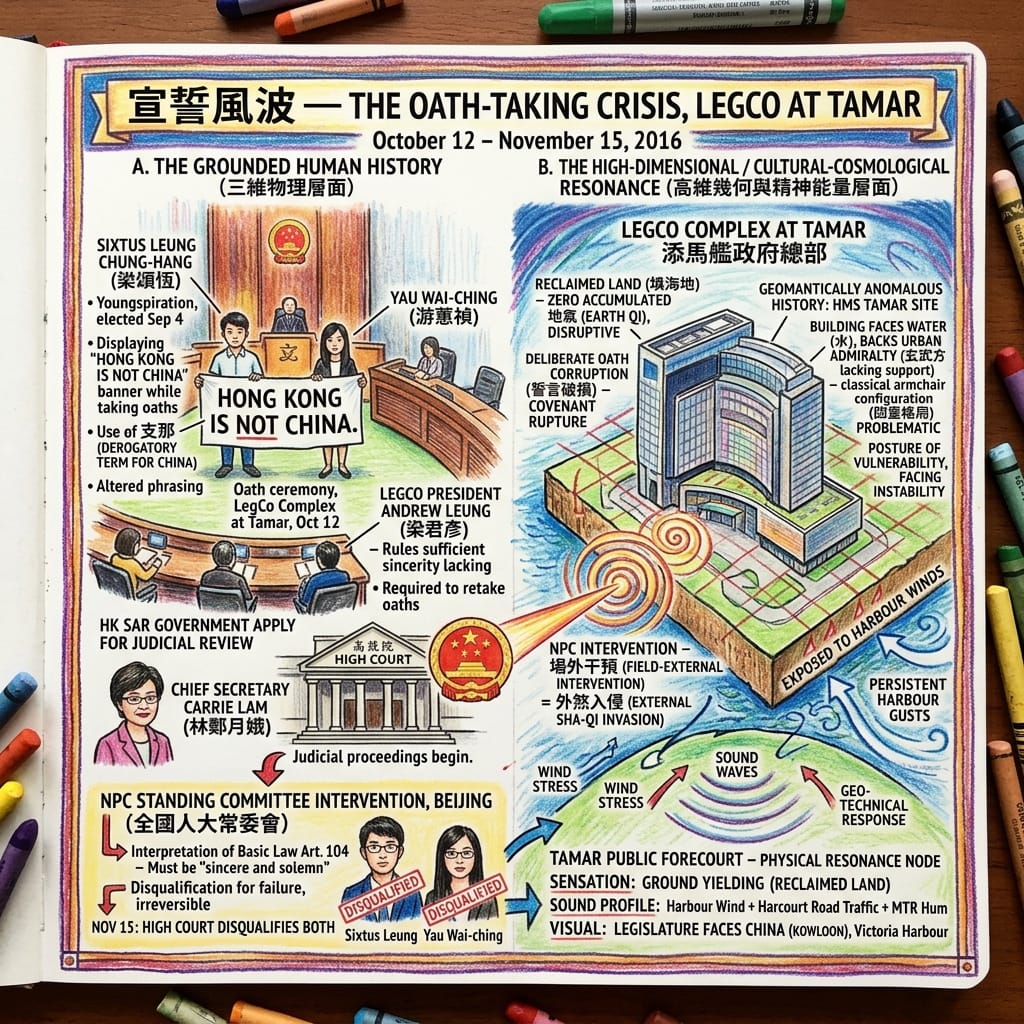
On September 4, 2016, Hong Kong's Legislative Council elections returned an unprecedented result: the localist and self-determination camp won six seats, placing candidates who articulated various positions on Hong Kong's constitutional future — from significantly expanded autonomy to formal independence — inside the legislature for the first time in the territory's post-handover history. Among them were Sixtus "Baggio" Leung Chung-hang (梁頌恆) and Yau Wai-ching (游蕙禎) of Youngspiration (青年新政), representing the New Territories East constituency.
On October 12, at the inaugural session of the sixth LegCo, Leung and Yau took their oaths while displaying banners reading HONG KONG IS NOT CHINA. Both used the term Zhīnà (支那) — a historically charged word for China — in place of the standard Chinese in the Cantonese portion of their oaths, and both altered the pace and phrasing of the oath in ways the LegCo President subsequently ruled constituted insufficient sincerity. They were required to retake the oath.
What followed happened at a speed that Hong Kong's legal culture had never previously experienced. Before either legislator could approach the podium again, the city government applied for judicial review. On November 7 — before Hong Kong's own courts had reached their conclusion — the Standing Committee of the National People's Congress in Beijing issued an interpretation of Article 104 of the Basic Law, specifying that oath-takers who fail to swear sincerely and solemnly are permanently and immediately disqualified. On November 15, the Hong Kong High Court ruled accordingly. Thirty-five days from oath to disqualification. A threshold had been crossed. The speed was part of what crossed it.
The Oath That Broke Hong Kong
The Feng Shui Reading
The LegCo Complex sits on Tamar (添馬), the site of the former Royal Navy shore base HMS Tamar on the northern shore of Hong Kong Island. The critical fact about this land is that it is reclaimed (填海地): seabed built up to ground level by deliberate landfill, creating a platform of young, engineered earth above the harbour floor.
Classical Cantonese geomancy assigns reclaimed land a specific geomantic liability: the absence of accumulated earth qi (地氣). Natural land gathers earth qi over geological time — layers of ancestral inhabitation, historical event, biological activity — giving it the spiritual density that practitioners associate with permanence and legitimate authority. Reclaimed land begins from nothing. There is no accumulation to draw upon. The tradition calls this condition gēn jī xū fú (根基虛浮): floating without roots. To place the principal seat of post-handover government — the Executive compound and the Legislative chamber — on reclaimed land is, in the geomantic vocabulary, a structural statement about the nature of that authority: constructed, recent, without the gravitational weight of accumulated spiritual tenure.
The site's spatial configuration is equally problematic in the armchair analysis. The ideal political building position requires mountain support at the rear (玄武方). The Tamar buildings face Victoria Harbour — the water-before condition is satisfied — but their rearward support is the dense office towers of Admiralty, not a mountain. The famous "always open" design of the government complex, its glass facades projecting civic transparency, reads in the feng shui vocabulary as wú kào zhī jú (無靠之局): a site without backing, exposed to its own instability, facing outward toward what it cannot control.
The oath-taking ceremony, meanwhile, draws on a deeper stratum of Cantonese ritual. In the folk religious practice of the city, an oath is not merely a legal speech act; it is a three-party covenant between the oath-taker, the community they are sworn to serve, and the witnessing spiritual field of the territory. A deliberately corrupted oath —岔曲的誓言 — creates what practitioners call covenant damage (誓言破損): a rupture not merely in legal validity but in the spiritual bond between office and officeholder, between the person and the land they are pledging to govern. And the NPC intervention — an external legal force overriding Hong Kong's domestic procedure before that procedure could reach its own resolution — maps, in spatial cosmological terms, onto the concept of external field intrusion (場外干預): an energy from beyond the territorial boundary redefining the internal rules of the space without the consent of the space itself.
These are not political metaphors dressed in spiritual language. They are spatial observations, calibrated to the specific geography of Tamar and to the specific ritual tradition of Cantonese oath-making. The two analytical languages say, in different vocabularies, the same thing.
Holographic Sensory Cue: The public forecourt of the Tamar government complex, facing Victoria Harbour, any working weekday. Even on days of general stillness elsewhere in the city, a persistent horizontal wind moves here from the water's direction — salt-tinged, continuous, crossing the glass facades at low speed. Underfoot: the specific quality of engineered reclaimed land, flat and precise, yielding fractionally under weight in a way that distinguishes it from the resistance of natural bedrock. It is the sensation of being held up by something that is making an effort to hold you, rather than something that simply is. Across the harbour, the Kowloon skyline is visible with unusual clarity. Behind the building: the sound of Harcourt Road traffic, but not its sight.
IV. Tai O: The Last Tanka at the Water's Threshold
The Grounded History
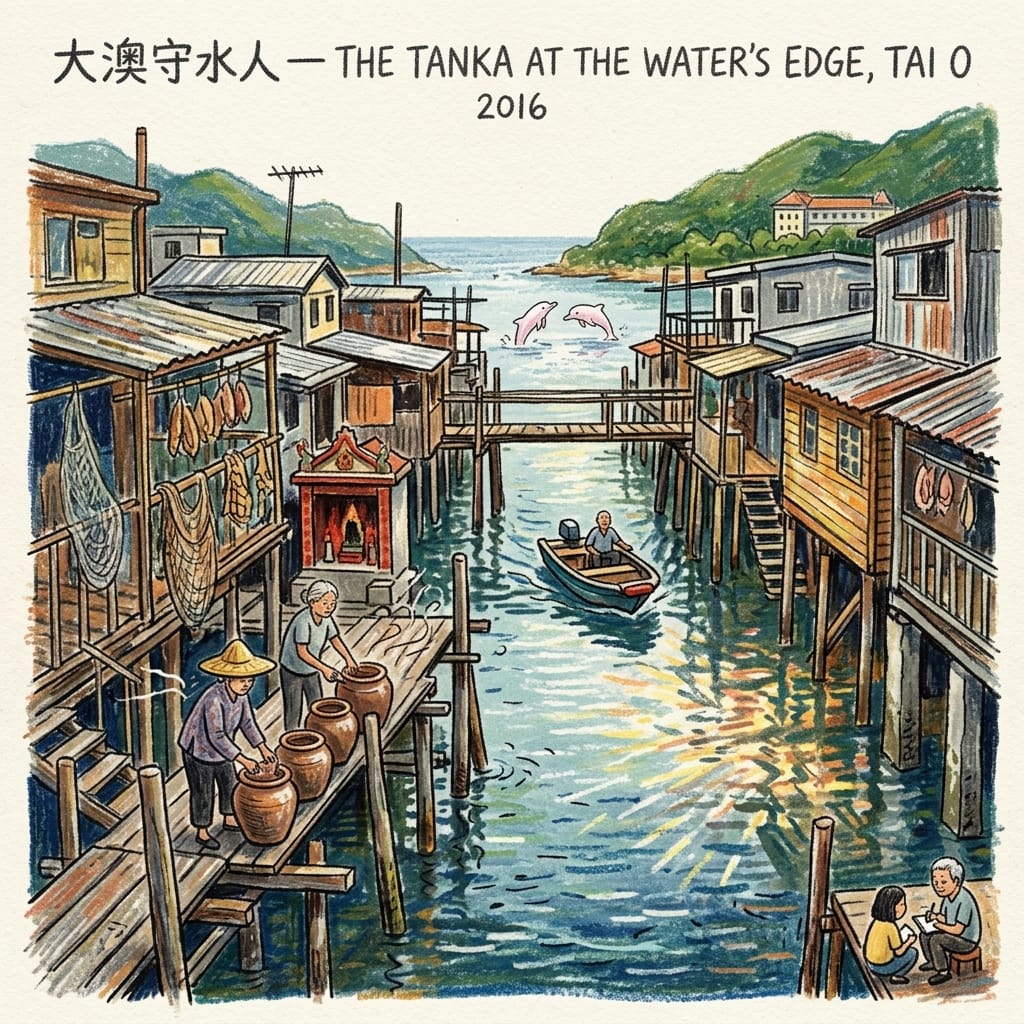
At the western extremity of Lantau Island, where the Pearl River's freshwater outflow meets the saline push of the South China Sea, Tai O (大澳) sits at one of the most geographically liminal points in Hong Kong's territory: a tidal estuary, a fishing village, and the last surviving stilt-house community of any significant scale in East Asia.
The Tanka (蜑家) people who built these structures did not begin by living on land. They lived on boats — for centuries, in some accounts for millennia — moving across the waters of the Pearl River Delta and the South China Sea in a maritime civilisation that has left almost no written record because it had no use for writing. When they began the slow transition toward fixed dwelling, they built a spatial solution that reflected their ontological position: the stilt house (棚屋), raised on wooden piles above the tidal zone, neither fully on land nor fully in water, approached by narrow catwalks over the current below. Not a compromise. A position. A community's refusal to accept the binary of earth or sea as the only two options available to a human being.
A fire in June 2000 destroyed more than ninety stilt houses. The government offered resettlement in concrete public housing on dry land. Many elderly Tanka residents refused. Their refusal was interpreted, in various registers of commentary, as stubbornness, heritage consciousness, attachment to place. In the Tanka understanding, it was something more fundamental than any of these: an ontological refusal. To move permanently to land was not a change of address. It was a change of what you were.
By 2016, the permanent Tanka community at Tai O was deeply aged. Universities and NGOs were racing to conduct oral history recordings with the generation who still remembered being born on water — who carried in their bodies the navigational literacy of the estuary, the meteorological knowledge of people who had read weather through the movement of birds and current rather than through instruments. These recordings were understood, by those making them, to be a specific kind of archive: not the preservation of a culture but the notation of a culture's passing. The archive as elegy for what cannot be archived.
The People Who Refused Solid Ground
The Tanka Cosmological Reading
Here the analytical framework must shift from mainland Cantonese feng shui to the Tanka's own spatial cosmology — a tradition that is water-primary in its fundamental orientation. Where Punti-Cantonese geomancy reads landscape as a dragon-body descending from mountains into water, treating land as the active, yang principle and water as the receptive destination, the Tanka tradition inverts this priority structure entirely. The sea is the generative field — the source, the site of life and livelihood and spiritual attention. Land is the margin. These are not variant positions within the same cosmological system. They are two different systems that happen to coexist in the same estuary.
The Tanka's principal deity, Tin Hau (天后), the sea goddess whose historical origin lies in the figure of Lin Mo (林默) — a woman from coastal Fujian said to have calmed storms and guided sailors from the spirit world after her death — is not, in the Tanka understanding, a deity one petitions for protection from a position of land-dwelling safety. She is the intelligence of the sea made personal: the spiritual articulation of a world that most of us never enter deeply enough to understand as a world rather than a background condition.
In the vocabulary of classical Cantonese geomancy, Tai O sits at a water mouth (水口): the node at which water exits or enters a geographic unit, where energy concentrates to its maximum density and where wealth and instability coexist in their tightest proximity. The convergence of Pearl River freshwater and South China Sea saltwater creates a yin-yang confluence (陰陽交匯): two energetically distinct water bodies meeting at a dynamic, perpetually shifting interface. Wealth has historically concentrated at water mouths because energy concentrates there. Instability concentrates there for precisely the same reason.
The stilt house is the architectural incarnation of this liminality. It stands on the seabed, its floor above the tidal zone, its roof toward the sky. It is not land. It is not water. It is the space between, constructed to be inhabited. The Tanka people who refused relocation after the 2000 fire were refusing something more specific than we have understood: not modernity, not comfort, not convention. They were refusing to vacate a cosmological position — the guardianship of the threshold between two worlds — that constitutes, in the Tanka understanding, the proper site of human habitation. The stilt house is not a primitive precursor to real architecture. It is the fullest expression of a spatial philosophy that has no equivalent in the land-based traditions around it.
Holographic Sensory Cue: The stilt-house channels of Tai O, mid-afternoon. The water is translucent brownish-green; three or four inches down, the wooden pilings are visible, crusted with barnacles and green algae. The catwalks are narrow enough that two people can only pass each other sideways. Underfoot: irregular wooden boards that sink fractionally with each step and spring back, a rhythm determined by the structure's ongoing conversation with tidal movement rather than by your own pace. The smell is layered — brine, drying shrimp paste aging in open clay urns on the stilt platforms, the occasional diesel exhaust of a passing sampan. At dusk, the channel water goes gold and the undersides of the stilt houses are illuminated from below, the reflection brighter than the original, the world beneath the water more vivid than the world above it.
**Resonance Node: The interior of Yeung Hau Temple (楊侯廟) on the main channel at Tai O. This temple is dedicated to Yang Liang (楊亮節), a loyal official of the Southern Song court who died in 1279 protecting the child emperor as the dynasty collapsed before the Mongol advance — his death occurring somewhere near these same waters. The temple therefore holds two griefs simultaneously and without contradiction: a maritime community's ongoing relationship with a living sea, and the frozen grief of a dynasty's extinction seven centuries ago. The altar wood is darkened by generations of incense smoke; the brass offering vessels are worn smooth by the passage of hands. Standing here, in the specific quality of air that old temples in active use produce — dense with accumulated smoke and accumulated petition — you feel not one historical event but the overlay of all the occasions on which this space has been used to make something unbearable bearable. That density is precisely what the 2016 oral history projects were racing to record before it went silent. It has not gone silent yet.
V. Nathan Road's Fire Dragon: The Great Neon Extinction
The Grounded History
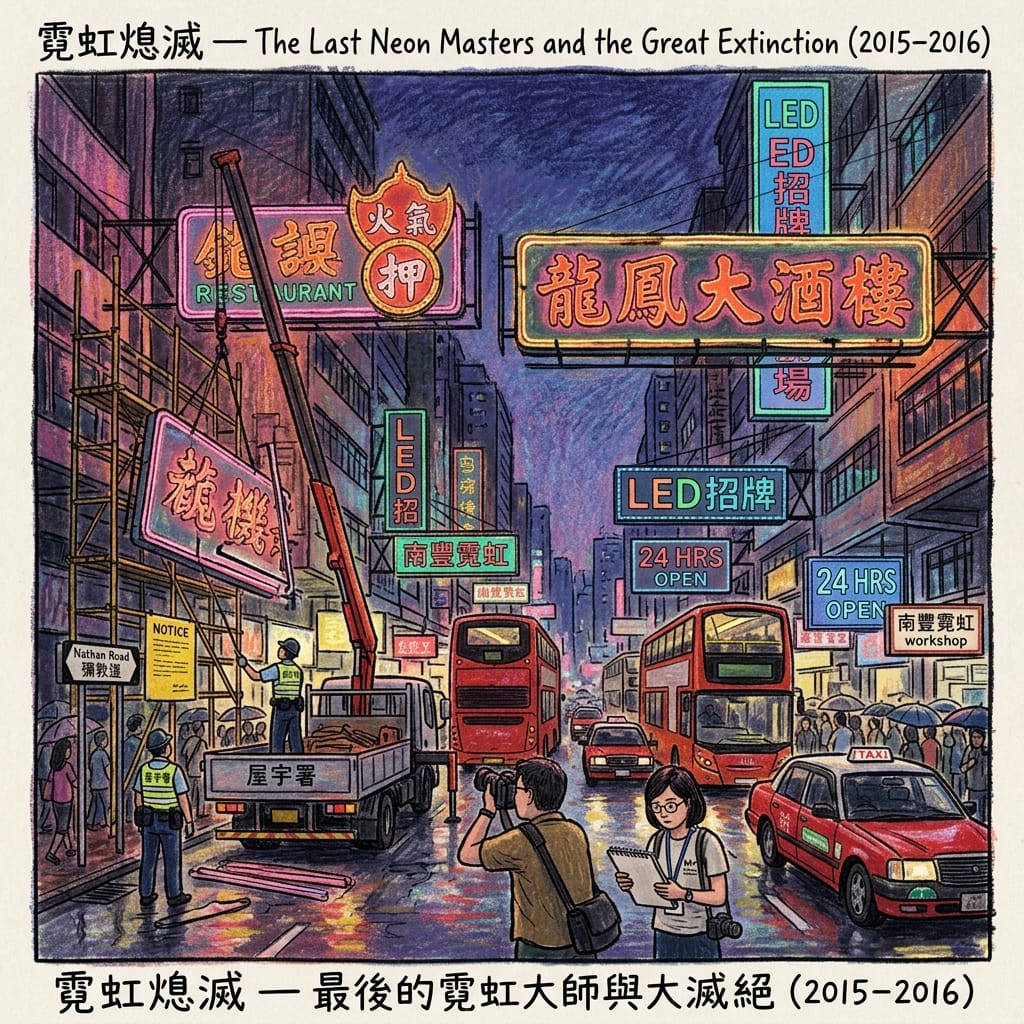
At its peak — running from the 1960s through the 1980s — Hong Kong was the neon capital of the world. The claim is not sentiment. The density of hand-fabricated glass neon signs along Nathan Road (彌敦道), Hennessy Road, Temple Street, and the commercial arteries of Mong Kok and Jordan exceeded, by any measurement, what had ever been assembled in any other city on the planet. And these were not standardised products. Each was custom-made by craftsmen who heated glass tubing over open propane flames, bent the softened glass by hand into Chinese characters and graphic forms of extraordinary complexity, sealed the tubes, evacuated the air, introduced noble gas mixtures — pure neon for the warm pinkish-orange, argon and mercury for the blues and greens — and attached them to transformer systems that produced a light qualitatively unlike any other light source in the built environment. The warm, slightly variable glow of a glass neon tube is not the same phenomenon as the uniform cold emission of an LED panel. They do not occupy the same category.
The Buildings Department's campaign against projecting signs — classified as potentially dangerous structures under the Buildings Ordinance — began in the 1990s and intensified dramatically across the 2010s. By 2015 and 2016, the last major neon concentrations on Nathan Road were being systematically removed. The craftsmen who could fabricate them were in their seventies and eighties; no apprentices were being trained at any of the surviving workshops. At places like Nam Fong Neon (南豐霓虹) in Cheung Sha Wan, the situation was simply one of human time running out: the specific embodied knowledge of how to do this work was approaching its last custodians.
In 2016, the M+ museum began acquiring surviving neon signs as cultural artefacts, recognising that signs removed from buildings would otherwise be destroyed. Photographers and documentary filmmakers undertook systematic recording campaigns. These efforts were important and are important. They are also, as the people conducting them well understood, a form of institutionalised elegy — the archive as the monument we build to what we cannot save.
Extinguishing Hong Kong's Neon Engine
The Feng Shui Reading
In the Five Elements system (五行), light and heat are attributes of Fire (火): expansion, brilliance, visibility, and the activation of commercial and social energy. The dense concentrations of neon signs along Hong Kong's commercial arteries were, in classical Cantonese geomantic analysis, more than decoration. They constituted Fire Dragon corridors (火龍走廊): commercial arteries whose vitality depended on sustained visual and energetic intensity — on the quality of the street as a living, radiating organism rather than an inert passageway.
Nathan Road — the "Golden Mile" of Kowloon — was the territory's primary Fire Dragon corridor, running from Tsim Sha Tsui in the south northward toward Boundary Street, with neon densities at its peak that practitioners would have read as the full activation of the commercial dragon vein (龍脈) running along its axis. In classical Cantonese commercial feng shui, a business's neon sign participated actively in its wealth-attracting (招財) spatial configuration: the colour of the gas, the arrangement of the characters, the intensity and direction of the light were understood as active factors in the energetic metabolism of the commercial space, not its ornamental supplement.
The specific optical quality of glass neon matters to this analysis. Glass neon produces light through the excitation of gas molecules within a physically warm tube: not generated from a cold circuit, but from a process involving heat and pressure and the particular responsiveness of noble gases to electrical current. The glow carries the slight variation and flicker of a living process. It falls in the warm-pink register — Fire's colour range. LED panel light is generated by an entirely different mechanism: a semiconductor process, cold, precise, perfectly uniform from unit to unit. In the Five Elements register, it falls in the Metal (金) range: manufactured precision, uniformity, the quality of the processed and finished rather than the active and organic. The replacement of neon by LED across Hong Kong's commercial districts was therefore, in the geomantic vocabulary, an elemental substitution (元素置換): Fire energy systematically replaced by Metal energy, expansion and organic vitality replaced by precision and standardisation. The fire qi of the commercial dragon veins was being withdrawn, corridor by corridor, sign by sign, removal order by removal order.
The knowledge the last craftsmen held is of a kind that resists archiving. It is not propositional knowledge — this is what you do — but embodied knowledge: this is how the glass feels when it reaches exactly the right temperature; this is the angle of bend for this specific character form; this is the sound the flame makes when the tube wall is about to crack. Video can record the actions; it cannot record the calibration of a hand trained across decades. When the last craftsman is gone, that calibration does not become inaccessible. It ceases to exist.
Holographic Sensory Cue: A working neon sign, close enough to touch, in the night air. The glass tube is warm — not hot enough to burn, but warm in the specific way of a thing that is generating rather than simply conducting: the warmth of the transformer's current and the gas's excitation, sustainable and continuous. The transformer hums at sixty hertz; aging equipment adds a harmonic overtone to the base frequency, not quite noise, not quite tone, something closer to a very slow and very steady exhaled breath. The sign's reflection in rain-wet pavement is diffuse, slightly trembling, with a depth that does not resolve into sharpness as you move closer to it. An LED panel's reflection in the same pavement is precise and depth-less, perfectly resolved at any distance. The neon reflection has interiority. The LED reflection is a surface. The distinction between them is the distinction between a living thing and a high-resolution photograph of the same thing.
Five-Threshold Convergence: The Pattern Conventional History Missed
None of the five stories above, taken alone, is the story of 2016 Hong Kong. Each is a story. What makes 2016 extraordinary — what the "2026 is the new 2016" nostalgia is reaching for, probably without fully knowing what it is reaching for — is the fact that they happened simultaneously.
Cantonese geomantic theory has no established term for the phenomenon. But one can be coined: Five-Threshold Convergence Syndrome (五界臨界同發症). The geomantic condition in which all five of a territory's primary spatial registers — street commerce, industrial transformation, governmental legitimacy, maritime boundary, and commercial luminosity — reach existential threshold simultaneously, producing a brief, intense period in which the city becomes, in every spatial sense, fully visible to itself. The accumulated tensions of the place are simultaneously present and simultaneously active. The city, for a season, is maximally legible.
Hong Kong was always configured as a threshold city: between China and the world, between colony and sovereignty, between mountain and sea, between the Cantonese and the Tanka, between the land-based and the water-based. The dragon vein descending from the Kowloon peaks through the commercial density of Mong Kok into Victoria Harbour is a vector of permanent productive tension — mountain energy perpetually meeting sea energy, neither resolving into the other. For a century and a half, this unresolved tension was the engine of Hong Kong's extraordinary economic and cultural vitality. Threshold cities, in this analysis, are not places of disorder. They are places where the energy that accumulates at every boundary — every meeting of unlike things — is available to be drawn upon.
In 2016, the tension reached simultaneous critical mass across all five registers. The Earth Gods of Mong Kok fired back when their streets were cleared. The Metal-to-Water transmutation of Kwun Tong was cut off mid-cycle. The reclaimed-land legitimacy deficit of Tamar became a constitutional crisis. Tai O's threshold between sea-world and land-world entered its last generation. The fire qi of the commercial dragon veins began its systematic retreat from Nathan Road's neon corridor. These were not separate events unfolding in parallel on separate tracks. They were five expressions of the same underlying condition: a city whose accumulated spatial tensions had been brought, simultaneously, to their limit.
What nostalgia reaches for, when it reaches for 2016 Hong Kong, is not the aesthetics of a particular year — not the neon as visual backdrop, not the fishballs as culinary memory, not the music as playlist content. It reaches for the sensation of living inside a city that was, for one year, simultaneously and fully aware of itself. A city that had reached its five thresholds at once and was burning — briefly, completely, with a kind of terrible lucidity — across all of them at the same time.
That sensation cannot be recreated by a social media movement. It can only be found in the physical coordinates where it left its marks. The worn pavement at the corner of Portland Street. The industrial freight elevator in Kwun Tong that still smells of hydraulic oil. The Tamar forecourt where the harbour wind never quite stops. The Tai O catwalks that spring and yield above tidal water. The few surviving neon signs on Temple Street whose reflections still tremble in the rain.
The past is not a nostalgia object. It is a location. It can still be visited. And for those who know how to read what they are walking through, it has not stopped speaking.
If this kind of historical travel writing — the kind that reads cities through their own spiritual geographies rather than their skylines — is what you have been looking for, the Historical Travel Stories newsletter goes exactly here. Every piece looks for what the standard guides have missed, because the standard guides are not looking in the right places.
Accessing the Physical Nodes
Mong Kok — The Fishball Revolution Site
MTR to Mong Kok Station (荃灣線 or 觀塘線), Exit E2. Portland Street and Sai Yeung Choi Street South are a three-minute walk. The remaining night-market atmosphere — partial, diminished, but still present — is best experienced on weekend evenings and during festival periods, particularly the days around Chinese New Year. Temple Street Night Market (廟街, Jordan Station Exit C2, five minutes on foot) extends the evening northward and remains one of the best sites in the territory for surviving neon signs in their original commercial context.
Kwun Tong — The Industrial Underground
MTR to Kwun Tong Station (觀塘線), Exit B4. The industrial building corridors around Lai Yip Street (黎業街) and Hung To Road (鴻圖道) retain the spatial texture of the era — the freight elevator lobbies, the stairwells, the upper-floor windows. The Kwun Tong Promenade (觀塘海濱長廊) offers harbour views that make the district's "Watch the Harbour" etymology geographically legible, and gives a sense of what the factory workers on their lunch breaks would have looked out at when the buildings were full.
Tamar — The Legislative Council Complex
MTR to Admiralty Station (港島線), Exit C1; approximately eight minutes on foot to the Tamar campus. The public forecourt and Tamar Park are freely accessible at all hours. The harbour wind at the LegCo building's sea-facing side is a consistent and distinctive feature on almost any day; allow time to stand in the forecourt long enough to register the difference between this wind and the sheltered air of Admiralty's office towers a fifteen-minute walk away. The sensation of the reclaimed-land ground underfoot is subtle but real — worth attending to.
Tai O — The Last Tanka Village
From Tung Chung Station (東涌站), New Lantau Bus 11 or 1 to Tai O Bus Terminus; approximately forty to fifty minutes. Plan to arrive no later than 4:00 p.m. to allow time in the stilt-house channels before dusk; dusk is the optimal hour. The Tai O Heritage Hotel — a converted colonial police station overlooking the main channel — offers boutique accommodation that makes an overnight stay viable, and this is strongly recommended: the village after the day visitors leave is a substantially different experience. Yeung Hau Temple is a five-minute walk from the main channel; it rewards a sustained visit rather than a brief stop. The M+ museum in West Kowloon holds an acquired collection of historic neon signs — a different register of encounter with the same material, in which the object has been preserved while its context has been, necessarily, lost.
Temple Street and Nathan Road — The Neon Corridor
MTR to Yau Ma Tei Station (荃灣線), Exit A; Temple Street Night Market is three minutes on foot. For the Nathan Road neon walk: start at Tsim Sha Tsui Clock Tower and proceed northward on Nathan Road toward Jordan. The number of surviving traditional neon signs decreases with each passing year, but on rain-wet evenings the concentration remaining between Tsim Sha Tsui and Mong Kok is still sufficient to show why this corridor once deserved its international reputation. Attend to the reflections in the pavement as much as to the signs themselves — the comparison between neon reflection and LED reflection is most visible in the first thirty minutes after rain.
💡 Frequently Asked Questions
Is Hong Kong still worth visiting in 2026 compared to 2016?
Visiting Hong Kong in 2026 offers a refined cultural experience rather than a mere dynamic repeat of 2016. While high-end retail landscape has evolved, local creative scenes, heritage revitalizations, and neighborhood cafes in districts like Sham Shui Po and Sheung Wan have matured significantly. For travelers seeking authentic storytelling, historical depth, and local community resilience, 2026 Hong Kong provides a unique, layered travel perspective.
What are the best local experiences to understand Hong Kong's transformation?
To truly experience Hong Kong's narrative evolution, explore local neighborhoods on foot instead of staying in mega-malls. Take iconic Ding Ding trams across Hong Kong Island to witness the contrast between financial hubs and old traditional markets. Spend time visiting independent art studios in heritage buildings, sampling traditional Cha Chaan Teng dishes alongside third-wave coffee, and exploring neighborhood histories that showcase the city's living memory.
How many days should I plan for a trip to Hong Kong in 2026?
A 4-to-5-day itinerary is ideal for experiencing Hong Kong's multifaceted character. Dedicate 2 days to urban heritage and neighborhood walks (Sheung Wan, Sham Shui Po, Central), 1 day to world-class art and museum hubs like West Kowloon Cultural District (M+ Museum), 1 day to outdoor landscapes like Sai Kung or Tai O fishing village, and leave the remaining time for local culinary exploration.
Reference and Further reading
First layer – Main sources of literature and institutions:
- 香港政府憲報 (Hong Kong Government Gazette) — FEHD enforcement records, relevant 2015–2016 period
- 香港警務處 (HKPF) — Public incident reports, 旺角騷亂, February 2016
- 立法會秘書處 (LegCo Secretariat) — Oral questions and interpellations on Mong Kok disturbances, March–April 2016 sessions
- 屋宇署 (Buildings Department) — enforcement action records pertaining to Kwun Tong industrial premises, 2014–2016
- 市區重建局 (Urban Renewal Authority) — 觀塘市中心重建計劃 project documentation
- 食物及衞生局 and relevant licensing authorities — records on public entertainment licensing in industrial zones
- 全國人民代表大會常務委員會《關於香港基本法第一百零四條的解釋》(2016年11月7日)
- 香港高等法院判決書 HCAL 185 & 186 of 2016 — Leung and Yau disqualification
- 立法會會議紀錄 (LegCo Official Records of Proceedings), 12 October 2016
- 添馬發展計劃文件 (Tamar Development Project documentation), Development Bureau
- 香港發展局文物保育 — Tai O survey and documentation records
- 屯門區議會 (Lantau District Council) — Community services and housing records related to Tai O post-2000 fire resettlement
- 離島區議會記錄 — Relevant planning discussions, 2015–2016
- 屋宇署 (Buildings Department) — Dangerous structures and signage removal orders, 2010–2016
- 香港政府憲報 — Relevant Buildings Ordinance enforcement notices
- M+ 博物館 — Acquisition records for neon sign collection, West Kowloon Cultural District Authority
The second layer – secondary academic materials:
- Lee, Francis L.F. (李立峯). Media, Social Mobilisation and Mass Protests in Post-colonial Hong Kong. Routledge, 2018.
- Ortmann, Stephan. "The Umbrella Movement and Hong Kong's Protracted Democratization Process." Asian Affairs 46.1 (2015) — applicable contextually to 2016 localist evolution
- Ma, Eric Kit-wai (馬傑偉). Desiring Hong Kong, Consuming South China. Hong Kong University Press, 2002 — on Cantonese identity and consumer culture
- Davis, Mike, and Daniel Bertrand Monk, eds. Evil Paradises: Dreamworlds of Neoliberalism. The New Press, 2007 — for industrial to post-industrial spatial transformation frameworks
- Siu, Helen F. (蕭鳳霞). Merchants' Daughters: Women, Commerce, and Regional Culture in South China. Hong Kong University Press, 2010 — Cantonese commercial culture context
- Abbas, Ackbar. Hong Kong: Culture and the Politics of Disappearance. University of Minnesota Press, 1997 — the concept of disappearance as structuring HK cultural dynamic
- Chan, Johannes M.M. (陳文敏). Various works on HK constitutional law and judicial independence, HKU Faculty of Law
- Davis, Michael C. Making Hong Kong China: The Rollback of Human Rights and the Rule of Law. Columbia University Press, 2020
- Ghai, Yash. Hong Kong's New Constitutional Order. Hong Kong University Press, 1999 (foundational context)
- Cheung, Sidney C.H. (張展鴻). "The Meanings of a Heritage Trail: Place, Environment and Identity in Hong Kong." Asian Anthropology 2.1 (2003)
- Tam, Maria (譚少薇). Salty and Wet: A Social History of Fishing People in Hong Kong. Various journal publications, CUHK
- 科大衞 (David Faure) and Helen Siu (蕭鳳霞), eds. Down to Earth: The Territorial Bond in South China. Stanford University Press, 1995 — on Cantonese territorial and lineage organization
- Lui, Tai-lok (呂大樂). Hong Kong: Becoming a Chinese City. Polity Press, 2015 — on HK's identity transformation
- Erni, John Nguyet, and Lisa Stokes, eds. Technologizing Arts: Hong Kong Arts in Transition. Hong Kong University Press, 2005
- Yung, Chi-man (容植民). Various works on Hong Kong material culture — 建議進一步查證原始檔案
Third layer – Supplementary information:
- Hong Kong Free Press (HKFP) contemporaneous reporting, February 8–12, 2016
- Civic Passion and Hong Kong Indigenous social media archives (Facebook posts, February 2016)
- Mong Kok Tin Hau Temple committee oral accounts — 建議進一步查證原始檔案
- TimeOut Hong Kong, Vice HK, and HKFP contemporaneous coverage of Hidden Agenda, 2015–2016
- Social media archives: Hidden Agenda Facebook page, local music community documentation
- 觀塘裕民坊 oral history projects — community accounts of the simultaneous transformation — 建議進一步查證原始檔案
- Feng shui commentary on the Tamar site from HK media (2011–2012 building opening period) — 建議進一步查證原始檔案
- Oral accounts from LegCo staff and observers present on October 12, 2016
- HKU and CUHK oral history project recordings, Tai O community, 2014–2016 — 建議進一步查證原始檔案
- 大澳楊侯古廟 (Yeung Hau Temple) committee records — 建議進一步查證原始檔案
- Tin Hau temple oral traditions as recorded by local knowledge-keepers — treated as cultural-interpretive data, not verified empirical fact
- Photographic archives: Brian Yen and other HK photographers documenting neon signs, 2015–2016
- Oral history recordings with 南豐霓虹 (Nam Fong Neon, 長沙灣) craftsmen — 建議進一步查證原始檔案
- M+ museum acquisition documentation and curatorial notes
Historical gap:
- No formal geomantic or feng shui analysis of the Mong Kok spatial configuration in relation to the 2016 events exists in published literature. The relationship between 土地公 worship practices in the district and hawker culture has not been formally documented. The oral memory of FEHD officers themselves — their account of what they encountered that night — has not been systematically collected. The specific history of the Temple Street Tin Hau Temple's festival-period relationship with surrounding market activity requires further local archival research.
- No formal musicological study exists of the relationship between 工廈 industrial acoustics and the specific aesthetic development of Hong Kong's 2010s independent music. The cultural mapping of successive HA locations within Kwun Tong's industrial grid has not been formally documented. No feng shui analysis of the Metal-to-Water qi transmutation in post-industrial 工廈 spaces has been published. The oral histories of 裕民坊 residents experiencing simultaneous demolition — and the temporal overlap with HA's displacement — require dedicated oral history collection before the 2016 generation ages out.
- No formal academic analysis integrates the geomantic critique of the Tamar site with the political crisis of 2016; the cosmological and constitutional anomalies map onto each other in analytically productive ways that remain unexplored. The oral record of what occurred in the Chamber during the oath-taking from the perspective of ordinary LegCo staff — rather than elected members or government officials — has not been collected. The NPC intervention's speed and its relationship to the specific spatial dynamics of HK's legal field (rather than just its political dynamics) requires further constitutional-spatial analysis.
- The specifically Tanka cosmological tradition as distinct from land-based Cantonese feng shui has not been systematically documented in English-language scholarship; the primary sources, where they exist, are in Cantonese oral tradition and are disappearing with the community. The relationship between Tai O's 水口 geomantic position and its historical economic function (as a node of the pearl, salt, and maritime trade networks) has not been formally analysed. The parallel demographic decline curves of the Chinese White Dolphin population and the Tanka elder community — both traceable through available data for the 2010–2016 period — have not been synthesized into a single analytical account.
- No formal feng shui analysis exists of the correlation between neon sign removal intensity in specific districts and commercial vitality changes in those same districts across the 2010s — this would require longitudinal data combining Buildings Department removal records with commercial vacancy rates and pedestrian count data. The technical knowledge of the surviving neon craftsmen has not been formally archived in a medium adequate to preserve procedural knowledge (video is partial; text is insufficient for craft knowledge of this type). The specific history of how individual businesses chose their neon sign configurations — who they consulted, what feng shui considerations shaped the design — is almost entirely unrecorded and is now beyond recovery for most historic examples.
 Lawrence
 Lawrence