(ENG) Hung Hom Historical Walk – 5 Surprising Stories of Industry, Faith, and Life
From the heavy steel of the Whampoa Dock to the incense of Kwun Yum Temple, this walking guide reveals the hidden layers of Hung Hom.

 Lawrence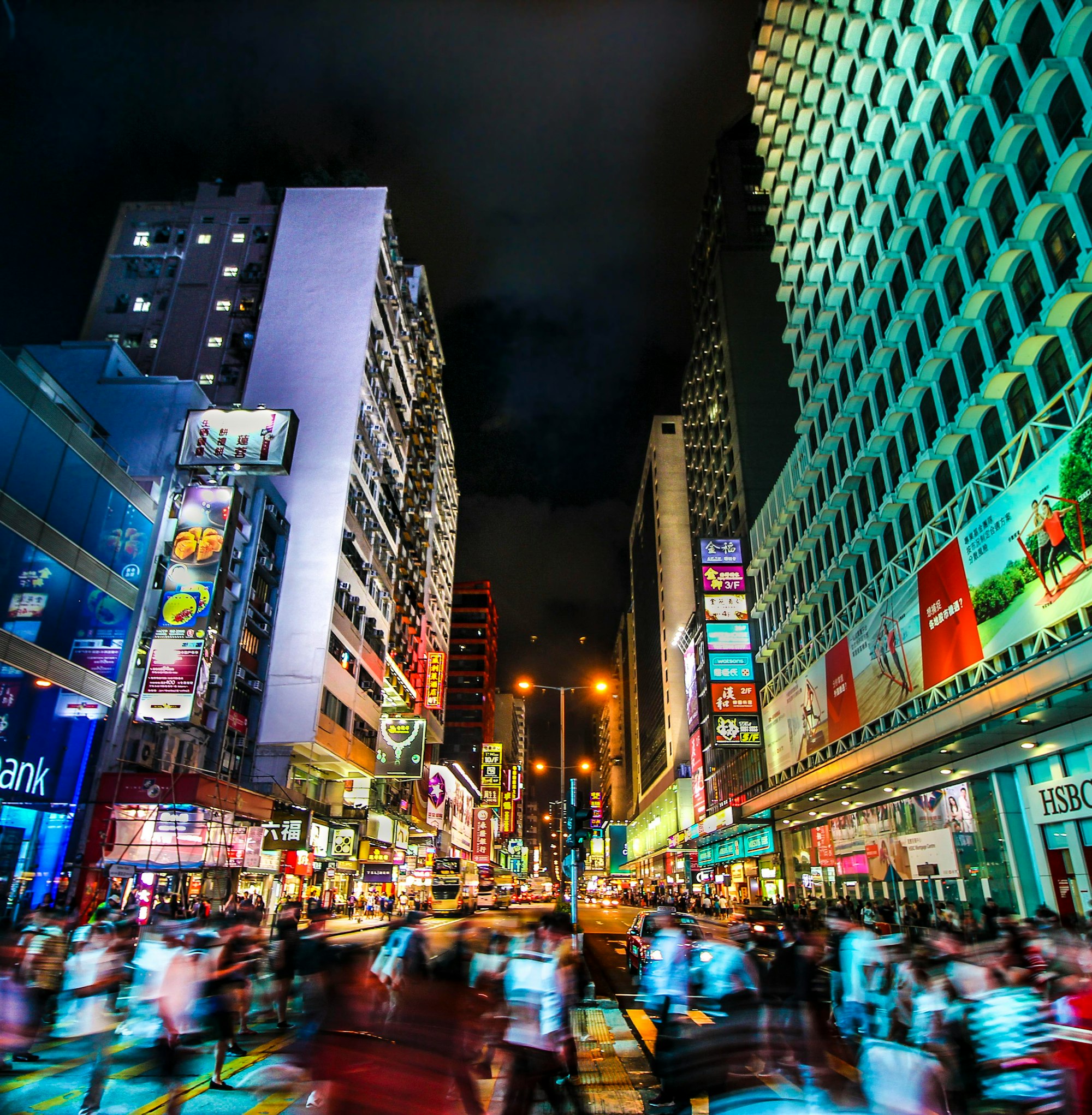
This is a historical travel story and walking guide to Hung Hom, a district defined by its transition from a heavy industrial hub to a spiritual center. Through five local stories, it explores the legacy of the Whampoa Dock, the resilience of the Hung Hom Kwun Yum Temple, and the unique urban landscape where the funeral industry and everyday life coexist. Readers will gain a deep perspective on how this Kowloon neighborhood balances its gritty past with modern community identity.
The Industrial Palimpsest
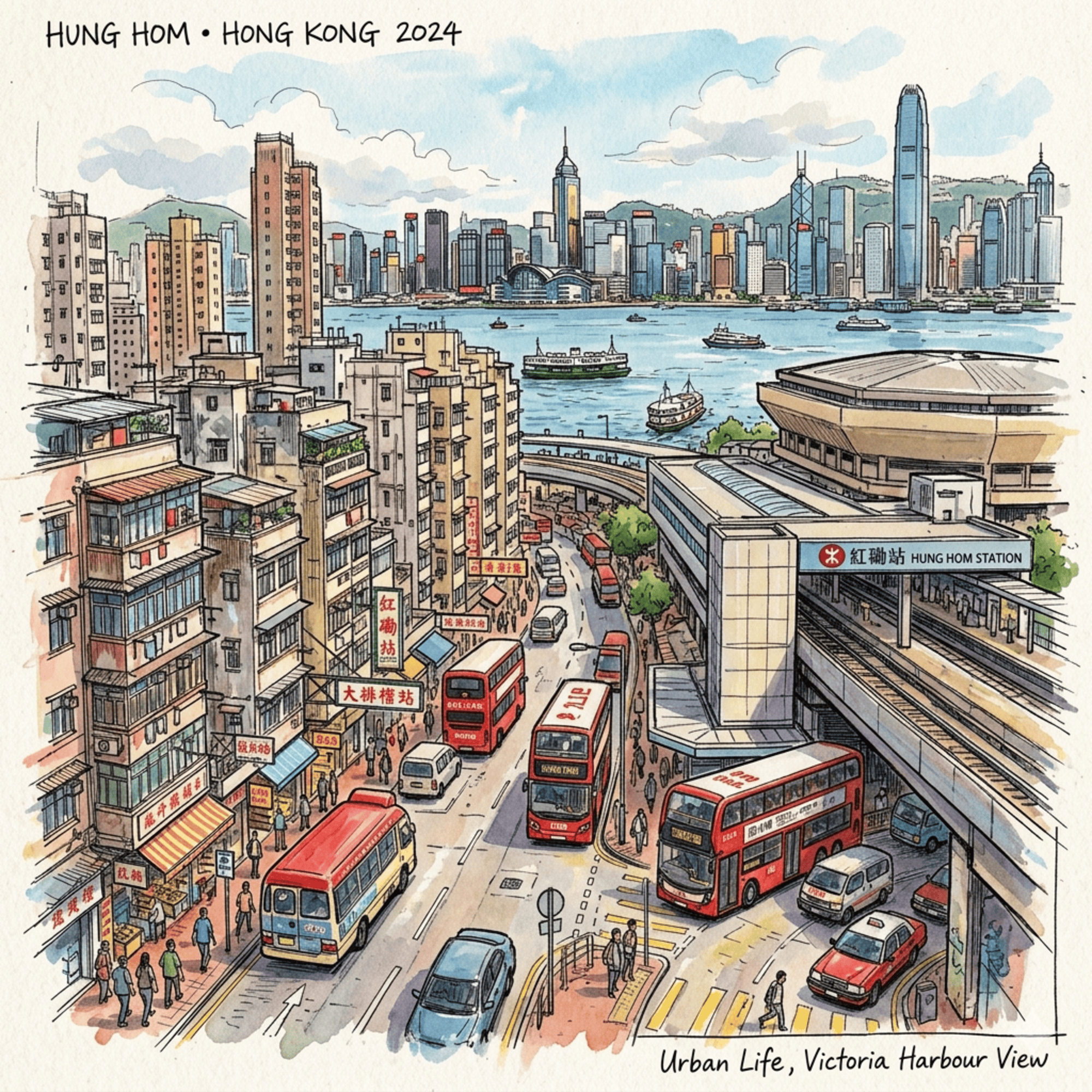
Hung Hom is a landscape defined by rapid, often violent transformation. Once a 19th-century industrial frontier on the rugged edge of the Kowloon Peninsula, it has evolved into a dense residential and commercial hub. However, beneath the gleaming glass of modern high-rises and the rhythmic hum of the MTR lies a complex urban palimpsest—a surface where earlier histories have been erased and overwritten, yet remain faintly visible to the observant eye.
To truly understand Hong Kong is to look past the tourist checklists and engage with the "lived experience" of its districts. In Hung Hom, the streets are not merely transit routes; they are historical records of colonial pragmatism, wartime trauma, and grassroots resilience. By exploring the spatial awareness of this neighborhood, we can uncover how geopolitical forces and industrial ambition shaped the very pavement we walk upon. Our journey begins by peeling back the first layer: the deep scars of the Second World War.
Listen to the historical stories told in detail (For subscribers only)
The 1944 Air Raid: Divine Intervention or Human Tragedy?
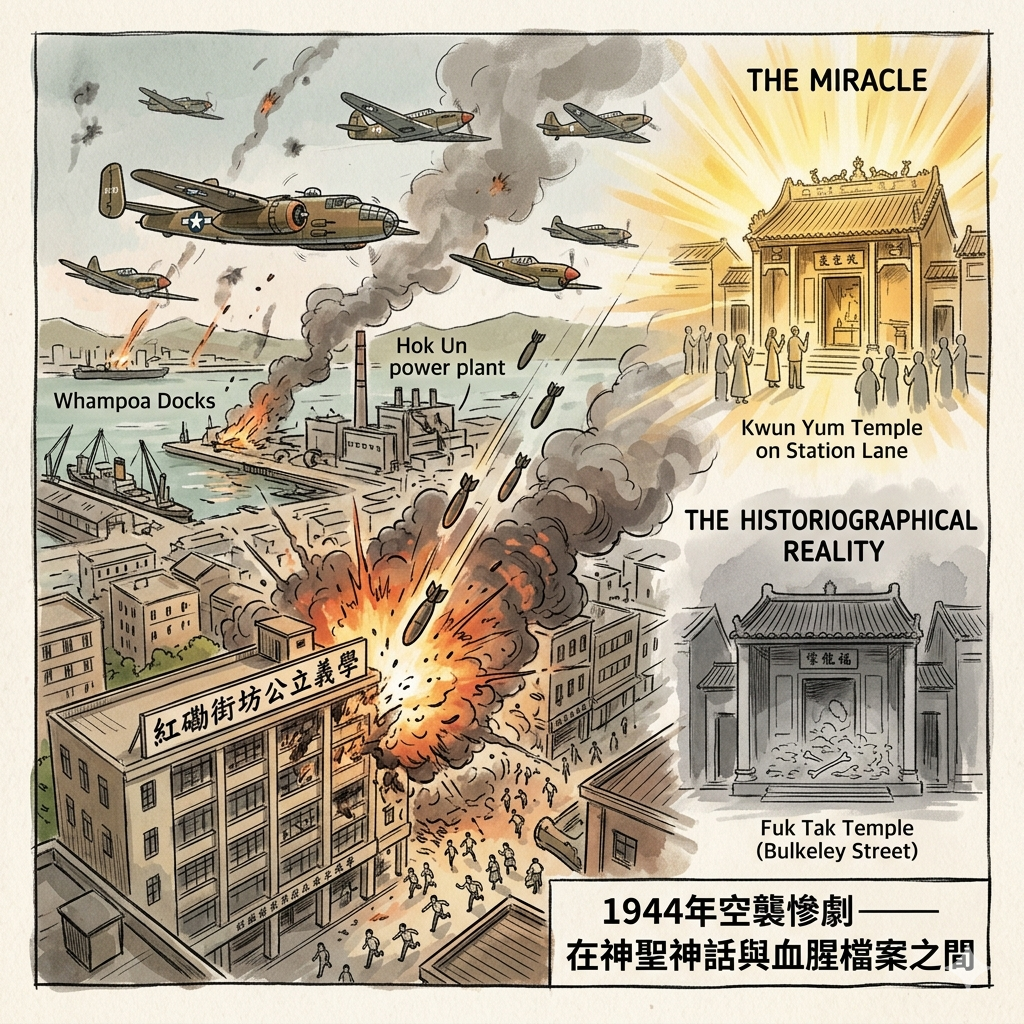
During the Japanese occupation of World War II, Hung Hom was a site of immense strategic gravity. As the home of the massive Whampoa Docks and the Hok Un power plant, it functioned as the industrial heart of the Japanese military infrastructure in South China. This importance turned the district into a primary target for Allied forces—specifically the US 14th Air Force—seeking to paralyze Japanese ship-repair capabilities.
On October 16, 1944, a formation of B-25 bombers and P-40 fighters launched a devastating raid. While aiming for the docks, technical limitations and smoke led to a catastrophic "mis-hit." Several bombs struck the Hung Hom Kaifong Public School (紅磡街坊公立義學) during class hours. The result was a tragedy of immense proportions: nearly the entire student body and faculty perished, with total local casualties exceeding 300 dead and 300 injured.
Comparative Analysis: The Miracle vs. The Historiographical Reality
Narrative Dimension | The "Sacred Miracle" Narrative | The "Historical Reality" (Archives) |
State of the Temple | Claims the temple stood perfectly still and untouched by divine power. | News archives and institutional records show the temple suffered severe structural tilting and damage. |
Fate of the Children | Asserts those who fled inside the temple were saved by the Goddess of Mercy. | Records suggest many students were killed by collapsing masonry and blasts while attempting to reach the temple. |
"So What?" Layer | Served as a vital tool for psychological healing (心理救濟) in a traumatized community. | Documents the objective cost of "total war" and the inherent risks of urban strategic bombing. |
Spatial Anchors: Today, the Kwun Yum Temple on Station Lane remains a bustling site of worship. However, for the historian, it is a monument to how communities process mass death through myth. A short walk away on Bulkeley Street, the Fuk Tak Temple acts as a more visceral vessel for memory; it houses the actual remains—ashes and bones—of the 300 victims, forming a hidden religious landscape of suffering and redemption.
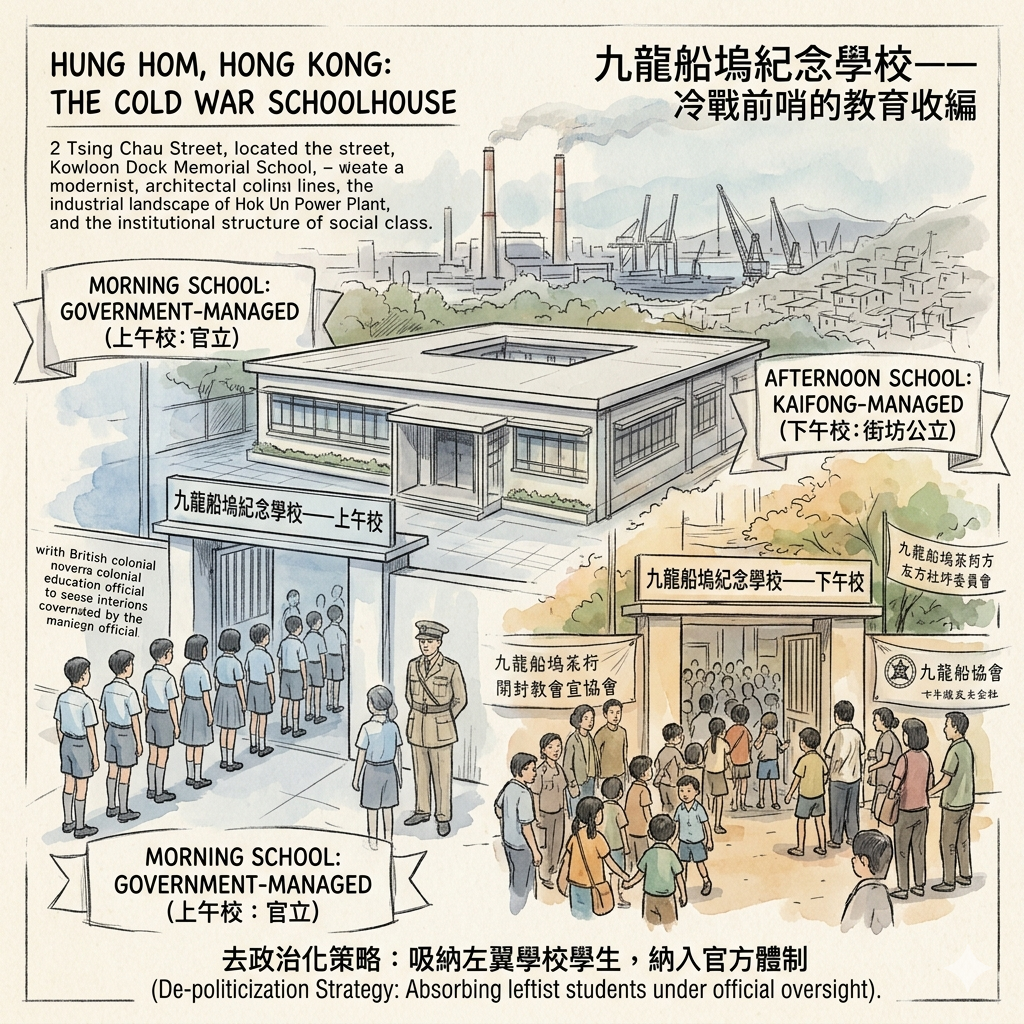
The Cold War Schoolhouse: Education as an Ideological Bastion
Following the 1949 revolution in China, Hong Kong was flooded with refugees, creating a desperate shortage of school places. In Hung Hom, the colonial government faced a dual threat: social instability and the expansion of communist ideology within the labor force. The British administration moved aggressively to shutter 13 schools belonging to the "Hong Kong and Kowloon Workers' Education Promotion Association" to curb leftist influence.
In response, the Kowloon Dock Memorial School was established in 1948. While officially a memorial to the dockworkers killed in the 1944 raid, the school functioned as a "soft defense" strategy. It was a tool of de-politicization (去政治化), designed to absorb students from the shuttered leftist schools and bring them under official colonial oversight.
The Institutional Structure of Social Class
The school’s internal structure reflected the sharp colonial-class divide:
- Morning School (Government-managed / 官立): A state-funded, elite-track institution managed directly by the Education Department with strict screening.
- Afternoon School (Kaifong-managed / 街坊會獨立行政): A grassroots session for the children of laborers, emphasizing vocational pragmatism and community funding.
Spatial Anchor: The former school site at 2 Tsing Chau Street features a single-story, modernist architectural style. Its flat-roofed, functionalist design is a physical manifestation of late-1940s pragmatism—built quickly to stabilize a volatile population.
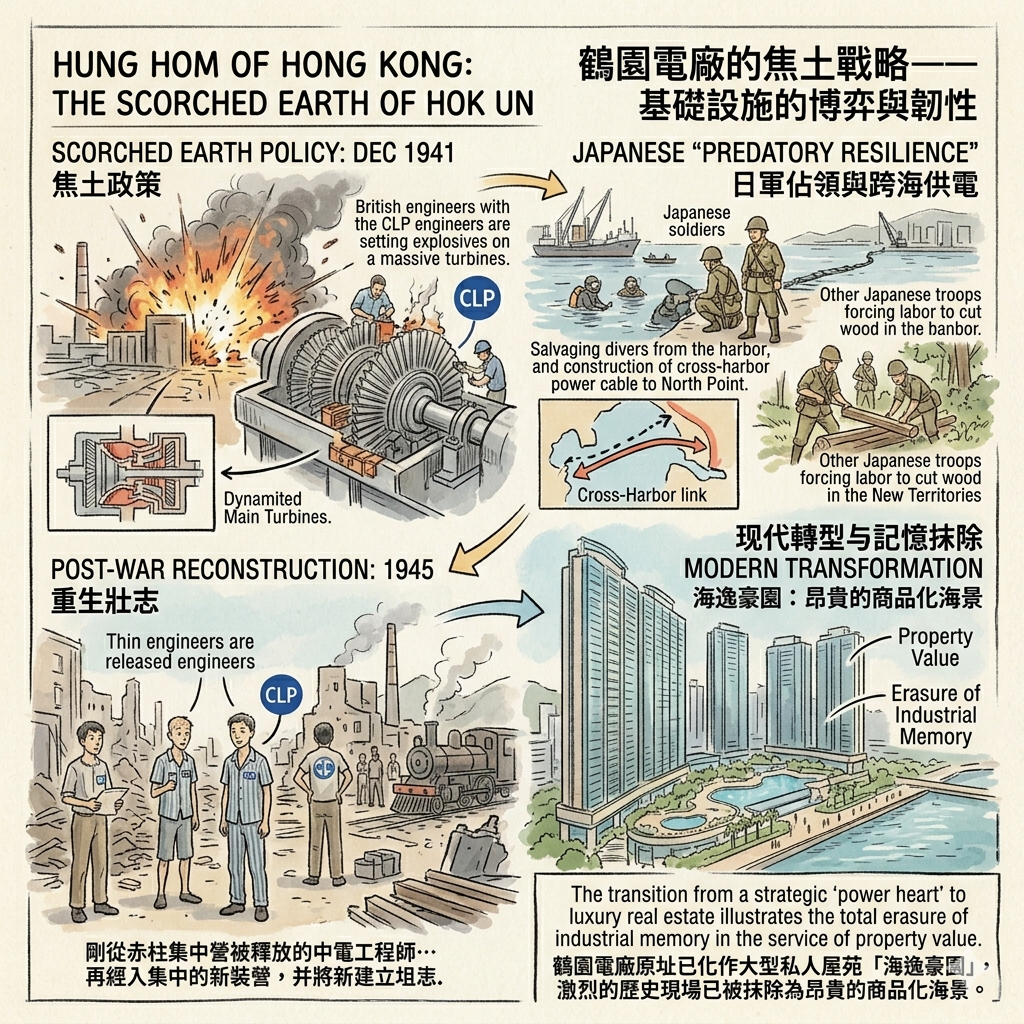
The Scorched Earth of Hok Un: Infrastructure as a Battlefield
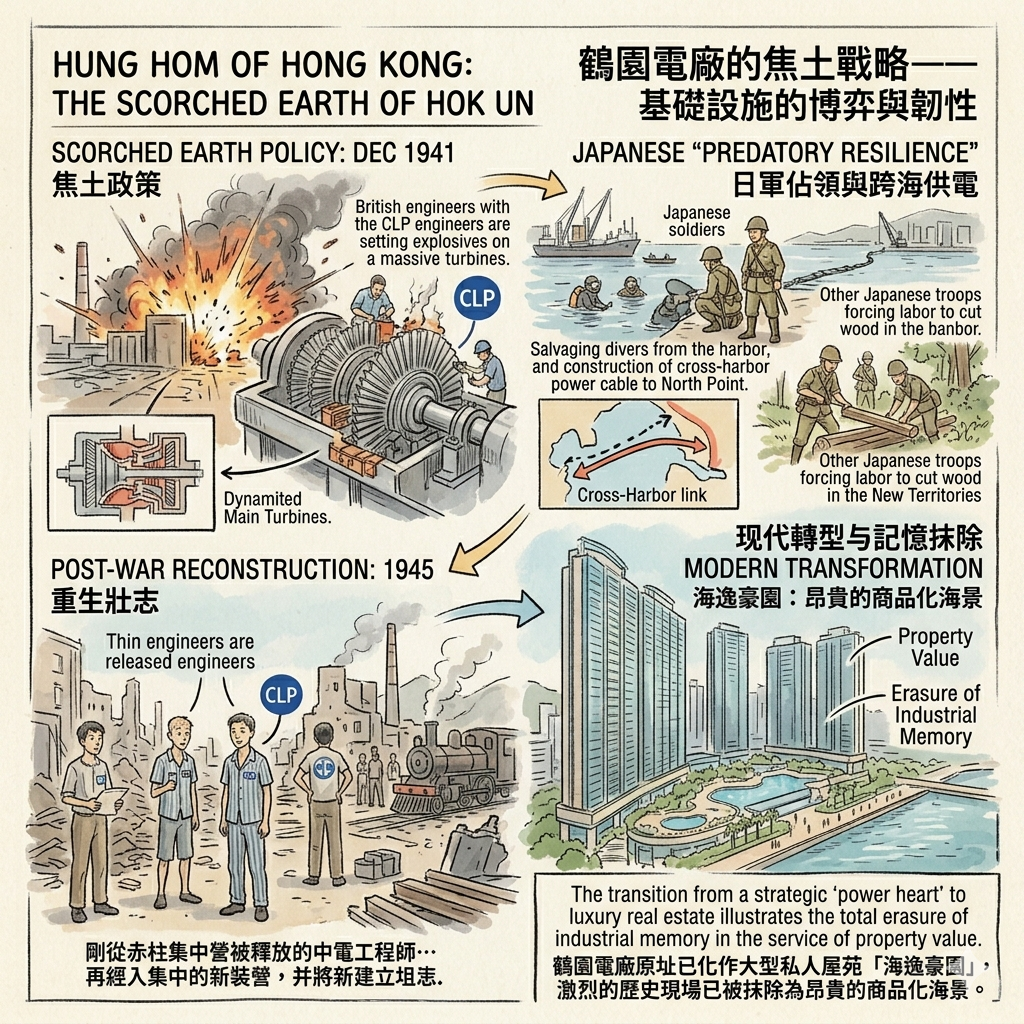
If the docks were the district's muscles, the China Light and Power (CLP) Hok Un station was its heart. By the 1920s, it provided the energy required to power Kowloon's heavy industry. When the Japanese invaded in December 1941, the power plant became a literal frontline.
Under a "Scorched Earth" policy, CLP engineers were ordered to sabotage their own facility. They destroyed the core turbines and cast vital components into the harbor to deny the enemy a functional asset. However, the Japanese demonstrated surprising engineering resilience, salvaging parts from the seabed and even launching a "Cross-Harbor Power" project to link Hung Hom’s plant to North Point on Hong Kong Island—a bold demonstration of technical dominance. By the end of the war, desperate for fuel, Japanese forces were forced to send troops into the New Territories to harvest wood for the boilers, a stark visual of the occupation's resource depletion.
Spatial Anchor: The industrial frontline has been entirely overwritten. The Laguna Verde residential complex now stands where the coal-fired turbines once hummed. This transition from a strategic "power heart" to luxury real estate illustrates the total erasure of industrial memory in the service of property value.
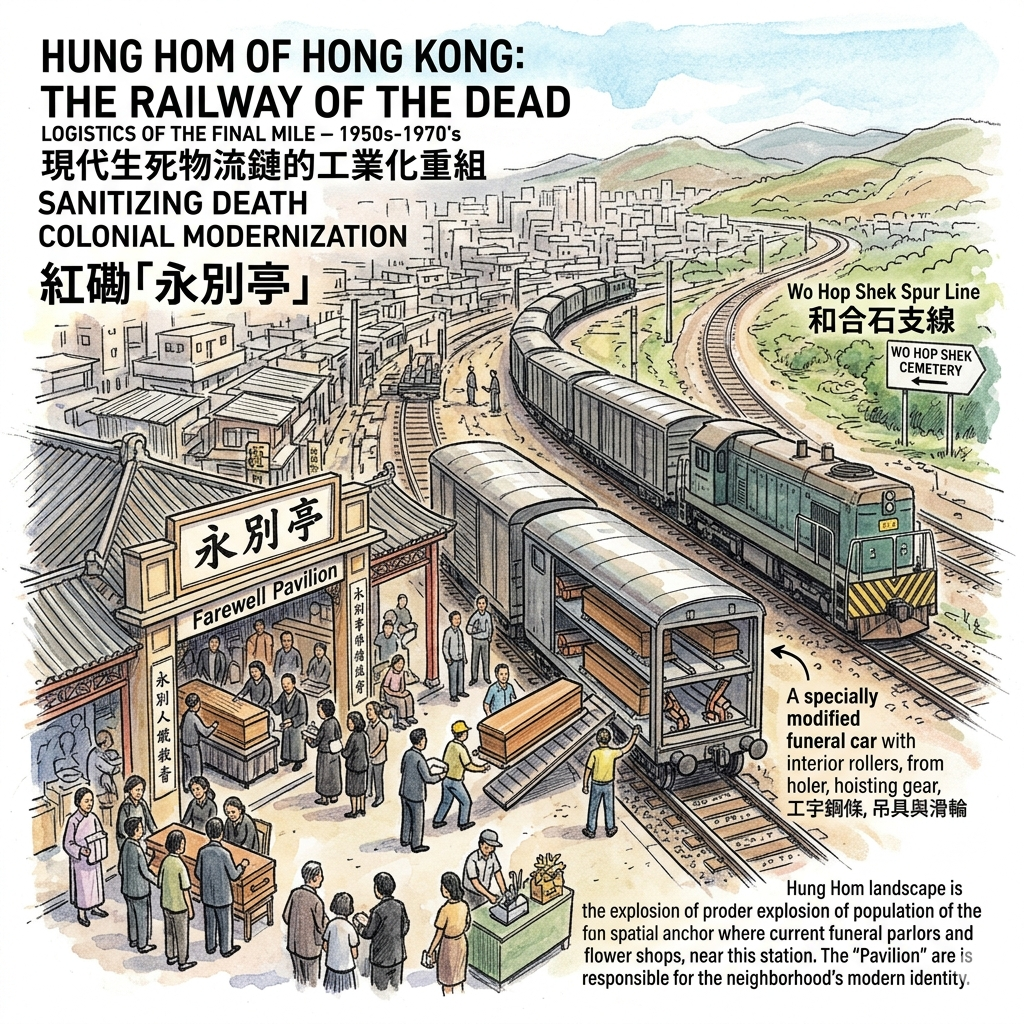
The Railway of the Dead: Logistics of the Final Mile
As Hong Kong’s population exploded, traditional urban cemeteries became a public health concern. The colonial government’s solution was the institutionalization of death via the "Wo Hop Shek" system. To manage the final journey, the government constructed a specialized logistics chain.
A 950-meter Wo Hop Shek Spur Line connected the main railway to the remote cemetery. Specially modified funeral cars, equipped with rollers and hoisting gear, transported coffins from a dedicated "Farewell Pavilion" in Hung Hom.
"The logistics of the era were precisely codified: 150 dollars for the first coffin transported, and 100 dollars for each subsequent one."
This shift from publicly displayed street funerals to a hidden "logistics chain" represented the colonial modernization of Chinese culture—sanitizing death by moving it onto the rails.
Spatial Anchor: While the "Farewell Pavilion" (永別亭) was demolished in the 1980s, its presence is responsible for the neighborhood’s modern identity. The current cluster of funeral parlors and flower shops near the station exists only because this was once the starting point of the "Railway of the Dead."
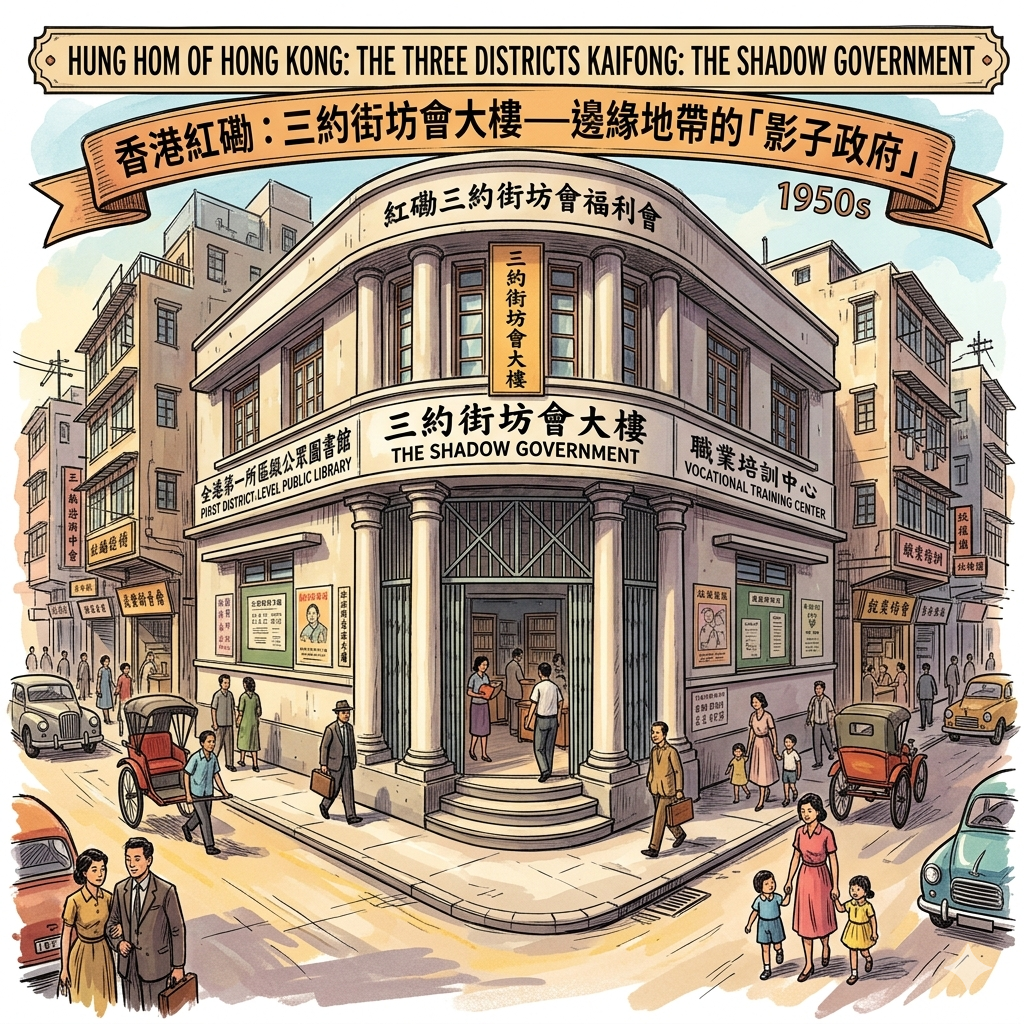
The Three Districts Kaifong: The Shadow Government
In the 1950s, the British government’s "Active Non-Interventionism" created a vacuum in social services. Into this gap stepped the Hung Hom Three Districts Kaifong Welfare Association, representing the united interests of Hung Hom, Hok Un, and Tokwawan.
Acting as a "shadow government," the association established the first district-level public library in Hong Kong, alongside vocational training centers and kindergartens. This was "Kaifong Governance"—a hybrid model where local elites managed social stability when the formal state would not.
Spatial Anchor: The association’s headquarters at the corner of Gilles South Road and Station Lane is a masterclass in 1950s Hong Kong Modernism. Its diagonal gate, granite steps, and elegant columns serve as a testament to an era when the community organized its own welfare to ensure survival.
Synthesis & Philosophical Reflection
Hung Hom is not a destination for a simple checklist; it is a site of "layered observation." To walk these streets is to traverse a map of geopolitical tension, industrial sacrifice, and cultural evolution. From the divine myths born of the 1944 bombings to the cold logistics of the funeral trains, the district reveals a fundamental truth about Hong Kong: it is a city built on the ability to adapt to, and overwrite, trauma.
As modern urbanization favors high-rise luxury over historical preservation, we must ask: In our rush toward the future, what do we choose to remember, and what are we willing to let the skyline erase?
If you wish to see a hidden fragment of this history, visit the Fuk Tak Temple on Bulkeley Street. Look for the small, unassuming niches; they house the remains of the 1944 air raid victims, a quiet, visceral reminder of the day the sky fell on Hung Hom.
For more deep-dives into the urban archaeology of Hong Kong, consider subscribing to our monthly historical narrative series.
Practical Logistics
- How to Get There: Take the MTR to Hung Hom Station (Exit B1) for the funeral cluster and Kaifong Association, or Whampoa Station (Exit A) for the Kwun Yum Temple and the former docklands.
- Recommended Tours/Stay: Look for walking tours specializing in "Industrial Kowloon" or stay near the Whampoa waterfront to experience the scale of the former dockyards.
Q & A
How did WWII air raids transform Hung Hom's religious identity?
The 1944 Allied air raids profoundly transformed Hung Hom’s religious identity by turning a site of immense wartime trauma into a sacred landscape of divine protection and collective healing. This transformation occurred through the construction of religious narratives that helped the community process the "total war" destruction of their neighborhood,.The evolution of Hung Hom's religious identity can be understood through the following key developments:
1. The Construction of the "Sacred Miracle" NarrativeFollowing the devastating air raid on October 16, 1944—which killed approximately 300 people and destroyed two-thirds of the area's housing—the Hung Hom Guanyin Temple became the focal point of a "sacred miracle".
- Narrative of Invincibility: Traditional folk memory and official temple records emphasize that while surrounding buildings were reduced to rubble, the Guanyin Temple "stood upright and firm," supposedly shielding those who sought refuge inside,.
- Identity Shift: This event elevated the temple from a local community shrine to a symbol of supernatural efficacy, establishing a reputation for divine protection that persists in its modern-day fame for "borrowing wealth" (Guanyin Opening the Treasury) and general blessing.
2. Religious Narratives as Psychological CompensationThe transformation of Hung Hom’s identity was a functional response to mass trauma. Scholars note that the "miracle" narrative served as a form of psychological compensation for a community that lacked formal psychological relief after the war. By reframing the "tragic massacre" of students and residents into a story of "divine protection," the community was able to spiritually soothe the collective wounds of the war.
3. The Tension Between Miracle and RealityHung Hom's religious identity is characterized by a significant narrative tension between divine intervention and historical tragedy:
- Contradictory Evidence: While the "miracle" narrative claims the temple was unscathed, historical archives and news reports from the time indicate the temple was actually severely tilted by the blast's impact, and many students died either inside or while fleeing to the temple,.
- Selective Memory: The religious identity of the area is built upon this selective "religious discourse construction," where the community chose to emphasize the survival of the structure over the reality of the technical damage and loss of life.
4. Formation of a Dual Religious LandscapeThe air raids created a unique, layered religious geography in Hung Hom that combines "suffering remains and sacred salvation":
- Guanyin Temple: Represents the public face of salvation and protection.
- Fuk Tak Temple (福德古廟): Provides a more hidden, somber counterpart. After the war, many families of the students who perished in the air raid placed their relatives' ashes in this temple on Bulkeley Street.
- Resulting Identity: This created a distinct local religious landscape where the memory of wartime victims is physically and spiritually entwined with the neighborhood's sacred spaces.
In summary, the WWII air raids did not just damage Hung Hom; they catalyzed a reimagining of the area’s spiritual space, turning the Guanyin Temple into a "soft defense" against the memory of trauma and cementing its status as a pillar of local resilience and divine intervention.
How did schools help maintain social stability during the Cold War?
During the Cold War, schools in areas like Hung Hom functioned as a "soft defense fortress" used by the British Hong Kong government to counter the spread of communist ideology and maintain social stability. This was achieved through a combination of political co-option, "depoliticization" techniques, and the provision of social mobility.The sources detail several ways schools helped maintain stability:
1. Political Co-option of Labor StudentsFollowing the establishment of the People's Republic of China in 1949, the colonial government was highly wary of communist influence spreading among the working class. To combat this:
- Closing Left-Wing Schools: The government used legal measures to shut down 13 schools with pro-communist backgrounds operated by the "H.K. & Kowloon Workers' Children Schooling Promotion Association".
- Strategic Relocation: To prevent these displaced students from becoming a source of instability or remaining under left-wing influence, the government intentionally moved them into government-run schools, such as the Kowloon Dock Memorial School. By bringing labor children into the official colonial education system, the government successfully implemented a form of political co-option.
2. Building an "Ideological Defense Line"Schools were used as a spatial and administrative tool to compete for the ideological loyalty of the grassroots:
- Government-Corporate Collaboration: The Kowloon Dock Memorial School was co-funded by the government and the British-owned Whampoa Dock. This partnership between "monopoly capital" and the colonial administration was designed to build an ideological defense line against radicalism.
- Depoliticization: History scholars note that the government employed hidden "depoliticization" educational techniques. By restructuring school schedules and administrative systems, they transformed politically charged labor issues into a regulated, stable, and manageable daily routine.
3. Promoting Social Mobility through Community SchoolsBeyond direct government control, local self-governing bodies like the Hung Hom Three Districts Kaifong Association played a crucial role in maintaining order:
- Filling the Welfare Vacuum: Because the government followed a policy of "positive non-intervention," it provided limited direct welfare. The Kaifong Association stepped in as a "shadow government," establishing kindergartens, youth centers, and the first district-level public library.
- Channels for Upward Mobility: By providing vocational training and educational spaces for poor students who could not afford private schools, these institutions offered a path for social mobility. This helped alleviate the social pressures and grievances of the impoverished refugee population, thereby preventing political unrest.
In summary, schools served as a critical mechanism for the colonial state to neutralize political opposition and integrate the working class into a stable social order during the heightened tensions of the Cold War.
Reference and Further reading
- 紅磡街坊小學- accessed April 3, 2026,
- 紅磡街坊會小學-, accessed April 3, 2026,
- 嘉道理私人資料歷史導賞發現老紅磡炸電廠避日軍 - Walkin HK, accessed April 3, 2026,
- 紅磡- 維基百科,自由的百科全書, accessed April 3, 2026,
- 一日有炸彈落於紅磡區,廟側屋宇蕩然無存,惟觀音廟則屹立如故 - Finedoor, accessed April 3, 2026,
- 抗戰勝利80年|紅磡1944年遭空襲慘劇廣華醫院收近300傷者東華三院修復檔案展抗戰歷史, accessed April 3, 2026,
- 九龍船塢紀念學校- accessed April 3, 2026,
- 工業前沿和理想家園– 紅磡和九龍塘的發展| 港文化18區, accessed April 3, 2026,
- Tai Wan, Hung Hom - accessed April 3, 2026,
- 香港連結生死的鐵路|運輸與可步行性 - City Unseen, accessed April 3, 2026,
- 消失的和合石鐵路|紅磡殯儀館林立與和合石墳場有關? | 飛凡香港| 樂活灣區| 當代中國, accessed April 3, 2026,
- Hong Kong's Railway of the Dead|Transport & Walkability - City Unseen, accessed April 3, 2026,
- 和合石支線-accessed April 3, 2026,
- Historic Building Appraisal - Antiquities Advisory Board, accessed April 3, 2026,
- 九龍紅磡機利士南路66 號, accessed April 3, 2026
 Lawrence
 Lawrence
 Lawrence