(ENG) Kasai Historical Walk: From Tokyo’s Fishing Roots to a Modern Global Hub
Take a historical journey through Kasai, Edogawa. This story explores how a quiet Tokyo fishing village transformed through massive land reclamation into a bustling international hub, uncovering the layers of history and diverse cultures hidden within its modern streets.

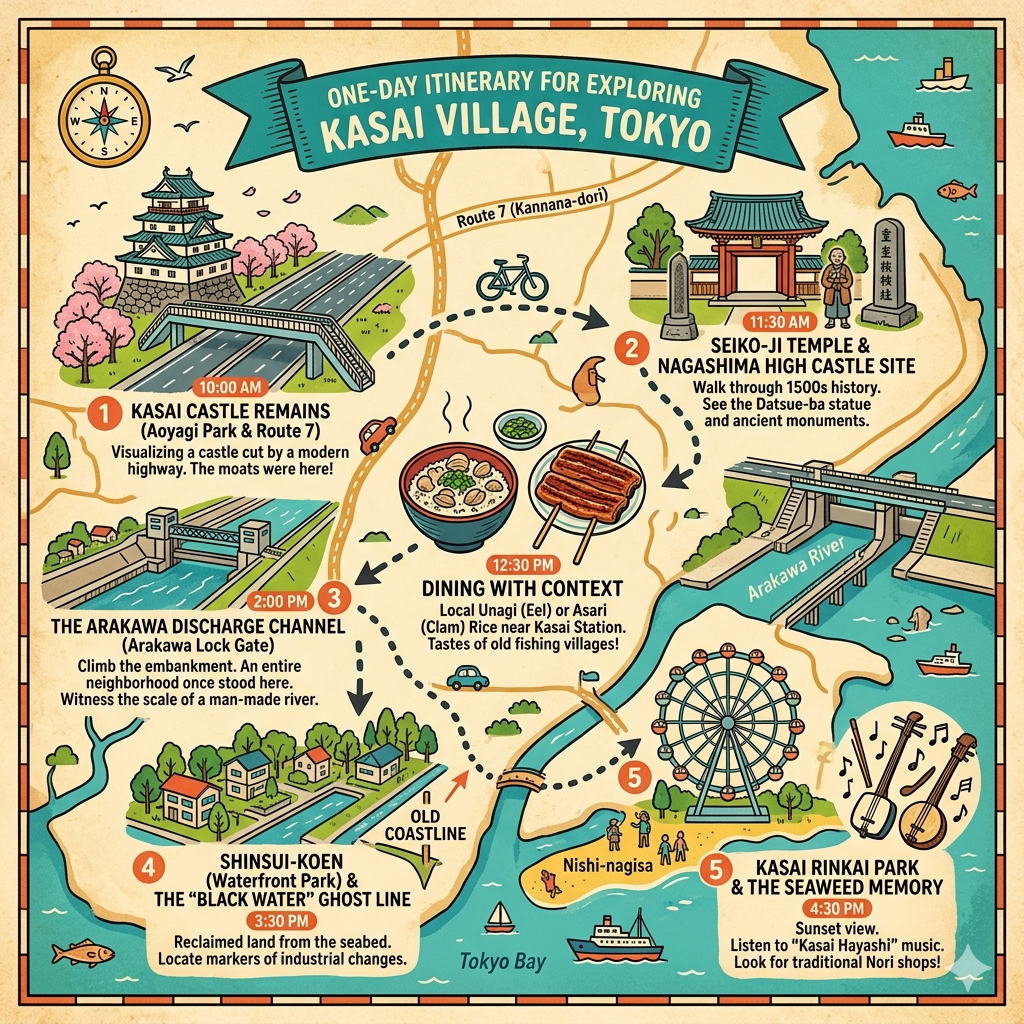
This is a historical travel story and walking guide to Kasai, a coastal district in Tokyo’s Edogawa Ward. By tracing its evolution from a traditional seaweed-farming village to one of Japan’s most diverse international neighborhoods, this walk explores how land reclamation and migration reshaped Tokyo's eastern edge. Readers will discover hidden shrines, the legacy of the fishing era, and the vibrant multicultural identity that defines Kasai today.
 Lawrence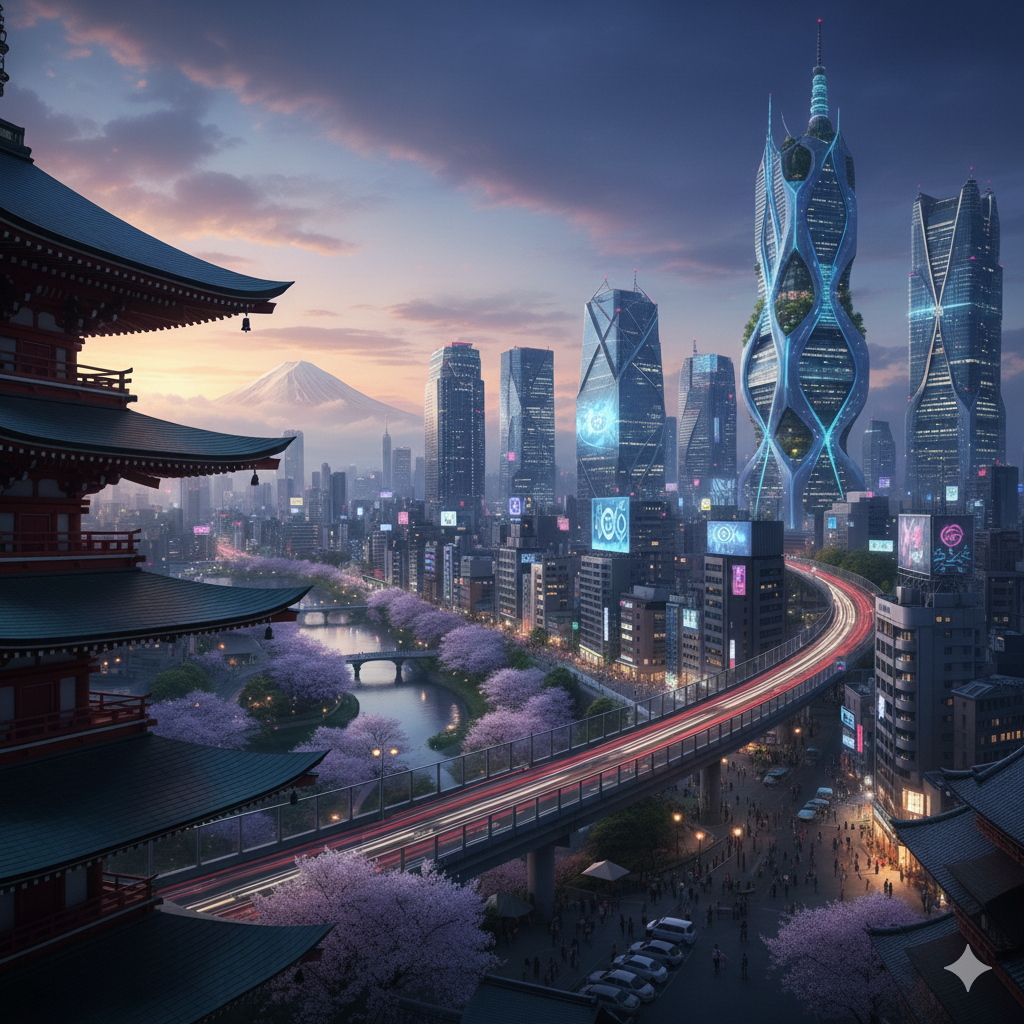
Kasai, in the southern reaches of modern Edogawa, was once a strategic "water-bound frontier." For centuries, this gateway between Musashi and Shimosa provinces was where Kanto’s river systems met the sea. To the modern observer, it appears as a landscape of orderly apartment blocks, yet beneath this surface lies a history of "geographical trauma" and rebirth. Understanding these layers is essential to see beyond the suburban facade; it reveals how a modern district grew from a fortified medieval harbor and a site of intense environmental struggle. From the vanished castles of the Ashikaga Shogunate to the 20th-century engineering that literally severed the land to protect it from floods, Kasai is a testament to human resilience. To walk Kasai today is to navigate spectral layers of old Tokyo, where the strategic heartbeat of a vanished delta still pulses beneath the concrete.
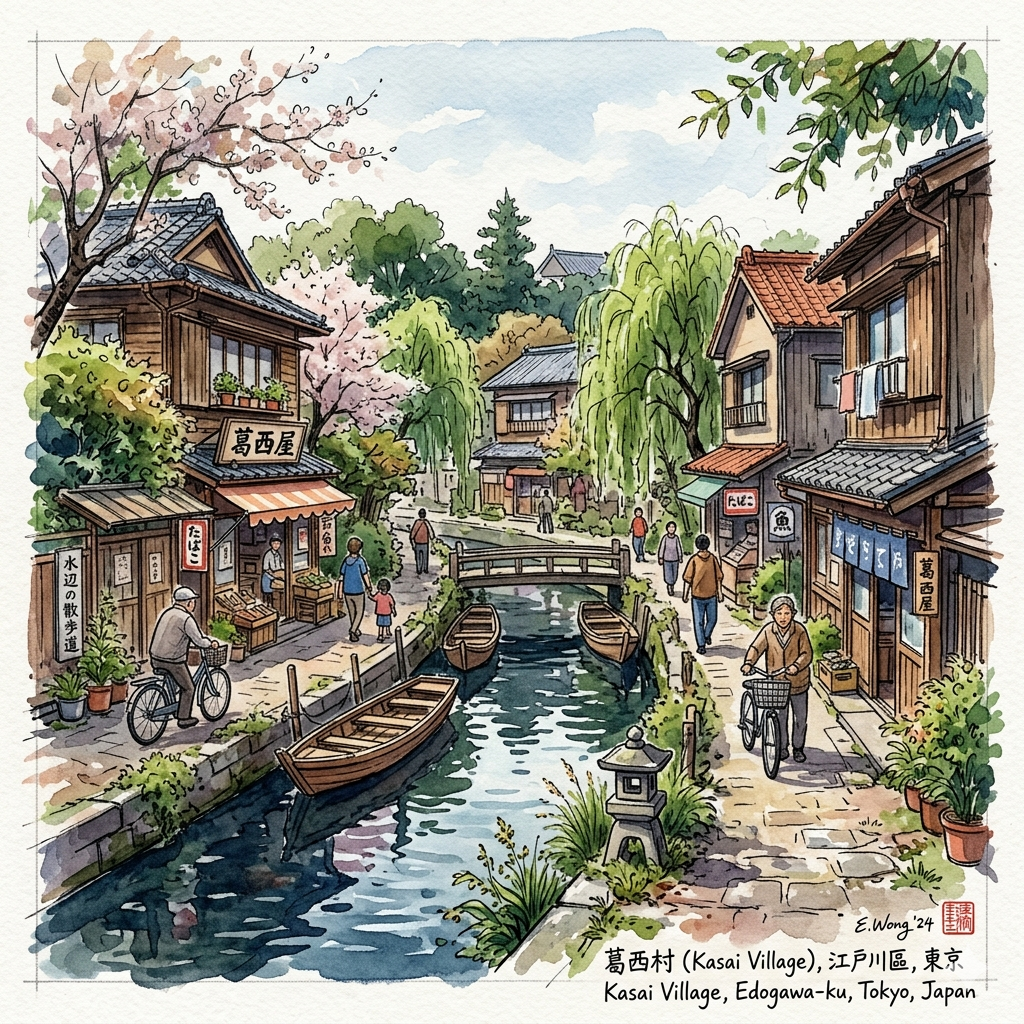
Listen to the historical stories told in detail (For subscribers only)
Nagashima—The Vanished Harbor of the Middle Ages
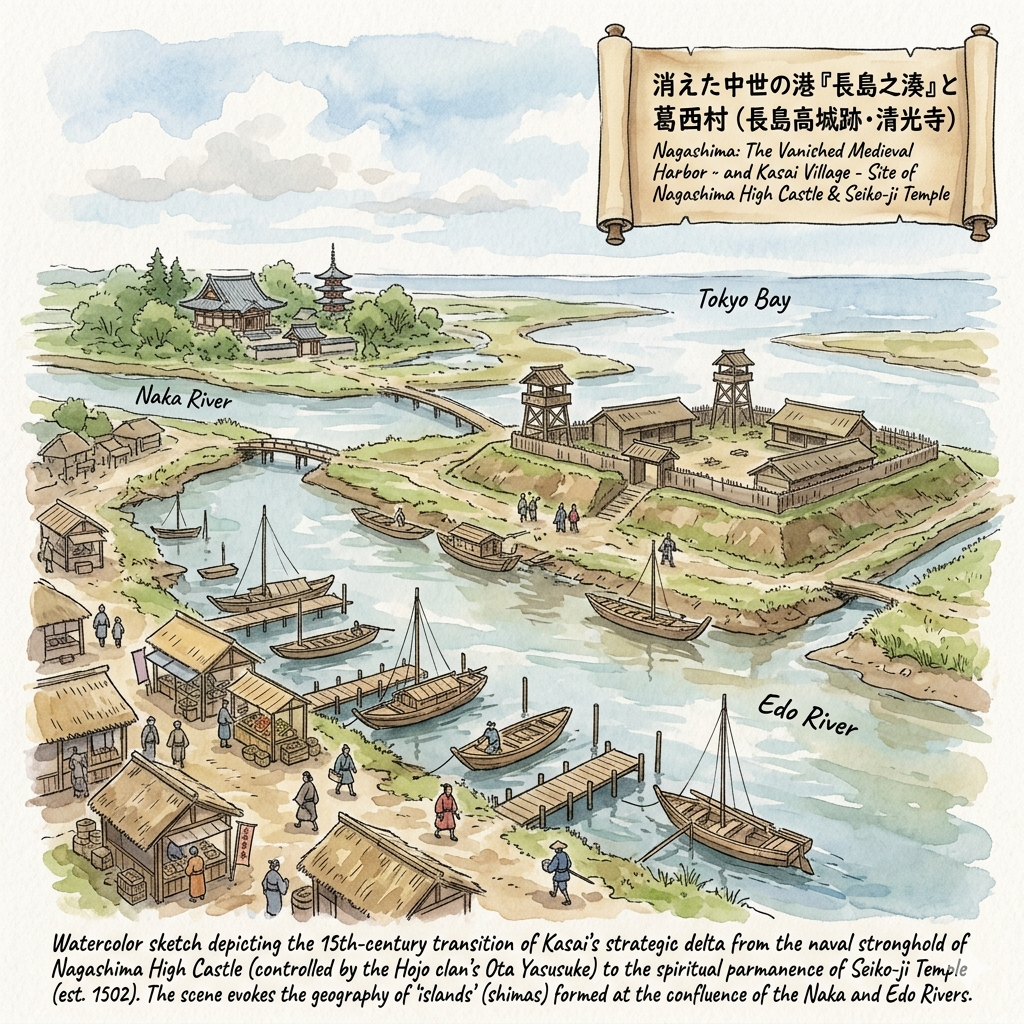
In the medieval geography of the Kanto region, Kasai was not a singular landmass but a collection of "shimas," or islands, formed by the deltaic silt of the river mouths. Among these, Nagashima held the most vital position, sitting at the confluence of the Naka and Edo Rivers. Known as Nagashima-no-minato (the Port of Nagashima), it functioned as a critical commercial and military node for the region. The eventual transition of this site from a naval stronghold to the Seiko-ji Temple reflects the broader stabilization of the Kanto, as the violent surveillance of the riverways gave way to religious and agricultural permanence.
The Ghost of a Fortress: Nagashima High Castle
During the 15th century, Nagashima High Castle—also known as Nagashima-yakata—served as the defensive sentinel of the delta. Controlled by Ota Shinnokuro Yasusuke, a prominent commander under the Hojo clan, the castle monitored all maritime traffic entering the inner river systems. Today, this military history is anchored in the modern East Kasai 3-chome. While the physical earthen walls have long been leveled, the history survives in "small character" (ko-aza) names that the observant traveler can still find on local neighborhood maps or small street signs: Mababa (Horse Track), Omote-mon (Front Gate), and Ura-mon (Back Gate). These invisible linguistic traces are often more evocative than ruins; they provide a spatial map of a vanished military world now hidden within the geometry of modern residential streets.
"The temple was founded in 1502 by the monk Tokuyu Hoin on the very grounds where Nagashima High Castle once monitored the flow of river traffic, marking the site’s transition from a military fortress to a center of spiritual community."
The decommissioning of the castle did not mean the end of Kasai’s strategic importance; rather, the focus shifted to a more centralized seat of power.
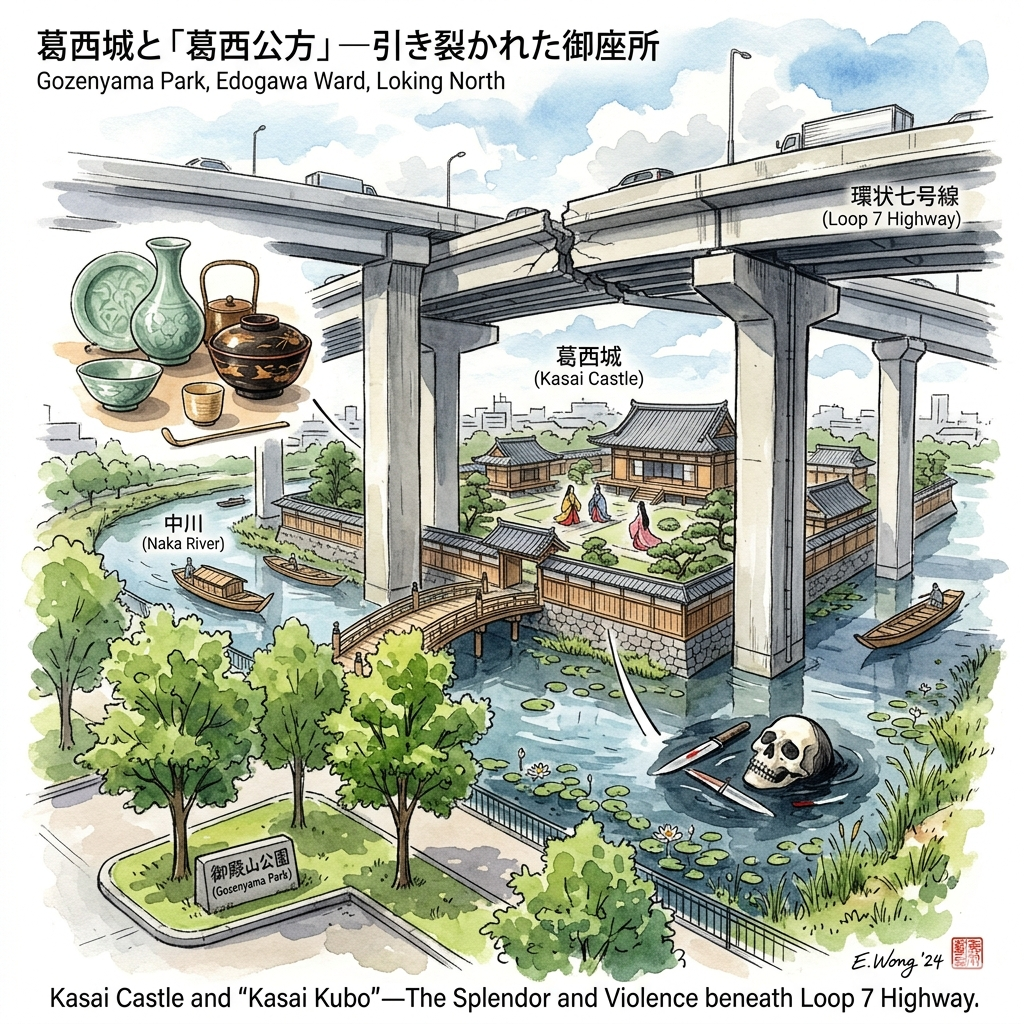
Kasai Castle—The Splendor and Violence of the "Kasai Kubo"
Kasai Castle was a quintessential mizujiro (water castle), utilizing the winding Naka River as a massive natural moat. Its significance peaked in the mid-16th century when it served as the Gozosho, or palace, for Ashikaga Yoshiuji. Though the physical site lies just north of the modern district in Aoto, Yoshiuji’s presence as the "Kasai Kubo" transformed the entire region into a rare site of Shogunal prestige and courtly elegance on the Kanto frontier.
Elegance and Execution: Beneath the Loop 7 Highway
Archaeological excavations at the castle site have revealed a startling dichotomy between high culture and military brutality. Digs uncovered "prestige goods" such as Yuan Dynasty celadon and fine lacquerware, suggesting a life of immense refinement. However, this beauty was mirrored by a grim reality: in the castle's old moat, researchers discovered the skull of a 35-year-old woman bearing the marks of two fatal blade strikes. This tension between courtly "beauty" and military "ugliness" is now literally buried beneath the Ring Road No. 7 (Loop 7). The modern highway acts as a "violent covering," a piece of infrastructure that severed the medieval spatial continuity, leaving only fragments of the Kasai Kubo’s world beneath the asphalt.
Archaeological Object | Historical Meaning |
Yuan Dynasty Celadon | Symbol of international trade and Shogunal prestige. |
Ota-style Earthenware | Signifier of political alignment with the Hojo clan. |
Female Skull with Blade Marks | Evidence of the ruthless military reality of internal struggles. |
Lacquer Combs and Geta | Indicators of a high-status urbanized lifestyle within the castle. |
While the castle represented the political height of the region, the true lifeblood of the community remained tied to the resources of the sea.
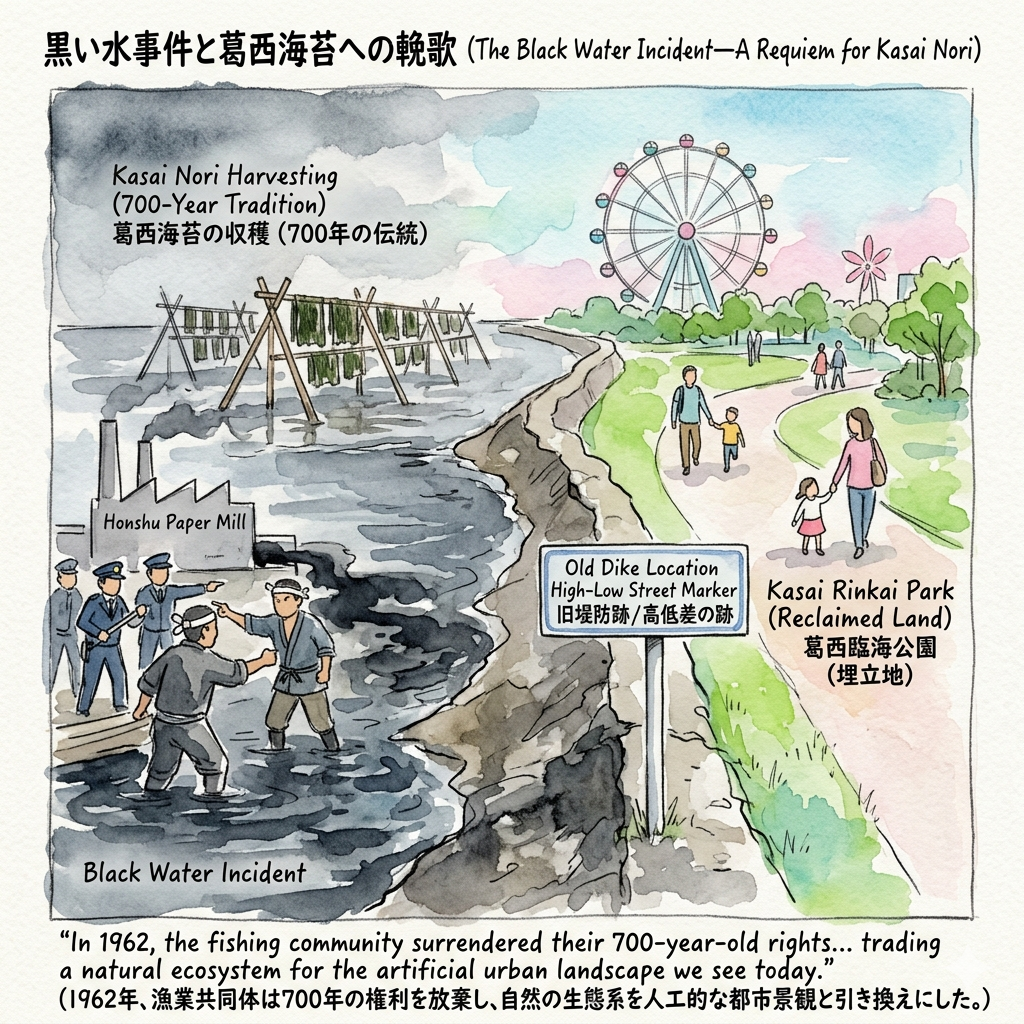
The Black Water Incident—A Requiem for Kasai Nori
For centuries, the spirit of Kasai was found in the "Sanmai-su," a vast expanse of shallows at the river’s mouth where fresh and salt water mixed perfectly to produce Japan’s finest nori (seaweed). This 700-year tradition of "Edo-mae" fishing was the village's economic anchor until the mid-20th century, when industrialization led to the catastrophic 1958 "Black Water Incident" at the Honshu Paper Mill.
The 700-Year Harvest: When the Sea Turned Black
In April 1958, the Honshu Paper Mill released toxic effluent that turned the sea black, decimating the fish and seaweed populations. This sparked a historic confrontation in June as 900 fishermen clashed with riot police at the factory gates. While the struggle catalyzed Japan’s first environmental laws, the victory was a requiem for a way of life. By 1962, the fishermen were forced to surrender their ancient rights for the sake of "public interest," a cultural extinction that enabled the massive land reclamation projects that created Tokyo Disneyland and Kasai Rinkai Park. Today, the "High-Low" street markers in South Kasai serve as spatial anchors; these abrupt height differences are the physical scars of the old dikes that once marked the former coastline, separating a desperate village from a toxic tide.
"In 1962, the fishing community was compelled to surrender their 700-year-old rights for the sake of 'public interest,' effectively trading a natural ecosystem for the artificial urban landscape we see today."
The loss of the sea’s silence was balanced by the enduring pulse of the local village rhythm.
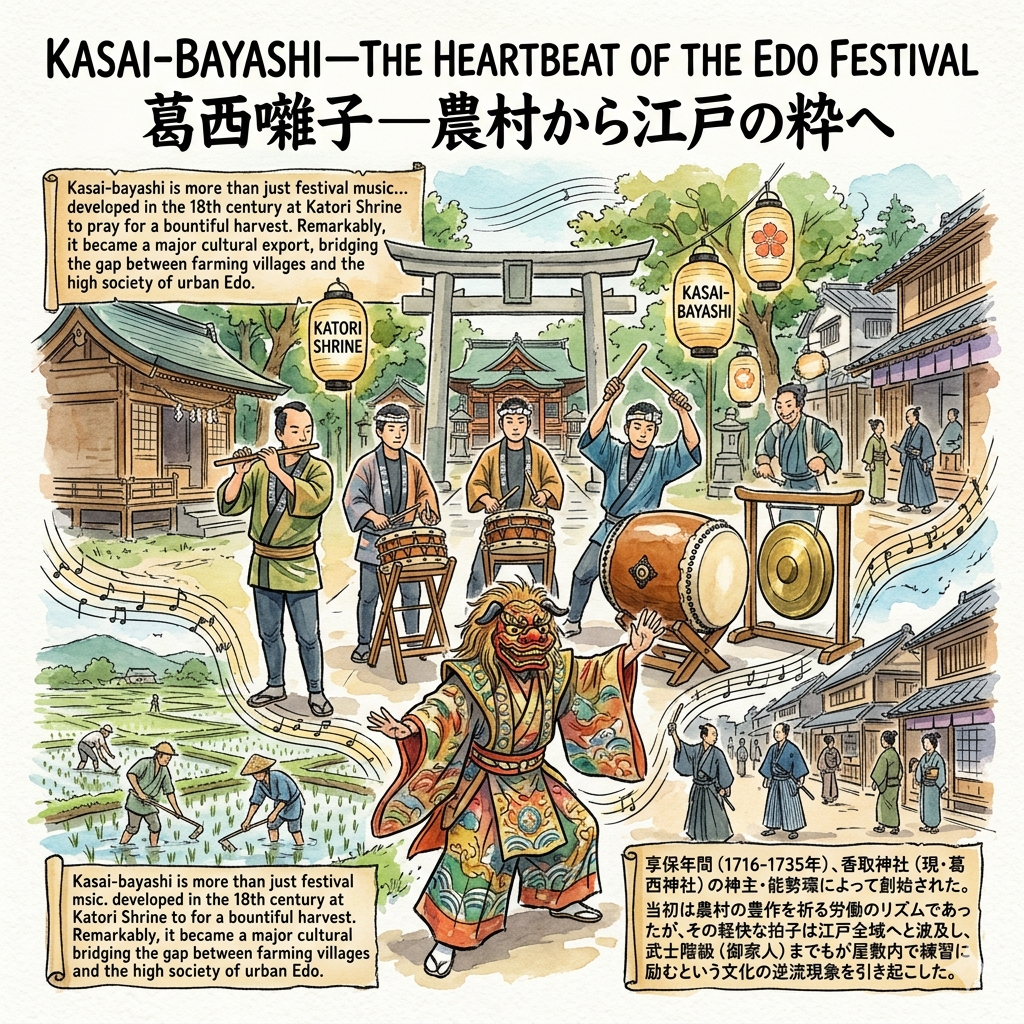
Kasai-bayashi—The Heartbeat of the Edo Festival
Kasai-bayashi is more than just festival music; it is the rhythmic DNA of Eastern Tokyo. Developed in the 18th century at the Katori Shrine, it served as a spiritual tool to pray for a bountiful harvest. Remarkably, this rural ritual became a major cultural export, bridging the gap between farming villages and the high society of urban Edo.
Rhythms of the Harvest: The Shogun’s Favorite Beat
The beat of Kasai was so infectious that even the Ogome-yui (samurai) practiced it within their estates (buke-yashiki), treating it as a refined, high-class amateur hobby. This "bottom-up" cultural flow challenges the idea of Edo as a purely top-down authority. The rhythm remains a living tradition, still performed at festivals like those at the Nagashima Katori Shrine. The "intelligent rhythm" is created by a standard five-part ensemble:
- Fue (Shinobue): A bamboo flute that leads the melody and sets the emotional tone.
- Shime-daiko: Two small drums providing the skeletal, driving beat.
- O-daiko: A large bass drum used for depth and structural transition.
- Atari-gane: A brass gong that accents the speed and tempo.
- Kagura-mai: Masked dancers who interpret the rhythm through narrative movement.
As these cultural rhythms flowed toward the city, the literal flow of the rivers was being forcibly reimagined through massive engineering.
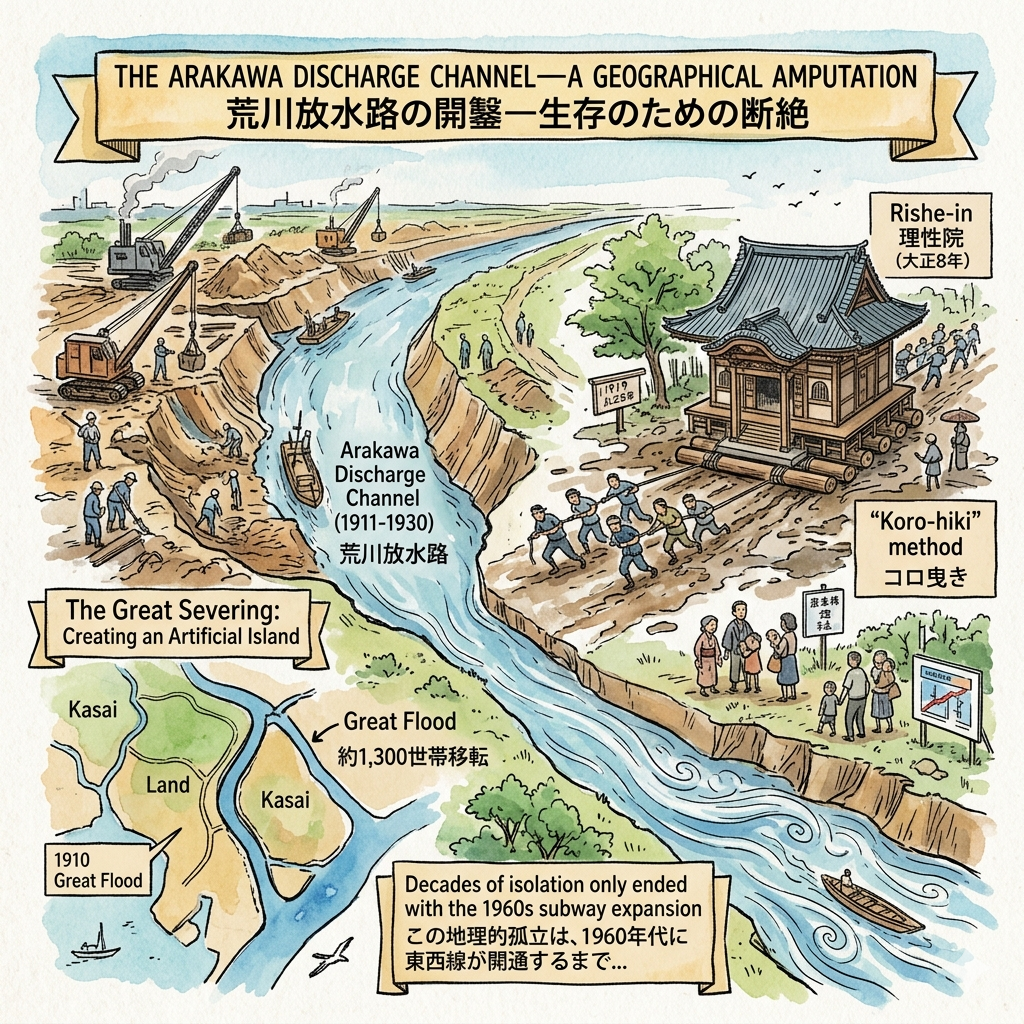
The Arakawa Discharge Channel—A Geographical Amputation
The catastrophic flood of 1910 was a turning point for the Japanese state. Faced with the repeated destruction of Tokyo’s "Low City," the government initiated the Arakawa Discharge Channel project, an engineering feat that would "mutilate" the natural landscape to ensure the city's survival.
The Great Severing: Creating an Artificial Island
Between 1911 and 1930, a massive 22-kilometer artificial river was carved through the land. This "geographical trauma" displaced 1,300 households and literally severed Kasai from its northern neighbors, turning it into an "artificial island." One of the most remarkable technical details of this era was the "Koro-hiki" (log-pulling) method: entire temples, such as Rishe-in, were placed on timber rollers and dragged for months to new locations. This amputation defined Kasai’s isolation for decades, a state that only ended with the 1960s subway expansion. The engineering was a triumph of survival, yet it permanently altered the community's relationship with its ancestral soil.
The Hidden Gem
For the historically minded walker, the Shogen no Hana (The General’s Nose) in South Kasai offers a profound experience. This site was once a strategic dike head—a promontory or "nose" of land that jutted into the water to redirect the current. Today, it remains a physical touchpoint where the struggle against water and pollution is still etched into the earth. Standing here, the sudden height differences between the old dike remnants and the reclaimed land below provide a visceral sense of the line that once separated the original village from the encroaching sea.
Conclusion: A Philosophical Reflection
To walk through Kasai today is to navigate a "Spectral Geography." The district is a true palimpsest, where every layer of modern convenience sits atop a previous layer of sacrifice. The splendor of the Kasai Kubo rests beneath a highway; the 700-year harvest of the sea is buried under an amusement park; and the original village layout was amputated by an artificial river. This history forces us to confront the true cost of "progress." Kasai is a testament to resilience, but it also leaves us with a haunting question: what is the ultimate price a community pays for its safety and modernization when its very geography must be sacrificed to achieve them?
Subscribe to uncover the layers beneath your next destination.
Exploring the Kasai Palimpsest
How to Get There: Take the Tokyo Metro Tozai Line to Kasai Station or Nishi-Kasai Station. Recommended Accommodation: Stay near Kasai Station for easy walking access to the historic Nagashima and South Kasai areas. Recommended Historical Walks: Start at the Arakawa Discharge Channel dikes, walk through East Kasai to visit the Katori Shrines and Seiko-ji Temple, and conclude in South Kasai to see the old dike remnants at Shogen no Hana.
Q & A
What was the cultural impact of the Kasai-bayashi festival music?
The Kasai-bayashi festival music, which originated in the mid-Edo period (1716–1735), had a profound cultural impact that extended far beyond its rural roots, eventually becoming the "heartbeat" of Edo's festival culture.
Its impact can be categorized into several key areas:
1. Foundation of Kanto Festival Music
Kasai-bayashi is considered the "mother" of festival music (matsuri-bayashi) in the Kanto region. Originally created by the priest Nose Kan at Kasai Shrine to encourage youth participation in religious ceremonies, its unique blend of local labor rhythms and waka melodies formed a five-person performance system that became a standard for the region.
2. Urban Cultural Transformation ("Countryside Surrounds the City")
The music's most significant impact was its successful migration from the rural outskirts into the heart of Edo (modern-day Tokyo).
- Leader of the "Edo Five Bayashi": After a sensational performance at the Kanda Myojin festival, its energetic and sophisticated rhythms became so popular that it was adopted by major shrines throughout the city, earning its place as the head of the "Edo Five Bayashi".
- Influencing Modern Major Festivals: The rhythms heard today in famous events like the Kanda Matsuri and Sanja Matsuri can be traced back to the beats originally created by Kasai farmers in their fields.
3. Breaking Social Class Barriers
Kasai-bayashi served as a rare cultural bridge between strict social strata. During the late Edo period, it gave rise to "Okunin-bayashi," where high-ranking warriors (Hatamoto) and lower-ranking vassals (Gokunin) would secretly practice the music in their estates. This transition from a "peasant's rhythm" to an "elegant hobby" for the ruling class demonstrates how folk art could penetrate and influence elite circles.
4. Preservation of Intangible Heritage
In the modern era, the cultural significance of Kasai-bayashi has been formalized as a pillar of regional identity:
- Cultural Asset Designation: Recognizing its historical value, it was among the first traditions to be designated as an Intangible Cultural Asset by the Tokyo Metropolitan Government.
- Ongoing Community Vitality: Through the work of local preservation societies and the Kasai Kagura Preservation Society, the music continues to be a living tradition, echoing through the streets during autumn festivals at shrines like Nagashima Katori and Kuwakawa.
Ultimately, Kasai-bayashi proves that Kasai was not merely a recipient of urban culture, but a primary cultural exporter that defined the festive atmosphere of the Japanese capital for centuries.
How did industrialization and pollution lead to environmental protection laws?
Industrialization and the resulting pollution led to the creation of environmental protection laws through a process of severe ecological trauma followed by intense social activism. In Japan, the primary catalyst for this legal shift was the 1958 "Black Water Incident" (Honshu Seishi Edogawa Factory Incident).
The Catalyst: The Black Water IncidentDuring Japan's period of high economic growth, industrial expansion often occurred without environmental regulation. In April 1958, the Honshu Seishi factory discharged massive quantities of industrial wastewater into the Old Edogawa River. This "black toxic water" devastated the marine ecosystem at the river's mouth, killing fish and destroying the "Kasai Nori" (seaweed) industry, which had been the economic lifeblood of the region for centuries.Social Conflict and the "Urayasu Riot"
The legislative change was driven by a "violent awakening" of the affected public. When industrial polluters and government regulators initially failed to take responsibility, approximately 900 fishermen from Kasai and neighboring Urayasu took direct action. In June 1958, they stormed the factory and clashed with riot police, resulting in over 100 injuries.
This bloody confrontation was widely reported by the media, turning local pollution into a national crisis of conscience.The Emergence of the "Two Water Quality Laws"The public outcry and social unrest forced the Japanese government to shift from a policy of "economic growth at all costs" to one of legal regulation. In December 1958, the government enacted the "Two Water Quality Laws" (水質二法):
- The Public Water Body Water Quality Conservation Law
- The Factory Effluent Control Law
These statutes represented the first environmental protection legislation in Japanese history.
Historical Significance
The transition from industrial pollution to environmental law marked a fundamental shift in how the state managed natural resources. It signaled the end of an era where nature was viewed as a bottomless resource for industry and the beginning of modern environmental citizenship. While these laws arrived too late to save the traditional fishing culture of Kasai—which was eventually abandoned in 1962 in favor of urban development—they established the precedent for the more stringent ecological and public health regulations that would follow in the 1960s and 1970s.
Reference and Further reading
- 旧町名 東京府南葛飾郡葛西村大字長嶌 - 歩・探・見・感 - はてなブログ, accessed April 18, 2026,
- 長島之碑(香取神社) - 東京都江戸川区の歴史 - SHINOBI.JP, accessed April 18, 2026,
- 東京都江戸川区の城・長島高城跡を訪ねる|Saburo(辻 明人) - note, accessed April 18, 2026,
- 清光寺|江戸川区東葛西にある浄土宗寺院、長島高城の跡地 - 猫の足あと, accessed April 18, 2026,
- 安照山太子院清光寺|長島高城と呼ばれた城館跡に建つ古刹, accessed April 18, 2026,
- 葛西城 - accessed April 18, 2026,
- 葛西城と古河公方足利義氏 | 「雄山閣」学術専門書籍出版社, accessed April 18, 2026,
- 長島高城 - 城びと, accessed April 18, 2026,
- 新編武蔵風土記稿 - accessed April 18, 2026,
- 文化財論文 葛西城と古河公方足利義氏 - 全国文化財総覧, accessed April 18, 2026,
- 葛飾区青戸7丁目26番地点発掘調査報告書 - CiNii Research, accessed April 18, 2026,
- WebOPAC Local書誌詳細 - 東京都立大学, accessed April 18, 2026,
- 葛西城(東京都) | いるかも 山城, accessed April 18, 2026,
- 環状7号線の下には「戦国城跡」が眠っている!? 高度成長時代に失 ..., accessed April 18, 2026,
- 葛西城 余湖, accessed April 18, 2026,
- 葛飾区郷土と天文の博物館・展示物[てつさん] - 葛西城, accessed April 18, 2026,
- 葛西城(東京都葛飾区)の詳細情報・口コミ | ニッポン城めぐり, accessed April 18, 2026,
- `葛飾区郷土と天文の博物館` | 歴史・考古学専門書店 六一書房, accessed April 18, 2026,
- 【ち】 中世の 遺跡が語る 葛西城|葛飾区公式サイト, accessed April 18, 2026,
- シリーズ・中世関東武士の研究 第 37巻 古河公方・足利義氏 - 戎光祥出版, accessed April 18, 2026,
- 葛西沖 vol.7 高度経済成長期の影 江戸川区ホームページ, accessed April 18, 2026,
- 葛西沖の歩み, accessed April 18, 2026,
- 葛 西浦 の海苔 づくり(1) - 東京 - 江戸川区, accessed April 18, 2026,
- 江戸川区 水との闘いの歴史 明治~昭和, accessed April 18, 2026,
- 本州製紙工場事件|浦安市公式サイト, accessed April 18, 2026,
- ディズニーランドは埋立地に作られたのか?|TamifuruD|テーマパークの「なぜ?」 - note, accessed April 18, 2026,
- 葛西はよく考えると「島」だった。16年住んで分かった「葛西の ..., accessed April 18, 2026,
- 江戸川区郷土資料室 - 文化財・史跡, accessed April 18, 2026,
- "東京ディズニーランド"という場所。, accessed April 18, 2026,
- 葛西囃子 - 文化財・史跡 - 江戸川区, accessed April 18, 2026,
- 江戸時代、現在の江戸川区一帯には田畑が広がり、海では - 漁が盛んに行われていました。 そこで暮らす庶民にとって、「祭礼」, accessed April 18, 2026,
- 東京葛飾区 三十三郷の総鎮守の杜|葛西神社 公式サイト|葛西囃子, accessed April 18, 2026,
- 第二章 祭り囃子の歴史 - 神田囃子保存会, accessed April 18, 2026,
- 【て】 てんすけてん 葛西ばやしは 江戸囃子|葛飾区公式サイト, accessed April 18, 2026,
- 知っていますか?荒川放水路のこと「荒川放水路通水100周年」 - 足立区, accessed April 18, 2026,
- 明治・大正・昭和期に行われた荒川放水路開削工事と 市民の生活, accessed April 18, 2026,
- 荒川(荒川放水路)の歴史と風景 旧岩淵水門と荒川河口 - 江戸川フォトライブラリー, accessed April 18, 2026
 Lawrence
 Lawrence
 Lawrence