(ENG) Mount Davis Historical Walk – Tracing WWII Ruins on Hong Kong’s Western Edge
A historical journey to the western edge of Hong Kong Island. Explore the overgrown WWII ruins of Mount Davis, where silent military batteries tell the story of the city’s defense, survival, and the haunting beauty of nature reclaiming history.
This is a historical travel story and walking guide to Mount Davis, the westernmost point of Hong Kong Island. By exploring the hidden WWII military batteries and overgrown ruins, it reveals the strategic rise and fall of British coastal defense and offers a unique perspective on the city’s wartime heritage and "ruin aesthetics."
 Lawrence
The Palimpsest of the Western Peak
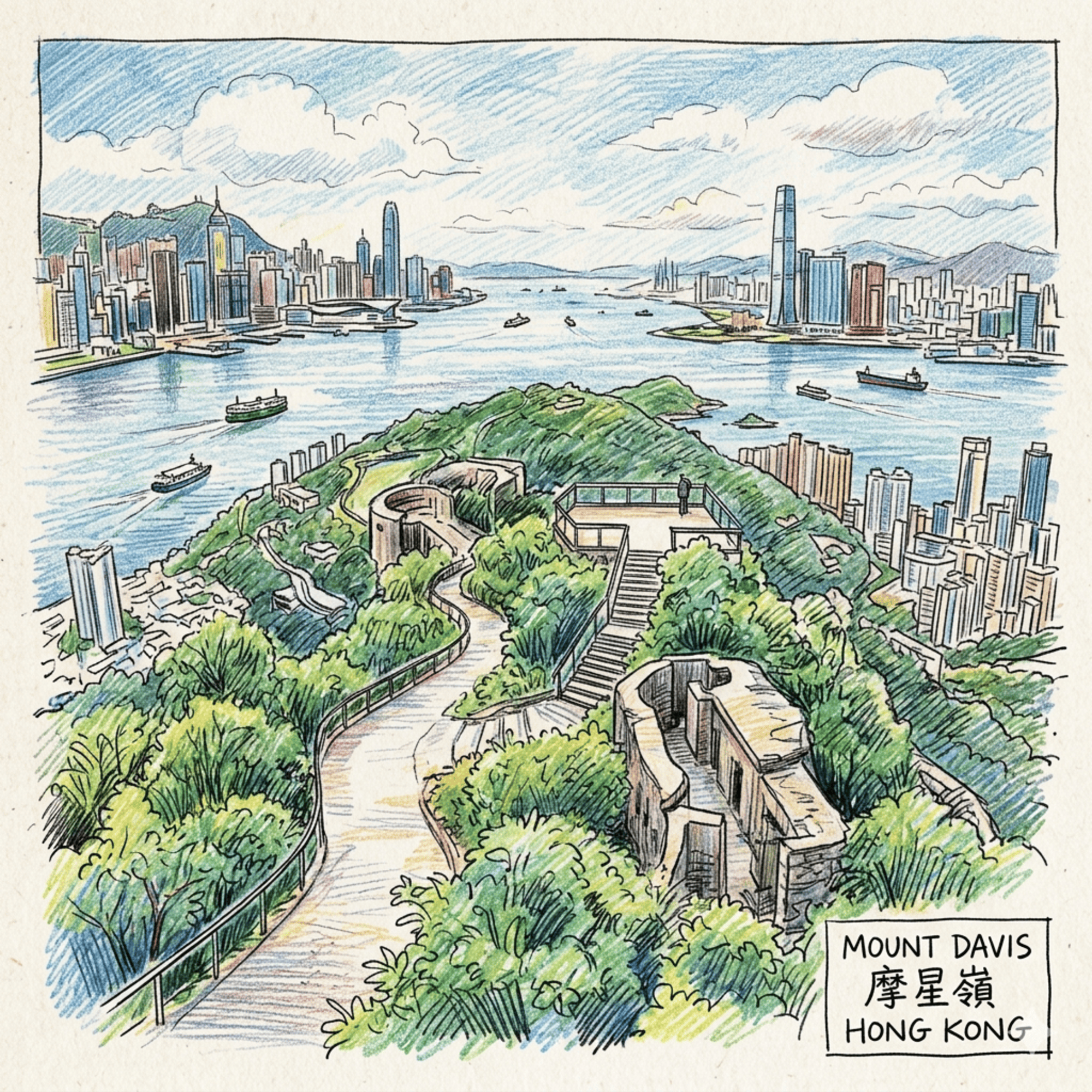
Standing at 269 meters on the westernmost precipice of Hong Kong Island, Mount Davis (摩星嶺) serves as a bruised sentinel over the Sulphur Channel. To the casual observer, it is a verdant escape for hikers, yet to the cultural historian, it functions as a profound spatial archive—a palimpsest where the concrete marrow of British imperial defense, Cold War paranoia, and marginalized social histories are etched into the landscape. Mount Davis is not merely a hill; it is a site where military ruins, elite academic institutions, and ancient cemeteries do not sit side-by-side but are vertically stacked through time. Understanding this peak requires a walking perspective, a slow ascent to witness how the "lived experience" of the past is embedded in the current urban fabric. Here, the physical world transitions from a defender of the British Empire to a repository of narratives often excluded from the city's glossy self-portraits.
Listen to the historical stories told in detail (For subscribers only)
The Gibraltar of the West: The Rise and Self-Destruction of the Fort
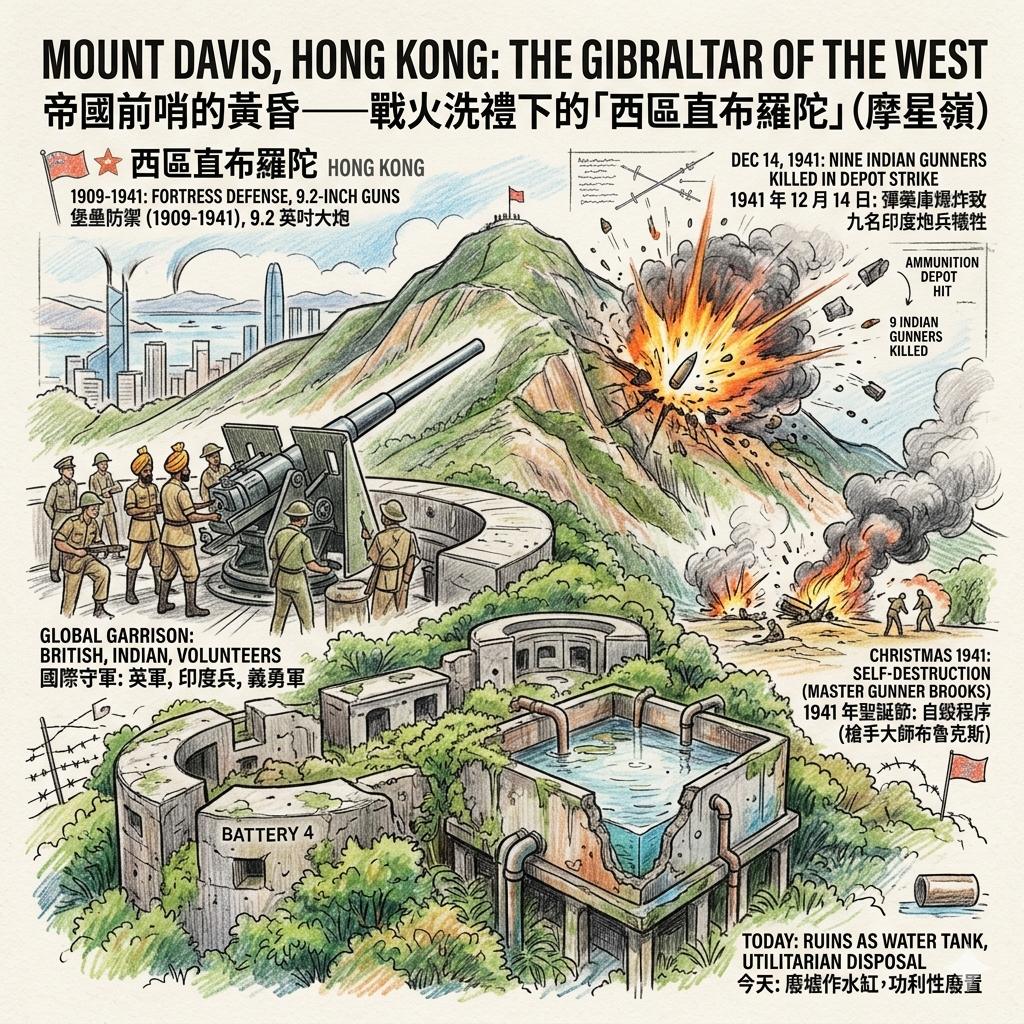
From 1909 to 1941, Mount Davis was the physical manifestation of the British Empire’s "fortress defense" mentality. Designed to protect Victoria Harbour’s western approach against rising Far Eastern powers, the fort was completed in 1912. However, its strategic zenith was short-lived; by 1936, following the constraints of the Washington Naval Treaty and a shifting focus toward landward defense, two of its massive 9.2-inch guns were dismantled and relocated to Stanley.
The fort’s history challenges simplified "East vs. West" narratives by highlighting the multinational nature of its garrison. The defense was a global tapestry of British regulars, local volunteers, and Indian artillerymen. The cost of this diversity was recorded in blood on December 14, 1941, when a Japanese shell struck the ammunition depot, killing nine Indian gunners—a poignant reminder of the global lives spent defending a colonial outpost. The fort’s final days were harrowing; RSM Enos Charles Ford’s diary recounts soldiers persisting through power outages and water shortages as shells from Japanese 240mm howitzers breached the bunkers. On Christmas Day, 1941, rather than surrender their technology, the garrison executed a final act of self-destruction, blowing up the remaining guns. Today, Battery 4 has been repurposed as a common water tank, a prime example of Hong Kong’s utilitarian disposal of history, where the ruins of empire are forced into the service of urban infrastructure.
The "White House": Cold War Phantoms in a Glass Cage
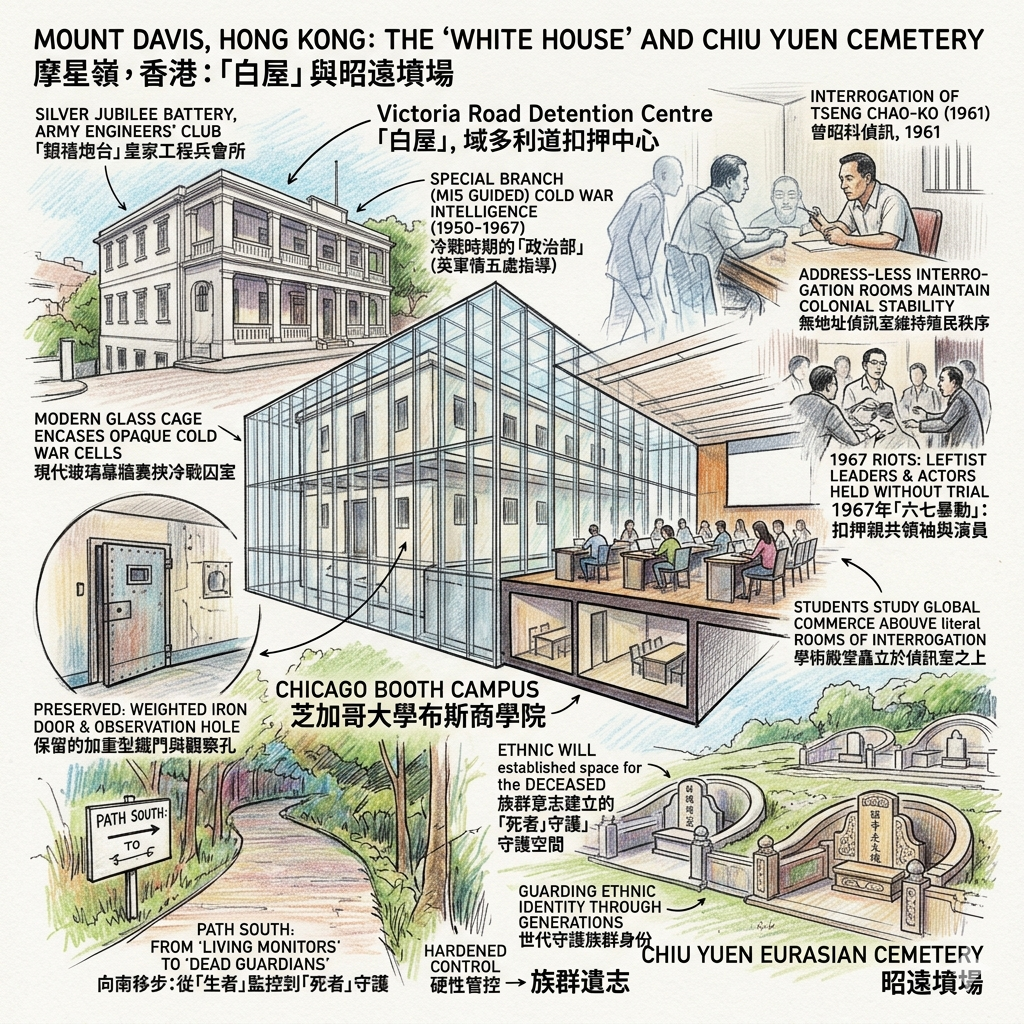
At the intersection of Victoria Road and Mount Davis Path sits a site of profound opacity: the Victoria Road Detention Centre, or the "White House." This site was physically anchored in the remains of the pre-WWII Silver Jubilee Battery, originally an army engineers’ club, before being repurposed by the Special Branch—a secretive political police unit guided by MI5—to serve as the front line of Cold War intelligence between 1950 and 1967.
The White House represented a "state of exception" where address-less interrogation rooms maintained colonial stability through "hardened control." It was here that high-profile figures like the suspected communist spy Tseng Chao-ko were interrogated in 1961, and where leftist leaders and actors were held without trial during the 1967 Riots. In a striking architectural irony, the site has been transformed into the Chicago Booth campus. The modern, transparent glass architecture now encases the opaque, oppressive cells. The university has meticulously preserved the weighted iron doors and observation holes, creating a jarring juxtaposition where students of global commerce study atop the literal rooms of political interrogation.
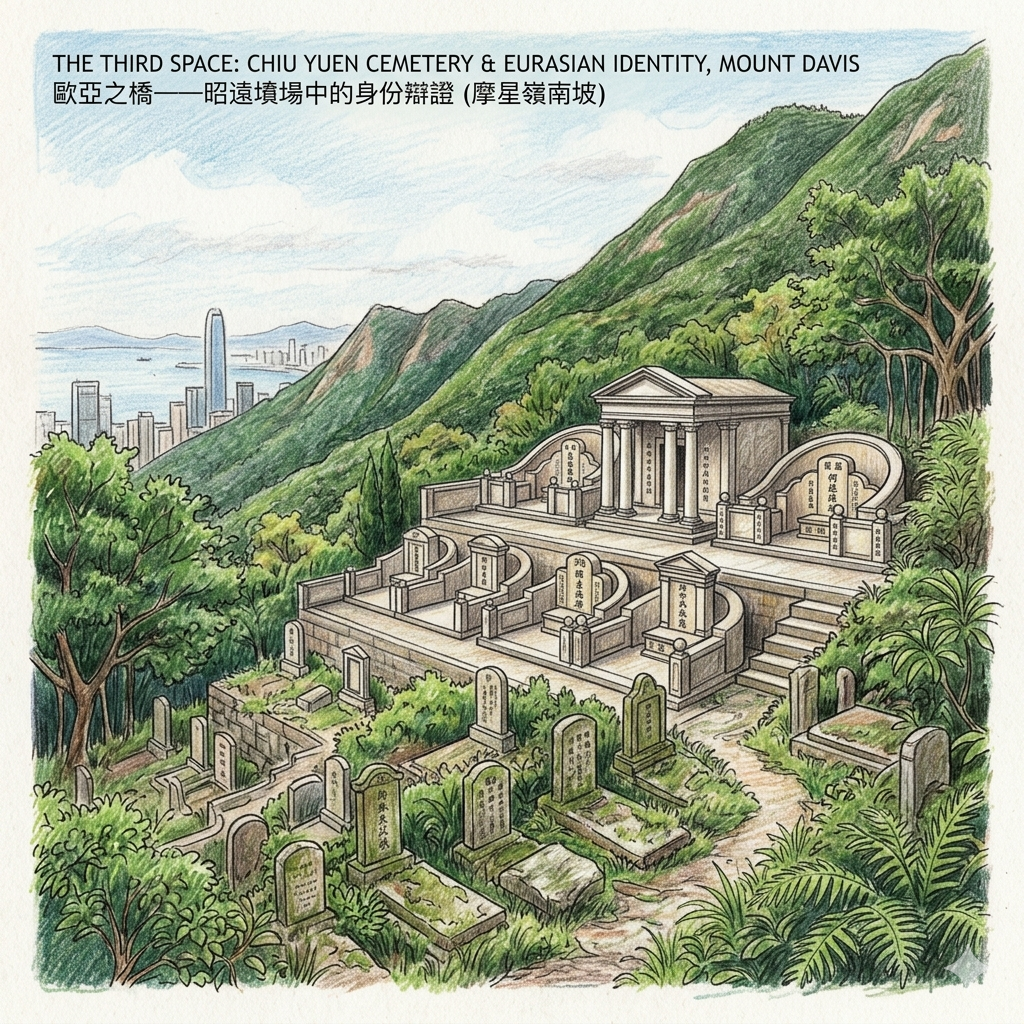
The Third Space: Chiu Yuen Cemetery and Eurasian Identity
On the mountain's southern slopes, the Chiu Yuen Cemetery (昭遠墳場) functions as a site for identity construction for Hong Kong’s early Eurasian community. Established in 1897 through the lobbying of Sir Catchick Paul Chater and the Ho Tung brothers, this cemetery provided a permanent "Third Space" for a community marginalized by both European and Chinese circles.
The layout of the "Ho Zhuang" (何莊), built in 1915, reflects a hybrid identity seeking legitimacy. To prove their social standing, the Eurasian elite adopted strict Confucian patriarchal structures more rigorously than many traditional Chinese families. The burial hierarchy is explicitly tiered: the patriarch at the summit, followed by wives, then descendants. As you walk the grounds, observe the bilingual epitaphs and neoclassical monuments positioned according to strict Feng Shui principles. This search for elite permanence via hybridity offers a sharp contrast to the unmarked, forgotten layers buried further down the slope.
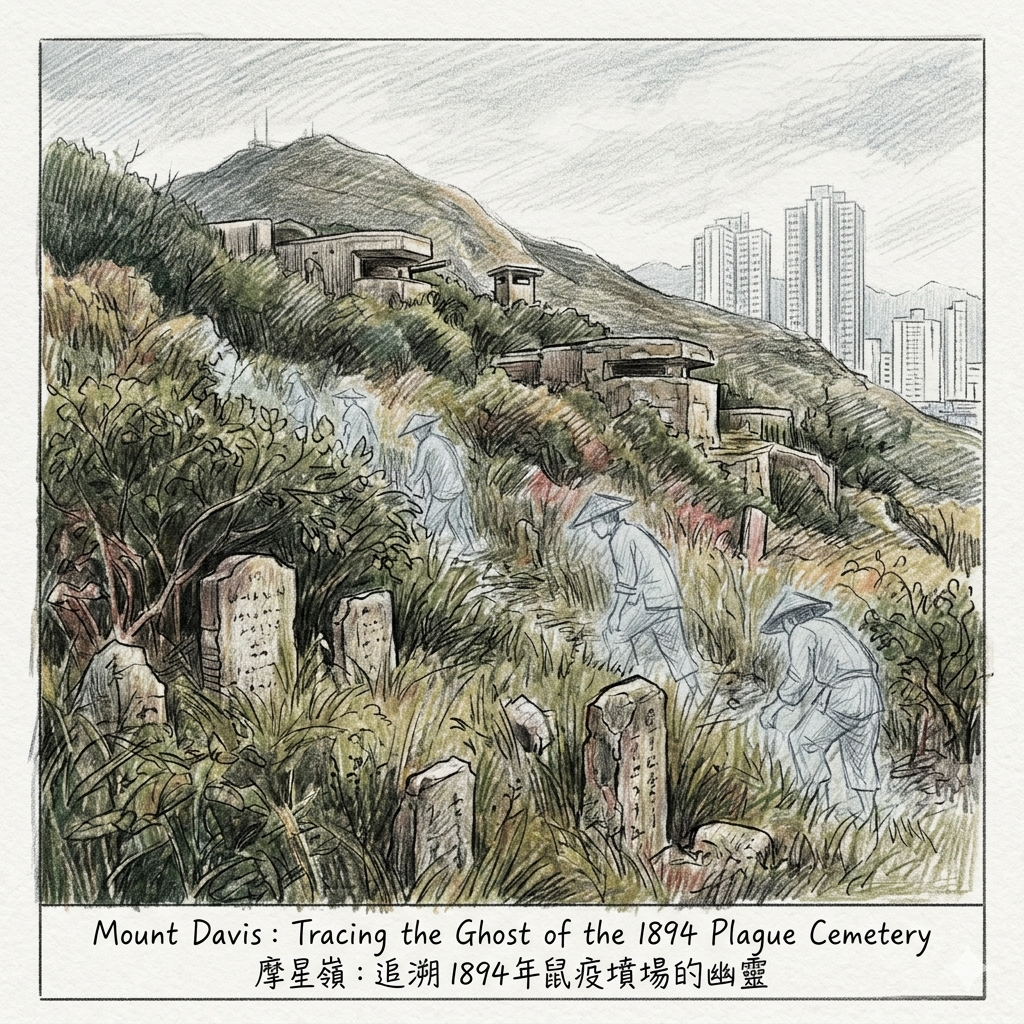
The Death Landscape: Tracing the Ghost of the 1894 Plague
Long before the military claimed the heights, Mount Davis was a "landscape of death." During the 1894 Plague, the colonial government utilized the mountain's isolation to manage the bodies of the Chinese working class—largely the "coolies" of the harbor docks. This was the site of the first traumatic collision between Western public health mandates and traditional Chinese mourning rituals. Today, this history is under renewed threat by public housing redevelopment plans, which risk erasing the final "death markers" hidden in the brush.
Survey of Plague Cemetery Relics
Relic Type | Physical Description | Historical Value |
Granite Headstones | Inscribed with "先友之墳" (Graves of Departed Friends) and regnal dates like Guangxu Dingyou (1897). | Documents the migrant laborers neglected by official histories. |
Boundary Obelisks | 8-10 foot tall granite pillars, square-topped and unlettered. | Marks the physical limits of the colonial "isolation zone" for the dead. |
Platform Ruins | Stone tiers on the southern slope directly beneath 1914 military paths. | Illustrates the spatial "overwriting" where military development literally displaced plague graves. |
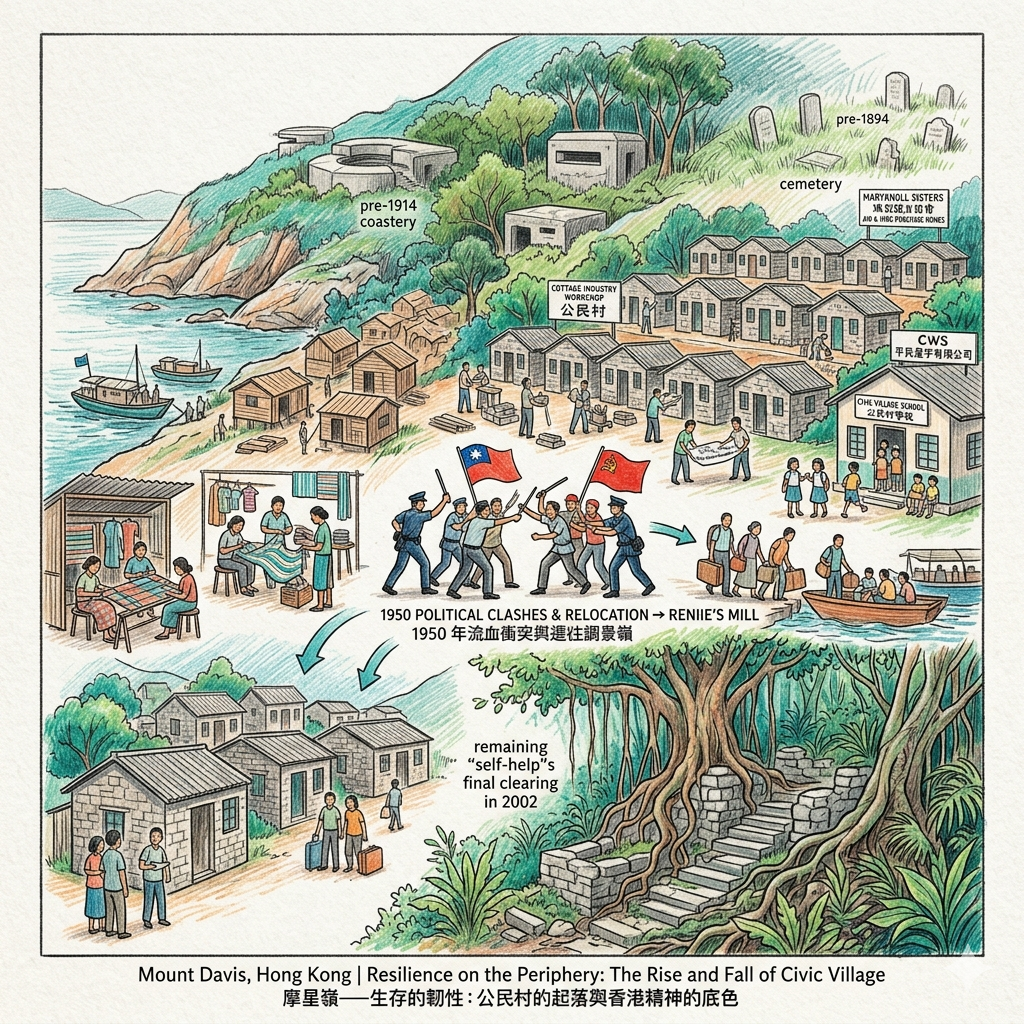
Resilience on the Periphery: The Rise and Fall of Civic Village
Following 1949, Mount Davis became a sanctuary for those fleeing the mainland, evolving from disordered squatting into the organized settlement of Civic Village (公民村). This was a site of "spontaneous order" where refugees, NGOs, and the government collaborated to build stone bungalows through hire-purchase schemes.
The village’s history is etched with political friction; in June 1950, violent clashes between pro-Nationalist and Leftist groups forced the government to relocate over 7,000 refugees to the remote Rennie's Mill (Little Taiwan). Those who remained forged a resilient "self-help" community, establishing their own schools and small industries before the village was finally cleared in 2002. Today, the encroaching banyan roots claim the remaining stone foundations, marking the transition from a living community back into the mountain’s silent strata.
Hidden Gems & Internal Narrative Links
For the traveler seeking a visceral connection to these layers, two sites are essential. The Mount Davis Artillery Command Headquarters remains a haunting skeleton of Empire; look for the ruins of the officers' drawing room and the tactical observation slots. Secondly, search for the remnant cement paths of Civic Village near Mount Davis Path, which offer a tactile connection to the vanished refugee community.
- Related thematic articles on Hong Kong’s cemeteries: [The Colonial Graveyards of Happy Valley]
- Broader city-level historical travel guide: [Western District Historical Guide]
Conclusion: The Layered Observation
Mount Davis is a microcosm of Hong Kong—a place defined by borders, defenses, and the constant "overwriting" of land. It is a site where the utilitarian needs of the present collide relentlessly with the heavy memories of the past. As we navigate its slopes, we are excavators of a landscape that has served as a shield for an empire, a prison for dissidents, a sanctuary for a marginalized elite, and a pit for the plague-stricken.
What does it mean to walk on ground where the living once displaced the dead, and where glass universities now stand atop interrogation cells and forgotten graves? Mount Davis reminds us that in this city, the earth is never just earth; it is a dense, compressed history of human survival and the relentless pursuit of order amidst constant change.
Sign up for the Historical Travel Stories newsletter for monthly deep-dives into the hidden archives of the world's most storied landscapes.
Travel Logistics (Navigating the Western Fringe)
- How to Get There: Take the MTR to Kennedy Town Station (Exit C). Transfer to the green minibus route 54 or begin the ascent on foot via Victoria Road to the start of Mount Davis Path.
- Recommended Accommodation: The Jockey Club Mt. Davis Youth Hostel sits atop the summit, offering immediate access to the WWII battery ruins and the heritage trail.
- Nearby Historical Tours: Seek out specialized walking tours focusing on the "Western District Military Trail" or the "Plague History of Kennedy Town" for guided spatial analysis.
Q & A
What are the most significant military and Cold War secrets here?
Mount Davis holds a complex history of clandestine operations, ranging from its role as a primary defensive fortification to its use as a secretive interrogation center during the Cold War. The most significant military and Cold War secrets are layered across the mountain's landscape:
1. The "Gibraltar of the Western Island" and the 1941 Self-Destruction
In the early 20th century, Mount Davis was the physical embodiment of British "fortress defense" in the Far East.
- The Heavy Battery: It was equipped with 9.2-inch BL Mk X guns, which were among the most powerful coastal artillery pieces at the time, designed to counter heavy armored warships.
- The Ultimate Sacrifice: During the Battle of Hong Kong in 1941, the site was heavily bombarded by Japanese forces. On December 25, just before the surrender, British Master Gunner Charlie Brooks executed a secret self-destruction procedure to blow up the remaining guns and facilities to prevent them from falling into enemy hands.
- Multicultural Defense: The garrison was a global mix of British, local Hong Kong volunteers, and Indian gunners, nine of whom were killed when a shell directly hit the ammunition depot.
2. The "White House": Cold War’s Secret Interrogation Base
At the foot of the mountain lies a group of buildings known as the "White House" (the former Victoria Road Detention Centre). This was perhaps the most secretive site in Hong Kong during the Cold War.
- Special Branch (SB) Headquarters: It was operated by the Special Branch, a secret wing of the police guided by British MI5. The site was used for counter-espionage, political screening, and monitoring both pro-Communist and pro-KMT activities.
- Interrogation of High-Level Spies: The most famous secret held within its walls was the 1961 Tsang Chiu-ko case. Tsang, the Assistant Commissioner of Police, was exposed as a high-ranking CCP spy. He was detained and interrogated at the White House before being deported.
- The "Black Site" for Political Prisoners: During the 1967 Riots, the government used "emergency regulations" to detain leftist leaders and famous actors (such as Fu Qi and Shek Hwei) here without trial for long periods. The facility's oppressive design—narrow cells, poor ventilation, and late-night interrogations—earned it the nickname "The Devil's Cave" in local lore.
- Invisible on Maps: For decades, the site had no official address and was either omitted from maps or labeled simply as government land to maintain its secrecy.
3. The Hidden "Death Landscape" (Plague Cemetery)
One of the older "secrets" of the mountain is a forgotten mass burial site related to the 1894 plague.
- Forced Secrecy: The colonial government used the then-remote Mount Davis to bury plague victims from the bottom rungs of society, such as dockworkers (coolies).
- Physical Markers: While largely forgotten by the public, the site is still marked by hidden granite headstones dating back to the Qing Dynasty (e.g., 1897) and boundary obelisks that once defined the limits of this infectious disease burial zone. Many of these graves were later built over by military paths or housing, a process described as "the living driving out the dead".
4. The Prelude to "Little Taiwan" (Mount Davis Refugee Camp)
In 1950, Mount Davis was the site of a volatile political secret involving the influx of refugees from Mainland China.
- The 1950 Conflict: A bloody clash broke out between pro-KMT refugees living in camps on Mount Davis and local leftist groups.
- Strategic Relocation: To prevent a wider political uprising, the British government executed a massive, sudden operation to move 7,000 refugees from Mount Davis to the remote Rennie's Mill (Tiu Keng Leng). This event was the secret origin of the "Little Taiwan" community that existed in Hong Kong for decades.
Today, the "White House" has been transformed into the University of Chicago Booth School of Business, where modern glass walls now enclose the original detention cells and heavy iron doors, serving as a permanent, though often overlooked, monument to these Cold War shadows.
What does the Eurasian cemetery reveal about Hong Kong's mixed identity?
Chiu Yuen Cemetery (昭遠墳場), located on the southern slope of Mount Davis, served as a foundational site for the formal establishment and identity construction of Hong Kong’s Eurasian community. In the 19th century, this community occupied a precarious "marginalized" position, often rejected by both the European elite and traditional Chinese society. This exclusion extended to the afterlife, as the Hong Kong Cemetery was primarily for Europeans and Christians, while traditional Chinese cemeteries often discriminated against those of mixed race.
The role of the Eurasian community at Chiu Yuen Cemetery can be understood through several key aspects:
- Establishment of a Recognized Social Class: In 1897, Sir Robert Ho Tung and his brother Ho Fook successfully lobbied Governor William Robinson to grant the land as a permanent resting place specifically for Eurasians. This act transformed the community from a marginalized group into a distinct and legally recognized social stratum within Hong Kong.
- Cultural Synthesis and the "Third Space": The cemetery serves as a "Third Space" where traditional binary racial categories (Chinese vs. British) were challenged. It reflects a unique cultural fusion; for instance, the "Ho Chuang" (何莊) burial site, built in 1915, utilizes Neoclassical Western architecture while strictly adhering to traditional Chinese Feng Shui and Confucian hierarchical structures.
- "Self-Awareness of the Marginalized": To assert their legitimacy and social status, Eurasian families often practiced traditional Chinese rituals—such as specific burial rankings for wives and concubines—even more strictly than some "pure" Chinese families. This demonstrated a conscious effort to prove their cultural orthodoxy.
- A Bridge for Modernization: The prominent families buried there, such as the Ho Tung and Ho Hung-sun (Stanley Ho) families, acted as vital economic and political bridges between East and West. Their dual identity, reflected in tombstones that often feature both Chinese and English names, was instrumental in driving Hong Kong’s modernization and global trade.
- Community Trust and Management: Although often associated with the Ho Tung family, the cemetery remains a public space for the entire Eurasian community, with the Ho Tung family serving as the original trustees. This distinction highlights the collective nature of the site as a communal anchor rather than just a private family plot.
Ultimately, the role of the Eurasian community at Chiu Yuen Cemetery illustrates that Hong Kong's identity was built on cultural fluidity and resilience in the face of social pressure, rather than a single, "pure" heritage.
Reference and Further reading
- 摩星嶺|綠洲Oasistrek, accessed April 25, 2026,
- Mount Davis Battery [c.1912- ] | Gwulo, accessed April 25, 2026,
- Showcasing, Contextualizing, and Explaining the Diversity of Human Experiences in Combat Using gis: The Battle of Hong Kong in 1941 as an Example in - Brill, accessed April 25, 2026,
- 摩星嶺要塞古蹟徑 - 香港自遊樂在18區, accessed April 25, 2026,
- [香港山女] 摩星嶺二戰軍事遺址探秘| Fitz 運動平台, accessed April 25, 2026,
- 域多利道扣押中心- accessed April 25, 2026,
- 摩星嶺歷史遊 - 活力環島長廊, accessed April 25, 2026, x
- 摩星嶺「白屋」變校園 - 主頁, accessed April 25, 2026,
- Special Branch (Hong Kong) - accessed April 25, 2026,
- 'Patriotism to You Can Be Revolutionary Heresy to Us': Hardened ..., accessed April 25, 2026,
- 《摩星嶺下》紀錄片放映及座談會 - 邵逸夫堂, accessed April 25, 2026,
- 何東身份認同的心結, accessed April 25, 2026,
- No Mixed Blood, No Mixed Bones: The Ongoing Saga of Hong Kong's Eurasian Cemetery, accessed April 25, 2026,
- 香港大老何東 - 創業群俠傳, accessed April 25, 2026, x
- 昭遠墳場及何莊- 古蹟天行樂Skywalker's Heritage - 天行足跡, accessed April 25, 2026,
- Chiu Yuen Cemetery 昭遠墳場 With Dr. Joseph Ting, Andrew Tse and David Ho - The University of Hong Kong Museum Society, accessed April 25, 2026,
- 從墳場特色看香港歷史發展, accessed April 25, 2026,
- 討論文件中西區文教會文件第13/2020 號保育堅尼地城前公民村鼠疫 ..., accessed April 25, 2026,
- 摩星嶺前公民村遺址將建公屋碩果僅存的「鼠疫墳場」遺跡恐遭破壞?在工程開展前追溯香港百多年前的鼠疫歷史- 明周文化, accessed April 25, 2026,
- Abandoned cemetery on south-east slope of Mount Davis [1856 ..., accessed April 25, 2026,
- 當年今日收回「小台灣」調景嶺發展將軍澳| 飛凡香港 - 當代中國, accessed April 25, 2026,
- 非政府機構對戰後香港房屋建設的貢獻, accessed April 25, 2026,
- Wing Lee Development Construction Holdings Limited 榮利營造控股有限公司 - HKEXnews, accessed April 25, 2026,
- Unsettling Exiles: Chinese Migrants in Hong Kong and the Southern Periphery During the Cold War 9780231558211 - DOKUMEN.PUB, accessed April 25, 2026
Lawrence Lawrence
 Lawrence