(ENG) Brick Hill Has No Bricks: What's Buried Beneath Hong Kong's Theme Park
Nam Long Shan is often just seen as the backdrop to Ocean Park, but it holds layers of Hong Kong's deepest history. This walking guide takes you through five forgotten stories, uncovering 3,000-year-old rock carvings, a vanished brick factory, and wartime remnants on a scenic southern hike.

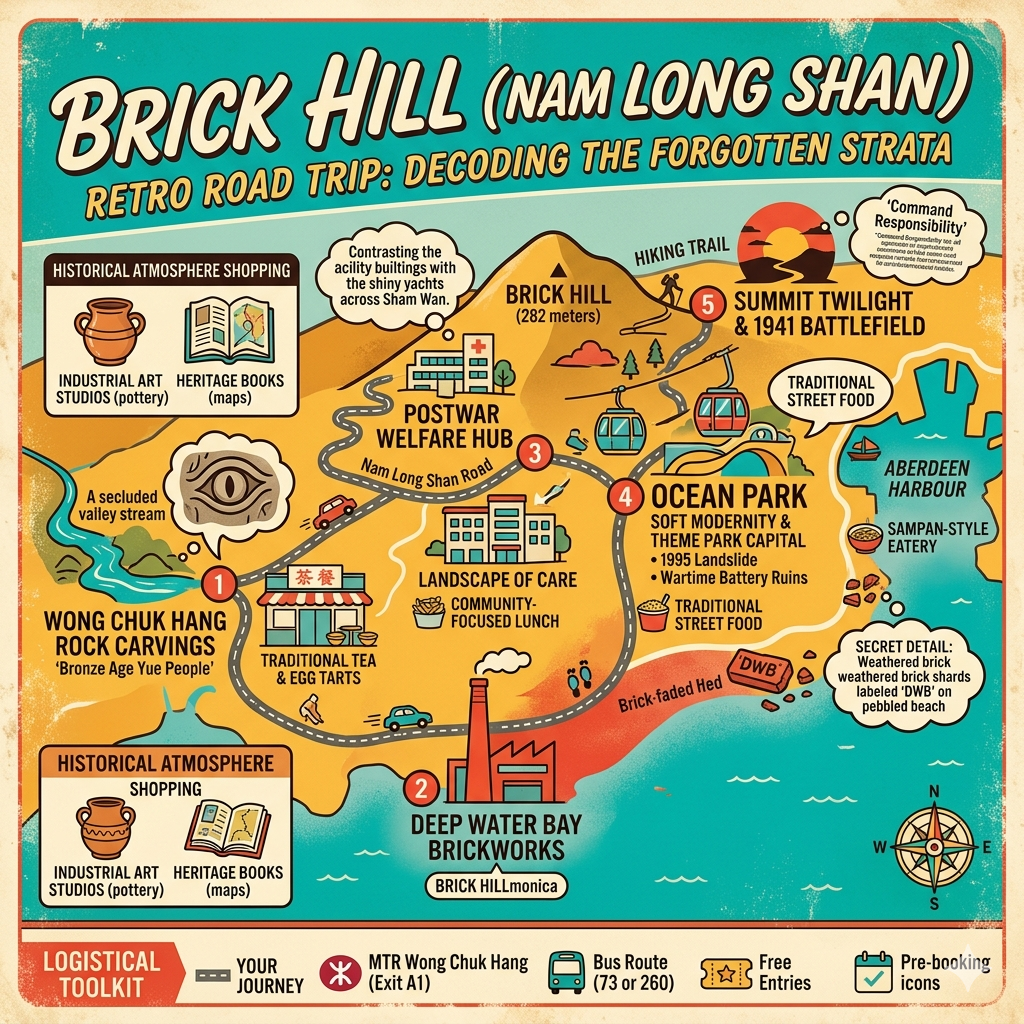
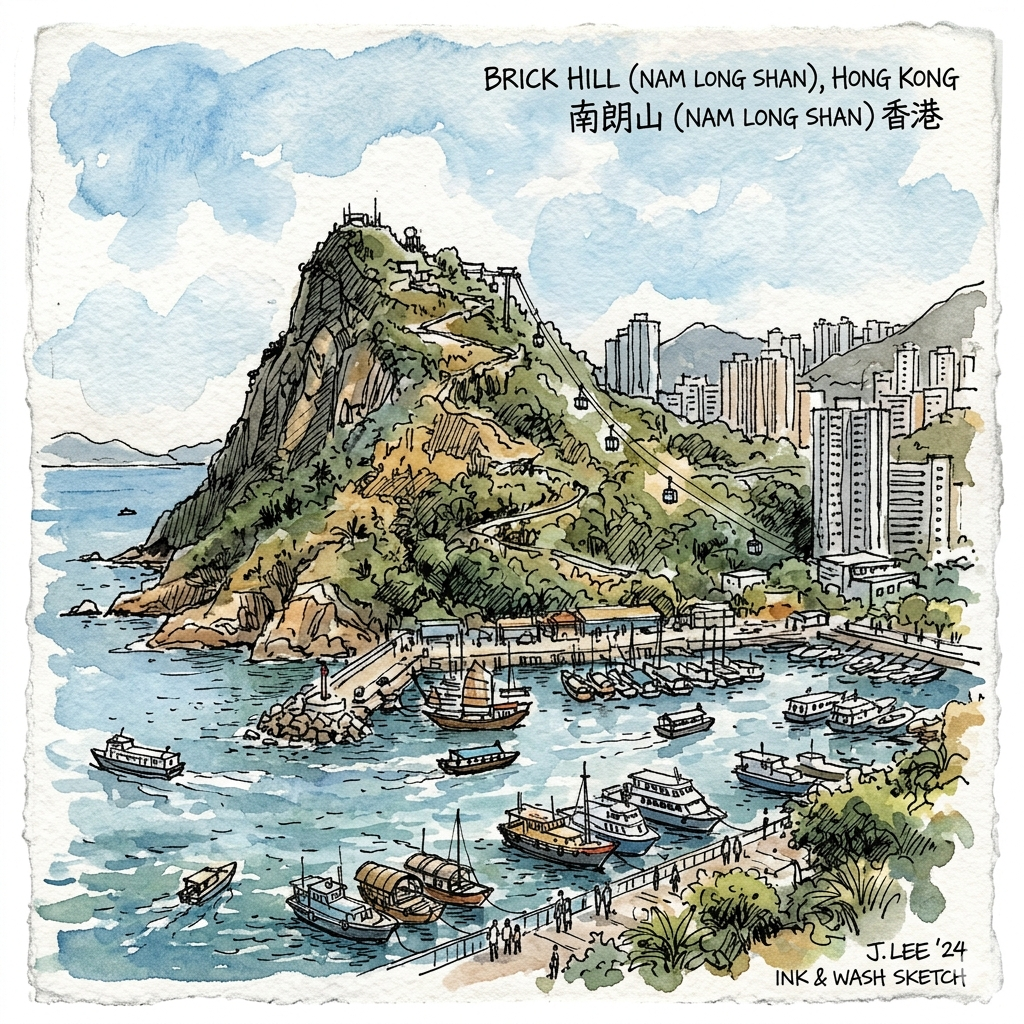
This is a historical travel story and walking guide to Nam Long Shan, a 284-meter peak standing right next to Hong Kong's famous Ocean Park. Moving away from the screams of rollercoasters, this guide explores five forgotten layers of history hidden on this hill, from 3,000-year-old ancient rock carvings and a vanished colonial brickworks to World War II military ruins. Through this unique hiking route and landscape perspective, readers will discover an honest, multi-dimensional story of Hong Kong’s Southern District that goes far beyond mass tourism.
 Lawrence
There's a particular kind of irony in standing at the top of Nam Long Shan, looking down at a giant fluorescent-green seahorse logo glowing on the hillside, and realizing that the hill's English name has nothing to do with anything you can currently see. Brick Hill. There isn't a brick in sight. There's a roller coaster, a cable car gliding overhead, a scatter of hikers checking their phones for the best sunset angle over Telegraph Bay's yacht moorings, and — somewhere down in Aberdeen — the screams of people on a ride called Hair Raiser. No bricks. The name just sits there, printed on trail maps and road signs, doing nothing, explaining nothing, daring nobody to ask why.
Almost nobody does ask. Why would they? It's a 284-metre hill on the south side of Hong Kong Island, mostly known as "the hill behind Ocean Park." It doesn't make anyone's list of must-see heritage sites. It has no plaque worth photographing, no temple, no colonial mansion with a view. And yet if you stop halfway up the stone steps — not for the view, just because your legs are asking you to — you are standing on one of the most historically overcrowded small hills in Hong Kong. Not overcrowded with people. Overcrowded with time. A three-thousand-year-old ritual site. A vanished Victorian brick factory. A massacre that nobody put a plaque on. A cluster of welfare institutions that has been quietly operating for over fifty years without anyone noticing. And a theme park that was, almost literally, built on top of all of it.
Listen to the historical stories told in detail (For subscribers only)
Before there was a name for any of this
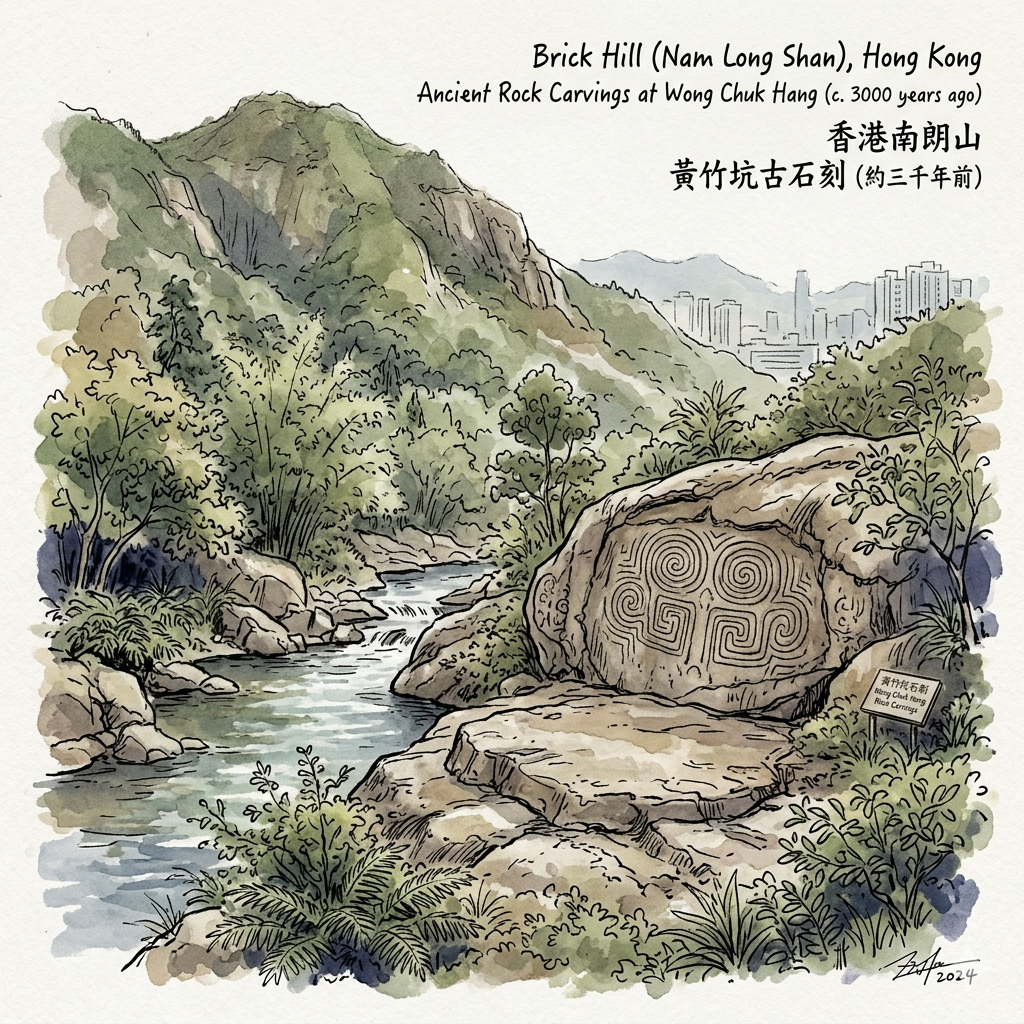
Three thousand years ago, there was no Hong Kong, no British, no concept of "South China" as a single place. There were coastal Yue peoples living off the sea, and at some point one of them — or several of them, over generations — crouched by a stream at the base of what's now called Nam Long Shan and carved spirals and meander patterns into the rock at Wong Chuk Hang. The carving was declared a statutory monument in 1984. The Antiquities and Monuments Office describes the motifs as resembling tribal totems or deities, and suggests the flat rock in front of the carving may have served as a gathering or ritual platform.
May have. That's an honest word, and it's doing real work in that sentence, because nobody actually knows. What makes this particular carving interesting to archaeologists isn't the carving itself — Hong Kong has eight of these — but its location. The other seven all sit directly on headlands, facing the sea. This one is over a kilometre inland, next to a freshwater stream. Was the sea level higher three thousand years ago, close enough to reach this spot? Or was the stream itself, not the ocean, the thing that mattered to whoever carved this? Nobody has resolved that question, and to their credit, nobody seems to be pretending otherwise.
I find that more useful than certainty. A travel write-up that tells you exactly what an ancient carving "means" is usually lying to you a little. A rock that comes with an honest shrug attached is, in its own way, closer to what history actually feels like.
The hill that kept its industrial name and lost everything else
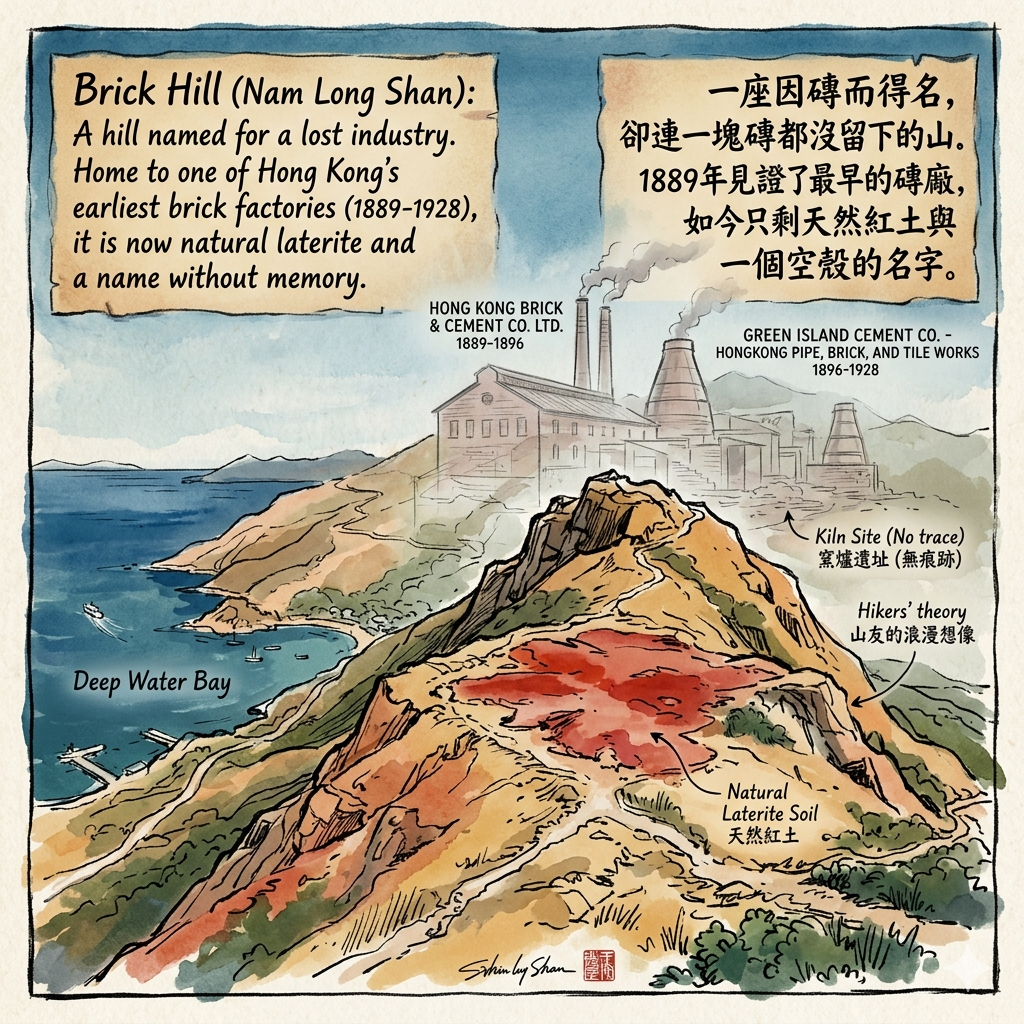
Fast-forward to 1889. At the western end of Deep Water Bay, a company called the Hong Kong Brick & Cement Co. Ltd. opened a factory producing machine-pressed building bricks, firebricks, and clay drainpipes for a colony that was expanding faster than it could build itself. This was one of the earliest brick factories in colonial Hong Kong — which is worth sitting with for a second, because the popular version of Hong Kong's industrial history tends to start the clock in the 1950s, with refugees from the mainland filling factory floors. This factory predates that story by six decades.
It didn't last. Undercapitalised and in financial trouble, the company was absorbed in 1896 by the Green Island Cement Company, which reorganised the site as the Hongkong Pipe, Brick, and Tile Works. It kept running until 1928, when it closed for good, apparently at a loss. The buildings came down. The kilns are gone. There is no documented physical trace of the factory left on the ground today.
And yet the name survived. "Brick Hill" outlived the brickworks by nearly a century, still showing up on maps decades after the factory itself had been demolished, sold off, and forgotten. This is, as far as quirks of Hong Kong toponymy go, a fairly unusual one: an English place name that exists purely to commemorate an industrial enterprise which has otherwise left no trace whatsoever — and almost nobody who uses the name knows that's what it's doing. The name outlived the building. The memory outlived the object. Except the memory has been hollowed out — it's just a sound now, repeated by hikers and minibus drivers who have no reason to wonder what it once referred to.
Some hikers point to a patch of reddish ground near the summit and suggest it's a remnant of the old clay pits — a neat, satisfying theory. The less romantic and probably more accurate explanation is that it's just natural laterite soil, unrelated to any quarrying at all. That gap, between the romantic story and the verified one, is where most popular history quietly lives.
What happened after the surrender
This next part is heavier, and I want to be careful with it.
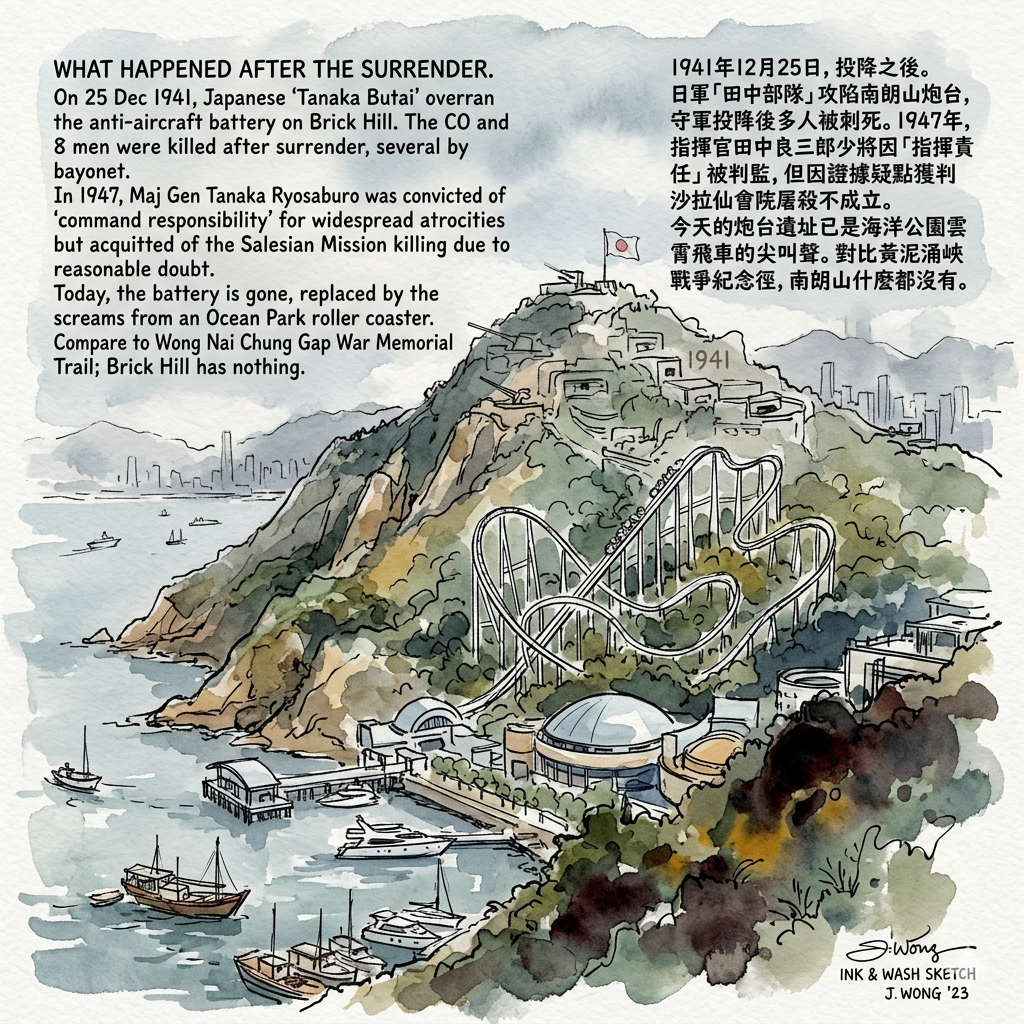
On the day Hong Kong fell — 25 December 1941 — Brick Hill held a Heavy Anti-Aircraft battery, manned by the Hong Kong Singapore Royal Artillery. Twelve days earlier, the battery had shot down a Japanese aircraft. By Christmas Day, Japanese forces — specifically the unit referred to in the historical record as the Tanaka Butai, the 229th Regiment — had pushed south through Wong Nai Chung Gap, Shouson Hill, and Repulse Bay, and overran the position. After the gunners surrendered, the commanding officer and eight of his men were killed. Several, according to the record, by bayonet.
This wasn't an isolated incident. The same unit, moving along the same line of advance, is documented in connection with several other killings of surrendered or captured personnel that December — at the Salesian Mission in Sau Ki Wan, at the Eucliffe estate in Repulse Bay, and in the area around Shouson Hill and Little Hong Kong afterward. Brick Hill sits on that same chain of events, as one of its less-discussed links.
In 1947, the regiment's commanding officer, Major General Tanaka Ryosaburo, was tried before British Military Court No. 5 in Hong Kong on three charges. The court found him guilty on the first two — relating to the mistreatment and killing of prisoners of war and surrendered personnel — and sentenced him to twenty years. The legal basis wasn't that he had personally ordered the killings, but that the violence had been widespread enough, under his command, that failing to prevent it carried responsibility of its own — an early application, in this part of the world, of the command-responsibility doctrine that had just been tested in the Yamashita case in the Pacific.
What I find genuinely instructive — and a little unsettling — is that the same court acquitted him on the third charge, the Salesian Mission killings specifically, because the evidence left reasonable doubt as to whether the unit responsible for that particular massacre was actually his. Even in a case where the broader pattern of atrocity was not in question, pinning a specific killing to a specific chain of command turned out to be something the evidence couldn't fully support.
I mention that not to soften anything, but because it says something true about how history actually gets recorded: even well-documented atrocities can fracture, at the level of specific responsibility, into gaps that no court, archive, or historian can fully close. The cruelty isn't only in what happened. It's also in how much of the truth about exactly who did what gets lost along with the people who could have told you.
Today, the Brick Hill battery site was completely demolished in 1975 during the construction of Ocean Park. Some accounts suggest a few wartime structures may survive somewhere between the Ocean Theatre and Pacific Pier, inside the paid area of the park — unmarked, unexplained, not part of any tour. Compare that to Wong Nai Chung Gap, which has a proper War Memorial Trail with interpretive panels and public access. Brick Hill has nothing. A place where men were bayoneted after surrendering now produces, instead, the sound of people screaming on a roller coaster.
The side of the hill nobody photographs
If you only ever come up here for the sunset, you'll never notice that the western slope of Nam Long Shan has quietly housed a cluster of welfare institutions for more than fifty years — institutions that have never once made it into a travel article, because there is nothing photogenic about them.
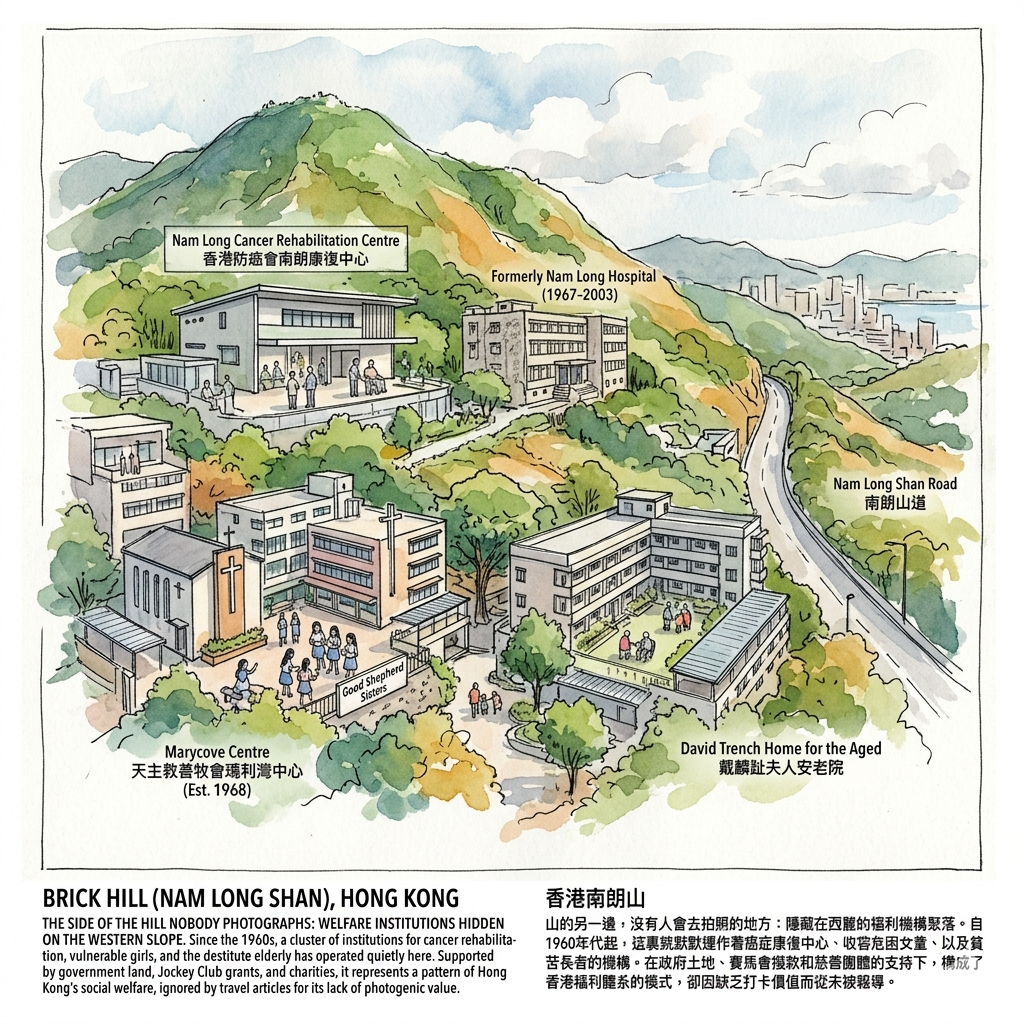
In 1967, the Hong Kong Anti-Cancer Society opened Nam Long Hospital on Nam Long Shan Road — the territory's first hospital dedicated specifically to cancer patients, built with an initial donation of HK$2.65 million and eventually expanded to 180 beds. From 1987 it offered one of Hong Kong's earliest hospice services. It stopped operating as an inpatient hospital in 2003, and with a Jockey Club grant of over HK$100 million, was converted into the Cancer Rehabilitation Centre that still operates there today.
In the same period, in 1968, the Catholic Sisters of the Good Shepherd — a congregation founded in seventeenth-century France, dedicated to women and girls who had been harmed by society — established Marycove Centre on the same hillside, a residential facility for vulnerable young women. Nearby sits the David Trench Home for the Aged, named after the governor who served from 1964 to 1971. Three entirely different categories of people society had decided needed to be cared for somewhere out of sight — the dying, at-risk girls, the destitute elderly — ended up on the same patch of hillside, not because anyone planned it that way, but because the land happened to be available and nobody else wanted it.
That's not a coincidence; it's a pattern. Government land, Jockey Club money, religious or voluntary organisations doing the actual work — that hybrid funding model has been quietly holding up large parts of Hong Kong's social welfare system since the late colonial period, and Nam Long Shan may be one of the places where its physical footprint is most concentrated.
None of it photographs well. So none of it gets written about.
Building a theme park between two ruins
Which finally brings us to Ocean Park — though I'd ask you to look at it a little differently than usual.
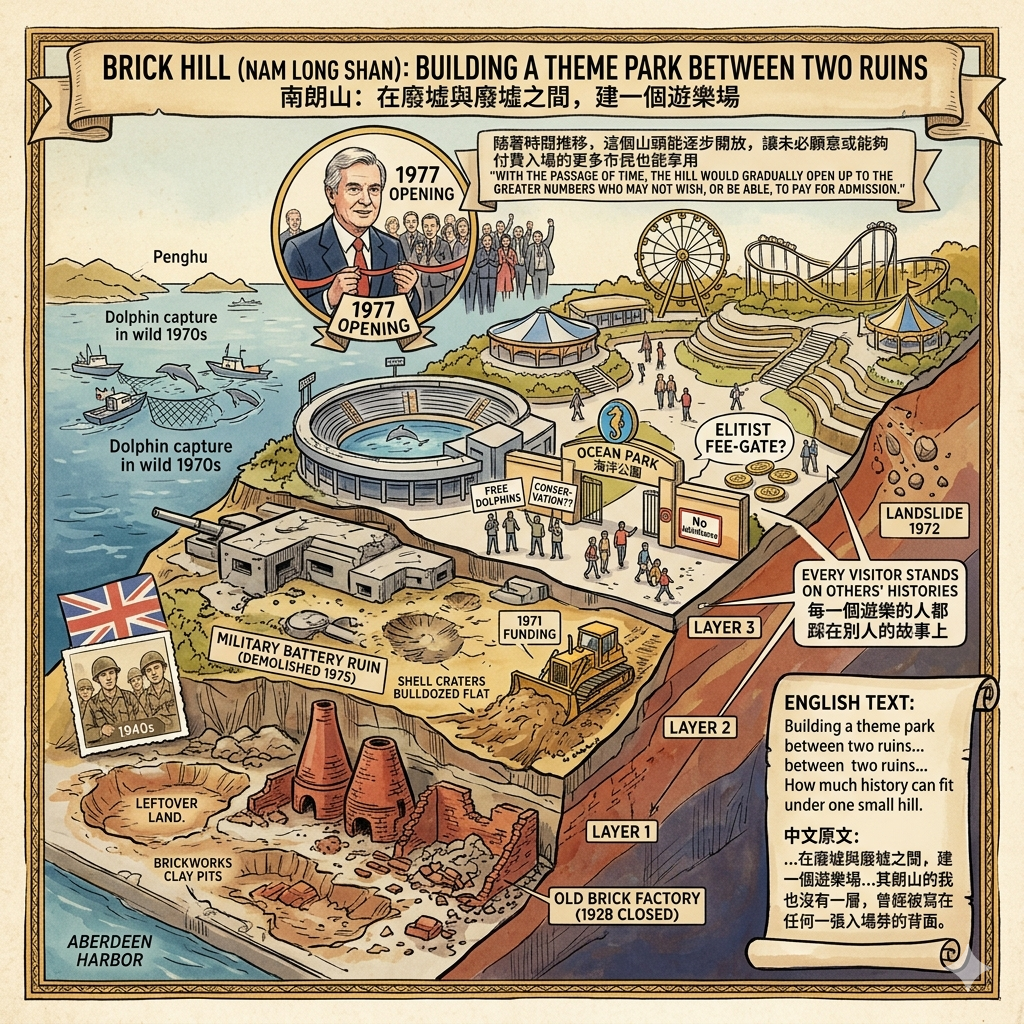
The idea of an "oceanarium" first showed up in the press in 1959. In 1967, the government offered to grant roughly 69 hectares at Brick Hill, Aberdeen, free of charge — land that, by then, had no other use left in it. The brickworks had closed in 1928; the battery would be demolished in 1975. It was, in the most literal sense, leftover land, valuable mainly because nobody else wanted it. In 1971 the Hong Kong Jockey Club took over funding, put up around HK$150 million, hired an American marine biologist as lead consultant, and sent a team to the Philippines, Japan, and Taiwan's Penghu islands to capture dolphins.
The park opened on 10 January 1977, with Governor Sir Murray MacLehose presiding. His opening remarks were, notably, a little defensive — he expressed hope that "with the passage of time," the hill would gradually open up to "the greater numbers who may not wish, or be able, to pay for admission to all its attractions" — an oblique response to criticism, already circulating before opening day, that the park was an elitist, fee-gated affair. Construction had been dogged by landslides, a fire, cable car delays, and two outbreaks of disease that killed 38 dolphins, four whales, and five seals before the park even opened to the public.
A park branded around "education and conservation" carried, from day one, a contradiction it has never fully shaken off. That tension is still alive: animal welfare groups continue to question the conservation value of keeping marine mammals in captivity, and to point out how far the park's early practice of capturing wild dolphins sat from the mission it claimed to serve. I'm not going to pretend to resolve that here. I just want to flag that telling this story as either an uncomplicated "pride of Hong Kong" narrative, or an uncomplicated tale of cruelty, both flatten something genuinely more complicated than either version allows.
What's worth sitting with, instead, is the literal ground the park stands on. It wasn't built on a clean lot. It was built, quite directly, over the wreckage of what came before it — the brickworks' old clay pits, the battery's shell craters, all of it bulldozed flat and paved over before the seahorse went up. Everyone who buys a ticket and walks through the gate is standing on three, four, five layers of other people's history, and not one of those layers makes it onto the back of the ticket.
How much history can fit under one small hill
Nam Long Shan is 284 metres tall. It wouldn't crack the top hundred hills in Hong Kong by elevation. But measured by historical density, it might rank near the top: a prehistoric ritual landscape, a colonial industrial ruin, a wartime massacre site, a half-century-old cluster of welfare institutions, and a piece of theme-park modernity, stacked on top of one another with almost no overlap between them — and yet, oddly, all sharing the same underlying logic. This hill has always been the place that got used because nothing else wanted it: needed for industry, needed for defence, needed for people the city preferred not to look at, needed eventually for a theme park. What it has never been needed for is remembering.
Next time you're standing on the rock at Nam Long Pavilion, watching the lights come on across the yachts in Telegraph Bay while the roller coasters scream somewhere behind you, it might be worth remembering that the "brick" in this hill's name hasn't existed for a hundred years — and that what the hill has actually held onto, this whole time, is something no trail sign will ever tell you: a quiet, layered silence, with no plans to be disturbed.
Q & A
What are the hidden layers of history beneath Ocean Park?
Beneath the modern commercial image of Ocean Park lies a dense, multi-layered history of Nam Long Shan (Brick Hill). This history spans over three thousand years, evolving from a prehistoric ritual site to a colonial industrial hub, a tragic World War II battlefield, a post-war welfare settlement, and finally a modern theme park.The following five hidden layers define the historical landscape of the area:
1. Prehistoric Ritual Landscape
Long before any formal political entity existed in Hong Kong, the foot of Nam Long Shan served as a site for Bronze Age maritime rituals roughly 3,000 years ago.
- Wong Chuk Hang Rock Carvings: This site features patterns of spiders, spirals, and abstract eye-like motifs.
- Geographical Mystery: Unlike most other prehistoric carvings in Hong Kong that are located directly on coastal capes, these are situated by a stream about a kilometer inland. This suggests either higher sea levels in the past or that the stream itself was considered a spiritually significant body of water.
2. Colonial Building Material Industry (1889–1928)
The English name "Brick Hill" is a direct legacy of a Victorian-era industrial enterprise that has almost entirely vanished from the physical landscape.
- Early Industrialization: In 1889, the Hong Kong Brick & Cement Co. Ltd established a factory at the western end of Deep Water Bay to produce bricks and drainage pipes.
- Green Island Cement: The factory was later acquired by Green Island Cement in 1896 and operated until 1928.
- Memory through Names: While the kilns and offices are gone, the name "Brick Hill" remains on official maps, though most visitors today mistake it for a generic English translation rather than a tribute to this early industry.
3. The "Southern Route" War Atrocities (1941)
The hilltop was a site of significant tragedy during the Battle of Hong Kong in December 1941.
- Nam Long Shan Battery: A heavy anti-aircraft battery was located here. When it fell to the Japanese "Tanaka Unit" on December 25, 1941, the commander and eight soldiers were killed after surrendering, many by bayonets.
- Erasure of Memory: The ruins of the battery were completely demolished in 1975 to make way for Ocean Park. While some suspected wartime bunkers remain between the "Ocean Theatre" and "Pacific Pier," there are no official commemorative plaques, causing this history to be largely excluded from mainstream narratives.
4. Hidden Welfare Settlement (1960s–1980s)
The western slope of the mountain became a "welfare colony" for marginalized groups that the colonial government preferred to keep at the city's periphery.
- Nam Long Hospital: Established in 1967, it was Hong Kong's first specialized cancer hospital and a pioneer in hospice care.
- Diverse Care Network: The area also houses the Marycove Centre (for girls in crisis) and the David Trench Home for the Aged.
- Contrast of Landscapes: This "welfare cluster" exists in stark contrast to the nearby yacht clubs and international schools, yet it is rarely mentioned in travel guides because these institutions are not considered "attractions".
5. Theme Park Modernity and its Tensions (1959–Present)
The birth of Ocean Park in 1977 marked a shift toward "soft modernity" and a leisure economy, but it was built literally on the rubble of war and failed industry.
- The Hybrid Model: The park was developed through a partnership where the government provided land and the Hong Kong Jockey Club provided capital—a model also used for the nearby welfare institutions.
- Early Ethical and Geological Struggles: The park's early years were marked by animal welfare controversies (high dolphin mortality rates during collection) and geological instability, including a fatal landslide on Nam Long Shan Road in 1995.
Summary of Historical PatternsNam Long Shan represents a rare historical phenomenon in Hong Kong: peripheral land used as a recurring container for essential but "unvalued" functions—ritual, heavy industry, military defense, and social welfare. This history is often subject to systematic erasure, where commercial leisure facilities replace sites of war and labor, leading to a selective public memory.
What is the geological mystery of the prehistoric rock carvings?
The geological mystery surrounding the prehistoric rock carvings at Nam Long Shan (specifically the Wong Chuk Hang Rock Carvings) centers on their unusual geographical location compared to other similar sites in Hong Kong.
According to the sources, the mystery involves the following key elements:
- Distance from the Coast: While almost all other prehistoric rock carvings in Hong Kong (such as those at Big Wave Bay, Lung Ha Wan, and Po Toi) are located directly on coastal capes or headlands, the Wong Chuk Hang carvings are situated at least one kilometer inland next to a stream.
- The Geographical Anomaly: This makes them the only group among the eight listed prehistoric carvings in Hong Kong that is significantly removed from the sea (with the Shek Pik carvings being the only other partial exception).
This anomaly has led to two main competing theories, which remain a subject of debate in the archaeological community:
- Sea Level Changes: One hypothesis suggests that sea levels may have been higher 3,000 years ago, meaning the coastline might have once reached the vicinity of the stream where the carvings are located.
- Spiritual Significance of Fresh Water: Alternatively, it is possible that the ancient tribes viewed the stream itself, rather than the ocean, as a body of water possessing spiritual power (靈力), making it a significant site for ritualistic purposes.
The sources note that there is currently no academic consensus on which of these explanations is correct, leaving the true reason for the carvings' inland location a lingering historical and geological mystery.
Reference and Further reading
First layer – Main sources of literature and institutions:
- 香港古物古蹟辦事處(Antiquities and Monuments Office)——香港島法定古蹟名錄,黃竹坑石刻(1984年列為法定古蹟)官方說明
- 香港特別行政區政府古物諮詢委員會——法定古蹟名單(截至最新公布版本)
- 香港政府憲報(Hong Kong Government Gazette),1889年4月20日刊
- 《孖剌西報》(China Mail),1889年12月28日
- 《士蔑西報》(The Hong Kong Telegraph),1902年4月14日、1910年1月22日
- 《香港星期日先驅報》(Hong Kong Sunday Herald),1932年1月10日
- 英國國家檔案館(The National Archives, UK)——WO 172/1687(戰時作戰日誌);WO235/1030(戰爭罪行審判案卷)
- 香港大學圖書館「香港戰爭罪行審判檔案」(Hong Kong's War Crimes Trials Collection, HKU Libraries) ——田中良三郎案完整案情紀錄,包括控罪、判決、求情及判決確認日期
- 香港浸會大學「1941年香港戰役:空間史研究計劃」(The Battle of Hong Kong 1941: A Spatial History Project, HKBU)——軍事構造資料庫,部分數據源自1941年防務計劃(Defence Scheme)及英國國家檔案
- 香港防癌會賽馬會癌症康復中心(JCCRC)官方機構歷史頁面「關於我們」,記載南朗醫院創立、擴建及轄屬轉移之具體年份及資助金額
- 維基百科「南朗醫院」、「南朗山」條目(屬二級整理資料,建議透過醫院管理局歷史檔案進一步覆核具體年份數據)
- 香港賽馬會慈善信託基金(Charities & Community, HKJC)官方紀錄——海洋公園批地及資助歷史說明
- 海洋公園官方網站「機構資料」(General Facts) 頁面
The second layer – secondary academic materials:
- 香港大學圖書館數碼典藏「香港古石刻」(Rock carvings in Hong Kong, HKU Digital Repository)
- TRACCE(國際岩畫研究網絡)關於香港古石刻的綜合介紹,比較其紋飾與華南、華北青銅時代印紋陶器及青銅器紋飾的關聯
- Twentieth Century Impressions of Hong-Kong, Shanghai, and Other Treaty Ports of China, ed. Arnold Wright(Lloyd's Greater Britain Publishing Company, 1908)——當時對深水灣磚廠之詳細記述
- 青洲英坭有限公司(GICH)官方企業歷史頁面「關於青洲英坭」,記載公司1887年於港註冊及1896年接手深水灣磚廠之過程
- Kwong Chi Man and Tsoi Yiu Lun, Eastern Fortress: A Military History of Hong Kong, 1840–1970(Hong Kong University Press, 2014)
- Philip Cracknell, Battle for Hong Kong, December 1941(Amberley Publishing, 2019, 2021年再版)
- "Feeding Refugees, Saving Souls, and Planting Churches: Lutheran Ministry in 1950s Hong Kong" 及相關論文,刊於 International Journal of Asian Christianity, Vol. 3, Issue 1 (2020, Brill)
- Glen Peterson, "To Be or Not To Be a Refugee: The International Politics of the Hong Kong Refugee Crisis, 1949–1955," Journal of Imperial and Commonwealth History, 36:2 (2008)
- 相關刊於 Modern Asian Studies(Cambridge University Press)之香港戰後難民與西方人道機構研究論文
- 維基百科(英文版)"Ocean Park Hong Kong" 條目,引用《南華早報》1959年3月4日及1967年8月16日之歷史報導(屬二級整理,建議查閱《南華早報》原始檔案以核實具體報導內容)
Third layer – Supplementary information:
- 民間攝影與行山愛好者對石刻的觀察紀錄(Flickr、Wikimedia Commons 等),僅作補充參考,其中涉及具體圖像詮釋部分,建議進一步學術查證,不應視為定論
- Industrial History of Hong Kong Group(industrialhistoryhk.org)——香港工業史民間研究社群整理之檔案彙編,引用上述原始報章及憲報資料
- Gwulo.com 歷史社群討論——關於「Brick Works, Deep Water Bay」之檔案彙整及實物(磚塊)發現報告,部分細節建議進一步查證
- Gwulo.com 歷史社群——「Brick Hill AA Battery」檔案頁面整理之口述及檔案綜合紀錄
- battleforhongkong.blogspot.com(Philip Cracknell個人研究部落格)關於南朗山周邊戰役細節之補充討論
- 天主教善牧會香港分會官方網站「關於我們」頁面,記載歷年在港設立各服務中心的年份(1951、1968、1972、1974、1979年)——屬機構自述史料,建議以獨立檔案進一步覆核
- 《南華早報》Post Magazine 專題報導 "How Hong Kong's Ocean Park got off the ground 40 years ago"(2017年)
- 中文維基百科「深灣」條目,記載1995年8月13日南朗山道山泥傾瀉事件(建議向土力工程處查證正式調查報告原文)
- ParkVault、Localiiz 等海洋公園歷史愛好者整理文章
 Lawrence
 Lawrence
 Lawrence
This piece draws on an extended historical research dossier prepared for in-depth travel and history coverage. Readers with further interest in any of the five episodes are encouraged to consult primary sources directly — several details, particularly around the wartime occupation period, remain genuinely contested in the scholarly literature.