Sanxia: The Three-Corner Surge
A historical guide to Sanxia (Three-Corner Surge) in New Taipei City. Discover how five sacred orders—from 1895 militia battles to the masterfully carved Qingshui Zushi Temple—have left their marks on this historic Taiwanese river confluence.

 Lawrence
Five Sacred Orders at Sanxia's Water Gate
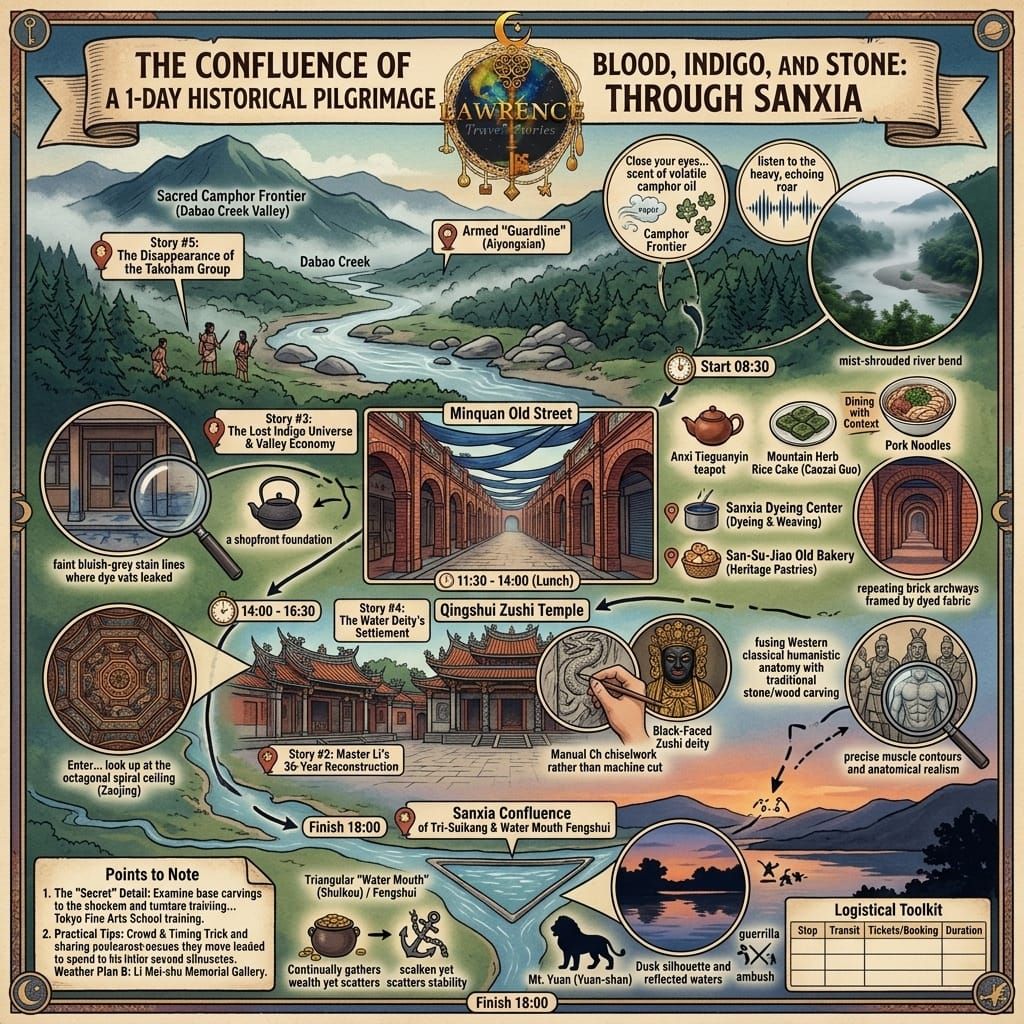
This is a historical travel story and walking guide to Sanxia (formerly Three-Corner Surge) in New Taipei City, Taiwan. Exploring the dramatic river confluence where the Dahan River and Sanxia Creek meet, this piece reveals how five distinct sacred orders—from Qing-dynasty water gods and 1895 militia resistance to Western-influenced temple art and camphor forests—have shaped and reshaped this historic town. Readers will gain a rich historical perspective, detailed walking routes, and a deep cultural narrative of Sanxia's enduring spirit.
The Japanese renamed this place in 1895, the year they acquired Taiwan by treaty. They gave it a literary name — Sanxia, Three Gorges — that carried faint echoes of the famous gorges on the Yangtze. But the Quanzhou settlers who had built their lives at this bend in the river over the previous century had called it something older and more accurate: Sānjiǎo Yǒng, the Three-Corner Surge. The name described a physical fact — the triangular confluence where the Dahan River and the Sanxia Creek collide and churn before flowing north together toward the sea — and contained, without intending to, a long-range prophecy about what this place does to every system of belief that arrives here.
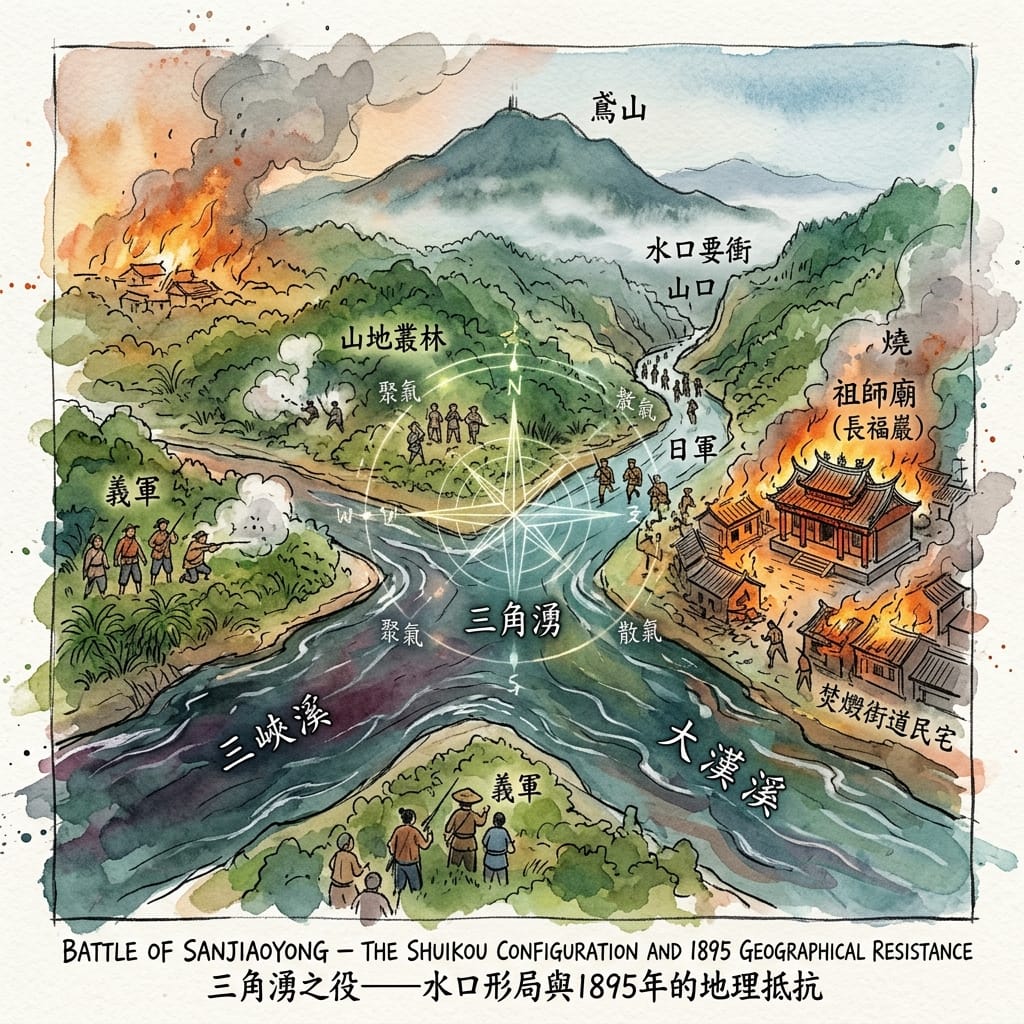
In Chinese geomantic tradition, the confluence is called the shuǐkǒu, the water gate: the decisive point where a settlement's vital energy either accumulates or disperses. Where waters gather and linger, wealth consolidates. Where they rush through and flee, nothing holds for long. Three-Corner Surge is a geomantic paradox. Water gathers here — the triangular confluence is a natural accumulation point — but gathers only to surge and rush away again. Full for a moment, then gone.
Five distinct systems of meaning have arrived at this water gate and believed themselves permanent. Five have been displaced, suppressed, dismantled, or economically destroyed. And five, without exception, have left something behind — a trace in the stone, a smell in the air, a name that refused its own erasure — that the replacement order could not entirely efface.
What follows are those five stories.
The Water Deity
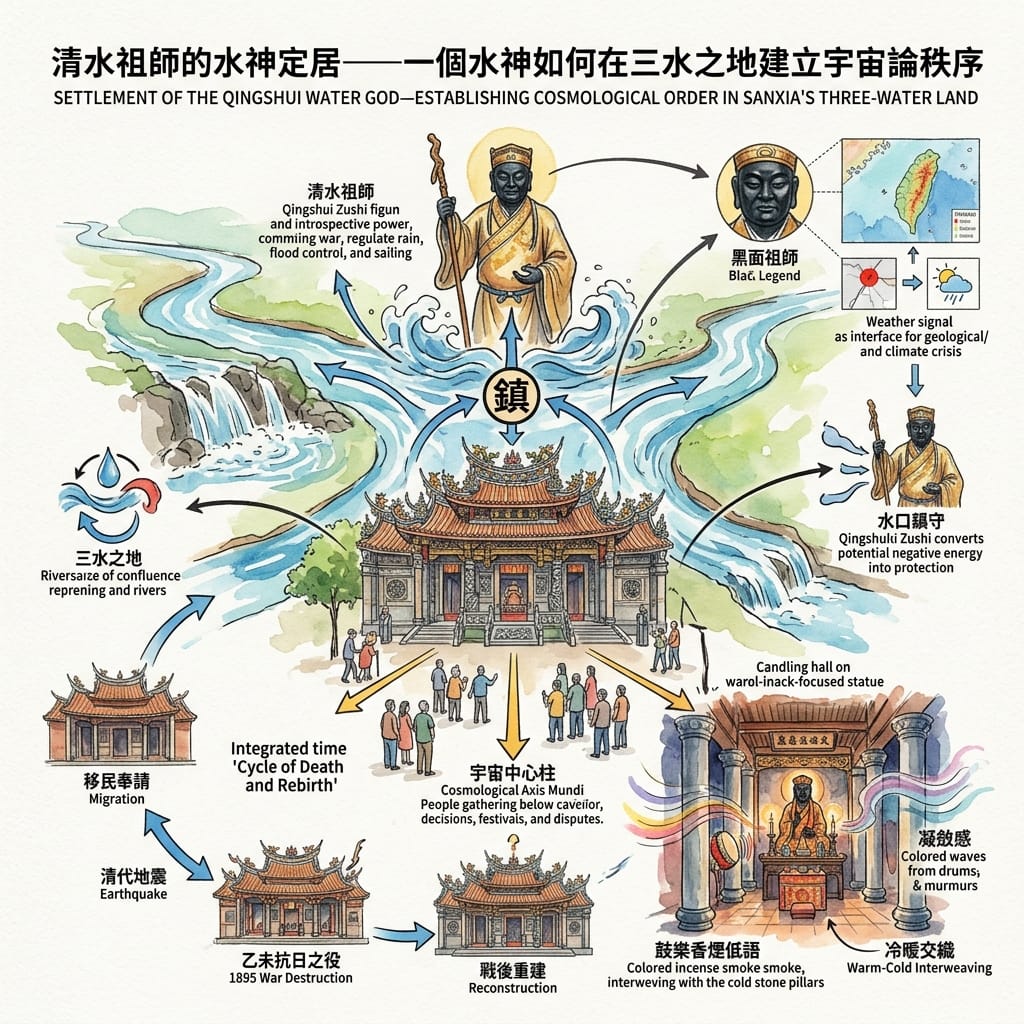
The settlers who founded Three-Corner Surge in the mid-eighteenth century knew precisely what kind of divine protection a turbulent water gate required. From the Anxi district of Fujian — the homeland most of them had left — they carried the cult of Qingshui Zushi, the Patriarch of Clear Water, and installed him as close to the confluence as the topography allowed.
The historical figure behind this deity was a Song-dynasty Buddhist monk who had practiced at Clear Water Rock in Anxi County, achieving fame for invoking rain in droughts, calming floods, and protecting the river routes that his community depended on for survival. His powers were, at their core, powers over water — the control of its excess, its scarcity, its danger. To place a water deity at a turbulent water gate was not a coincidence. It was a deliberate cosmological argument: the very forces that made this location difficult to inhabit could be bound, through the authority of the right divinity, into forces that protected it instead.
The Patriarch's face is black. Folk tradition accounts for this in several ways — a fire that scorched the original image, a ritual dyeing — but one persistent belief holds that the blackness deepens before earthquakes and typhoons, that the statue's face functions as an early-warning instrument for geophysical disturbance. What this belief reveals is not superstition but accumulated intelligence. A community living on one of the most seismically active islands in the world has encoded generations of environmental observation into the appearance of a divine face, converting the body of a god into a node in a collective sensing network. The temple is not only a place of worship. It is an early-warning system wearing the clothes of religion.
The temple has burned and been rebuilt more times than its current records can fully account for. Each cycle of destruction and reconstruction has been, at its heart, a cosmological act: a community reaffirming, in wood and stone and lacquer, that the sacred order it has built at this water gate has not been dissolved by fire. The fire, the rebuilding, the fire, the rebuilding — this rhythm is itself a form of memory, more durable in some respects than any archive.
Listen to the historical stories told in detail (For subscribers only)
The Summer of 1895
In April of that year, the Treaty of Shimonoseki transferred Taiwan from the Qing dynasty to the Japanese Empire. Local gentry declared a short-lived Taiwan Republic, which collapsed within months, its president fleeing to the mainland. What remained across the island were local militias — farmers, merchants, elders — who fought their corners of the territory without strategic command, without supply lines, without any realistic prospect of reinforcement.
Three-Corner Surge offered the militia one genuine advantage. Advancing south from Taipei, any military force had to cross the Dahan and the Sanxia Creek where those rivers were crossable. The crossings at a turbulent confluence are structurally unpredictable: channels shift seasonally, depths vary, the force of the water changes across short distances in ways that are difficult to calculate in advance. The militia positioned themselves along the water gate and used its hydrological character as a defensive asset. The same geography that made this settlement hard to hold — where accumulated wealth dispersed as quickly as it gathered — made it, from the inside, genuinely hard to take.
The Town Erased By Its Own Geography
The Japanese forces crossed nonetheless. When they did, they burned the streets. The Qingshui Zushi temple was damaged — how severely the record does not clearly say, since Japanese military documentation tended to record tactical outcomes rather than the fate of particular shrines. The names of the militia commanders who organized the defense have been largely lost, preserved, where they survive at all, only in fragmentary local sources. The precise civilian toll of the punitive clearance that followed the crossing remains poorly documented. This is not a coincidental gap. It is a predictable consequence of which side controlled the post-battle archive.
What the river kept was its confluence. The water continued north. The ruined streets and the damaged temple became, in their destruction, the origin point of the next story.
The Temple That Will Not Be Finished
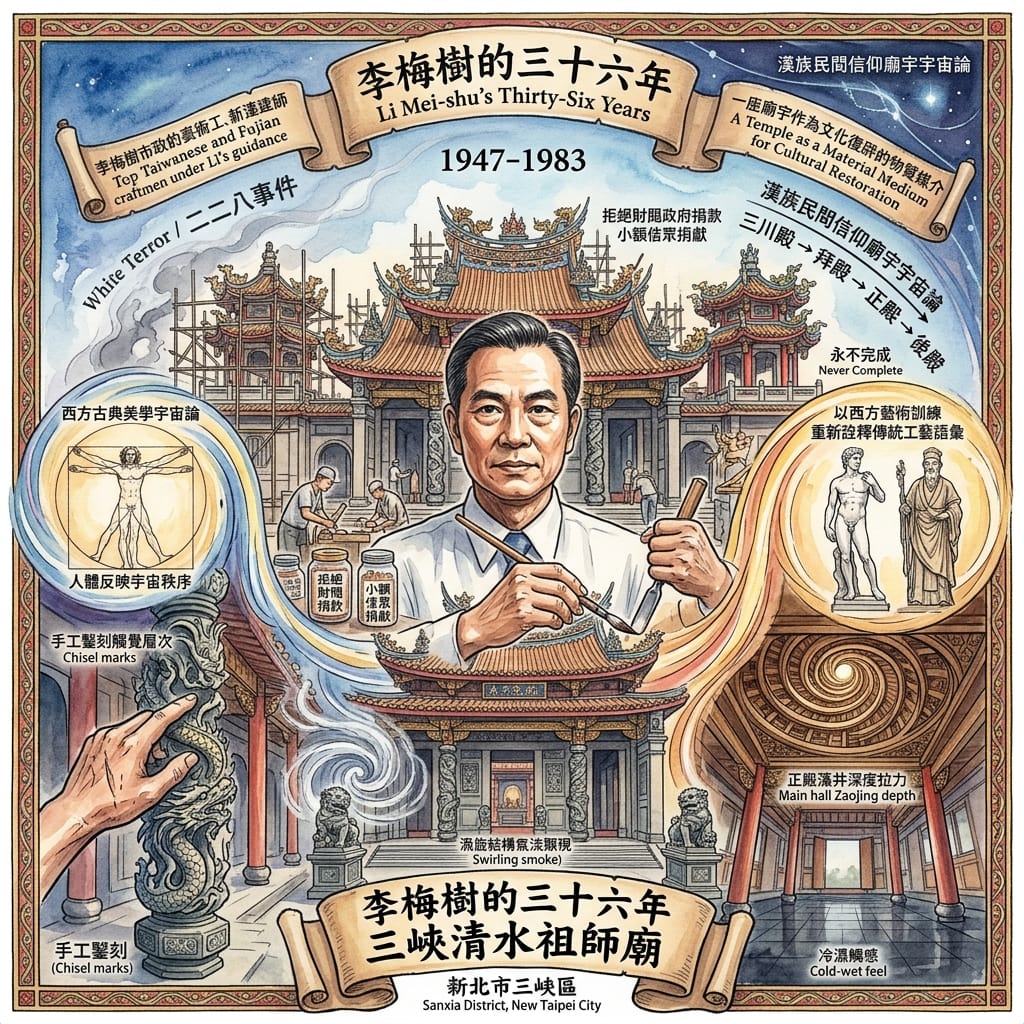
In 1947 — the year of the February Twenty-Eighth Incident and the beginning of the White Terror that would suppress Taiwanese cultural and political life for decades — a painter named Li Mei-shu accepted responsibility for the Qingshui Zushi temple's reconstruction.
Li (1902–1983) had trained at the Tokyo School of Fine Arts, where he absorbed the European painting tradition: its anatomy, its theory of proportion as the outward sign of inner order, its attention to how tension distributes across a body in motion. Back in Taiwan he had exhibited work at the colonial-era art exhibitions and served in local government. By 1947 he was a man in whom two very different systems of knowledge had been deposited, and who found, in the ruined temple, a problem that required both of them simultaneously.
He operated under three principles that he never compromised. He refused donations from corporations or government ministries, insisting that every funding relationship that might compromise aesthetic decisions be excluded from the project. He directed the reconstruction with the full authority of his European-trained eye, guiding craftsmen from Taiwan and the mainland toward a standard of execution that blended iconographic tradition with Western anatomical precision. And he decreed that the temple would never be declared finished.
The Temple Built With Western Anatomy
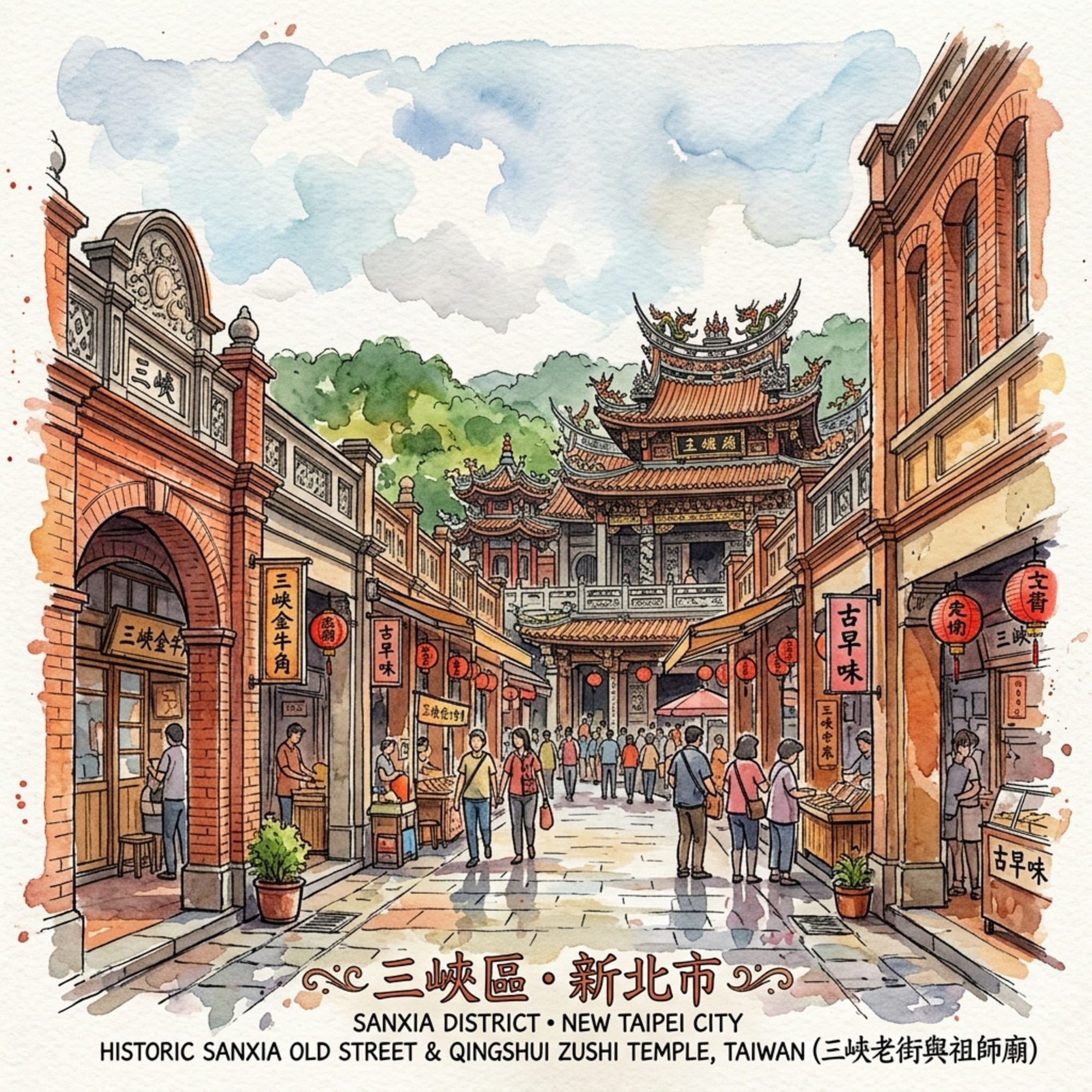
The evidence of these principles is directly accessible to anyone who visits. Run a finger down one of the dragon pillars on the main facade and you will feel individual chisel marks — each blow placed at a slightly different angle, each cut a unique negotiation between the tool and the stone, nothing mechanically repeated. The musculature of the dragons shows an anatomical precision that exceeds what devotional iconography requires: the precision of someone who has studied how bodies generate and distribute force. Two cosmological traditions — the European understanding of the body as the measure of cosmic proportion, and the Taiwanese temple tradition of divine representation — coexist in the same carved surface, neither subordinated to the other, neither translated into the other's terms.
The decree of permanent incompleteness, which might seem an artistic affectation, was in fact a political calculation of considerable subtlety. Under the White Terror, declaring the temple finished would have been to convert a living cultural process into a static monument — one more closed case, one more thing the state could regard as settled. Keeping the chisels moving meant keeping the culture alive. The incompleteness was the argument.
Li died in 1983, the work still in progress. The temple continues to be built.
The Blue That Disappeared
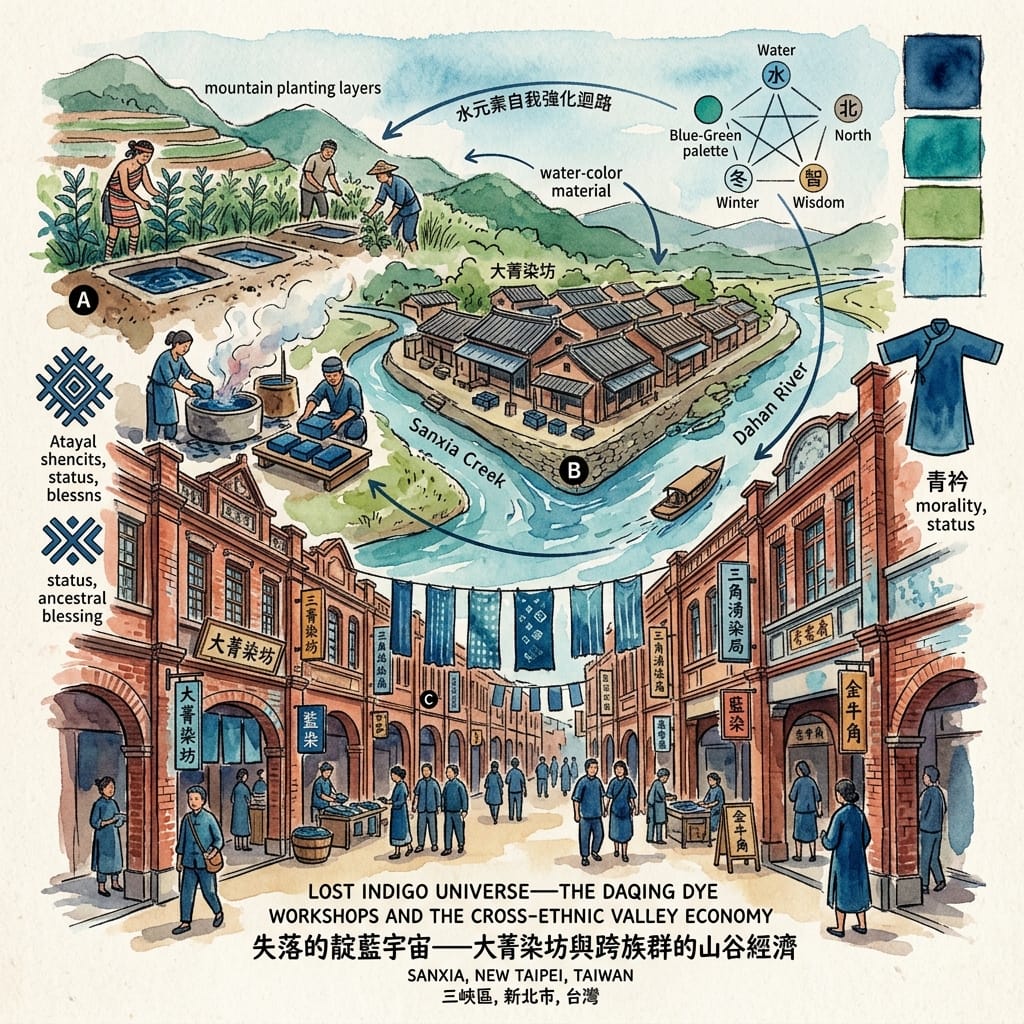
For most of the nineteenth century, Three-Corner Surge was one of the most important natural indigo production centres in northern Taiwan. The plant used was Strobilanthes cusia — called dà qīng in Chinese, mountain blue — cultivated on the hillside territories above the river valleys, harvested and carried down to the dyehouses along the Sanxia Creek, where fermentation and alkaline treatment converted the leaves into the blocks of indigo mud that were loaded onto boats on the Dahan River and shipped to markets on the mainland, in Southeast Asia, and in Japan.
In the vocabulary of the Five Phases — the Chinese cosmological system that maps the natural world through five elemental qualities and their correspondences — indigo belongs to the domain of water. Blue-black is water's colour. Water's attribute is the accumulation of hidden wealth, the slow gathering of what will eventually flow. That Three-Corner Surge, positioned at a triangular water gate, built its principal economy around producing the colour of water is the kind of alignment that the cosmological tradition would describe as appropriate — a confirmation that the site and its productions were, in some deeper sense, already matched to one another. The dyehouses ran along the creek, drew water as their medium, and produced a blue product that then flowed outward through the water routes. The element, its colour, and the trade moved in the same direction.
There is a detail that the scholarly literature has almost entirely failed to address: the hill territories where Strobilanthes cusia was cultivated were Atayal land. The Atayal people of the surrounding mountains had their own ceremonial relationship with deep-blue dyeing — indigo-dyed hemp threads carried specific significance in Atayal ritual weaving, marking identity and ancestral connection. The indigo economy of the Sanxia dyehouses must have intersected, in ways that have left no documentation, with Atayal land use and with the sacred meaning the plant held in Atayal culture. What was exchanged in those transactions, who held the power in them, what the Atayal understood themselves to be giving and receiving — none of this survives in any source I have been able to find. This silence is not an accident of archival preservation. It is an archival choice, made by people who judged that one side of the transaction was worth recording and the other was not.
The Indigo Empire Erased By A Lab
The German chemical industry ended the indigo economy with casual efficiency. When synthetic indigo reached mass production in the late nineteenth century, the price differential with natural indigo made the Sanxia dyehouses economically unviable within a generation. The Japanese Government-General restructured Taiwanese agriculture in ways that accelerated the process. By the 1920s, the dyehouses were closed, the mountain fields of dà qīng had returned to scrub, and the knowledge of the craft had aged out of the people who held it.
In the brickwork of the old street today, in the mortar between nineteenth-century courses of brick, you can sometimes see — if the light falls at the right angle, in the low sun of late afternoon — a trace of old pigment, a faint blue shadow in the grey. Nobody preserved it. Nobody decided it was worth keeping. The bricks absorbed it over decades of industrial use and have simply not let it go.
The Forest Above the Dabao
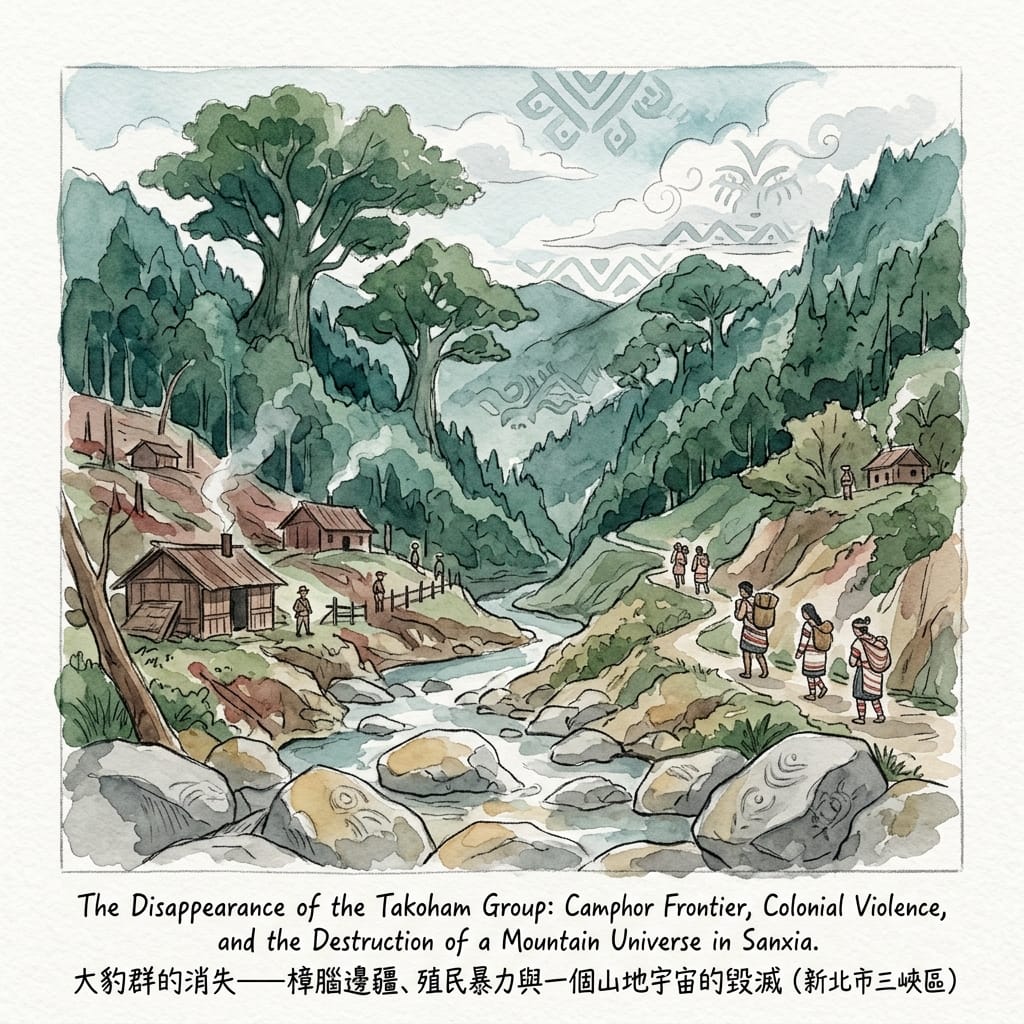
Higher in the hills, where the Dabao Creek runs between forested slopes before joining the main river system, the air in the warmer months carries something sharp and aromatic — camphor, rising from the warming bark and leaves of trees that have grown back, without instruction or assistance, over more than a century of slow recovery. The trees that produce this smell are not the trees that were here before. The original old-growth camphor forest was cleared long ago. These are the second-growth trees, reclaiming the hillside on their own terms.
The people who inhabited this valley before the clearing were the Takoham, a group within the broader Atayal confederacy, whose communities had lived along the Dabao Creek for generations. Their relationship to their territory was organised through a system of inherited law called gaga — a body of obligations and prohibitions, established by the founding ancestors, that governed access to hunting grounds, farmland, and sacred sites, and that bound the living community to both the ancestral dead and the land those ancestors had originally settled. The old-growth camphor trees — among the largest living things in the valley, some of them centuries old — were understood to be inhabited by utux, ancestral spirits. This was not a metaphor. In the Takoham understanding of how the world worked, the great trees were where the ancestors dwelt. To cut them down was to do something specific and irreversible to the dead.
Taiwan, at the end of the nineteenth century, supplied most of the world's natural camphor — an essential industrial compound in enormous demand. The Japanese colonial government monopolised camphor production, and advanced the extraction frontier into the mountains using armed force. The policy called riban — literally, the administration of the savages — combined military suppression with systematic dispossession. In the first decade of the twentieth century, the Takoham were subjected to military campaigns that caused severe population loss, followed by forced relocation that removed the survivors from the Dabao Creek valley permanently. Their forests were cleared. Their settlements were dismantled. Their territory was opened to Japanese camphor interests.
The Bloody Price Of Camphor
Forced relocation produces a specific and underappreciated form of injury. Memory situates itself in particular places — a specific creek, a specific slope, a specific root system. When communities are removed from those places, grief loses its address. The mourning cannot happen where it needs to happen, because the place that could hold the mourning is the same place from which the mourners were expelled. This is not a metaphysical claim. It is a description of what enforced displacement does to the people it is done to, and it applies here with full and undiminished force.
The oral tradition of the Takoham — what was lost, what the valley held, what the removal meant in the terms of their own cosmological understanding — is still carried by descendants living elsewhere. It has received only the beginning of the scholarly attention it deserves. Japanese administrative records document the campaigns from the administration's perspective, in the language of efficiency and pacification. The Takoham accounts of the same events — the utux displaced with the trees, the gaga obligations severed by relocation — remain largely outside the formal archive, preserved in living memory that has not yet been systematically collected.
The camphor smell in the Dabao valley comes from trees that planted themselves. The forest is reconstructing itself at a pace the administrative record cannot track, following an agenda of its own.
What the Water Gate Keeps
I returned to the confluence at dusk. The light on the Dahan had turned the colour of old lacquer. The sounds of the town — engines, children, the low rhythm of the weir — reached the riverbank as a general murmur, indistinct and collective.
Every system of meaning I had encountered across the day had passed through this geographical bottleneck. The Ketagalan people, who held the river valleys before the Han settlers arrived and whose own cosmological relationship to this confluence has been almost entirely lost — absorbed so early and so thoroughly into what came after that the written record barely caught them before they were already part of something else. The Atayal, who held the hills and whose world was taken apart piece by piece, beginning with the trees. The Fujian immigrants, who read the geomancy of the water gate and placed their water deity at the point that most needed one. The Japanese, who renamed the place, damaged the temple, built Shinto shrines that they themselves dismantled when the political order that produced them collapsed. Li Mei-shu, who used the one form of cultural production the state could not easily suppress, and spent thirty-six years filling it with work that did not belong entirely to any single tradition.
How Water God Geography Tames A Chaotic River
Each of these orders arrived believing it was establishing something durable. Each was eventually replaced. None was erased without remainder.
Palaeontologists use the term Lazarus taxon for a species that disappears from the fossil record for millions of years and then reappears, apparently unchanged, having survived somewhere the record could not reach. The sacred orders of Sanxia are Lazarus orders: officially superseded, structurally displaced, but not actually gone. They persist in the residue of pigment in old mortar. In the smell of camphor rising from trees that nobody planted. In chisel marks on stone that is still being cut. In oral accounts held by people who know what they are carrying and are waiting for the right kind of attention.
The water gate does not keep what passes through it. It was never designed to. But it keeps the traces — the thin sediment of everything that has surged through and moved on — and those traces accumulate in layers that a certain quality of attention can learn to read.
Three-Corner Surge. The name that was officially replaced has outlasted every administration that tried to replace it. It is still what this place is called by people who know the place, which is the only kind of naming that finally counts.
💡 Frequently Asked Questions (FAQ)
Q: Why is Sanxia called Sanjiaoyong, and what is its historical significance in Taiwan?
Sanxia was originally called Sanjiaoyong, meaning "triangular rushing waters," named after the strategic confluence of the Dahan, Sanxia, and Heng rivers. In 1895, during the Japanese occupation of Taiwan, local volunteer militias used this turbulent river terrain to mount a fierce guerilla defense against Japanese forces in the Battle of Sanjiaoyong. After the town and its temple were destroyed in retaliation, Japanese colonial authorities renamed the district "Sanxia" (Three Gorges).
Q: Why is Sanxia Zushi Temple known as the "Oriental Art Palace"?
Sanxia Zushi Temple earned the title "Oriental Art Palace" due to its extraordinary stone and wood carvings rebuilt under master painter Li Mei-shu starting in 1947. Trained in Western fine arts at Tokyo Fine Arts School, Li integrated realistic human anatomy and three-dimensional perspective into traditional Taiwanese temple architecture. He declared that the temple should never be officially finished, making it a living museum of Taiwanese cultural identity and craftsmanship.
Q: What is Sanxia Old Street famous for, and why was indigo dyeing so important?
Sanxia Old Street is famous for its well-preserved Taisho-era (1910s–1920s) red-brick archways blending Baroque ornamentation with traditional Taiwanese storefronts. During the 19th century, Sanxia served as a major river port exporting tea, camphor, and indigo dye made from local mountain plants. Today, visitors can experience hands-on indigo dyeing workshops, sample traditional ox-horn bread, and explore historic riverfront heritage.
Reference and Further reading
First layer – Main sources of literature and institutions:
- 台灣總督府公文類纂(1895年起)——日方軍事行動原始記錄
- 《台灣總督府警察沿革誌》(含乙未戰役各地戰況)
- 《台灣日日新報》創刊期(1898年後)的回溯性地方報導
- 李梅樹紀念館(三峽)藏:李梅樹日記、書信、廟宇設計手稿及施工紀錄(部分已數位化,建議確認開放查閱範圍)
- 三峽清水祖師廟管理委員會歷年建廟誌及捐獻記錄
- 台灣省行政長官公署及國民政府相關文件(查考二二八後地方政治脈絡)
- 台灣總督府殖產局農業統計報告(含靛藍作物產量與輸出數據)
- 《台灣日日新報》(1898年後)相關農業商業報導
- 廟方藏:歷次重建石刻碑記(部分為清代原件,具有一次史料價值)
- 清代台灣方志相關廟宇記錄(如《淡水廳志》、《台北府志》)
- 台灣總督府公文類纂中的「理蕃」相關行政文件
- 《台灣總督府警察沿革誌:理蕃誌稿》(最重要的一次史料,含隘勇線前進記錄及各社「討伐」始末)
- 台灣總督府樟腦局相關行政文書及統計年報
The second layer – secondary academic materials:
- 許佩賢《殖民地台灣的近代學校》涉及乙未戰役地方脈絡
- 黃秀政、張勝彥、吳文星合著《台灣史》相關章節
- 戴天昭著、李明峻譯《台灣國際政治史》
- 顏娟英《台灣近代美術大事年表》及李梅樹相關學術論著
- 謝里法《日據時代台灣美術運動史》
- 蕭瓊瑞《台灣美術史研究論集》相關章節
- 國立台灣美術館關於李梅樹的策展研究文獻
- 林淑雯等研究者關於台灣藍染工藝史的論著(需具體確認作者姓名與出版資訊)
- 蔡承豪《台灣農業史》相關章節
- 三峽藍染協會出版品(地方史料性質,學術引用時需標注其屬性)
- 李豐楙等學者關於清水祖師信仰的宗教學研究論著
- 林美容《台灣人的社群與信仰》及相關台灣民間信仰研究
- 王見川、林萬傳合著《台灣的民間宗教與信仰》
- 藤井志津枝《日治時期台灣總督府的理蕃政策》
- 吳密察等歷史學者關於台灣原住民族土地史的論著
- 近年逐漸增加的大豹群歷史研究成果——建議系統性查考台灣原住民族歷史語言文化大辭典「大豹社」條目及引用文獻
Third layer – Supplementary information:
- 三峽區公所出版《三峽鎮志》(2003年版)
- 地方文史工作者相關田野記錄(需具體查考原始出處)
- 李梅樹紀念館口述歷史計畫成果(家族及門生訪談)
- 藍染復興計畫參與工藝師的口述歷史(部分已由地方文史單位記錄)
- 廟方口述歷史資料(廟祝及長期信眾的儀式記憶)
- 大豹群後裔族人的口傳歷史(近年已有部分學術田野調查成果,強烈建議以一次文化材料的規格查考並引用)
- 相關族群記憶的公開記錄,如地方原住民族文化機構的文件
- 藤井志津枝《日治時期台灣總督府的理蕃政策》
- 吳密察等歷史學者關於台灣原住民族土地史的論著
- 近年逐漸增加的大豹群歷史研究成果——建議系統性查考台灣原住民族歷史語言文化大辭典「大豹社」條目及引用文獻
Historiographical Discontinuities and Contradictions:
- 三角湧之役義軍指揮結構及傷亡數字:在目前可查閱的公開二次文獻中嚴重不足,日方軍事記錄(一次史料)可能含有更詳細資料但視角偏向佔領者;本地口傳史料需交叉驗證
- 廟宇損毀的直接記錄:現有說法多為轉引,原始文獻尚待查考
- 平民傷亡記錄:在公開研究中幾乎付之闕如,強烈建議查考台灣歷史博物館及台灣大學圖書館台灣研究室相關檔案
- 李梅樹在廟宇重建過程中對宇宙論佈局的具體設計決策,尤其是其如何有意識地在西方美學與傳統廟宇語彙之間進行協商,至今缺乏學術深度研究;其私人日記是否含有相關反思,有待系統性查考
- 廟宇建設在白色恐怖語境下是否具有刻意的政治保護功能,目前在政治文化史研究中幾乎未被觸及
- 重建工程的財務管理細節(捐款來源結構、工匠薪酬記錄)或含有豐富的地方社會史資料,建議查考廟方原始帳冊
- 最重要的研究空白:泰雅族在大菁種植與靛藍原料供應鏈中的具體角色——漢族藍染商業如何與泰雅族的土地使用權及大菁種植地進行協商,在現有學術文獻中幾乎付之闕如,建議查考中研院台灣史研究所族群經濟史相關資料
- 藍染商號的具體規模、資本結構及商業網絡(如與淡水港的連結),需進一步查考清代商業文書及方志記載
- 產業終結的具體時間序列(何時染坊關閉、大菁種植何時停止)缺乏精確的文獻記錄
- 廟宇最初選址的具體決策過程——堪輿師介入選址的記錄在台灣廟宇史研究中普遍缺失
- 「黑面祖師流汗預警」傳說在地震或災難發生時序上的具體記錄,值得與台灣地震史料進行系統性交叉查核
- 清代廟宇地震受損及歷次重建的確切年代與規模,需進一步查考廟方碑記原件
- 大豹群事件的日文一次史料大量散布於日治時期原始文書中,尚待系統整理與中文翻譯
- 大豹群人口遷移後的分散地點及其後代的追蹤記錄,在現有公開研究中嚴重不足
- 最根本的空白:大豹群後裔的口傳歷史,目前幾乎未進入主流歷史學的正式分析框架——這是一個需要原住民族史學者、田野工作者與族群後裔三方協作的研究工程,也是讓這段歷史在台灣社會完整化的必要前提
 Lawrence
 Lawrence
 Lawrence
Research for this article draws on the administrative records of the Taiwan Governor-General's Office; the collections of the Li Mei-shu Memorial Gallery, Sanxia; scholarship on Qingshui Zushi temple traditions and Taiwanese folk religion; the Governor-General Police Almanac (Lǐfān zhì gǎo) for the campaigns against Takoham communities; and documentary evidence for the nineteenth-century indigo industry in northern Taiwan. Takoham oral historical accounts are only beginning to receive sustained scholarly attention; readers interested in pursuing this history are encouraged to seek out research produced by and with Atayal descendant communities.