Buckingham Palace: The Crown's Perpetually Re-Made Sanctuary
Buckingham Palace was never sacred to begin with. Its authority has had to be built, breached, and rebuilt by hand, generation after generation.

💡 Join a community of discerning travelers. Simply enter your email to instantly unlock audio guides and one-day itineraries, and carry our exclusive historical walking maps with you on your journey.
 Lawrence
Most people who stand at the railings waiting for the Changing of the Guard assume they're looking at something unbroken — a thousand years of monarchy, solid as the stone in front of them. They're not. What's actually in front of them is the record of five centuries of seizure, failure, trespass, and deliberate redesign, each one layered on top of the last like sediment. This isn't a guide to opening hours. It's an account of why this particular patch of London marsh keeps having to be re-declared sacred, and what that tells us about how power actually maintains itself. In the terms this series uses, Buckingham Palace is a Cluster Node rather than a Pillar Node — not a site with its own inherent power, but a place where a state's need for authority has repeatedly been discharged onto the same few acres of ground.
The Framework: No Ley Lines Here — Just Engineering That Works
Before going further, an honest admission the site itself demands: there is no continuous indigenous cosmology attached to this particular ground. No dragon veins, no songlines, no builders working from a sacred text. What Buckingham Palace does have — and it's arguably more interesting — is Britain's own documented tradition of genius loci and state processional geometry: the practice, alive since medieval coronation routes, of encoding political authority directly into sightlines, thresholds, and axes. This is not folklore. It's architectural history with names, dates, and surviving planning documents attached — chiefly those of John Nash and, later, Sir Aston Webb, whose work is discussed below. Where popular writing has claimed that mystical "ley lines" cross Westminster, that idea comes from Alfred Watkins, who coined the term in 1921 — a twentieth-century invention, not an ancient inheritance, and this piece treats it as exactly that.
I. The Silk That Never Was: From Monastic Land to Mulberry Garden
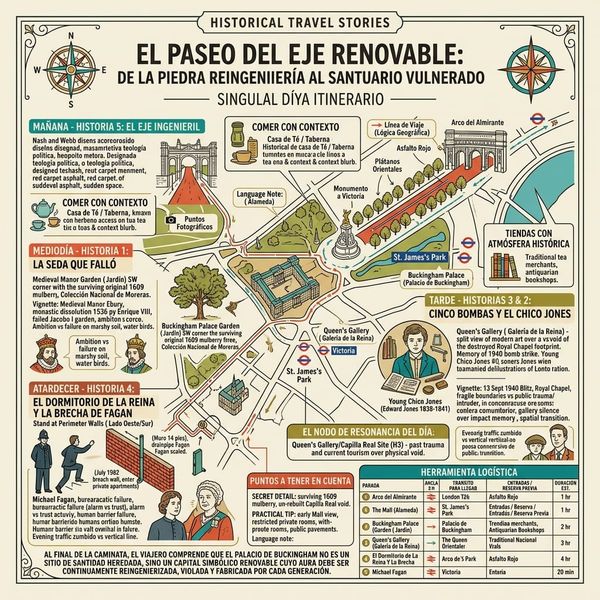
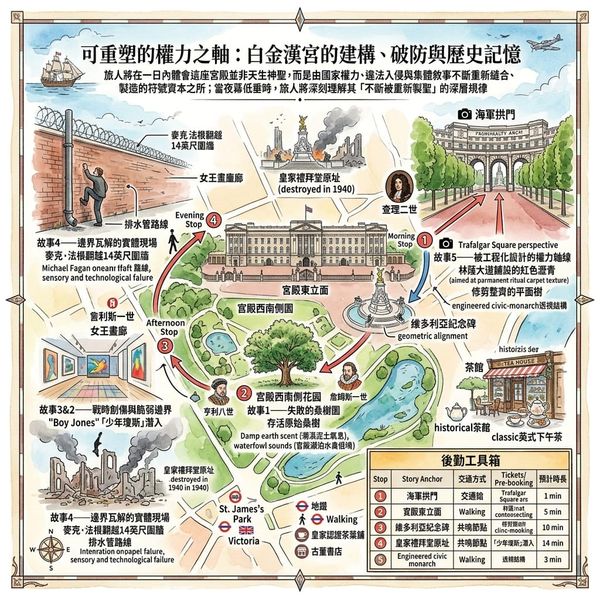
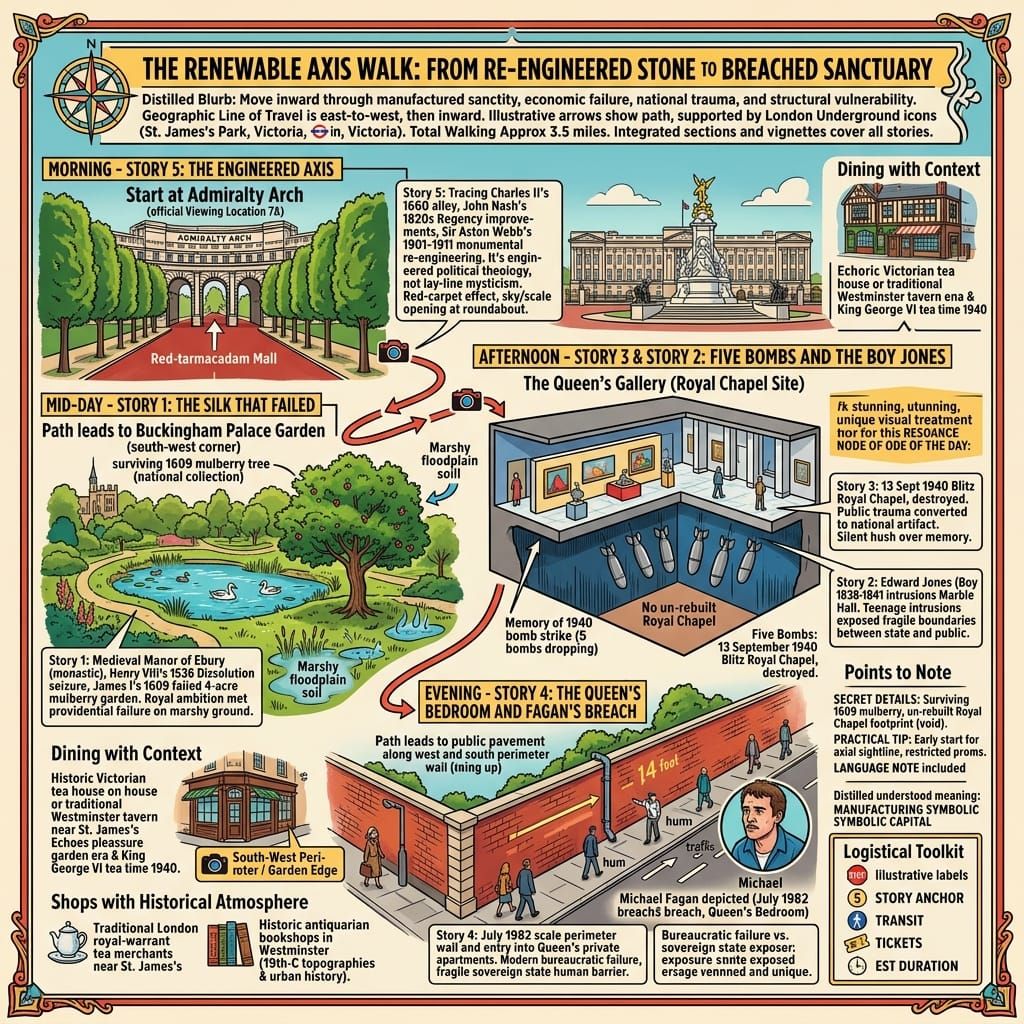
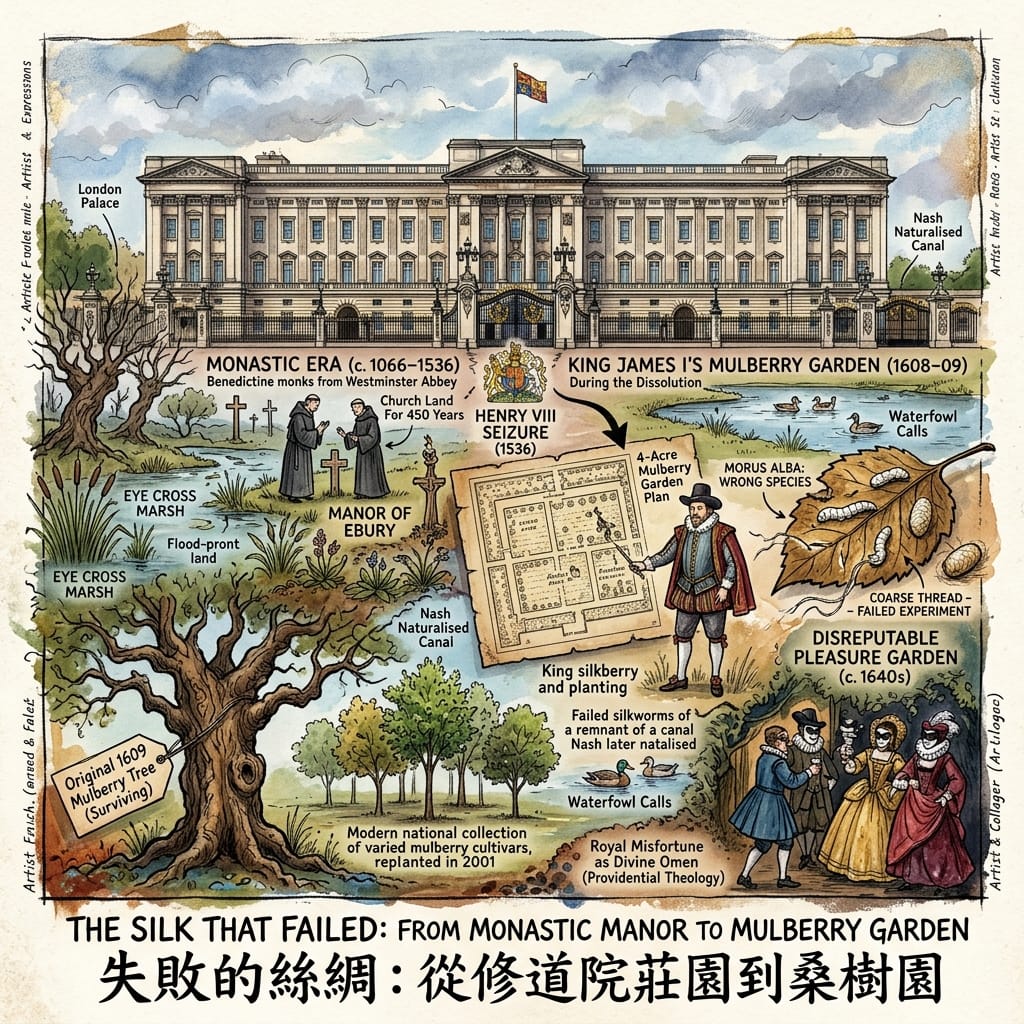
The ground under Buckingham Palace was once the Manor of Ebury, granted by William the Conqueror to Geoffrey de Mandeville, who handed it to the Benedictine monks of Westminster Abbey. For roughly 450 years it belonged to the Church. Henry VIII seized it back for the Crown in 1536, during the Dissolution of the Monasteries — the first time this land had been in royal hands since the Conquest. In 1608–09, James I, jealous of French silk production, planted a four-acre mulberry garden here, hoping to build an English silk industry from scratch. The project failed outright — he'd planted the wrong species of mulberry, producing thread too coarse to spin properly — and the enclosed grounds slid into use as a fashionable, and by most contemporary accounts disreputable, pleasure garden. Ownership passed hand to hand — Goring, Arlington, the future Duke of Buckingham — until the Crown bought it back in 1761–62, helped along by an almost comic legal technicality: a 1640 lease that had simply never made it past the Great Seal before Charles I fled the city.
The Blunder Beneath Buckingham Palace
Reading it through genius loci: you don't need to import any foreign mysticism to find this resonant — the documented legal and religious record does the work on its own. Church land, forcibly secularised by Tudor power. A royal economic fantasy failing on ground the Crown had only just reclaimed. A pleasure garden with a bad reputation, sitting directly beneath what would become the most tightly regulated ceremonial space in the country. The site's only real continuity is a habit of being seized, re-planted, and quietly re-legitimised.
Holographic sensory cue: a single mulberry tree from James I's original 1609 planting still stands in the garden's southwest corner. The soil around it holds a persistent dampness traced back to the Thames floodplain that lay here before any building did — and the sound of waterfowl on the palace lake is the last audible trace of the canal Nash later reshaped into something more "natural."
II. The Boy Jones: England's First Celebrity Stalker
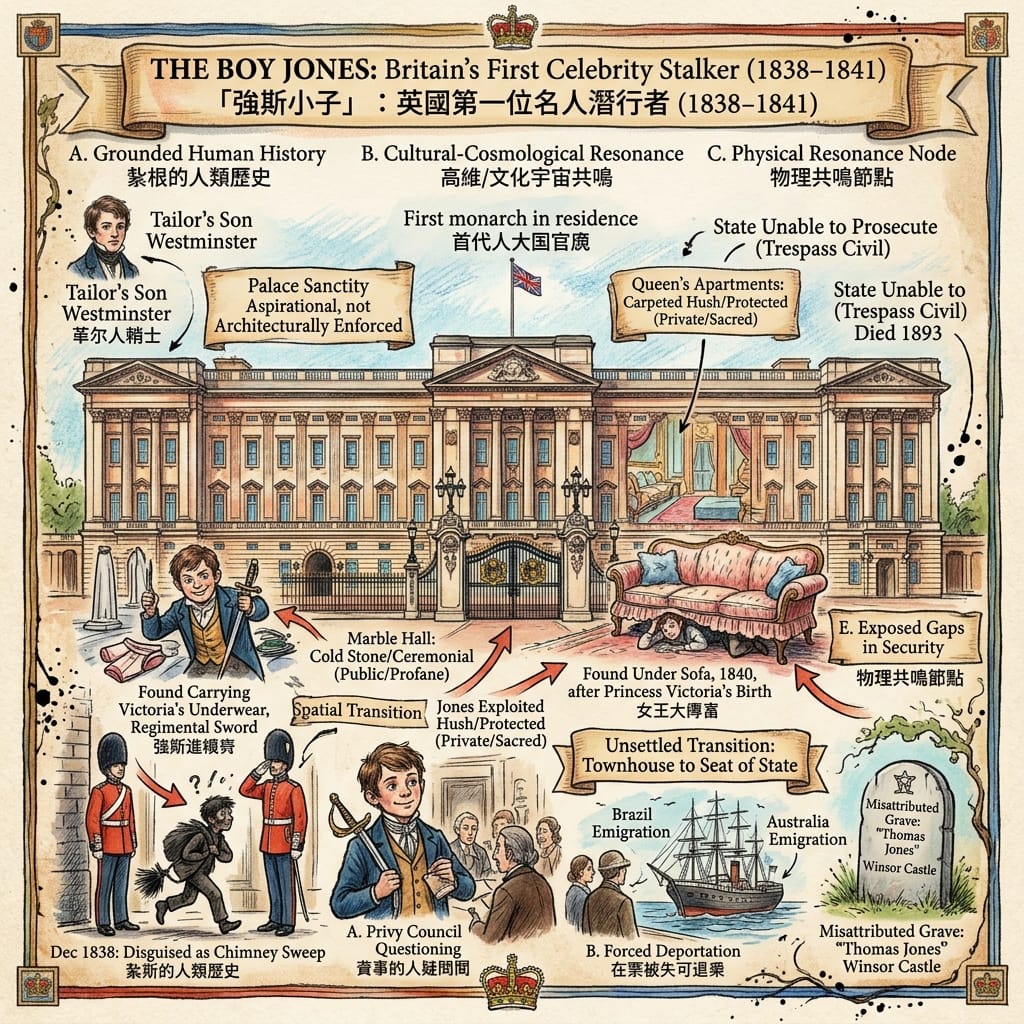
In December 1838, a fourteen-year-old tailor's son named Edward Jones talked his way into Buckingham Palace disguised as a chimney sweep and was caught in the Marble Hall with a stolen sword and — famously — Queen Victoria's underwear stuffed in his trousers. A jury acquitted him. He came back in 1840, ten days after the birth of Princess Victoria, and was found hiding under a sofa near the Queen's own rooms, an incident serious enough to be brought before the Privy Council. Because trespass was then only a civil offence, the authorities had no real charge to hold him on. At a loss, they offered him a place in the Royal Navy. He refused. He was eventually deported to Brazil aboard a prison ship, later drifted to Australia under the alias "Thomas Jones," and died in 1893 after a drunken fall — his gravestone still misattributing his exploits to Windsor Castle rather than Buckingham Palace.
The Teenager Who Stole The Queen S Underwear
The resonance: Jones's break-ins landed at exactly the moment the palace was becoming, for the first time, a monarch's actual full-time home rather than an aristocratic townhouse — Victoria was its first live-in sovereign. A teenager repeatedly breaching that boundary, and the Crown's genuine inability to prosecute him for it, exposed a gap between what the palace claimed to be (inviolable) and what it structurally was (a large house with a distracted staff). That same gap would reopen almost identically 144 years later.
Resonance Node: The corridor between the Marble Hall and the private apartments is still the palace's working thoroughfare today — cold stone giving way, with almost no buffer, to carpeted private hush. That short stretch of transition is the exact architectural seam Jones exploited, and it remains the point in the building where "ceremonial" and "private" sit closest together.
III. One Morning, Five Bombs: The Palace in the Blitz
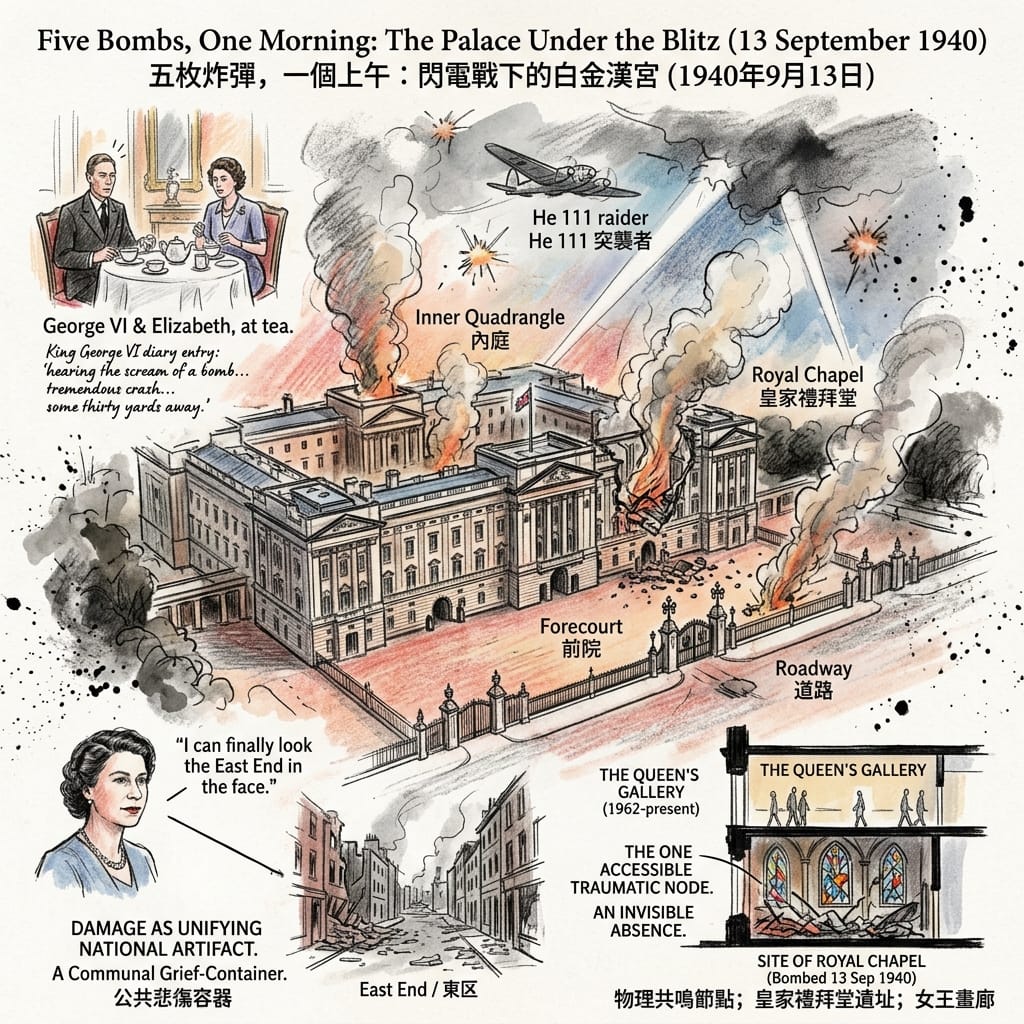
On the morning of Friday, 13 September 1940, a single German raider — reportedly a Heinkel He 111 — dropped five high-explosive bombs on Buckingham Palace while King George VI and Queen Elizabeth were having tea. Two bombs hit the inner quadrangle, one destroyed the interior of the Royal Chapel in the South Wing, and two fell on the forecourt and the road outside the gates. Four staff were injured; one later died. The King's diary records "the scream of a bomb" and a crash "about 30 yards away." The royal couple, who had refused to leave for Windsor where their daughters had been sent, were unhurt. Queen Elizabeth's remark afterward — that she could finally "look the East End in the face" — became, almost immediately, a deliberately deployed piece of wartime messaging. It wasn't the last strike: a delayed-action bomb went off days later, and a V1 flying bomb hit near Constitution Hill in June 1944, destroying the palace swimming pool and an 18th-century summer house.
Five Bombs Over Buckingham
The resonance: this is the clearest case here for reading the site through collective-memory geography rather than anything mystical. Most historical assessment holds that the raid wasn't a deliberately targeted strike so much as part of broader area bombing across central London — yet it was received, and consciously narrated by the Crown, as a wound shared equally by monarch and East End alike. The palace functions here almost exactly as a communal grief-container: a private misfortune converted, in something close to real time, into shared national material.
Holographic sensory cue: the Royal Chapel was never rebuilt after 1940 — postwar funding restrictions meant the damaged site was redeveloped instead as the Queen's Gallery, opened to the public in 1962. It's the one room in this story where the resonance is an absence: a public gallery built directly over the palace's single sharpest brush with wartime trauma, walked past today by visitors who have no idea what they're standing on.
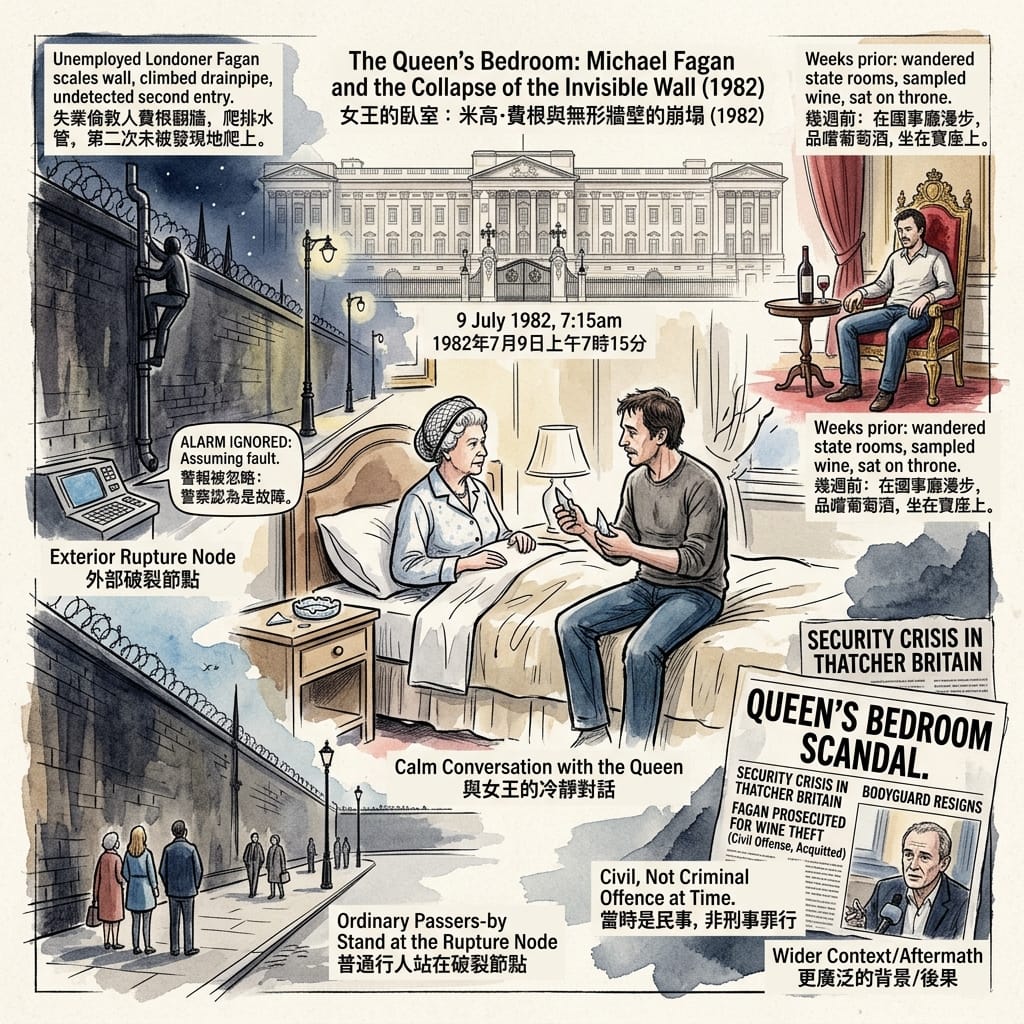
IV. The Queen's Bedroom: Michael Fagan and the Collapse of an Invisible Wall
In July 1982, an unemployed 33-year-old Londoner named Michael Fagan, in the middle of his marriage falling apart, scaled the palace's 14-foot perimeter wall — topped with revolving spikes and barbed wire — and climbed a drainpipe into the building, twice, undetected both times. On the first occasion he wandered the state rooms, sampled some wine, and reportedly sat on a throne before leaving. On the second, 9 July, a motion sensor actually did detect him — police assumed it was faulty and switched it off. He cut his hand breaking a glass ashtray, then walked into the sleeping Queen's bedroom holding a shard of it at roughly 7:15am. Elizabeth II woke, stayed calm, and phoned twice for help while chatting with him; the calls went unanswered until a duty footman and police finally arrived. Because unauthorised entry to a private home was still only a civil offence, Fagan was prosecuted for nothing more than stealing a bottle of wine — and was acquitted of that too, receiving a psychiatric evaluation instead. The scandal broke the same week the Queen's own bodyguard resigned over an unrelated personal matter, compounding a sense of institutional crisis that had nothing to do with security systems at all.
The Buckingham Palace Bedroom Breach
The resonance: read alongside the Boy Jones story, this is the same structural vulnerability reappearing in modern form — a monarch's body, constitutionally the most "inviolable" point in the state, physically reachable by an ordinary person with no plan beyond opportunity. What's genuinely new by 1982 is that the palace's technology had outpaced institutional trust in it: the sensor worked, and was ignored anyway. That's a distinctly bureaucratic failure mode, but it rhymes, almost exactly, with 1838.
Resonance Node: The perimeter wall and drainpipe route Fagan used are visible today from the public pavement on the palace's west and south sides — the only place in this whole account where an ordinary passer-by can stand at the literal point of rupture without ever setting foot inside.
V. The Engineered Axis: The Mall and the Victoria Memorial
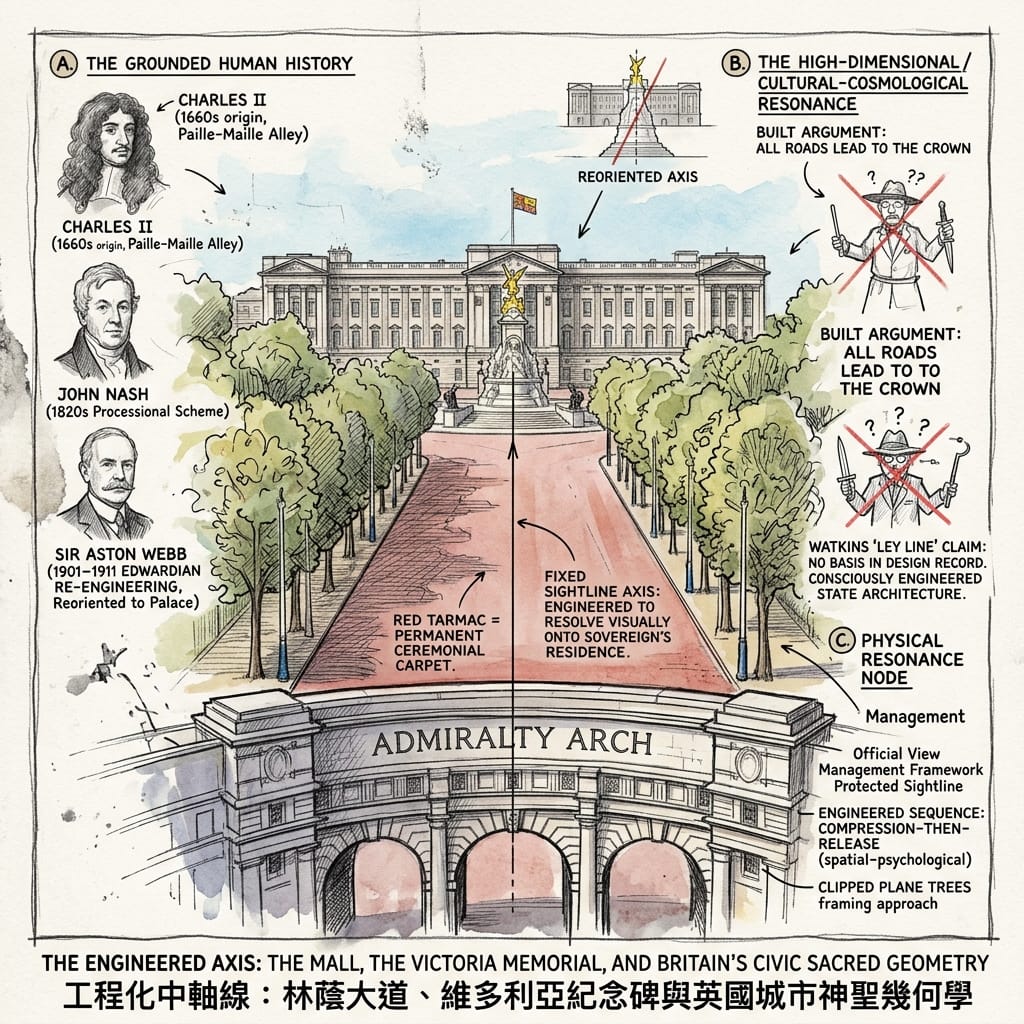
The Mall began in the 1660s as a tree-lined alley Charles II had cut through St James's Park for the French game of pall-mall. It was John Nash who, in his 1820s "Metropolitan Improvements" for the Prince Regent, folded it into a much larger scheme of ceremonial planning — the same project that produced Regent Street, Trafalgar Square (built on the site of the old Royal Mews, made redundant by new stabling built behind the palace), and Marble Arch, relocated to serve as the palace's ceremonial gateway. After Queen Victoria's death in 1901, architect Sir Aston Webb was commissioned to formalise the route into a genuine state processional axis: widened, resurfaced, and — this is the important part — physically reoriented so it lines up exactly with a rebuilt east façade of Buckingham Palace and a newly positioned Victoria Memorial, finished by 1911 with Admiralty Arch closing the eastern end.
How Buckingham Palace Hacks Your Sightlines
The resonance: this is the one story here where "sacred geometry" isn't a borrowed metaphor at all, but a documented design intention. Nash and Webb built a fixed sightline: from Trafalgar Square, through Admiralty Arch, straight down the Mall, resolving only ever onto the sovereign's residence. That's genuine encoded political theology, with clear precedent in medieval coronation routes and in the ceremonial avenues built in Paris, Berlin, and Washington in the same decades. What has to be explicitly rejected here is the ley-line claim mentioned earlier — since the 1920s, writers in Watkins' tradition have occasionally claimed mystical energy alignments running through this exact stretch of Westminster. There's no archival basis for that. The real story is better: this isn't a rediscovered ancient alignment but a dated, archivally documented piece of engineering, built specifically to produce the effect the mystical version later claimed to have "found."
Holographic sensory cue: standing at the officially protected viewing point just southwest of Admiralty Arch's central arch, the whole axis resolves in one unbroken line to the Victoria Memorial and the palace beyond. The Mall's red tarmac (chosen deliberately to suggest a permanent ceremonial carpet), the symmetrical plane trees, and the sudden opening of sky at the Victoria Memorial roundabout — compression, then release — is functionally identical to processional architecture used in religious contexts worldwide. Here, there's no religion in it at all. Just state.
Conclusion: Memory as the Only Thing Actually Sacred
From a monastic estate to a failed silk garden, from the Boy Jones to Michael Fagan, from bombs in the quadrangle to an axis engineered down to the inch — Buckingham Palace's real history isn't one of inherited sanctity at all. It's a record of a state that has had to keep re-consecrating the same ground, generation after generation, through law, stone, and story, precisely because nothing about the land itself was ever holy to begin with. That's not a diminishment. In an age where meaning increasingly gets generated automatically, there's something almost bracing about a place that's honest, on inspection, about how deliberately its own significance was built. If places like this — the ones history hasn't finished explaining — are your kind of thing, our newsletter goes out with more of them, London and otherwise, when we find them.
Accessing the Physical Node
Buckingham Palace sits in central London; the nearest stops are St James's Park and Green Park on the London Underground. The Mall itself closes to traffic on weekends, public holidays, and ceremonial occasions, making a walk from Trafalgar Square straight down to the palace gates the most direct way to feel Nash and Webb's engineered sightline for yourself. For an overnight base, Westminster and Mayfair put you within easy walking distance of every site mentioned above. If you want to go deeper than the standard tour, several London walking-tour operators run itineraries specifically built around the palace's unofficial history — the perimeter wall, the corridor seams, the protected viewpoints — routes that don't show up on the standard itinerary.
💡🏛️ Buckingham Palace: Ghost Stories & Historical Dossier Q&A
Q1: Is Buckingham Palace haunted by the "Brown Monk"? What is the historical truth behind the ghost story?
Answer: The legend of the "Brown Monk" haunting the terrace and garden of Buckingham Palace is one of London's most famous ghost stories. Historically, the land was part of the Manor of Ebury, owned by the Benedictine monks of Westminster Abbey for over 450 years until King Henry VIII seized it during the Dissolution of the Monasteries in 1536. The land was later converted into King James I's failed mulberry garden in 1609 before returning to royal ownership. The "monk ghost" is not a supernatural entity, but a 19th-century Victorian Gothic folklore romanticization reflecting collective cultural memory of the forcible secularization and disruption of monastic holy ground.
Q2: Is Buckingham Palace built on ancient ley lines or an energy grid? What is the reality behind its alignment?
Answer: Claims that Buckingham Palace sits on ancient "ley lines" or mystical energy grids stem from Alfred Watkins's 1921 hypothesis, a modern amateur pseudo-archaeological concept rather than ancient British lore. Originally a low-lying marshland near the River Thames, the palace's grand spatial layout is actually a product of deliberate 20th-century urban planning. Architects John Nash and Sir Aston Webb designed the iconic ceremonial axes, including The Mall and Victoria Memorial, as a form of "national ceremonial geometry." This carefully engineered visual alignment encodes monarchical authority into London's urban fabric, creating an artificial sense of place (genius loci) rather than tapping into supernatural ley lines.
Q3: Are the secret tunnels beneath Buckingham Palace haunted? Where did the underground ghost rumors originate?
Answer: Rumors of haunted underground tunnels and phantom footsteps beneath Buckingham Palace originate from a blend of real security breaches and subterranean infrastructure. Between 1838 and 1841, an intruder named Edward Jones ("The Boy Jones") repeatedly infiltrated the palace, hiding under Queen Victoria's sofa and wandering secret corridors undetected. Additionally, the palace grounds sit above culverted waterways, including the subterranean River Tyburn and WWII air-raid shelters. Over time, public fascination with these historical security flaws and hidden drainage tunnels transformed real intrusion events and underground echoes into urban legends of haunted subterranean passages.
Reference and Further reading
First layer – Main sources of literature and institutions:
- Historic England List Entry 1000795 (Buckingham Palace, statutory listing and historic development record);
- Royal Collection Trust archives on the Buckingham Palace Garden.
- Contemporary court records from Queen Square Police Court (December 1838);
- London Evening Standard court reporting of the period.
- Royal Archives materials published via royal.uk for the 80th anniversary (2020), including Queen Elizabeth The Queen Mother's letter to Queen Mary and King George VI's diary extract.
- UK Home Office Freedom-of-Information release (file ref. "6674 Intrusion Palace Fagan 1982"), including 1982 ministerial correspondence and briefing notes to the Home Secretary;
- Contemporary Hansard record of the Home Secretary's House of Commons statement, 21 July 1982.
- Historic England List Entry 1001362 (Trafalgar Square); Greater London Authority, London View Management Framework (official document identifying and protecting the Mall/Admiralty Arch/Buckingham Palace axial view, Viewing Location 7A).
The second layer – secondary academic materials:
- W. H. St John Hope's Buckingham Palace (1908, the standard early scholarly architectural history);
- Relevant chapters in academic urban-history treatments of the Manor of Ebury and Westminster Abbey's medieval estates.
- Jan Bondeson, Queen Victoria's Stalker: The Strange Story of the Boy Jones (2012) — the standard modern scholarly treatment;
- Elizabeth Murphy's 2010 biographical research on Jones.
- Standard Blitz historiography (Battle of Britain/Blitz operational histories covering the 13 September raid sequence).
- Scotland Yard's internal post-incident report (heavily critical of officer conduct), referenced across multiple secondary biographical accounts.
- Architectural-historical scholarship on John Nash's Metropolitan Improvements and on Sir Aston Webb's 1901–1911 Victoria Memorial scheme.
Third layer – Supplementary information:
- Edward Walford, Old and New London, vol. 4 (1878) — a Victorian antiquarian secondary source, useful for period flavour and quoted verse but not primary evidence;
- Contemporary satirical references (e.g., Clement Walker, Anarchia Anglicana, 1649) to the garden's disreputable use, treated as period commentary rather than fact.
- Queen Victoria's own diary entries recording her alarm at the 1840 intrusion — treated as a valuable first-person emotional record, not independently verified fact regarding Jones's exact movements.
- Popular royal-history retrospectives (British Heritage, Royal Family official retrospectives) — useful for narrative detail and direct quotation but secondary to the Royal Archives material itself.
- Fagan's own later interviews (e.g., 1993 radio interview; 2012 press interviews) — his personal account of events, particularly regarding what was or wasn't said to the Queen, differs from popular dramatisation and should be treated as a contested first-person narrative, not verified fact.
- Popular walking-history accounts of the Mall's redesign — useful for texture, secondary to the listed-building and planning documentation above.
Historical gap:
- The precise terms of Geoffrey de Mandeville's original grant, and any pre-Conquest use of the Ebury marshland, are not well documented. 建議進一步查證原始檔案 / Further archival verification of Westminster Abbey's medieval Ebury records is recommended for anyone extending this thread.
- Jones's own motivations remain contested — contemporary and modern accounts range from simple mischief to an early clinical account of stalking/obsessive fixation; no primary source from Jones himself clarifies this. 建議進一步查證原始檔案.
- Whether the raid was a deliberate targeted strike or incidental to area bombing remains debated in secondary literature; official wartime messaging had incentive to frame it either way depending on audience. 建議進一步查證原始檔案 regarding Luftwaffe operational records for that sortie specifically.
- The precise sequence of the alarm-silencing decision, and why the second officer's radioed sighting of Fagan on the railings produced no response, is documented in outline via the FOI release but the full internal disciplinary findings were not made public. 建議進一步查證原始檔案.
- None significant regarding the documented design intent — this is one of the better-archived urban design sequences in London. The genuine historiographical gap is sociological rather than architectural: how far 20th-century ordinary Londoners actually experienced the axis as a statement of monarchical authority, versus simply as a park, is not well studied and would require oral-history or contemporary-press-reception research to establish. 建議進一步查證原始檔案 for reception history specifically.
 Lawrence
 Lawrence
 Lawrence
 Lawrence
© Historical Travel Stories — Unraveling Strange Tales Across Dimensions and Time