(ENG) Quarry Bay Historical Walk – Industrial Memories and Modern Life in a Hong Kong Hub
A journey through Quarry Bay’s evolution. From the industrial roots of Tong Chong Street to the dense living of the Monster Building, discover the historical stories and local flavors that define this unique Hong Kong neighborhood.

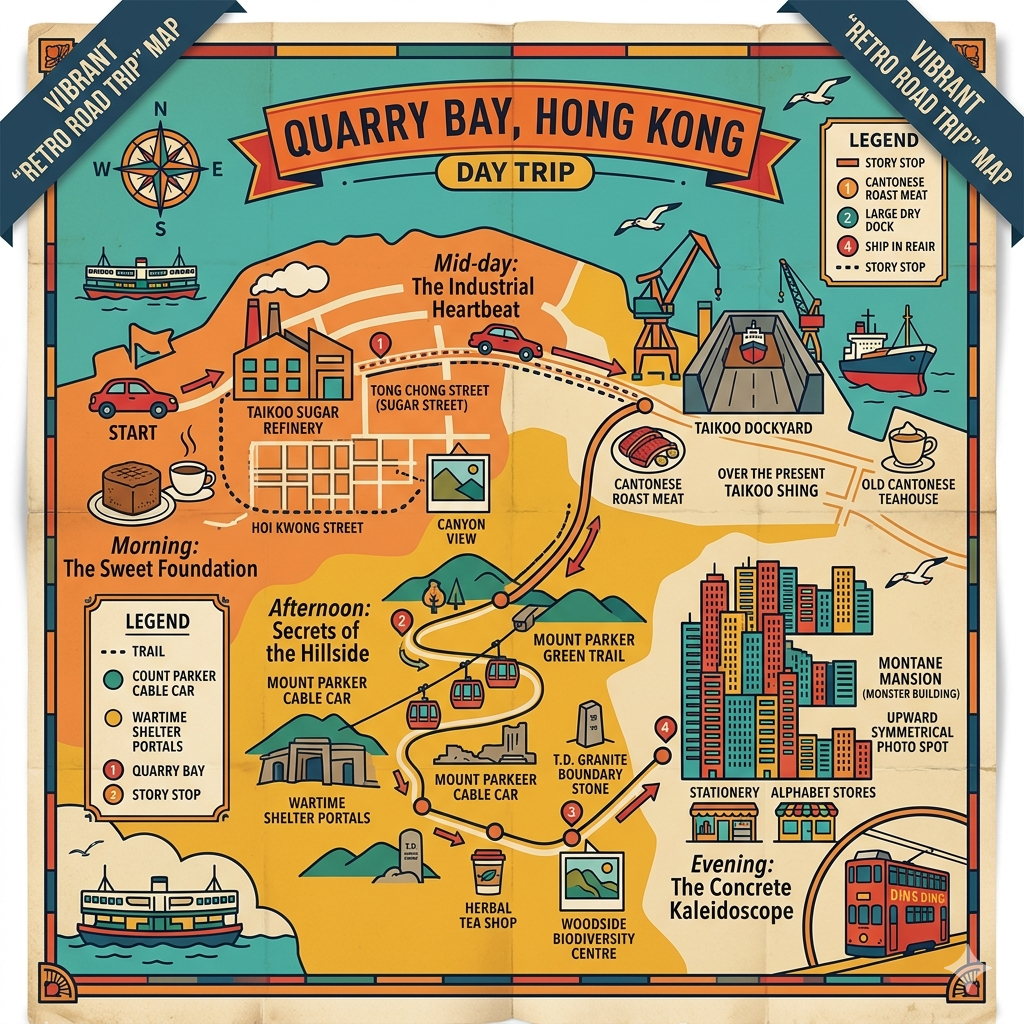
This is a historical travel story and walking guide to Quarry Bay, an eastern district of Hong Kong Island shaped by its industrial past. By exploring Tong Chong Street, the iconic "Monster Building," and the waterfront, it reveals how the legacy of the Taikoo Sugar Refinery transformed into a vibrant modern community filled with unique architectural and emotional layers.
 Lawrence
The Glass Facade and the Industrial Ghost
To the casual observer, Quarry Bay is a quintessential modern business hub—a dense forest of glass-and-steel towers defined by the fast-paced rhythm of Hong Kong’s white-collar workforce. However, beneath this polished exterior lies a complex industrial archaeology. For over a century, this district served as the strategic power center of the "Taikoo Empire" (the Swire Group). It was here that colonial corporate interests, pioneering engineering, and a self-contained "Company Town" first took root, transforming a desolate quarry into an industrial powerhouse.
Today, this rich history is not confined to archives but is remarkably accessible on foot. By walking through its backstreets and mountain paths, one can trace the remnants of a vanished world: from the ruins of the territory’s first passenger ropeway to the wartime kitchens that stood for a brief, desperate ten days in 1941. This exploration reveals a layered history where the "Company Town" survives through urban transformation, transitioning from a site of production to a post-industrial spectacle. As we leave the sterile roar of King's Road for the quiet ascent of Mount Parker, we step back into a 19th-century landscape defined by vertical ambition and colonial anxiety.
Listen to the historical stories told in detail (For subscribers only)
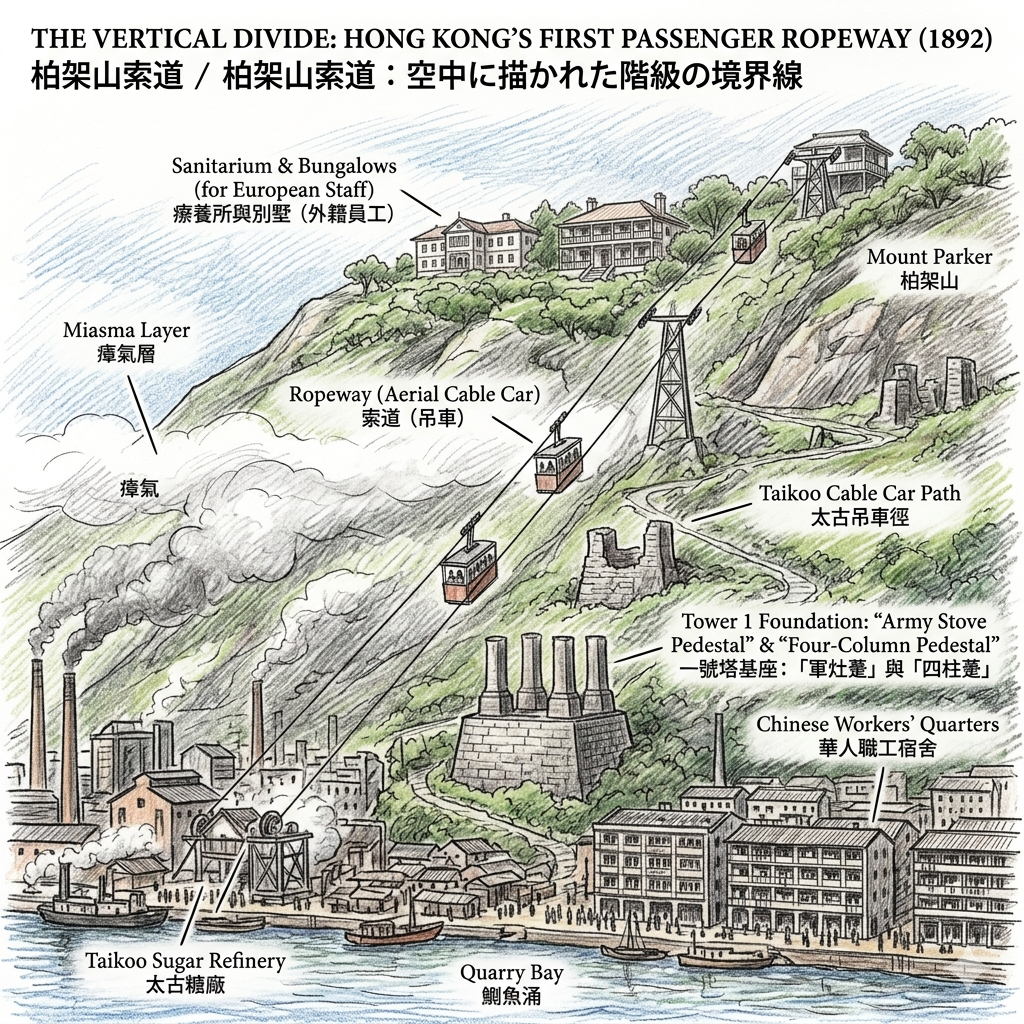
The Vertical Divide: Hong Kong’s First Passenger Ropeway (1892)
In the late 19th century, living on high ground in Hong Kong was not merely a matter of prestige; it was a perceived medical necessity. Following the 1894 plague outbreak, colonial authorities and corporate elites subscribed heavily to "miasma" theories, believing that the humid, low-lying coastal areas were breeding grounds for disease. To protect its senior European staff from the "foul air" and perceived sickness of the coastal refineries, Butterfield & Swire looked toward the breezy heights of Mount Parker.
While the Peak Tram (1888) is more famous today, the Mount Parker Ropeway, established in 1892, was a technical marvel of a different order. Unlike the Peak Tram’s ground-based rails, this was the world’s first steam-driven aerial ropeway specifically designed for passenger transport. It served as a physical manifestation of the colonial vertical social structure: while Chinese laborers resided in crowded seaside dormitories, the managerial class was whisked 320 meters above the "miasma" to the cool heights of a mountain sanitarium.
Technical Specification | Details |
Construction Year | 1892 |
Manufacturer | Bullivant & Company, London |
Total Length | Approximately 2.3 km |
Maximum Altitude | 320 meters (Quarry Gap) |
Capacity | 6 passengers per open-air car |
The walk begins at the current 116 bus terminus near Yue Man Street (祐民街), the original site of the lower terminus. As you climb the "Taikoo Cable Car Path," keep an eye out for the "Four-Column Pedestal" (四柱躉) and the "Army Stove Pedestal" (軍灶躉). The latter is a massive granite tower foundation (Tower 1), named for its stove-like appearance, though it must not be confused with the actual wartime cooking stoves found further up the mountain. As we descend from the breezy heights of the elite, the gravity of industrial production pulls us back toward the shoreline and the heart of the "Company Town."
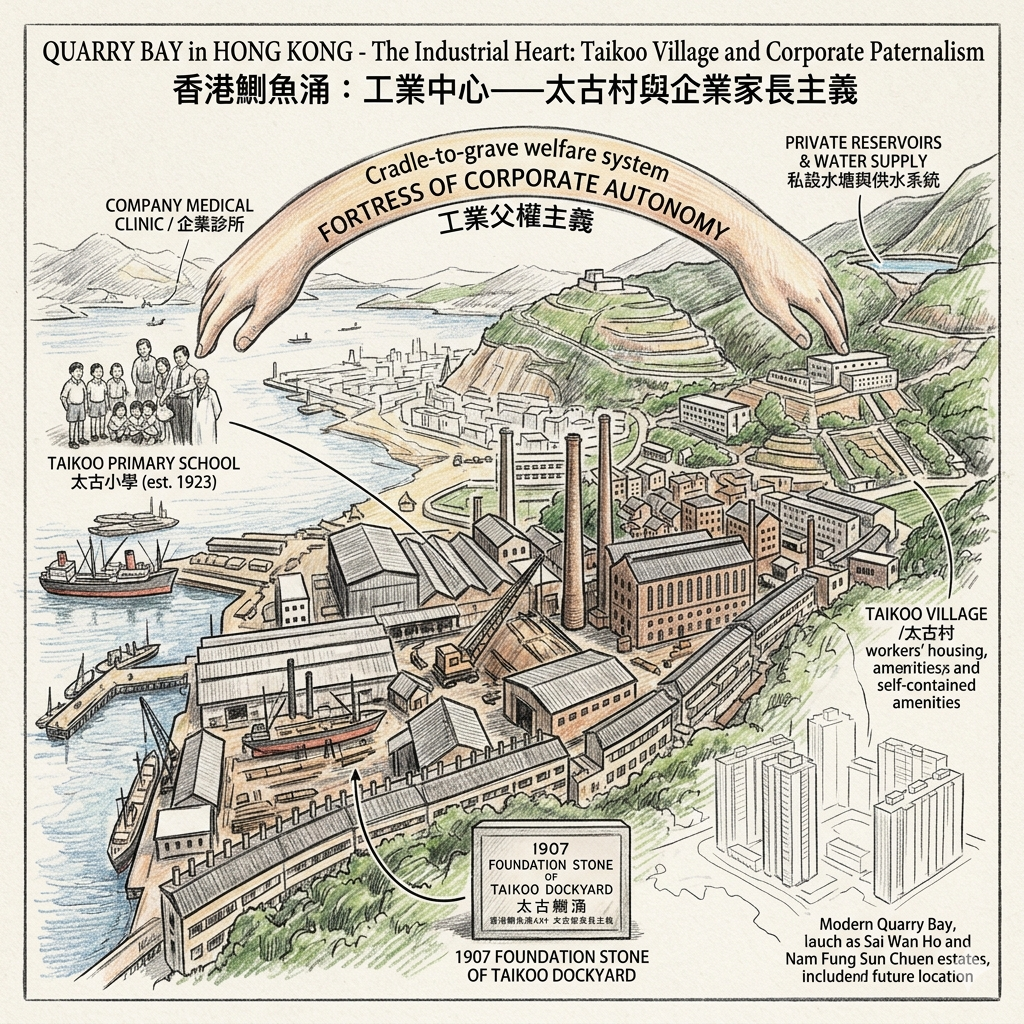
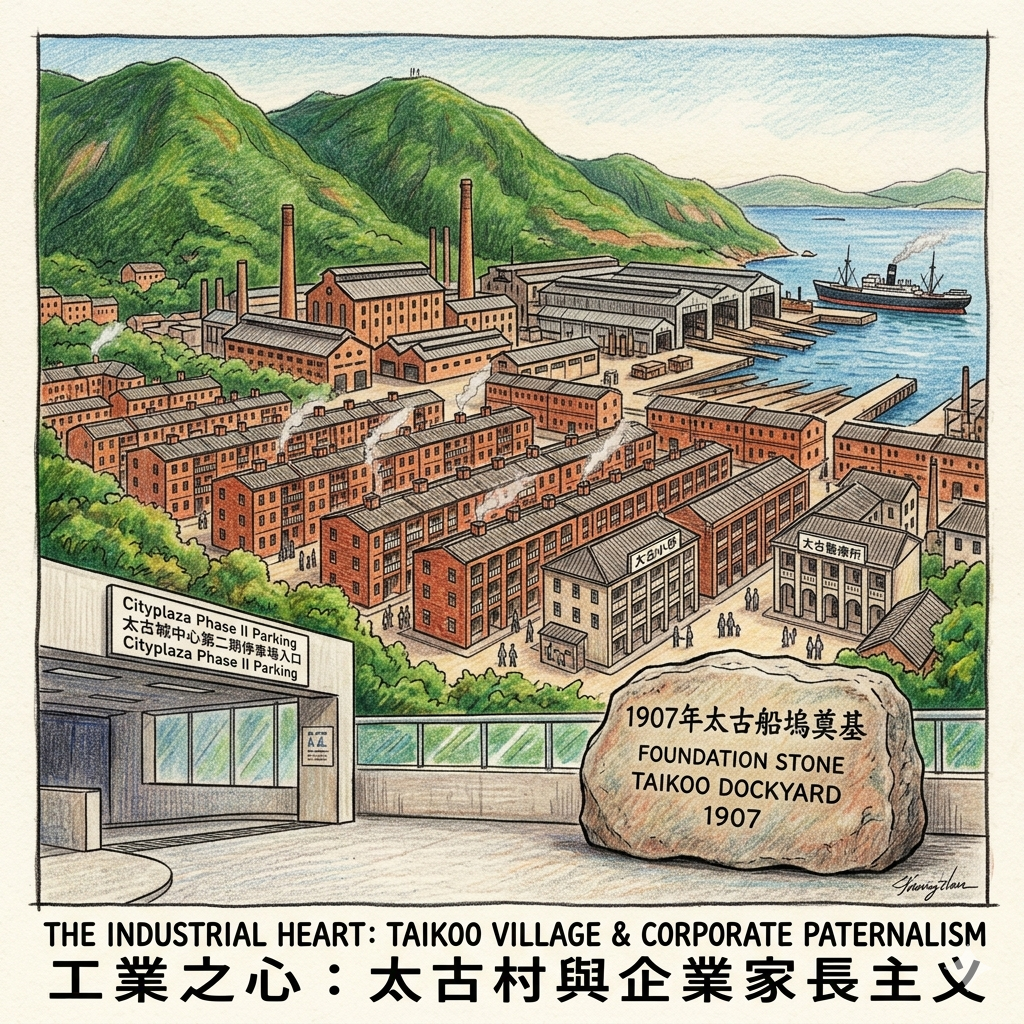
The Industrial Heart: Taikoo Village and Corporate Paternalism
In the 1880s, Quarry Bay was a remote outpost. To ensure a stable workforce for its massive sugar refinery and dockyards, Swire adopted the "Company Town" model—a strategic experiment in "industrial paternalism." Taikoo Village was born not just as a housing project, but as a self-contained micro-society where the company acted as a benevolent, all-powerful parent.
This "industrial feudalism" was remarkably comprehensive. The company provided housing, medical care, and even education through the Taikoo Primary School (established in 1923). To ensure independence, Swire built its own private reservoirs—sites now occupied by the Sai Wan Ho and Nam Fung Sun Chuen estates. This cradle-to-grave welfare system was designed to foster worker loyalty, creating a fortress of corporate autonomy decades before the government provided public housing.
Editorial Reflection: The welfare provided at Taikoo Village was a rare anomaly in the early 20th century. While it served corporate efficiency, the provision of structured urban planning and free education represented a standard of care that the colonial government would not match for generations.
A tangible anchor of this era can be found near the Cityplaza Phase II parking entrance: the 1907 Foundation Stone of the Taikoo Dockyard. It is a heavy, silent witness to the era of industrial production, but the landscape would soon shift from the business of sugar to the business of survival.
The "Big Pot Rice" Experiment: The 1941 Wartime Kitchens
As the shadow of World War II lengthened, the back hills of Mount Parker shifted from a corporate retreat to a strategic civil defense sanctuary. Fearing a blockade, the colonial government utilized the area’s water and proximity to worker populations to build an emergency network of "Public Kitchens."
These brick stoves were a pragmatic experiment in "civilian resistance," designed to feed tens of thousands of refugees should the urban centers fall. However, the British severely miscalculated Japanese mobility. While the kitchens were prepared for a long siege, the defense of the surrounding hills collapsed in just ten days after the Japanese landing in December 1941.
Wartime Kitchen Specifications:
- Locations: 10 sites across the Mount Parker slopes.
- Stove Count: 81 total red-brick stoves.
- Fuel Source: Locally sourced firewood.
- Command HQ: Based at Woodside (The Red House).
Visitors to the Quarry Bay Tree Walk can still see the circular red-brick remains. Unlike the granite ropeway pedestals, these are delicate, functional ruins that reveal a tragic irony: a massive humanitarian infrastructure utilized for barely a week.
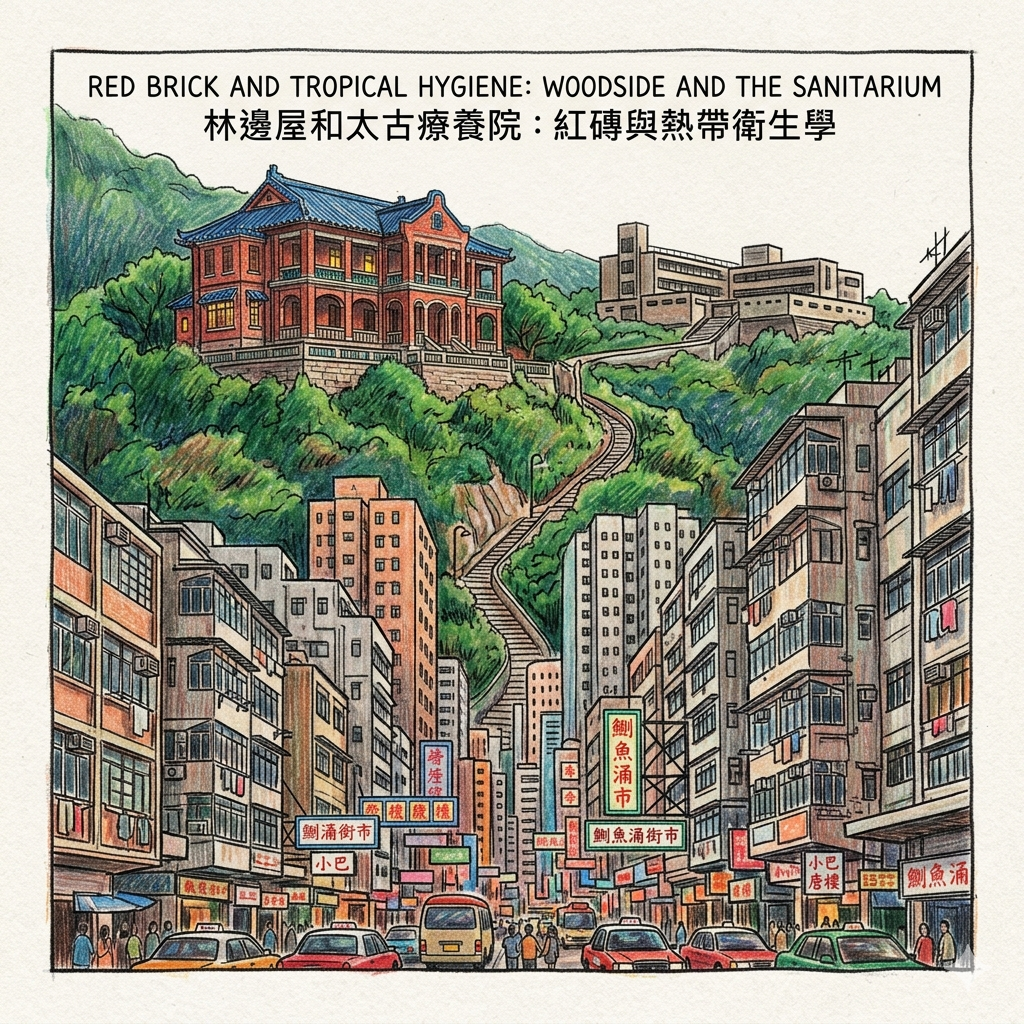
Red Brick and Tropical Hygiene: Woodside and the Sanitarium
The architectural landscape of upper Quarry Bay was dictated by the same "Miasma Theory" that birthed the ropeway. Senior staff sought refuge at the Mount Parker Sanitarium (1893) and the managerial residence known as Woodside (1920s). These buildings represented a colonial social geography where "height equaled value"—a logic that remains the bedrock of Hong Kong’s real estate market today.
The styles were distinct: the Sanitarium was a secluded, utilitarian refuge lit by oil lamps, while Woodside featured an eclectic mix of red brick and Chinese glazed tiles. Woodside’s "eclectic" style was a deliberate attempt by the elite to blend British architectural tropes with local materials, signaling permanence. In 2012, Woodside was transformed into the Biodiversity Education Centre. Walking through its high-ceilinged rooms, one feels the transition from the planned colonial order to the spontaneous, high-density collage of the post-war era.
The Monster Building: From Industrial Crisis to Cyberpunk Icon
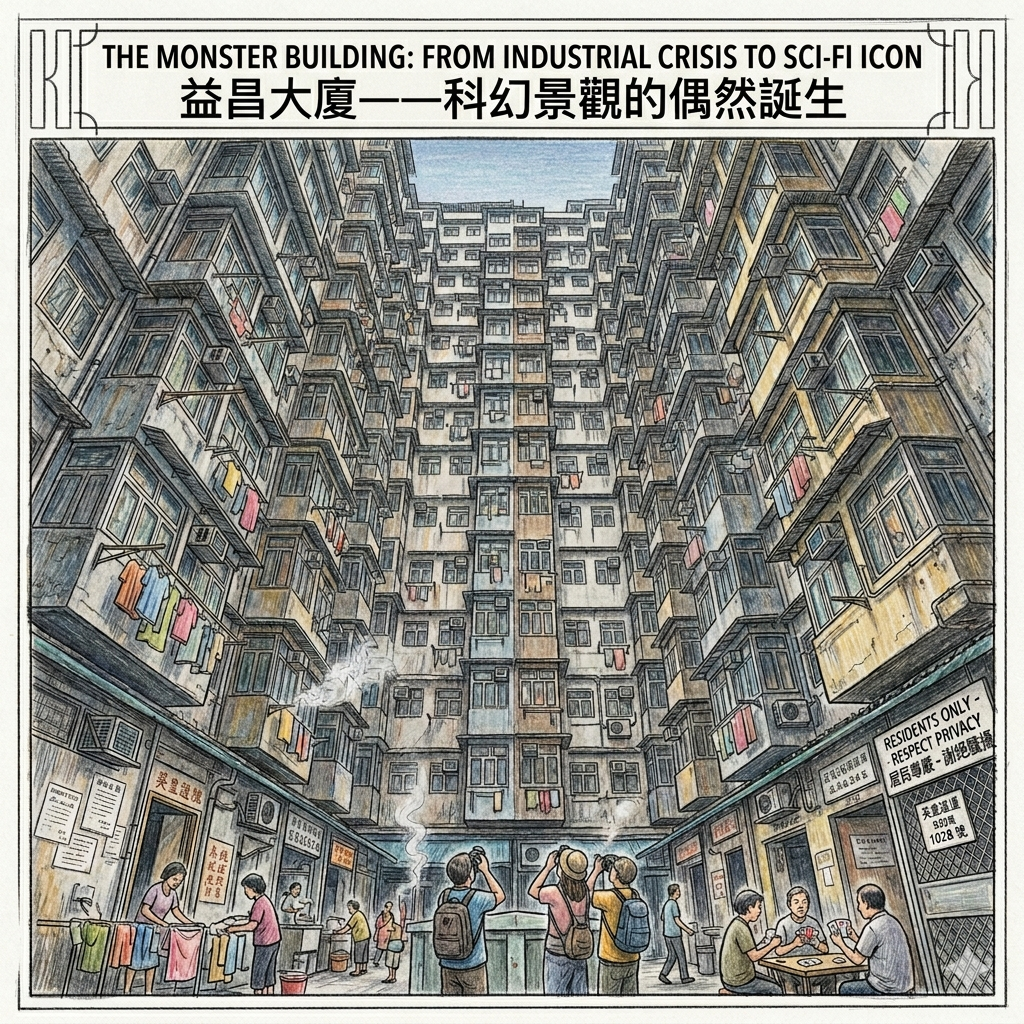
As Swire transitioned away from heavy industry in the 1960s, the peripheral lands saw a surge of spontaneous development. The most famous result is the Yick Cheong Building, or the "Monster Building." This massive complex was not a deliberate aesthetic choice but a byproduct of "accidental density" and capital maximization by the Cheong K. development group during a period of economic instability.
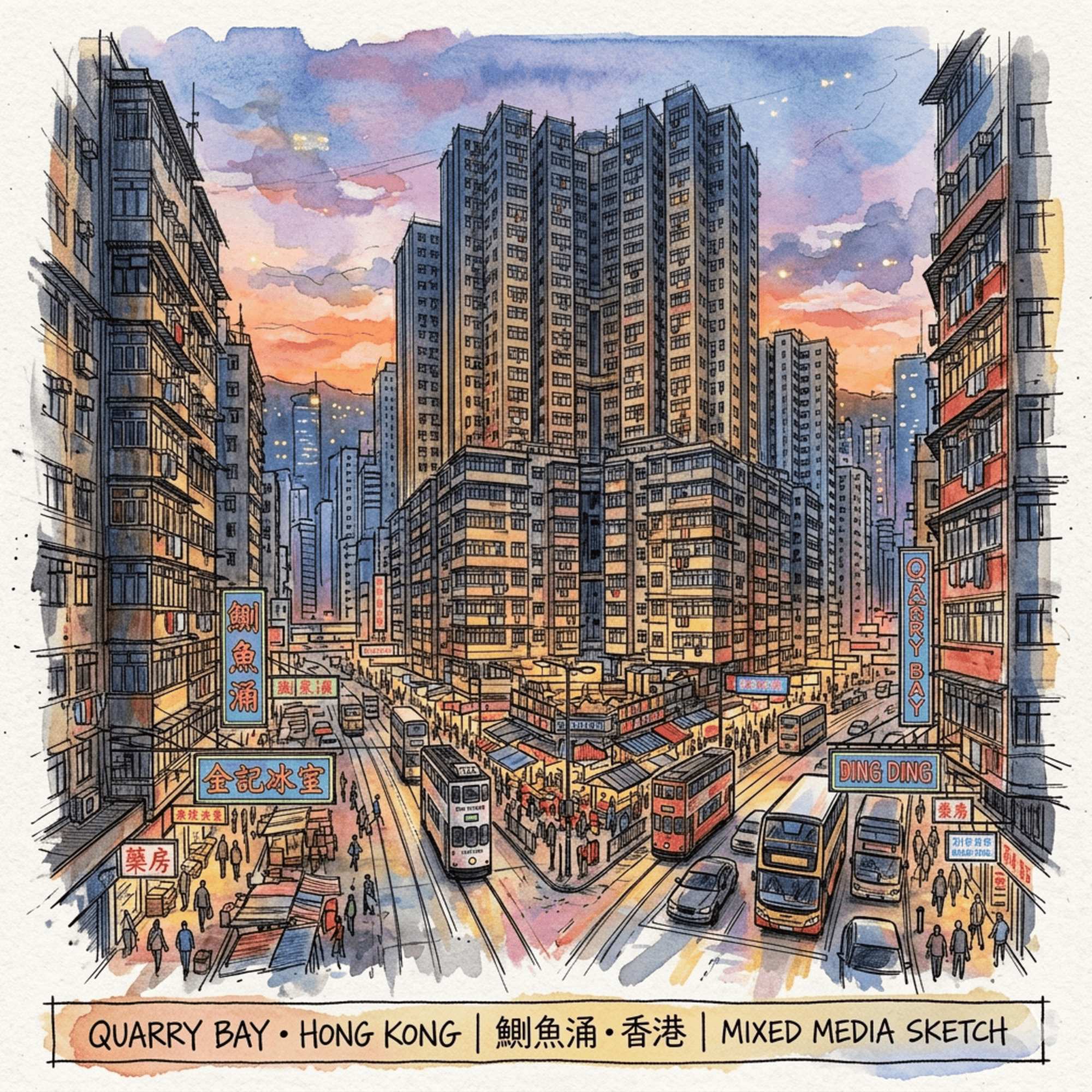
Originally intended as low-income housing, the building’s U-shaped courtyard at 1028 King's Road has since become a global "Cyberpunk" visual symbol. The sensory experience here is overwhelming: the smell of incense and cooking grease, the visual rhythm of a thousand air conditioners, and the sky-blocking weight of the concrete walls. This "spectacle" for tourists contrasts sharply with the "grassroots urbanism" of the residents’ daily lives—where laundry hangs in the shadow of a global icon.
Hidden Gem: The Industrial Soul’s Return
While the Monster Building represents the future, the district's "industrial soul" is encapsulated in the 1907 Taikoo Dockyard Foundation Stone. After the dockyards closed, the stone was moved to Tsing Yi in 1978. However, in a rare move of historical repatriation, it was returned to its original site at Taikoo Shing in 1991. Its journey symbolizes the enduring connection between the land and the industrial history that built it—a rare victory for heritage in a city of constant change.
Conclusion: The Layered Observation of Quarry Bay
Quarry Bay’s evolution mirrors the wider narrative of Hong Kong—from a remote quarry to a corporate territory, and finally to a post-industrial spectacle. It is a "three-dimensional history book" compressed into a few city blocks, where a 19th-century foundation stone, a wartime stove, and a cyberpunk icon coexist.
One must wonder: as we look at the glass towers of Taikoo Place today, how will future historians "excavate" our current era? The history of Quarry Bay teaches us that no facade is permanent, and every era leaves a ghost in the landscape.
To explore more of Hong Kong's layered history, consider walking the paths of our industrial past.
Planning Your Historical Walk
- Getting There: MTR Quarry Bay Station, Exit A.
- Recommended Route:
- Start at Yue Man Street (site of the Ropeway Terminus).
- Visit the Monster Building at 1028 King’s Road.
- Walk to Taikoo Shing to see the Dockyard Foundation Stone.
- Ascend Mount Parker Road to visit Woodside (Biodiversity Centre).
- Continue to the Quarry Bay Tree Walk to see the Wartime Stoves and Ropeway Pedestals.
- Nearby Interest: Taikoo Place offers numerous dining options to conclude your journey.
Q & A
Why did the 'Monster Building' become a global visual icon?
The "Monster Building" (益昌大廈建築群) in Quarry Bay became a global cyberpunk cultural icon due to its extreme urban density, the visual contrast of its "accidental" architecture, and its adoption by international pop culture.According to the sources, the following factors contributed to its status as a cyberpunk symbol:
1. Extreme "Accidental" Density
Built in the late 1960s and early 1970s during a population explosion, the building was designed to squeeze the maximum number of units (approximately 2,243 units) into a limited space to maximize profit. This resulted in an "accidental density" that wasn't born from an aesthetic choice but from capitalistic necessity, creating a world-class specimen of hyper-dense living.
2. Intense Visual Compression
The architectural layout consists of five interconnected buildings (Montane Mansion, Oceanic Mansion, Fook Cheong Building, Yick Fat Building, and Yick Cheong Building) arranged in a massive "U" shape.
- Verticality: The structure creates narrow, vertical open-air lightwells that surround observers on three sides, offering a sense of intense visual oppression as the windows and air conditioning units seem to "soar into the clouds".
- Layered Life: The visual layers—shops at the bottom, stacked residential units above, and laundry hanging in the patios—create a complex, cluttered aesthetic central to the cyberpunk genre.
3. "Grassroots Urbanism" vs. Corporate Order
The building is often viewed as a piece of "grassroots urbanism," standing in stark contrast to the orderly, corporate-planned territory of nearby Taikoo Shing. This juxtaposition of a spontaneous, chaotic, and lively "mega-structure" next to planned corporate power mirrors the classic cyberpunk theme of high-tech corporate dominance versus low-life survival.
4. Global Media Influence
The building's transition from a low-income housing complex to a visual icon was cemented by its appearance in major international media:
- Hollywood: It served as a major filming location for the blockbuster movie Transformers: Age of Extinction.
- Asian Pop Culture: It was featured in music videos, such as those by the Japanese singer Hikari Mitsushima.
These appearances shifted the historical narrative of Quarry Bay from "producing goods" (like sugar and ships) to "producing visual spectacles" for global consumption. Today, the site is a world-renowned destination where the "spectacle" of the architecture coexists with the authentic, everyday activities of its residents, such as playing chess or drying laundry in the central patios.
How did the Monster Building compare to corporate Taikoo Shing?
The comparison between the Monster Building (the Yick Cheong Building complex) and corporate Taikoo Shing represents a profound contrast between spontaneous grassroots urbanism and structured, planned corporate development.The following points detail how these two iconic Quarry Bay sites differ based on the sources:
1. Planning vs. Spontaneity
- Taikoo Shing (Corporate Territory): This development evolved from the "Company Town" model (Taikoo Village) established by the Swire Empire, which was characterized by orderly planning and self-sufficiency. It represents a "private enterprise-led urbanization" where the company acted as an all-powerful "parental" figure, managing everything from housing to education and infrastructure.
- Monster Building (Grassroots Urbanism): In contrast, the Monster Building is described as a piece of "grassroots urbanism" that grew spontaneously on the fringes of the Swire territory. It was born out of the 1960s population explosion and a lack of strict building controls, as developers tried to squeeze the maximum number of units into a limited space to meet post-war housing demands.
2. Aesthetic and Spatial Density
- Ordered Density: The planning for the original Taikoo Village was 20 years ahead of its time, focusing on lighting, ventilation, and organized public spaces. This philosophy carried over into the modern, structured design of Taikoo Shing.
- Accidental Density: The Monster Building’s density was not an aesthetic choice but an "accidental" byproduct of capitalism. Its "U-shaped" layout and narrow lightwells created an intense, oppressive visual landscape that eventually turned it into a global "Cyberpunk" icon—a sharp departure from the sterile, orderly environment of Taikoo Shing.
3. Social and Economic Origins
- Corporate Welfare: Taikoo Shing sits on the former site of the Taikoo Dockyard and represents the transition of Quarry Bay from a heavy industrial hub into a high-end service-oriented residential and commercial area.
- Refugee Relief and Profit: The Monster Building (originally a project by real estate pioneer "Cheong K.") was a target for middle-to-lower-class families and refugees. Its birth was marked by economic uncertainty and even periods of halted construction, reflecting the struggles of post-war Hong Kong rather than the stable industrial hegemony of the Swire Group.
4. Cultural Symbolism
- Taikoo Shing symbolizes the industrial and financial power of colonial-era corporations and their lasting influence on Hong Kong’s urban fabric.
- The Monster Building has transitioned from a functional residential space into a "spectacle-based landscape" for global visual consumption, symbolizing the "cluttered life" and grassroots resilience of the city.
In summary, while Taikoo Shing represents a top-down, highly organized corporate vision, the Monster Building serves as a bottom-up, chaotic, and "accidental" urban collage that stands as its perfect visual and social antithesis.
Reference and Further reading
- 從湮沒到重現,百年吊車的歴史軌跡 - Parks and Trails, accessed May 5, 2026,
- The Aerial Ropeway (1891-1932) and Sanitarium (1893-1932) of the Taikoo Sugar Refinery - The Industrial History of Hong Kong Group, accessed May 5, 2026,
- 太古洋行太古糖廠太古船塢, accessed May 5, 2026,
- The Taikoo Sugar Refinery – The Industrial History of Hong Kong ..., accessed May 5, 2026,
- 太古歷史檔案部精選的六個故事(下) l 新聞室l 太古公司 - Swire Pacific, accessed May 5, 2026,
- 柏架山吊車 - 香港鐵路大典- Fandom, accessed May 5, 2026,
- The Mount Parker Ropeway - The First in Hong Kong — J3 Private tOURS Hong Kong | Authentic Experiences Since 2010, accessed May 5, 2026,
- Six favourite stories from the Swire Archives (Part 2), accessed May 5, 2026,
- Creative transformation l News Hub l Swire Pacific Limited, accessed May 5, 2026,
- Engaging a broader community through the archive - Swire, accessed May 5, 2026,
- 太古吊車徑 - 行行企企路線, accessed May 5, 2026,
- 柏架山太古吊車遺蹟- 天行足跡Skywalker's footprints, accessed May 5, 2026,
- 太古歷史檔案部迎來新一頁 - Swire, accessed May 5, 2026,
- Royal Asiatic Society Hong Kong, accessed May 5, 2026,
- RASHK Journal — Royal Asiatic Society Hong Kong, accessed May 5, 2026,
- INDEX TO THE JOURNAL OF THE HONG KONG BRANCH OF THE ROYAL ASIATIC SOCIETY - Squarespace, accessed May 5, 2026,
- 太古船塢- accessed May 5, 2026,
- Taikoo Sugar Refinery General Letters - SOAS Archive Catalogue, accessed May 5, 2026,
- Dr Ferdinand Korn, Tai Koo Sugar and a case of the 'British disease'? - The Industrial History of Hong Kong Group, accessed May 5, 2026,
- 戰時爐灶遺跡 - 香港自遊樂在18區, accessed May 5, 2026,
- 戰時爐灶- 古蹟天行樂Skywalker's Heritage - 天行足跡, accessed May 5, 2026,
- The Defence of Hong Kong: December 1941 - Scholars Commons @ Laurier, accessed May 5, 2026,
- 栢架山戰時爐灶 - 行行企企路線, accessed May 5, 2026,
- Battle of Hong Kong - accessed May 5, 2026,
- The three battles of Canada's Hong Kong Veterans, accessed May 5, 2026,
- Heroic Defense of Hong Kong - Warfare History Network, accessed May 5, 2026,
- 拍攝場地- 戰時爐灶遺蹟 - CCIDAHK, accessed May 5, 2026,
- Hong Kong University Press, accessed May 5, 2026,
- Remembrance Series - Veterans Affairs Canada, accessed May 5, 2026,
- 林邊屋- accessed May 5, 2026,
- 隱藏在柏架山郊野的百年故事- 體驗自然- AFCD, accessed May 5, 2026,
- 1444 幢歷史建築物簡要_478, accessed May 5, 2026,
- 林邊屋的變革林邊生物多樣性自然教育中心教育活動計劃 - 體驗自然, accessed May 5, 2026,
- 林邊生物多樣性自然教育中心 - 香港自遊樂在18區, accessed May 5, 2026,
- Royal Asiatic Society Hong Kong Gallery, accessed May 5, 2026,
- 益昌大廈- accessed May 5, 2026,
- 五一假期跟著書本去打卡走訪香港影視與歷史地標 - 橙新聞, accessed May 5, 2026,
- Spaces-magazine-final.pdf - Journalism and Media Studies Centre, accessed May 5, 2026
Lawrence Lawrence
 Lawrence