(ENG) Repulse Bay: A Deep Mapping of Power, Memory, and the Ghostly Castles of Hong Kong’s South Side
Take a slow walk through Repulse Bay to explore the intersection of colonial luxury and local history. From the terrace of the former Repulse Bay Hotel to the echoes of Eileen Chang’s "Love in a Fallen City," this story uncovers the timeless charm of Hong Kong’s most famous southern bay.

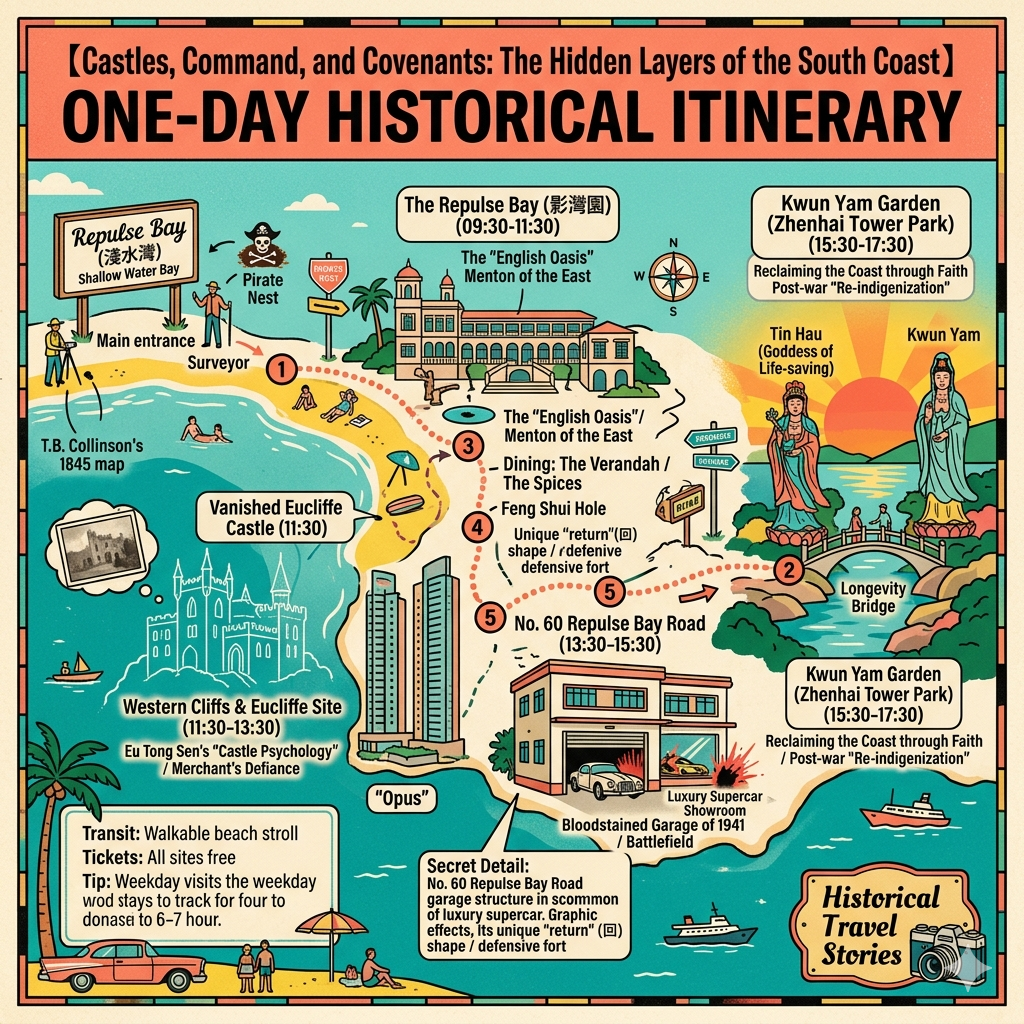
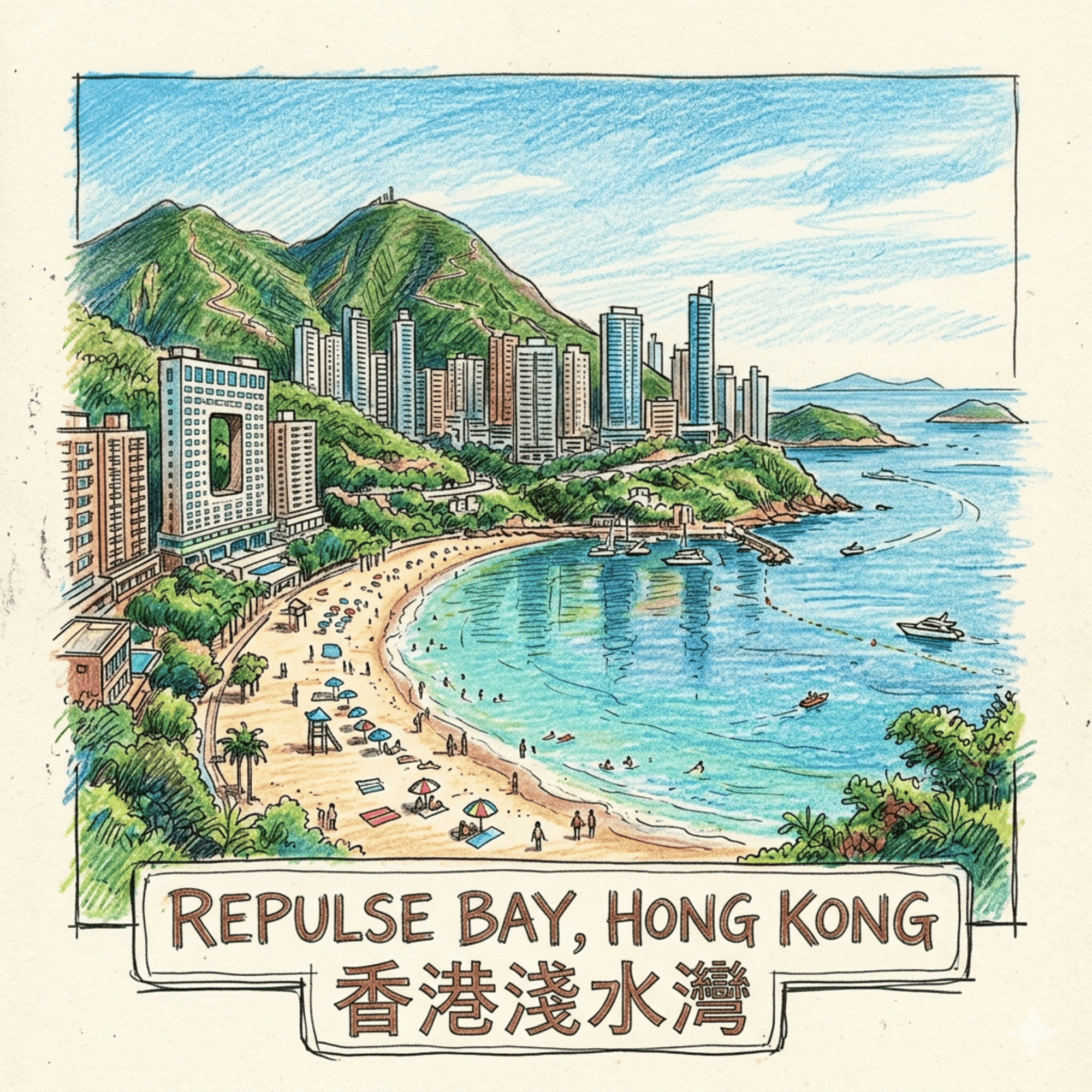
This is a historical travel story and walking guide to Repulse Bay, one of Hong Kong’s most iconic coastal destinations. By weaving together the colonial elegance of The Repulse Bay Hotel, the literary footsteps of Eileen Chang, and the area's transformation from a high-society retreat to a public beach, this walk reveals the multi-layered history behind the city's "oriental riviera."
 Lawrence
The Shoreline of Shifting Identities
To the casual observer, Repulse Bay is a crescent of golden sand and luxury high-rises—a playground for Hong Kong’s contemporary elite. However, for the historically minded traveler, this shoreline serves as a profound "layered archive," where the ghosts of colonial expansion, wartime trauma, and capitalist ambition reside just beneath the surface. This bay is a microcosm of Hong Kong’s broader evolution, shifting from a neglected maritime frontier to a fortified colonial enclave, and eventually into a space of public ritual. The history of this South Side gem is not merely found in archival texts; it is physically etched into the steep hillsides and the few remaining architectural relics accessible to the modern walker. By looking past the modern facade, we find a landscape defined by the strategic imposition of power and a persistent, often violent, struggle for cultural belonging.
Listen to the historical stories told in detail (For subscribers only)
The Cartographic Myth: Naming as an Act of Hegemony
In the mid-19th century, naming a coastline was an act of primary colonial hegemony. For the British Royal Navy, mapping the southern coast of Hong Kong Island was a way to assert sovereignty over a strategic waterway that the Qing authorities had largely left unmanaged.
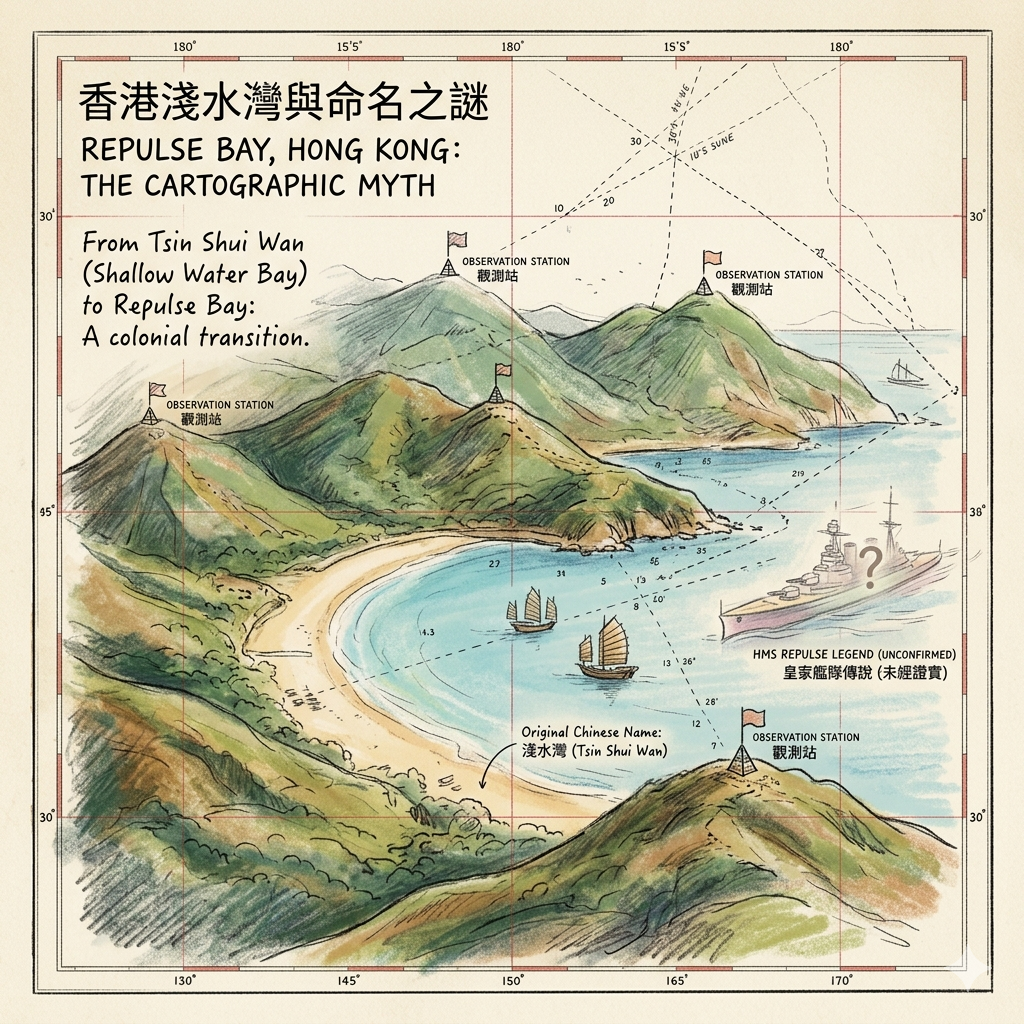
The transition from the functional Chinese name Tsin Shui Wan (Shallow Water Bay) to "Repulse Bay" was fraught with colonial incompetence and subsequent myth-making. In 1841, Commander Edward Belcher originally mislabeled the area "Chonghom Bay" (now Chung Hom Kok) during his preliminary survey—a blunder that highlights the initial disconnect between the colonizer and the local landscape. The eventual name "Repulse Bay" is likely a product of military deterrence rather than heroic action. While later legends claimed the bay was named after the "repulsion" of pirates to justify colonial order, or the presence of a phantom ship called HMS Repulse, archival records from the British Admiralty show no such engagement.
Instead, the name first appears with authority on the 1845 map by Royal Engineers Lieutenant T.B. Collinson. His map notes reveal the bay’s ridges were primarily used as "Observation Stations" to establish precise longitudinal and latitudinal coordinates for the empire. The militant English branding was a linguistic claim to a territory that was, at the time, still physically untamed.
Connective Tissue: These abstract lines and observation points on a map eventually gave way to a physical manifestation of colonial order: the creation of a restricted, high-capital luxury enclave.
The Kadoorie Enclave: Constructing an "English" Mediterranean
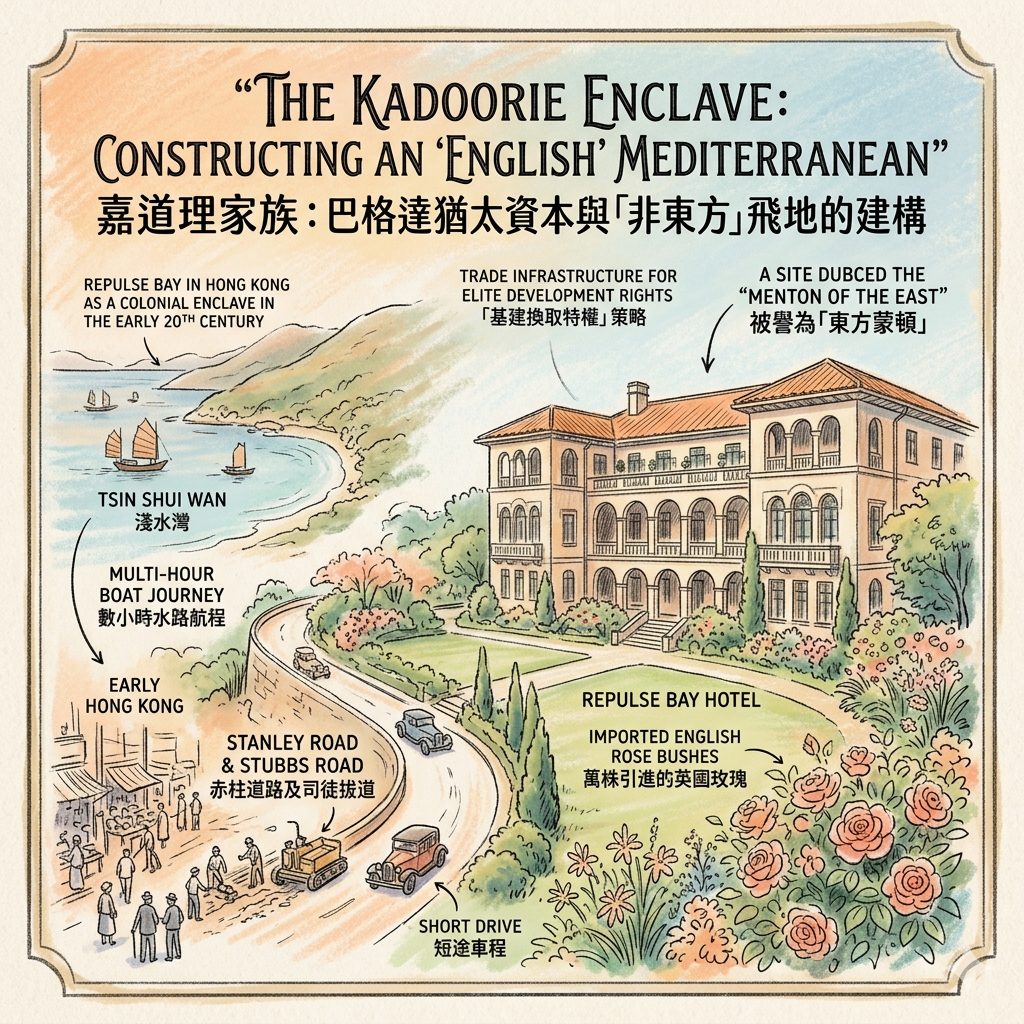
By the early 20th century, Hong Kong’s social fabric was defined by strict spatial segregation, codified by the 1904 Hill District Reservation Ordinance. In this environment, the Kadoorie family—prominent Baghdadi Jewish entrepreneurs—sought to develop the South Side into a "non-Oriental" retreat.
In 1918, James Taggart, representing the Hong Kong Hotel Company, entered negotiations with the government to transform the bay. The Kadoories utilized a sophisticated strategy of trading infrastructure for elite development rights; they promised a world-class luxury hotel if the government provided the roads. This resulted in the construction of Stanley Road and Stubbs Road, turning a multi-hour boat journey into a short drive.
The Repulse Bay Hotel, designed by the firm Denison, Ram and Gibbs, opened in 1920. Architecturally, it was a piece of the Edwardian Mediterranean transported to the subtropics. With 2,000 imported English rose bushes, the hotel was an intentional attempt to recreate a European "home"—a site famously dubbed the "Menton of the East." It was a space where the colonial elite could retreat into a curated English garden, physically and psychologically isolated from the surrounding territory.
Connective Tissue: The elegant socialite lifestyle of the 1920s and 30s, defined by garden parties and the rustle of imported roses, was destined to be shattered by the tactical brutality of the Pacific War.
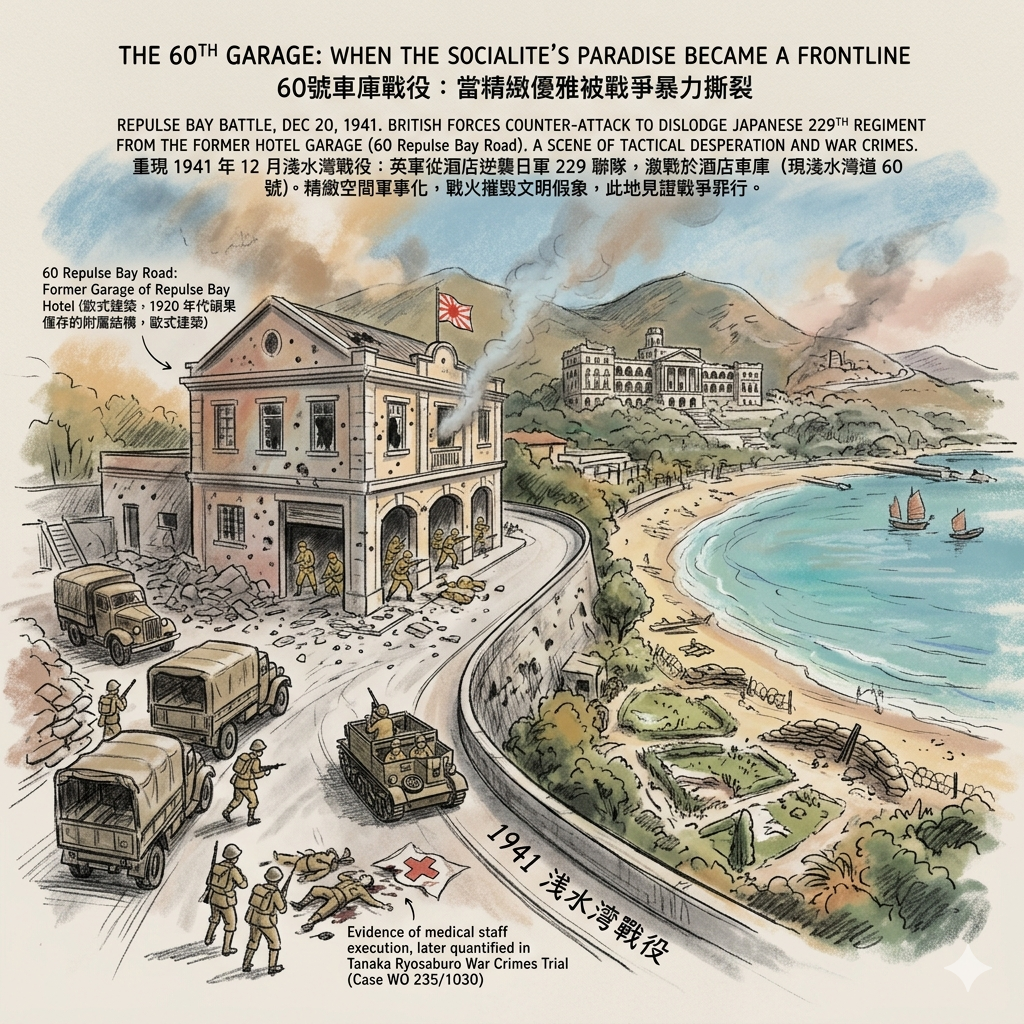
The 60th Garage: When the Socialite’s Paradise Became a Frontline
During the December 1941 Japanese invasion, Repulse Bay’s geography became its curse. Positioned as the "middle ground" between the critical Wong Nai Chung Gap and the final defensive lines at Stanley, the bay was transformed from a playground into a tactical slaughterhouse.
While literary figures like Eileen Chang romanticized the hotel’s "ruins" in Love in a Fallen City, the ground reality at 60 Repulse Bay Road (the former hotel garage) was one of tactical desperation. On December 20, 1941, this two-story structure became the site of a fierce counter-attack by British forces attempting to dislodge the Japanese 229th Regiment.
The brutality of the occupation here was quantified during the war crimes trial of Tanaka Ryosaburo (Case WO 235/1030). Evidence revealed that Japanese forces did not differentiate between combatants and non-combatants in the heat of the siege; medical staff were among those executed within the bay’s perimeter, grounding the "romantic" literary memory of the bay in the grim facts of mid-century warfare.
Connective Tissue: From the trauma of war emerged a new era of local Chinese capital, which sought to challenge the old colonial order through grand and defensive architectural expressions.
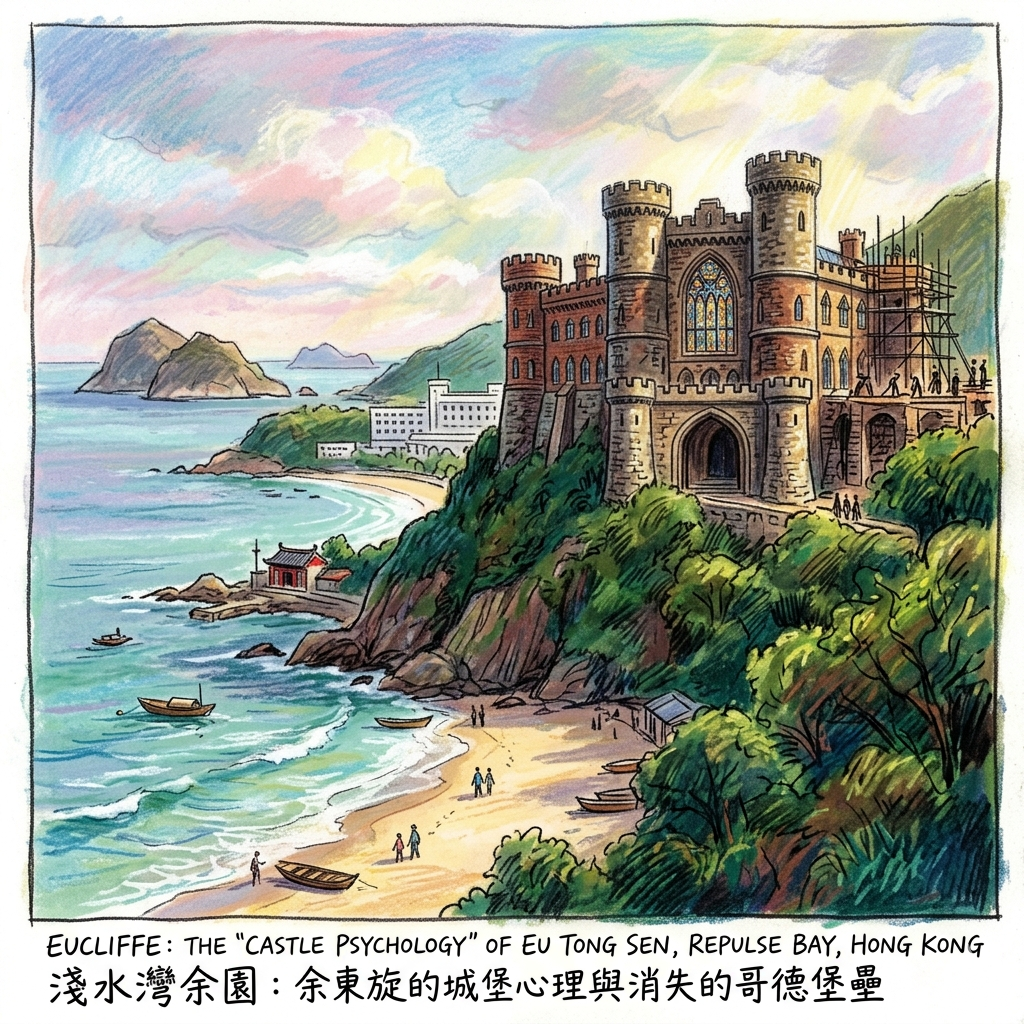
Eucliffe: The "Castle Psychology" and Cultural Appropriation of Eu Tong Sen
In the 1930s, the "Tin Kings" of Southeast Asia began to exert their status within Hong Kong’s hierarchy. Chief among them was Eu Tong Sen, who constructed "Eucliffe," a sprawling Gothic fortress that sat in direct visual defiance of the British-run Repulse Bay Hotel.
Eucliffe was a manifestation of "Castle Psychology"—a personal superstition held by Eu that constant construction could stave off death. By adopting the Gothic aesthetic of turrets, stained glass, and marble halls, Eu performed a radical act of cultural appropriation. He used the architectural language of the European aristocracy to signal that Chinese capital was on an equal footing with British power.
The castle’s end was as dramatic as its inception. During the occupation, General Tanaka Ryosaburo used the castle as a platform to deliver a speech to his troops. More harrowing are the archival reports of British soldiers being bayoneted and left at the base of Eucliffe’s stone walls during the final days of the defense. Though the castle was demolished in 1988, its history serves as a reminder of the fragility of even the grandest monuments.
Connective Tissue: As these private castles of capital were replaced by high-density developments, the bay underwent a democratization, shifting from an elite enclave to a public space protected by local spiritual rituals.
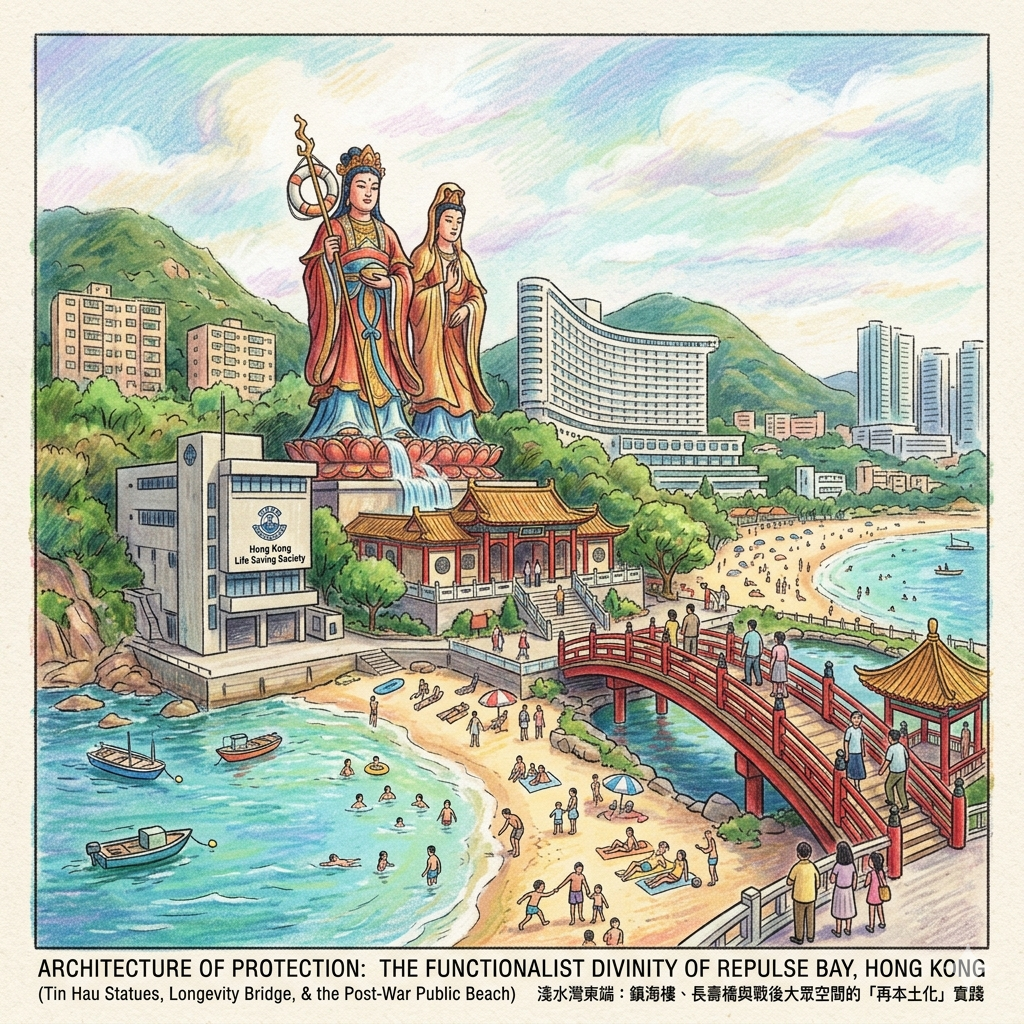
The Architecture of Protection: From Taboo to the Tin Hau Statues
In the post-war decades, Repulse Bay transitioned into a public beach. However, this democratization brought a psychological challenge: frequent drownings and a persistent local fisherman's taboo that held that saving a drowning person would anger the gods.
To address this, the Hong Kong Life Saving Society (HKLSS) engaged in a fascinating piece of "social psychology engineering" at the eastern end of the beach. They integrated spiritual protection into their functionalist headquarters by installing massive statues of Tin Hau and Kwun Yum. By rebranding Tin Hau as the "God of Life Saving," the society provided lifesavers with a moral mandate that bypassed traditional taboos.
This "functionalist divinity" is most visible at the Longevity Bridge. According to local myth—carefully maintained as part of the beach’s ritualistic landscape—crossing the bridge adds exactly "three days of life" to the walker. This synthesis of folk religion and public safety represents the final layer of the bay’s history: the reclamation of the shore by the public through spiritual ritual.
Connective Tissue: This transition from private capital to public ritual brings us to the present-day spatial reality, where the traveler can now physically walk through these disparate layers of time.
Walking the Layers: Hidden Gems for the Mindful Traveler
For those wishing to explore these narratives, the most significant relic is the Former Repulse Bay Hotel Garage (No. 60 Repulse Bay Road). While it now serves as a luxury supercar showroom, this European-style structure is the only original 1920s hotel building still standing. It is the silent, physical witness to the 1941 counter-attacks, standing as a lone survivor of a vanished colonial era.
Conclusion: A Philosophical Reflection on the Sand
Repulse Bay is a landscape of profound contradictions. It is a place where T.B. Collinson’s compass once mapped a frontier, where Kadoorie’s roses masked a segregated society, and where Eu Tong Sen’s Gothic dreams met the reality of Tanaka’s bayonets.
Today, we experience a "Paradox of Tranquility." The current romantic atmosphere enjoyed by those taking afternoon tea at the reconstructed Verandah relies on the selective forgetting of the blood shed at the Garage and the executions at the walls of Eucliffe. As the original monuments are replaced by modern luxury, we must ask: How do we choose to remember a place once its physical witnesses have been erased?
For more deep dives into the hidden narratives of the world's most storied landscapes, subscribe to our "Historical Travel Stories" newsletter.
Travel Logistics: Continuing the Journey
- How to Walk the History: To appreciate the steep terrain and the perspective of the 1845 survey, take the scenic bus routes (6, 6A, or 260) from Central. The journey over the hills reveals the bay's historic isolation and the strategic difficulty of the 1941 defense.
- A Taste of the Past: Visit The Repulse Bay (The Verandah) for tea to experience the reconstructed colonial aesthetic. Contrast this comfort with the knowledge of the "blood at the Garage" located just up the road.
- Military History: For a deeper look at the defense lines, explore the nearby "Wong Nai Chung Gap Trail," which details the path the Japanese 229th Regiment took to reach the South Side.
Q & A
Tell me about the religious and cultural significance of the statues.
The statues at the eastern end of Repulse Bay, located within Zhenhai Tower Park (鎮海樓公園), carry a significance that extends far beyond traditional religious worship. They represent a unique blend of "social psychological engineering" and grassroots cultural reclamation within a formerly colonial space,.Here is a breakdown of their religious and cultural significance according to the sources:
1. Breaking the "Drowning Taboo"
In the 1950s and 60s, a deep-seated cultural taboo existed among Hong Kong's coastal fishermen. Many believed that saving a drowning person would offend the water gods or the "scapegoats" (替死鬼) seeking a soul to take their place. This belief created a psychological barrier to rescue efforts. To combat this, the Hong Kong Life Saving Society (HKLSS)—whose headquarters is actually the site of these statues—embarked on a project to provide "divine moral legitimacy" to the act of saving lives.
2. Redefining Tin Hau as the "Goddess of Life Saving"
The centerpieces of the park are the massive statues of Tin Hau and Kwun Yam. The giant Tin Hau statue, unveiled in 1970, was a deliberate symbolic move. Its inscription explicitly defines her as the "Goddess of Life Saving along the Coast of China" (中國沿海拯溺之神). By reframing a traditional sea deity as a patron of professional lifesaving, the HKLSS transformed the act of rescue from a potential offense against spirits into a sacred duty mandated by the gods.
3. A "Functionalist" Religious Landscape
The park features an eclectic mix of deities added between 1972 and 1973, including Kwun Yam, the Dragon King (海龍皇), He Bo (河伯), and the God of Wealth. This "messy" fusion of Taoist and Buddhist figures reflects a "functionalist deity worship" typical of post-war Hong Kong.
- Spiritual Support: For older generations of lifeguards, these statues and the nearby Longevity Bridge (相傳每走一次增壽三天) served as vital spiritual pillars when they faced life-threatening conditions during rescues.
- Cultural Hybridity: The site represents a "grassroots religious landscape" that stands in stark visual contrast to the elite, colonial architecture of the nearby Repulse Bay Hotel (now The Repulse Bay).
4. Cultural "Re-indigenization"
Historically, Repulse Bay was developed as an "English enclave" designed to be "non-Oriental" and separate from the local Chinese population,. The establishment of the Zhenhai Tower Park and its towering statues in the 1970s marked a powerful process of "re-indigenization". It was an instance where grassroots religion and public leisure asserted themselves in a space previously reserved for the colonial elite, reclaiming the beach for the broader Hong Kong public.
In summary, these statues are not just landmarks; they are tools of a "救生宗教" (Lifesaving Religion), designed to solve a specific social problem by merging professional training with deep-seated folk beliefs.
How did the Lifesaving Society use 'divine moral legitimacy'?
The Hong Kong Life Saving Society (HKLSS) used "divine moral legitimacy" as a strategic tool of "social psychological engineering" to overcome a deep-seated cultural taboo that hindered rescue efforts in the mid-20th century.
According to the sources, the society employed this strategy in the following ways:
- Countering the "Drowning Taboo": In the 1950s and 60s, local fishermen often refused to save drowning people, fearing that interfering would offend the water gods or the "scapegoats" (替死鬼) seeking a replacement to allow their own reincarnation.
- Divine Representation (神權代言): To break this barrier, the HKLSS adopted a strategy of "divine representation," using religious symbols to provide a higher moral authority for the act of saving lives.
- Redefining Tin Hau: In 1970, the society unveiled a massive statue of the goddess Tin Hau at their training headquarters in Repulse Bay. Crucially, the inscription on the statue explicitly defined her as the "Goddess of Life Saving along the Coast of China" (中國沿海拯溺之神).
- Sanctifying the Rescue Act: By officially labeling Tin Hau as a patron of lifesaving, the HKLSS transformed the act of rescue from a potential offense against spirits into a sacred duty sanctioned by the goddess. This gave lifeguards and the public the "divine moral legitimacy" needed to act without fear of supernatural retribution.
This approach allowed the HKLSS to bridge the gap between professional lifesaving techniques and traditional grassroots beliefs, effectively turning a training base into a space where functionalist deity worship supported a modern social mission.
Reference and Further reading
- Repulse Bay - accessed May 10, 2026,
- What's in a Name? | Southside Living and Nearby Attractions - The Repulse Bay, accessed May 10, 2026,
- 「淺水灣」的名稱由來成謎 - The Repulse Bay, accessed May 10, 2026,
- Repulse Bay Facts for Kids, accessed May 10, 2026,
- Greetings, Author at Hong Kong Greeters - Page 3 of 8, accessed May 10, 2026,
- Surveying & Built Environment Vol. 34 - Issue 1 - HKIS, accessed May 10, 2026,
- Thomas Bernard Collinson - accessed May 10, 2026,
- HONG KONG STUDIES - Brill, accessed May 10, 2026,
- SPE Int - Planning Buildings for a High-Rise Environment in Hong Kong, accessed May 10, 2026,
- The Kadoorie Family: Power, Property and a Long Horizon | by Global Times - Medium, accessed May 10, 2026,
- 淺水灣酒店歷史 - The Repulse Bay, accessed May 10, 2026,
- 香港淺水灣淺水灣道60號 前淺水灣酒店車庫 Former Garage of Repulse Bay Hotel, No. 60 Repulse Bay Road, Repulse Bay, HK, accessed May 10, 2026,
- The Repulse Bay Hotel History, accessed May 10, 2026,
- Hubbing for Tourists: Airports, Hotels and Tourism Development in the Indo-Pacific, 1934–2019 9783111326641, 9783111324869 - DOKUMEN.PUB, accessed May 10, 2026,
- The Repulse Bay - accessed May 10, 2026,
- Not the Slightest Chance: The Defence of Hong Kong, 1941 - Tony Banham - Google Books, accessed May 10, 2026,
- The East River Column: the rebels who helped Second World War prisoners of war, accessed May 10, 2026,
- 香港文學地圖:張愛玲第三集:淺水灣傾城, accessed May 10, 2026,
- WO235/1030 - Hong Kong's War Crimes Trials Collection, accessed May 10, 2026,
- Hong Kong's War Crimes Trials Collection, accessed May 10, 2026,
- Japanese Atrocities At Hong Kong - Hansard - UK Parliament, accessed May 10, 2026,
- What's Left from Hong Kong's Vanished Mansions, Euston and Eucliffe, accessed May 10, 2026,
- The Lost Mansions of the Mid-Levels, Part III: Euston Castle - ZOLIMA CITYMAG, accessed May 10, 2026,
- Part of Euston, a dwelling at Nos. 41-46 Bonham Road, the Mid-Levels - 香港記憶, accessed May 10, 2026,
- Eucliffe [1933-1988] - Gwulo, accessed May 10, 2026,
- 由《傾城之戀》到《色,戒》 看淺水灣酒店歷史| 飛凡香港 - 當代中國, accessed May 10, 2026,
- Eucliff castle at Repulse Bay - Digital Commonwealth, accessed May 10, 2026,
- 鎮海樓公園- 古蹟天行樂Skywalker's Heritage - 天行足跡, accessed May 10, 2026,
- 醉人閒情淺水灣 - 活動內容, accessed May 10, 2026,
- Hong Kong Fun in 18 Districts - Spots, accessed May 10, 2026,
- NTU Digital Library of Buddhist Studies ::: Fulltext, accessed May 10, 2026
Lawrence Lawrence
 Lawrence