(ENG) Sai Wan Heritage Walk – 5 Hidden Layers of Hong Kong’s Urban Backstage and Colonial Disciplinary History
Beneath the gentrified surface of modern Sai Wan lies a cold logic of colonial discipline. This walking guide takes you through five spatial layers of Kennedy Town, Shek Tong Tsui, and Sai Ying Pun, decoding the architecture of plague hospitals, temples, and asylums to reconstruct early Hong Kong.

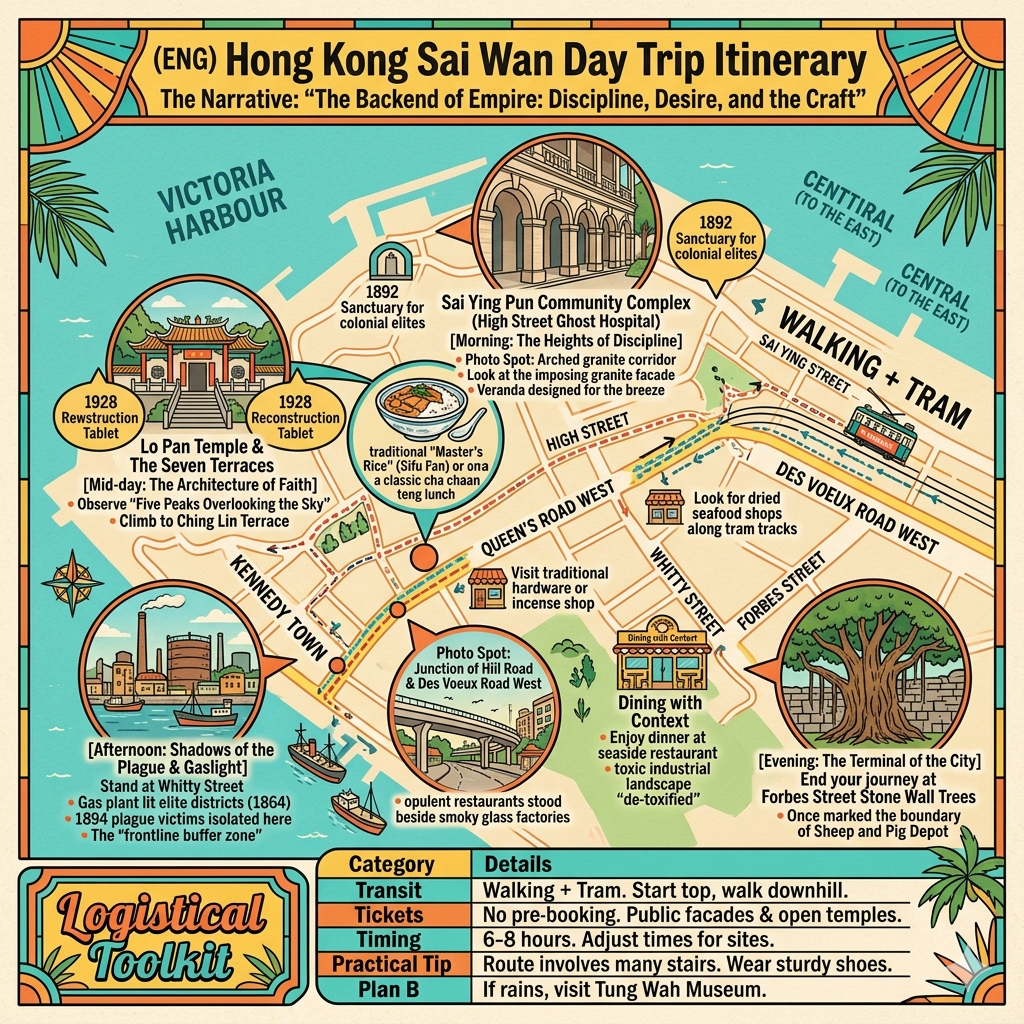
This is a historical travel story and walking guide to Sai Wan, the evocative western fringe and former "urban backstage" of colonial Hong Kong. Through five hidden spatial layers across Kennedy Town, Shek Tong Tsui, and Sai Ying Pun, it explores how infectious diseases, artisan guilds, red-light culture, and industrial waste shaped the district's landscape. This deep guide offers a historical archaeology of the slopes and shorelines to reveal how imperial control and local resilience collided on the margins of the City of Victoria.
 Lawrence
The Terminal of Victoria
In the early colonial geography of Hong Kong, Sai Wan functioned not as a destination, but as the "urban backstage"—the geographical terminal of the City of Victoria. It was the leeward frontier where the colonial administration relegated the visceral realities it sought to obscure from the pristine center: hazardous industry, infectious disease, and the social "other." This western fringe served as a strategic buffer zone for a burgeoning empire that prioritized sanitization through distance. Today, for the historical traveler, Sai Wan remains an evocative palimpsest. To walk its steep slopes and coastline is to trace the physical layers of how a city survives its own contradictions. It is a place where the modern observer can still find the remnants of a crisis that redefined the district’s shoreline, marking the start of an era where hygiene became a primary tool of imperial control.
Listen to the historical stories told in detail (For subscribers only)
The Glassworks Hospital: Hygiene as a Tool of Empire
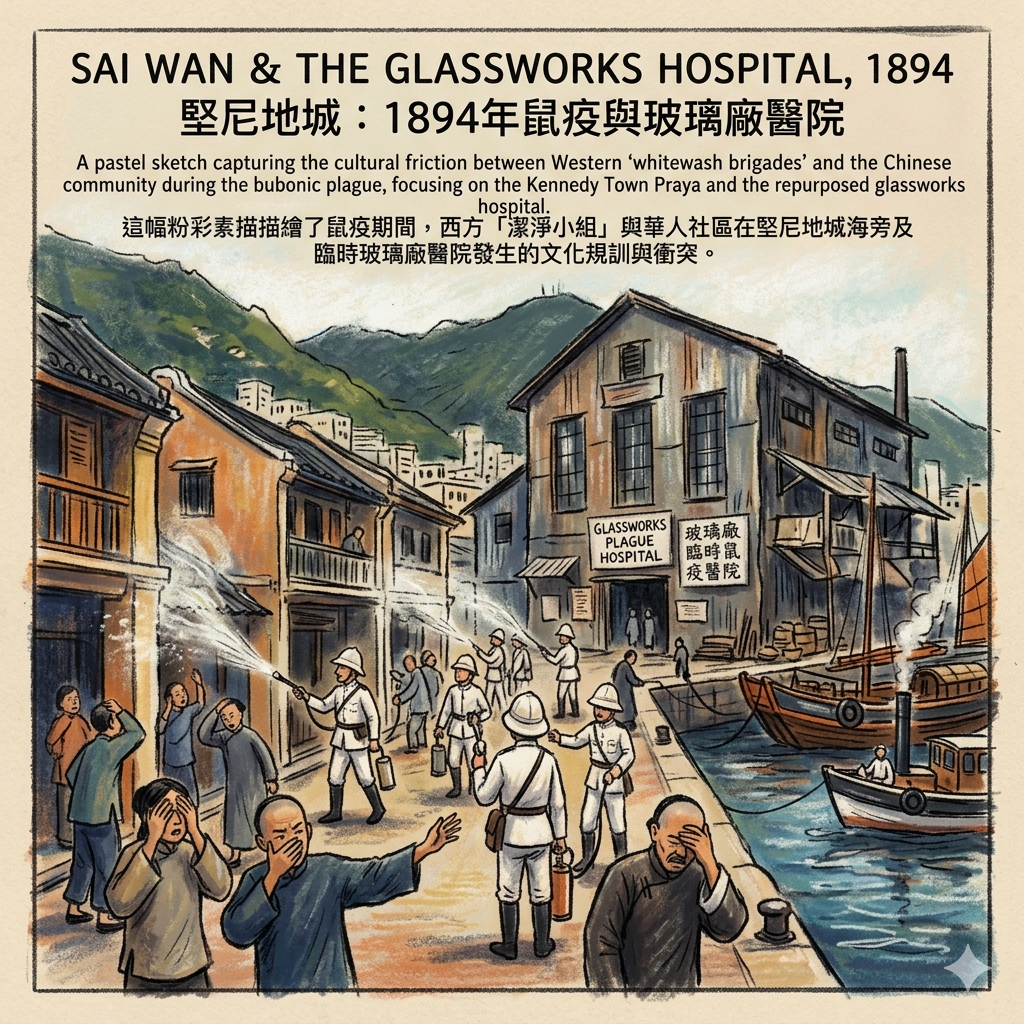
The 1894 bubonic plague transformed Kennedy Town from a quiet coastal fringe into a frontline buffer zone for colonial hygiene experiments. Facing a crisis that threatened the colony’s survival, the government abandoned its non-interventionist medical policy, pivoting toward aggressive surveillance of the Chinese community. The epicenter of this struggle was an abandoned glassworks factory on the Kennedy Town Praya, hastily converted into a temporary plague hospital. This facility became a site of profound cultural friction between Western "sanitary brigades" and the Chinese populace.
"The forced entry of 'whitewash brigades' into private homes, utilizing lime powder for disinfection and seizing the sick, triggered a wave of fear and resistance that resonated throughout the district."
The crisis necessitated a delicate power play involving the elites of the Tung Wah Hospital. These leaders acted as mediators, negotiating between the government’s sanitary demands and the community’s preference for traditional "home treatment." This era of high-stakes hygiene left an indelible mark on the district’s landscape. Even today, at the Kennedy Town Praya, the traveler can observe the parallel structure of the streets and coastline—a rigid, 19th-century industrial logic designed for efficient maritime logistics and the containment of "unclean" infrastructure. This spatial solidity provides a sharp contrast to the invisible, chaotic threats of the plague years.
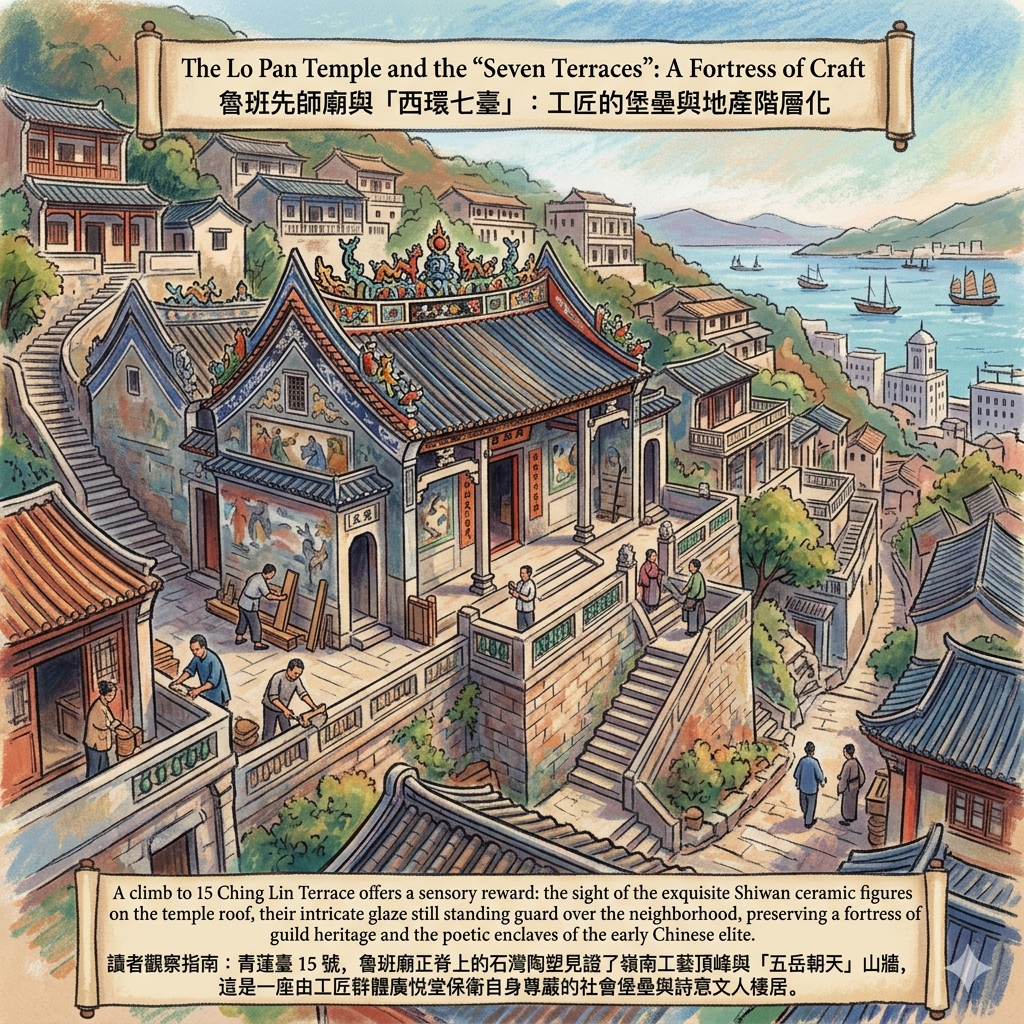
The Lo Pan Temple and the "Seven Terraces": A Fortress of Craft
As the colonial government sought to discipline the district through hygiene, the physical fabric of Sai Wan was being raised by the "Three Trades"—the guilds of wood, stone, and plaster. These artisans were the essential builders of Victoria, and in 1884, they established the Lo Pan Temple. The temple’s architecture is a sophisticated expression of artisanal pride, specifically the "Five Peaks Facing Heaven" gable design. This sharp-stepped roofline, rare in Hong Kong, signifies the elevated status of the craftsman deity.
The temple sits at the heart of the "Seven Terraces" (Sei Wan Tsat Toi), a residential development by the entrepreneur Li Po-lung. These enclaves represented a fusion of elite aspiration and artisan labor, providing a structured, poetic environment on a challenging slope. When a financial crisis threatened the area with redevelopment in the 1920s, the building industry successfully rallied to save the temple, preserving it as a fortress of guild heritage.
The Poetic Enclaves of the Seven Terraces:
- Ching Lin Terrace (青蓮臺): The spiritual center, home to the Lo Pan Temple.
- To Li Terrace (桃李臺): Named for literary elegance.
- Tai Pak Terrace (太白臺): Reflecting the cultural tastes of the early Chinese elite.
- Hee Wong Terrace (羲皇臺): Notable for its tiered residential logic.
- Hok Sz Terrace (學士臺): Evoking the dignity of the scholar-official.
- Kwong Hoi Terrace (廣海臺): Referencing the vastness of the sea.
- Tsz Kwok Terrace (紫國臺): Completing the poetic landscape of the slope.
A climb to 15 Ching Lin Terrace offers a sensory reward: the sight of the exquisite Shiwan ceramic figures on the temple roof, their intricate glaze still standing guard over the neighborhood. This artisanal resilience provides a transition from the heights of craft to the institutional discipline of the slopes above.
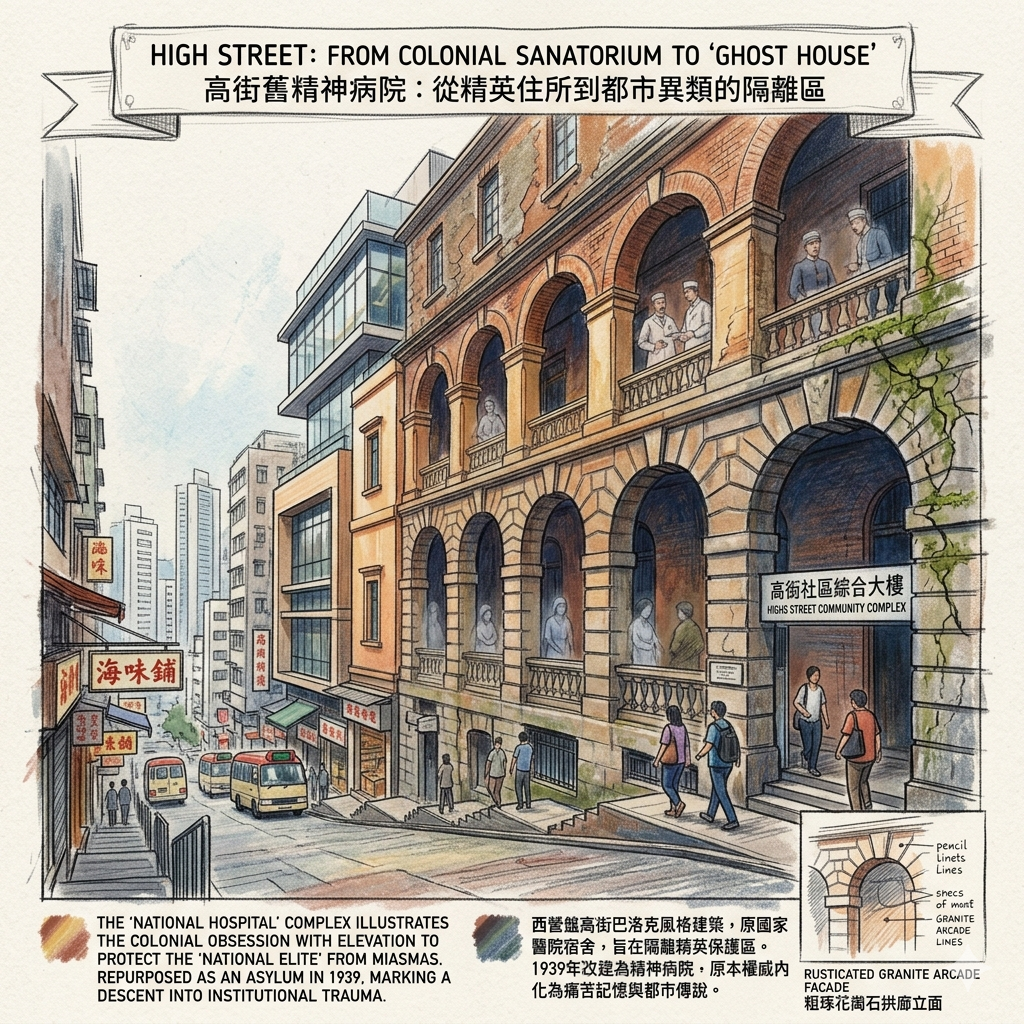
High Street: From Colonial Sanatorium to "Ghost House"
Further up the vertical spine of Sai Ying Pun, the "National Hospital" complex on High Street illustrates the colonial obsession with elevation as a defense against disease. Built in 1892 as quarters for European medical staff, the structure utilized the high, ventilated ground to protect the colonial "national elite" from the perceived miasmas of the lower city. However, the 20th century forced a dramatic demotion in the building's status within the colonial hierarchy.
In 1939, the site was repurposed as a mental health asylum to house an influx of psychiatric patients and female wards fleeing conflict in mainland China. This shift from "National Elite" to "Urban Outcast" marked the building's descent into a site of institutional trauma.
Original Function (1892) | Transformation (1939-1971) |
Quarters for National Hospital Staff: A sanctuary for laboratory technicians and European nurses. | Mental Health Asylum: Repurposed to house the "urban outcasts" and refugees. |
Colonial Sanctuary: Designed for protection, health, and European comfort. | Site of Trauma: Known for controversial "Insulin Coma Therapy" and wartime interrogation rumors. |
Baroque Authority: Representing the vigor and prestige of British public architecture. | "Ghost House": Decades of dereliction following its 1971 closure birthed the "Ghost House" myth. |
Today, the rusticated granite arcades of the facade remain—a somber, beautiful shell of Baroque authority that now fronts a modern community center.
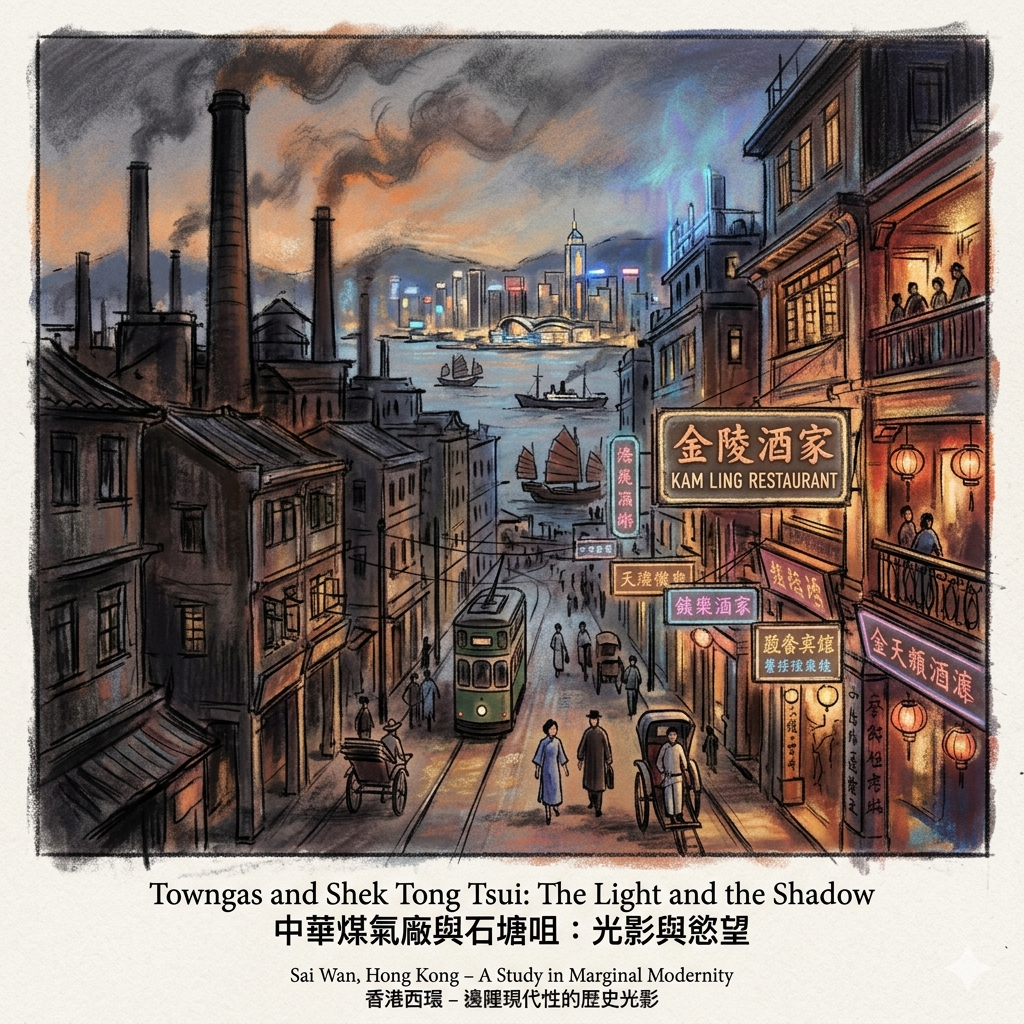
Towngas and Shek Tong Tsui: The Light and the Shadow
The development of Sai Wan is a primary study in "Marginal Modernity." In 1862, the Hong Kong and China Gas Company (Towngas) established its plant in West Point to provide the luxury of light to the banks of Central. This created a stark spatial inequality: the chimneys of Sai Wan polluted the local air so that the colonial center could shine. This industrial intensity merged with a different "shadow" economy in 1903, when the government relocated all brothels from Central to Shek Tong Tsui.
The resulting district, known as "Seven-West Moon," became a sensory paradox where the soot of energy production met the opulence of the red-light district.
"In this strange symbiosis, the soot-stained chimneys of the gas plant stood alongside the opulent, neon-lit restaurants like the Kam Ling. It was a place where the 'nightlife beneath the chimneys' was defined by a heavy mix of coal smoke and high-end jasmine tea."
This coexistence of vice and industry served to keep the colonial core "clean" and orderly, pushing the sensory intensity of modern urban life to the periphery.
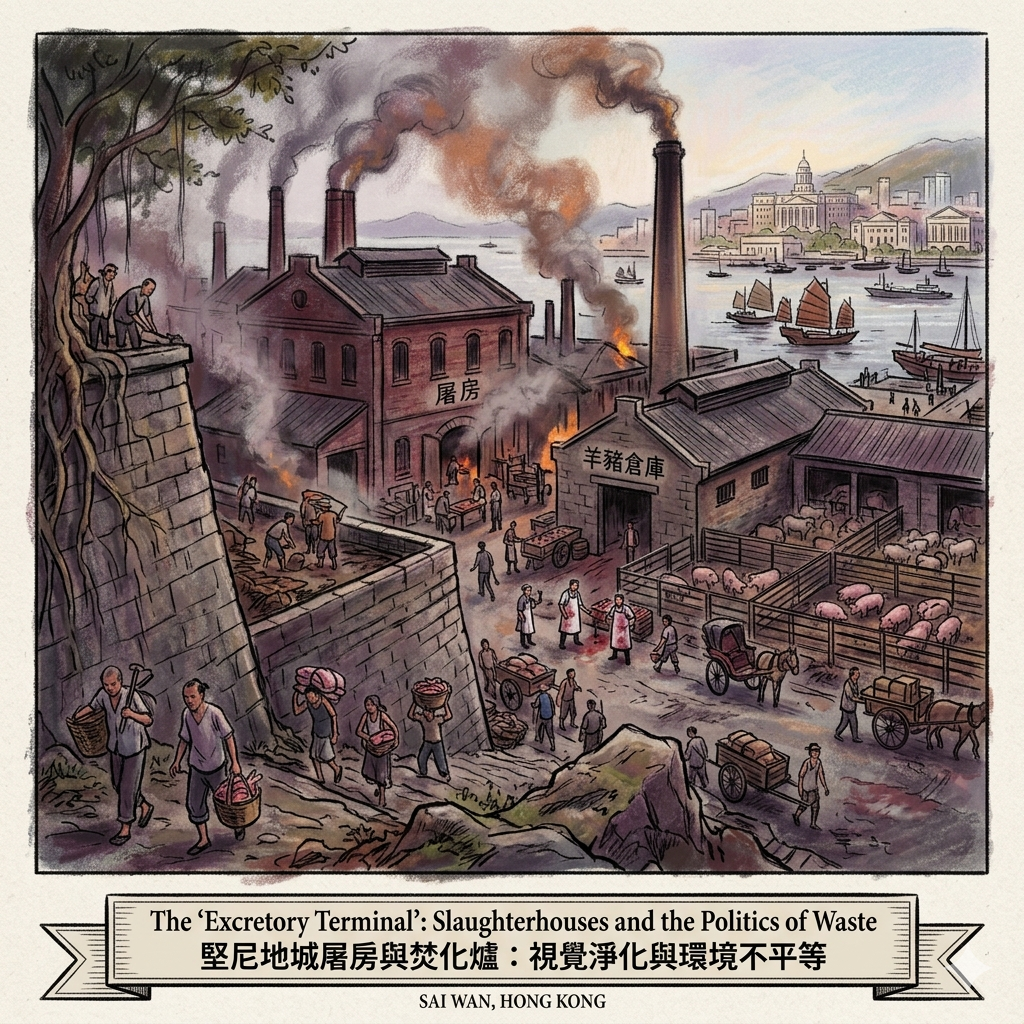
The "Excretory Terminal": Slaughterhouses and the Politics of Waste
By the late 19th century, urban planning in Victoria was driven by the logic of "visual purification." To maintain the prestige of the center, the city’s most visceral functions were pushed to the western leeward. In 1889, Kennedy Town became the "excretory terminal" of the city, housing the primary Abattoir, the Sheep and Pig Depot, and the municipal Incinerator.
This was more than a matter of hygiene; it was a matter of state control. The "Market Ordinance" granted the government a monopoly on meat slaughtering, turning sanitary concerns into a tool for monitoring taxes and the food supply. While the colonial core remained pristine, a resilient community of butchers, laborers, and coolies grew in the shadow of these "unclean" facilities. Today, the massive stone walls on Forbes Street, now famously overtaken by ancient banyan trees, serve as the last physical boundary of these livestock depots—the point where the city's visceral functions were once contained.
Hidden Gems for the Historical Traveler
For those seeking the physical echoes of these narratives, two sites are essential:
- The Forbes Street Masonry Walls: These towering granite walls and their century-old banyan trees are remnants of the livestock depots, a powerful visual of 19th-century civil engineering and environmental resilience.
- The Victoria Public Mortuary: Still in operation, this site is the final functioning piece of the district’s historical landscape of "death and disposal," anchoring the western end of the city’s life cycle.
Conclusion: A Sophisticated Reflection
Sai Wan serves as a perfect "Heterotopia"—a real space that mirrors, yet contradicts, the rest of the city. Within its borders, the fundamental tensions of the Hong Kong experiment were most visible: Western science clashing with Chinese faith, elite sanatoriums transforming into asylums, and industrial pollution fueling the center's light.
To understand a city, one must look at its "backstage." Sai Wan reminds us that the polished highlights of a metropolis are often sustained by the labor and "impurities" pushed to its margins. As modern gentrification replaces slaughterhouses with luxury apartments and gas chimneys with cafes, we must ask: what part of our collective urban memory is obscured when we sanitize the very spaces that allowed the city to function?
For more deep-history explorations of forgotten urban corners, subscribe to our series on the evolution of colonial landscapes.
Planning Your Historical Walk
How to get there: Take the MTR Island Line to Kennedy Town (for the Praya, Lo Pan Temple, and Forbes Street) or Sai Ying Pun (for High Street). Recommended Tours: Search for local heritage walks focusing on "Western District Industrial History" or "The Three Trades of Hong Kong." Accommodation: For an immersive experience, stay in one of the boutique hotels in Sai Ying Pun, where the steep street slopes provide a daily encounter with the district’s vertical history.
Q & A
Tell me about the culture and legends of High Street Hospital.
The High Street Hospital (formally known as the Old Mental Hospital and now the Sai Ying Pun Community Complex) is a site where colonial elite protection, controversial medical history, and dark urban legends converge. Its cultural significance lies in its transition from a space of "colonial privilege" to one of "social exclusion" and collective trauma.
1. From "Elite Sanctuary" to "Social Exclusion Zone"
Originally built in 1892, the building was designed in a grand Baroque style to serve as a dormitory for European staff (nurses, chemists, and laboratory assistants) of the National Hospital. Located on high ground for better ventilation and isolation from the crowded Chinese quarters, it was initially an "elite protection zone". However, the 1930s saw a massive influx of refugees and a spike in mental health issues, leading the government to convert the building into a female mental ward in 1939. This shift transformed the building from a site of colonial comfort into a space for the "urban outcasts".
2. Controversial Medical Culture
In the 1940s and 1950s, the hospital became a primary site for experimental psychiatric treatments in Hong Kong. Under the direction of prominent psychiatrist Dr. Yap Pow-meng, the facility introduced several procedures that are now considered highly controversial:
- Insulin Coma Therapy: A treatment where patients were repeatedly injected with large doses of insulin to induce daily comas.
- Leucotomy (Lobotomy): A neurosurgical procedure involving the cutting of connections in the brain's prefrontal cortex. These "cutting-edge" yet brutal techniques contributed to the building’s reputation as a place of suffering and institutional dread.
3. The Legend of the "High Street Ghost House"
The building is widely known in Hong Kong folklore as the "High Street Ghost House" (高街鬼屋), a reputation fueled by its history and its eerie appearance during its thirty-year abandonment (1971–2001). The legends are rooted in two main historical narratives:
- Japanese Occupation Rumors: During WWII (1941–1945), it is rumored that Japanese gendarmes used the hospital’s basement as an interrogation and execution chamber for local Chinese. While these claims are largely unverified by official records, they remain a core part of the local oral history.
- The Mass Grave Connection: The haunting atmosphere is reinforced by its proximity to King George V Memorial Park across the street, which was rumored to have been a mass grave site during the Japanese occupation.
4. Architectural Culture and "Facadism"
The building is culturally significant today for its "Facadism"—a controversial preservation approach where only the exterior granite facade was kept during the 2001 reconstruction.
- Visual Authority: The facade features a rusticated granite arcade and an L-shaped veranda designed for tropical climates.
- Symbolism: The heavy, rugged stonework was intended to project the authority and robustness of the colonial government's public infrastructure.
In 2015, the facade was officially declared a statutory monument, serving as a permanent physical reminder of the complex layers of madness, trauma, and colonial power that once resided behind its walls.
Tell me about the ghost stories of George V Park.
The ghost stories surrounding King George V Memorial Park (佐治五世公園) are inextricably linked to its proximity to the Old Mental Hospital (the "High Street Ghost House") and the grim history of the Japanese occupation in Sai Ying Pun.
The park is shrouded in the following legends:
- The Mass Grave Rumor: The most enduring legend is that the park was used as a mass grave site (亂葬崗) during the Japanese occupation (1941–1945). It was rumored that the bodies of those who died in the neighborhood or were executed nearby were disposed of in the area now occupied by the park.
- Atmospheric Connection to the "Ghost House": The park sits directly opposite the High Street Old Mental Hospital. While the hospital itself was rumored to have housed Japanese interrogation and execution chambers in its basement, the park is seen as the environmental extension of those horrors, forming a localized zone of collective fear and urban legend.
- The "Death and Disposal" Landscape: Historically, this specific pocket of West Point was characterized by what researchers call a "death and disposal" landscape. The park's proximity to the Victoria Public Mortuary and the former hospital contributed to a public perception of the area as being spiritually "unclean" or haunted.
While these stories of mass graves and hauntings are unverified by official records, they remain deeply embedded in Hong Kong's urban folklore, largely because they reflect the real institutional trauma and the "dark history" of the surrounding colonial and wartime infrastructure.
Reference and Further reading
- 鼠疫與香港殖民醫學下的華人女性病患(1841-1900), accessed May 14, 2026,
- 堅尼地城玻璃廠 - 香港記憶, accessed May 14, 2026,
- A Medical History of Hong Kong: 1842–1941 [1 ed ... - dokumen.pub, accessed May 14, 2026,
- Hues of Healing - Center for Interdisciplinary Studies in Science and Cultural Theory - Duke University, accessed May 14, 2026,
- 香港堅尼地城青蓮臺15 號, accessed May 14, 2026,
- 該廟備受地區人士重視。 - 據1873年的差餉冊記載,油麻地居民多經營船隻維修、理, accessed May 14, 2026,
- 古物古蹟辦事處- 香港法定古蹟- 香港島(764), accessed May 14, 2026,
- 香港魯班廣悅堂: 首頁, accessed May 14, 2026,
- 舊精神病院立面文物價值評估報告 - 歷史價值, accessed May 14, 2026,
- 【高街鬼屋】香港精神病院的故事- 港識多史|香港歷史社會研究社, accessed May 14, 2026,
- Towngas and CulinArt 1862 - Chestnut Journal, accessed May 14, 2026,
- The Hongkong and China Gas Company Ltd – early history from ..., accessed May 14, 2026,
- Possession Street - accessed May 14, 2026,
- Agreement to use PDF files from The Chinese University of Hong ..., accessed May 14, 2026.
 Lawrence
 Lawrence
 Lawrence