(ENG) Shau Kei Wan Historical Walk – 5 Shifting Shoreline Stories on Hong Kong’s Strategic Throat
A spatial walking guide to Shau Kei Wan, Hong Kong’s historical maritime gateway. Follow a route from old coastlines to A Kung Ngam’s shipyards, exploring 5 stories of Hakka stonecutters, WWII command posts, and the transition from maritime production to modern land development.

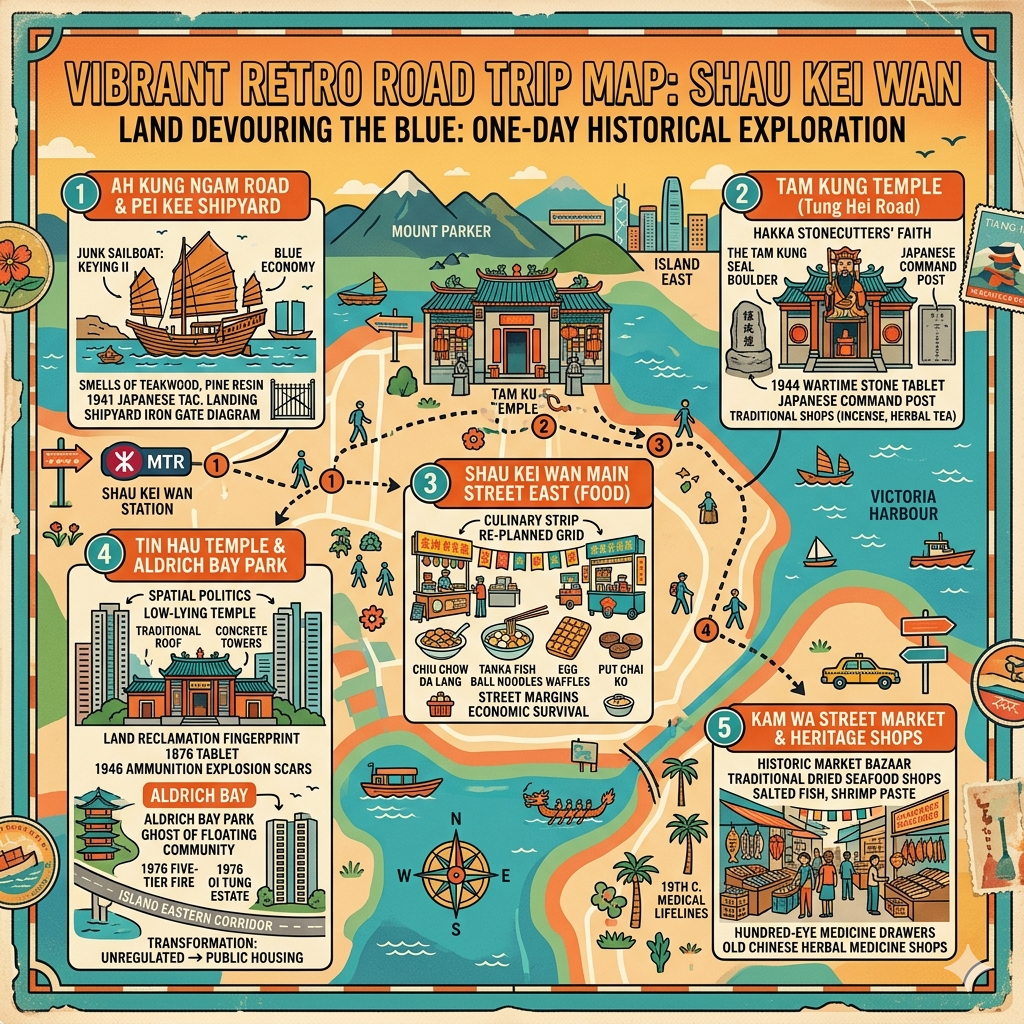
This is a historical travel story and spatial walking guide to Shau Kei Wan, the historical "strategic throat" of Hong Kong Island. Through five layered shoreline stories, it explores the Tin Hau and Tam Kung temples, the industrial edges of A Kung Ngam, and traditional wooden shipyards to reveal how Hakka stonecutters, wartime conflicts, and a vanishing blue economy shaped this resilient maritime community.
 Lawrence
The Shoreline that Moved
Walking through the high-density residential corridors of modern Shau Kei Wan, the urban fabric feels permanent, even sterile. Yet, beneath the concrete of the MTR station and the high-rises of Aldrich Bay lies a "proto-urban" frontier defined by rugged stonecutters, pirate havens, and a sprawling water-world of boat people. Shau Kei Wan—named for its resemblance to a shau kei or rice-washing basket—was never just a peripheral fishing village; it was the "strategic throat" of the Lei Yue Mun channel. This geography dictated its fate, making it a vital maritime gateway that demanded colonial regulation. To walk these streets today is to engage in a "layered observation," peeling back the modern topographical footprint to reveal a hidden identity carved from the very granite of the coast. This is a story of how a community of laborers first shaped the rocks of a coastline that would eventually be moved by the hands of empire and capital.
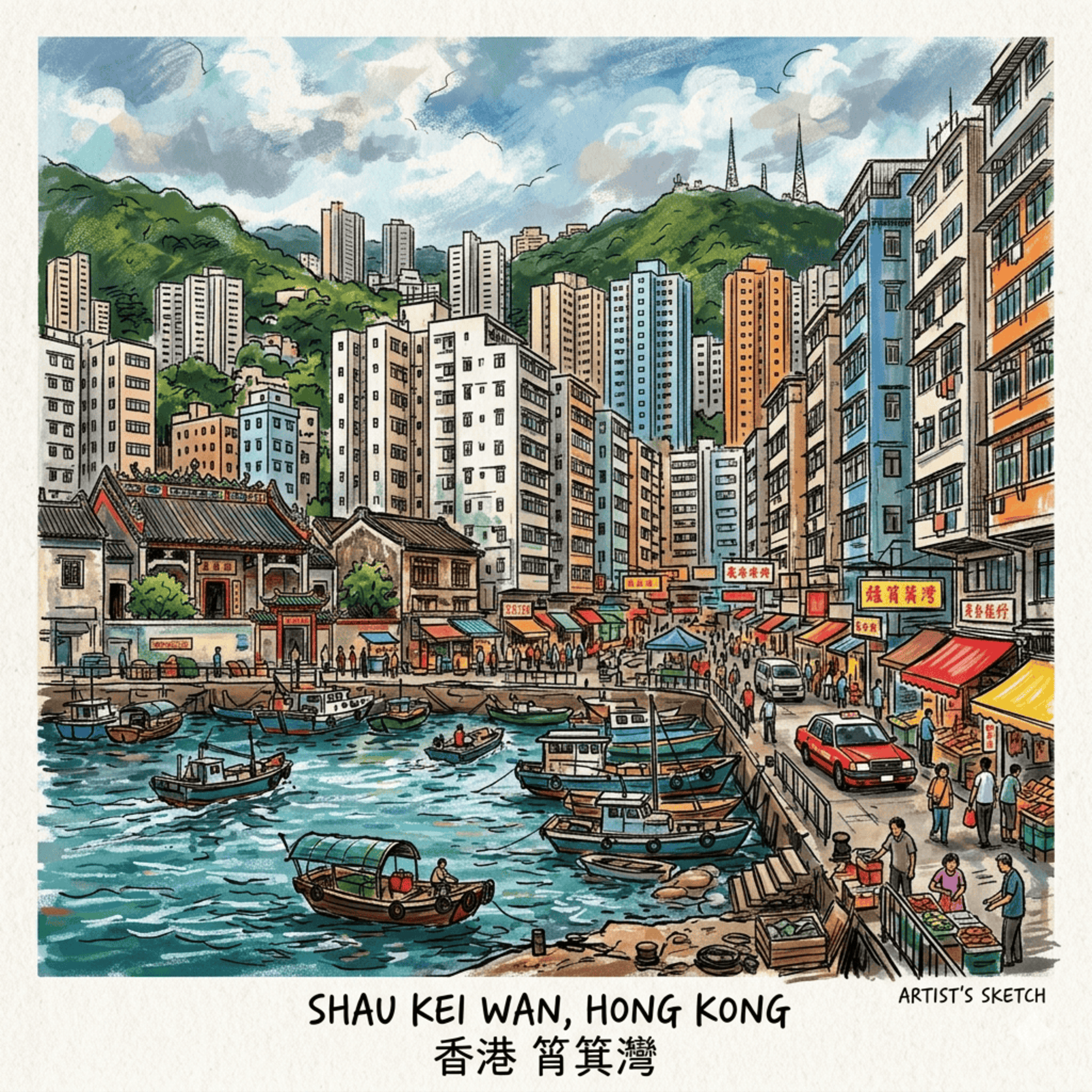
Listen to the historical stories told in detail (For subscribers only)
The Stonecutter’s "Grandfather": A Kung Ngam and the Tam Kung Faith
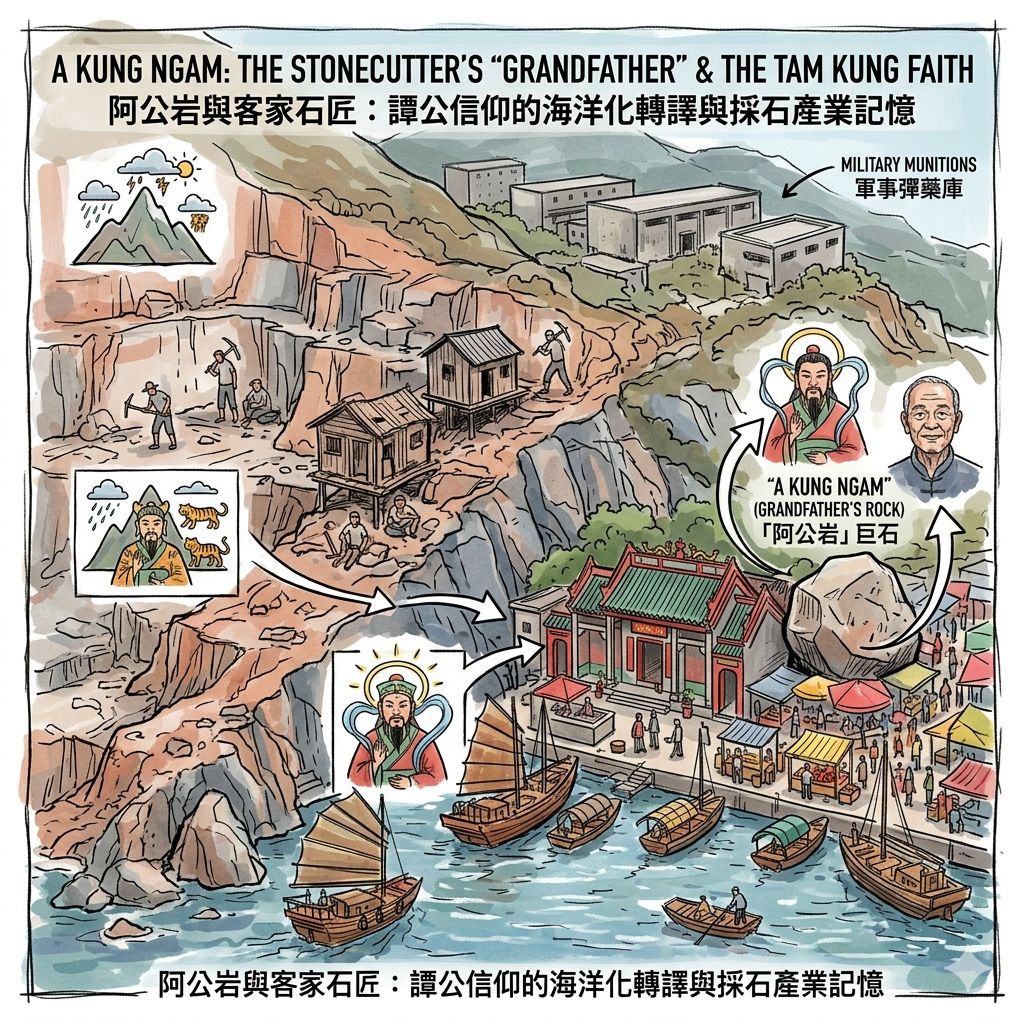
In the mid-19th century, the demand for high-grade granite to build the colonial capital of Victoria triggered a massive migration of Hakka stonecutters from Huizhou to the outcrops of A Kung Ngam. These laborers, living in precarious hillside huts, brought with them the "Tam Kung" faith. Remarkably, Tam Kung was originally an inland deity—a mountain-dwelling protector against tigers and a bringer of rain.
Upon reaching the littoral zone of Shau Kei Wan, the deity underwent a "maritime reconstruction." Tam Kung evolved from an inland rain god into a maritime protector capable of forecasting typhoons. This was a "structural contribution" to Hong Kong's culture: inland migrants did not merely adopt maritime traditions; they reshaped their own to master a new environment. For the traveler standing at A Kung Ngam, the temple represents the guild hall of a rugged industrial community that quite literally carved the city out of the cliffside.
"The namesake 'A Kung Ngam' (Grandfather's Rock) remains a point of historiographical intrigue. While most devotees believe it refers to 'Tam Kung,' whom they affectionately called 'A Kung,' historical analysis suggests it may honor a respected Hakka elder who pioneered the local quarrying industry. This overlap of deity and patriarch underscores the inextricable link between labor and faith in the early quarries."
While these laborers sought spiritual protection, they could not insulate their sacred ground from the physical dangers of the colonial military munitions housed on the slopes above them.
Sacred Space vs. Imperial Munitions: The Double Trials of Tin Hau
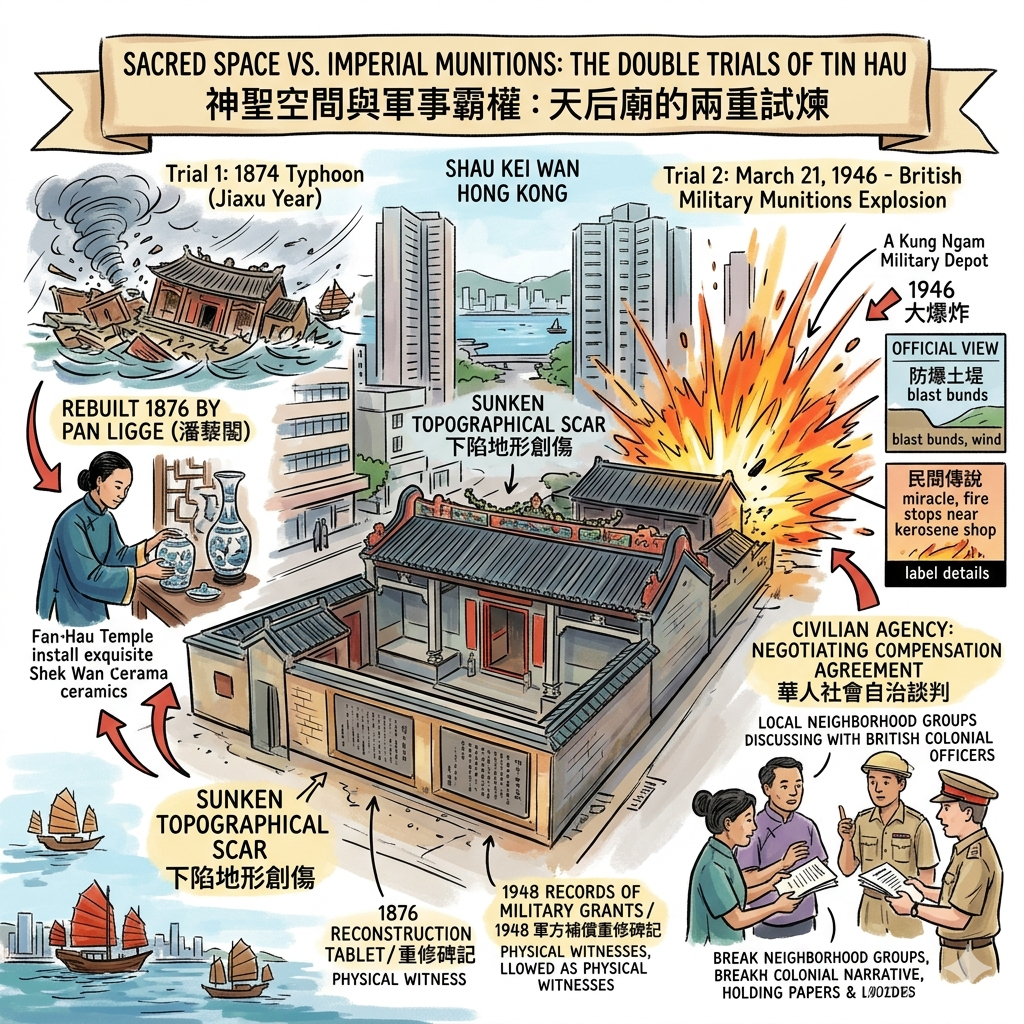
The Tin Hau Temple, established in 1845, stands as a testament to the resilience of Shau Kei Wan’s maritime society against the twin forces of nature and empire. Its history is marked by two catastrophic destructions. The first was the "Typhoon of the Jiaxu Year" in 1874, a storm of such ferocity it leveled the structure. It was rebuilt in 1876 under the leadership of local gentry member Pan Ligge (潘藜閣), who brought in exquisite Shek Wan ceramics to restore its dignity.
The second destruction occurred on March 21, 1946, when a British military ammunition depot at the rear of the temple exploded. The resulting blast was a moment of rare "civilian agency"; local neighborhood organizations successfully pressured the colonial military into a compensation agreement—a departure from the usual narrative of colonial dominance.
"The resilience of the community is etched into the temple’s reconstruction tablets (重修碑記). The 1876 tablet by Pan Ligge and the 1948 records of military grants following the explosion serve as physical witnesses to the temple's survival against state-led accidents."
Today, the temple’s "sunken" physical appearance is a direct result of reclamation; the city literally rose around it, leaving the sacred ground as a topographical scar. However, this was not the first time the state had seized this sacred ground; five years earlier, it had been occupied by a different empire.
The Night the War Landed: Tam Kung Temple as a Command Post
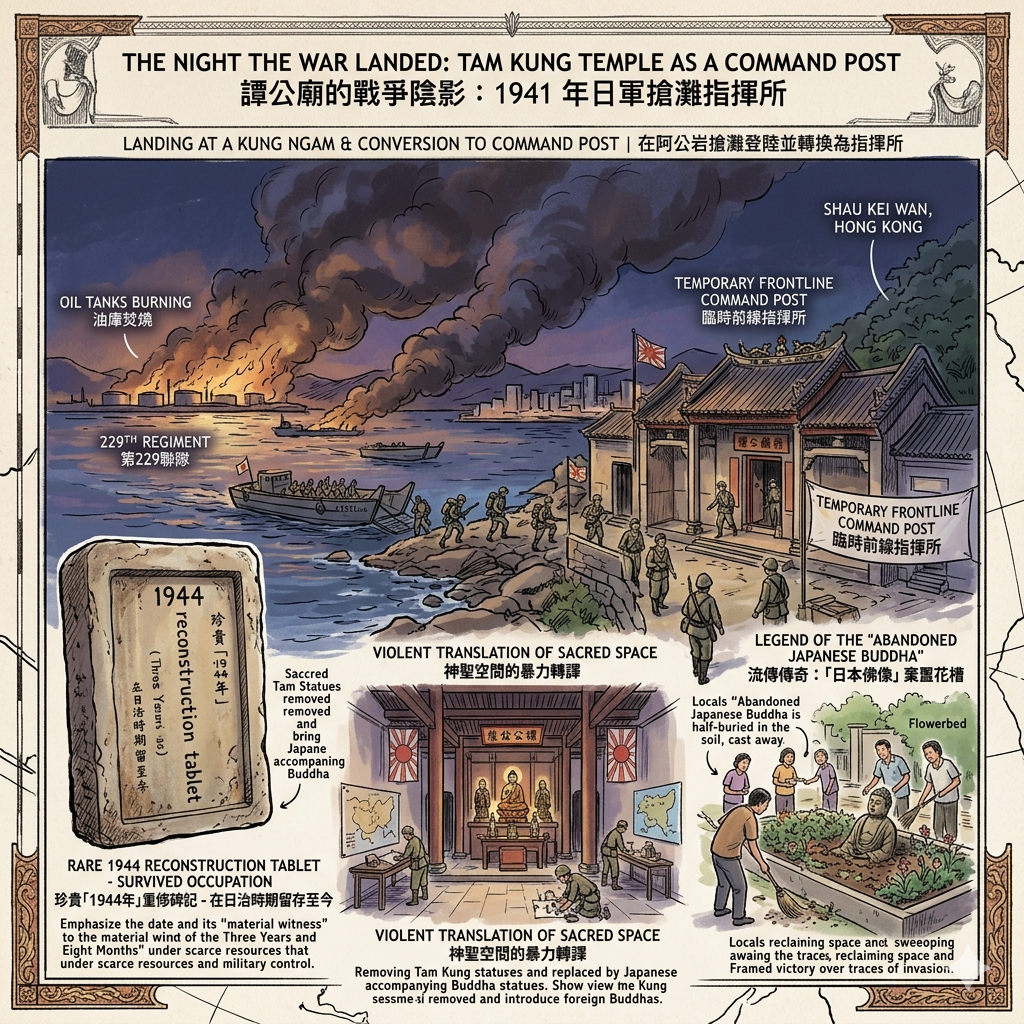
The tranquility of the Tam Kung Temple was violently shattered on the night of December 18, 1941. As Japanese forces launched their invasion of Hong Kong Island, the 229th Regiment utilized the cover of smoke from burning oil tanks to cross the harbor's narrowest point. They landed directly at A Kung Ngam, seizing the Tam Kung Temple and transforming it into a "Temporary Frontline Command Post."
This event "violently translated" a space of spiritual protection into a site of imperial violence. Inside the temple today, a rare "1944 reconstruction tablet" survives from the Japanese occupation—a material witness to the "Three Years and Eight Months" that most colonial records attempt to gloss over. The local legend of the "abandoned Japanese Buddha," supposedly left behind and cast into a flowerbed, remains a potent psychological tool for the community to reclaim their space, framing the eventual return of Tam Kung as a victory over the traces of invasion.
The Great Fire of 1976: From Water-World to High-Rises
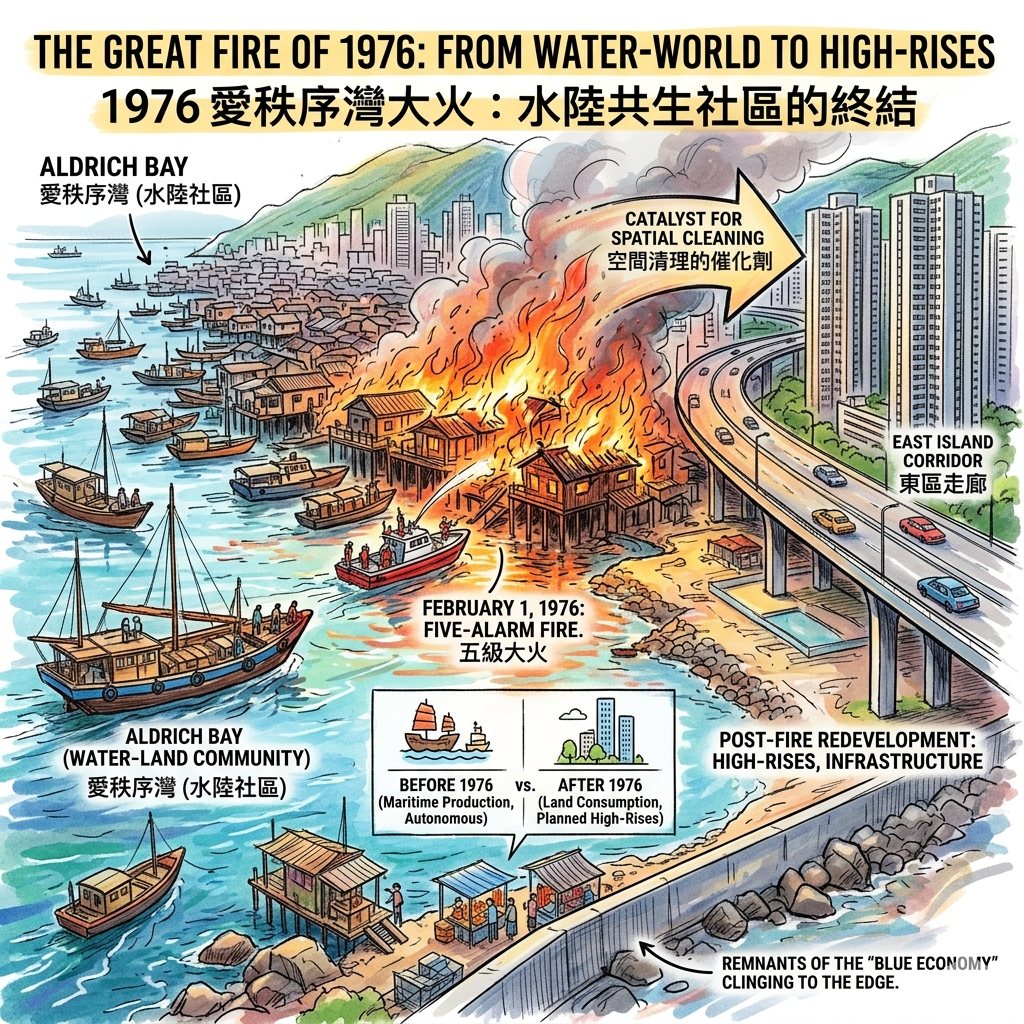
For decades, Aldrich Bay was a sprawling "water-land" community. This "proto-urban" autonomy ended on February 1, 1976, when a massive fire destroyed the homes of 3,000 "boat people" and squatters. While official reports blamed domestic accidents, a "structural conspiracy theory" persists: the fire acted as a "catalyst for spatial cleaning," allowing the government to bypass the complexities of clearing a dense, autonomous community. This "purification" of high-value waterfront land was the essential prerequisite for the East Island Corridor (東區走廊) project.
Historical Era | Coastline Position | Primary Spatial Function |
1840s–1890s | Along modern Shau Kei Wan Main St East | Stonecutting, natural harbor, pirate haven |
1950s–1970s | Old Aldrich Bay Typhoon Shelter | Dense squatter huts, Tanka boat community |
1980s–Present | Modern Tam Kung Temple Rd / Waterfront | High-density housing, East Island Corridor, leisure parks |
The fire signaled the final transition from maritime production to land consumption. However, at the very edge of the new concrete shore, a few remnants of the "Blue Economy" still cling to the rock.
The Last Shipwrights: Pui Kee and the Vanishing Blue Economy
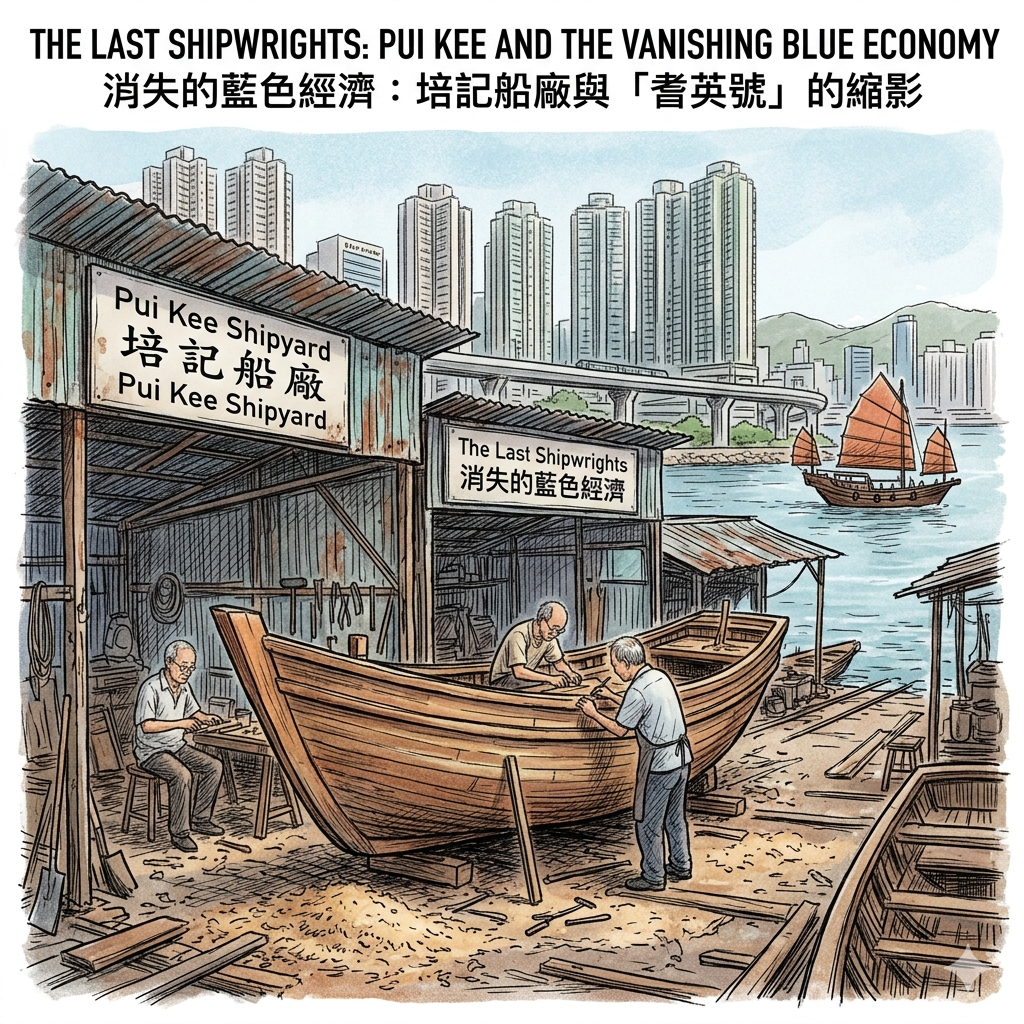
At the remote edge of A Kung Ngam sits the Pui Kee Shipyard. Famous for building the "Keying II" junk for the 1980 Hong Kong Festival, the yard’s history is one of forced spatial migration—pushed from Bowwen Street to Nam On Street, and finally to its current oxidized iron sheds as land reclamation prioritized real estate.
The existence of Pui Kee challenges "Western-centric technological determinism." While the modern world favored steel, traditional Chinese wooden hulls remained superior for local conditions, offering better stability in rough seas and ease of repair in shallow waters. The yard’s current "mottled and weathered" state is a physical witness to the death of maritime production. The smell of sawdust and engine oil here is a sensory ghost in a city that has chosen to forget how to build the vessels that once defined it.
Walking the Layers: A Note for the Curious Traveler
To experience this "spatial continuity," start at Main Street East (the 1840s shoreline) and walk toward Tam Kung Temple Road. Notice how the architecture shifts from colonial-era streetscapes to the industrial edge of A Kung Ngam Village Road.
The Hidden Gem: Look for the "Tam Kung Treasure Seal" directly in front of the Tam Kung Temple. This giant, uniquely shaped rock is a rare intersection of geology and myth—a remnant of the area's past as a granite quarry that has been re-imagined as a divine artifact. It is the most honest monument in the district: a piece of the earth that refused to be moved by reclamation.
Conclusion: The Victory of Land over Sea
Shau Kei Wan serves as a sophisticated "spatial politics classroom." Its history is a record of the "Blue Economy"—the world of shipwrights, stonecutters, and mariners—being systematically conquered by the standardizing force of land-based real estate and colonial discipline. When we walk these streets, we are walking over the ghosts of 3,000 sunken homes and the granite foundations of a lost maritime frontier.
What is lost when a city forgets its maritime production in favor of a purely consumerist waterfront? Shau Kei Wan’s temples and shipwrights offer a final, defiant answer to those who care to look beneath the concrete.
For more deep dives into the spatial history of maritime East Asia, subscribe to our "Travel-Through-History" series.
Planning Your Historical Walk
How to Get There:
- MTR: Take the Island Line to Shau Kei Wan Station (Exit B1) to begin at the Tin Hau Temple.
- Tram: Ride the iconic "Ding Ding" to the Shau Kei Wan Terminus to arrive in the heart of the old town center.
Recommended Tours Nearby:
- Museum of Coastal Defence: Located a 10-minute walk from A Kung Ngam, this museum—housed in the former Lei Yue Mun Fort—provides the military context for the "strategic throat" mentioned throughout this guide.
Q & A
How did Hakka stonecutters influence the area's culture and faith?
Hakka stonecutters played a foundational role in shaping the identity of Shau Kei Wan, particularly the A Kung Ngam area. Their influence is most evident in the transformation of local religious beliefs and the establishment of community governance structures.
1. The Transference and Reinvention of Faith (Tam Kung)
The most significant cultural contribution of the Hakka stonecutters was the introduction of the Tam Kung (Tam Tak) deity.
- From Inland to Maritime: Originally a local deity from Huizhou (specifically Jiulong Peak in Guanshan County) who served as a "rain god" and "tiger-driving god" in the mountains, Tam Kung was "reinvented" by the stonecutters to suit their new coastal environment. In Hong Kong, he became a maritime protector capable of predicting weather and ensuring safe sea travel, eventually standing alongside Tin Hau as a primary protector of the waters.
- The Naming of "A Kung Ngam": The name of the area itself, "A Kung Ngam" (Grandfather’s Rock), is deeply tied to these stonecutters. They affectionately and respectfully referred to Tam Kung as "A Kung" (Grandfather), leading the surrounding community to name the rocky coastline where they worked and worshipped after the deity.
2. Shaping the Cultural and Social Landscape
The stonecutters established a permanent physical and social anchor in the form of the Tam Kung Temple:
- A Multi-functional Community Hub: Built in 1905 through the joint efforts of Hakka stonecutters, Cantonese fishermen, and local merchants, the temple served as more than just a place of worship. it functioned as a public center for community governance, a venue for "Sun Kung Hei" (operas for the gods), and even housed early village schools.
- Guild Functions: The temple acted as a core meeting hall for the stone-cutting industry guild, providing a space for laborers working in dangerous and disease-prone quarries to organize and find spiritual and social support.
3. Expanding the Maritime Narrative
The presence of Hakka stonecutters challenged the "monocultural" view of early Hong Kong's maritime history. Their influence showed that:
- Diverse Maritime Culture: The religious landscape was not solely dominated by the Tanka (boat-dwelling) people's devotion to Tin Hau. The Hakka "terrestrial" migrants brought their own spiritual traditions, which were then adapted to the sea, creating a more complex "Blue Economy" cultural map.
- Tangible Heritage: Today, the Shau Kei Wan Tam Kung Temple (a Grade I historic building) and features like the "Tam Kung’s Seal" (a unique boulder near the temple) remain as physical evidence of the stonecutters' historical presence and their integration into the local urban fabric.
In summary, the Hakka stonecutters did not just extract granite; they "carved" their faith into the local landscape, turning a peripheral quarrying site into a vibrant community centered around a newly adapted maritime deity.
How did the Keying II project prove traditional craftsmanship?
The Keying II (耆英二號) project, undertaken in 1980, served as a powerful validation of traditional Chinese shipbuilding techniques at a time when the industry was shifting toward steel and modern engineering.Based on the sources, the project proved the efficacy of traditional craftsmanship in the following ways:
1. Construction Without Modern Blueprints
The most significant proof of craftsmanship was that the Pui Kee Shipyard (培記船廠) successfully built the vessel without relying on any modern Western-style blueprints. Instead, the master shipbuilders relied entirely on traditional wooden-work tacit understanding (傳統木工默契) and oral craft traditions passed down through generations. This demonstrated that complex, large-scale maritime engineering could be executed through experiential knowledge rather than formalized academic drafting.
2. Validation of Traditional "Tacit Knowledge"
The project was commissioned by shipping tycoon Sir Y.K. Pao for the "Hong Kong Festival" in London to replicate the original 1846 Keying junk. Pui Kee Shipyard was selected because its craftsmen possessed the manual skills required to build a 150-foot wooden vessel by hand. The successful completion of the Keying II proved that the "tacit understanding" between master and apprentice was a precise and viable method for constructing seaworthy vessels capable of international voyaging.
3. Challenging Western Technical Determinism
The sources suggest that the Keying II project helped re-evaluate what was often dismissed as "backward" technology. The project and the history of the shipyard proved that traditional Chinese flat-bottomed wooden junks possessed unique geographical adaptability:
- Stability: They demonstrated extreme stability against heavy wind and waves.
- Navigation: They were exceptionally suited for shallow water navigation.
- Maintenance: They offered a level of maintenance convenience that modern steel ships often lacked.
4. Functional Durability
The craftsmanship was not merely for show; it was rooted in a history of functional success. The sources note that these wooden vessels were robust enough to survive long-distance voyages, including historical treks to the Great Barrier Reef in Australia. The Keying II project served as a material witness to this "Blue Economy" heritage, proving that traditional techniques were technically sound and capable of competing with Western steel construction in terms of seaworthiness and durability.
Today, a hand-painted structural diagram of the Keying II remains on the iron gate of the Pui Kee Shipyard in A Kung Ngam, serving as a physical memorial to this feat of traditional engineering.
Reference and Further reading
- Shau Kei Wan - accessed May 21, 2026,
- 消失的漁村 - 香港記憶, accessed May 21, 2026,
- 佬文青的世界|「英雄被困筲箕灣,不知何日到中環」——400年筲箕灣今昔「等閒」的老百姓和「不等閒」的將軍石 - 橙新聞, accessed May 21, 2026,
- 阿公岩- accessed May 21, 2026,
- 筲箕灣譚公廟 - 華人廟宇委員會, accessed May 21, 2026,
- 筲箕灣五級火毀過千木屋愛秩序灣填海建新家園| 飛凡香港, accessed May 21, 2026,
- Patrick H. Hase: Villages and Market Towns in Hong Kong: Settlement and History (Royal Asiatic Society Hong Kong Studies Series.) Hong Kong: Chinese University of Hong Kong Press, 2024. ISBN 978 9 882 37317 4. | Bulletin of SOAS | Cambridge Core, accessed May 21, 2026,
- Exportation of Hong Kong Granite to the Pacific Rim in the 19th and 20th Century, accessed May 21, 2026,
- 筲箕灣譚公廟- accessed May 21, 2026,
- 譚公誕 - 香港非物質文化遺產資料庫, accessed May 21, 2026,
- A Kung Ngam - accessed May 21, 2026,
- 筲箕灣歷史古蹟之旅, accessed May 21, 2026,
- 赤柱天后廟 - 福山堂, accessed May 21, 2026,
- 香港攻防戰 - accessed May 21, 2026,
- 筲箕灣天后古廟 - 華人廟宇委員會, accessed May 21, 2026,
- Vol. 10 (1970 ) - Hong Kong Journals Online, accessed May 21, 2026,
- 香港保衛戰- accessed May 21, 2026,
- INDEX TO THE JOURNAL OF THE HONG KONG BRANCH OF THE ROYAL ASIATIC SOCIETY - Squarespace, accessed May 21, 2026,
- 石硤尾 - 香港巴士大典- Fandom, accessed May 21, 2026,
- 筲箕灣老船廠屹立逾70年!由打造包玉剛長征英國木帆船「耆英二號」至維修街渡,見證香港造船業榮衰| 尋‧情‧味- 美食- 生活 - ETNet, accessed May 21, 2026,
- 培記船廠– 筲箕灣 - 香港老舖記錄冊, accessed May 21, 2026,
- HONG KONG PUBLIC AND SQUATTER HOUSING, accessed May 21, 2026,
- British Colonial Rule over Littoral Space and Watercraft in Hong Kong, 1841–1898, accessed May 21, 2026,
- Journal of the Hong Kong Branch of the Royal Asiatic Society - Google Books, accessed May 21, 2026
Lawrence Lawrence
 Lawrence