(ENG) Minamisenju: Walking the Shadowed Threshold of Tokyo’s Modernity
How did the Kozukappara execution grounds revolutionize Japanese medical science?
How is the hidden lives of Yoshiwara courtesans at Jokanji?
How did Minami-senju transition from an industrial hub to modern Tokyo?
 Lawrence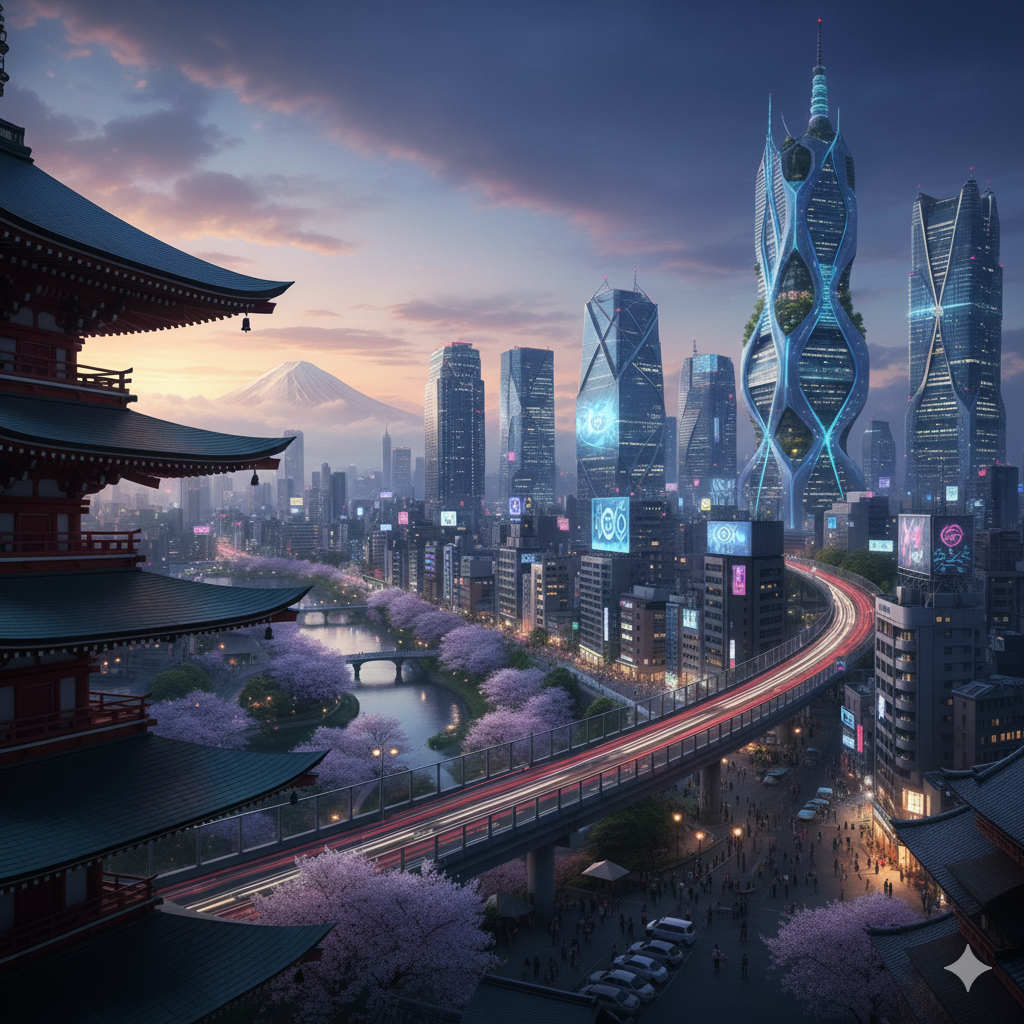
In the cartography of Tokyo, Minamisenju exists as a profound "heterotopia"—a singular space where the currents of power, industry, and mortality have historically converged at the city’s northern gate. Once the strategic boundary where the civilization of Edo met the rustic sprawl of the Nikko Kaido, this neighborhood remains a "historical fold." It is not a place of neon highlights, but of deep, sedimented layers that reveal the true costs and catalysts of Japan’s modernization. To walk these streets is to tread upon a threshold where the state processed what it found inconvenient or essential: its criminals, its industrial waste, its defeated soldiers, and its marginalized laborers. By peeling back these five haunting layers, we uncover a narrative of the "shadow city" that underpins the brilliance of the modern metropolis, offering a meditative look at a landscape defined by its strategic isolation.
Listen to the historical stories told in detail (For subscribers only)
The Anatomy of a Revolution: Kozukappara Execution Grounds
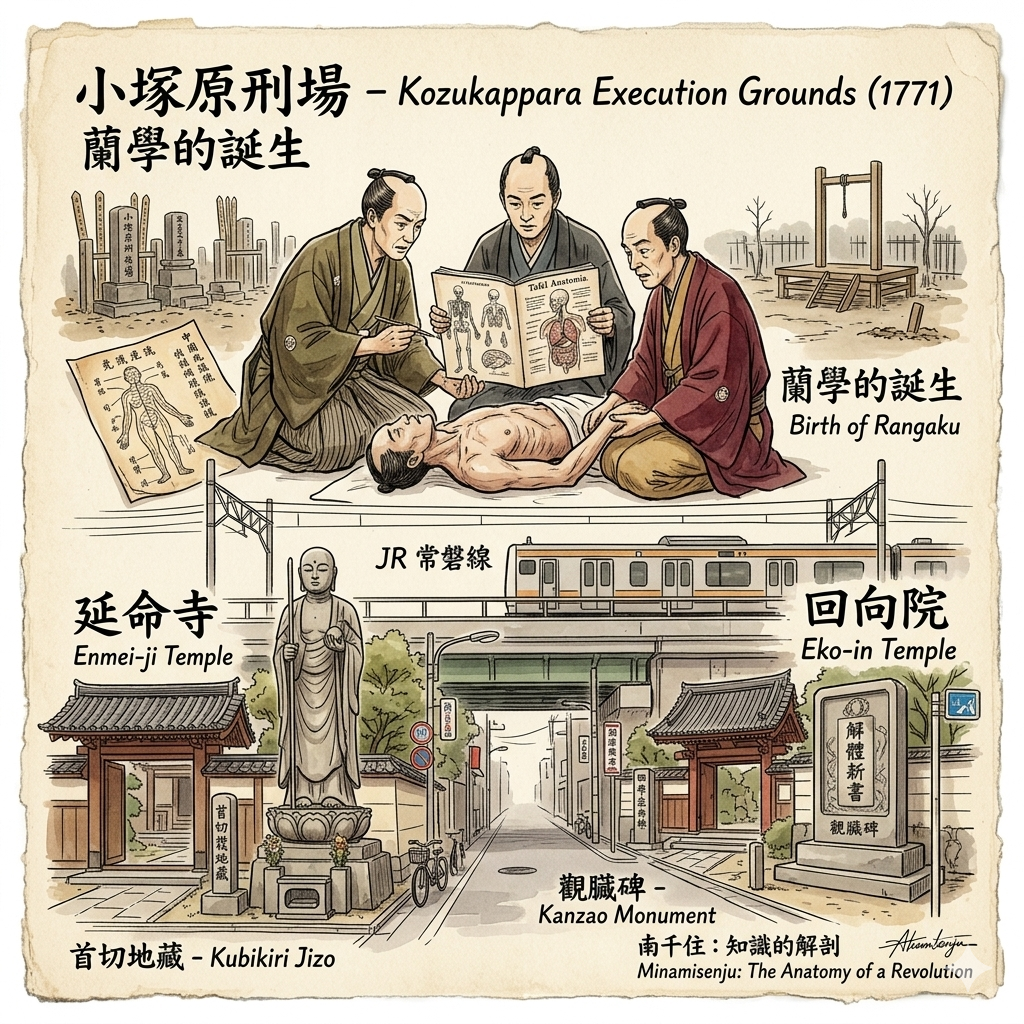
In the geography of the Edo period, spaces of punishment were intentionally positioned on the periphery, yet these sites of state-sanctioned death unexpectedly became the cradles of scientific enlightenment. The Kozukappara Execution Grounds, established in the 17th century near the Senju gateway, served as the grim entry point to the city—a place where legal discipline met the physical limit of the urban order.
It was here, in March 1771, that a 90-year-old woman known as "Chaba" was executed and dissected, an event that would dismantle centuries of medical dogma. Physicians Sugita Genpaku and Maeno Ryotaku arrived with a Dutch anatomical text, the Tafel Anatomia. As the dissection progressed, they were struck by a staggering realization: the 1,000-year-old Hanfang (Traditional Chinese Medicine) charts, which depicted the body through abstract theories of "qi" and invisible vessels, were mere diagrams of belief. In contrast, the Western charts were literal and clinical. This shift from deductive authority to inductive evidence marked the birth of Rangaku (Western studies).
"Comparing the internal structures of the body to the Dutch charts, we realized the shocking accuracy of the Western observations and the profound limitations of our traditional medical understanding." — Reflective synthesis of Sugita Genpaku’s memoirs.
This history is physically fractured today; the construction of the JR railway line literally bisected the original execution grounds, creating a spatial rupture that separated the memorial sites of Eko-in and Enmei-ji. At the latter, the Kubikiri Jizo—a 3.6-meter stone deity—stands as a silent witness to those lost to the blade. This site represents the literal birth of Japanese medical modernity, moving the national narrative from the punishment of the physical body to the scientific mastery of it.
The Fabric of the State: Senju Woolen Mill
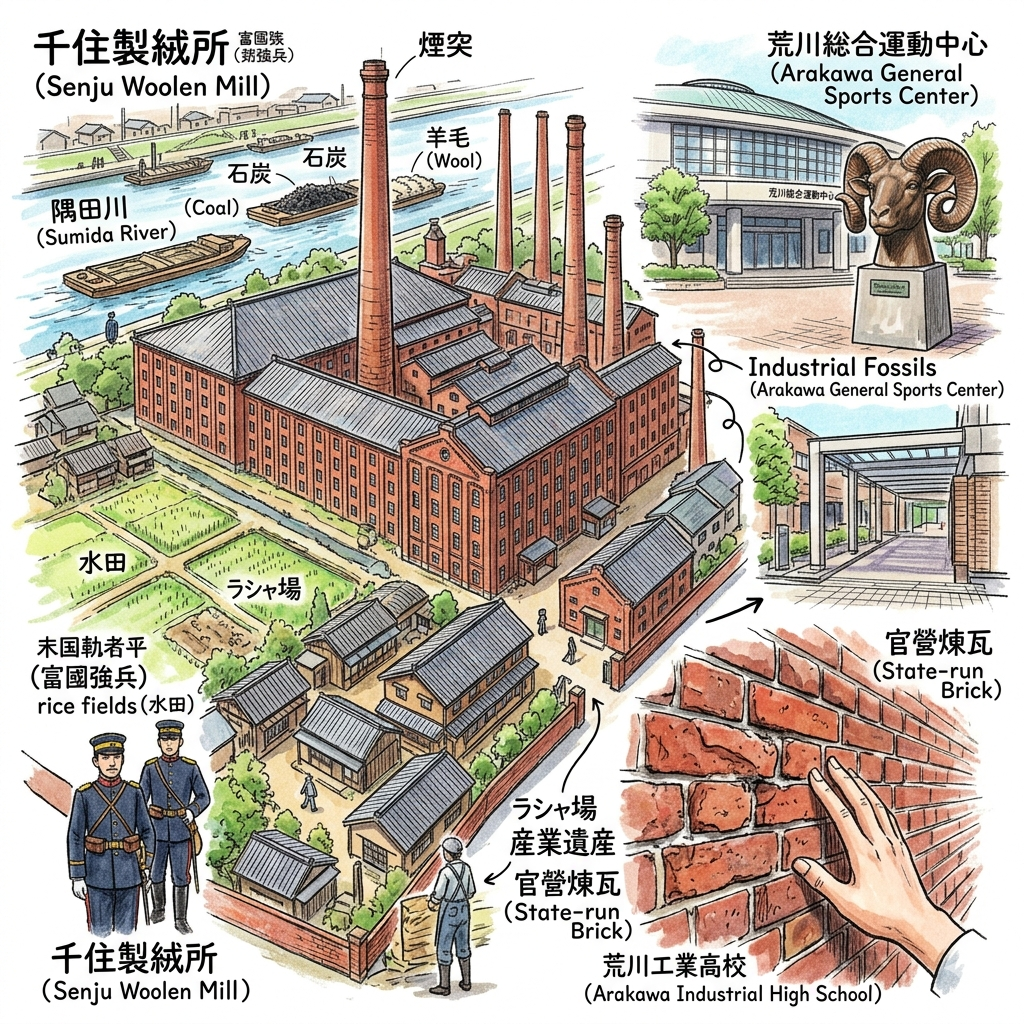
As Japan transitioned from the Tokugawa shogunate to the Meiji era, the strategic utility of Minamisenju shifted from a site of execution to a site of intensive industrial production. The state required a new "national fabric" to clothe its westernizing military, leading to the 1879 establishment of the Senju Woolen Mill (Senju Seijū-sho).
The selection of this site was governed by the Sumida River, which provided the immense volume of water needed for washing wool and served as a maritime highway for coal. Under the leadership of Inoue Shozo, the mill—known locally as the Lasha-ba (the wool field)—became a physical manifestation of the Fukoku Kyohei ("Rich Country, Strong Army") policy, producing the very uniforms that defined the Meiji military. The visual landscape was ruptured as massive red-brick chimneys rose above traditional rice fields, signaling the dawn of large-scale wage labor.
Today, the site is a palimpsest of Japan's changing priorities: the industrial war machine of the mill eventually gave way to the Tokyo Stadium for professional baseball, which in turn was replaced by the modern Arakawa General Sports Center. Yet, "industrial fossils" remain. Near the Arakawa Industrial High School, visitors can find remaining red-brick walls that once enclosed this state-run powerhouse. This mill did more than produce uniforms; it transformed agrarian peasants into urban industrial laborers, fundamentally altering the Japanese social fabric.
The Dignity of the Defeated: Entsu-ji and the Shogitai
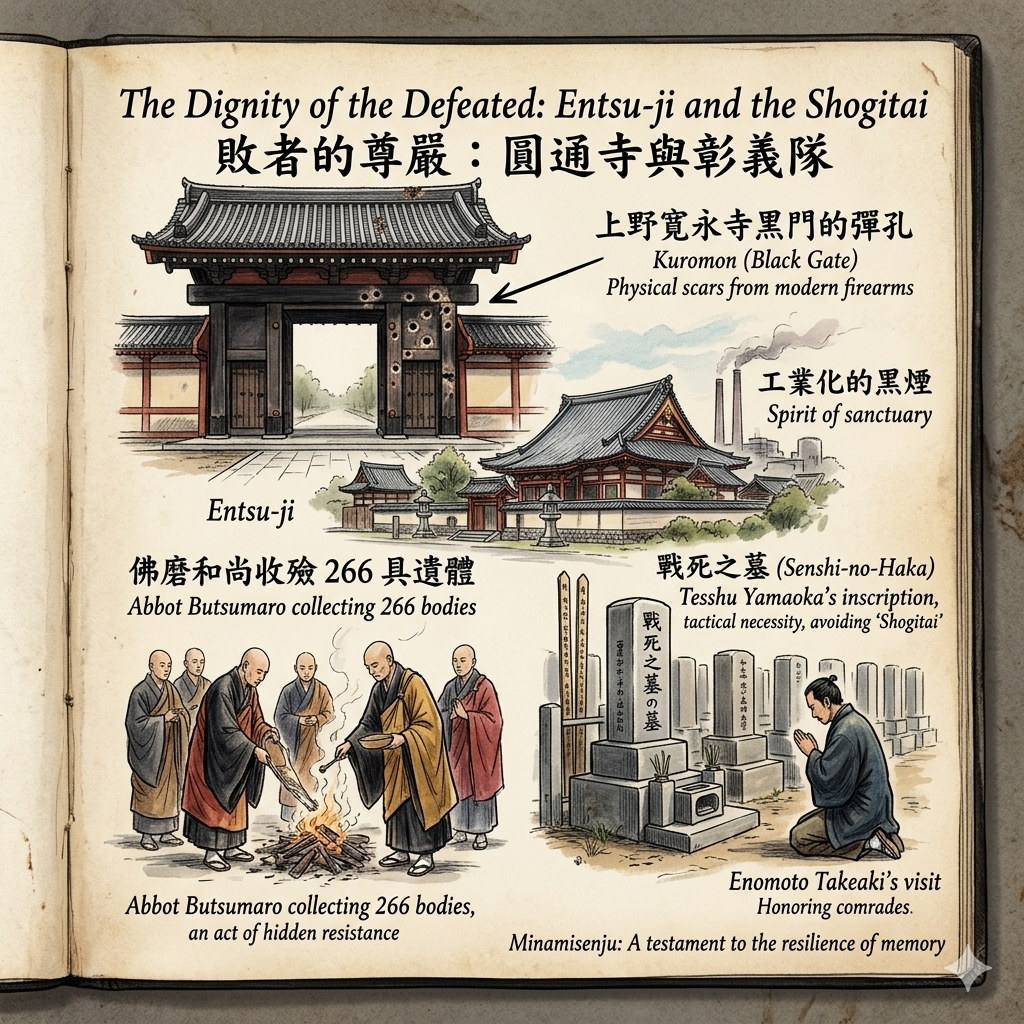
History is often written by the victors, but the "politics of the dead" allows the defeated a sanctuary within the city's spiritual landscape. Following the 1868 Battle of Ueno, the Meiji government branded the Shogitai—loyalist remnants of the old shogunate—as "rebels," forbidding the burial of their corpses as a sign of state power.
In an act of humanitarian defiance, Abbot Butsumaro of Entsu-ji negotiated with government officials to collect and cremate 266 bodies left in the summer heat. By providing a proper burial, Entsu-ji became a site of "hidden resistance." Former Tokugawa loyalists like Enomoto Takeaki later visited to honor their comrades, erecting graves with the inscription Senshi-no-Haka ("Graves of those who died in battle"). This phrasing was a tactical necessity, intentionally avoiding the word "Shogitai" to evade government censorship while still preserving the men's dignity.
The most striking evidence of this collapse is the Kuromon (Black Gate), moved from the battlefield at Ueno to the temple grounds. The gate is riddled with bullet holes—physical scars from the modern firearms that decimated the samurai class. The temple preserves the memory of those written out of official history, standing as a testament to the resilience of those who refused to let the defeated be forgotten.
The "Thrown-In" Temple: Jokan-ji and the Yoshiwara Courtesans
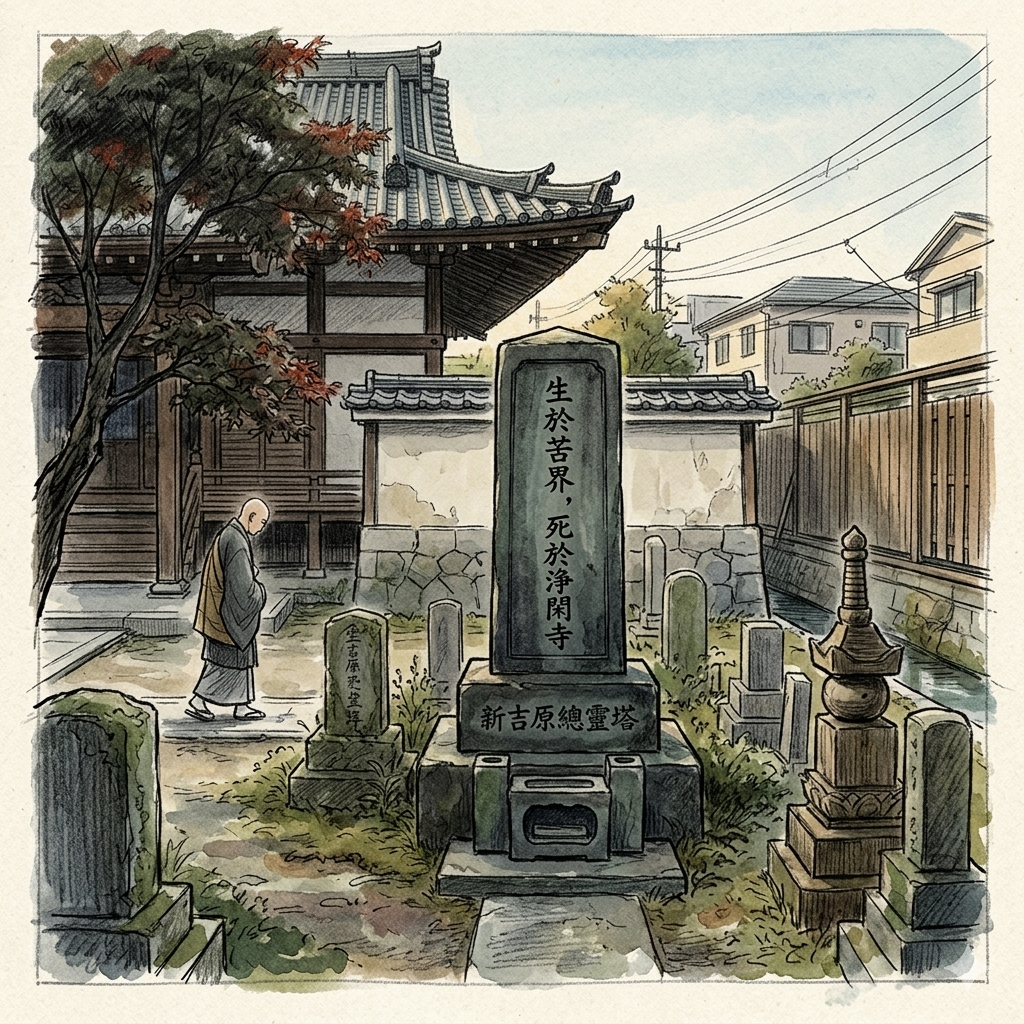
While the Yoshiwara pleasure quarters are often romanticized through woodblock prints, Minamisenju’s Jokan-ji reveals the harsh reality of that world’s "endpoint." Known as the Nagewari-dera or "Thrown-in Temple," this site served as the final destination for those who lived and died within the physical and social walls of the sex industry.
Data from the temple’s Kakocho (death registers) reveals a systemic tragedy: approximately 25,000 people are buried here, mostly young women in their early twenties. The records show that the 1855 Ansei Great Earthquake was particularly catastrophic for this population; trapped by the Yoshiwara’s high walls and escape-proof moats, 90% of the earthquake victims buried here were courtesans who perished in the ensuing fires.
"Born in the bitter world, dead at Jokan-ji."
This famous poem, inscribed on the memorial tower, encapsulates the terminal nature of the neighborhood. The writer Nagai Kafu felt a deep spiritual affinity for this site, using its somber silence to critique the hollow glamour of Meiji-era values. To him, Jokan-ji was the "anti-space" to the Yoshiwara's dreamworld—a sobering reminder of the structural sacrifices that fueled the city’s hedonism.
The Urban Stomach: Sumidagawa Freight Station and Sanya
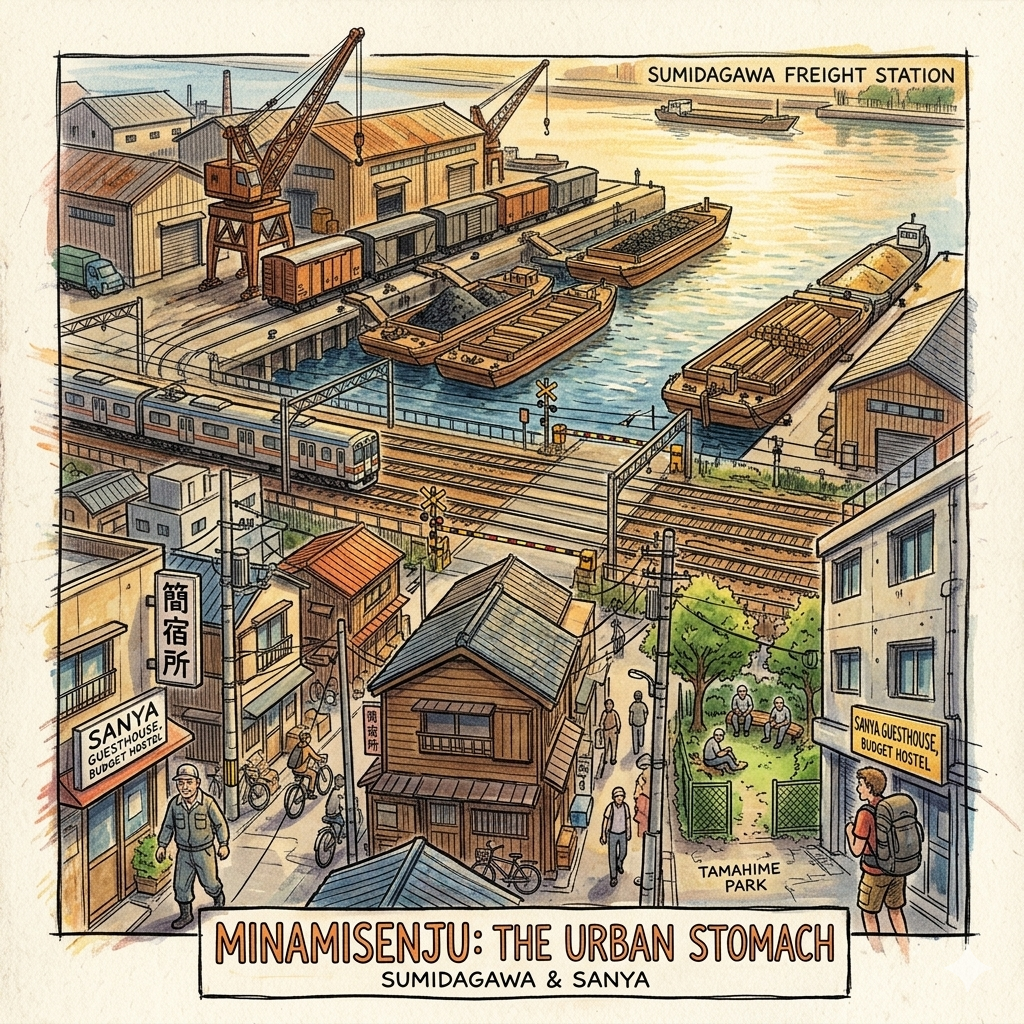
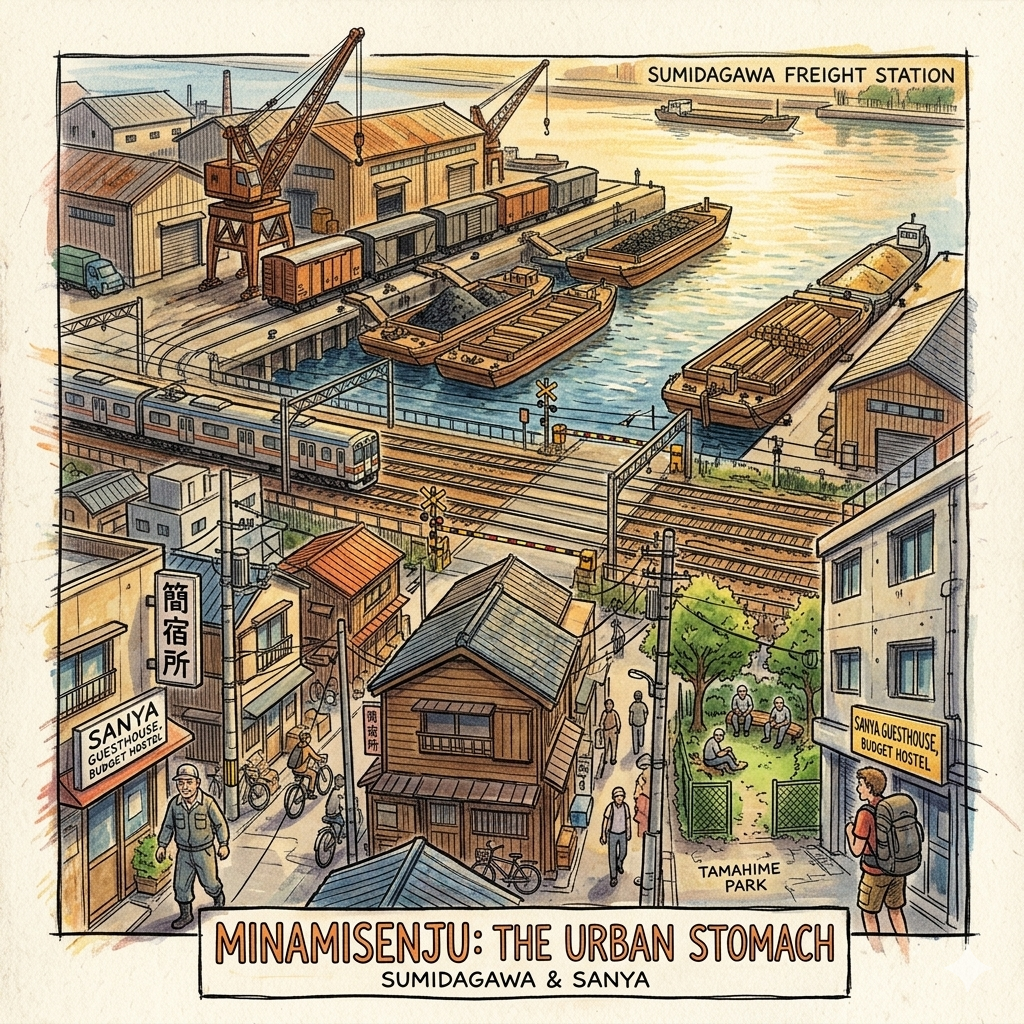
By the late 19th century, Minamisenju evolved into a vital node for the city’s logistics. The opening of the Sumidagawa Freight Station in 1896 turned the district into the "stomach" of Tokyo. Its design was a feat of industrial metabolism, featuring a "dock" system that allowed freight cars to interface directly with river barges on the Sumida.
The station’s presence necessitated a "labor warehouse"—the Sanya district. Sanya was defined by a triad: Rails (Logistics) - Lodgings (Flophouses) - Labor Markets (Yoseba). This neighborhood functioned as a buffer for Tokyo's growth, housing thousands of single men who provided the low-cost, high-flexibility physical labor required to move coal, timber, and grain into the city’s heart.
While modern gentrification is transforming Sanya—turning old labor hostels into budget-friendly options for foreign backpackers—the physical presence of the tracks still dictates the urban flow. The neighborhood remains a reminder of the spatial production of labor, where the city’s metabolism still relies on the logistical systems and marginalized hands of the past.
Hidden Gems & Local Continuity
To synthesize these stories into a single, physical reality, one must visit the Arakawa Furusato Bunkakan. This regional museum acts as the final repository for the stories of Minamisenju, housing the actual tools of the trade, archival documents from the Kakocho, and artifacts from the Kozukappara execution grounds. It is here that the "shadow histories" of the neighborhood take on tangible form, grounding the sophisticated narrative of the district in the raw evidence of its past.
A Reflection on the Shadow City
Minamisenju serves as a "converter"—a unique urban space that processes what the rest of Tokyo seeks to hide: the criminal, the industrial, the defeated, the exploited, and the laborer. It is a place where the "backside" of Japanese modernity remains perpetually visible.
The history of this neighborhood reinforces a core principle: a city is truly understood through its layers, not just its highlights. The red bricks, bullet-scarred gates, and death registers of Minamisenju are as essential to Tokyo’s identity as the glass towers of Shinjuku. They are the scars and the marrow of a metropolis that has always been defined by what it places at its edge.
As we look at our own modern cities, one must wonder: what "shadow spaces" are we creating today, and what histories will they reveal to those who walk them a century from now?
Subscribe to Historical Travel Stories for more deep-history explorations of the world’s hidden urban landscapes.
Navigating the Layers of Minamisenju
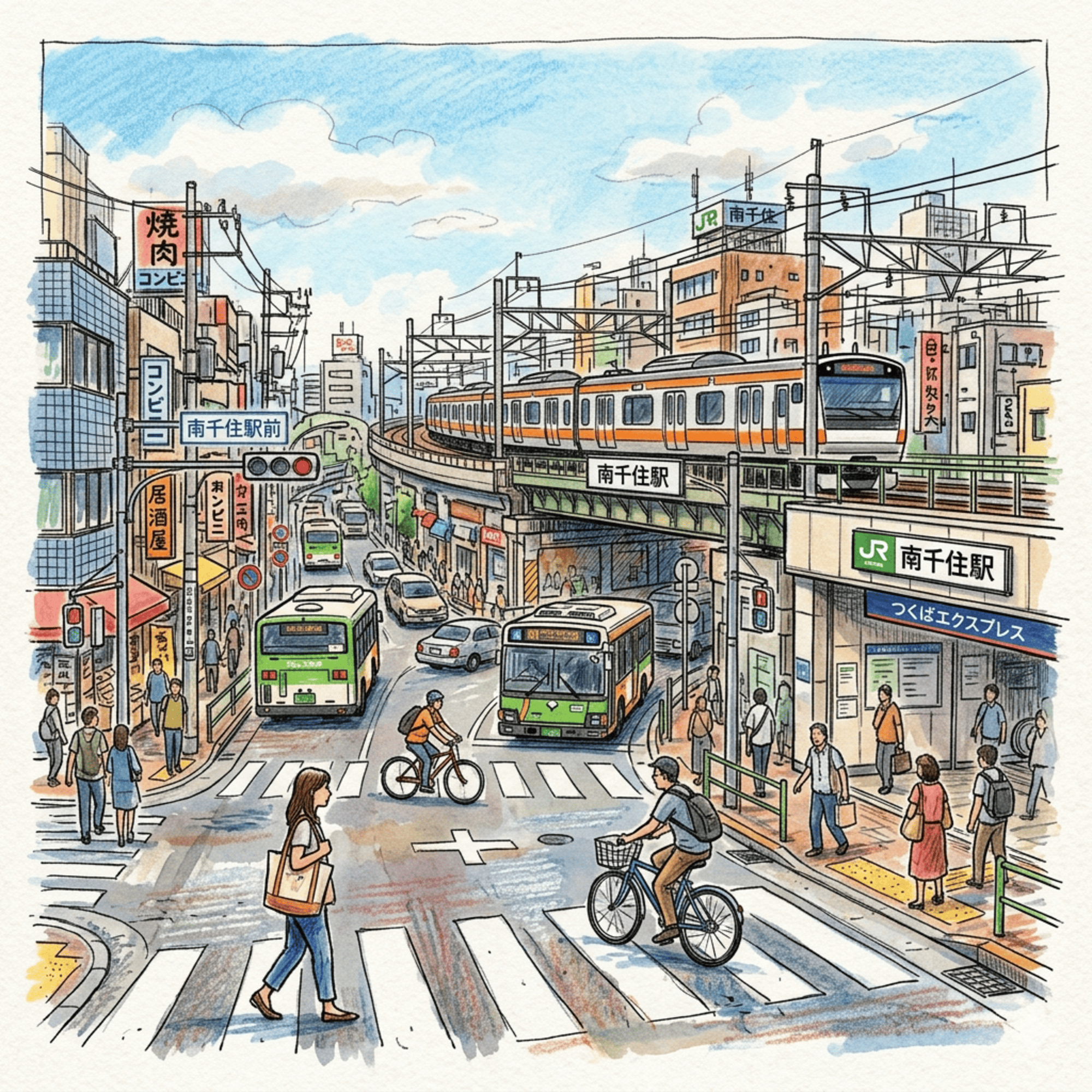
How to Get There Minamisenju is accessible via the JR Joban Line, the Tokyo Metro Hibiya Line, and the Tsukuba Express.
Recommended Walking Route
- Enmei-ji: Begin just south of the station at the Kubikiri Jizo.
- Entsu-ji: Walk west to view the bullet-scarred Kuromon and the Shogitai memorials.
- Jokan-ji: Head toward the Minowa area to visit the "Thrown-in Temple" and Nagai Kafu’s monuments.
- Arakawa Furusato Bunkakan: End your journey here to see the artifacts that ground these layers in reality.
Nearby Stays The southern edge of Minamisenju (the former Sanya district) offers a unique look at the neighborhood's gentrification. Many former labor hostels have been converted into budget-friendly, minimalist hotels for modern travelers, providing a functional connection to the district's industrial past.
Reference and Further reading
- 小塚原刑場跡と首切地蔵(延命寺) - 歴史探訪と温泉 - FC2, accessed March 17, 2026,
- 南千住の史跡さんぽ~千住大橋から首切り地蔵の延命寺まで - 荒川区立図書館, accessed March 17, 2026,
- 『蘭学事始』に描かれた知の衝突 ―― 杉田玄白と前野良沢、解体新書誕生前夜の人間ドラマ, accessed March 17, 2026,
- 小塚原回向院(東京都 荒川区南千住5丁目33番の13)- 小塚原刑場跡の浄土宗寺院, accessed March 17, 2026,
- 京都大学所蔵資料でたどる文学史年表: 解体新書 | 京都大学貴重資料 ..., accessed March 17, 2026,
- 杉田玄白 『解体新書』を著した蘭学者 - 日本の旅侍, accessed March 17, 2026,
- 小塚原刑場 - accessed March 17, 2026,
- 延命寺・首切り地蔵/小塚原刑場跡(東京・南千住) | agataJapan.tokyo, accessed March 17, 2026,
- 荒川ふるさと文化館 |地域資源紹介記事 - TOKYOイチオシナビ, accessed March 17, 2026,
- 荒川区立荒川ふるさと文化館 - accessed March 17, 2026,
- 名画周遊:南千住 – Japan Gentleman's Lounge, accessed March 17, 2026,
- 千住製絨所 - アジア歴史資料センター, accessed March 17, 2026,
- 「日本毛織物工業の父」井上省三と千住製絨所(荒川区) - 戦跡紀行ネット, accessed March 17, 2026,
- 江戸旧蹟を歩く 千住製絨所, accessed March 17, 2026,
- 南千住、再開発で生まれ変わった歴史の街 - オールアバウト, accessed March 17, 2026,
- 吉村昭『彰義隊』から上野戦争の爪痕を巡る - 吉村昭の歴史小説の ..., accessed March 17, 2026,
- 歴史と文化とともに 日々の暮らしが流れるまち - 東京ケーブルネットワーク, accessed March 17, 2026,
- 社寺史料研究会会報 - 岩田書院, accessed March 17, 2026,
- 浄閑寺 - 荒川区, accessed March 17, 2026,
- 平均寿命22歳 苦界に身を落とした遊女が死して投げ込まれた、現存する「浄閑寺」とは?, accessed March 17, 2026,
- 「都市型限界集落」となった山谷:歴史とその変遷(吉間慎一郎) | BIG ISSUE ONLINE, accessed March 17, 2026,
- 常磐線 1枚の写真から vol.4, accessed March 17, 2026,
- 隅田川駅 - accessed March 17, 2026,
- 山谷の現状(2/3) 2014/12/17 | 無縁仏となってしまうホームレスの人々が入れるお墓を建てたい!(油井 和徳(NPO山友会) - クラウドファンディング READYFOR, accessed March 17, 2026
 Lawrence
 Lawrence
 Lawrence