(ENG) The Layered Cliffline of Nippori: A Walking Guide Through Tokyo's Scars and Scandals

 Lawrence
The Vertical Soul of Nippori
Nippori is far more than a mere transit interchange; it is a profound historical fault line carved into the eastern edge of the Musashino Upland. Here, the landscape drops precipitously along a sea-eroded cliffline that has, for over 400 years, dictated the social and political divide between the Yamanote heights and the Shitamachi lowlands. While its name—"the village of the setting sun"—evokes a peaceful Edo-period retreat, the physical reality of Nippori is a living archive of Tokyo’s internal frictions. As you walk this vertical boundary, you navigate a space where geological memory meets urban evolution. The history of this district is written not just in archives, but in the very scars left on its hillsides and temple gates. It is a narrative of resilience, scandal, and the persistent survival of those pushed to the city's edge, where the history of the defeated is preserved in the shadows of the cliffs.
Listen to the historical stories told in detail (For subscribers only)
The Commodity Cliff: Infrastructure vs. The Sacred Landscape
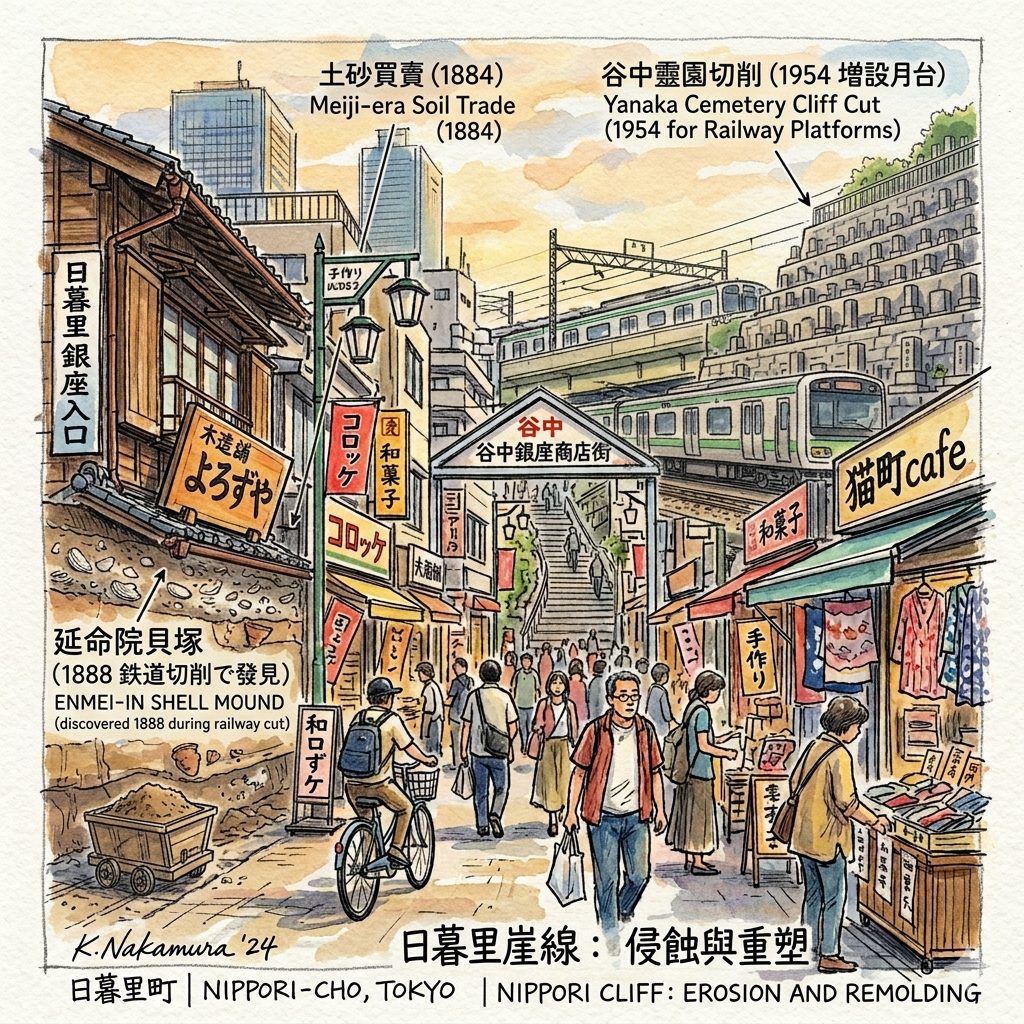
For centuries, the Nippori cliffline was a "Scenic Sanctuary," a place where temples like Enmei-in utilized the elevation to create breathtaking garden vistas overlooking the lowlands. However, the dawn of the Meiji era saw a cold, strategic shift: the landscape was reimagined as an industrial resource. In 1884, a controversial "soil and sand trade" began as local temples, exhausted by financial hardship, sold the very earth of their cliffsides to developers. This ancient Musashino soil was hauled away to fill the marshy banks of Shinobazu Pond for urban expansion, marking the moment the landscape ceased to be sacred and became a commodity.
There is a striking paradox in this destruction. During the 1888 excavations to further cut the cliff for the railway, workers unearthed the Enmeiin Shell Mound (Kaizuka), a 3,500-year-old settlement site. It was as if the violent erasure of the Buddhist landscape was the only way to reveal its prehistoric bones. This "infrastructure determinism" reached a tragic peak in June 1952, when a wooden cross-line bridge at Nippori Station collapsed under the weight of surging crowds, killing eight. To prevent a recurrence, the government executed a radical plan in 1954, cutting deep into the Yanaka Cemetery cliffs to widen the platforms. Today, the public’s "View Rights" to the sunset have been replaced by a startling urban section where modern trains scream past a vertical, artificial wall of graves.
The Enmei-in Affair: Forbidden Desires and the O-oku’s Escape
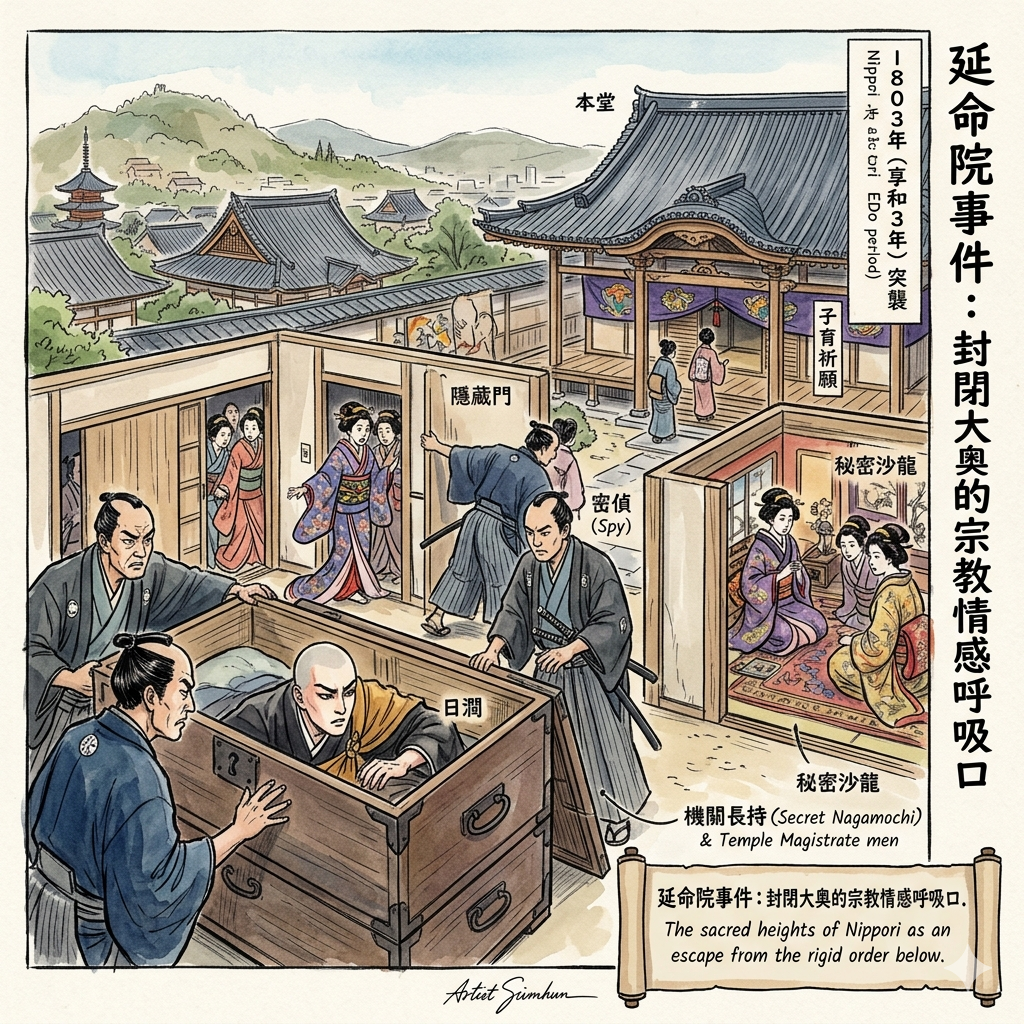
In the late Edo period, Nippori’s temples served as social pressure valves. As the Shogunate’s discipline loosened, Enmei-in became the center of the era's most explosive scandal. Its status as a "child-rearing prayer" site gave the women of the Shogun’s Inner Palace (O-oku) a rare, legitimate excuse to leave their gilded cage for "pilgrimage." The temple functioned as a secret salon, led by the charismatic and strikingly handsome monk Nichirun—the son of the legendary Kabuki actor Onoe Kikugoro II.
"The temple was outfitted like a ninja residence, utilizing hidden doors, double-bottomed storage chests (nagamochi), and secret passages to facilitate illicit meetings between the clergy and high-ranking women of the O-oku." — Historical records of the Temple Magistrate (1803)
When the authorities raided the temple with 80 men in May 1803, they found a sophisticated system designed to cater to suppressed desires. For the women trapped in the O-oku, Enmei-in was a "respiratory outlet." The Shogunate’s response was a desperate attempt at moral reform: Nichirun was sentenced to beheading and exposed at Nihonbashi for three days as a public warning. Several women were sentenced to life imprisonment, illustrating the structural tension where the sacred heights of Nippori provided a literal high ground for those escaping the rigid social order below.
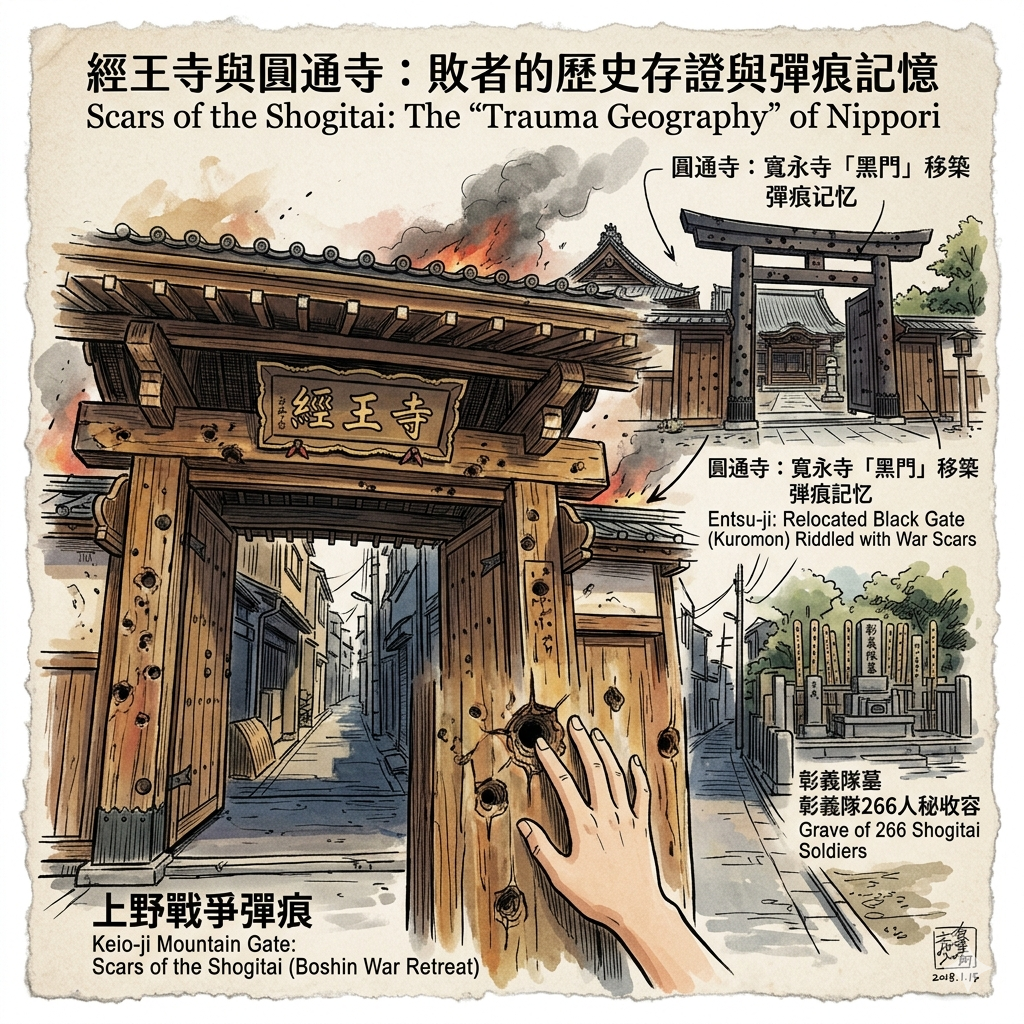
Scars of the Shogitai: The "Trauma Geography" of the Boshin War
During the 1868 Battle of Ueno, Nippori became a strategic bloody ground. As the Shogitai—pro-Shogunate forces—faced the superior firepower of the New Government’s Armstrong cannons, they retreated through the narrow alleys of Nippori. If you visit the mountain gate of Keio-ji, you can still touch the "trauma geography" of this era. The wooden gate is pockmarked with deep bullet holes, violent signatures of the shift from the age of the sword to the age of gunpowder.
While the new government transformed Ueno into a modernized park to erase the memories of the civil war, Nippori became the custodian of the "History of the Defeated." At nearby Entsu-ji, the "Abbot Butsuma" risked execution by collecting the remains of 266 Shogitai soldiers, who had been branded as traitors and left to rot. In 1907, the original "Black Gate" (Kuromon) from Ueno, riddled with war scars, was moved to Entsu-ji. It stands there today as a spiritual relocation of memory, marking Nippori as the place where the losers of history finally found a dignified resting place.
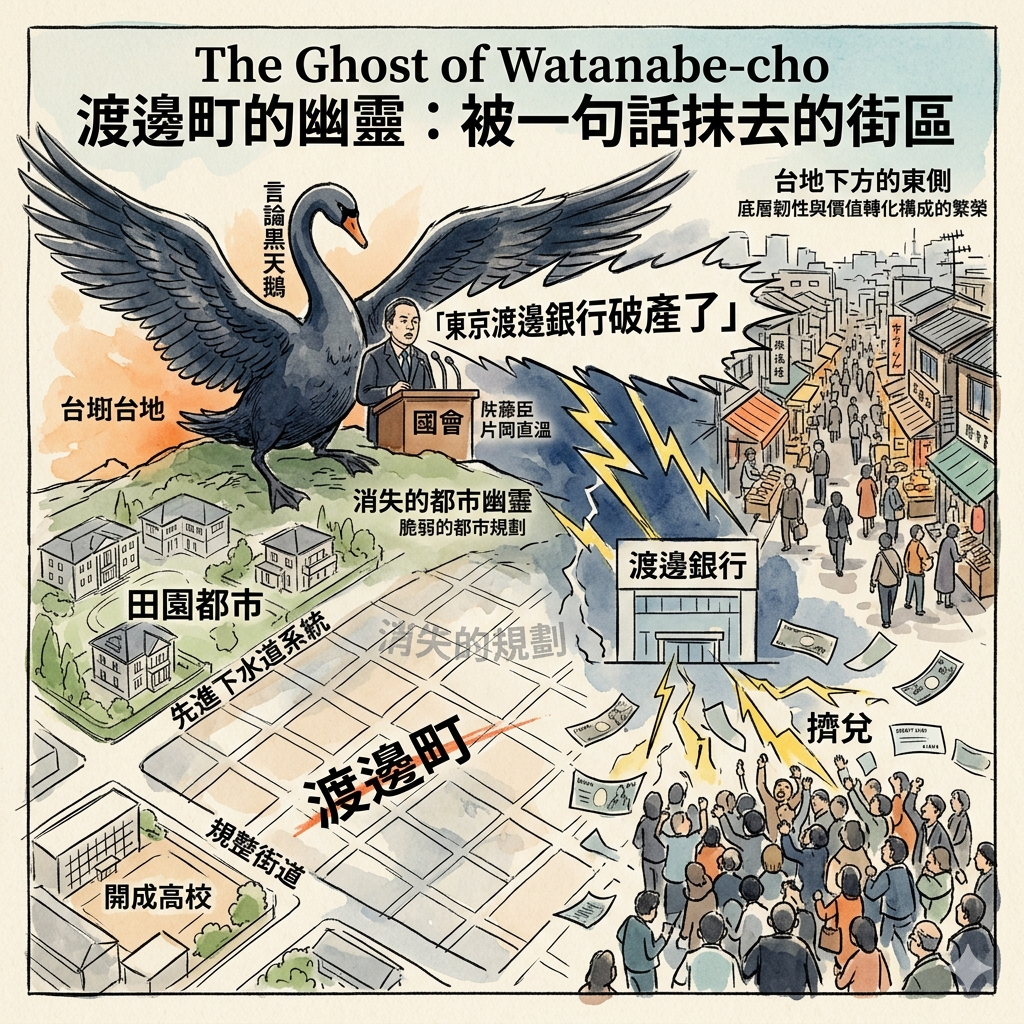
The Ghost of Watanabe-cho: A Neighborhood Erased by a Sentence
In 1916, a vision emerged for the Nippori heights that rivaled the elite suburbs of London. Planned by the Watanabe zaibatsu on a wasteland previously known as "Sakake-no-hara," the proposed "Watanabe-cho" was to be a "Garden City" for the elite, featuring advanced sewage systems and a structured grid of high-end residences. However, this dream was destroyed not by fire, but by a "Black Swan" event of political rhetoric. In 1927, Finance Minister Kataoka made a fatal slip of the tongue in the Diet, stating prematurely that the Watanabe Bank had gone bankrupt. This single sentence triggered an immediate bank run, leading to the collapse of the Watanabe zaibatsu and the evaporation of the neighborhood’s funding. By 1934, the name "Watanabe-cho" was officially struck from the maps. Today, the rectangular street layout near Kaisei High School is the only ghost of this failed utopia, a sobering reminder of the fragility of urban planning when tied to the volatility of credit.
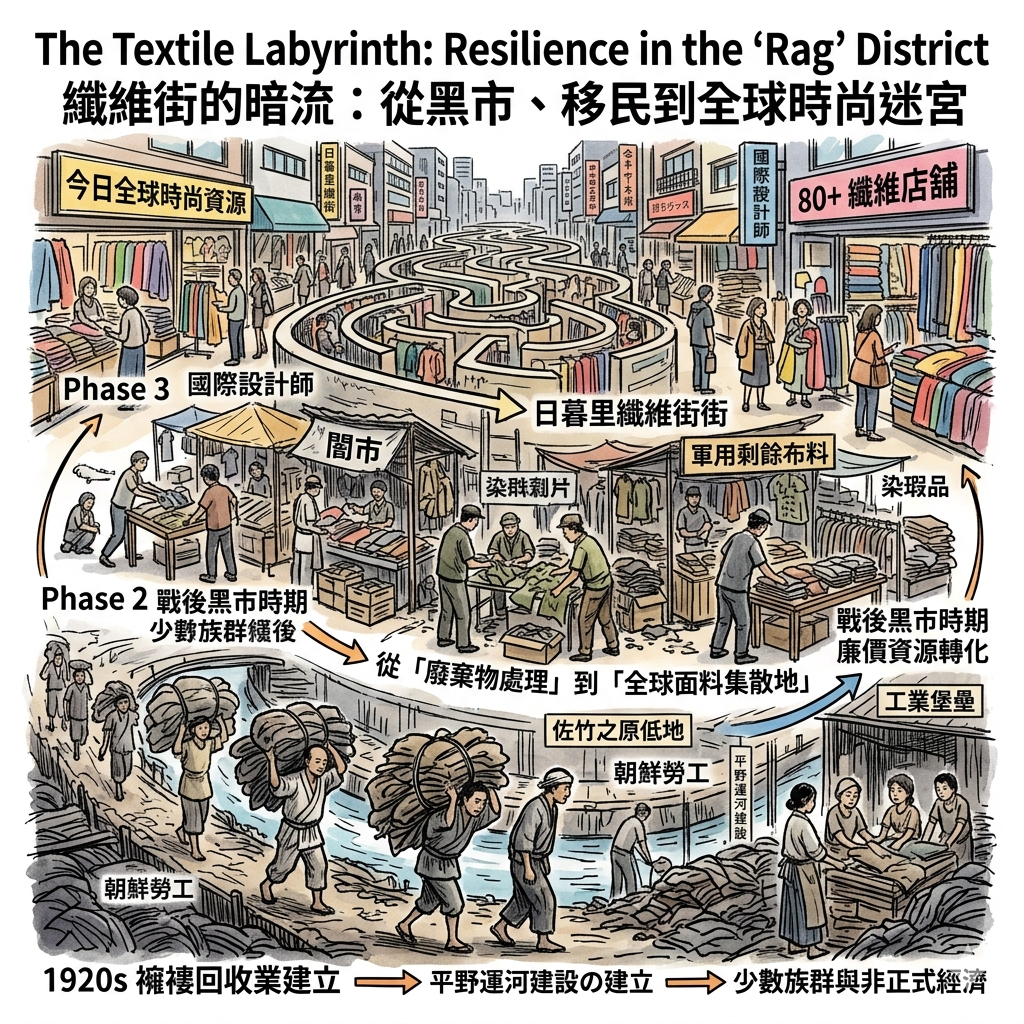
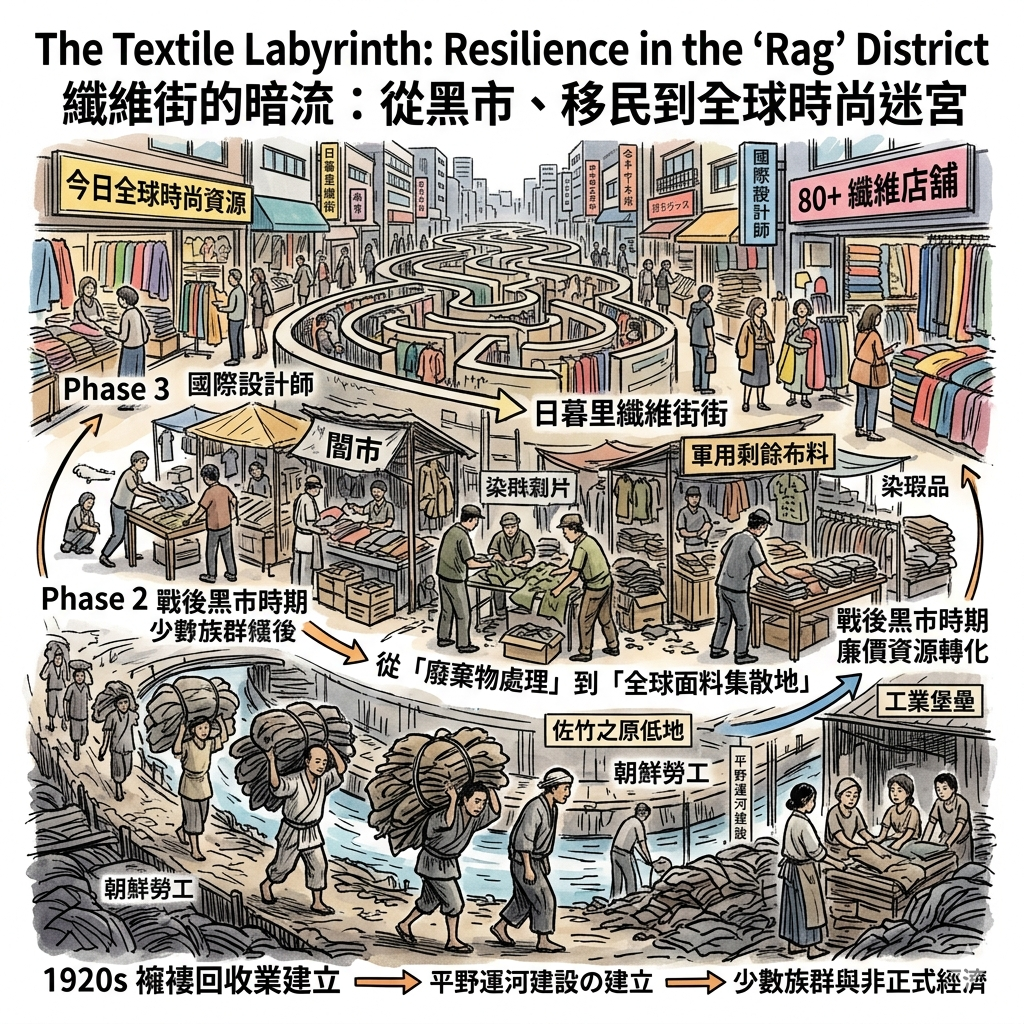
The Textile Labyrinth: Resilience in the "Rag" District
As the dreams of the elite on the heights crumbled, a resilient survivalist economy was forming in the lowlands. The Nippori Fabric Town did not begin as a fashion hub, but as a "rag" (boro) district. In the 1920s, marginalized groups—including many Korean laborers brought in for the construction of the Hirano Canal—utilized the "gaps" in the urban economy to establish a waste-recycling industry.
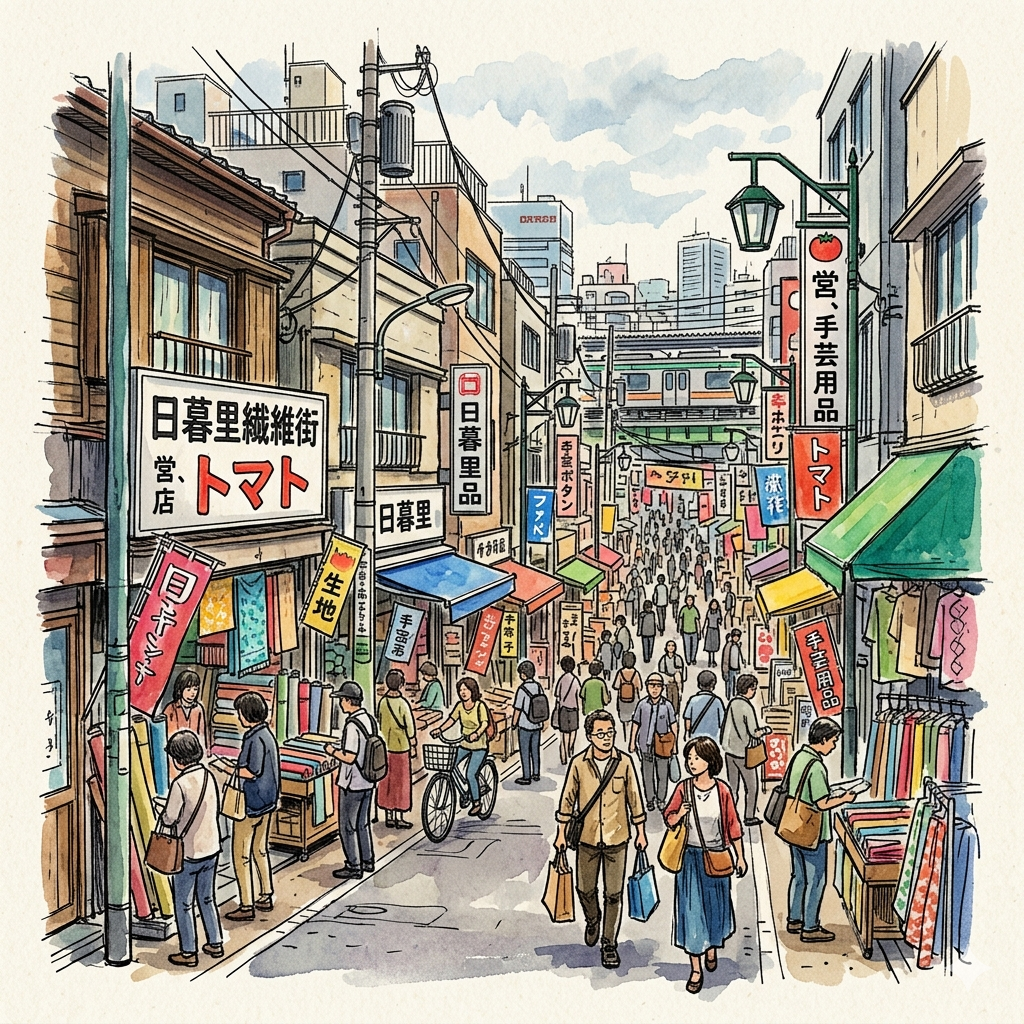
After World War II, this industry transformed during the "Black Market" era. Traders repurposed military surplus and fabric scraps, turning what was once considered waste into a professional textile wholesale industry. Today, this one-kilometer stretch of over 80 shops serves as a global fashion resource. It is a testament to how the working-class lowlands built a lasting industrial fortress by literally recycling the city's discarded past into its creative future.
Beyond the Main Path: Hidden Gems
To truly appreciate the "Deep Topography" of the area, seek out the Suwa Shrine. Located atop the cliffline, it offers the most evocative view of the rail lines below. It is the perfect spot to observe the literal intersection of the Musashino Upland and modern transit—a place where you can stand on ground that has hosted settlements since the Jomon period and watch the Shinkansen slice through the artificial valley created by Meiji-era engineering.
Conclusion: The Wisdom of the Cliffside
The history of Nippori is a narrative of the "buffer zone." It is a place that has consistently accommodated the marginalized and the displaced: the defeated samurai of the Boshin War, the immigrant laborers of the Hirano Canal, and the suppressed desires of the O-oku women. Its landscape is not a static postcard, but a series of layers where the natural cliff has been chipped, sold, and reinforced to meet the needs of a relentless metropolis. Nippori teaches us that a city’s identity is found in its scars—the bullet holes in a gate, the vertical drop of a station platform, or the grid of a vanished elite neighborhood. These are the physical markers of moments when Tokyo had to choose between its past and its future, and where the marginalized found the strength to build something enduring in the gaps.
In a city like Tokyo, which relentlessly paves over its past to build anew, does the Nippori cliffline remain the only place where the city's true bones are exposed? Perhaps the only way to understand the present is to walk the edge where the landscape was broken.
If you have enjoyed this exploration of Deep Topography, consider subscribing to Historical Travel Stories for more deep dives into the hidden narratives of our urban landscapes.
Planning Your Walk
- How to get there: Use Nippori Station, accessible via the JR Yamanote and Keisei Lines.
- Recommended Tour: Begin at the "Sunset Stairs" (Yuyake Dandan), walk through Yanaka Cemetery to view the 1954 cliff cut, and follow the heights north toward the textile district. This "Yanaka-Nippori Historical Cliffside Walk" offers the best perspective on the area's verticality.
- Accommodations: For those wishing to stay longer, the traditional ryokans in the nearby Yanaka district offer a sense of the quiet "setting sun" atmosphere that originally gave Nippori its name.
Q & A
What is the Enmein scandal involving the Ooku?
The Enmein Scandal (延命院事件), which erupted in 1803 (Kyowa 3), is considered one of the most controversial sex scandals in the history of the Edo period. It centered on the Enmein Temple in Nippori and exposed a clandestine world of forbidden relationships between Buddhist monks and women from the Ooku (the Shogun’s inner palace).
1. The Temple as a Gateway for the OokuDuring the reign of the 11th Shogun, Tokugawa Ienari, Enmein Temple held a high political status due to its historical ties to "O-raku no Kata," a concubine of the 3rd Shogun, Tokugawa Iemitsu. Because the temple was famous for "Kodakara" (fertility) prayers, it became one of the few places where Ooku officials and noblewomen could legally leave their confined quarters for "pilgrimage".
2. The "Secret Salon" and NichijunThe central figure of the scandal was the chief priest, Nichijun (also known as Nichido), who was rumored to be the son of the famous Kabuki actor Onoe Kikugoro II. Possessing striking beauty and charisma, Nichijun transformed the temple into a high-level "secret salon" for women. To facilitate these illicit meetings and evade surveillance, the temple was equipped with elaborate mechanisms similar to a "ninja house," including:
- Hidden doors and secret tunnels.
- Double-bottomed "nagamochi" (large storage boxes) used to smuggle women in and out of the premises.
3. The Investigation and "Secret Agent"Because the scandal involved high-ranking Ooku officials—such as "Koro," a subordinate to the influential O-chu-ro Umemura—the Temple Magistrate (Jisha-bugyo), Wakizaka Yasutada, conducted the investigation with extreme caution. He employed a modern detective tactic by sending the daughter of one of his retainers to act as a "secret agent" (mitsu-tei). She visited the temple under the guise of a worshiper to gather evidence of Nichijun’s misconduct.4. The Raid and Harsh PunishmentsOn the morning of May 26, Wakizaka led a raid of 80 elite men on Enmein. Nichijun was eventually discovered hiding inside one of the concealed storage boxes. The Shogunate used the ensuing trial to reassert social discipline:
- Nichijun was sentenced to beheading, and his head was displayed at Nihonbashi for three days to intimidate corrupt clergy.
- Ooku women, such as "Hana" (age 19) and "Yui" (age 30), were sentenced to "Ei-no-oshikomi" (life imprisonment/confinement). One of the involved women reportedly committed suicide while in custody.
5. Historical SignificanceThe sources suggest that the Enmein scandal was more than a moral failing; it was a structural backlash against the rigid spatial and sexual repression of the Edo period. For the women of the Ooku, who lived in an extremely restricted and "choked" environment, the temple functioned as an "emotional breathing hole".Furthermore, the scandal became a fixture in Japanese pop culture. While official records decried Nichijun as a "depraved monk," later literature and Kabuki plays, such as the Enmein Jikki (1885), often romanticized him as a tragic hero who defied oppressive social and religious dogmas. Today, a memorial tower for Nichijun still stands at the quiet Enmein Temple in West Nippori as a physical marker of this historical rupture.
How did the 1952 train disaster reshape Nippori's geography?
The 1952 train disaster at Nippori Station acted as a violent catalyst for the physical destruction of the area’s natural landscape, forcing a radical geographical reshaping to accommodate the demands of post-war urban growth.According to the sources, the transformation occurred through the following stages:
1. The Trigger: The 1952 Cross-Bridge CollapseOn June 18, 1952, an aging wooden cross-bridge (built in 1928) collapsed under the weight of an overcrowded commute. Dozens of passengers fell seven meters onto the tracks just as a Keihin-Tohoku Line train was entering the station, resulting in eight deaths and numerous injuries. This tragedy exposed the dangerous contradiction between the area's narrow, restricted geography and the surging population of post-war Tokyo.
2. The Solution: Aggressive Cliff ExcavationTo prevent future overcrowding and alleviate platform pressure, the Japanese National Railways (JNR) determined they needed more space—space the natural geography did not provide. In 1954, as a direct response to the accident, the government authorized the large-scale cutting and excavation of the cliff face beneath the Yanaka Cemetery (谷中靈園).
3. The Resulting Landscape: An "Urban Cross-Section"This engineering project fundamentally altered the local topography in several ways:
- Elimination of the Natural Cliff Line: The project completely destroyed the natural海蝕 (sea-erosion) cliff morphology in that specific section of the Nippori Cliff Line.
- A Unique Vertical Contrast: The excavation created the striking, almost surreal urban scene visible today, where the station platforms sit directly adjacent to a vertical cliff wall topped by the Yanaka Cemetery.
- Physical Manifestation of "Infrastructure Determinism": The sources describe the modern Nippori Station as a "three-dimensional historical fault line". While the western side (the "Sunset Steps") retains a nostalgic atmosphere, the eastern side—with its narrow platforms cut precisely into the backbone of the Musashino Plateau—serves as a permanent physical legacy of the 1954 post-disaster reconstruction.
In summary, the 1952 disaster shifted Nippori’s geography from a natural "scenic boundary" to a purely functional transport corridor, where the integrity of the land was sacrificed to ensure the safety and efficiency of the city's rail infrastructure.
Reference and Further reading
- 寄稿・富士見坂考 - 坂学会, accessed March 24, 2026,
- 魯迅と日暮里(25)辻潤の見たダイヤモンド富士 1902年11月の日暮里富士見坂, accessed March 24, 2026,
- 崖の魅了を探っていく。スタートは道灌山(標高20m)|はなぽん - note, accessed March 24, 2026,
- 田園調布になり損ねた渡辺町 - FC2, accessed March 24, 2026,
- 日暮里(JY07)・西日暮里駅(JY08): 風情あふれる「日暮らしの ..., accessed March 24, 2026,
- 日暮里駅で発生した二つの『人災』 - ランサーズ, accessed March 24, 2026,
- 荒川区の高台、日暮里の台地を歩く, accessed March 24, 2026,
- 延命院事件 (日暮里・谷中史跡散歩②) - 気ままに江戸 散歩・味・読書の記録, accessed March 24, 2026,
- イケメン僧侶と大奥女中のスキャンダル : 延命院事件 - nippon.com, accessed March 24, 2026,
- 延命院事件 生臭坊主が引き起こした衝撃の一大スキャンダル…美僧と大奥の秘密とは?, accessed March 24, 2026,
- vol.58「延命院事件」について, accessed March 24, 2026,
- 昔人の物語(135) 日潤『59人のセレブ女性と関係した僧侶』 - 医薬経済ONLINE, accessed March 24, 2026,
- 延命院 (荒川区) - accessed March 24, 2026,
- 【歴史さんぽ#1】上野に残る戦争の痕跡|稲垣湧斗 - note, accessed March 24, 2026,
- ~彰義隊・上野戦争のゆかりの地を訪ねる~ - 富士見市民大学, accessed March 24, 2026,
- 荒川ゆうネットアーカイブ > 史跡・名所(日暮里) > 日暮里(写真解説) - 荒川区, accessed March 24, 2026,
- 西洋式銃の弾痕が残っている場所/ホームメイト - 刀剣ワールド, accessed March 24, 2026,
- 経王寺(きょうおうじ) - 荒川区, accessed March 24, 2026,
- 上野戦争の爪痕 - 歴旅.こむ, accessed March 24, 2026,
- 彰義隊の墓(円通寺・荒川区) - 戦跡紀行ネット, accessed March 24, 2026,
- 観光モデルコース 6 彰義隊ゆかりの地を歩くコース - 荒川区, accessed March 24, 2026,
- 円通寺 - 彰義隊士を葬ったゆかりの寺院の遺構 - 日本伝承大鑑, accessed March 24, 2026,
- 第1号 - 荒川ふるさと文化館だより, accessed March 24, 2026,
- 西日暮里と成増、共通点は「沿線開発で挫折」 高級住宅街や行楽地が生まれるはずだった, accessed March 24, 2026,
- 東京渡辺銀行 - accessed March 24, 2026,
- 地域と共に歩む「日暮里繊維街」 - 東京, accessed March 24, 2026,
- 区の特色 | 荒川支部 - 東京商工会議所, accessed March 24, 2026,
- 学会誌 コリアン・スタディーズ 第 2 号, accessed March 24, 2026,
- 現代の日暮里の風景を眺めるコース - Tokyo, accessed March 24, 2026,
- 歴史・建物・生業が織りなす日暮里繊維街の風景, accessed March 24, 2026
 Lawrence
 Lawrence
 Lawrence