Taipei 2016: Five Forgotten Sites Where the Dragon Vein Still Runs
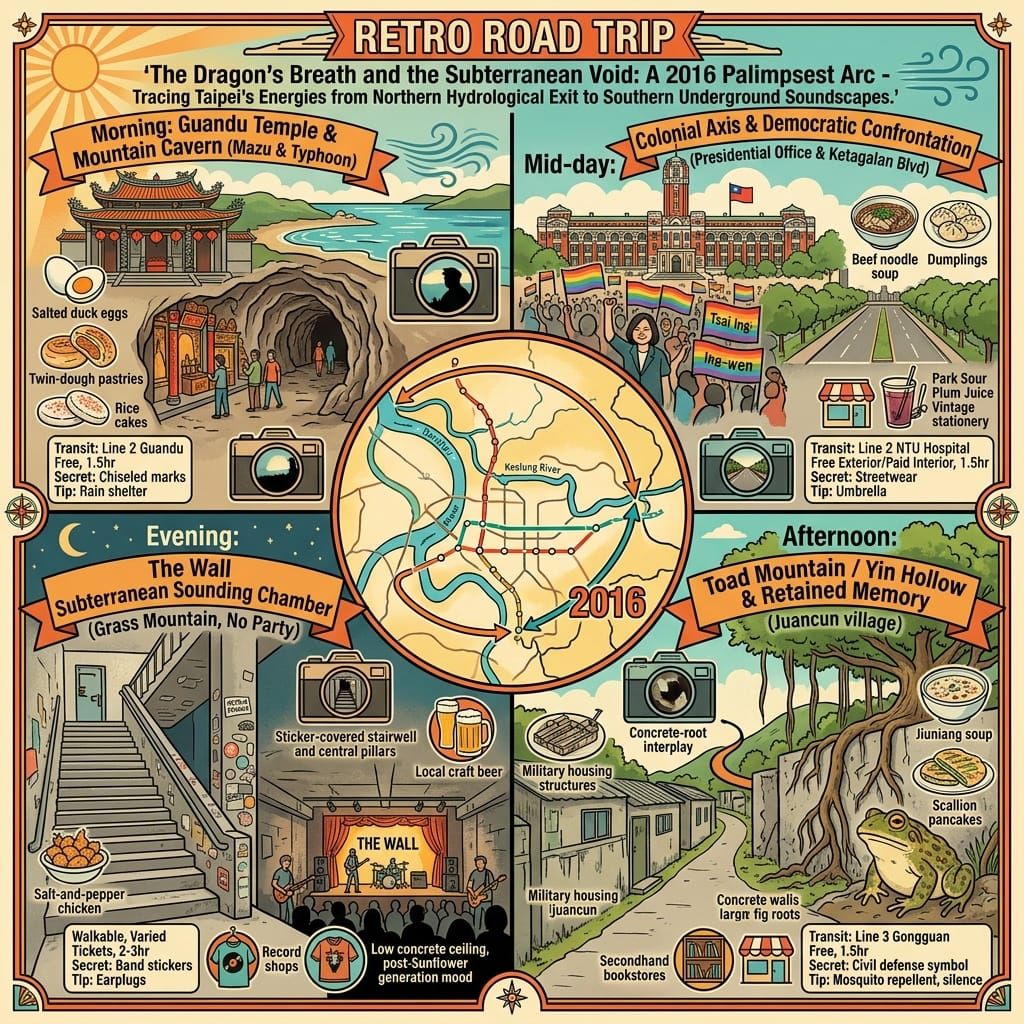
In 2016, Taipei was simultaneously an election, a hillside of soldiers who never went home, a boulevard named for a vanished people, a sea goddess in a typhoon, and a basement stage. Five sites. One hidden geography. The history books skipped all of them.
"2026 is the New 2016" Series · Volume III
 Lawrence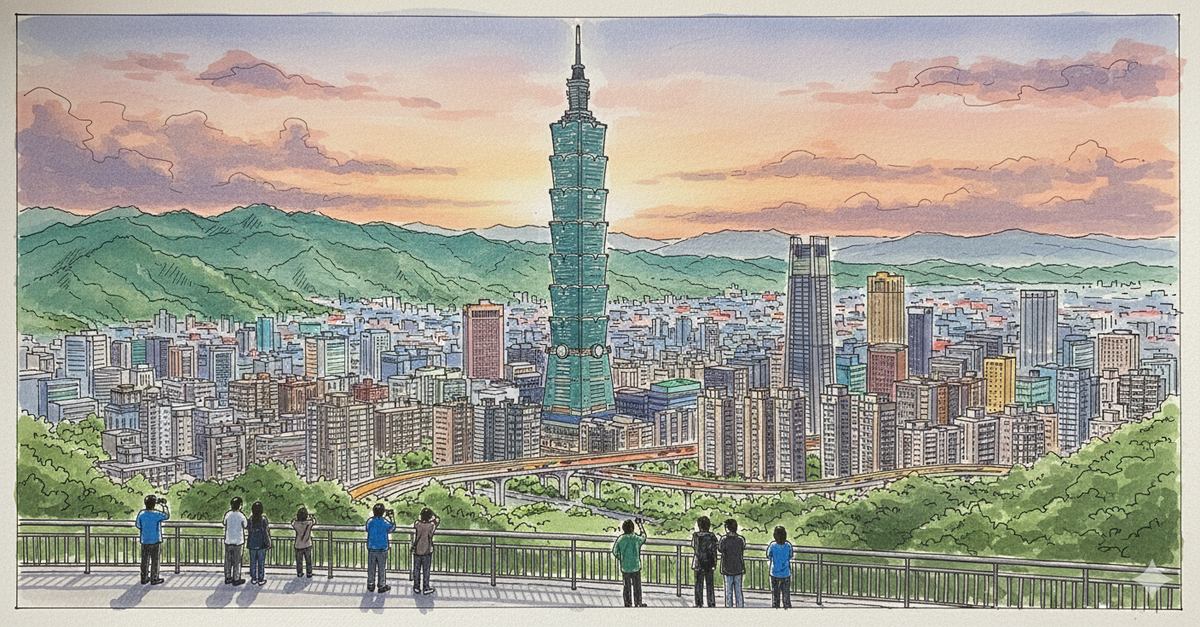
This is a historical travel piece about Taipei in 2016 — a year that the "2026 is the new 2016" cultural movement is now recovering as a touchstone of the last era before algorithmic monoculture rewired human attention. It visits five overlooked sites: the Presidential Office building on its ancient geomantic axis, a hillside community of soldiers who never returned home, a boulevard named after a people the city erased, a sea goddess temple at the exact point where the city's water flows out to sea, and a basement music venue where a political generation found its voice. Together, they reveal a hidden geography older than any government that has tried to claim this land.
The Weight of What Was Buried Here
There is a Chinese term — lóngmài (龍脈), dragon vein — that describes the channels through which vital energy moves through a landscape. In traditional Sinosphere cosmology, mountains are dragons lying prone across the land, their spines tracing lines of power through valleys and river basins. Where the dragon's breath accumulates, cities rise. Where it converges, temples are built. Where it exits, someone always stations a god.
Taipei knows something about this. Its basin is encircled on three sides by mountains — a volcanic range to the north, ridgelines holding the east and south — and opens westward where the Tamsui River carries the basin's accumulated energy to the sea. This is what classical feng shui calls cáng fēng jù shuǐ: wind sheltered, waters gathered. A formation that concentrates rather than disperses. For two thousand years before any government named this place, the land already had a grammar.
Every regime that has ever arrived in Taipei — Ketagalan indigenous clans, Qing administrators, Japanese colonists, the Republic of China government in exile — has believed it was writing on a blank page. Every single one of them, without exception, has written in the same ink, on the same paper, along the same dragon's spine.
In 2016, five overlooked sites in this city made that hidden grammar legible, all at once. Most of them never made the history books. The "2026 is the new 2016" nostalgia wave circulating online right now is, in its way, trying to recover them — though it doesn't yet know exactly what it's mourning.
Here is what it's mourning.
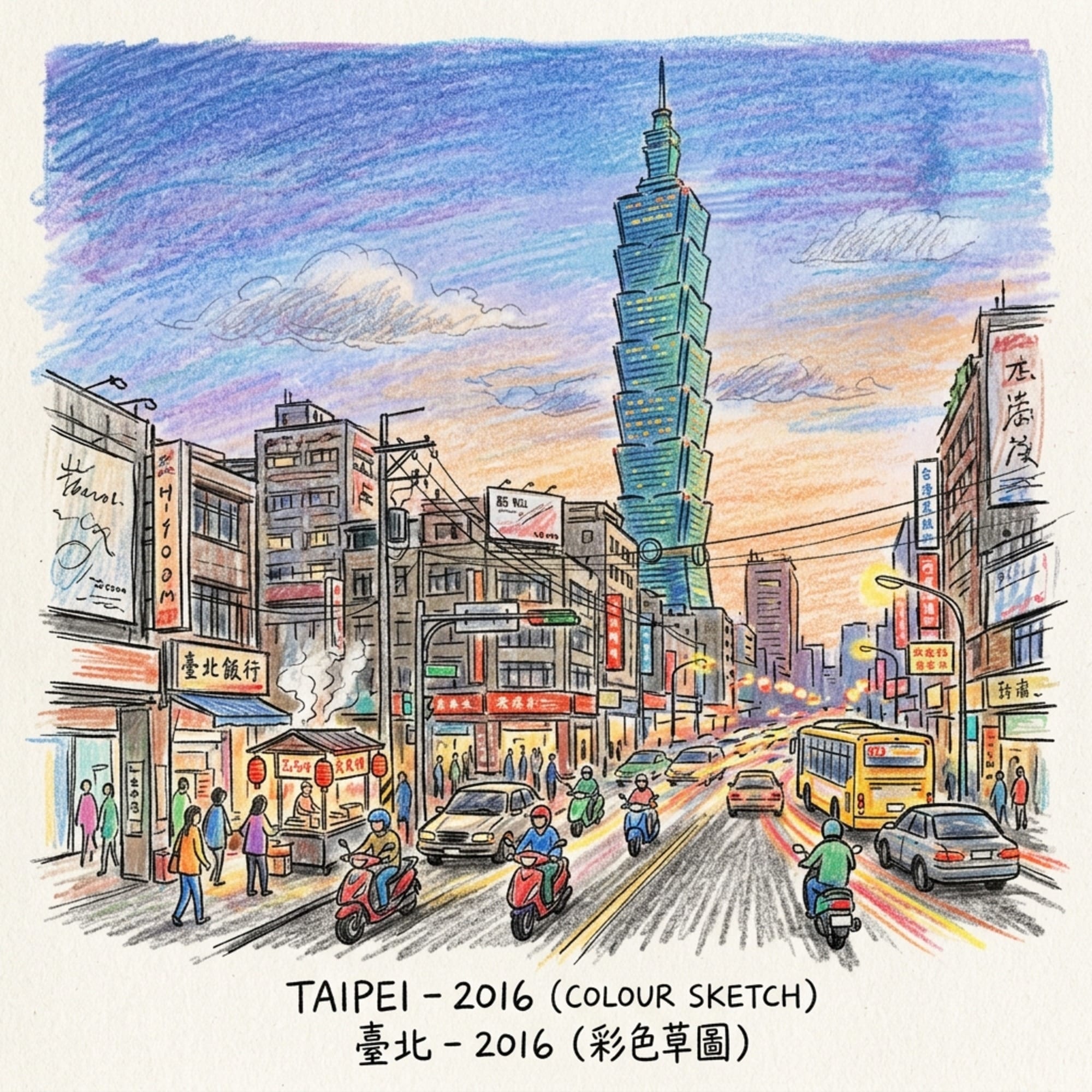
Listen to the historical stories told in detail (For subscribers only)
I. The Night the Dragon's Seat Changed Masters
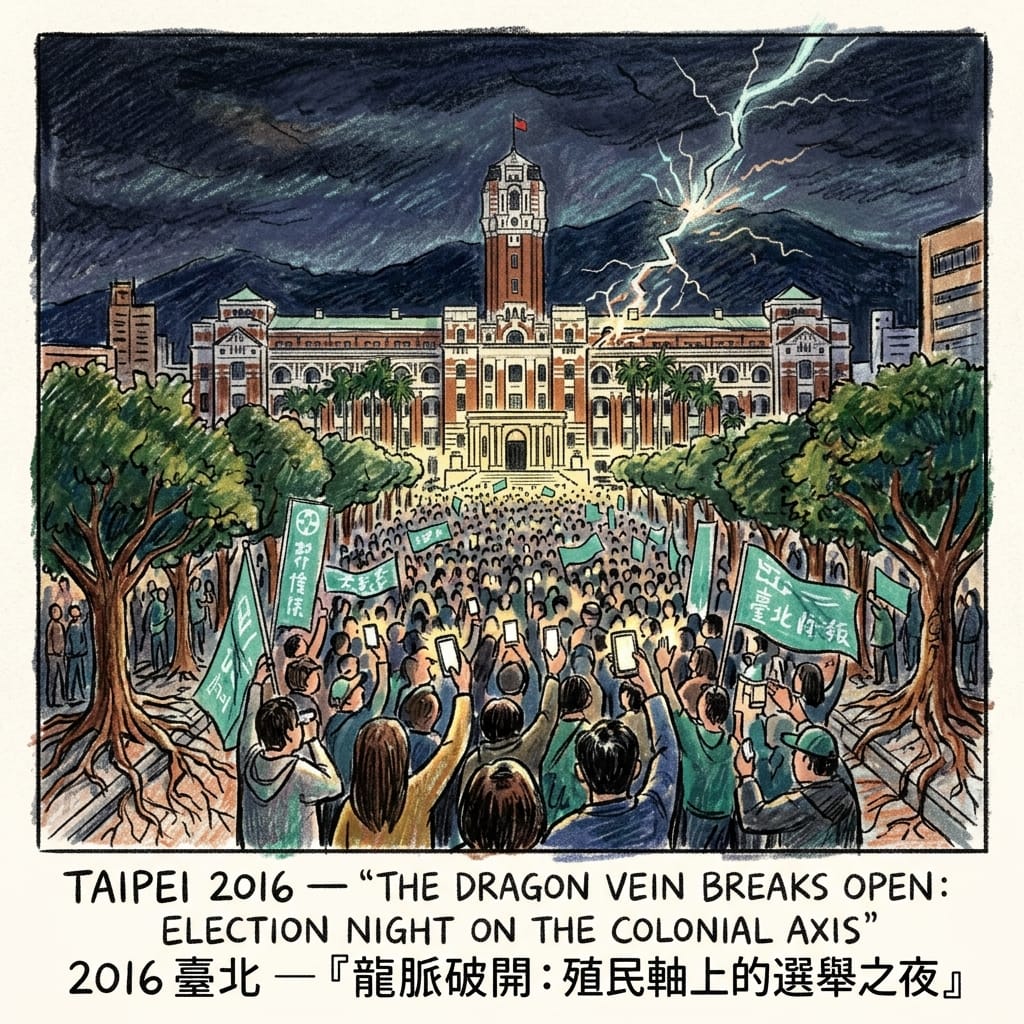
On the night of January 16, 2016, the wind coming off Yangmingshan carried a volcanic chill down into Taipei's streets.
The Presidential Office Building had been waiting for this. It had been waiting for every handover before this one, too. Built between 1906 and 1919 by the Japanese colonial administration as the Office of the Governor-General, it stands at the northern end of what is now Ketagalan Boulevard — a building designed for permanence, its pale stone facade carved in baroque severity, its clock tower visible across much of the city. It faces north, orienting itself toward Yuanshan, the Round Mountain across the river where the Taiwan Jinja — Japan's paramount Shinto shrine on this island — once stood.
The alignment matters. In feng shui analysis, a building facing its sacred mountain is said to jiē shān qì — to receive the mountain's breath, to draw the dragon's vital energy down from the high ground into its halls. Every government that has occupied this building since 1919 has inhabited that same geomantic argument. Qing officials, Japanese governors, Republic of China presidents: all of them found the same node, named it differently, and stayed.
On January 16, Tsai Ing-wen was elected Taiwan's first female president, with approximately 56 percent of the popular vote. The Democratic Progressive Party won a legislative majority at the same time. The Kuomintang — the party that had governed Taiwan since 1945 and governed mainland China before that, the party of Chiang Kai-shek and the two-million-person retreat across the Taiwan Strait in 1949 — was effectively rendered a minority opposition for the first time.
In the city streets, tens of thousands celebrated. But the building at the top of the boulevard stayed silent, lit from outside, facing its mountain, waiting.
The cosmological dimension that none of the political commentary captured: every previous occupant of that building had been male, mainland-born or mainland-oriented, the product of explicitly patriarchal state structures. Tsai Ing-wen — a Hakka woman, a domestic law scholar, someone whose political career had been built within and against the KMT system — was none of these. In the yin-yang vocabulary of the tradition that named this building's site, her occupancy introduced a fundamental reversal of the building's energetic polarity. The dragon vein had changed masters before. It had never been given a yin master.
There is one more thing that most people standing on the boulevard that night did not register. The avenue beneath their feet was named Ketagalan Boulevard — Kǎidágelán Dàdào — after the indigenous Austronesian people who inhabited the Taipei Basin before Han Chinese settlement in the eighteenth century. The renaming happened in 1996, when Chen Shui-bian, then the city's mayor, stripped the street of its previous name (which honored Chiang Kai-shek's birthday) and returned an indigenous name to the city's primary political artery, in the same year Taiwan held its first direct presidential election. It was an act of simultaneous democratization and indigenization, compressed into one street sign.
Hijacking Taipei's Dragon Vein
The Ketagalan had been on this ground first. Their cosmology preceded feng shui, preceded Shinto, preceded every flag. On election night 2016, a crowd celebrating one era's beginning walked on a road that was itself a monument to two prior eras' erasure.
Holographic Sensory Cue:
January midnight, Ketagalan Boulevard: the wind from Yangmingshan arrives in pulses rather than a steady stream, rolling down the volcanic slopes and channeling between the government ministry buildings that flank the avenue. The Presidential Office building in floodlight is a warmer stone than it looks in photographs — the subtropical weathering gives it a slightly ochre cast. The stone is pitted under your fingers, each pore a year's worth of monsoon. In the crowd, phone screens create a low cold light distinct from the warm amber of the streetlamps — that specific two-temperature light environment is the optical signature of 2016, of the last era when a phone was still primarily a tool rather than an attention-harvesting device. The cheering rises and falls in waves. The building says nothing.
II. What a Toad Knows About Waiting
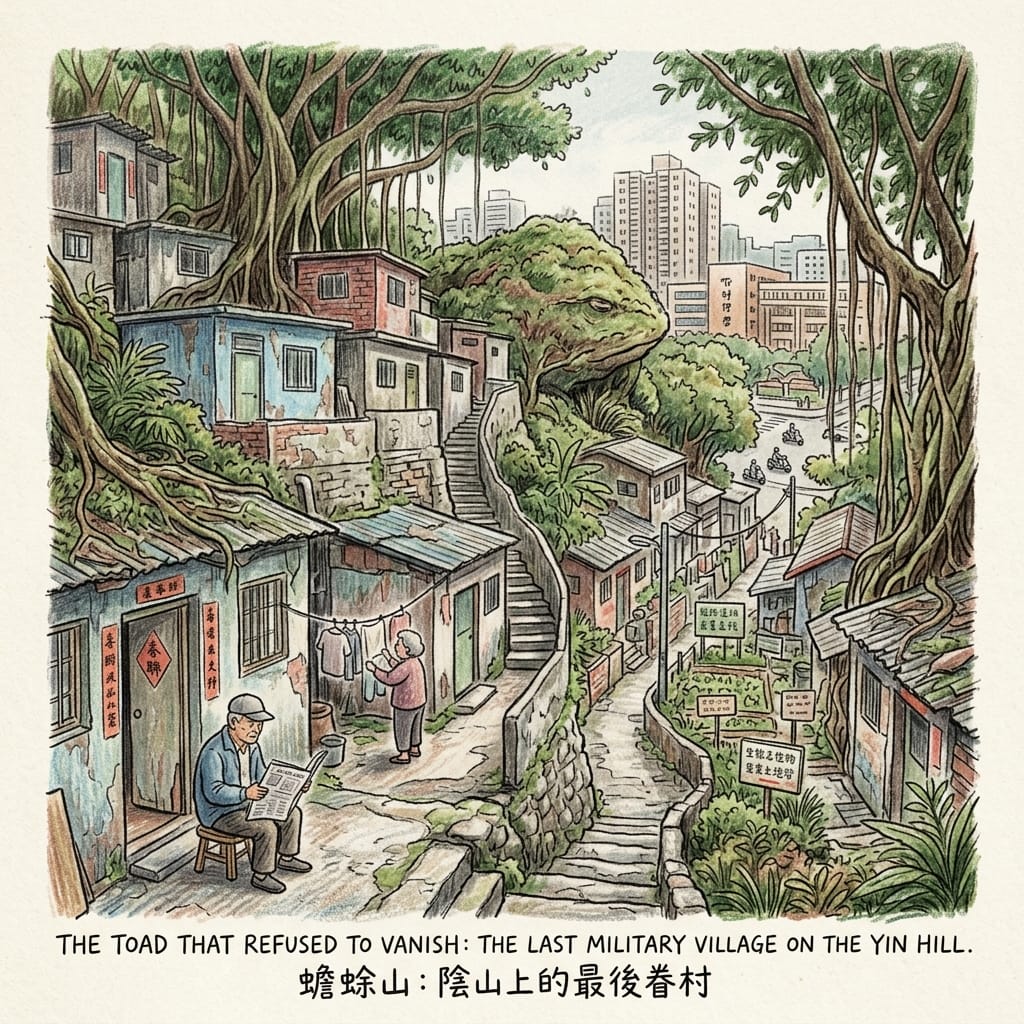
South of the National Taiwan University campus, on a low hill called Chanchushan — Toad Mountain — a group of old people were waiting for a verdict in 2015 and 2016. They had been waiting, in various forms, since 1949.
The toad in Chinese cosmological tradition is not the mundane creature of Western garden folklore. It is the animal of the moon — the creature that, in the most ancient versions of the Chang'e myth, inhabits the lunar palace alongside the immortal herself, guardian of the elixir of eternal life. It is an animal of thresholds: not fish, not frog, not quite either. It inhabits the margin between water and earth, both of which are yin elements, making it a creature of accumulated, patient yin energy. In feng shui topology, a hill named for the toad signals a yīn xué — a yin cavity, a site where the landscape's energy concentrates and stores rather than projects and flows. Toad hills hold things.
Chanchushan had been holding something for seven decades.
The people on its slopes were the descendants of soldiers who retreated from mainland China to Taiwan with the Kuomintang military in 1949 — men who set up what they called juàncūn, military dependents' villages, in makeshift concrete housing across Taiwan, expecting to stay for a few years at most before the mainland was reclaimed. Decades passed. The mainland was not reclaimed. The soldiers aged. Their children grew up in a culture that was neither quite Chinese nor quite Taiwanese — a specific, isolated formation bred from the permanent postponement of return. They developed their own cuisine, their own accent, their own way of being in the world that had nowhere else to go.
By 2015-2016, the original veteran generation was mostly elderly or gone. Their descendants occupied the hillside in houses built for transience that had outlasted empires. The city government was deciding what to do with Toad Mountain: develop it, demolish it, designate it. Preservation advocates from National Taiwan University argued for an "eco-museum" model — let the remaining residents stay, open the community to cultural engagement, treat the place as a living archive rather than a teardown site.
The Village That Waited Forever
The hill's physical character mirrors its cosmological name in ways that are hard to dismiss as coincidence. Chanchushan is low-profiled and gently rounded — a yin topography — with dense subtropical canopy that creates an acoustic enclosure unusual for urban Taipei. Traffic noise from surrounding streets is muffled by the vegetation. The temperature on the hillside runs a degree or two cooler than the surrounding blocks. The concrete housing from the early 1950s is the color of old bone in daylight. The lanes don't follow a grid; they follow the hill's contours, which means they follow the hill's own logic rather than any planner's.
Seven decades of grief about a home no one could return to accumulated on a hill that is, in the geology and cosmology of this place, literally a site for the accumulation of things that cannot be released. This is not metaphor. This is the landscape's grammar, and the juàncūn found it, or it found them.
In 2016, the city moved toward protecting Chanchushan as a cultural landscape. The toad's patience, after all these years, had outlasted the arguments for demolition.
Resonance Node:
The upper lanes of Chanchushan, closest to the hill's crown — reachable on foot from Xinglong Road — are among the few places in Taipei where the city's temporal density becomes physically palpable. Ficus roots have split the 1950s concrete; moss has colonized the cracks. There are cats but no tourists. Occasionally a window is open, and the sound of a television or a radio drifts out — old Mandarin, the accent of a mainland that no longer quite exists. Stand still. That sound is seven decades of waiting, still circling the yin cavity of the hill, with nowhere else to go.
III. The Ghost on the Boulevard
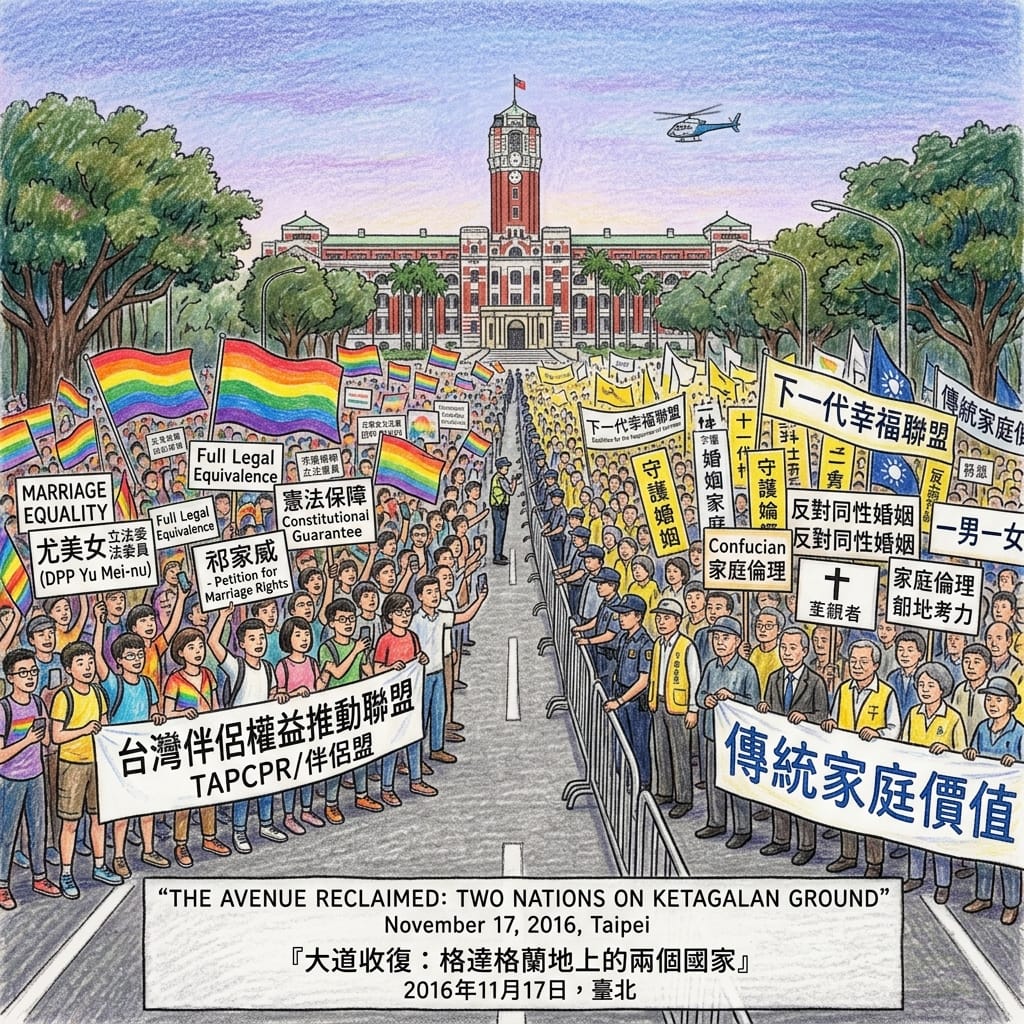
November 17, 2016. The Legislative Yuan was holding its first committee reading of a marriage equality bill.
Outside, Ketagalan Boulevard was occupied by two of the largest competing demonstrations in Taiwan's recent history. Pro-equality supporters had gathered with rainbow flags. The Coalition for the Happiness of Our Next Generation — mobilized primarily by evangelical Protestant churches whose organizational capacity in Taiwan is disproportionate to their numbers — had gathered with their own banners. Estimates on both sides were contested and enormous. The scale of the confrontation was unmistakable.
Both coalitions claimed to speak for "Taiwan's tradition." Both invoked, in different ways, the idea that there was a natural order to family and marriage that needed defending or extending.
Neither acknowledged what was written on the road beneath them.
The Ketagalan people inhabited the Taipei Basin before any Han Chinese or Japanese presence. The available anthropological evidence — fragmentary, because Sinicization in the eighteenth century was thorough — suggests their kinship systems were bilateral or matrilineal rather than patrilineal, diverging fundamentally from the Confucian family structure that the anti-equality coalition cited as Taiwan's foundational tradition. Comparable Austronesian-speaking Pingpu peoples in northern Taiwan had documented ceremonial gender roles that operated outside the binary the argument assumed. The Ketagalan's own relationship to the specific institutions being debated that day is unrecorded — too much was lost. But the direction of the divergence is clear enough to make the irony operationally available to anyone who looks.
The Irony Beneath Taipei's Biggest Protest
A Confucian patrilineal argument about "natural" family and "traditional" marriage was being made on a boulevard named for people whose social structures preceded, and substantially contradicted, Confucian patrilinealism. The Ketagalan ghost stood in the crowd's gaps, unaddressed by either side.
In feng shui's spatial logic, Ketagalan Boulevard runs on the city's primary north-south axis — the central spine of a properly oriented city, the channel through which the most concentrated political energy flows. Every major civil mobilization in Taipei's post-democratic era has gravitated to this corridor: nuclear opposition, media freedom marches, the aftermath of the Sunflower occupation, the marriage equality confrontation. This is not habit or infrastructure alone. The boulevard functions as the city's primary qì mài — its energy vessel for collective political force — and it draws mass events the way a river draws rain.
Two enormous competing bodies of people occupying that axis simultaneously creates, in the cosmological vocabulary, what practitioners call duìchōng: a direct oppositional energy confrontation, the maximum-intensity version of the boulevard's recurring function. The site amplifies; it does not resolve.
Taiwan would become the first place in Asia to legally recognize same-sex marriage, in 2019. That resolution happened in the Constitutional Court, on paper. The more complex and ancient argument — about who gets to invoke "tradition" on land whose original inhabitants knew nothing of the tradition being claimed — remains, so far, unaddressed.
IV. The Sea Goddess Was Right About the Typhoons
At the exact point where the Taipei Basin exhales — where the Tamsui and Keelung rivers converge and the water that has gathered from the entire mountain-encircled basin finally flows westward toward the Taiwan Strait — there is a temple built into a cliff face.
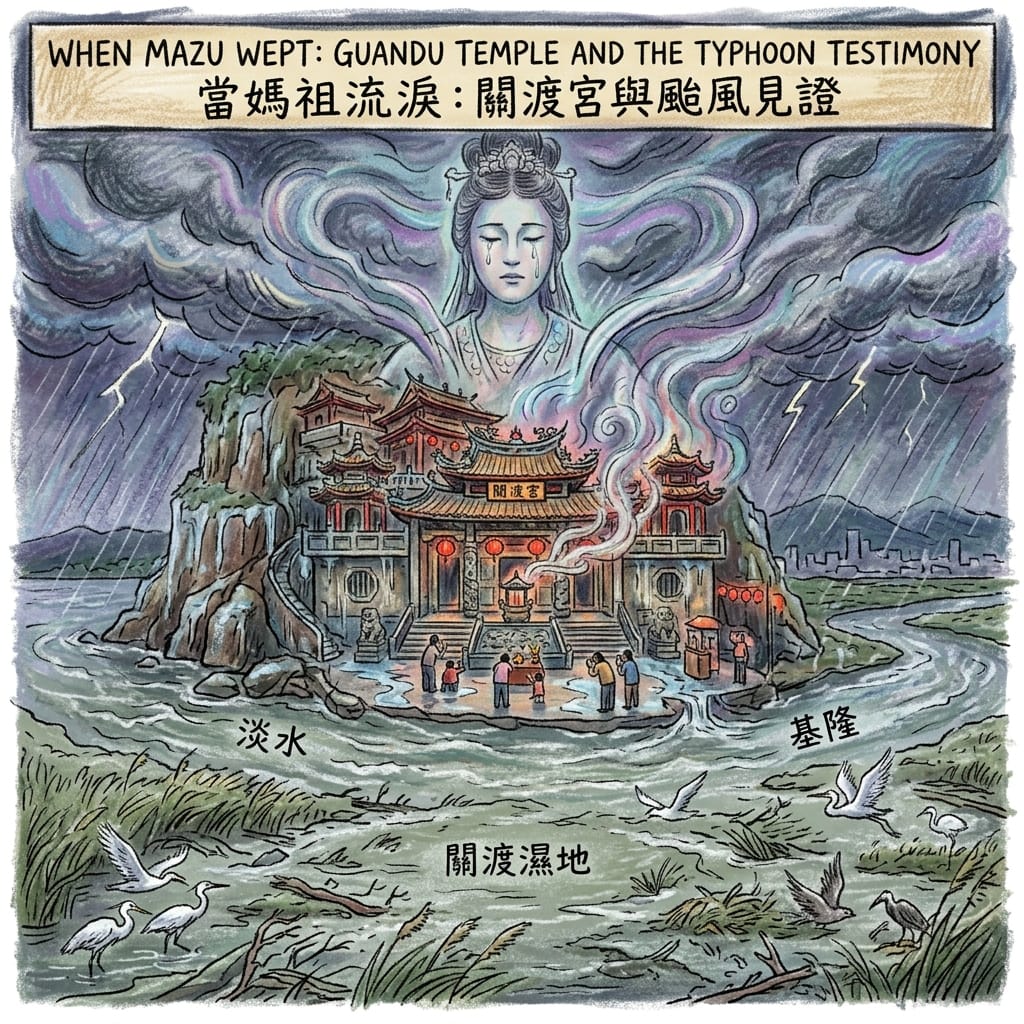
Guandu Temple has been here, in various forms, since the late seventeenth century. It is dedicated to Mazu, the Sea Goddess — in Taiwanese folk religion, the protectress of those who work the water, the deity who governs what the sea does and does not do. The temple's position is not arbitrary. In classical feng shui analysis, the point where a basin's water exits is called the shuǐkǒu — the water mouth — and it is the single most cosmologically critical node in any cáng fēng jù shuǐ formation. Whoever controls the water mouth controls the flow of the entire basin's vital energy. Guandu's temple has sat at that node for three centuries, a god installed precisely where the landscape's own logic demands a guardian.
In 2016, Typhoon Nepartak made landfall on Taiwan's eastern coast in early July — one of the strongest typhoons to strike the island in decades, its remnants pushing massive rainfall into the river systems that drain into the Taipei Basin. The Keelung River rose. The Tamsui rose. The Guandu wetland — the tidal flat adjacent to the temple, one of the last significant urban wetlands in Taipei, a bird sanctuary that has survived development pressure partly through its inherent hydrological impracticality — was temporarily submerged. Watermarks appeared on the temple's stone approach paths. Months later, the debris lines on the mudflat still marked where the storm surge had been.
When The Sea Goddess Wept
In the weeks around the typhoon, pilgrimage to Guandu Temple increased visibly. This is a documented pattern in Taiwanese folk religion: when natural forces exceed what human infrastructure can contain, communities return to the deity whose domain those forces belong to, and intensify the relationship. When the sea goddess's territory overflows the city's drainage systems, you bring more incense. You acknowledge that the contract has not expired. The infrastructure was a convenience; the contract is older.
The temple contains a surprise that guidebooks mention but rarely prepare you for. Behind the main deity hall, a passage runs through the mountain itself — thirty or forty meters of bare rock, undecorated, the ceiling pressing low. It is called, in various temple documents, a grotto passage, and it opens at the far end onto a sudden view of the Guandu wetland: flat, grey-green, populated by egrets and black-faced spoonbills and whatever the tide has brought in.
In Daoist sacred geography, certain sites are classified as dòngtiān — grotto heavens — spaces where the membrane between ordinary reality and a more fundamental one becomes thin. The classification is technically formal (there are thirty-six major and seventy-two minor grotto heavens enumerated in classical texts, and Guandu does not appear in those lists as a named site). But the structure of the experience is consistent: you move from human-made sacred space through the earth itself and emerge into raw, unmediated landscape on the other side. The mountain breathes you through it.
After the 2016 typhoon season, the wetland still bore its evidence. Reed beds disturbed. Debris lines at the storm's high-water mark. The egrets standing in the shallows, completely indifferent to the fact that human infrastructure had recently failed and then been repaired. They had always been here. The sea goddess had been here longer.
Holographic Sensory Cue:
The Guandu Temple cave passage: incense smell cuts off at the passage entrance, replaced immediately by mineral cold — the specific smell of wet stone and compressed air in an enclosed rock corridor. The floor is uneven; you adjust your gait without being told to. The ceiling height drops enough to make the body aware of the mountain pressing from above. Your footsteps are the loudest thing in the passage; your own breathing becomes audible. Then the exit appears — not gradually but as an explosion of light, the entire Guandu wetland spread in front of you after the passage's darkness. If it is autumn migration season: black-faced spoonbills at close range, entirely unbothered. The cold of the cave gives way to wetland air — salt, mud, rotting vegetation, the specific productive smell of tidal flats. The typhoon's watermarks are still visible on the near mudflat. The sea goddess made her point, and the stone still shows it.
V. No Party at the Foot of the Volcano
The political yang energy of Ketagalan Boulevard needs a yin counterpart. In 2016, that counterpart was a basement.
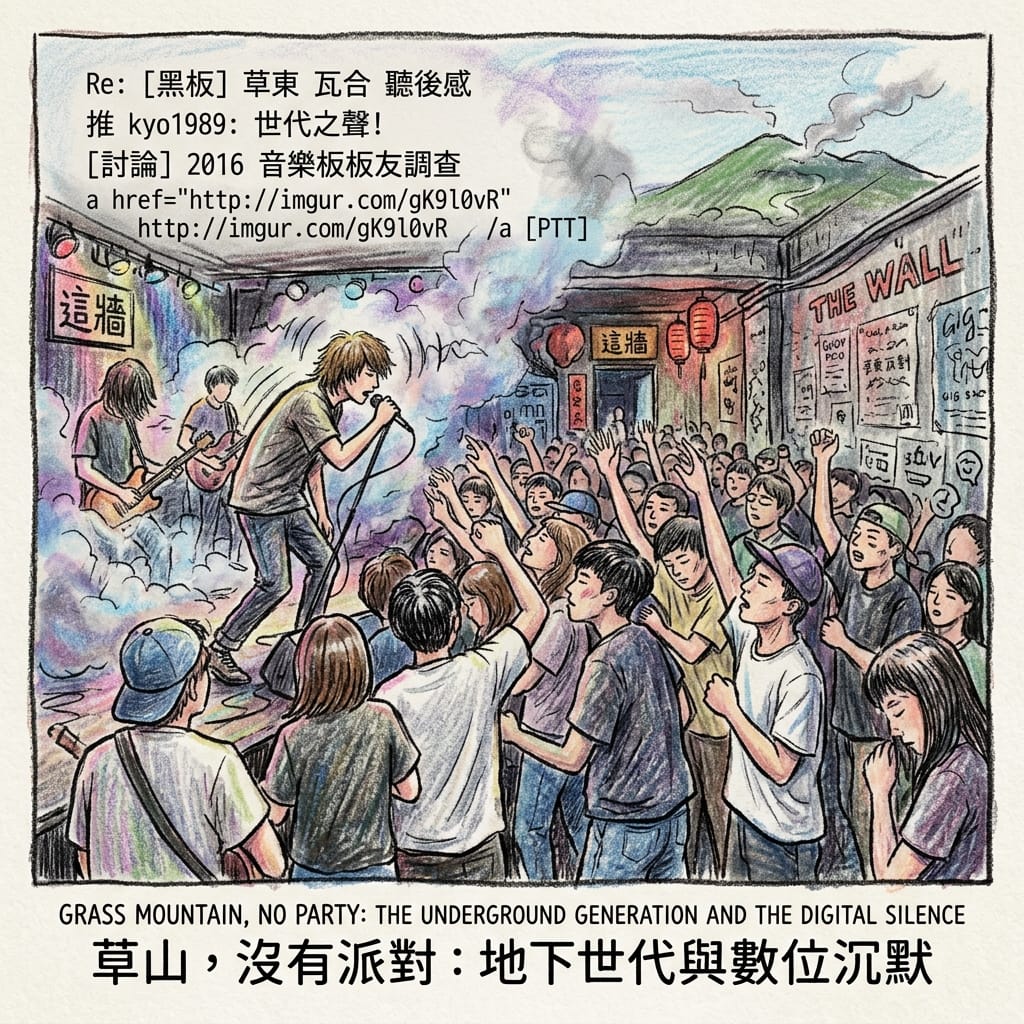
The Wall — Zhè Qiáng in Mandarin, two syllables meaning "this wall" — sits below street level in the Gongguan area, near National Taiwan University, accessible by a flight of stairs that deposits you into a low-ceilinged concrete space with a small stage, minimal lighting, and a sound system calibrated to make the music physically present in your body rather than merely audible to your ears. When full, the distance between you and the performer is measurable in meters rather than rows. There is no algorithm. There is no recommendation engine. You are there because another person — a person with a face and a name, someone you know — told you to come.
In 2016, a band called No Party for Cao Dong (草東沒有派對, Cǎodōng méiyǒu pàiduì) was moving from The Wall's underground to wider visibility. Their music — indie rock with lyrics in Mandarin and Taiwanese Hokkien, addressing youth precarity, systemic unfairness, the complicated emotional residue of political hope — spoke to a generation whose political education had happened in the most specific possible way: in 2014, they had occupied the Legislative Yuan for twenty-four days in what became known as the Sunflower Movement, physically blocking a trade agreement with Beijing they believed would compromise Taiwan's political autonomy. They had, by any reasonable measure, won that battle. The agreement was suspended. The election they helped engineer, in 2016, went their way. And then they had to figure out what to do with all the feelings that victory doesn't resolve.
No Party for Cao Dong was what you did with those feelings.
The band's name contains a geographic clue that may or may not be intentional. Cǎodōng — Grass East, or East of the Grass — may reference Cǎoshān, Grass Mountain, which is the historical name for Yangmingshan, the volcanic highland that commands Taipei's northern skyline. The Kuomintang government renamed it Yangmingshan after Wang Yangming, a Neo-Confucian philosopher, in the 1950s; the original name was not restored. In the dragon vein geography of this basin, Yangmingshan is the dragon's head — the source point of the primary energy spine descending into the city. The band may or may not have been naming themselves after that geography. (This reading awaits further verification and is offered here as interpretive framing rather than established etymology.) But the effect holds regardless: a band that called itself "No Party at the Foot of the Dragon's Head" and filled that absence with music about unresolvable political grief was doing something specific with the city's cosmological grammar, even if it arrived there instinctively.
The Generation That Retreated Underground
There is one more dimension to the 2016 Taipei underground that the nostalgia wave of 2026 is genuinely reaching for, even if it can't quite name it. PTT — Pītitiē — is the Bulletin Board System that National Taiwan University has hosted since 1995, a text-only social platform that requires command-line access, operates with no images by default, runs no algorithm, generates no feed, and accumulates content in strict chronological threads. In 2016, PTT's music boards were where Taipei's serious music discourse lived: album analyses, concert accounts, scene debates, written in full sentences by people who had actually listened to the record. Its aesthetic is, by design, maximally yin — not in a mystical sense but in the precise feng shui sense of receptive, accumulating, non-spectacular. It is the opposite of what social media became: slow, text-dense, requiring effort to participate, rewarding depth over velocity.
"2026 is the new 2016" is, at one level, a nostalgia meme. At another level, it is a community of people mourning a specific information environment — one in which attention was still a thing you controlled, and music was discovered by asking a person rather than a system. PTT is part of what they're mourning. The Wall's basement is part of what they're mourning. The feeling of being in a room of three hundred people who all came because someone they trusted said you have to hear this — that is the thing that the algorithm, however sophisticated, has not yet learned to manufacture.
It may never learn.
Resonance Node:
The floor of The Wall after a show: concrete, faintly damp from condensed body heat and spilled drinks, slightly sticky under your shoes. This is the 2016 generation's physical signature — not on the boulevard with the political speeches, not in the Presidential Office with the democratic ceremony, but on this floor, in this basement, in this compression of sound and bodies and shared emotional intelligence that the surface world had not yet found a name for. If you visit The Wall now, stand on that floor before the next show. The floor remembers more than the city's official memory does.
The Dragon Vein Grammar: Reading Five Sites as One Map
Lay the five sites on a map of Taipei.
The Presidential Office occupies the geomantic spine descending from Yangmingshan — the dragon's backbone, the energy channel that every power formation in this city has settled on, without exception, across four centuries of competing claims. Guandu Temple sits at the western shuǐkǒu, the water mouth where the basin exhales into the sea — the position that classical landscape cosmology designates as the most critical control point of the entire formation, which is why a sea goddess has occupied it for three centuries regardless of which government controls the city above. Chanchushan — Toad Mountain — occupies a yin cavity in the city's southern margin, a landscape feature coded for accumulation and patient endurance, which is what it has been asked to hold. Ketagalan Boulevard runs along the city's north-south yang axis, the political energy channel that the dragon vein activates at the urban scale. The Wall sits beneath street level in the basin's interior — yin, compressed, subterranean, the necessary counterweight to the boulevard's public yang.
This is not coincidence arranged to fit an argument. This is the landscape's grammar, visible once you know the vocabulary.
The thesis that emerges from reading these five 2016 sites against each other: Taipei is not a city of erasure and replacement, in which each regime writes over the last. It is a palimpsest city — a city of layered inscription — in which every claimed erasure is actually a re-inscription on the same spatial logic, the same geomantic grammar, the same dragon vein that runs from the volcano to the water mouth regardless of who names it and who ignores it.
The Ketagalan people inhabited this basin before the Han Chinese brought feng shui vocabulary to it. The vocabulary changed. The grammar did not. Japan built its supreme colonial shrine on the Round Mountain that the feng shui reading identifies as the dragon's guardian peak — they may not have known the feng shui argument, but the landscape argument was the same. The Republic of China moved into the colonial building on the dragon's spine and has never left, regardless of which party has won the election. Guandu's sea goddess has been at the water mouth since the late seventeenth century, under every flag, through every political reorganization of the city above.
What traditional historiography misses when it narrates Taipei as a sequence of regimes replacing each other is the continuity that underlies the replacement: the land's spatial grammar persists. The grammar is older than any of the languages spoken in it.
In 2016, five sites made that grammar legible simultaneously — the year the dragon spine got a yin master, the year the yin hill was finally protected, the year the indigenous boulevard became the site of Taiwan's largest civil confrontation about what "tradition" means, the year the sea goddess flooded her domain to remind the city of their arrangement, the year the yin basement became the venue for the most honest testimony the generation possessed.
What 2026 Is Actually Mourning
The "2026 is the new 2016" movement is, on the surface, about fashion and music playlists. Underneath that, it is about something harder to name: the last cultural moment before AI-generated content and engagement-maximizing algorithms completed their reorganization of human attention and human memory.
In 2016, the way you found music was through people. The way you encountered political ideas was through public squares and text-heavy online platforms that rewarded reading. The way you chose to spend a Thursday night was in a basement where the stage was five meters away and the floor was concrete. You knew you were there because someone trusted you with the information.
Taipei's 2016 was a specific crystallization of that environment: the election night Facebook share that spread through friendship networks rather than engagement algorithms; the PTT thread where the debate about a band's new album ran to four hundred replies across two weeks; the marriage equality demonstration that was organized through WhatsApp and Facebook groups and word of mouth, not by a recommendation engine that had identified you as a likely participant.
What the nostalgia movement is actually mourning, even if it expresses this through retro fashion and Spotify playlists, is the texture of that information environment — the specific gravity of attention that was still, in 2016, mostly human-directed.
The sites in this piece are not merely historical. They are coordinates. The Presidential Office building's dragon vein is still there, under every administration. The Toad Mountain hill still accumulates its yin cold, its bird calls, its compressed time. Ketagalan Boulevard still functions as the city's political energy channel, still doesn't acknowledge the people whose name it bears. Guandu Temple's cave passage is still a thirty-meter walk through the mountain's own body, still exits into wetland air and egret silence. The Wall's floor is still concrete.
History is not what happened. History is a set of coordinates that you can return to with your body. The body reads what the algorithm cannot generate.
That — not the vintage clothing — is what "2026 is the new 2016" is actually trying to recover.
If this kind of deep historical travel writing speaks to you, consider subscribing to our newsletter — each piece returns to a specific set of coordinates, in a specific year, and tries to read what the official record left out.
Accessing the Physical Node
Getting There
Taiwan Taoyuan International Airport (TPE) is the main international gateway. The Airport MRT connects to central Taipei in approximately 35 minutes. Songshan Airport (TSA), closer to the city center, serves regional and some international routes.
Taipei's MRT (捷運, jièyùn) system covers all five sites in this piece:
- Presidential Office / Ketagalan Boulevard: MRT National Taiwan University Hospital Station (Blue Line), a five-minute walk north
- Chanchushan community: MRT Gongguan Station (Green Line), then a fifteen-minute walk toward Xinglong Road; best combined with a walk through NTU campus
- Guandu Temple: MRT Guandu Station (Red Line, toward Danshui), exit 1, five-to-ten minutes on foot; the Guandu Nature Park wetland entrance is a short walk further
- The Wall / Gongguan area: MRT Gongguan Station
Where to Stay
Da'an District and the Xinyi District offer the widest range of hotels and are centrally positioned. For closer proximity to the sites in this piece:
- Gongguan area (near NTU): Smaller guesthouses and youth hostels, within walking distance of Chanchushan and The Wall; the neighborhood has the density and texture of a university district that has been absorbing bohemian culture for forty years
- Dadaocheng / Dihua Street area (Datong District): Heritage-building guesthouses and design hotels in Taipei's oldest commercial district; a different but complementary layer of the city's palimpsest
For current accommodation recommendations and prices, search recent travel reviews — the landscape shifts.
Guided Context
- Presidential Office public tours: Available on selected days; check the Office of the President's website for current schedules (president.gov.tw). The building's interior is operatically colonial and worth seeing from inside.
- Guandu Temple: No formal guided tour is required; the cave passage is self-navigating. The adjacent Guandu Nature Park offers wetland walks with seasonal bird-watching guides, particularly rewarding from September through March.
- Chanchushan: Self-guided; the community is accessible on foot. Walk slowly. The spatial logic of the hill reveals itself in layers.
Temporal Coordinates
- January (election years): Taiwan's presidential election falls in January every four years. The Ketagalan Boulevard energy on election night is, as described, distinct.
- Mazu's Birthday (23rd day of the third lunar month, typically April): Guandu Temple holds one of Taipei's major annual temple festivals. The relationship between the city and its water mouth deity is most publicly visible on this date.
- Late October: The Taiwan LGBTQ+ Pride Parade uses Ketagalan Boulevard as its primary route — the political energy channel fulfilling its function once again, still walking over the Ketagalan name, still in the shadow of the colonial building, still adding new layers to the palimpsest.
- Typhoon season (July–September): The sea goddess's domain becomes demonstrably real. Travel insurance recommended; the wetland after a major typhoon is, from a purely observational standpoint, extraordinary.
💡 Frequently Asked Questions (Q&A)
Q1: What is the historical significance of Taiwan Presidential Office and Ketagalan Boulevard in Taipei?
The Presidential Office Building in Taipei was originally built between 1906 and 1919 as the Office of the Governor-General during Japanese colonial rule. Aligned with traditional geomancy facing Yangmingshan, it served as the center of power through colonial, military dictatorship, and modern democratic eras. In 1996, the main thoroughfare was renamed Ketagalan Boulevard to honor the indigenous Katagalan people of Taipei Basin. In 2016, this historic site witnessed Taiwan's first female president take office alongside massive civil rallies for marriage equality, transforming a venue of authoritarian authority into a global symbol of democracy and progressive social rights.
Q2: What makes Huanmin New Village on Toad Mountain (Toads Mountain) a unique historic site in Taipei?
Toad Mountain (Huanmin New Village), located near Gongguan in Taipei, is a rare historical enclave preserving multiple layers of Taiwan's urban heritage—spanning Qing Dynasty settlements, Japanese agricultural research facilities, and post-WWII military veterans' housing (Juancun). In traditional feng shui, the mountain is considered a lunar 'yin' node, representing resilience and quiet memory at the margins of urban development. Facing total demolition in 2016, community activism successfully led to its designation as a official Cultural Landscape, preserving the authentic living history of military families and local ecosystems against high-density redevelopment.
Q3: Why is 'No Party For Cao Dong' significant in Taiwanese indie music and 2016 youth culture?
The Taiwanese indie rock band 'No Party For Cao Dong' (草東沒有派對) gained massive popularity in 2016 with their groundbreaking debut album 'The Servile' (醜奴兒). Emerging from Taipei's underground music scene at venues like Revolver, their distorted guitar riffs and disillusioned lyrics captured the angst, economic pressure, and political fatigue of Taiwan's post-Sunflower Movement generation. Unlike earlier protest songs that focused on political rallies, Cao Dong articulated an internal youth malaise, reflecting how a generation processed social anxiety into iconic indie rock anthems that reshaped Chinese-language alternative music.
Reference and Further reading
First layer – Main sources of literature and institutions:
- 中央選舉委員會 (Central Election Commission): 第十四屆總統副總統選舉結果, January 16, 2016. [cec.gov.tw]
- 總統府: 蔡英文總統就職演說暨相關記錄, May 20, 2016. [president.gov.tw]
- 台北市政府: 凱達格蘭大道命名記錄, 1996.
- 台北市文化局 (Taipei City Bureau of Cultural Affairs): 蟾蜍山文化景觀指定記錄 (建議進一步查證 precise designation date and scope)
- 國立台灣大學城鄉所/建築與城鄉研究所: Research outputs on 蟾蜍山 preservation
- 立法院 (Legislative Yuan): 民法第972條修正草案第一讀會紀錄, November 17, 2016.
- 司法院大法官第748號解釋 (Constitutional Court Interpretation No. 748), May 24, 2017.
- 台灣伴侶權益推動聯盟 (TAPCPR): 2016年活動記錄及倡議文件.
- 中央氣象局 (Central Weather Bureau of Taiwan): 2016年颱風年報及尼伯特颱風特報記錄. [cwb.gov.tw]
- 關渡自然公園管理處: 2016年濕地生態監測記錄 (建議進一步查證 specific reports)
- 關渡宮管理委員會: 廟志及年度報告 (建議進一步查證 for 2016 pilgrimage data)
- 金曲獎 (Golden Melody Awards): 第28屆金曲獎 (2017) records, reflecting 2016 musical output. [goldmelody.ncaf.org.tw]
- PTT批踢踢實業坊 /music板: 2015–2016 archived threads (primary digital source for community music discourse)
- g0v GitHub repositories and documentation: 2016 civic tech project records [g0v.tw]
The second layer – secondary academic materials:
- Ho, Ming-sho. Challenging Beijing's Mandate of Heaven: Taiwan's Sunflower Movement and Hong Kong's Umbrella Movement. Temple University Press, 2019.
- Rigger, Shelley. Taiwan's Rising Rationalism: Generations, Politics, and 'Taiwanese Nationalism.' CAPS/RAND, 2006.
- Harrison, Mark. "The 2016 Taiwan Elections." China Perspectives, 2016. (建議進一步查證 specific issue number)
- 劉益昌; 潘英海 等: 凱達格蘭族及台北盆地平埔族研究, 中央研究院民族學研究所 (for Ketagalan historical geography)
- Allen, Joseph R. Taipei: City of Displacements. University of Washington Press, 2012. — Foundational for the 眷村 cultural geography of Taipei.
- 夏鑄九 (Hsia Chu-joe): Scholarship on Taipei urban morphology and heritage, National Taiwan University.
- 黃麗玲 (Huang Li-ling): Urban heritage scholarship on Taipei's military village communities (建議進一步查證 specific papers).
- Huang, Hans Tao-Ming. Queer Politics and Sexual Modernity in Taiwan. Hong Kong University Press, 2011.
- Martin, Fran. Backward Glances: Contemporary Chinese Cultures and the Female Homoerotic Imaginary. Duke University Press, 2010.
- Fell, Dafydd. Government and Politics in Taiwan. Routledge, 2018.
- 劉益昌; 潘英海: 凱達格蘭族及北台灣平埔族研究 (for Ketagalan kinship and gender role documentation). 中央研究院民族學研究所.
- 林美容: Anthropological scholarship on Mazu worship in Taiwan and community disaster response. Multiple publications, 建議進一步查證 specific articles.
- 王見川: Historical research on Taiwan temple culture and the Mazu cult.
- 康豹 (Paul Katz): Demon Hordes and Burning Boats: The Cult of Marshal Wen in Late Imperial Chekiang. SUNY Press, 1995. And subsequent Taiwan folk religion scholarship on deity-community relationships during crisis events.
- 台北縣志 / Taipei County Gazetteer: Historical records on Guandu Temple founding and hydrological geography (建議進一步查證 specific volumes and editions).
- 王雅各: Scholarship on Taiwan popular music and cultural identity (建議進一步查證 specific papers).
- 何東洪; 張釗維 等: 搖滾樂的政治經濟學 and related scholarship on Taiwanese rock and indie music culture.
- Academic literature on g0v movement: Various papers in civic tech and digital democracy journals (建議進一步查證 specific peer-reviewed outputs).
- Hsiau, A-chin. Contemporary Taiwanese Cultural Nationalism. Routledge, 2000. (Background on the cultural-political context within which 2016 indie music operated.)
Third layer – Supplementary information:
- Feng Shui media commentary on the Presidential Office building's geomantic significance, January–May 2016: 建議進一步查證 in 聯合報, 自由時報, and digital media archives
- Oral histories of Chanchushan residents (partially collected by NTU scholars and cultural activists — 建議進一步查證 specific collections and their availability)
- Community-produced maps and documentation of the settlement's spatial organization
- Media coverage of November 17, 2016 demonstrations across 自由時報, 中國時報, 蘋果日報, and 聯合報 — the competing political framings across these publications are themselves primary sources for understanding the ideological structure of the confrontation
- 祁家威 personal testimonies and media interviews, 2016
- Temple community oral tradition on the interpretation of typhoon seasons as Mazu's 顯靈 (divine manifestation): documented in general terms in ethnographic literature on Taiwanese folk religion; 2016-specific accounts require fieldwork verification
- NTU ecological monitoring fieldwork documentation for Guandu wetland, 2016
- The Wall and Legacy Taipei social media archives, 2016 (Facebook, Instagram posts from venue accounts documenting specific shows)
- No Party for Cao Dong concert/recording circulation in underground networks, 2015–2016 (建議進一步查證 via venue records and music community documentation)
- PTT /music板 cultural discourse archives, 2016
Historiographical Discontinuities and Contradictions:
- The intersection of geomantic analysis with Taipei's political geography remains largely in popular rather than academic discourse; the Presidential Office's feng shui has not been formally analyzed in peer-reviewed literature
- Ketagalan cosmological interpretation of the specific geography of the boulevard zone is insufficiently documented
- The emotional and aesthetic texture of the 2016 election night — its visual and fashion language — has not been documented as cultural history; this represents the gap that the "2026 is the new 2016" series is positioned to fill
- The geomantic dimension of the Chanchushan site's name and physical configuration has not been formally analyzed in academic literature — this dossier proposes an original analytical contribution
- The precise Ketagalan sacred geography of this specific hill prior to Han Chinese settlement is undocumented; the Ketagalan primarily inhabited the basin floor, and their relationship to hillside landscape spirits at this location is unclear
- The 眷村 culture's emotional texture as a form of "institutionalized impermanence grief" has been treated sociologically but rarely through the lens of landscape cosmology
- The connection between the 1996 indigenous renaming of the boulevard and the LGBTQ movement's subsequent use of the same space has not been formally analyzed in either indigenous studies or LGBTQ studies academic literature — this is an original analytical observation in this dossier
- Ketagalan kinship and gender norms as relevant to the 2016 equality debate: entirely absent from both sides' public discourse
- The organizational funding networks and transnational connections of the anti-equality coalition's infrastructure deserve sustained scholarly scrutiny not yet fully present in the literature
- The specific impact of Typhoon Nepartak (2016) on Guandu wetland ecology and its correlation with pilgrimage intensity has not been formally studied
- The Daoist 洞天 classification of the Guandu cave passage is this dossier's interpretive proposal, not an established scholarly position
- Ketagalan sacred geography of the Guandu water mouth area: entirely underdocumented. The Ketagalan relationship to the river confluence at Guandu — almost certainly a significant node in their cosmological geography — is unrecorded in available literature
- The emotional relationship between the Sunflower Movement's aftermath and the 2015–2016 Taipei indie music scene has received substantial journalistic treatment but insufficient academic analysis
- The band name's cosmological resonance with Yangmingshan/龍脈 geography is this dossier's original interpretive observation — not in existing literature
- PTT as a "yin digital medium" in the cosmological sense is this dossier's original framing — formal media studies treatment of PTT in spatial or cosmological terms is absent from the literature
- The specific cultural texture of 2016 Taipei's digital-aesthetic moment — the fashion, the platforms, the meme cultures — has not been documented as cultural history; it exists only in rapidly-degrading social media archives. The "2026 is the new 2016" movement is itself the first archival effort
 Lawrence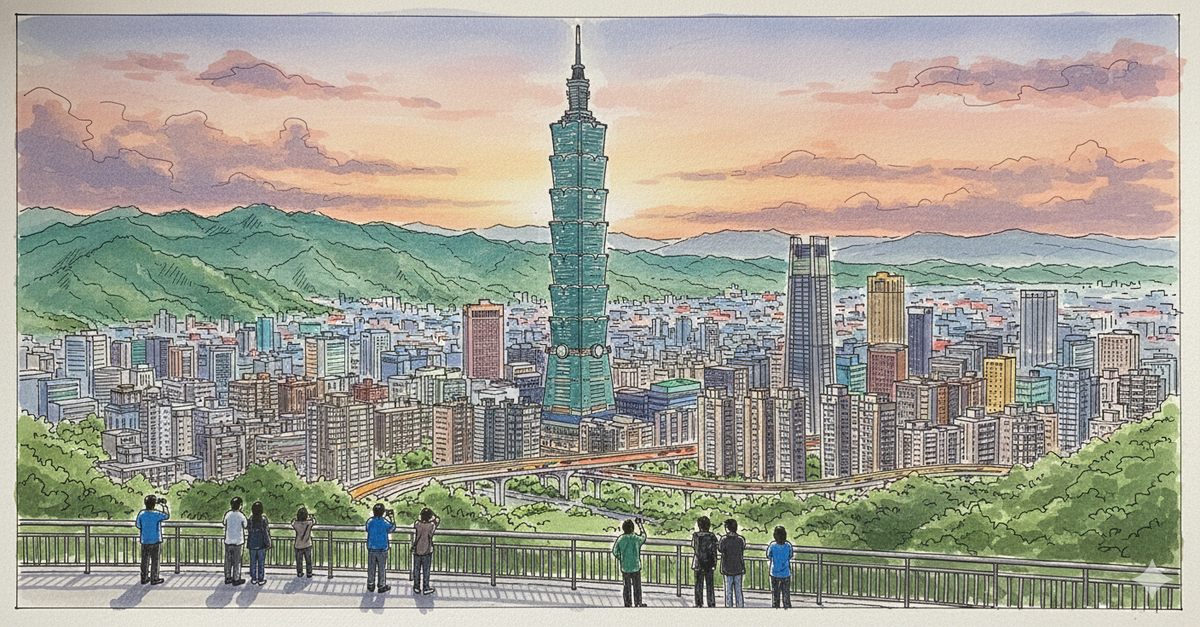
 Lawrence
 Lawrence
This is the third piece in the "2026 Is the New 2016" series. Tokyo and Hong Kong preceded it. The dragon vein runs through all three cities, in three different vocabularies. The grammar is the same.
© lawrencetravelstories.com — A Spiritual Anchor in Multidimensional Spacetime